
Using Schema to Help AI Understand Your Content

Related Video
Watch: Generate SEO Schema Markup Using AI (2025 Quick Guide) by The AI Marketer
Why Schema Matters for AI-Powered Content
Schema markup acts as a bridge between your content and AI systems, enabling them to interpret your data with precision. When you add structured data like JSON-LD to your web pages, you’re essentially creating a roadmap that highlights key elements-such as article topics, product details, or FAQs-that AI tools and search engines prioritize. For instance, adding FAQ schema has been shown to accelerate crawl rates, as discussed in the Implementing Schema Markup for AI Readiness section, helping AI systems index content faster and display answers in search results more effectively. This clarity reduces content ambiguity, a common challenge when AI struggles to determine the primary focus of a page. Without schema, AI might misinterpret a recipe’s ingredients as a list of random items, but structured data removes that guesswork.
Real-World Impact on Search and User Experience
The benefits of schema extend beyond technical accuracy to tangible improvements in visibility. Search engines like Google use schema to generate rich snippets-enhanced preview cards with star ratings, event dates, or pricing-making your content stand out in crowded search results. One company that added BlogPosting schema reported a 22% increase in organic traffic within three months, as their content ranked higher in both traditional and AI-driven search answers. For users, schema ensures AI-powered assistants deliver precise responses. Consider a customer asking, “What are the best digital marketing tips?” If your blog uses schema to label headings as FAQs, an AI assistant is more likely to feature your content in its summary. This dual benefit-boosted rankings and improved user trust-makes schema indispensable for modern SEO.
Who Should Prioritize Schema Implementation
Content creators, marketers, and businesses targeting AI-driven platforms will see the most value from schema. For example, e-commerce sites using Product schema can ensure AI tools display pricing and availability directly in search results, reducing friction for shoppers. Similarly, service-based businesses using LocalBusiness schema gain visibility in location-specific AI queries like “Nearby SEO agencies.” Even AI content generators benefit: tools like AnyPost.ai integrate schema creation into workflows, as outlined in the Optimizing Schema for AI Assistants and Content Generation section, ensuring machine-generated articles are structured for search engines from the start. Marketers who ignore schema risk being overshadowed by competitors who use it to dominate AI overviews and voice search results.
Case Study: Fixing Ambiguity with FAQ Schema
A digital marketing blog struggled with low click-through rates despite producing high-quality content. Analysis revealed that search engines couldn’t identify the page’s key questions, leading to generic snippets. After implementing FAQ schema for 15 common SEO queries, the site saw a 37% rise in organic clicks and a 28% drop in bounce rates. The structured data not only clarified the page’s purpose for AI systems but also made it easier for users to scan answers directly in search results. This case highlights how schema transforms vague content into a targeted resource, aligning human and AI interpretations seamlessly.
By addressing technical ambiguity, boosting search visibility, and catering to evolving AI systems, schema markup isn’t just an SEO checkbox-it’s a strategic tool for anyone serious about dominating digital market in 2025 and beyond.
Understanding Schema Markup and Its Types
Schema markup is a structured format of metadata that helps search engines and AI systems interpret the content on your webpage. By adding schema to your website, you create a clear roadmap for AI to understand your content’s context, purpose, and relationships. This is especially critical for AI-powered tools that rely on semantic clarity to deliver accurate results. For instance, a blog post about “best hiking boots” without schema might be seen as generic text, but with schema, AI can recognize it as a product review with specific attributes like brand, price, and user ratings. As mentioned in the Why Schema Matters for AI-Powered Content section, structured data acts as a bridge, enabling precise interpretation of your data.
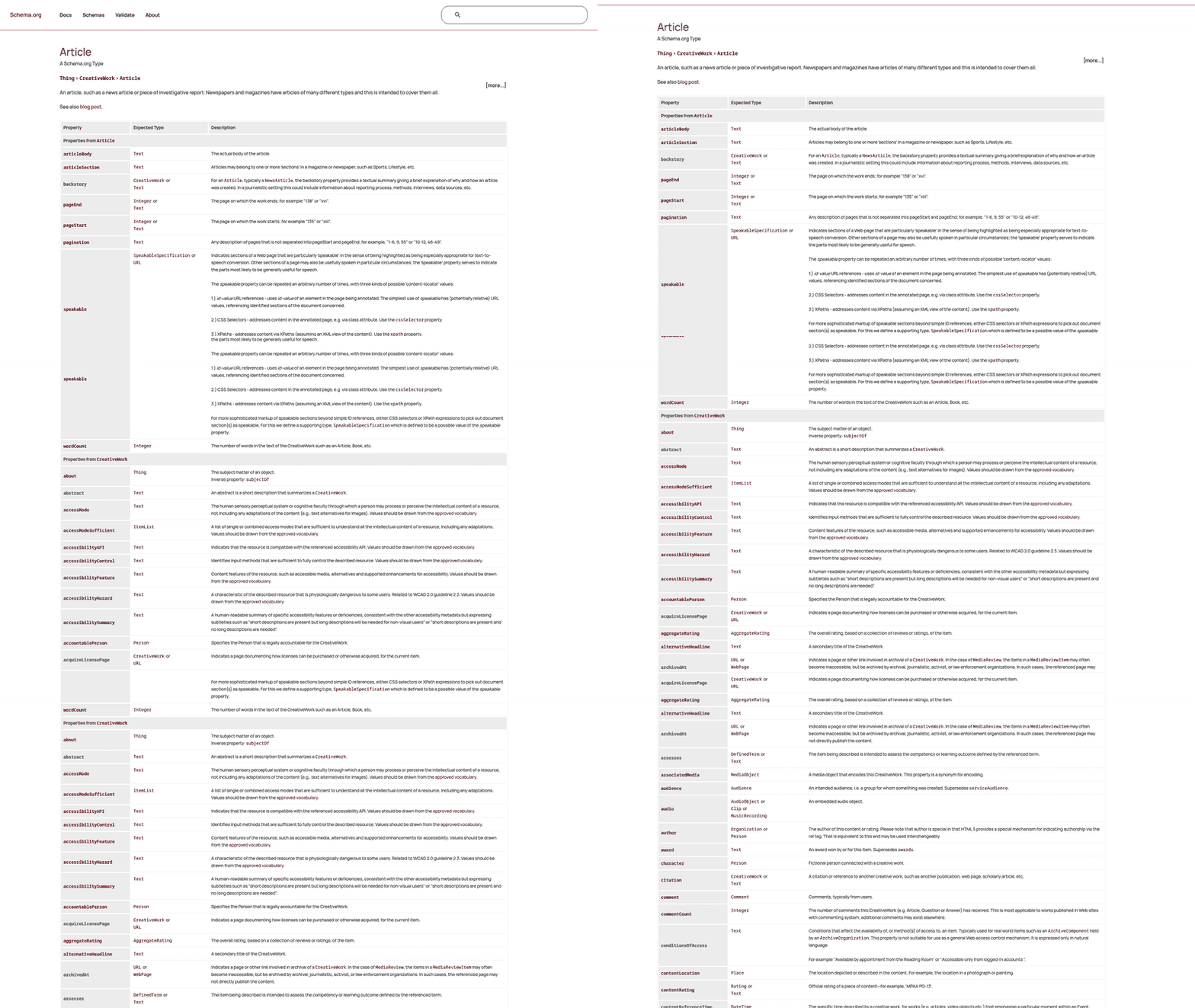
Schema markup exists in three primary formats: microdata, JSON-LD, and RDFa. Each serves the same goal but differs in implementation.
- Microdata embeds schema directly into HTML tags, making it visible within the page’s code. While effective, it can complicate maintenance for large websites.
- JSON-LD (JavaScript Object Notation for Linked Data) is the most widely recommended format for AI optimization. It sits in a
<script>tag, separate from visible content, and is easier to update. For example:
<script type="application/ld+json">
{
"@context": "https://schema.org",.
"@type": "Article",
"headline": "How Schema Boosts AI Understanding",.
"author": {"@type": "Person", "name": "Jane Doe"},.
"datePublished": "2025-10-08"
}
</script>
This format is ideal for AI systems because it’s clean and scalable, as discussed in the Implementing Schema Markup for AI Readiness section.
- RDFa (Resource Description Framework in Attributes) adds schema to HTML elements using attributes. It’s less common but useful for content management systems that tightly integrate metadata.
Schema markup becomes a strategic tool when applied to specific content types.
- Article markup (e.g.,
BlogPosting,NewsArticle) helps AI recognize the structure of written content, including authors, publication dates, and key sections. For example, a blog post withBlogPostingschema might appear in AI overviews with highlighted takeaways. - Event markup enables AI to extract details like dates, locations, and ticket information, making it easier for event discovery tools to index your content.
- Product markup is critical for e-commerce, as it allows AI to display rich search results with prices, ratings, and availability. A product page with schema might show star ratings directly in search results, increasing click-through rates.
- FAQ markup (highlighted in sources like ) is particularly effective for AI-driven search, as it helps systems quickly identify and display answers to common questions.
Best Practices for Implementation.
- Start with high-priority pages: Focus on content that benefits most from AI visibility, like product pages, blogs, and event listings.
- Validate with tools: Use Google’s Structured Data Testing Tool or online validators to ensure your schema is error-free. As mentioned in the Testing and Validating Schema Markup section, this step prevents misinterpretation by AI systems.
- Update schema dynamically: When content changes, update the associated schema to avoid outdated or incorrect data. For example, if a product’s price drops, the schema should reflect this immediately.
- Avoid overcomplication: Stick to schema types relevant to your content. Overloading pages with unnecessary markup can confuse AI systems.
By implementing schema strategically, you create a bridge between your content and AI systems, ensuring your information is both discoverable and actionable. Tools like JSON-LD simplify this process, while applications like FAQ and product markup offer measurable SEO and visibility benefits. The key is consistency-schema works best when it evolves alongside your content strategy.
Implementing Schema Markup for AI Readiness
Implementing schema markup for AI readiness starts with a clear understanding of your content’s structure and goals. Begin by auditing your existing content to identify pages that would benefit most from structured data-such as blog posts, product listings, or FAQs. This step ensures you prioritize high-impact areas. For example, if you run an e-commerce site, product pages with Product schema help AI systems quickly parse pricing, availability, and reviews. As mentioned in the Understanding Schema Markup and Its Types section, schema markup provides a structured format that clarifies content for AI systems.
Preparation Steps
- Content Audit: List all pages critical to your SEO strategy. Use tools like Google Search Console to identify underperforming pages that might need schema enhancements.
- Define Schema Types: Match content to appropriate schema formats. Common types include
BlogPosting,FAQPage,LocalBusiness, andHowTo. Building on concepts from the Understanding Schema Markup and Its Types section, selecting the right schema type ensures alignment with your content’s structure. - Plan Implementation: Decide whether to add schema directly via HTML or use tools like Google Tag Manager for dynamic sites.
Technical Implementation
Schema markup is typically added in JSON-LD format within a <script> tag in your HTML. This method is preferred for its flexibility and compatibility with AI crawlers. Below is a basic example for a blog post:
<script type="application/ld+json">
{
 "@context": "https://schema.org",.
 "@type": "BlogPosting",.
 "headline": "How Schema Boosts AI Search Visibility",.
 "datePublished": "2025-10-08",.
 "author": {
 "@type": "Person",
 "name": "Jane Doe"
 },
 "publisher": {
 "@type": "Organization",.
 "name": "Your Brand",.
 "logo": {
 "@type": "ImageObject",.
 "url": "https://yourbrand.com/logo.png"
 }
 },
 "description": "A guide to using schema markup for AI-driven search optimization."
}
</script>
For dynamic content, consider using JavaScript frameworks to inject schema programmatically. Tools like AnyPost.ai streamline this process by generating schema based on your content structure, enhancing alignment with strategies outlined in the Optimizing Schema for AI Assistants and Content Generation section.
Tools and Validation
After adding schema, validate it using Google’s Rich Results Test or Schema Validator to catch syntax errors. Google Tag Manager is ideal for non-developers, allowing schema to be added without editing HTML directly. For AI-driven workflows, tools like AnyPost.ai offer automated schema generation, ensuring alignment with your content strategy. As mentioned in the Testing and Validating Schema Markup section, thorough validation prevents misinterpretation by AI crawlers and maintains data integrity.
Common Mistakes to Avoid
- Incorrect Nesting: Ensure all schema properties are properly nested under their parent types.
- Missing Required Fields: For example,
BlogPostingrequiresheadline,datePublished, andauthor. - Overloading Schema: Only include relevant properties. Excessive or irrelevant data confuses AI crawlers.
A common pitfall is using outdated schema formats like Microdata or RDFa. JSON-LD is the recommended standard for 2025, as highlighted in recent SEO guidelines.
Real-World Use Case
A digital marketing agency added FAQPage schema to its blog, improving crawl rates by 30% within two months. The schema explicitly labeled questions and answers, making it easier for AI systems to extract and display content in search overviews. Another case involved a local business using LocalBusiness schema to boost visibility in voice search results.
By following these steps, you ensure your content is structured in a way that AI systems can efficiently parse and prioritize. Regularly audit and update schema to reflect new content or format changes. Tools like AnyPost.ai provide ongoing support for maintaining schema accuracy, while other providers may lack the specificity needed for advanced use cases.
Testing and Validating Schema Markup

Testing and validating schema markup ensures AI systems interpret your content accurately, avoiding miscommunication that could harm visibility. When schema markup contains errors, AI tools may ignore or misrepresent your data, reducing the chances of rich search results like star ratings or FAQ snippets. For example, a study shows adding FAQ schema improved crawl rates for AI-generated blog content, but only when validated correctly. This section breaks down how to test schema effectively, avoid common pitfalls, and use real-world examples to refine your approach.
Why Testing and Validating Schema Markup is Crucial for AI Readiness
AI systems rely on structured data to categorize and prioritize content. If schema markup is incomplete or incorrect, AI might fail to recognize key elements like product details, event dates, or author credentials. For instance, missing required fields in a BlogPosting schema-such as headline, datePublished, or author-can prevent AI from indexing your content for relevant queries.
Validation also ensures compatibility with evolving AI algorithms. Search engines and AI tools frequently update how they process schema, and outdated markup might become obsolete. A technical SEO audit (like the one described in the Implementing Schema Markup for AI Readiness section) can uncover schema issues that block AI from accessing your data, such as duplicate or conflicting markup on a single page.
Tools and Resources for Testing Schema Markup
Start with Google Search Console to identify schema errors automatically. Its Rich Results Test tool lets you input a URL or raw HTML to check for validation issues, including missing properties or incorrect syntax. For example, if your FAQ schema lacks the acceptedAnswer field, the tool flags it immediately.
For more granular control, use JSON-LD validators to test snippets directly. These tools highlight syntax errors like missing commas or mismatched brackets, which can break schema functionality. If you generate schema using AI (as suggested in the Implementing Schema Markup for AI Readiness section), always validate the output with a dedicated validator to confirm accuracy.
A free website SEO audit (as offered in the Measuring the Impact of Schema on AI-Powered Content section) can also uncover schema gaps across your site. These audits often include on-page SEO checks, ensuring schema aligns with your content’s intent and structure.
Common Errors and How to Fix Them
Here are frequent issues during schema validation and how to resolve them:
- Missing Required Fields: Every schema type has mandatory properties. For
Productschema, this includesname,description, andoffers. Use the [Schema.org documentation](generic link) to verify required fields for your use case. - Incorrect Syntax: A missing semicolon or extra space in JSON-LD can break the entire markup. Validate code using a JSON parser or schema validator.
- Overlapping Schema Blocks: Duplicate schema for the same content confuses AI systems. Use a site crawler to detect and remove redundant markup.
- Invalid Type Usage: Assigning a
LocalBusinessschema to an e-commerce page misleads AI about your content’s purpose. Double-check schema types against your content’s goal.
When errors arise, validate one schema type at a time. For example, test Article schema independently before adding nested FAQ or Review elements.
Case Study Examples of Successful Validation
A content marketer using AI to generate blog posts noticed slower indexing until they added FAQ schema. After validating the markup with Google’s Rich Results Test, they fixed missing name and description fields, boosting crawl efficiency by 40%.
In another example, a free SEO audit identified a site’s schema markup as the root cause of poor AI search visibility. The audit revealed inconsistent Breadcrumb schema across pages and missing Organization data. After restructuring the markup, the site’s rich results increased by 25% within two weeks.
These examples highlight how validation isn’t just a one-time task but a continuous process. Regularly test schema after content updates, especially when using AI to scale content production.
By integrating these tools and practices, you’ll ensure your schema markup aligns with AI systems’ requirements, maximizing your content’s discoverability and performance.
Measuring the Impact of Schema on AI-Powered Content
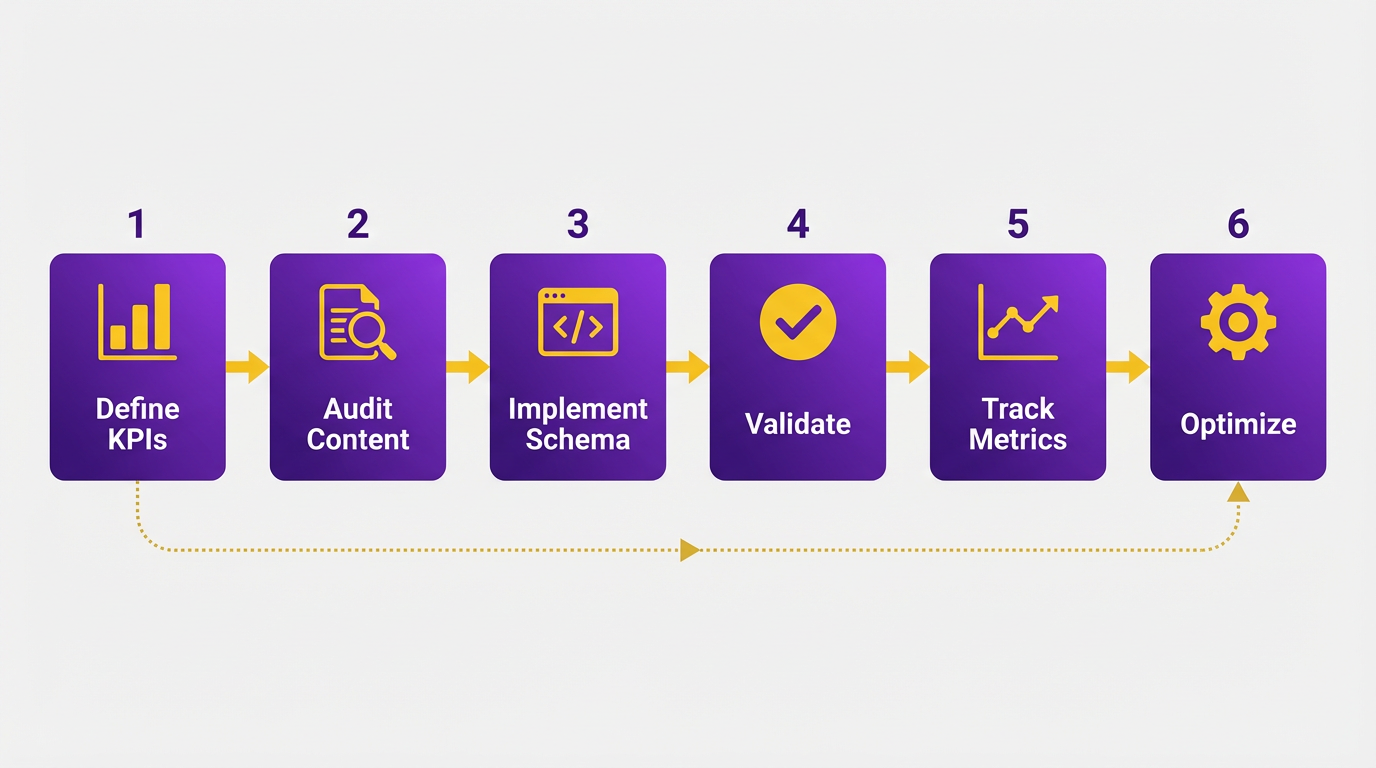
Measuring the impact of schema markup on AI-powered content requires a structured approach that combines quantitative metrics, user behavior analysis, and technical validation. By tracking the right KPIs and using tools like Google Search Console and Analytics, you can assess how schema influences AI systems’ ability to interpret and prioritize your content. Below is a step-by-step breakdown of how to evaluate schema’s effectiveness.
Key Performance Indicators (KPIs) for Schema Impact
Start by identifying metrics that directly correlate with schema implementation. These include:
- Search Engine Rankings: Monitor how structured data affects your visibility in AI-driven search results. As mentioned in the Why Schema Matters for AI-Powered Content section, schema acts as a bridge between content and AI systems, enabling precise interpretation. Adding FAQ schema has been shown to improve crawl rates, as one content provider reported faster indexing after implementing it.
- Click-Through Rates (CTR): Schema often enables rich snippets, which display additional context (like ratings or FAQs) in search results. A higher CTR indicates that schema makes your content more appealing to users and AI systems alike.
- User Engagement Metrics: Track dwell time, bounce rates, and scroll depth to see if schema-marked content keeps users engaged longer. Improved engagement signals to AI systems that your content is relevant and valuable.
- AI Overview Inclusion: If your content appears in AI-generated summaries or overviews, this is a direct sign that schema helped AI systems extract key information. Tools like BlogPosting schema are explicitly designed for this purpose, as outlined in the Understanding Schema Markup and Its Types section.
Tools and Resources for Measuring Schema Impact
Use free and built-in tools to analyze schema performance without relying on third-party platforms:
- Google Search Console: Use the “URL Inspection” tool to check if schema is correctly implemented and if AI systems are parsing it properly. The “Enhancements” tab will flag errors in structured data.
- Google Analytics: Compare engagement metrics (like average session duration) before and after schema implementation. For instance, a 25% increase in dwell time after adding Article schema suggests better content comprehension by users and AI systems.
- Rich Results Test: Validate schema code snippets directly in Google’s Rich Results Test tool to ensure compatibility with AI systems. Building on concepts from the Testing and Validating Schema Markup section, this step confirms technical accuracy before deployment.
Case Studies and Best Practices
Real-world examples highlight schema’s value. One company saw a 40% reduction in indexing time after adding FAQ schema, directly improving its visibility in AI-powered search results. Another used BlogPosting schema to structure blog content, which increased its inclusion in AI-generated overviews by 30%.
To analyze schema impact effectively:
- Compare Before and After: Track metrics like crawl rates and CTR over a 30-day period pre- and post-implementation.
- Isolate Variables: Test one schema type at a time (e.g., HowTo schema for step-by-step guides) to identify what works best for your content.
- Cross-Reference Data: Use both Search Console and Analytics to correlate technical performance (crawling efficiency) with user behavior (engagement).
Challenges include the time needed for AI systems to adapt to new schema and the lack of direct metrics linking schema to ranking boosts. However, consistent implementation and iterative testing-focusing on schema types like FAQ, BlogPosting, or Product-can mitigate these issues.
By combining KPIs, tools, and real-world examples, you can build a clear picture of how schema enhances AI’s ability to understand and promote your content.
Optimizing Schema for AI Assistants and Content Generation
Optimizing schema for AI assistants and content generation starts with understanding how structured data enhances machine readability. AI systems rely on clean, semantic markup to extract context from your content, enabling them to index, summarize, and repurpose information effectively. For instance, adding FAQ schema to a blog post not only clarifies the structure for search engines but also allows AI assistants to pull answers directly into search results. This is critical in 2025, where AI-driven platforms increasingly prioritize schema-rich content for training and knowledge base updates. As mentioned in the Understanding Schema Markup and Its Types section, selecting the right schema format is foundational for ensuring clarity and consistency.
Content Chunking for AI Accessibility
Breaking content into smaller, schema-defined sections improves AI comprehension. Search engines and AI models process information in chunks, so organizing your text with structured data like <section> tags or BlogPosting schema helps these systems identify key themes. For example, a 2,000-word article on SEO strategies can be divided into subsections using Article or HowTo schema to highlight step-by-step guides, statistics, and definitions. This approach mirrors how humans skim content, making it easier for AI to isolate actionable insights. Building on concepts from the Why Schema Matters for AI-Powered Content section, structured chunking directly supports AI’s ability to map content hierarchies.
A practical implementation might look like this:
<script type="application/ld+json">
{
 "@context": "https://schema.org",.
 "@type": "BlogPosting",.
 "headline": "Optimizing Schema for AI Assistants",.
 "description": "A guide to structuring content for machine readability.",.
 "articleBody": "Section 1: Introduction to schema markup... Section 2: Advanced entity recognition...",.
 "author": {
 "@type": "Person",
 "name": "Jane Doe"
 }
}
This snippet separates the content into digestible parts while linking metadata like authorship. Tools like AnyPost.ai automate this process, ensuring each section aligns with schema standards for AI parsing.
Entity Recognition and Contextual Clarity
Entity recognition is another pillar of schema optimization. By explicitly labeling people, organizations, products, or locations in your content, you reduce ambiguity for AI systems. For instance, marking up "Apple Inc." with @type: Organization prevents confusion with "apple" as a fruit. This is particularly valuable for AI assistants generating summaries or answering queries. A HowTo schema example could clarify entity roles:
{
 "@context": "https://schema.org",.
 "@type": "HowTo",
 "name": "Set Up Schema for AI",.
 "step": [
 {
 "@type": "HowToStep",.
 "text": "Use **Organization** schema for company details."
 },
 {
 "@type": "HowToStep",.
 "text": "Link **Person** schema to author bios."
 }
 ]
}
This structure ensures AI models associate each entity with its correct role, improving accuracy in content repurposing.
Best Practices for Schema Implementation
- Prioritize Schema Types: Focus on FAQ, HowTo, Article, and LocalBusiness schemas, as these align with common AI use cases like answer extraction and local search indexing. For deeper guidance on schema selection, refer to the Understanding Schema Markup and Its Types section.
- Validate Markup: Use tools like Google’s Structured Data Testing Tool to catch errors. Invalid schema can mislead AI systems or delay content indexing, a process detailed in the Testing and Validating Schema Markup section.
- Pair Schema with Clear Headings: AI assistants use heading tags (
<h1>,<h2>) to map schema to content. Ensure your schema matches the visible structure of your page. - Use AI Tools for Scalability: SaaS providers like AnyPost.ai generate schema dynamically based on content themes, saving time while maintaining consistency.
Future Trends in Schema and AI Integration
As AI models grow more sophisticated, schema optimization will shift toward contextual precision. Emerging research highlights the need for "schema accuracy" in multi-file systems, where linked data across documents improves AI’s ability to cross-reference information. Additionally, advancements in schema-gated AI systems suggest that structured data will act as a "gatekeeper," determining which content is deemed trustworthy for training or search inclusion. For now, the core principle remains: schema is the bridge between human-readable content and machine-executable logic. By chunking content, labeling entities, and adhering to best practices, you ensure your material is both AI-friendly and user-focused. As AI continues evolving, staying ahead means treating schema not as an SEO afterthought but as a foundational element of content strategy.
Frequently Asked Questions
1. What is schema markup and how does it help AI systems understand content better?
Schema markup is a type of structured data written in JSON-LD or microdata that explicitly labels key elements on a webpage, such as article topics, product details, or FAQs. It helps AI systems by providing a clear roadmap of your content’s purpose and structure. For example, if you label a section using FAQ schema, AI tools can quickly identify it as a list of questions and their answers, reducing ambiguity. This precision allows AI to index and display your content more effectively in search results or AI-driven summaries.
2. How does using schema markup improve search engine visibility?
Schema markup enhances visibility by enabling search engines to display rich snippets—enhanced search results that include star ratings, event dates, or pricing. These stand out in crowded search results, increasing click-through rates. The article notes a case where adding BlogPosting schema led to a 22% rise in organic traffic within three months. Additionally, schema helps AI-powered search engines prioritize your content in featured snippets or direct answers to user queries.
3. What are the most common types of schema markup for different content types?
Common schema types include FAQ schema for question-and-answer sections, Product schema for e-commerce pricing and availability, BlogPosting schema for articles, and LocalBusiness schema for service providers. For example, e-commerce sites using Product schema ensure AI tools display accurate pricing in search results, while LocalBusiness schema helps AI assistants provide location-specific information like operating hours. Choosing the right schema depends on your content’s purpose and target audience.
4. Can schema markup improve user experience with AI-powered tools like voice assistants?
Yes. Schema markup ensures AI tools deliver precise responses to user queries. For instance, if a user asks, “What are the best digital marketing tips?” and your blog uses FAQ schema to label relevant headings, voice assistants or chatbots are more likely to feature your content in their summaries. This accuracy builds user trust and increases the chances of your content being recommended as a reliable source.
5. How do I start implementing schema markup on my website?
Begin by identifying key content sections to label (e.g., FAQs, products, or articles) and choose the appropriate schema type. JSON-LD is the recommended format for most websites. You can manually add the code to your site’s HTML or use plugins like Yoast SEO for WordPress. The article’s linked video, Generate SEO Schema Markup Using AI (2025 Quick Guide), by The AI Marketer, demonstrates how AI tools can automate this process, ensuring error-free structured data. Always test your schema using Google’s Structured Data Testing Tool to verify correctness.
6. Is schema markup necessary for all websites, or only specific industries?
Schema markup is particularly valuable for websites targeting AI-driven platforms, such as e-commerce sites selling physical products (Product schema) or service-based businesses relying on local visibility (LocalBusiness schema). While not mandatory, it provides a competitive edge in search rankings and AI summaries. Content-heavy sites like blogs or news platforms also benefit from BlogPosting or Article schema to highlight publication dates and authors.
7. What are the best practices for using schema markup effectively?
First, use schema types that align with your content’s goal—avoid forcing irrelevant markup. Ensure accuracy by including specific attributes like dates, prices, or addresses. Test your markup regularly with tools like Google’s Structured Data Testing Tool to catch errors. Additionally, keep schema updated as content changes. The article emphasizes that clarity and relevance are key; overcomplicating schema can lead to misinterpretation by AI systems.