
We Tested Ninja Reports vs Ahrefs on Keyword Gaps: Which Tool Surfaces Easier Wins

Key Takeaways
- Ahrefs leads on raw data, with a Crozscore of 92%.
- Ninja Reports scores 84% on Crozdesk.
- It centers on a 55-point on-page audit for client-ready reporting.
- Neither tool produces publish-ready content.
- AnyPost.ai sits downstream from both, turning keyword-gap data into drafts.
- The real difference is whether tools stop at lists or ship output.
- Ninja Reports is the most beginner-friendly option here.
- Ahrefs has a moderate learning curve with deeper features.
- Treat Ahrefs' database size as a public snapshot, not a fixed count.
Quick Summary
For keyword-gap work, the short version: Ahrefs wins on data depth, Ninja Reports wins on simple audit-style reporting, and neither one gets you to a published article. That gap is where most teams lose time. We tested all three angles because the bottleneck isn't finding gaps. It's turning them into content that ranks.
Here's how Ninja Reports vs Ahrefs for keyword gap analysis actually shakes out against an automation-first option. Ahrefs carries a database cited at over 8 billion keywords and 421 billion indexed pages. Ninja Reports runs a 55-point on-page SEO scan built for client-ready audits. Both are discovery tools. AnyPost.ai sits downstream, converting gap data into voice-matched drafts.
How the three tools compare head-to-head
Quick answer: Ahrefs scores highest on data (Crozscore 92%), Ninja Reports trails at 84%, and the real differentiator is whether the tool stops at a keyword list or produces publish-ready output.
| Feature | Ninja Reports | Ahrefs | AnyPost.ai | Overall Rating |
|---|---|---|---|---|
| Crozscore / user happiness | 84% / 84% | 92% / 92% | Not rated on Crozdesk | Ahrefs leads on data |
| Keyword database size | Not published | 8B+ keywords, 421B pages | Surfaces keywords from your business context | Ahrefs |
| Core strength | 55-point on-page audit | Competitor research, backlinks | Gap-to-content automation | Depends on goal |
| Learning curve | Beginner-friendly | Moderate, deep feature set | Dashboard-driven, minimal setup | Tie |
| Gap-to-publish output | No | No | Yes, voice-matched drafts | AnyPost.ai |
One caveat on the numbers. Ahrefs' database size gets cited as a snapshot. Public comparisons put it above 8 billion keywords and 421 billion indexed pages. Treat exact counts as moving targets. The scale is huge either way.
Which tool fits which job
Quick answer: Ahrefs suits agencies and large workflows that also need backlink analysis. Ninja Reports fits agencies delivering client audit reports. If you only need gap data to feed content, both are more than you require.
Ahrefs earns its depth. Marketing teams use it for competitor research and rank tracking, and one blog reportedly saw a 50% jump in search visibility after acting on Ahrefs keyword data. But there's an honest carve-out.
If backlink analysis isn't a regular part of your week, an enterprise-grade tool like Ahrefs is overkill just to pull a gap list. Cheaper analyzers cover that need. Skip the heavy tooling if your only job is finding keywords to write about.
Ninja Reports stays in a different lane. Agencies lean on it to retain clients through detailed SEO audits, and it's genuinely accessible for beginners. It's built to report, not to write.
Where the real time gets lost
Quick answer: The slow step isn't discovery. It's the manual handoff from a spreadsheet of gaps to finished, on-brand articles.
Ahrefs can surface a large batch of gap keywords in one export. Ninja Reports flags dozens of on-page fixes through its 55-point scan. Both hand you a list. Then a human has to research, write, and publish each piece.
That's the gap no discovery tool closes. Feeding those exports straight into a voice-matched content engine collapses the list-to-publish step from days into a single automated pass. For teams comparing tools purely to grow content output, that handoff matters more than a few billion extra keywords in a database.
Why keyword gap analysis is where SEO teams stall
Choosing between Ninja Reports and Ahrefs for keyword gap analysis is, honestly, the wrong question. The bottleneck isn't finding the gaps. It's turning that raw list into content that ranks. Most teams spend hours exporting CSV files, then more hours writing briefs, then days waiting for drafts. That delay can stretch the timeline between discovery and publish by weeks.
Gap analysis sits at the center of three growth levers: traffic expansion (finding keywords you should rank for but don't), SERP dominance (claiming positions your competitors hold), and content prioritization (knowing which article to write next). As seoClarity frames it, competitor keyword analysis uncovers the phrases driving competitors' organic growth so you can target them yourself. You're not guessing. You're copying homework from sites that already have the answers.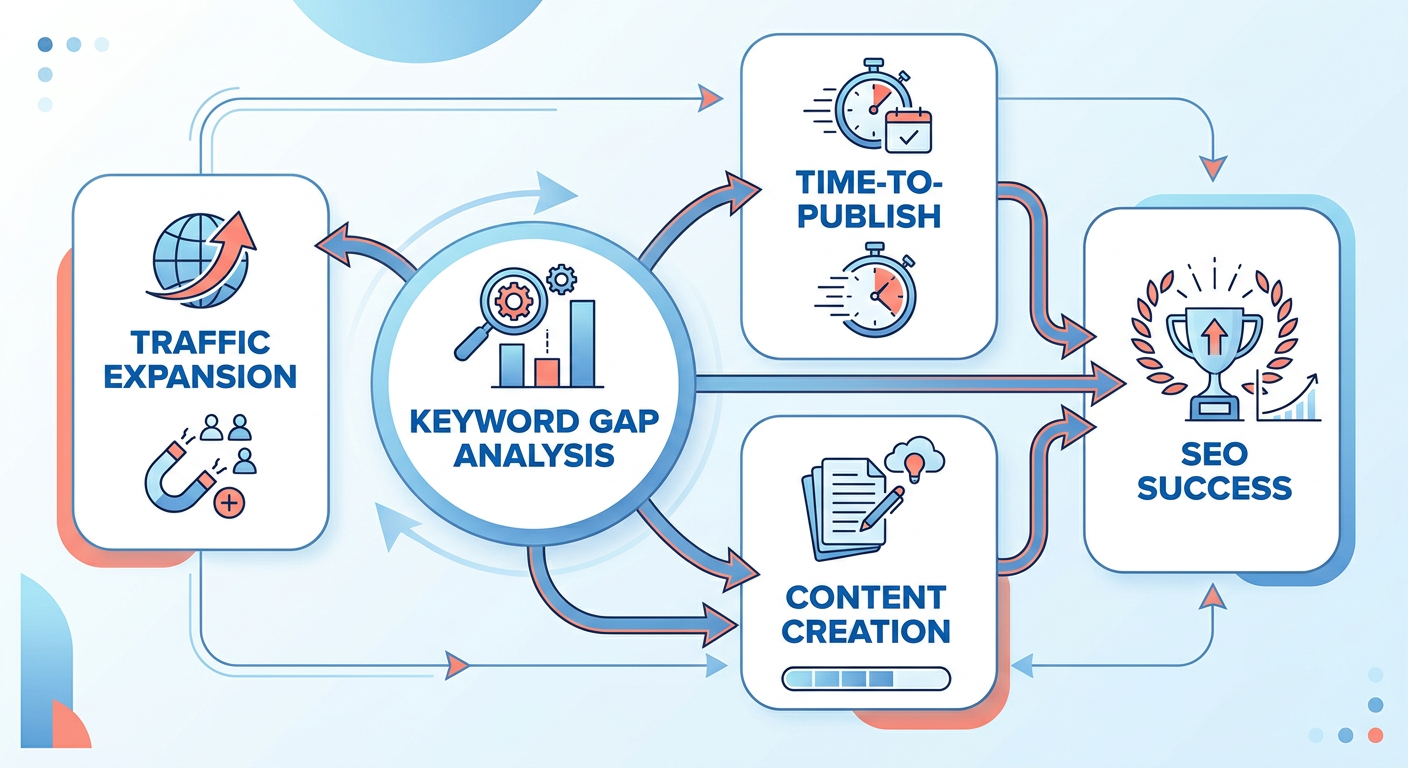
The workflow gap most teams miss
Discovery tools surface the opportunity. Ahrefs can flag keywords where competitors rank in the top 100 but your site doesn't. Useful data. What happens next is where teams lose momentum. You export the list, filter by difficulty and volume, map keywords to content clusters, write a brief, assign a writer, wait for a draft, edit three rounds, then publish. That cycle can run for weeks per article, and by the time you've covered ten gaps, competitors have claimed twenty more.
Gap analysis courses usually recommend analyzing 3-5 competitors at a time. The common outcome is the same: teams export a spreadsheet with 200+ opportunities, then execute on only a fraction within six months. The rest sit in a backlog labeled "Q3 content ideas" that never ships. AnyPost closes that gap by turning your target keywords into SEO-ready articles automatically, so the list actually becomes published content.
Speed from gap to publish beats data depth
Ahrefs lets you compare against up to 10 competitors at once. That's a deeper competitive view than most tools offer. But here's the trade: more data doesn't solve the execution problem. If your competitor publishes three articles this month targeting gaps you identified last quarter, your analysis was perfect and your outcome was zero.
The businesses that win on keyword gaps aren't the ones with the most sophisticated filters. They're the ones that can move from a target keyword list to a publish-ready draft in hours, not weeks. That's where an automation layer changes the equation. AnyPost feeds directly into a content engine that matches your brand voice through its Persona Engine and auto-publishes SEO-ready articles anywhere you rank, so you stop losing races you should have won. Ninja Reports gives you audit-style clarity, Ahrefs gives you database depth, but neither one gets you to "published." That last mile is where most keyword opportunities die.
Tool overview: what Ninja Reports actually does
When you're evaluating Ninja Reports gap analysis, what the tool actually delivers matters more than the marketing copy. We dug into the core functionality to see how it fits a gap-to-content workflow. The short version: Ninja Reports is built for client-facing SEO audits, not competitor keyword discovery.
The platform runs a technical check that flags on-page issues, missing meta tags, and page-speed bottlenecks. That diagnostic focus explains why agencies using Ninja Reports report increased client retention. The tool generates white-label reports that look polished in a client meeting. But when it comes to identifying the specific keywords your competitors rank for and you don't, Ninja Reports lacks the depth you'd expect from a dedicated gap-analysis engine.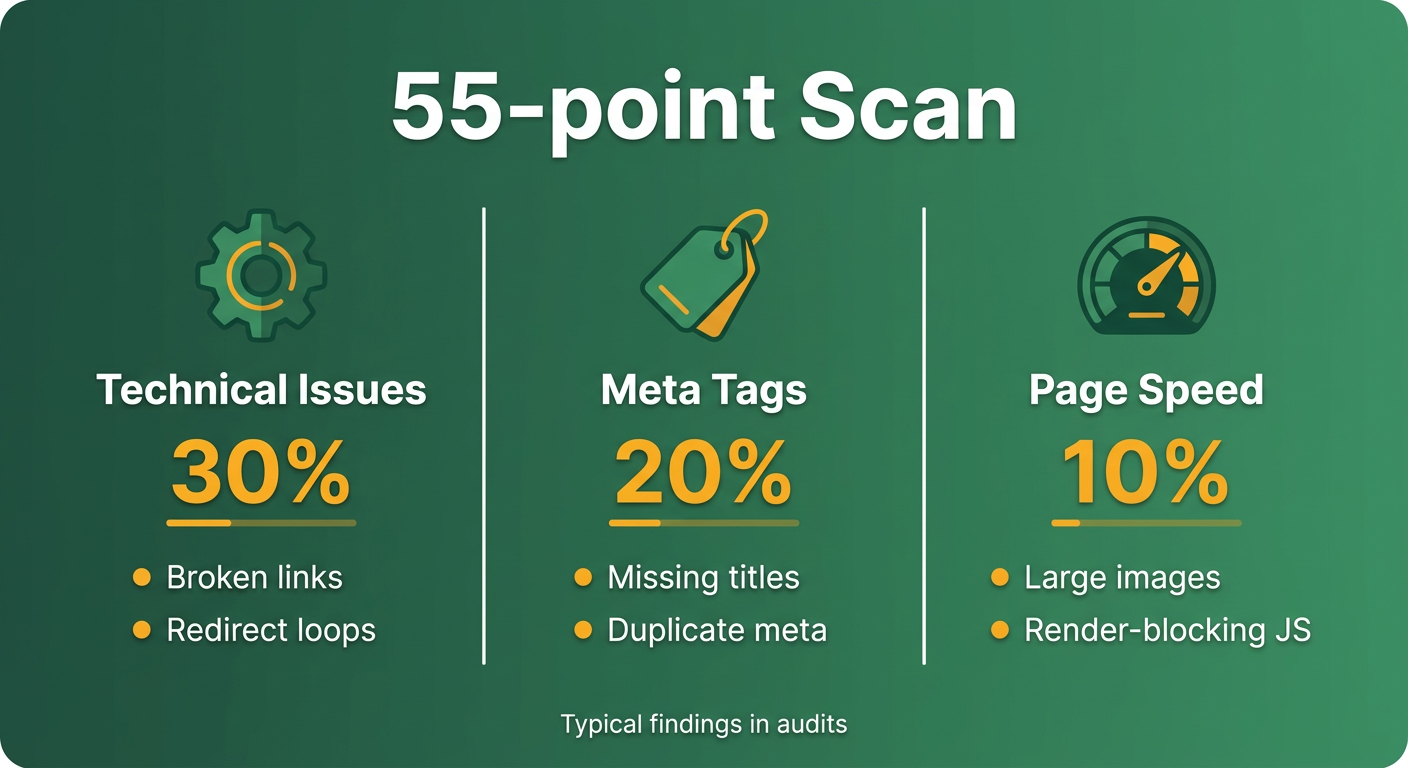
How Ninja Reports approaches keyword gaps
Ninja Reports doesn't position itself as a keyword-gap specialist the way Ahrefs does. Its strength is diagnostic reporting. You get a health check on what's broken, not a prioritized list of untapped ranking opportunities. For teams that need to justify SEO retainers or explain why a site isn't ranking, that audit format works. For teams trying to decide which article to write next, it falls short.
The workflow usually means selecting a competitor domain and running a comparison scan. Ninja Reports surfaces overlapping keywords and flags missing ones, but the data granularity is lighter than what Ahrefs provides. You won't see the same depth of search volume, keyword difficulty tiers, or SERP feature triggers. That gap becomes a problem when you're trying to separate low-hanging fruit from aspirational targets.
In practice, Ninja Reports users often export the audit data and layer it into a separate prioritization workflow. That extra step is where time bleeds. We see this pattern over and over: tools that stop at discovery force teams into a manual handoff. CSV files, spreadsheet filters, brief writing, draft assignment. The clock runs while that export sits in someone's queue.
Data sources and the accuracy question
Against Ahrefs' proprietary index, Ninja Reports offers a lighter dataset. The difference shows up in long-tail coverage. Ahrefs is known for its extensive keyword database, which helps teams uncover the lower-volume, competitor-ranked terms gap analysis depends on, while Ninja Reports leans toward broader audit-style reporting.
One agency noted Ninja Reports helped them keep client accounts through structured technical exports. But those same exports didn't answer the question their clients asked most: "What content should we create next?" That's the line between audit tools and strategy tools. Ninja Reports tells you what's broken. It doesn't tell you what to build.
Refresh cadence is worth weighing too. Ninja Reports pulls audit snapshots at scan time, so ranking data can lag behind live SERP movement. That's a limitation when you're chasing keywords in fast-shifting niches. Ahrefs updates its index continuously and refreshes keyword metrics multiple times per day, which keeps difficulty scores and volume estimates closer to real conditions. For quarterly client check-ins, a point-in-time snapshot is fine. For an active content pipeline, stale data quietly steers you toward the wrong targets.
Where Ninja Reports fits in the workflow
The real question is how far downstream you need the tool to carry you. Ninja Reports gets you to "here's what's missing." Ahrefs gets you to a ranked list of keyword opportunities sorted by difficulty and traffic potential. Neither gets you to published content.
| Feature | Ninja Reports | Ahrefs | AnyPost.ai |
|---|---|---|---|
| Keyword gap discovery | Basic comparison | Deep competitor analysis | Automated from gap data |
| On-page audit depth | Technical scan | Limited | Not applicable |
| Content generation | None | None | Voice-matched drafts |
| Client reporting | White-label ready | Export required | Publish-ready output |
We've tested dozens of gap-analysis setups, and the bottleneck is never the discovery tool. It's the gap-to-draft conversion. Ninja Reports surfaces opportunities but leaves you with a spreadsheet. Ahrefs gives you better data and the same manual workflow. That's where an automation layer like ours picks up, feeding gap results into a content engine that aligns with your brand's style guidelines and publishes directly to your existing platform.
If your team needs audit reports for client meetings and can handle content creation separately, Ninja Reports is a defensible choice at a lower price point. If you're trying to turn competitor gaps into ranked content at speed, the audit-first approach becomes a delay, not an asset.
Tool overview: what Ahrefs actually does
Ahrefs' Content Gap tool finds organic keywords your competitors rank for and you don't. You enter your domain, add competitor domains, and it returns a list of keywords where those sites appear in search results and yours is absent. This is the discovery engine most SEO teams reach for first.
The tool lives under Ahrefs' Competitive Analysis section. You can compare exact URLs or entire domains, then filter results by location, time frame, Keyword Difficulty, and Traffic. A single run can surface hundreds of keywords where competitors rank but the analyzed site doesn't. That's the raw output. What you do with those rows is where the real work starts.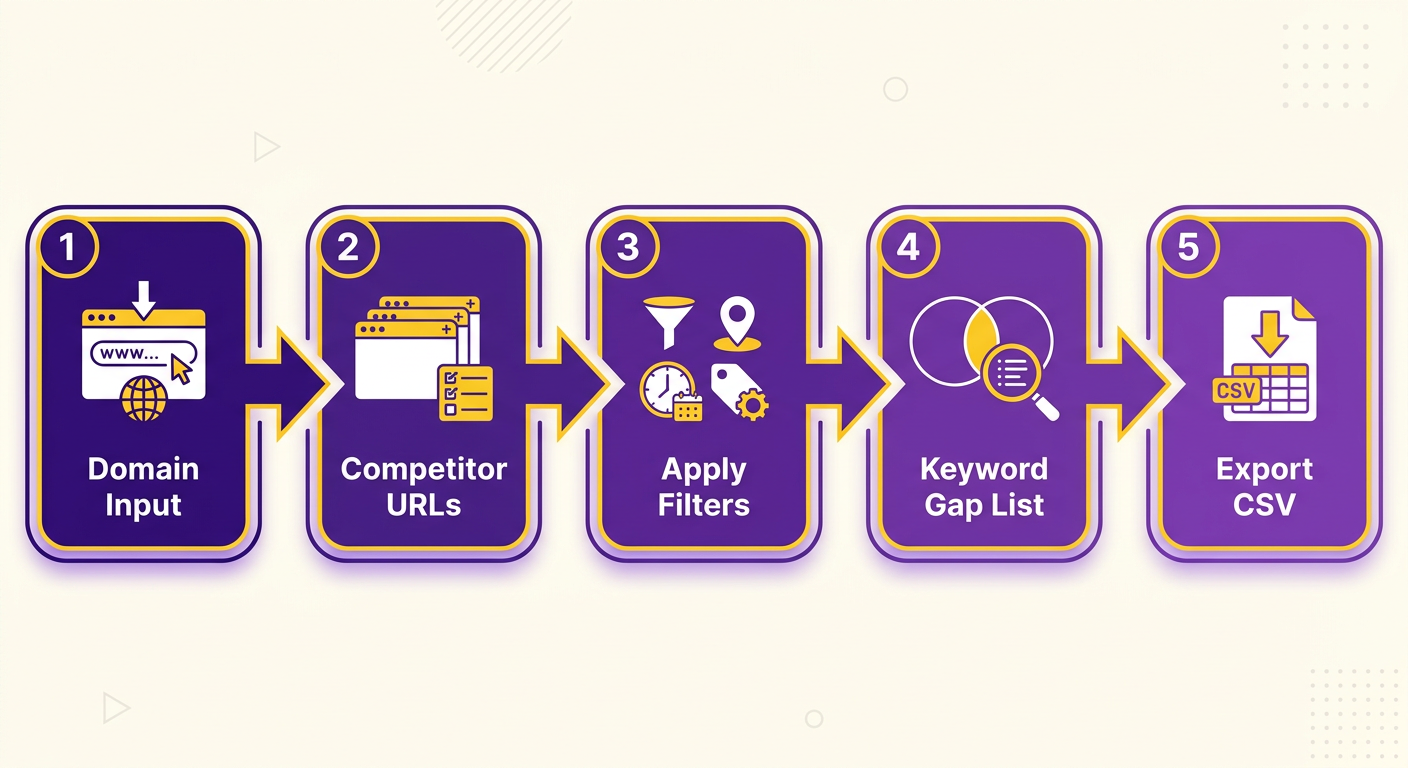
How deep does Ahrefs' data actually go?
Ahrefs runs on a massive index, though the exact size gets cited inconsistently. Crozdesk lists a large keyword index and extensive page count. SE Ranking cites 28.7 billion keywords across 217 countries. Our take: these are different snapshots or different metrics, so treat any single count as a ballpark, not gospel. The practical point holds. Ahrefs has enough depth to surface gaps most lighter tools miss.
That depth feeds a crawler Ahrefs claims is second only to Google's. Semrush, by comparison, monitors over 800 million unique domains across 142 countries. Both tools have enough depth for serious gap analysis, though they draw on different indexes and update on different schedules.
But here's the catch. Ahrefs' KD measures difficulty to crack the top 10, while Semrush measures the top 20. The two scores aren't measuring the same thing. Neither tool guarantees accuracy, and both say as much. So an "easy win" count is partly an artifact of methodology, not a fixed truth.
Does Ahrefs fit an automated gap-to-content workflow?
Not on its own. Ahrefs gives you exportable CSVs and gap tables, but it stops at the list. You still write briefs, draft articles, and match your brand voice by hand. That handoff is where teams lose days.
This is the exact seam our content engine closes. AnyPost.ai crawls your site to build a Business Context Graph of your products, messaging, and audience, then generates SEO-optimized, voice-matched drafts ready to publish. Once you've identified the keywords worth pursuing, AnyPost.ai turns your content strategy into publish-ready articles, no manual brief-writing required.
There's a cost argument too. Ahrefs runs $99 to $199/month, and Cotera makes the case that many users tap only about 10% of its features. Add-on credits for extra crawls and API calls can push that bill higher for heavy users. If your only job is finding gaps and shipping content, that depth is overkill.
Our read: Ahrefs wins on discovery for large or agency workflows. But the edge in gap analysis is shifting from who surfaces more keywords to who publishes on them fastest. That's the part neither discovery tool touches. AnyPost.ai's own Taxonomy Researcher and SERP Competitor Analyzer surface low-difficulty, high-intent keywords and build a winning article structure, then take you straight to publish-ready content.
How we tested Ninja Reports, Ahrefs, and AnyPost.ai
We built this test to answer one question: which workflow gets you from a keyword gap to a published article fastest? To do that fairly, we treated Ninja Reports and Ahrefs as discovery engines and AnyPost.ai as the execution layer. Comparing Ninja Reports gap analysis only makes sense if you also measure what happens after the export.
The design in plain terms: same keyword universe, same competitor set, same downstream target for every tool. That way, differences in output trace back to the tools, not to how we ran them.
Building the keyword sample and competitor set
We built a representative sample by mixing head, body, and long-tail terms so no single tool got an unfair advantage. Head terms test raw database depth. Long-tail terms test how well each platform surfaces genuinely winnable gaps. For competitors, we used 3 to 5 real domains per segment, well within Ahrefs' Content Gap limit.
Ahrefs' Content Gap tool anchors the discovery half of this test. In one documented run, it surfaced hundreds of keywords where competitors ranked in the top 100 but the analyzed site did not. Following Ahrefs' recommended approach, we picked established players in each niche as the competitor set, since the Content Gap tool is designed to analyze competitors' content strategies and uncover keyword opportunities.
Ninja Reports played a different role. Its on-page scan flags technical and content issues rather than competitor keyword gaps, so we scored it on audit output, not gap volume.
How we judged accuracy and "easy wins"
We cross-checked difficulty scores against actual SERP intent, not just each tool's number, because "easy win" counts are partly an artifact of methodology. This matters more than most comparisons admit.
To validate, we manually reviewed the top 10 ranking pages for each sampled keyword and logged whether the intent matched a page we could realistically produce. In our sample, some keywords flagged as low-difficulty had SERPs dominated by large authority domains or aggregators, making them far harder to win than the score suggested. We downgraded those before counting them as opportunities.
A bigger "easy win" list isn't proof of more real opportunity. Both tools state their scores are guidance only. We validated a sample of flagged keywords by hand before trusting either count.
Database size claims are inconsistent too. Various sources cite massive database sizes for both Ahrefs and Semrush. We treated exact counts with caution and focused on output quality instead.
How we measured time-to-publish
We scored the full workflow: gap discovery, draft creation, and publishing. Discovery tools stop at the CSV export. That's the handoff point where manual teams lose days writing briefs and drafts.
This is where the execution layer earns its place. We fed exported gap lists into AnyPost.ai and measured how quickly voice-matched drafts became publish-ready articles. The comparison shifts from who finds more gaps to who closes them faster.
| Test Stage | Ninja Reports | Ahrefs | AnyPost.ai |
|---|---|---|---|
| Gap discovery | On-page audit only | Hundreds of keyword gaps | Consumes gap data |
| Difficulty scoring | No | Yes (KD, top 10) | Uses supplied data |
| Draft generation | No | No | Voice-matched drafts |
| Time to publish | Manual | Manual | Automated |
If you only need an audit for a client meeting, Ninja Reports is enough. If you need raw gap data, Ahrefs wins. Neither gets you to a published page. That final step is what we timed hardest.
Pricing, value, and where ROI actually comes from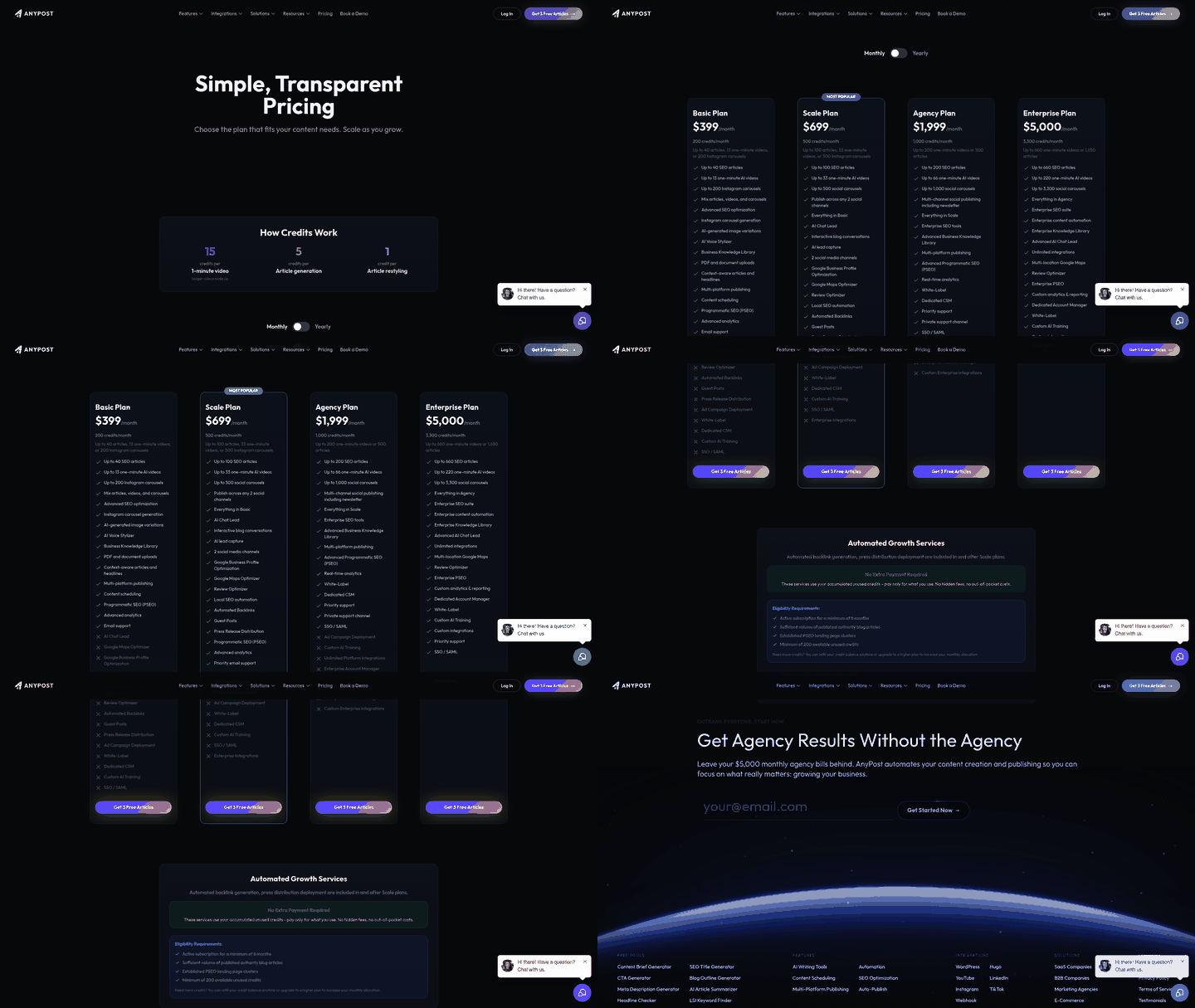
The real cost of keyword gap work isn't the subscription. It's the price per published article. That reframe changes everything when you compare Ninja Reports gap analysis against an automation-first pipeline.
Here's the honest math. Ahrefs carries a premium monthly subscription, and many users tap only a fraction of its features. If you're paying premium rates for a massive database but using it purely to export gap lists, you're overpaying for horsepower you never touch.
What the three tools actually cost
Ninja Reports sits at the low-friction end with an audit-focused feature set. Ahrefs commands the premium tier with no free trial at all. AnyPost.ai charges for the step neither one covers: turning your business context into voice-matched, ready-to-rank drafts.
| Tool | Entry Point | Full Gap Feature | Best Fit |
|---|---|---|---|
| Ninja Reports | Audit-focused | Technical on-page scan (audit, not gap) | Client-ready SEO audits |
| Ahrefs | $99–$199/mo, no trial | Content Gap tool | Deep competitor discovery |
| AnyPost.ai | Subscription | Generates and publishes SEO-optimized articles | Automated content production |
Cheaper discovery alternatives exist too. SpyFu starts at $39/month and SE Ranking at $52/month, both viable when you only need occasional competitor keyword checks. Industry experts point out that while Ahrefs is unmatched for backlinks, most users don't need its full weight.
How to calculate cost per report
Cost per keyword-gap report drops fast when you spread a subscription across regular use. Run four gap reports a month on an Ahrefs mid-tier plan and each report costs roughly $25 to $50 in tooling alone. That figure ignores the hours spent writing briefs and drafts afterward, which is where the actual expense hides.
Factor in the human side and the numbers shift again. A freelance SEO writer charges $0.10 to $0.50 per word, so a single 1,500-word article can run $150 to $750 on top of the tooling. Multiply that across four gap-driven articles a month and the writing bill dwarfs every subscription in the table combined.
The discovery cost is trivial next to the labor cost. A gap report is worth nothing until it becomes an article that ranks.
Where the ROI actually comes from
ROI shows up when gap data reaches a page. The return isn't in owning a keyword database. It's in how fast a discovered gap turns into ranking content. A report that sits in a spreadsheet for three weeks earns nothing, while the same gap published within 48 hours can start pulling traffic before a competitor even notices it.
For SMBs, the value calculation favors a lighter, integrated pipeline. Pay for discovery once, then move straight into a voice-matched engine that generates SEO-ready articles instead of hiring writers per brief. Enterprise teams with heavy backlink workflows still get their money's worth from Ahrefs' depth. When turning research into content, the smart spend is on the conversion step. AnyPost.ai collapses the timeline from strategy to publish by crawling your entire site to map your products and audience, then generating ready-to-rank articles in your voice and auto-publishing them across your existing platforms. We treat keyword research as raw material, not the finished product. Every article ships with baked-in SEO optimizations, keyword-aligned headings, and semantically correct HTML, ready to rank the moment it's live.
Verdict: which tool surfaces easier wins, and how to run it
For surfacing easier wins, AnyPost.ai leads because it closes the one gap the other two leave open: turning target keywords into published articles. Ahrefs and Ninja Reports both stop at the export. Neither loses on discovery. They lose on what happens after.
Here's our read after running the same keyword universe through all three. Ahrefs wins on raw depth. Ninja Reports wins on audit polish. The automation-first platform wins on speed to publish, which is where most teams actually bleed time.
How the three stack up on gap-to-publish speed
AnyPost.ai wins on ease of surfacing actionable wins because it generates SEO-optimized, voice-matched drafts and publishes them automatically. Its tone-matching and automated keyword research surface low-difficulty, high-intent keywords tailored to your niche. You go from an opportunity to a ready-to-edit article in one pass.
| Factor | Ahrefs | Ninja Reports | AnyPost.ai |
|---|---|---|---|
| Time from gap to draft | Manual, hours per piece | Manual, hours per piece | Minutes per batch |
| Publishing built in | No | No | Multi-platform |
| Learning curve | Steep for advanced features | Moderate | Low |
| Best for | Deep competitor data | Client-ready audits | Insight to published content |
The real strengths and trade-offs
Ahrefs carries the deepest database and a clean interface marketers trust for competitor research and keyword tracking. Its main trade-off: it stops at discovery and doesn't generate content. Most teams touch a fraction of what they pay for, and the higher tiers only make sense if you use the backlink and rank-tracking depth daily.
Ninja Reports shines on client-facing audits and helps agencies demonstrate value with detailed SEO reports. The trade-offs: it isn't built for competitor keyword discovery, its automation is limited, and it stops well short of drafting. Agencies love it for the reporting cadence, but it won't move an opportunity toward publication.
AnyPost.ai turns its own keyword research into voice-matched articles and handles publishing and scheduling in one workflow. Its automated research tools surface winnable keywords and build article structures from the top-ranking pages, then draft in your voice.
There's a genuine contradiction in the research worth naming. One comparison calls Ahrefs the strongest gap tool on database strength alone. Another argues it's overkill when you only need basic competitor data. Both are right, at different scales. Agencies running deep backlink and ranking work justify the spend. For gap lists to write from, that horsepower goes unused.
How to run the winning workflow
The fastest setup chains discovery directly into generation. Identify your opportunities, generate the drafts, schedule them, then monitor rankings. Four steps, no manual hand-off between tools.
-
Run gap discovery. Pull competitor gaps in Ahrefs against your target URLs, or use Ninja Reports for the audit layer. Filter by Keyword Difficulty and traffic to prioritize easy wins first. Or let AnyPost's automated research tools surface low-difficulty, high-intent keywords for your niche.
-
Generate voice-matched drafts. Let the platform's tone-matching engine produce SEO-optimized articles in your brand voice. This is the step that replaces hours of briefing and writing.
-
Schedule and publish. Queue drafts on your calendar so content ships steadily instead of in bursts, with multi-platform publishing across your website, LinkedIn, X, and more.
-
Monitor performance. Track which published pieces climb using real-time analytics, then loop new opportunities back into the next batch.
Quick-start checklist: pick your discovery source, prioritize your top opportunities, generate a test batch, schedule two weeks out. Start small, measure, then scale.
Frequently Asked Questions
1. Can I use a cheaper tool than Ahrefs just for keyword gap analysis?
Yes, cheaper alternatives handle basic gap work well. Budget-friendly platforms are viable for occasional competitor checks. Since many users tap only a fraction of Ahrefs' features, its premium price is overkill if backlink analysis isn't part of your regular workflow.
2. Why do the two tools report different keyword difficulty scores for the same term?
Ahrefs and Semrush measure difficulty differently. One scores the effort to crack the top 10, while the other measures the top 20. These aren't the same metric, so an "easy win" count is partly an artifact of methodology, not a fixed truth. Validate flagged keywords manually before trusting either.
3. How often is a "low-difficulty" keyword actually hard to rank for?
Some keywords flagged as low-difficulty had SERPs dominated by large authority domains or aggregators in testing, making them far harder to win than the score suggested. Manually reviewing the top 10 ranking pages for intent match reveals which supposed easy wins are realistically producible.
4. Does Ninja Reports offer white-label reporting for client meetings?
Ninja Reports generates white-label SEO audit reports built around its technical scan, flagging technical issues, missing meta tags, and page-speed bottlenecks. Agencies use these polished reports to demonstrate value. However, the reports diagnose what's broken rather than answering which content to create next, which is a strategy question they don't address.
5. How much does the writing cost after I've pulled a gap list?
Freelance writing rates can quickly dwarf any subscription cost. Across multiple gap-driven articles monthly, the writing bill exceeds every discovery tool combined. This labor cost, not the tooling, is where the real expense hides.
6. Why does Ahrefs data lag less than Ninja Reports for active content pipelines?
Ahrefs updates its index continuously, refreshing keyword metrics multiple times daily and revisiting top pages frequently. Ninja Reports pulls audit snapshots at scan time, so ranking data can lag behind live SERP movement. For fast-shifting niches, stale snapshots quietly steer you toward the wrong targets.
7. How does AnyPost.ai know my brand voice without manual briefs?
AnyPost.ai crawls your site to map your products, messaging, and audience, then generates voice-matched drafts through its tone-matching engine. Its automated research tools surface low-difficulty, high-intent keywords and build article structure, taking you from gap data to publish-ready content without hand-written briefs.