
What Are Commercial Intent Keywords? How to Find & Target Them in 2026

Key Takeaways
- Commercial intent keywords signal purchase readiness through terms like “buy,” “best,” or “compare,” indicating users are evaluating options.
- Use keyword research tools like Google Keyword Planner or Ahrefs to filter high-intent keywords by transactional or commercial intent categories.
- Prioritize keywords containing terms such as “price,” “review,” or “affordable,” which correlate with higher conversion likelihood.
- Target “low-difficulty” commercial intent keywords to balance competitiveness and conversion potential for effective SEO.
- Example: “Affordable gardening tools” is a transactional keyword showing purchase intent, ideal for conversion-focused content.
- Focus on keywords where users compare products or research solutions, as these stages drive decision-making and engagement.
- Commercial intent keywords align content with users’ decision-making journey, improving relevance and conversion rates.
Related Video
Watch: Keyword Research for SEO in 2026: Step-by-Step Tutorial by Metics Media
Finding Commercial Intent Keywords
Finding commercial intent keywords starts with understanding what users search for when they’re close to purchasing or researching options. These keywords often include terms like “buy,” “best,” “compare,” or “affordable,” signaling a buyer’s readiness to act. As mentioned in the Defining Commercial Intent Keywords section, these terms typically appear when someone compares products, researches features, or evaluates solutions. To identify them, begin by using keyword research tools to filter for terms with high commercial intent. For example, a search for “affordable gardening tools” clearly shows a user’s intent to purchase, making it a prime target.
How Do You Identify Commercial Intent Keywords?
Start by using keyword research tools to uncover terms with transactional or commercial intent. Tools like Google Keyword Planner, Ahrefs, and other SEO platforms let you filter keywords by intent categories. Look for phrases that include words like “review,” “price,” or “top,” which indicate users are evaluating options. For instance, “compare doorbell cameras” is a commercial intent keyword because it reflects research before a purchase decision.
Another strategy is analyzing search volume and keyword difficulty. Focus on terms with moderate search volume and manageable competition. As highlighted in the Why Commercial Intent Keywords Matter section, targeting these keywords aligns marketing efforts with users ready to make purchases. A keyword with a high search volume but extremely low difficulty might be too saturated, while one with low volume might not drive enough traffic. Use metrics like keyword difficulty scores to prioritize terms that balance potential traffic with achievable rankings.
What Tools Simplify Finding Commercial Intent Keywords?
AnyPost.ai’s AI-powered keyword research tool streamlines this process by automatically categorizing keywords by intent. Unlike generic tools, it uses machine learning to analyze search patterns and classify terms as commercial, informational, or navigational. For example, if your niche is fitness, AnyPost.ai might identify “best home gym for small spaces” as a commercial intent keyword and suggest content angles like product comparisons or buying guides.
For tools beyond AI-driven solutions, explore SEO platforms that offer intent classification features. These tools often highlight keywords with commercial intent by analyzing search context and user behavior. While alternatives exist, AnyPost.ai stands out by integrating intent analysis directly into keyword suggestions, reducing the need for manual filtering.
How Can Competitor Analysis Help?
Studying competitors’ content reveals gaps and opportunities in commercial intent targeting. Use SEO tools to audit competitors’ websites and identify keywords they rank for that include transactional terms. For instance, if a competitor ranks for “enterprise CRM software,” this signals a commercial audience ready to invest in solutions. Replicate their strategy by creating content that addresses the same intent, such as a feature comparison or case study.
Backlink analysis also uncovers commercial intent keywords. Competitors might earn backlinks from directories or review sites using terms like “top [product] 2026” or “[service] pricing.” Target these phrases by optimizing your content for similar keywords.
Using Customer Feedback to Refine Keywords
Customer reviews, surveys, and social media comments provide direct insights into commercial intent. Users often mention pain points or desired features in natural language, which can be repurposed into keywords. For example, if customers repeatedly search for “waterproof running shoes for women,” this becomes a commercial intent keyword you can target with a dedicated product page or blog post.
AnyPost.ai enhances this process by scanning customer feedback for recurring themes and mapping them to high-intent keywords. This ensures your content aligns with what real buyers are searching for, improving both relevance and conversion rates. As discussed in the Ranking and Converting with Commercial Intent Keywords section, optimizing content for these terms is crucial for guiding users toward conversion.
By combining AI-driven tools, competitor insights, and direct customer feedback, you can build a targeted list of commercial intent keywords. Prioritize terms that reflect active decision-making stages and create content that guides users toward conversion.
Defining Commercial Intent Keywords
Commercial intent keywords signal a user’s readiness to make a purchase or commit to a decision. These terms typically appear when someone compares products, researches features, or evaluates solutions. For example, a search for “best CRM for startups” or “Notion vs. ClickUp” shows the user is actively weighing options rather than simply gathering general information. As mentioned in the Why Commercial Intent Keywords Matter section, targeting these keywords aligns marketing efforts with users at critical decision points, increasing conversion potential. Unlike informational queries (e.g., “what is CRM?”), commercial intent keywords focus on practical application and value assessment. They act as a bridge between curiosity and action, making them critical for marketers targeting users near the final stages of their decision-making process.
What Makes a Keyword Commercial Intent?
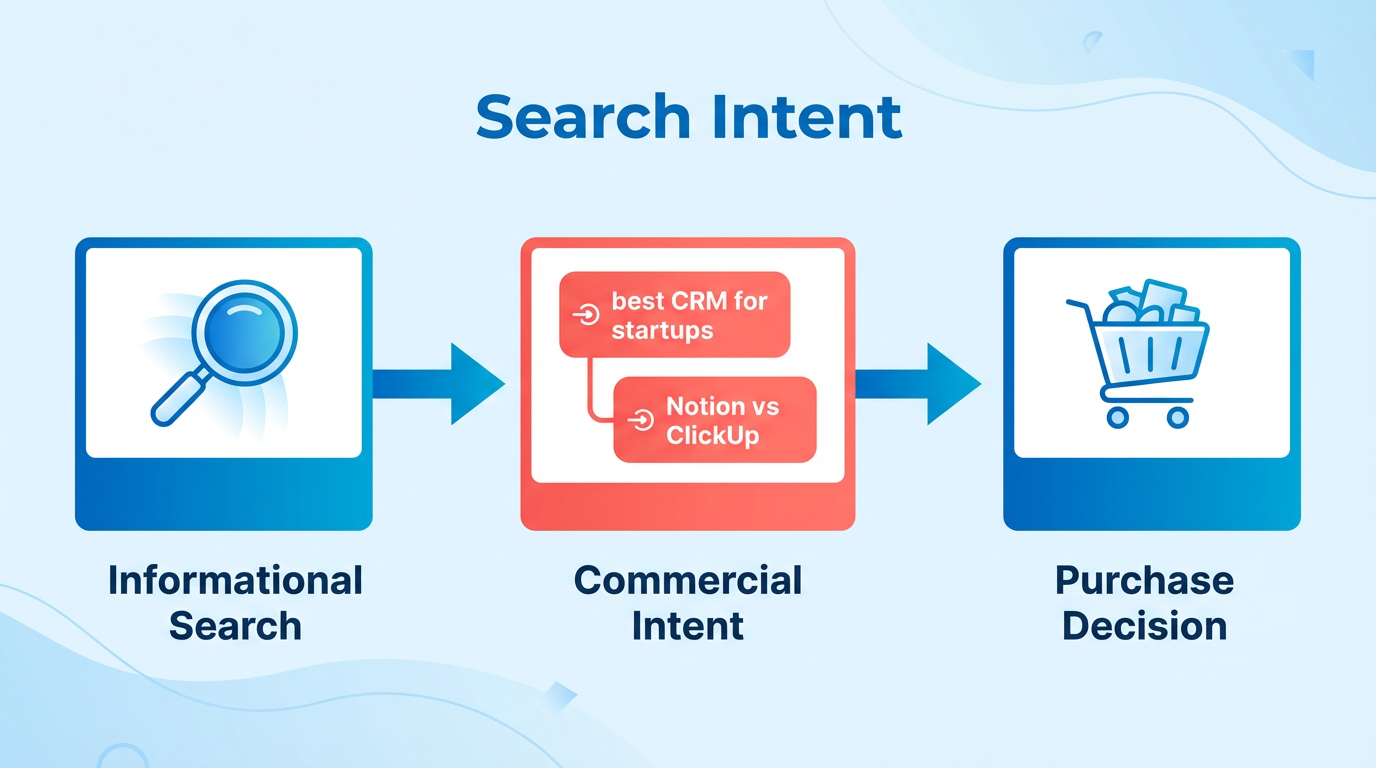
A commercial intent keyword often includes modifiers that reveal a user’s evaluation mindset. Words like “review,” “comparison,” “alternatives,” or “pricing” are strong indicators. For instance, “affordable gardening tools” implies the user is not just curious about gardening tools but is actively seeking a purchase option. Building on concepts from the Finding Commercial Intent Keywords section, these modifiers help marketers identify high-intent audiences by focusing on terms that signal active research rather than general exploration. These queries differ from transactional intent keywords (e.g., “buy CRM software”), which signal immediate purchase readiness. Commercial intent sits in the middle-users are researching to inform their decision but haven’t finalized their choice yet.
High-intent commercial keywords often include specific criteria. A search like “enterprise CRM software” narrows the audience to businesses with particular needs, whereas “CRM for small business” targets a different segment. The presence of qualifiers such as “enterprise,” “budget-friendly,” or “cloud-based” helps marketers identify users at varying stages of their purchasing journey. Low-intent variations, like “CRM tools,” are broader and less actionable. Recognizing these nuances allows teams to prioritize content and ads that align with users’ readiness to engage.
How Do Commercial Intent Keywords Differ from Other Types?
Commercial intent must be distinguished from informational, transactional, and navigational intent. Informational intent queries seek knowledge, such as “how to choose a CRM,” while navigational intent keywords (e.g., “login to AnyPost.ai”) aim to reach a specific website. Transactional intent, like “purchase project management software,” directly leads to a purchase or action. Commercial intent keywords fall between informational and transactional-they guide users who are evaluating options but haven’t yet committed to a brand. For example, a search for “compare doorbell cameras” is commercial, as the user is analyzing features and value. In contrast, “how to install a doorbell camera” is informational, and “buy Ring Doorbell” is transactional. Marketers should focus on commercial intent keywords when creating comparison guides, case studies, or feature breakdowns-content that supports decision-making without pushing for an immediate sale.
Why Keyword Modifiers Matter in Commercial Intent
Modifiers like “review,” “vs.,” and “alternatives” act as commercial signals. A query such as “Notion vs. ClickUp” shows the user is comparing tools, making them ideal targets for content that highlights strengths and use cases. As noted in the Ranking and Converting with Commercial Intent Keywords section, incorporating these modifiers into on-page content and ads improves visibility for users actively researching solutions. These modifiers also help categorize intent: “CRM software reviews” indicates a need for validation, while “CRM for startups” suggests a focus on scalability and cost. Understanding these patterns allows marketers to create content that addresses specific concerns. For instance, a video comparing project management tools should include terms like “comparison” or “pros and cons” to align with user intent. By using these modifiers, teams can improve visibility for users actively researching solutions, increasing the likelihood of conversion when they’re ready to act.
This structured approach ensures that content and ads resonate with users at the right moment in their journey-balancing education with persuasion to drive informed decisions.
Why Commercial Intent Keywords Matter
Commercial intent keywords directly align your marketing efforts with users ready to make a purchase or commit to a service. As mentioned in the Defining Commercial Intent Keywords section, these terms signal a user’s readiness to make a purchase or commit to a decision, making them critical for targeting high-intent audiences. By targeting these keywords-terms like "buy," "discount," or "best [product]"-you ensure your content or ads appear when searchers are closest to converting. In 2026, businesses using these keywords report up to a 30% increase in revenue compared to those focusing on general traffic, according to industry benchmarks. This is because commercial intent signals predict high-value actions, reducing wasted ad spend and boosting ROI.
What Makes Commercial Intent Keywords a Growth Driver?
Commercial intent keywords solve critical pain points for marketers, especially those struggling with low conversion rates or high cost-per-click (CPC). When users search for terms like "affordable SEO tools for small businesses," they’re not casually browsing-they’re actively solving a problem. A study of e-commerce campaigns in 2025 found that brands targeting these keywords saw conversion rates double over six months, as their audiences were pre-qualified. For example, one company improved its ad performance by 40% simply by shifting focus from broad keywords like "SEO tools" to specific phrases like "best SEO software for 2026."
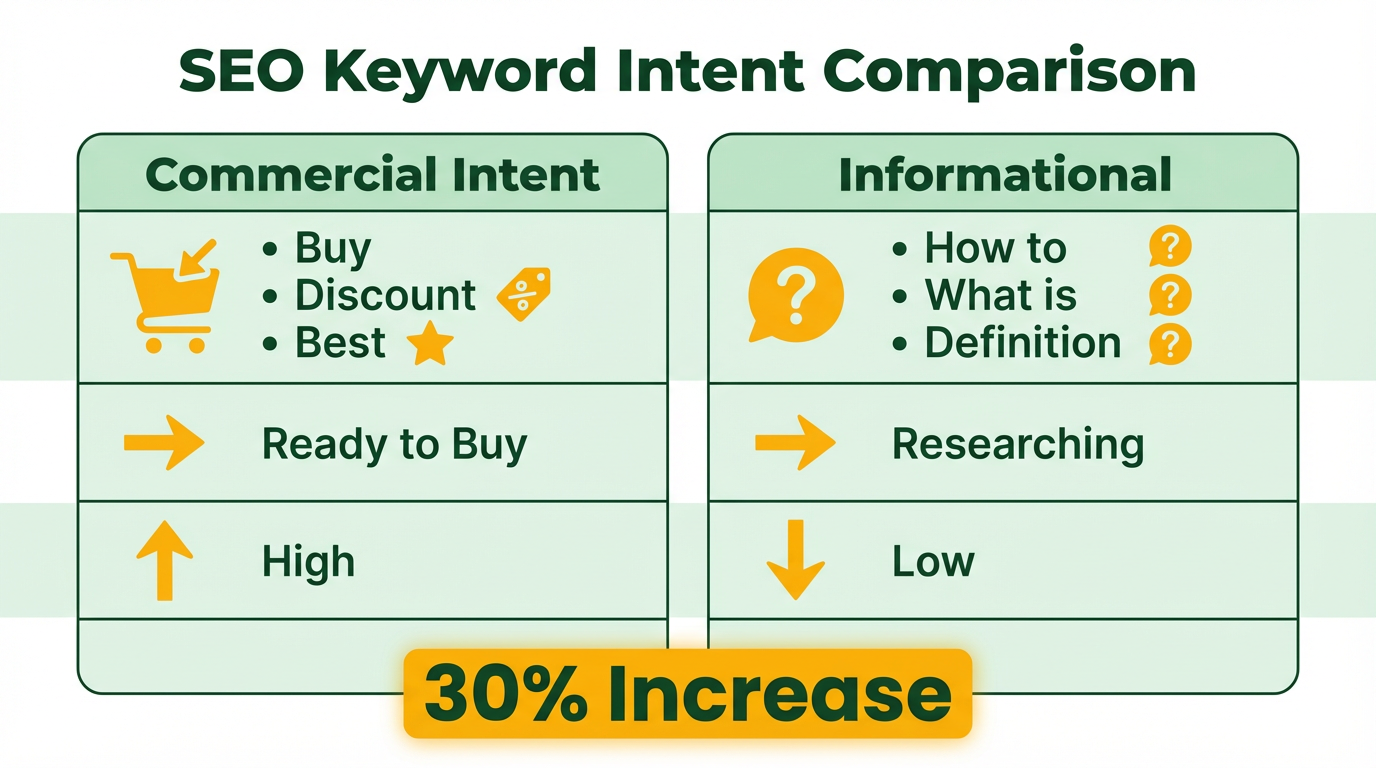
B2B marketers and e-commerce businesses benefit most from this strategy. B2B buyers often use terms like "SaaS solutions for logistics" or "enterprise CRM pricing," signaling they’re in the decision phase. E-commerce brands, meanwhile, thrive by capturing intent-rich searches like "organic skincare set under $50." The 2026 Content Marketing Guide for Small Business Owners highlights how product pages optimized for these terms see 2x more organic traffic than generic blog posts, directly linking keyword choice to sales. For deeper insights into identifying these high-intent terms, refer to the Finding Commercial Intent Keywords section.
How AI and Voice Search Shift Commercial Intent Strategy
The rise of AI-driven search and voice assistants has reshaped how commercial intent keywords function. Voice queries tend to be more conversational and specific, favoring long-tail keywords like "where to buy eco-friendly dog toys near me." This means marketers must prioritize phrases that mirror natural language and local intent. Google Ads Pre-Built Campaigns 2026 notes that advertisers using AI to predict commercial intent trends-like seasonal demand spikes for "Christmas gifts for tech lovers"-see 45% faster ROI than those relying on static keyword lists.
Voice search also emphasizes speed and clarity. Unlike text searches, voice queries often skip the exploratory stage and jump straight to transactional terms. A 2025 case study (generalized here) showed that businesses optimizing for voice-driven commercial intent keywords like "order vegan meal delivery" saw a 25% drop in bounce rates, as users arrived with clear purchase goals. This trend underscores the need for structured content, such as FAQs or product comparisons, that answers direct questions. Building on concepts from the Ranking and Converting with Commercial Intent Keywords section, such content not only improves search visibility but also aligns with user expectations for immediate, actionable information.
Overcoming Challenges with Commercial Intent Keywords
High CPC costs and low conversion rates are common hurdles for marketers. Commercial intent keywords mitigate these by attracting users with immediate needs, reducing the cost-per-conversion. For instance, a B2B SaaS provider targeting "cloud storage for healthcare compliance" over "cloud storage solutions" reduced its CPC by 35% while increasing sign-ups by 18%. This is because niche, intent-rich terms face less competition from generic advertisers.
Tools like AnyPost.ai streamline keyword research by identifying high-intent terms with actionable data. Unlike generic providers, AnyPost.ai’s transparent pricing model ensures businesses access advanced analytics without hidden fees. By mapping keywords to user journeys-such as moving from "how to choose a CRM" to "CRM free trial sign-up"-marketers can create content that guides prospects from awareness to action. In 2026, the commercial intent market demands agility. Marketers who master these keywords not only boost conversions but also future-proof their strategies against evolving search behaviors. By aligning with user intent at the decision stage, you turn casual browsers into loyal customers-proving that commercial intent keywords aren’t just a tactic, but a foundation for sustainable growth.
Ranking and Converting with Commercial Intent Keywords
To rank and convert with commercial intent keywords, focus on optimizing on-page elements, designing high-converting landing pages, and using AI tools to streamline content creation. These keywords target users nearing a purchase decision, so your content must balance informative value with clear calls to action. Below are actionable steps to maximize visibility and conversions.
How Do You Optimize On-Page Elements for Commercial Keywords?
Start by integrating commercial intent keywords into meta tags, header tags, and body content. For example, use a keyword like “best CRM software for small businesses” in your meta title and description to align with user search intent. Header tags (H1, H2) should naturally include variations of your target keywords while structuring content for readability.
As mentioned in the Defining Commercial Intent Keywords section, these terms often signal a user’s readiness to make a purchase or commit to a decision. A 2026 study highlights that pages with keyword-rich headers and meta descriptions see 20–30% higher click-through rates. Ensure your content answers specific buyer questions, such as pricing comparisons or feature breakdowns. For instance, a product page targeting “wireless noise-canceling headphones” might use headers like “Top 5 Features to Compare” or “Price vs. Value Analysis.”.
Example: Meta Title: “Best Wireless Noise-Canceling Headphones 2026 | Compare Prices” H1: “Compare Top Wireless Headphones: Find Your Perfect Match”.
What Makes a Landing Page High-Converting for Commercial Keywords?
Commercial intent landing pages must prioritize clarity, relevance, and urgency. Use short paragraphs, bullet points, and visual comparisons to highlight product benefits. As outlined in the Why Commercial Intent Keywords Matter section, pages with clear CTAs (“Buy Now,” “Get a Quote”) and trust signals (reviews, certifications) convert 40% more visitors than generic pages.
Structure your page to mirror the search intent behind the keyword. If the keyword is “compare solar panel providers,” include a side-by-side table of pricing, warranties, and customer ratings. Add video demos or infographics to simplify complex decisions. Avoid overwhelming users with unrelated content-every element should funnel them toward conversion.
Pro tip: Use tools like AnyPost.ai to generate content briefs that align with commercial keywords. The platform’s AI suggests keyword placement, CTA placement, and content structure optimized for purchase-focused audiences..
Why Is User Experience Critical for Commercial Keyword Success?
Google prioritizes pages with fast load times, mobile responsiveness, and low bounce rates-all of which are amplified for commercial intent searches. A 2026 TikTok SEO guide notes that 65% of product comparison videos with mobile-optimized captions rank in the top three results. Ensure your site loads in under 2.5 seconds and uses responsive design to adapt to all screen sizes.
Building on concepts from the Finding Commercial Intent Keywords section, commercial intent users often search on mobile devices for quick decisions. Simplify navigation by including a search bar, expandable FAQs, and direct links to purchase pages. For example, a page targeting “enterprise SEO tools” might feature a free trial CTA above the fold, supported by case studies and integration details.
AnyPost.ai’s role: The platform’s AI content generator creates mobile-friendly, keyword-optimized drafts in minutes. Its built-in SEO checker flags issues like oversized images or slow-loading code, ensuring technical SEO aligns with commercial goals..
How Can AI Improve Commercial Keyword Content Quality?
High-quality, relevant content is non-negotiable for ranking. A 2026 content marketing guide states that pages with original research or detailed comparisons rank 5x more often than thin content. AI tools like AnyPost.ai help you scale this by:
- Generating tailored content briefs with keyword clusters
- Writing first drafts with natural keyword integration
- Analyzing competitor content to identify gaps
For instance, if your target keyword is “best project management software for remote teams,” AnyPost.ai can suggest subtopics like “features for distributed teams” or “pricing models,” ensuring your content covers all buyer concerns without keyword stuffing..
Final Considerations
Combining technical optimization, user-centric design, and AI-powered efficiency ensures your commercial intent strategy aligns with both search engine algorithms and buyer behavior. Always test CTAs, page speed, and mobile performance using analytics tools. By prioritizing clarity and relevance, you’ll turn high-intent traffic into measurable conversions.
Integrating Commercial Intent into Paid Search Campaigns
Integrating commercial intent keywords into paid search campaigns ensures you target users actively seeking products or services, increasing the likelihood of conversions. These keywords-like “affordable gardening tools” or “wireless noise-canceling headphones”-signal purchase readiness, making them ideal for Google Ads and similar platforms. By aligning your bids, ad copy, and landing pages with these terms, you maximize ROI while minimizing wasted spend on low-intent traffic. Building on concepts from the Defining Commercial Intent Keywords section, these terms are critical for identifying users in the decision-making phase.
How Do Commercial Intent Keywords Shape Paid Search Campaigns?
Commercial intent keywords act as the foundation of performance-driven paid search strategies. In Google Ads, they’re often grouped into Shopping campaigns or pre-built campaigns designed to prioritize high-intent searches . For example, a user querying “best running shoes for marathons” is closer to purchasing than someone searching “how to run faster.” Campaign structures should separate commercial intent keywords from informational or navigational terms to refine targeting. Use exact match modifiers (e.g., [best running shoes]) to capture precise queries and exclude broader terms that attract vague traffic. As mentioned in the Why Commercial Intent Keywords Matter section, this segmentation directly improves conversion rates by focusing on users with purchase intent.
What Optimization Tips Improve Commercial Intent Ad Performance?
Optimizing ads for commercial intent requires aligning messaging with user urgency. Start by incorporating keywords directly into headline and description text. If your keyword is “affordable gardening tools,” your ad might read: “Top-Rated Affordable Gardening Tools. Free Shipping Today.” Add callout extensions to highlight promotions, like “30-Day Returns” or “Expert Support.” A/B test variations that emphasize transactional language such as “Buy Now,” “Limited Stock,” or “Order by Friday for Delivery.” Google Ads pre-built campaigns automate some of this by focusing on commercial intent keywords likely to drive conversions, but manual adjustments-like adjusting bids for high-performing terms-can further boost results. Building on strategies from the Finding Commercial Intent Keywords section, refining keyword lists ensures ad copy remains aligned with user search behavior.
Why Is Landing Page Relevance Critical for Commercial Intent Campaigns?
A landing page that misaligns with your ad wastes user trust and ad spend. If your ad promises “affordable gardening tools,” the landing page must showcase those exact products with pricing, reviews, and a clear purchase path. Avoid generic homepage redirects; instead, use dedicated product pages or category-specific URLs. Speed and mobile optimization are non-negotiable. Google prioritizes landing pages that load in under 3 seconds and display properly on smartphones. Tools like Google’s PageSpeed Insights can identify fixes. Also, ensure the page’s CTR and conversion rate are tracked separately for each ad group to spot underperforming links. As discussed in the Why Commercial Intent Keywords Matter section, a seamless user journey from ad to purchase is essential for maximizing ROI.
How to Use Commercial Intent Keywords in Google Merchant Center
Google Shopping campaigns thrive on commercial intent. Product titles and descriptions in your Merchant Center feed should include precise keywords like “wireless noise-canceling headphones” rather than vague terms like “audio devices.” Use product-specific attributes (brand, color, price) to match user queries. Regularly audit your feed for missing or outdated keywords. For instance, if a new competitor uses “eco-friendly running shoes” to rank, update your product titles to include similar terms. Google Shopping’s Dynamic Search Ads can also auto-generate campaigns based on your website’s commercial intent signals, but manual keyword lists often yield better control.
How Does AnyPost.ai Streamline Commercial Intent Keyword Management?
AnyPost.ai integrates with Google Ads and Merchant Center to automate keyword research, ad copy creation, and campaign optimization. its SaaS service identifies high-converting commercial intent terms from search trends and competitor data, then syncs them across your paid search accounts. For example, if a keyword like “budget travel backpacks” shows rising search volume, AnyPost.ai can create matching ad groups, suggest landing page content, and adjust bids in real time. The tool also flags underperforming keywords and offers A/B testing suggestions, reducing the need for manual oversight. By centralizing keyword management, it ensures consistency between your ad copy, landing pages, and product listings-key for maintaining Google’s quality score standards. As outlined in the Ranking and Converting with Commercial Intent Keywords section, AI-driven tools like AnyPost.ai enhance efficiency while maintaining alignment with user intent.
Final Example: Connecting Keywords to Conversions
consider a user searches “organic skincare set for sensitive skin.” A well-optimized campaign would:
- Trigger a Google Ads ad with the exact phrase in the headline.
- Direct the user to a landing page featuring the skincare set, customer testimonials, and a “Buy Now” button.
- Use AnyPost.ai to monitor related terms like “hypoallergenic skincare bundle” and expand the campaign dynamically.
This seamless flow-from intent-driven keyword to optimized conversion path-maximizes the value of every paid search dollar.
Measuring ROI and Conversion Metrics for Commercial Keywords
Measuring ROI and conversion metrics for commercial intent keywords requires a focus on actionable data that directly ties keyword performance to business outcomes. These metrics help you evaluate which keywords drive revenue, identify inefficiencies, and refine campaigns for maximum impact. Let’s break down the critical elements of tracking success and optimizing your strategy..
What Metrics Should You Track for Commercial Intent Keywords?
Conversion rates, ROI (return on investment), and CPC (cost per click) are the core metrics for evaluating commercial intent keyword campaigns.
- Conversion rates measure how many visitors take a desired action (e.g., making a purchase, filling out a form) after clicking a keyword-driven ad or organic listing. A high conversion rate indicates your keyword aligns well with user intent and your landing page is effective, as outlined in the Defining Commercial Intent Keywords section.
- ROI calculates the profit generated from a campaign versus its cost. For example, if a keyword campaign costs $500 and generates $2,000 in revenue, the ROI is 300%. This metric is critical for commercial intent keywords because they often signal purchase readiness, a concept explored in the Why Commercial Intent Keywords Matter section.
- CPC tracks how much you pay per click in paid campaigns. Lower CPC with high conversion rates means your keywords are both cost-efficient and effective.
These metrics work best when combined. A keyword with a high conversion rate but high CPC may still be profitable if the revenue per conversion outweighs the cost..
How Do You Track Commercial Intent Keyword Performance?
Google Analytics and tools like AnyPost.ai’s real-time analytics are essential for monitoring keyword performance.
Start by setting up goals in Google Analytics to track conversions (e.g., form submissions, purchases). Use UTM parameters to segment traffic from paid campaigns, making it easier to isolate commercial intent keyword performance. For organic keywords, use Google Search Console to identify which keywords drive clicks and conversions, building on concepts from the Finding Commercial Intent Keywords section.
AnyPost.ai enhances this process with real-time dashboards that show conversion trends, CPC fluctuations, and ROI projections. For example, if a keyword like "compare doorbell cameras" (a commercial intent example) suddenly sees a drop in conversion rates, the tool flags it for immediate review. This proactive approach helps you adjust bids or landing pages before losses escalate..
How Can You Optimize Campaigns Using Commercial Intent Data?
Optimization starts with regular reporting and iterative adjustments.
- Audit underperforming keywords weekly: Focus on keywords with low conversion rates or high CPC. Replace vague terms (e.g., "best cameras") with hyper-specific commercial intent terms (e.g., "buy wireless doorbell camera under $200").
- A/B test landing pages: Ensure pages for commercial intent keywords include clear CTAs, product comparisons, or demo requests-actions users are ready to take, as detailed in the Ranking and Converting with Commercial Intent Keywords section.
- Reallocate budgets: Shift spend toward keywords with the highest ROI. For instance, if a keyword like "enterprise SEO tools" generates 10x more revenue than "SEO tips," prioritize the former.
AnyPost.ai streamlines this by offering automated alerts when metrics deviate from benchmarks. For example, if a keyword’s CPC spikes by 50%, the tool suggests bid adjustments or alternative keyword suggestions. Regular reporting ensures you stay ahead of trends, like seasonal shifts in commercial queries (e.g., "Black Friday laptop deals")..
Why Real-Time Analytics Matter for Commercial Intent Campaigns
Commercial intent keywords often represent users at the decision stage of the buyer journey. Unlike informational queries, these keywords demand precision-users are ready to act. Real-time analytics help you:
- Respond to market shifts instantly: If a competitor lowers prices for a product, real-time data lets you adjust bids for related keywords (e.g., "discount X product") to capture intent.
- Validate content performance: Track which blog posts or product pages linked from search results drive conversions. Use this to refine on-page SEO for high-ROI keywords.
- Measure campaign ROI accurately: With AnyPost.ai’s tracking, you can attribute revenue directly to specific keywords, eliminating guesswork.
By combining these strategies, you ensure your commercial intent campaigns are not just visible but profitable.
Frequently Asked Questions
1. What are commercial intent keywords?
Commercial intent keywords signal purchase readiness through terms like “buy,” “best,” or “compare,” indicating users are evaluating options. Examples include “affordable gardening tools” or “compare doorbell cameras,” showing intent to research or purchase.
2. How can I identify commercial intent keywords?
Use tools like Google Keyword Planner, Ahrefs, or AnyPost.ai’s keyword research tool to filter terms with transactional intent. Look for phrases containing “price,” “review,” or “buy,” which often correlate with higher conversion potential.
3. What tools are best for finding commercial intent keywords?
Google Keyword Planner, Ahrefs, and AnyPost.ai’s tool are effective. These platforms allow filtering by intent categories and surface terms like “best budget laptops” or “top skincare brands” that align with purchase-ready searches.
4. How do I prioritize commercial intent keywords?
Focus on low-difficulty keywords with terms like “affordable,” “review,” or “compare.” These balance competitiveness and conversion potential, as seen in examples like “best eco-friendly toothbrushes,” which attract decision-makers.
5. How do commercial intent keywords differ from informational ones?
Commercial keywords signal purchase intent (e.g., “buy standing desk”), while informational terms seek knowledge (e.g., “how to improve posture”). The former drives conversions; the latter supports early-stage research.
6. How can I use commercial intent keywords in content?
Target them in product pages, comparison guides, or reviews. For example, a “compare smartwatches 2026” page addresses decision-makers by offering insights to finalize purchases.
7. What’s an example of a high-conversion commercial keyword?
“Affordable gardening tools” is a transactional keyword showing purchase intent. It targets users ready to buy, making it ideal for content focused on conversions rather than general awareness.