
What Does an SEO Specialist Actually Do? Roles and Deliverables

Key Takeaways
- The job comes down to three things: keyword research, on-page optimization, and link building. Everything else supports those.
- Most online journeys start in a search box. If you're not visible there, you're invisible to people who are actively looking to buy.
- A lot of the wins come from tuning pages you already have to match what people search for, not from cranking out new content.
- Day to day, the deliverables are optimization plans, ongoing keyword research, technical audits, and performance analysis.
- Pay tracks the mix of skills involved, and it varies a lot by experience and whether you're in-house or agency-side.
- Technical audits clear out the crawl, speed, and structure problems that keep search engines from indexing a site properly.
- Link building earns connections from other sites. Those are the authority signals that move rankings.
The short version
An SEO specialist makes a website easier to find in search, then drives organic traffic to it. The work lines up three things: a clean technical foundation, content that's actually relevant, and authority from other sites pointing to yours. The point is simple. When someone searches for what you sell, your pages show up.
Why does any of this matter? Because search is still the front door to most of the web. If your pages aren't there when people go looking for answers, the people most likely to buy from you never see you.
What you actually get from the work
A good specialist hands you roadmaps, content briefs, and structural site fixes. They tune on-page content and read performance metrics to see what's landing. The output isn't one big fix. It's a steady stream of improvements that lift rankings over months.
Short version of who does what:
| Responsibility | What It Involves | Why It Matters |
|---|---|---|
| Keyword research | Finding the terms your audience searches | Targets content at real demand |
| On-page optimization | Tuning titles, headings, and content | Helps pages rank for chosen terms |
| Technical SEO audits | Fixing crawl, speed, and structure issues | Lets search engines index your site |
| Link building | Earning links from other sites | Builds authority and trust signals |
| Performance analysis | Tracking metrics and rankings | Shows what to double down on |
The most underrated part of this: a lot of the lift comes from your existing pages. Align what you already have with search intent, and you capture missed traffic without publishing a mountain of new content.
What the role pays
Pay swings a lot depending on experience, location, and whether you're in-house or at an agency. Senior people who own strategy and technical audits sit at the top of the range.
The number reflects the skill mix. A solid specialist combines analytical thinking, content judgment, and technical know-how. In a single week they'll read data, fix site problems, and shape content. That breadth is the job.
Why it's worth understanding this role
Knowing what the work involves helps you set realistic expectations, whether you're hiring or doing it yourself. This isn't a quick fix. It's ongoing keyword research, structured audits, and steady content work that compounds over months.
One exception: skip a dedicated specialist if your site is brand-new with nothing to optimize. At that stage you need pages first. Once you've got something to rank, the specialist work starts paying off.
If outsourcing the cost gives you pause, AnyPost pulls the whole SEO workflow into one dashboard and lets you generate SEO-ready content in your own voice.
The rest of this guide breaks down each responsibility, so you can see how the deliverables connect to results.
Why SEO specialists matter
Search visibility decides who finds your business and who never does. A solid strategy turns a website into a steady source of qualified traffic. Without one, even great products sit on page two, where almost nobody looks.
The demand is real. Roughly 70% of online marketers treat SEO as a key priority, and 61% call it a key driver of their overall strategy. Those numbers tell you it isn't a side task. It's central to how companies grow online.
Why SEO actually drives revenue
Done well, SEO increases traffic, lifts conversions, and grows revenue. When your pages rank for what your customers search, you catch people at the exact moment they want what you offer. That intent is what makes organic search worth more than interruptive ads.
The benefits stack past traffic. Strong rankings build brand awareness, because every search appearance puts your name in front of a buyer. Over time, consistent visibility helps you establish thought leadership in your niche.
A specialist makes this happen through clear deliverables. They diagnose crawl issues, find high-value search terms, and refine existing pages. They handle the on-page work too: keyword targeting, internal linking, clean URLs, and meta tags that keep your pages relevant to users and search engines alike.
If you're weighing what this costs, our guide on SEO pricing models breaks down the common options.
Why the role keeps getting harder
Search engines change constantly, and that's the whole problem. A specialist has to watch industry shifts, refine strategy, and roll out new tactics as the rules move. A page that ranked last quarter can stall a few months later.
Algorithm updates are the main culprit. Each one can reshuffle rankings overnight, so specialists stay current with best practices just to protect the gains they've already built. This is maintenance, not a one-time project.
The work also spans several disciplines at once. One person juggles technical audits, structured data, keyword strategy, and performance analysis. Each area needs its own skill set, and they all have to work together to drive growth.
Why hire a specialist instead of going it alone
Because modern SEO is too broad for most teams to absorb part-time. The role combines content tuning, link building, technical fixes, and constant metric analysis. Doing all of it well takes focused attention a generalist rarely has.
A specialist also closes the visibility gap that hurts most small businesses. They find the keywords your customers actually use, then match your pages to them. That alignment is what moves you from invisible to found.
And the payoff compounds. Each optimized page, each fixed technical issue, each new ranking adds to a foundation that keeps pulling in traffic. That's why a dedicated specialist earns a place in any serious marketing plan.
Technical SEO: clearing the path for crawlers
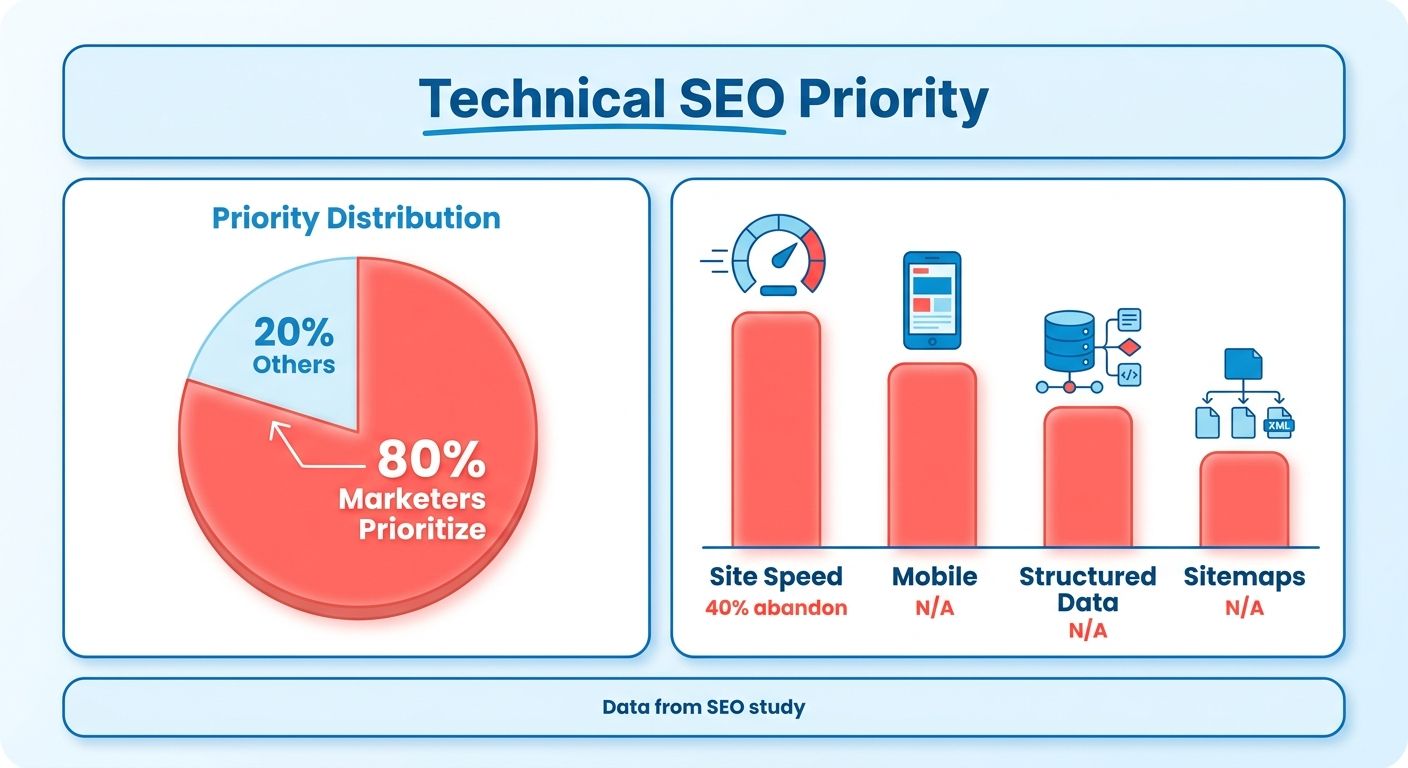
Technical SEO is the work of making your site easy for search engines to crawl, index, and rank. It covers site speed, mobile responsiveness, structured data, and sitemaps. Around 80% of marketers treat it as a key priority, which tells you it's not optional groundwork.
A specialist runs technical audits to find what's slowing a site down or blocking it from search. These audits are core to the job, and they catch problems most teams never notice until rankings drop.
Why site speed matters so much
Speed decides whether visitors stay or leave. 40% of users abandon a site that takes more than 3 seconds to load. Every second of delay costs you traffic and conversions before a visitor reads a word.
Specialists fix speed by compressing images, cutting code bloat, and trimming server response times. They test pages, measure load times, and prioritize the fixes that move the needle.
Speed feeds rankings too. Faster pages signal a better experience, and search engines reward that. A slow site undercuts even strong content and good keywords.
How much mobile responsiveness matters
A lot, because most searches happen on phones. Google uses mobile-first indexing, meaning it mostly looks at the mobile version of your site to decide rankings. If your site breaks on a small screen, you lose the majority of your audience.
A responsive site adjusts its layout to fit any screen. Text stays readable, buttons stay tappable, and images scale without forcing anyone to pinch and zoom.
Specialists test across devices to confirm it all holds up. Broken mobile layouts hurt usability and drag rankings down, since search engines weigh mobile performance heavily.
What XML sitemaps do
An XML sitemap is a file that lists your pages so search engines can find and index them efficiently. It maps your structure and content, giving crawlers a clear path through your site. Without one, important pages can stay hidden.
Sitemaps matter most for large sites or new pages that aren't well linked yet. They tell search engines what exists and where to look first.
Specialists also handle structured data, which adds context so search engines understand your pages better. Paired with a clean sitemap, it helps your content show up in richer search results.
The tools behind the work
Specialists lean on dedicated tools to run audits, track backlinks, and optimize at scale. These platforms cover keyword research, technical audits, competitor analysis, and link building in one place. With over 200 ranking factors in play, manual tracking can't keep up.
The right tools save hours of checking by hand. They flag crawl errors, broken links, slow pages, and missing tags automatically, so you act on real data instead of guesswork.
Good tools also tighten reporting. They show what's working, what's stalling, and where to focus next. For teams planning budgets, they're a real operational cost alongside the specialist's labor.
Working with the rest of the website team
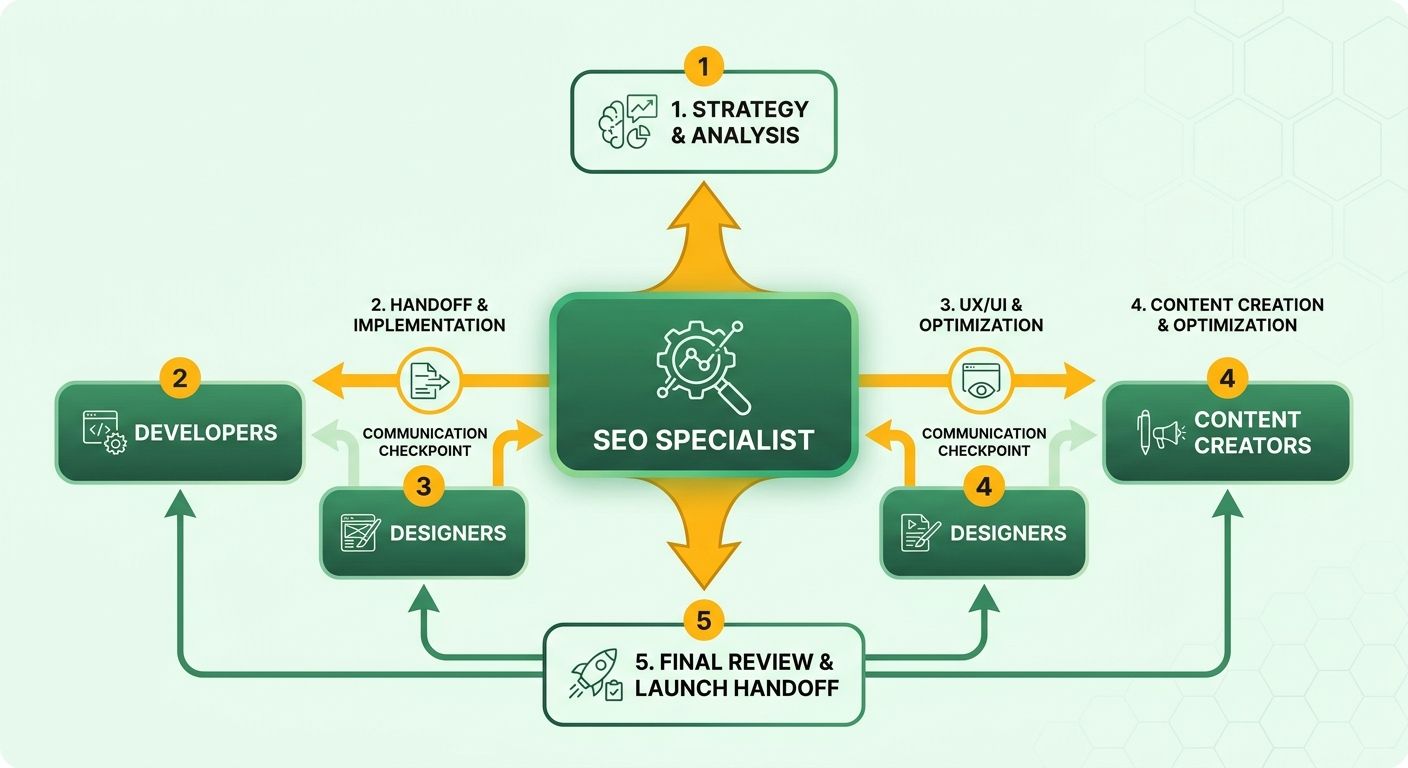
SEO specialists don't work alone. They sit at the center of a website project, connecting developers, designers, and content creators around one goal: better search visibility. The handoffs between those roles often decide whether a strategy ships or stalls, because recommendations rarely survive a broken chain of communication.
The reason is simple. SEO touches every part of a website. Code, layout, and copy all affect how search engines read and rank your pages. No single person controls all three, so the specialist coordinates across teams.
Working with developers
Specialists work with developers to fix the technical foundation that decides whether search engines can crawl and index a site. They flag issues from audits and hand over a clear list of changes.
This covers structured data, clean code, crawlability, and indexing. A specialist might spot the problem in an audit, but the developer writes the fix. The specialist explains what needs changing and why it matters for rankings.
Without that handoff, technical recommendations sit in a report and never reach the live site. The job is to translate SEO needs into developer tasks the engineering team can actually build.
Working with designers
Specialists work with designers so the site's user experience supports search performance. Layout, navigation, and visual structure all shape how visitors move through pages and how long they stay.
Design choices hit SEO directly. A confusing menu buries important pages. Heavy visual elements slow load times. The specialist gives designers feedback so the final design looks good and ranks well.
It's a balancing act. Designers care about aesthetics and usability. Specialists care about crawl paths and engagement signals. Good collaboration finds the version that serves both.
Guiding content creators
Specialists work with content creators to optimize copy for search without killing readability. They share keyword research and on-page guidance, then let writers turn it into content people want to read.
The specialist provides the target keywords and the strategy behind them. The writer produces the articles, product pages, and headlines. That split keeps the writing natural while still hitting the terms your customers search for.
It's a two-way exchange. Writers bring subject expertise and voice. Specialists bring data on what searchers actually type. Together they produce pages that rank and convert. If you want to see how this fits a wider plan, our guide on content analytics tools covers the measurement side.
Why communication makes or breaks a campaign
Clear communication holds all of this together. Specialists have to explain technical concepts to non-technical teammates and keep everyone aligned on goals. Without it, even strong strategies fall apart in execution.
A specialist who can't communicate becomes a bottleneck. Recommendations get misread, deadlines slip, rankings stall. Being able to brief developers, designers, and writers in language they understand is core to the role.
So the best specialists are translators as much as analysts. They turn search data into action across three different teams. That coordination is what separates campaigns that grow from ones that flatline.
Deliverables and the metrics that prove them
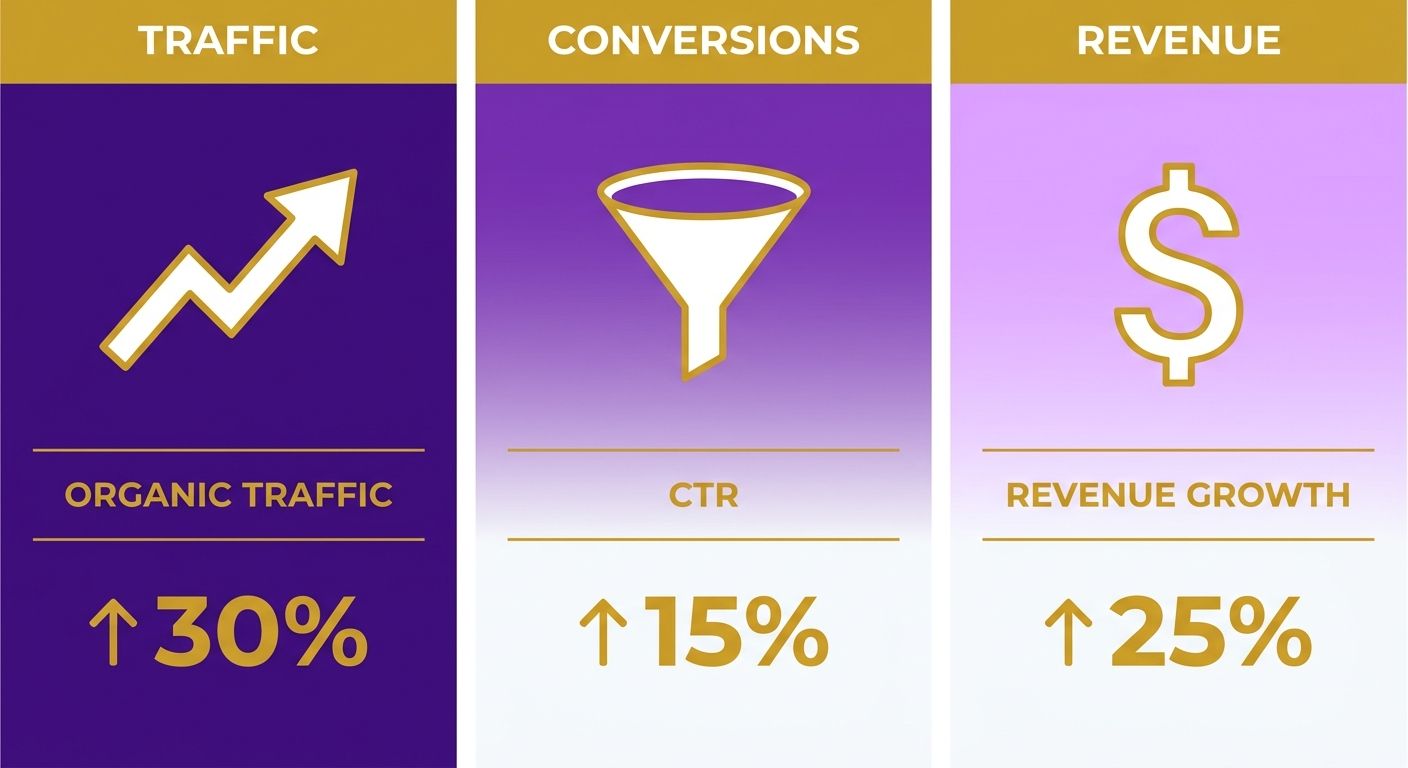
An SEO specialist's deliverables come down to three outcomes: more traffic, more conversions, more revenue. Everything they build feeds one of those. The rest of the job is proving the gains with hard numbers.
You measure success through metrics that track traffic, engagement, and conversions. Those numbers tell you whether the work is paying off or just spinning wheels. Without them, you're guessing.
The core deliverables
More organic traffic, higher conversion rates, and stronger revenue from search. A specialist optimizes your site so the right people find it, then turns those visitors into customers.
Traffic is the starting point. More qualified visitors mean more chances to convert. But traffic alone means nothing if people bounce without acting.
That's why conversions sit at the center. A good specialist tunes pages so visitors take action, whether that's a purchase, a signup, or a contact form. Revenue follows when those conversions add up.
How you measure a campaign
You track a defined set of KPIs. The main three are organic traffic, conversion rate, and return on investment (ROI). Together they show whether your strategy is working at every stage of the funnel.
Organic traffic tells you how many people reach your site through unpaid search. Watch the trend over weeks and months, not single days. A steady climb means your optimization is taking hold.
Conversion rate measures how many of those visitors do what you want. A rising number means your pages match what searchers came to do. ROI ties it together by comparing what you spent against what it returned.
Engagement metrics fill the gap between traffic and conversions. Time on page, pages per session, and bounce rate show whether visitors find your content useful. High engagement often predicts higher conversions later.
Why keyword rankings still matter
Rankings remain one of the clearest signals of progress. The top organic result on Google captures a far larger share of clicks than positions below it, and click-through rates drop sharply past the first few spots. Where your pages land for target terms directly shapes how much traffic you pull.
Rankings work as an early indicator. They often move before traffic does, so they tell you what's coming. If your terms climb, traffic usually follows.
Track rankings alongside traffic and conversions, not on their own. A page can rank first and still convert poorly. The full set of metrics keeps you honest about what's actually working.
When you judge a specialist's performance, look at all of it together. Rising rankings, growing organic traffic, climbing conversion rates, positive ROI. That combination is a campaign earning its keep.
The three core responsibilities
A specialist's daily work targets different parts of how search engines find, read, and trust your site. The role also means building optimization strategies and refining them as search behavior shifts. Specialists track engine updates and adjust their workflow to keep a site competitive.
What keyword research involves
Keyword research is finding the exact terms your customers type into search. It tells you what to write about and which pages to build. It sits at the front of every content decision, which is why specialists treat it as the starting point for any campaign.
The goal is matching content to real demand. You identify the phrases people use, gauge how many search for them, and figure out which terms you can realistically rank for.
Specialists do this on an ongoing basis, not once. Trends move. New terms emerge. A good specialist keeps the list current so your content always targets what people are searching for right now.
How on-page optimization works
On-page optimization means tuning the elements on each page so search engines understand and rank it. That includes structuring the body content so it directly answers the query. The work goes deeper than basic tags; specialists set up logical site hierarchies and descriptive URLs to serve up relevant results.
Internal links connect related pages and help search engines crawl your site in a logical order.
Clean URLs matter too. A clear, readable address tells users and search engines what a page covers before they click. Each small adjustment adds up to pages that rank better and read clearly.
What on-page optimization typically touches:
- Title tags: the headline search engines show in results
- Meta descriptions: the short summary under each result
- Header tags: the H1, H2, and H3 structure that organizes content
- Internal links: connections between related pages on your site
- URL structure: short, descriptive web addresses
Why link building carries so much weight
Link building is the work of earning high-quality backlinks from other sites. Those links act as votes of confidence that boost your authority and rankings. It's the main piece of off-page SEO, and the impact is hard to overstate.
Pages ranking at the top of Google tend to have far more referring domains than pages further down, which shows how closely backlinks track with visibility. When trusted sites link to yours, search engines read it as a signal your content deserves attention.
One link from a respected, relevant site beats dozens from low-quality pages. Specialists chase quality over quantity, building relationships and creating content worth linking to.
These three responsibilities work together. Keyword research points you at the right topics. On-page optimization makes each page rank-ready. Link building earns the authority that pushes those pages to the top.
Content SEO, from draft to distribution
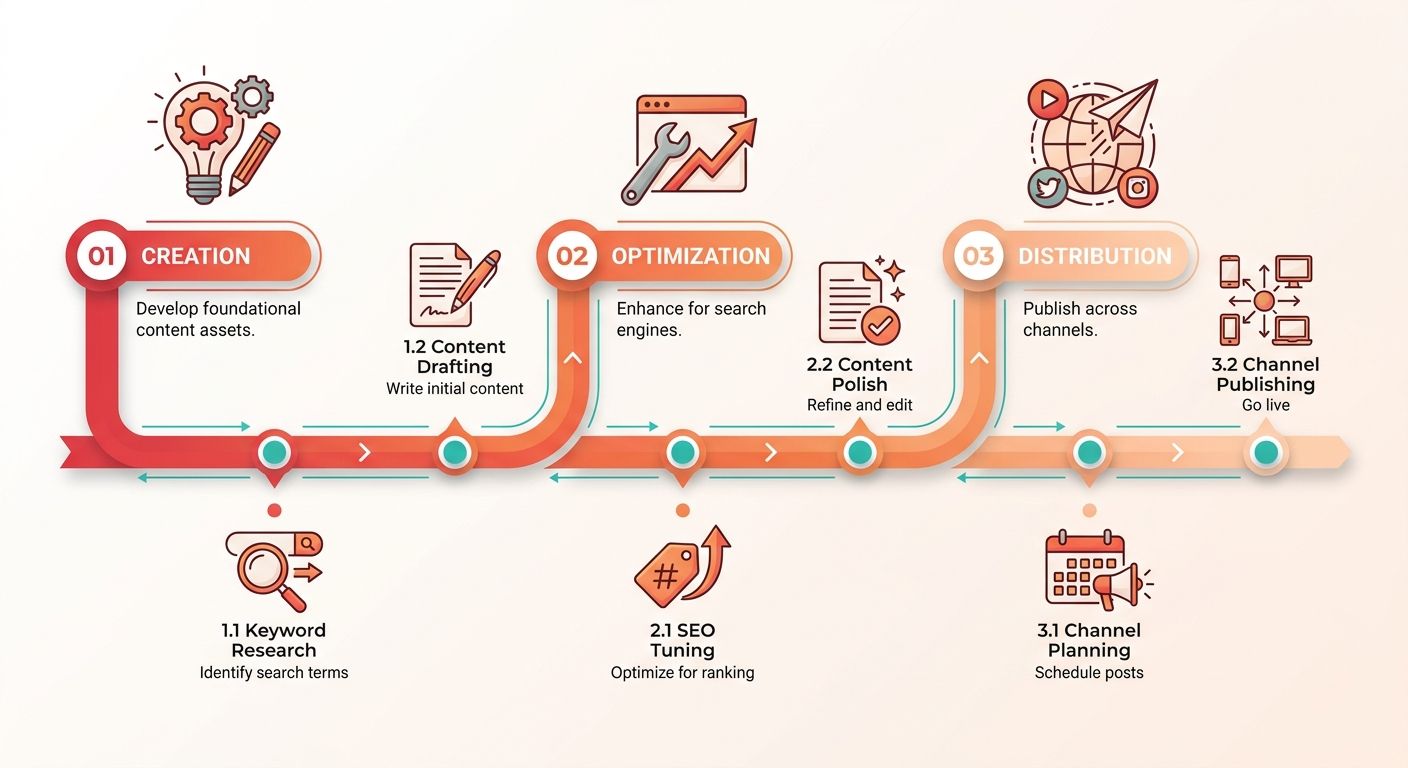
Content SEO is creating and optimizing written content so search engines rank it and readers act on it. It runs through three stages: creation, optimization, and distribution. Most marketing teams now fund it with a dedicated budget line, which puts it on the same level as the technical groundwork behind it.
The workflow starts with a page and ends with traffic. You write something worth reading, tune it so search engines understand it, then push it to the channels where your audience already hangs out.
How to create content that ranks
Good content is the foundation. It drives traffic and conversions because search engines reward pages that answer real questions well. Thin or generic content gets buried, no matter how clean the technical setup is.
Start by writing for the search intent behind a keyword. If someone searches for a how-to, give them clear steps. If they want a comparison, give them the trade-offs. The goal is a page that fully satisfies the query so the reader doesn't bounce back to the results.
Engagement matters as much as word count. Pages that hold attention signal value. Long-form articles over 3,000 words tend to earn more backlinks and shares than short posts, and that pattern holds because depth gives readers a reason to stay and a reason to cite you.
What needs optimizing on the page
Content optimization means tuning the specific elements that tell search engines what a page is about. The core targets are titles, meta descriptions, and header tags. Get these right and your pages are easier to crawl, index, and match to the right searches.
Your title tag carries the most weight. It should include the primary keyword and read like something a person wants to click. The meta description doesn't directly affect rankings, but a sharp one lifts click-through rates from the results page.
Header tags structure the page for readers and crawlers alike. One H1 for the main topic, then H2s and H3s to break content into scannable sections. This helps search engines parse the relationship between your sections and match them to the right queries.
On the technical side, internal links pass authority between your pages and help search engines find new content. A clean URL that describes the page beats a string of random characters every time.
How to distribute content after publishing
Distribution is promoting published content through channels beyond search. The main routes are social media, email marketing, and other owned or earned channels. Publishing alone isn't enough; distribution is how content reaches people before search picks it up.
Social media puts your content in front of an audience fast and earns the early engagement signals that help rankings. Email drives repeat visits from people who already trust you, and it still returns roughly $36 for every dollar spent, which makes it one of the steadier ways to build traffic that compounds.
Treat distribution as part of the workflow, not an afterthought. The same content optimized for search performs better when it also lands in feeds and inboxes. Strong on-page work plus active promotion is what turns a single page into a reliable source of organic traffic.
Analytics, reporting, and strategy
Analytics is the engine behind every smart SEO decision. You can't fix what you don't measure, and you can't prove value without data. The numbers separate a hunch from a defensible plan.
This part of the job has three moving pieces: pulling data, reporting it to stakeholders, and turning insights into a strategy that actually moves the needle.
How specialists use analytics to decide
Specialists analyze performance metrics to understand what's working and what isn't. They track traffic, engagement, and conversions, then read those numbers to spot patterns. This is where guesswork ends and strategy begins.
The data answers practical questions. Which pages bring in traffic? Where do visitors drop off? Which keywords convert and which just sit there? Performance analysis turns those answers into a to-do list.
Analytics also feeds technical audits and keyword research. When a page loses traffic, the metrics point to the cause. Maybe a competitor outranked you, or a content gap opened up. The numbers tell you where to dig.
What goes into an SEO report
A report communicates progress to stakeholders on a regular schedule. It pulls the key metrics into one place so decision-makers see exactly what the work delivered. Good reports build trust and justify the budget.
A strong report covers a few core areas:
- Traffic trends: How organic visits changed over the reporting period.
- Engagement signals: Time on page, bounce rate, and how visitors move through the site.
- Conversion data: How many visitors took the action that matters to the business.
- Ranking shifts: Which target keywords moved up or down.
Reporting isn't a formality. It's how a specialist proves the strategy is paying off and where it needs adjusting. Stakeholders fund what they can see working.
Why strategy is the piece that ties it together
Strategy is building a complete plan to drive traffic and conversions. Everything else serves it. With organic search driving roughly 53% of all website traffic, a focused strategy is what turns scattered effort into measurable gains.
A solid strategy ties keyword research, technical fixes, and content work into one direction. Without it, you get scattered tasks that don't add up. With it, every action points toward a goal you can measure.
The job doesn't stop at the first plan. Specialists track shifting search behavior and adjust their long-term plans accordingly. Algorithms update. Competitors move. A strategy that worked last quarter can stall this one, so the refinement never really ends.
This is also where budget and priorities get decided. The plan dictates how resources get split across technical fixes, content creation, and outreach.
The cycle is simple: measure, report, refine. Data shows what happened. Reports share it. Strategy decides the next move. Run that loop well, and the results compound over time.
Frequently Asked Questions
1. How long does it take to see results from SEO work?
Most websites see meaningful SEO results within 3 to 6 months of consistent effort. Search optimization compounds over time, so early gains often appear in keyword rankings before traffic and conversions climb. Brand-new sites take longer because they need indexed pages and accumulated authority before rankings can build.
2. What's the difference between an in-house and agency SEO specialist?
In-house specialists focus solely on one company's site, building deep product knowledge and tight team coordination. Agency specialists handle multiple clients, bringing broader industry exposure and varied tools. In-house roles often emphasize strategy ownership, while agencies offer scale. Compensation shifts based on which path you choose, with in-house roles often offering different bonus structures compared to agency career paths.
3. Can I do SEO myself without hiring a specialist?
You can handle basic SEO yourself if you have time to learn keyword research, on-page tuning, and technical audits. The challenge is breadth, since modern SEO spans content, links, and constant metric analysis. Modern content platforms can streamline this process by helping you draft search-friendly content that matches your brand voice, making basic optimization more accessible.
4. What qualifications should I look for when hiring an SEO specialist?
Look for someone who can translate raw data into creative content decisions while understanding how site architecture impacts crawlability. Strong candidates demonstrate a balance of technical troubleshooting and editorial oversight. Equally important is communication skill, since specialists must translate technical concepts for developers, designers, and writers to keep campaigns moving forward.
5. How often should keyword research be updated?
Keyword research should be an ongoing process, not a one-time task. Search trends shift, new terms emerge, and competitor behavior changes constantly. Effective specialists revisit their keyword lists regularly, often monthly or quarterly, to ensure content always targets what people actively search for rather than outdated demand patterns.
6. Why do my rankings drop even when I haven't changed anything?
Rankings often drop because of algorithm updates, which can reshuffle search results overnight. Competitors improving their pages, lost backlinks, or new technical issues can also cause declines. Because search algorithms evaluate hundreds of signals, ongoing monitoring and maintenance protect the gains you've built rather than treating SEO as a finished project.
7. How many backlinks does a page need to rank well?
There's no fixed number, because search engines prioritize the authority and contextual relevance of the referring domain over sheer volume. A single link from an industry-leading publication can carry more weight than numerous links from unrelated blogs. Focus on earning links that drive actual referral traffic and signal genuine trust.