
What SEO Automation Covers Now, From Content Briefs to Reporting

Key Takeaways
- Most SEO automation guides measure hours saved and rankings but ignore whether generated content preserves a consistent brand voice.
- Modern SEO automation spans the full content lifecycle, from brief generation and draft orchestration to quality assurance and unified reporting.
- Forrester's TEI study found content production times can fall by as much as two-thirds when teams adopt automation pipelines.
- Voice-consistent generation is the step most automation frameworks skip, causing brand tone to fragment across hundreds of AI-generated pages.
- Content brief automation converts keyword clusters into structured briefs containing search intent, primary and secondary keywords, and competitive context.
- The reporting layer normalizes crawl data, Search Console, and analytics into a single performance view for teams running SEO at volume.
- This automation approach suits B2B marketers and growth leaders whose output has outgrown manual review capacity, not small monthly publishers.
Why This Guide Matters
Most guides on seo automation and reporting measure the wrong thing. They count hours saved and keywords ranked, then stop. What they skip is whether the content coming off the pipeline still sounds like you.
That gap is why this guide exists. Marketing teams wire up automated briefs, drafting, and reporting every day, only to watch their brand voice fragment across a hundred AI-generated pages. This guide covers the full stack, from content briefs through automated reporting, with one thread running through it: keeping tone consistent while you scale.
What Will You Learn From This Guide?
You'll learn how modern SEO automation handles the end-to-end content lifecycle, and where voice fidelity fits into that pipeline. We cover brief generation from keyword clusters, draft orchestration, quality assurance, and the reporting layer that ties it together.
Here's what the sections ahead deliver:
- Content brief automation. How keyword clusters turn into structured briefs with search intent, primary and secondary keywords, and competitive context.
- Draft orchestration at scale. Where AI accelerates output and where a human still needs to spot-check.
- Voice-consistent generation. The step most frameworks ignore.
- Automated QA and reporting. Normalizing crawl data, Search Console, and analytics into one performance view.
Who Is This Guide For?
This guide is for B2B marketers, content strategists, and growth leaders running SEO at volume. If you're producing a handful of posts a month by hand, some of this is overkill. Come back when your output outgrows your review capacity.
The numbers explain the urgency. Forrester's TEI study highlighted that enterprise-level automation pipelines can yield significant cost avoidance by reducing reliance on external agencies. HubSpot's State of Marketing reports show AI use for content creation climbing sharply across teams. Speed matters because Ahrefs and SEMrush data both show top-10 rankings take months to years to earn, meaning early pipeline efficiency compounds over time.
But speed without voice control leaves value on the table. Semrush found that persona-based content produced a 100% increase in page views per visit. That's why a Persona Engine that crawls your entire site to build a Business Context Graph of your products, messaging, and audience matters: it keeps every article sounding like you wrote it. Voice fidelity is a multiplier stacked on top of SEO structure, and it's the one dimension most automation frameworks never address.
Guide Overview
| Detail | Info |
|---|---|
| Level | Intermediate to advanced |
| Read time | ~18 minutes |
| Best for | Teams scaling AI content past manual review |
| Skip if | You publish under a few posts a month |
| Core angle | Brand voice consistency across automated SEO content |
One tension we address head-on: should you automate the full lifecycle, or keep humans on every brief? The honest answer is both, depending on the layer. At the individual-brief level, a single wrong output causes real harm, so humans validate. At the pipeline level, automation handles throughput while your team spot-checks statistically instead of reading every piece.
That's the balance this guide teaches. For teams already thinking about connected workflows, the same principle applies across the content lifecycle: a SERP Competitor Analyzer studies the top-ranking articles and builds a winning structure you can use to take the top spot, while automation handles the throughput.
Fundamentals
SEO automation is the practice of handing repeatable content and technical tasks to software, so your team spends its time on strategy instead of manual busywork. It spans the full content lifecycle: brief generation, draft orchestration, quality checks, and the reporting layer that tells you what's working. The part most guides skip is voice, and that's where we'll spend our attention.
Here's the surprising number. Only about 1% of SEO teams run fully automated, even though roughly 87% already use AI somewhere in their stack and most tools live in the cloud. That gap isn't a tool problem. It's a workflow redesign problem. Teams bolt AI onto legacy manual steps instead of rebuilding the pipeline around seo automation and reporting from the ground up.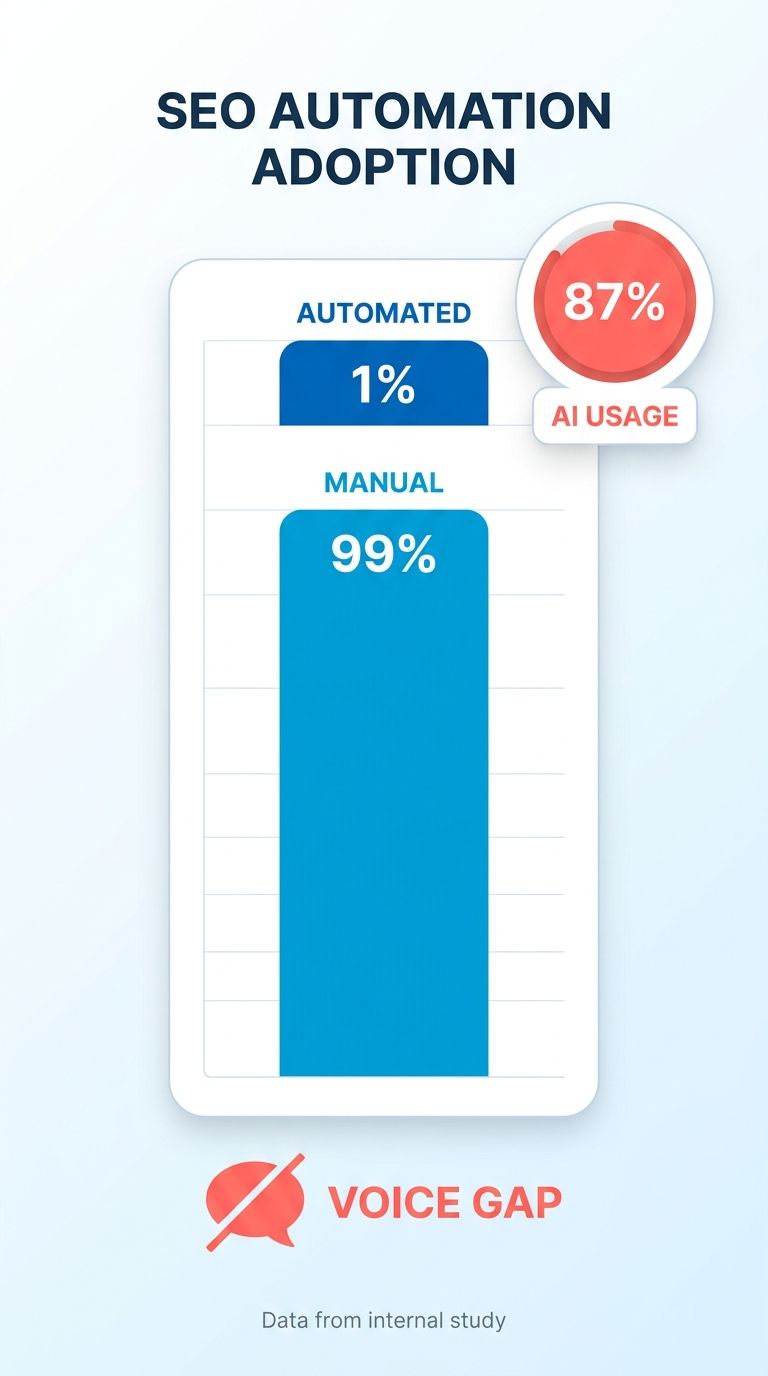
What Does SEO Automation Actually Cover?
At its widest, modern SEO automation runs four connected stages: brief creation, drafting, QA, and performance reporting. Each stage feeds the next, and the reporting layer loops signals back to the top so future briefs get smarter.
The architecture depends on clean data. A working system continuously ingests site crawl data, Google Search Console pulls, and analytics, then normalizes them into one place. Instead of a pile of disconnected tools, you want automated context extraction, taxonomy generation, SERP competitor analysis, and multi-channel production in a single dashboard. Core capabilities include automated brief generation, draft orchestration, and quality-assurance checks that flag issues before publish.
The payoff is real. Beyond simple speed, structured automation pipelines help enterprises reclaim hundreds of hours of internal coordination time, allowing senior strategists to focus on high-impact positioning rather than administrative tasks.
What Is an SEO Content Brief?
SEO content brief: a structured document that tells a writer (human or AI) the goal, search intent, keywords, word count, and internal and external links for a piece before drafting starts.
A good brief does more than list keywords. As Semrush puts it, "A good brief helps writers create content that satisfies search intent and outlines the strategy behind the content." Feed that same structure into an automation pipeline and every draft starts from the same strategic footing.
This is where persona detail earns its keep. By mapping your existing content ecosystem, modern platforms can extract your specific brand guidelines, product terminology, and target audience pain points. That ensures generated drafts align with your established editorial standards from day one. The brief encodes the keywords; the voice layer encodes how those pages actually sound.
Should You Automate the Whole Thing?
Not blindly. There's a genuine split here. One camp treats AI as an accelerant, not an autopilot, arguing a human must validate every output. The other argues full-lifecycle automation is the main lever for scaling output without losing quality.
Both are right at different altitudes. While a human editor should always sign off on high-stakes content, a modern pipeline allows you to scale up production by establishing automated guardrails. Instead of manually drafting every outline, your team shifts to a governance role—monitoring the system's overall output quality and refining the underlying prompts. Redesign your workflow so humans govern the system, not each individual draft. That's the shift most teams still haven't made.
Getting Started
Getting started takes one afternoon, not one quarter. You connect your content management system, hand the software your existing brand assets, and generate a first brief before you touch a single manual step. The setup order matters, because voice fidelity has to be locked in before you scale generation, not bolted on after.
Here's the sequence we recommend. Capture your voice first, wire up brief automation second, then turn on reporting last. Skip that order and you get fast, on-page content that sounds like a stranger wrote it.
How Do You Set Up Voice Before You Automate Anything?
Voice capture is the step that decides whether your automated content earns engagement or just fills a sitemap. Before generating anything, feed the system real examples of your writing: published posts, landing pages, your best-performing emails. This gives the automation a tonal reference to match against every draft.
Why start here? Semrush's data shows persona-aligned content produced a 900% increase in site visit duration for one B2B firm. Ensuring tonal alignment is the critical variable most automation setups leave blank. Get it wrong at setup and every downstream page inherits the flaw.
What Does First-Brief Setup Actually Involve?
A content brief is the instruction set your automation follows: primary and secondary keywords, search intent, target word count, and internal links. Manual brief creation runs 45 minutes to two hours each. AI compresses that same task to about two minutes.
Your first run should define these inputs explicitly:
- Target keyword and intent. Commercial, informational, or transactional
- Competitor outlines the tool extracts from the current top-ranking pages
- Internal linking suggestions pulled from your existing content
- Word count and heading structure aligned to search intent
- Voice profile you locked in during step one
Most teams recover the cost of their tooling within the first month through brief-creation time alone. That ROI is real and fast. Whether it stays that way depends on the next step.
Where Does Reporting Fit, and What's the Catch?
Turn on automated reporting only after your first briefs clear review. Reporting closes the loop by pulling ranking and traffic data straight from Google Search Console, so you see what changed rather than a summary of activity.
Here's the setup trap nobody warns you about. Generating 30 briefs in ten minutes sounds like pure gain, but a team that reviewed three briefs an hour now faces 30 to check. AI carries a roughly 12% inaccuracy rate, so your review burden scales right alongside your output.
Treat AI as an accelerant, not an autopilot. Design your review workflow before you flip the volume switch, because throughput without a review plan just moves the bottleneck downstream. For low-volume operations, a lightweight, semi-automated approach is often more practical than deploying a fully integrated enterprise pipeline.
Core Features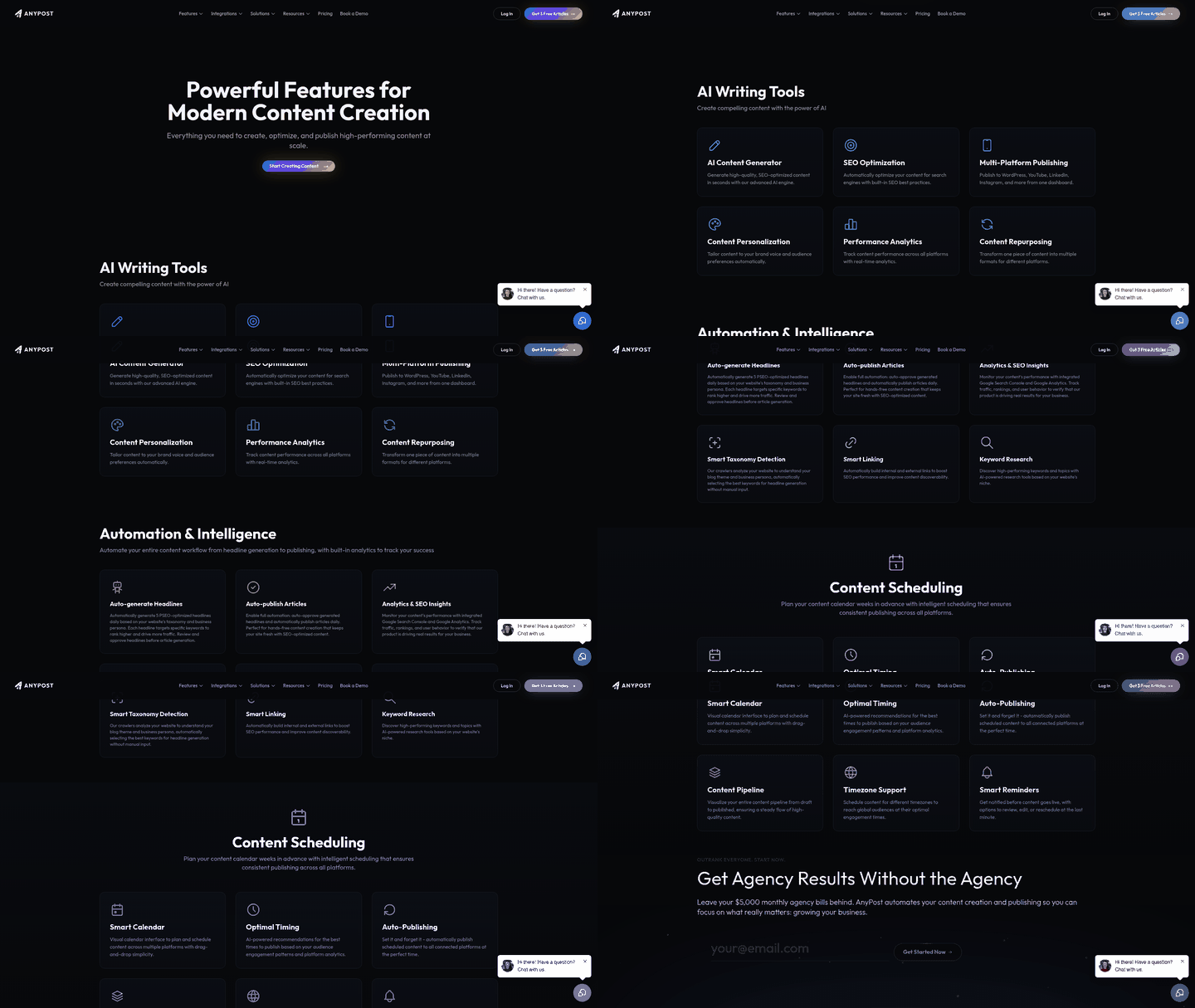
Modern automation covers four connected jobs: generating briefs, orchestrating drafts, running quality checks, and feeding a reporting layer that tells you what ranked. The features that matter most aren't the flashy ones. They're the ones that hold your brand voice steady while output scales.
We'll walk through the capabilities that define a real pipeline, then the one feature every framework we've seen still leaves out. The numbers get impressive fast, and the voice quietly falls apart if nobody's watching it.
What Can Brief Automation Actually Do?
Brief automation: software that analyzes top-ranking pages and produces a structured content outline with keywords, intent, headings, and word count in seconds. It replaces the manual research slog before writing begins.
The scaling math is what makes this stick. A single writer might complete three or four solid briefs in a working day; an automated system produces that volume before your coffee cools. At that throughput, the cost math shifts quickly. SaaS providers operate at a tenth of what traditional SEO agencies charge, and the brief-generation savings alone account for a significant share of that gap.
Under the hood, the system pulls SERP data, extracts competitor outlines, suggests internal links, and scores drafts on keyword usage, length, and metadata. As one SEO strategist put it, good tooling turns "guesswork into strategy."
Where Automation Hits Its Ceiling
Here's where sources disagree, and the split is worth your attention. One camp argues AI should be used strictly as a drafting assistant, with humans validating every output. Another argues that automating the full lifecycle is the main lever for compressing enterprise timelines. The reality is that automation excels at the heavy lifting of research and structuring, leaving humans free to focus on final polish.
This division of labor allows teams to maintain high editorial standards without sacrificing the speed advantages of automated generation.
Speed creates a new bottleneck nobody names. When generation capacity increases exponentially, the editorial queue can quickly become overwhelmed. That review queue is a workflow design problem separate from generation. Plan for it, or your throughput gains evaporate at the QA step.
Why Voice Fidelity Is the Feature Everyone Skips
Voice fidelity: the capability to keep tone, phrasing, and stylistic identity consistent across every AI-generated page, not just keyword coverage. It's the one dimension standard automation frameworks leave unaddressed.
Every efficiency metric measures time saved, keywords ranked, or traffic gained. None measure whether your content still sounds like you. That's the gap worth building around, because voice is a critical differentiator, not a nice-to-have.
The results bear it out. Sites that prioritize brand consistency alongside technical optimization see significantly higher engagement metrics. Structure gets you indexed. Voice keeps people reading, and the compounding effect shows up in the long-run numbers.
So when you evaluate features, look past the brief-generation speed everyone advertises. The capability that separates a sitemap-filler from content that converts is whether the automation preserves your register at scale. If you're weighing standalone brief tools against integrated platforms, choose based on your real bottleneck: speed alone points to point tools, end-to-end ranking outcomes point to a connected pipeline.
Advanced Topics
Once your pipeline runs, the advanced work starts. This is where automation stops being about volume and becomes about precision: matching voice to persona, tuning briefs against keyword clusters, and closing the loop between what ranked and what sounded like you.
The teams that get this right treat voice as a measurable variable, not a vibe. That's the shift most guides never make, and it's what separates a pipeline that scales cleanly from one that fragments across a hundred off-brand pages.
How Do Persona-Aligned Briefs Multiply Engagement?
Persona-aligned content is the highest-use advanced move in an automated pipeline. When briefs carry persona signals, engagement metrics like time on page and scroll depth climb because the content answers the reader's actual intent instead of a generic search query. Feed your persona into the brief, and every draft downstream inherits the right register.
Persona targeting isn't only an SEO structure play; it's a voice play. When you encode who you're speaking to into the brief, the automation produces content that sounds like it belongs to your brand and your reader at once.
Voice fidelity is a multiplier stacked on top of on-page SEO, not a separate task. The structure gets you indexed. The voice gets you read.
What Advanced Reporting Actually Tells You
Advanced SEO reporting connects to Google Analytics and Google Search Console to track performance, run site crawls, and flag technical issues automatically. Modern search engines lean on AI systems for automated reporting, so your dashboard reflects real ranking movement, not guesswork.
But the reporting layer most teams build has a blind spot. It measures traffic and rankings while staying silent on tone. You can watch a page climb and never notice it reads nothing like your last ten pages.
The advanced pattern worth pushing for starts upstream, at the brief. By embedding brand-specific guidelines directly into the generation prompts, you catch stylistic drift before the draft is even written, rather than three months later when a reader points it out. That's the optimization loop worth building.
Why Do Most Teams Hit an Automation Ceiling?
The automation ceiling is a workflow problem, not a tool problem. With 68% of automation tools now cloud-based and enterprise frameworks widely available, the technology isn't the constraint. Teams stall because they bolt AI onto legacy manual steps instead of redesigning the process around it.
Rebuilding the workflow means sequencing voice capture, brief automation, keyword clustering, and reporting into one connected flow. Skip the redesign and you get faster busywork, not real throughput. The Reddit consensus in r/seogrowth backs this: keyword clustering, SERP analysis, content briefs, and rank tracking automate well, while strategy and topical authority still need a human hand.
That division is your map. Automate the repeatable layers hard, keep a human on strategy and final voice sign-off, and the ceiling lifts. For teams also scaling off-page work, the same automation-first thinking applies to backlink automation.
One carve-out: for smaller operations, keeping the process manual ensures that every piece of content receives the direct attention of your core team without the overhead of managing complex software integrations.
Best Practices
The best practice most teams miss is simple: automate generation aggressively, but never automate the voice check. Treat AI as an accelerant, not an autopilot. That single rule keeps your pipeline from producing fast content that sounds like nobody in particular.
Here's the workflow pattern we recommend. Let the machine handle throughput. Keep humans on the two things machines can't judge well: factual accuracy and brand voice. Everything else in the reporting loop can run unattended once you've tuned it.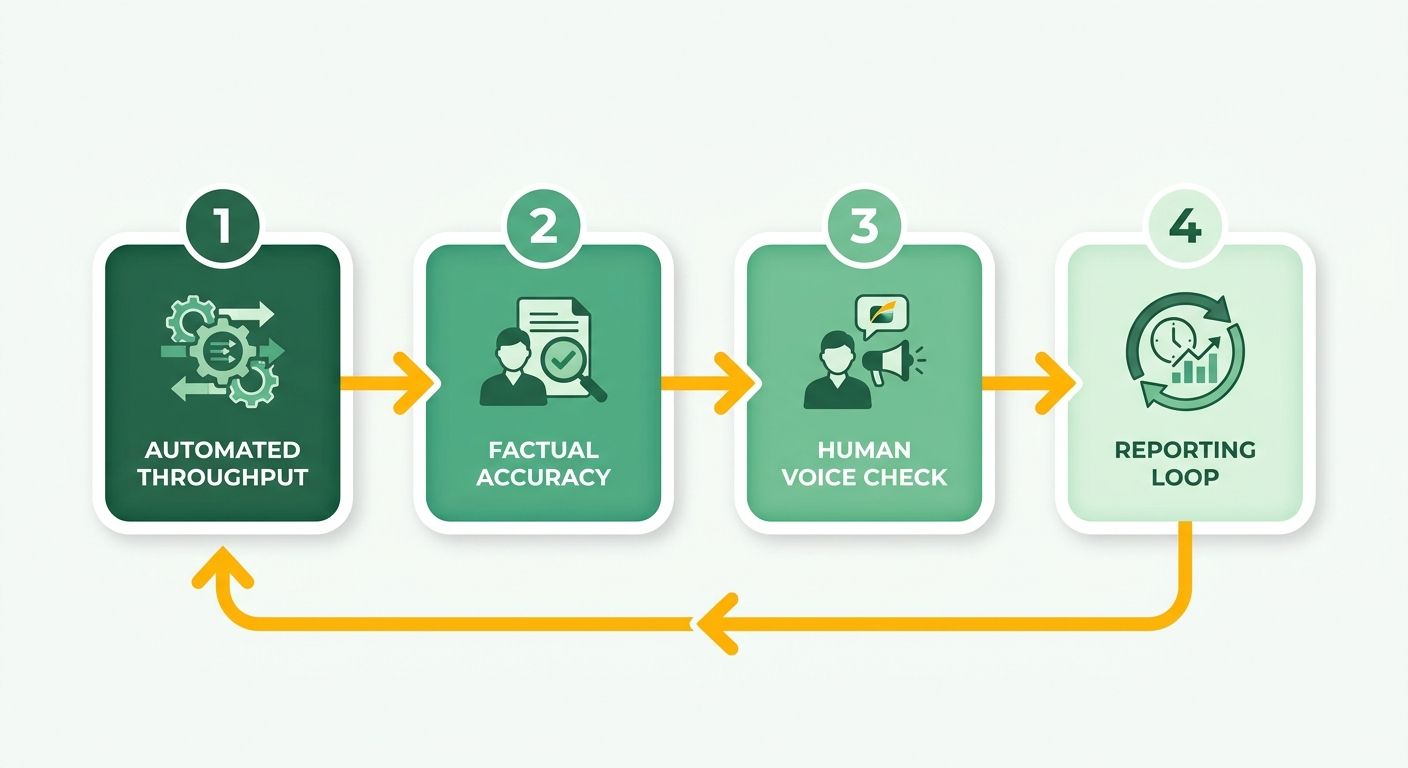
How Do You Balance Automation Speed Against Review Load?
Speed creates its own problem. When brief creation drops from hours to minutes, you don't just save time. You shift the bottleneck downstream to review.
The generation got faster; the checking didn't. This compounding review load is a workflow design problem, not a tool problem.
One practical approach is to prioritize by stakes rather than reviewing everything equally. High-impact landing pages and core product articles should always get human eyes, while top-of-funnel informational posts can be sampled statistically. Review a percentage of your high-volume output, watch the error patterns, and tighten your prompts when a category of mistakes repeats.
This tiered approach balances quality control with operational speed, ensuring your team's editing time is spent where it matters most.
What Voice-Consistency Checks Belong in the Pipeline?
Voice fidelity is the variable every efficiency metric ignores. Sources measure hours saved, keywords ranked, and traffic gained. None measure whether a hundred AI pages still sound like the same brand. That gap is where content-farm output comes from.
This is where feeding the system your real brand examples matters. By analyzing your existing high-performing content, the system can replicate your specific stylistic nuances, keeping voice consistent across formats before anything publishes.
The payoff justifies the extra attention. A consistent brand voice across platforms is one of the outcomes modern systems are built to deliver, alongside higher engagement rates and more qualified leads. Voice isn't decoration. It's a critical layer stacked on top of your on-page SEO structure.
Where Do the Efficiency Gains Actually Go?
Watch where the savings land, because it signals your competitive position. Reclaiming hours from the production cycle represents a significant operational return on investment.
Here's the honest read on the money. Only 4% of agencies have cut prices while 55% deliver more work for the same fee. The savings are getting captured as margin, not passed to clients. That works until a competitor decides to compete on price, and then it's a race to the bottom. Spend the reclaimed time on voice and strategy, the two things automation can't replicate, rather than banking it all as margin.
For low-volume publishers, a lighter touch is better. A manual workflow assisted by basic AI tools often yields better results than trying to force-fit a complex enterprise pipeline.
Comparison with Alternatives
When you weigh automation against the alternatives, the real question isn't which tool ranks fastest. It's which approach keeps your brand voice intact while it scales. Most comparisons skip that entirely.
Your three main options are standalone brief tools, integrated all-in-one platforms, and staying fully manual. Each solves a different bottleneck. We'll break down when each wins, and where voice consistency quietly makes or breaks the decision.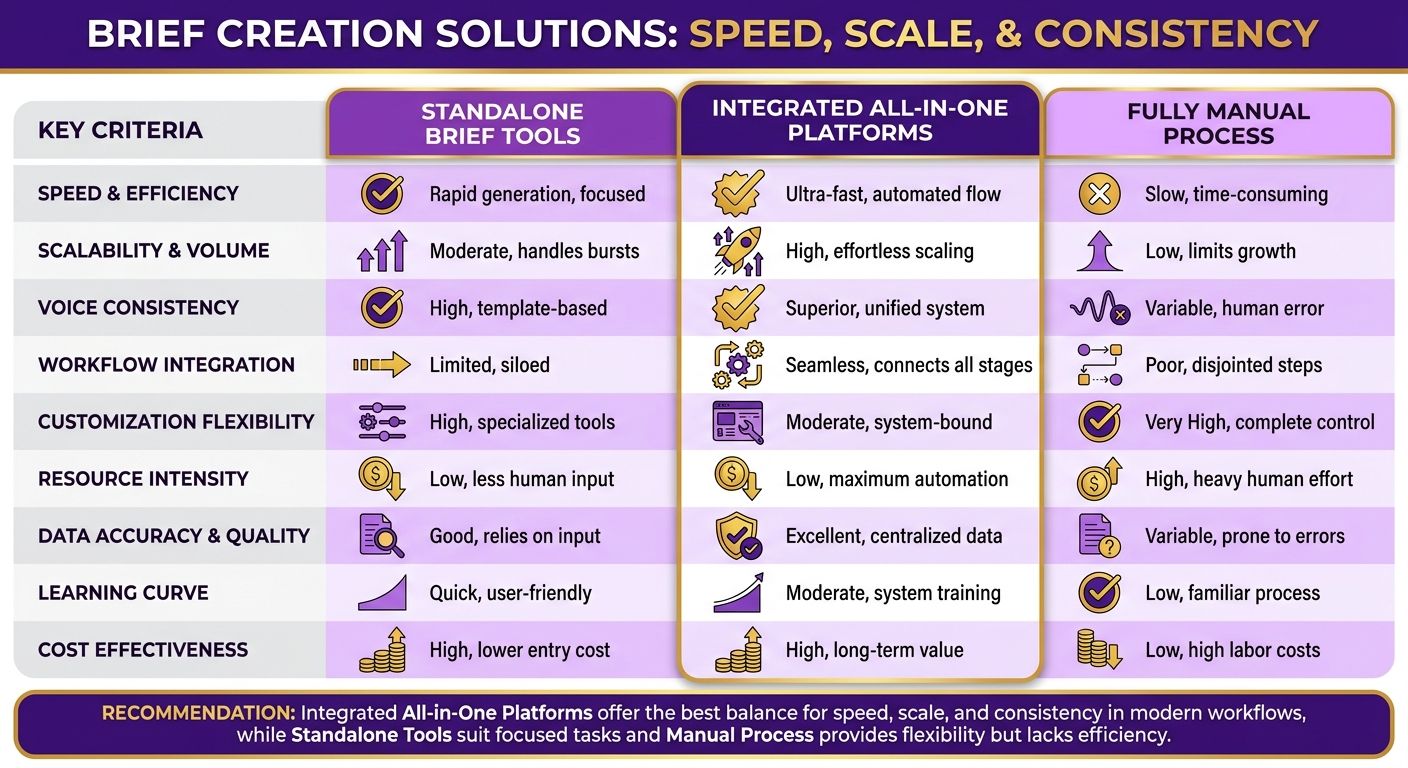
Standalone Brief Tools vs. Integrated Platforms: Which Wins?
Standalone brief tools win when brief creation is your only bottleneck. Integrated platforms win when you need end-to-end ranking outcomes across technical, local, and content work. The sources disagree on this, and the split is instructive.
One camp argues standalone brief tools are enough. Personal testing showed these tools cut content planning time in half, generating structured outlines from SERP analysis in minutes. If your team writes well but plans slowly, that's a fast, cheap fix. Entry pricing starts around $30/month.
The other camp pushes back, arguing that tools covering all SEO needs beat standalone brief generators, because brief quality alone can't explain traffic results. The case data backs the point: one orthodontics practice hit a 472% organic traffic jump, and a rehab facility ranked over 1,400 keywords in the top three positions using an integrated platform priced from $99 to $399/month.
Both are right, at different stages. Standalone tools fix a planning gap. Integrated platforms fix a ranking gap. But neither camp measures whether the output preserves your unique brand identity.
When Should You Stay Manual?
Stay manual when you publish fewer than a handful of pages a month and voice lives in one writer's head. Automation's efficiency gains don't pay off at low volume, and a single author holds tone naturally without any system.
The numbers favor automation once you scale, though. Over 70% of marketers report improved efficiency after automating, and automation saves up to 30% of time on manual tasks. One agency cut brief time by half; another lifted reporting accuracy by 40% while killing manual errors. Skip automation past a certain volume and you're paying a tax for no benefit.
Here's the carve-out most guides won't state. High efficiency and full automation are different thresholds. Tool-assisted work is common. Truly autonomous workflows are rare. Don't confuse "we use AI" with "our pipeline runs itself."
What Do Alternatives Miss on Voice?
Every alternative treats voice as an afterthought. That's the gap. Standalone tools structure your brief. Integrated platforms chase rankings. Manual work protects tone but caps your output. None bakes brand voice into the pipeline at scale.
By integrating brand voice directly into the generation layer, you ensure that brand alignment compounds instead of trading off. That's the comparison point no alternative advertises, and the one that decides whether automated content earns engagement or just fills a sitemap.
Resources and Tools
The tools that matter for automation fall into three buckets: brief generators, quality-check layers, and reporting integrations. You don't need all of them on day one. You need the ones that fit your actual bottleneck, plus one voice-check step nobody's tool sells you by default.
Here's the honest split before you spend anything. Standalone brief tools speed up one job. Integrated platforms chase end-to-end ranking. Which you pick depends on where your pipeline chokes, and we'll show you how to tell.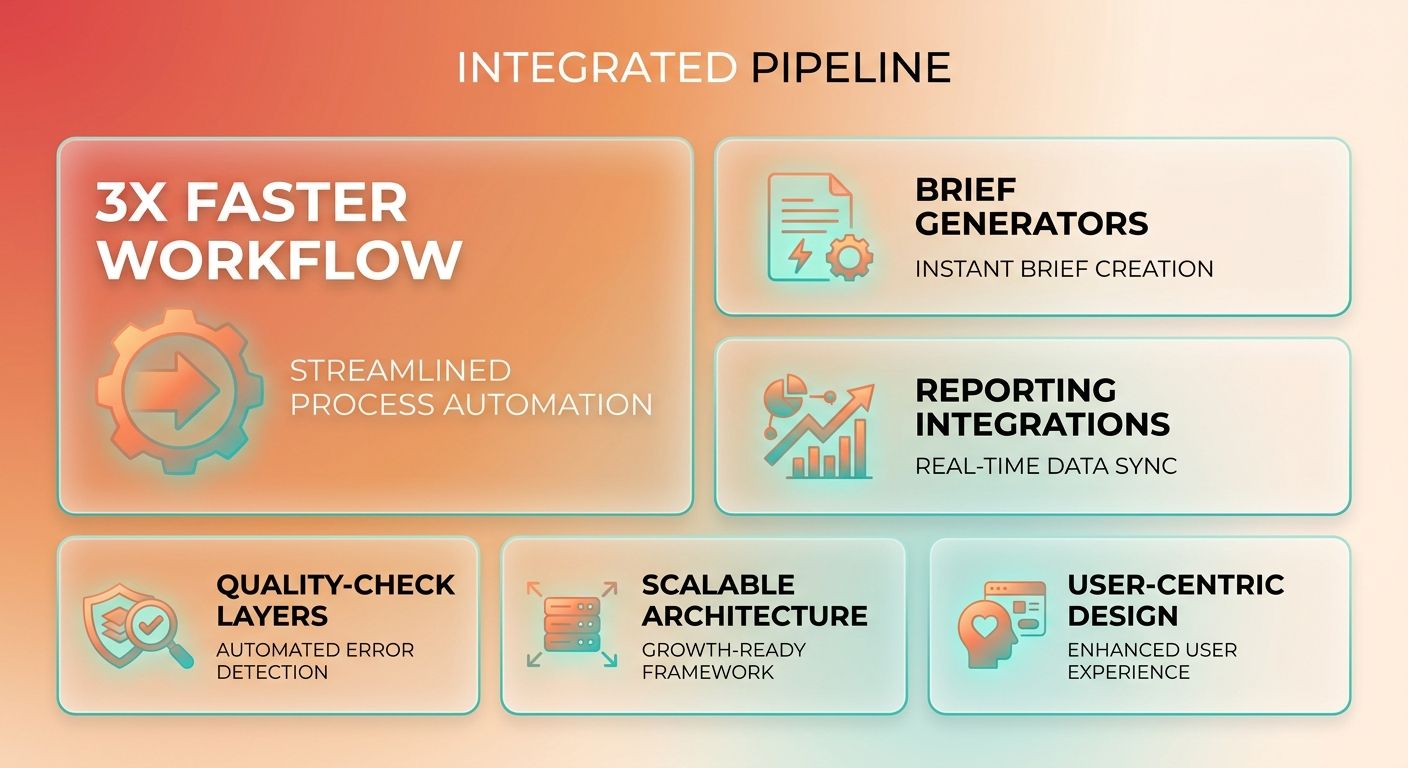
What Tools Handle Brief Generation and Reporting?
Brief-generation tools analyze top-ranking pages and hand you a structured outline with keywords, headings, and word count in seconds. Reporting integrations pull from analytics and search-console data to track what those pages actually did. Together they cover the two ends of the pipeline.
The speed is real. Automated brief tools can cut content-planning time in half, which turns guesswork into a repeatable strategy for writers and strategists.
Watch the integration surface before pricing, though. A tool that exports to Google Docs and pushes straight into your CMS saves more hours than one with a slightly richer keyword model but no API. Around 65% of marketers now run at least one automated SEO workflow, and the ones who see returns picked tools that fit an existing stack rather than forcing a new one. Cloud-based tools dominate this category, so most plug in without a migration.
On the reporting side, automation tools connect to analytics and search-console data to handle site crawls, performance tracking, and technical-issue monitoring without manual pulls. That's the layer that closes the loop between what you published and what ranked.
What Common Issues Break an Automated Pipeline?
The biggest issue is the review bottleneck. When generation speed increases, the editorial team faces a sudden surge of drafts to approve. Speed doesn't vanish; it moves downstream to quality assurance. Budget review capacity as deliberately as you budget generation.
The second issue is voice drift. Every efficiency metric across the research measures time saved, keywords ranked, or traffic gained. None measures whether your content remains cohesive at scale. That's the gap we keep flagging, and it's not academic.
Consider the multiplier. Content that reads as generic sees measurably higher bounce, and one study tied consistent brand voice to a 23% lift in revenue across touchpoints. If voice fidelity is what makes content land, then skipping the voice check doesn't just risk tone. It forfeits real engagement.
Run generation aggressively and gate every draft through a voice check tied to your captured brand assets. That's the one debugging step no brief tool ships with, and it's where voice-centric automation earns its place.
Where Should You Go Next?
Start with the bottleneck you can name. If brief speed is your only pain, a standalone generator clears it fast. If off-brand pages and flat engagement are the problem, a voice-aware pipeline is the fix.
For deeper reading on scaling the content side, look for platforms that apply a generate-then-verify pattern to tone matching, ensuring your brand guidelines are systematically enforced.
Next step: capture your voice, wire one brief tool, connect reporting, then measure engagement, not just rankings. That order keeps output fast and on-brand.
Frequently Asked Questions
1. Can I automate SEO content if I only publish a few posts a month?
If you only publish a few posts a month, focus on deep, highly customized content. At this scale, the overhead of setting up and maintaining automated pipelines outweighs the time saved. Instead, use basic AI tools for keyword research, but keep drafting and editing fully manual to ensure depth and personalization.
2. How accurate is AI-generated SEO content, and how much checking does it need?
AI-generated drafts require systematic quality assurance to catch factual errors, hallucinated statistics, or broken links. To manage this without slowing down, establish a clear QA checklist for your editors. Focus human review on verifying proprietary data, quotes, and brand-specific claims, while using automated tools to scan for basic formatting and SEO compliance.
3. What order should I set up an automation pipeline in?
Begin by establishing your brand's digital footprint within the platform's settings, uploading style guides and top-performing articles. Once the system understands your tone, integrate your keyword research tools to start generating structured briefs. Finally, connect your CMS and analytics platforms to automate the publishing and performance-tracking loops.
4. Why do most teams stall despite having automation tools?
Most teams stall because they try to force new AI capabilities into old, linear editorial processes. To break through this ceiling, teams must shift from a 'writer-first' mindset to a 'system-editor' mindset. This involves training your team to manage the automation pipeline itself—optimizing prompts and templates—rather than spending hours rewriting individual sentences.
5. Is a standalone brief tool enough, or do I need an integrated platform?
If you have a dedicated SEO strategist who prefers to hand-craft campaigns using a variety of specialized tools, standalone brief generators offer a cost-effective way to speed up research. However, if you are a lean marketing team looking to scale organic traffic without hiring additional headcount, an integrated platform provides the necessary automation to handle everything from research to publishing in one place.
6. Where do the time savings from SEO automation usually end up?
For in-house teams, the time saved should be reinvested into high-leverage activities that AI cannot perform. This includes conducting original research, interviewing internal subject matter experts, building relationships for digital PR, and refining your overall content strategy to target high-intent buyer personas.
7. Does persona targeting actually change content performance?
Yes. When content is tailored to a specific persona, it addresses their unique pain points, industry jargon, and decision-making criteria. This relevance builds immediate trust, encouraging readers to explore your site further, download resources, and engage with your product offerings, ultimately converting passive search traffic into qualified leads.