
What Tools Can I Use to Analyze Prompt Volume Trends for Geo-Specific AI Content Queries

Key Takeaways
- More searches now start as questions in ChatGPT or Perplexity than Google. This shift changes content planning.
- Prompt volume estimates monthly AI questions about a topic. It replaces keyword search volume as a demand signal.
- Over 80% of AI prompts are unique. Exact-match tracking therefore misses much of generative-search demand.
- Analytics platforms group prompts into broader intents. They use demographically weighted user panels for geo-level analysis.
- Every prompt volume number is modeled, not counted. Platforms do not publish their query logs.
- Content marketers, SEO specialists, and multi-location businesses benefit most from regional prompt tracking.
- Regional tracking reveals rising local questions before competitors notice them. It also supports better coverage of revenue queries.
Why Prompt Volume Is the Demand Signal You're Missing
Search is moving inside AI systems. More interactions now start with questions in ChatGPT or Perplexity instead of Google. That shift explains why teams ask which tools analyze geo-specific AI prompt trends. The answer affects content planning for every city you serve.
Prompt volume is the new demand signal. It estimates how often people ask AI tools about a topic each month. It replaces the keyword search volume marketers used for years. Regional tracking shows which local questions are gaining interest before competitors notice them. For local businesses, this means less guesswork and faster coverage of revenue-driving queries.
Why Prompt Volume Beats Keyword Data
Over 80% of AI prompts are unique. Exact-match tracking therefore misses much of the real demand. Newer analytics platforms group prompts into broader intents instead of tracking exact phrases. They use demographically weighted panels of internet users.
This clustering makes geo-level analysis possible. You can watch "sustainable luxury SUVs" rise while "performance luxury SUVs" stays flat. You can then compare that shift across your own markets.
Here's the limitation. Every prompt volume figure is modeled, not counted. AI platforms do not share their query logs. Treat the data as a prioritization signal, not gospel. It offers useful direction on generative-search demand, but it is not precise.
Who Gets the Most Out of It
Content marketers, SEO specialists, and multi-location businesses benefit most. Research suggests that tracking fewer than 20 core prompts can miss visibility opportunities. Some B2B SaaS teams track roughly 150 high-priority queries at scale.
That gap reflects different levels of maturity. Start with about 20 prompts per market. Expand the list as you learn which local questions convert.
An automated content engine can support this workflow. AnyPost.ai combines SEO-optimized publishing with multi-source content integration. It produces articles that match how people phrase questions and reduces manual work across locations. The content analytics tooling behind this reads demand signals and drafts content in your voice.
| Tool | Data method | Geo-specific support | Setup effort | Difficulty | Best for |
|---|---|---|---|---|---|
| AnyPost.ai | Automated SEO content generation, multi-platform publishing | Via content integration | Low | Easy | Local businesses automating output |
| Frase | SEO + AI visibility monitoring | Query-list based | Medium | Moderate | Content gap analysis |
One practitioner note matters before you begin. ChatGPT prompts average 96 words, while Perplexity prompts average 44. City pages therefore need conversational answers and concise FAQ blocks.
The Three Platforms Doing the Actual Work
Three platforms commonly support geo-specific prompt analysis. GetCito and Evertune track prompt volume across AI systems. AnyPost.ai handles the next step: generating voice-matched articles and publishing them across your chosen channels.
Their data methods differ. Evertune extrapolates from a panel of 25 million active internet users. It treats that panel as a representative sample of real-world behavior. GetCito processes over 62 million user queries. It groups them into roughly 1.4 million distinct topics to map broader demand.
These methods provide different views of the same problem. Both can support local planning.
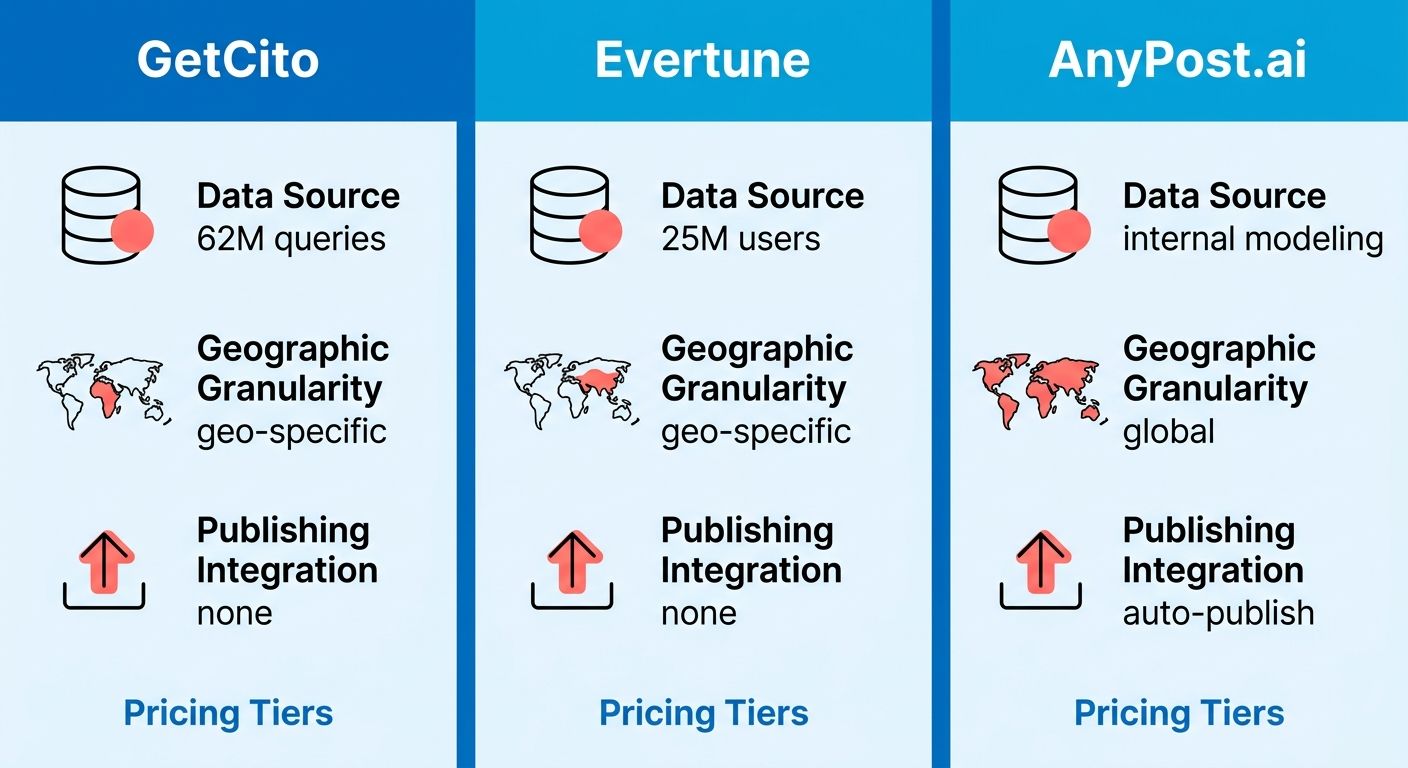
GetCito: Clustering That Shows Total Demand
GetCito works with topic clusters instead of exact keyword matches. Its engine groups semantically related queries under one demand signal. This shows total market interest instead of fragmented phrase-level data.
That approach helps when you enter a new city. You can see whether "plumber near downtown Austin" and "emergency pipe repair Austin TX" share one demand pool. You can also determine whether they represent separate intents.
That distinction affects how many pages you build. GetCito also surfaces temporal patterns. These include summer HVAC spikes and weekend restaurant-prompt surges. You can use those patterns to time content launches.
The tradeoff is significant. GetCito's estimates can differ greatly from actual counts. Use it for planning, not reporting.
Evertune: A Weighted Panel of Real Behavior
Evertune's panel captures user behavior across ChatGPT, Gemini, Perplexity, and Copilot. It tracks 25 million users and weights the sample demographically. This provides a representative market slice instead of an early-adopter sample.
Search a topic, and Evertune returns estimated monthly prompt volume. It also provides a trendline that shows changes before traditional research does.
The platform-specific insights support local content planning. Median query length is about 19 words on ChatGPT and 14 to 15 words on Perplexity. These figures show how users structure questions on each assistant.
Short answers work well on Perplexity. Longer, conversational responses fit ChatGPT. Evertune also maps related topics. A search for "electric bikes" can surface "folding electric bikes" with its own volume estimate. This helps identify topics that deserve dedicated pages.
The limitation is city-level sample size. A 25-million-user panel is strong nationally. However, smaller metros may have insufficient local samples. Cross-reference those directional signals with manual testing.
AnyPost.ai: Research Turned Into Published Pages
AnyPost.ai connects demand research with published content. After you identify important topics, it generates SEO-optimized articles in your brand's voice. It can auto-publish them to WordPress, LinkedIn, X, and more.
The Persona Engine matches your tone. A Business Context Graph crawls your site and keeps content aligned with your products, messaging, and audience.
Built-in SEO work includes search-intent headings, semantic HTML, and relevant links and media. Each article is prepared for traditional search and AI answer engines. Real-time analytics track performance, helping you identify content that drives traffic and leads.
| Tool | Methodology | Strengths | Limitations | Best For |
|---|---|---|---|---|
| GetCito | Clustering 62M+ queries into 1.4M topics | Shows total demand for a concept, not just one phrase | Estimates vary significantly from actual counts | Teams entering new markets who need broad demand signals |
| Evertune | 25M-user panel tracking real behavior | Platform-specific insights; trendlines reveal shifts early | Local sample sizes may be insufficient for smaller cities | Multi-platform content strategies requiring prompt-length optimization |
| AnyPost.ai | Automated generation and publishing of SEO content in your voice | Ready-to-rank articles auto-published across channels with brand-voice matching | Works best once you've identified target topics from research | Marketers who want to turn a content plan into published, on-brand articles |
A Closer Look at Evertune Prompt Volumes
Evertune Prompt Volumes estimates monthly questions about brands, topics, or categories. It then plots those queries as trendlines over time. For geo-specific analysis, it uses a large behavioral panel rather than pure guesswork.
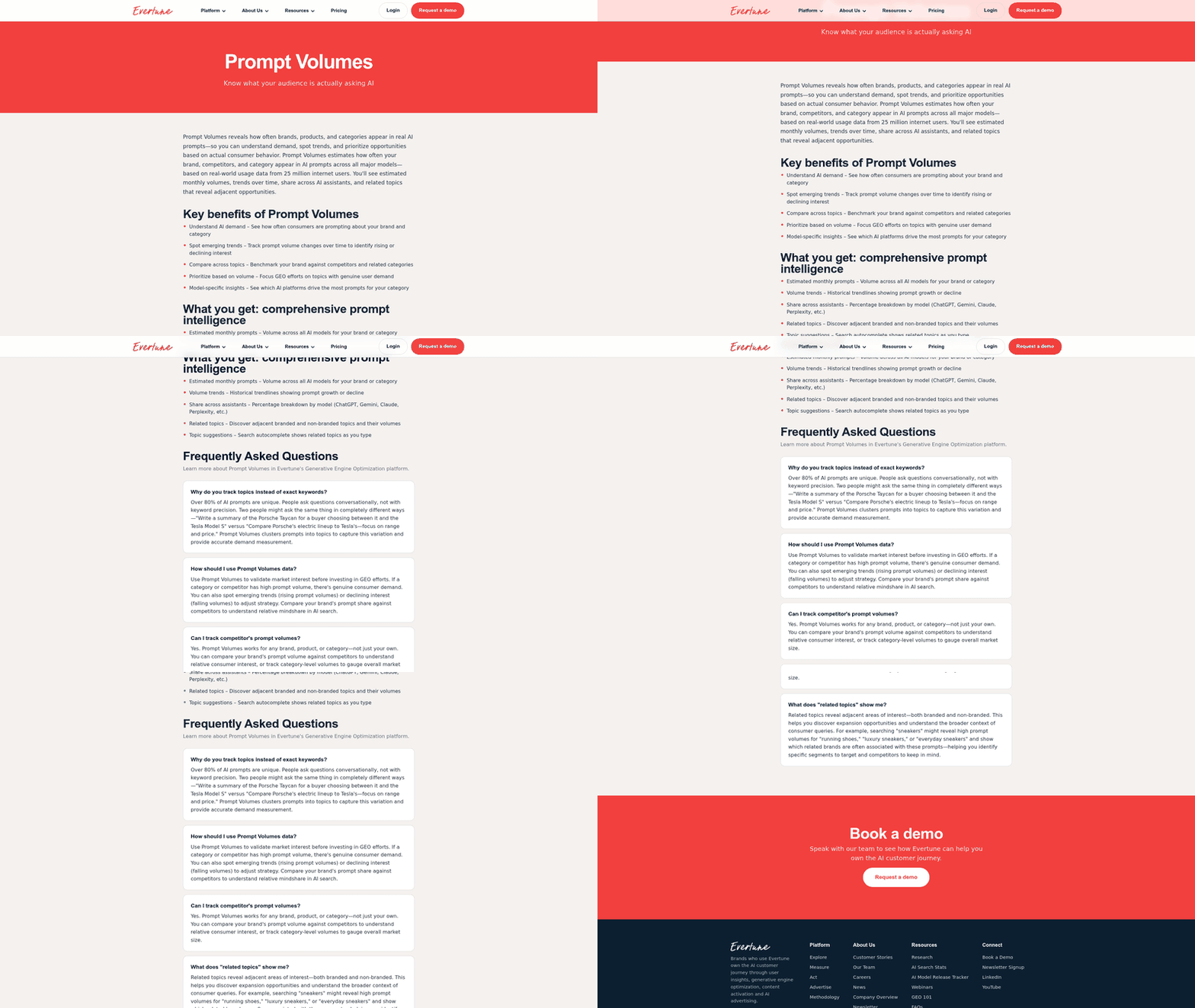
You can track brand mentions alongside broader category queries. This shows brand share of voice inside AI models. It also supports comparisons with local competitors.
How Evertune Estimates Prompt Volume
The panel reflects diverse user demographics. Captured queries therefore represent a balanced cross-section instead of a technology-heavy sample. This matters because early-adopter bias can distort AI usage data.
Local samples are thinner in smaller metros. The trendline across several months usually matters more than one month's number. A longer view smooths anomalies and shows whether interest is sustained.
The trendline provides the main value. As the Evertune team puts it:
"The trendline visualization shows topic popularity over time, revealing shifts in consumer interests before traditional market research does."
What You Can Actually Do With It
You can identify demand shifts and reprioritize content before competitors notice them. When one topic rises while a related topic stays flat, local interest may be changing.
Tracking "remote IT support" against "on-premise IT support" may show growth in the remote term. City-level variants provide the same view of local demand.
User behavior differs across AI engines. Your city pages therefore need concise FAQ answers for Perplexity. They also need longer, conversational passages for ChatGPT.
The Persona Engine keeps your brand voice consistent across both formats. You can change tone and structure without making the content sound like it came from different writers.
Quick Comparison
| Tool | Method | Best for | Watch-out |
|---|---|---|---|
| Evertune Prompt Volumes | Panel-based behavioral tracking, intent clustering | Spotting emerging trends before they peak | Public pricing isn't listed; absolute numbers thin out for small geos |
| AnyPost.ai | Multi-source content integration, automated SEO-optimized publishing | Scaling content creation with consistent brand voice | Works best when you have clear target keywords and topics identified |
Skip Evertune if you need only one or two pages per quarter. Its strength is trend monitoring at scale. That value decreases when you cannot act on the findings quickly.
How Well These Tools Actually Geotarget
The platforms differ in geographic detail.
Most model prompt demand at a national or category level first. They then divide it by region or language. Accuracy becomes less certain during that second step. Local sample sizes shrink quickly, so city estimates contain more noise than national estimates.
Treat city-level figures as directional. Confirm the trend before committing to a content calendar.
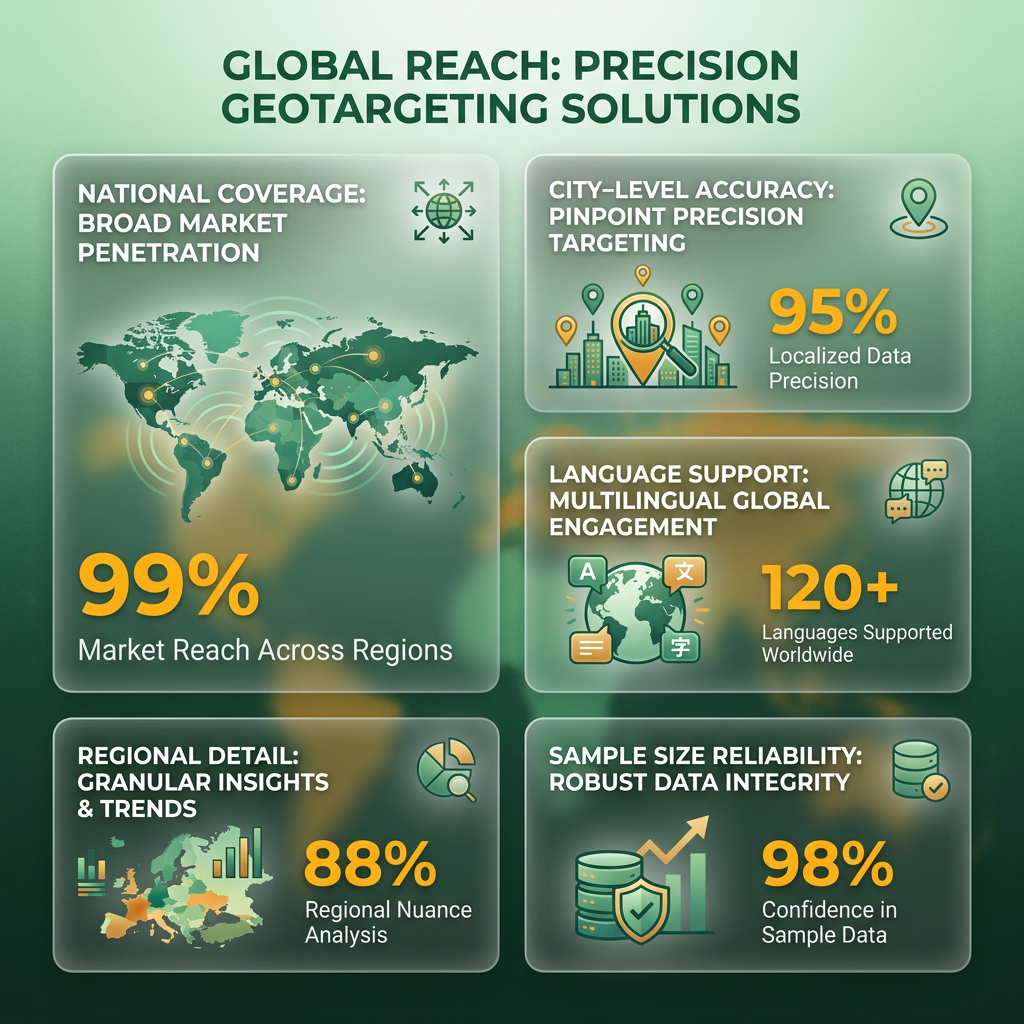
Geotargeting, Tool by Tool
| Tool | Geo capability | Key strength | Pros / Cons |
|---|---|---|---|
| GetCito | Slices topic-level demand by region and language | Topic-clustering model for directional trends | Pro: strong for spotting regional shifts. Con: estimates only, no auto-publishing |
| Evertune | Regional and platform-specific insights from a weighted panel | Captures real behavior from a user sample | Pro: grounded in actual usage. Con: thins out at the city level |
| AnyPost.ai | Surfaces low-difficulty, high-intent keywords, then drafts and publishes in your voice | End-to-end: research to published article | Pro: no manual keyword research per topic. Con: focused on content workflow, not raw geo modeling |
Where Geo Estimates Get Thin, and How to Validate Them
The margin of error rises as the target population shrinks. A major-metro trend may look large, while a mid-sized city appears flat. The difference may reflect limited local data.
Cross-reference a panel-derived regional estimate with a clustering model. If both support a local trend in Seattle versus Portland, it is reasonable to build on. If they disagree, wait for more data.
Your tracking footprint should match your campaign scope. A single-location business can track a short list of local queries. Multi-region operators need a broader matrix to capture regional differences.
Turning Keyword Research Into Published Articles
AnyPost.ai automates the path from keyword discovery to live content. The SERP Competitor Analyzer reviews current rankings for target queries. It then shapes an article structure for traditional search and AI answer engines.
This workflow helps businesses managing many locations. Instead of building research lists manually, you let the system review the competitive landscape. It then shapes the article structure.
The content answers real conversational prompts. This supports citations inside AI answers instead of links buried in lists.
The service depends on the quality of its inputs. For one storefront in one metro, manual research may be cheaper. The value increases when you cover ten or fifty cities. At that scale, real-time analytics connect market demand with published content.
Validating Prompt Volume: Cross-Checking Before You Commit
Relying on one data source creates risk. Before building a content calendar, confirm that a rising trend reflects market demand. It may instead be an anomaly in one dataset.
Use triangulation. Compare one tool's estimate with a different data method. Confirm the trend's direction instead of its exact count. Prompt volume is a directional view of generative-search demand, not a precise headcount.
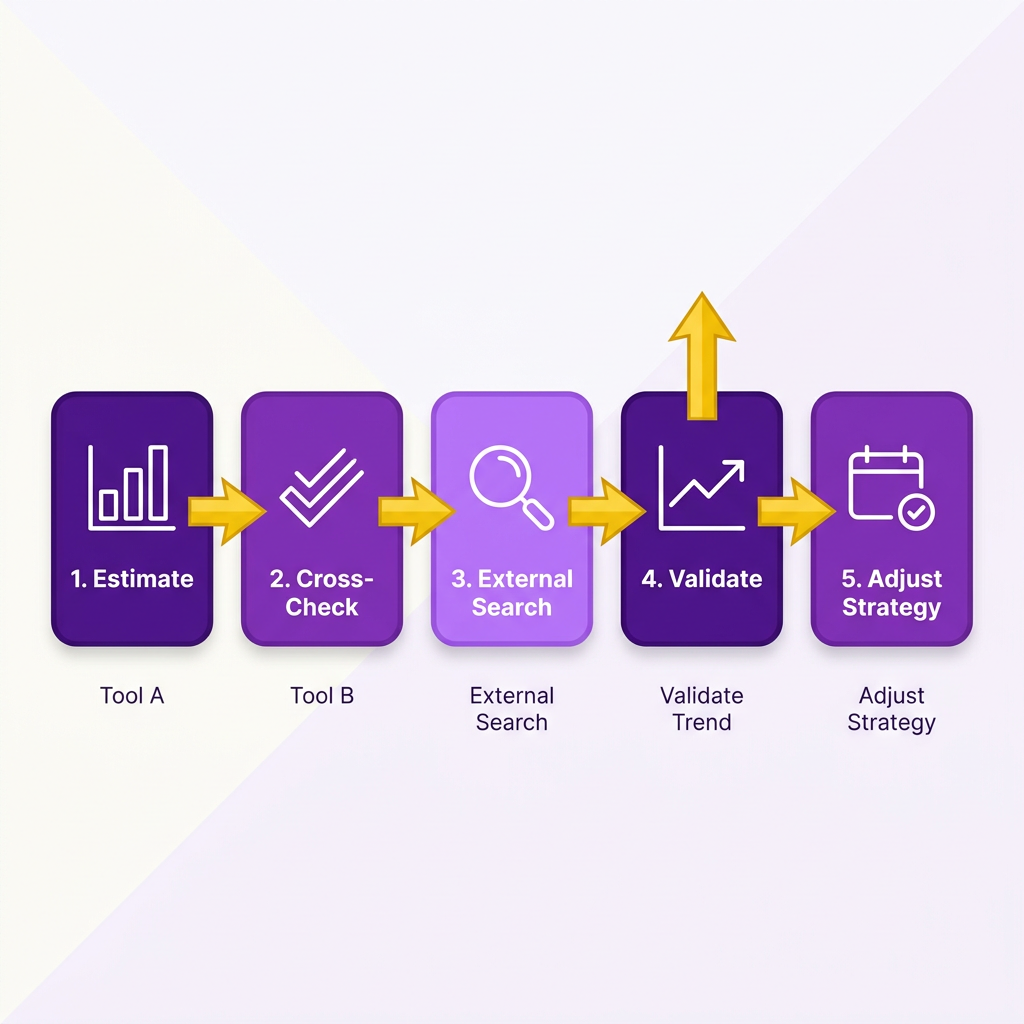
How to Cross-Check an Estimate
Compare target-topic trajectories across different models. When a panel trendline matches a query-clustering trendline, you have stronger support for creating content. When they diverge, the local sample may be too volatile for a major investment.
This matters most for city-level queries. National estimates smooth out noise. Neighborhood estimates amplify it. When independent methods disagree on a small geographic area, treat the topic as unproven. Wait for another data point before publishing.
Can Traditional Search Volume Validate AI Prompt Data?
Yes, as a sanity check. Google Keyword Planner and tools such as Semrush expose traditional search demand. A query like "What is a CRM?" with 14,800 monthly searches confirms interest in the topic. A near-dead term like "Hubspot alternative" with 260 searches may indicate inflated AI prompt estimates.
Keyword volume and prompt volume reflect different user mindsets. Traditional search data confirms baseline interest. It does not capture the conversational phrasing common in generative AI prompts.
What About Intent and Follow-Up Behavior?
Check whether a topic attracts one-time questions or multi-turn conversations. A commercial prompt like "best CRM for small business" usually resolves in one answer. A compact comparison table may fit that intent.
An exploratory prompt like "how do I set up a sales pipeline" may generate three or four follow-ups. A step-by-step guide with linked sub-answers fits better.
Match the page's depth to the conversation's depth. Review sample queries in your tool before choosing a format.
| Validation method | Best for | Key features | Pros / Cons |
|---|---|---|---|
| Panel vs. Clustering cross-check | Confirming geo trend direction | Two independent models, trendline overlay | Pro: catches thin-sample noise. Con: needs two paid tools |
| Traditional search volume sanity check | Confirming baseline topic demand | Localized volume, competition data | Pro: cheap, familiar. Con: doesn't map AI phrasing |
| Intent and follow-up matching | Format validation before publishing | Single-shot vs. Multi-turn signals | Pro: sharpens on-page fit. Con: manual to track |
After a trend clears validation, publish quickly. AnyPost.ai moves validated data into live, search-optimized articles. This reduces time to market for local campaigns.
Turning Prompt Data Into a Geo Content Strategy
Prompt volume matters only when it guides publishing. Pull demand signals for each city you serve. Group them by the questions locals ask. Then build pages using their language.
The harder step is turning those numbers into ranked, published pages. AnyPost.ai supports that process by generating articles and publishing them to your CMS and social channels.
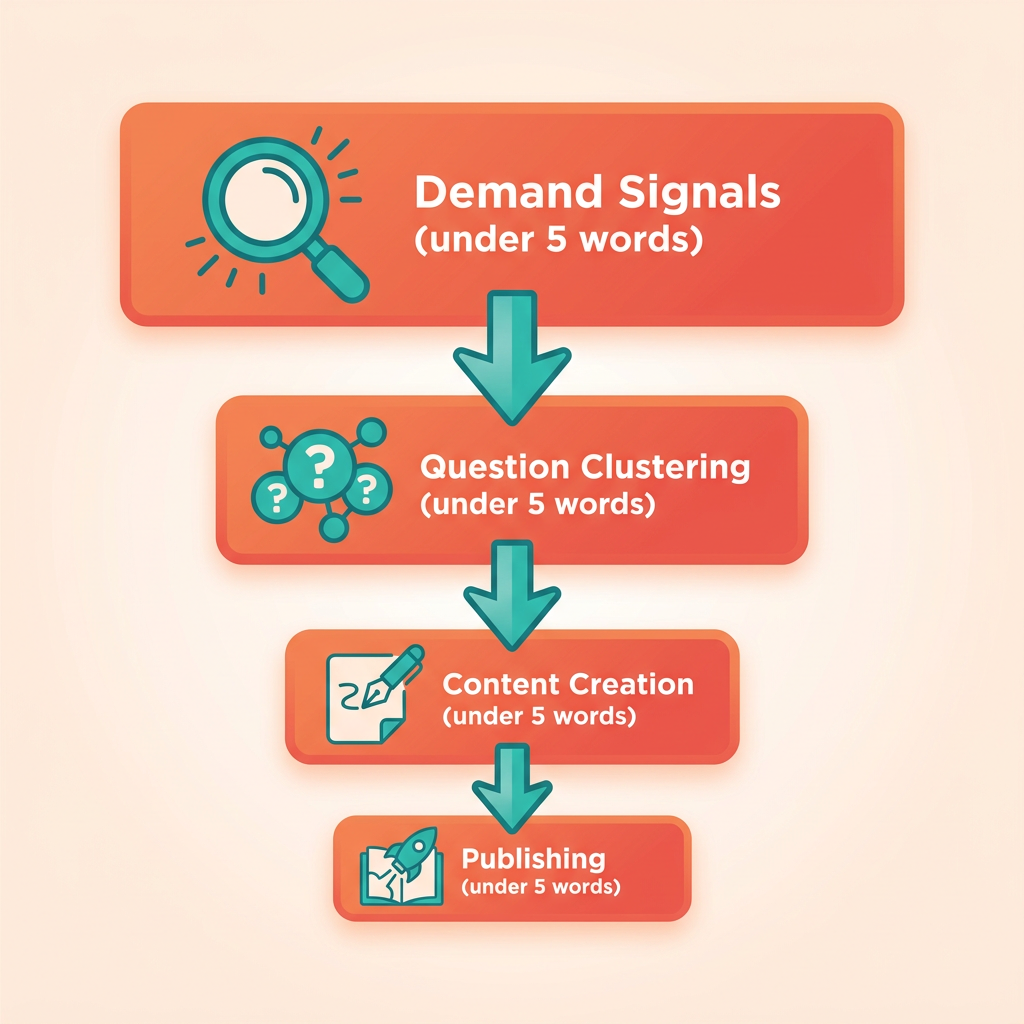
Building a Local Content Plan From Prompt Data
Set a baseline of target queries for every market. A focused list of high-priority questions lets you test templates before expanding your tracking matrix.
Next, cluster prompts by intent rather than exact wording. Use brand, product, competitive, and local groups.
A cybersecurity firm tracked prompts like "what's the most secure email encryption tool?" to find content gaps. A sustainable fashion brand monitored lifestyle questions to find wider mentions. Local businesses can group "best plumber near me" prompts by city and fill the resulting gaps.
Should You Optimize Differently by AI Platform?
Yes. User behavior and content consumption differ across platforms. Perplexity users tend to prefer direct, concise answers. ChatGPT conversations often include follow-ups and exploration.
Internal platform data reports Perplexity sessions at an average of 2.1 interactions. ChatGPT averages 4.7 exchanges per thread.
Structure pages for both patterns. Put a concise factual summary near the top. Use detailed, subheaded sections for users who want deeper answers.
Comparing Your Integration Options
| Approach | What it does | Key strength | Pros / Cons |
|---|---|---|---|
| AnyPost.ai | Researches winnable keywords, then generates and auto-publishes voice-matched articles | End-to-end from research to published page | Pro: eliminates manual research and publishing. Con: best for teams ready to scale content output |
| Manual clustering + CMS | Analyst groups prompts, writer produces pages | Full editorial control | Pro: precise voice. Con: slow, doesn't scale past a few cities |
| Monitoring tool + separate writer | Tracks prompts, then sends findings to a content team | Strong visibility tracking | Pro: good data. Con: no automation, publishing stays manual |
Use prompt volume to prioritize cities and questions. Human judgment still matters more than the raw estimate. The Persona Engine matches articles to your brand voice. Real-time analytics track their performance.
Choosing the Right Tool for Your Situation
The right platform depends on your team's capacity. A monitoring tool helps when data collection is the main challenge. A platform connecting research and publishing helps when localized production is the bottleneck.
Start with scope because scope affects cost. Tracking a few core terms differs from managing a large regional matrix. Begin small, prove the signal, and scale after confirming which cities convert.
What Actually Separates the Tools
Three factors matter most for local work: geo granularity, prompt-tracking limits, and output type. A tool that models national demand but cannot show city-level data may not support a business serving twelve metros.
| Tool | Best for | Geo granularity | Output | Trade-off |
|---|---|---|---|---|
| Frase | Combined SEO and AI visibility | Local query tracking | Monitoring dashboards | Under-tracking misses gaps |
| AnyPost.ai | Automated SEO content generation | Multi-source content integration | Ready-to-rank, voice-matched articles | Focuses on content automation over raw volume modeling |
Match the Tool to Your Bottleneck
Choose the tool that addresses your main constraint. A trendline tool helps when you need to identify rising topics. A publishing platform helps when research is complete but pages remain unfinished.
Geo-specific prompt data is only half the work. The other half is turning local questions into localized pages in your voice. That challenge becomes significant when you cover many cities.
AI engines also favor different content structures. Local landing pages need concise answers and detailed explanations. This helps maintain visibility across major assistants.
When to Skip a Dedicated Tool
Skip a standalone prompt volume subscription if you serve one location and track under 20 prompts. A spreadsheet and manual testing may cost less. Dedicated tooling becomes more useful across multiple cities. At that scale, manual research becomes difficult, and modeled geo-signals help prioritize work.
Frequently Asked Questions
1. 提示词量数据和传统关键词搜索量有什么本质区别?
提示词量反映了用户在生成式AI中进行完整、对话式提问的频率,而传统搜索量则侧重于搜索引擎中的碎片化关键词。由于AI用户的提问方式高度个性化且多变,提示词分析更侧重于理解用户的底层意图,帮助营销人员捕捉更深层次的消费需求。
2. 为什么所有提示词量数据都是模型估算而非精确计数?
由于各大AI平台出于隐私和商业保护不公开原始查询日志,第三方工具必须依靠行为面板或语义聚类技术进行推算。这意味着所有数据都应被视为高价值的趋势风向标,用于指导内容规划的优先级,而非用于精确的财务或流量审计。
3. 小城市的提示词量估算为什么不够可靠?
在统计学中,样本量越小,误差线就越宽。当全国性的用户数据细分到具体的二三线城市时,可用的本地样本量会急剧减少,导致数据容易受到少数极端用户行为的干扰。因此,在针对小城市制定预算时,应结合本地实际业务反馈进行评估。
4. 如何确定一个地区需要追踪多少个提示词主题?
这取决于您的业务规模和市场覆盖面。初创期或单店运营时,集中精力追踪少数几个最核心的本地服务痛点即可;而对于跨区域运营的品牌,则需要构建更广泛的监控矩阵,以捕捉不同地域用户在提问习惯上的细微差别。
5. 为什么需要针对不同AI平台调整内容长度?
不同AI平台的用户交互模式存在显著差异。例如,偏向搜索引擎替代品的平台,用户更倾向于获取快速、精准的单次解答;而偏向对话助手的平台,用户则习惯进行多轮追问和深度探讨。因此,内容结构必须同时兼顾精炼的摘要和详尽的背景延伸。
6. 如何验证提示词量趋势是否值得投入内容预算?
建议采用多源交叉验证法。除了对比不同AI分析工具的趋势走向外,还可以结合传统搜索引擎的广告竞价热度和本地销售团队的一线反馈。如果线上趋势与线下实际需求相吻合,则说明该主题具有极高的投资价值。
7. AnyPost.ai如何将提示词研究转化为已发布文章?
AnyPost.ai通过打通“需求分析-内容生成-多渠道发布”的完整链路来实现自动化。系统能够自动识别高潜力的本地化选题,并结合您的品牌知识库生成高质量、符合SEO规范的原创文章,一键分发至各大主流平台,帮助企业在无需扩充内容团队的情况下实现多城市覆盖.