Why AI Content Ranks or Gets Flagged: Information Gain Over Page One

Key Takeaways
- Google penalizes content that adds nothing, not AI itself.
- Google's SpamBrain flags patterns, whether written by humans or AI.
- AI predicts likely next words, so output often sounds generic.
- Google cites about five sources when synthesizing an answer.
- Information gain now drives citations more than polished prose.
- Ranking needs discovery signals and substantive, citable content.
- Google's Helpful Content system rewards content made for people.
Why AI Content Ranks or Gets Flagged Matters
Google doesn't penalize AI content for being AI. It penalizes content that adds nothing. That distinction matters, and many teams miss it.
Danny Sullivan of Google's Search Quality team said, "Our focus on the quality of content, rather than how content is produced, is a useful guide." His colleague Chris Nelson was more direct: "Using AI doesn't give content any special gains. It's just content." So ai content generation for seo isn't the risk. Derivative filler at scale is. Google's SpamBrain system flags patterns and signals, whether a human or a model wrote them.
Why Does AI Content Get Flagged When Human Content Doesn't?
It usually isn't about detection. It's about sameness. AI models predict the most likely next word, so raw output drifts toward consensus. That's the opposite of what earns rankings now.
Here's the structural problem. Google's Helpful Content system rewards content made for people, not rankings. Meanwhile, information gain has become the main citation driver. Google cites an average of five different sources when synthesizing an answer, so redundant coverage of existing material gets skipped.
Our take: unedited AI output is optimized for the consensus it must escape. An engine only wins when it adds unique data and first-hand voice, not just clean prose.
What Actually Drives AI Content Rankings?
Information gain and structure work together. Effective optimization needs discovery signals—titles, meta descriptions, and schema—and substantive content that earns citations once you're considered. Structure helps pages get discovered, but net-new insight earns the citation.
Treat structure as necessary, not sufficient. Information gain is the payload it carries.
This is where voice-personalization matters. Google's E-E-A-T model prizes Experience, the signal generic AI lacks. Capturing a business owner's first-hand statements creates the subject-matter-expert quote that turns flat AI text into cited content. Animalz says it best: "Primary research is the ultimate form of information gain."
Who Benefits Most, and What's at Stake?
High-growth SaaS, e-commerce, local businesses, and content agencies see the biggest swing. AnyPost's automated content generation captures first-hand voice and adds unique business context to every article, helping clients drive measurable organic traffic growth while maintaining E-E-A-T standards.
The downside is just as sharp. De-indexed content doesn't just stop earning. It drags down ad spend and brand trust, and remediation audits after a penalty can be expensive.
| Factor | Unedited AI | Voice-personalized + edited |
|---|---|---|
| Information Gain | Low (derivative) | High (first-hand data) |
| E-E-A-T Experience | Missing | Captured via owner voice |
| Helpful Content fit | At risk | Strong |
| Flag risk | Elevated | Low |
Skip aggressive AI scaling entirely if you can't add unique data or a real voice to each piece. Thin, keyword-stuffed, citation-free output is exactly what SpamBrain hunts. For a deeper build, see our guide to AI content that ranks.
Information Gain: The Core Ranking Signal for AI Content
Information Gain measures the unique semantic content your page adds beyond what's already ranking. Google evaluates content on this axis, not keyword density or word count. For AI content generation for SEO, that changes the goal: you're not matching top results, you're adding what they missed.
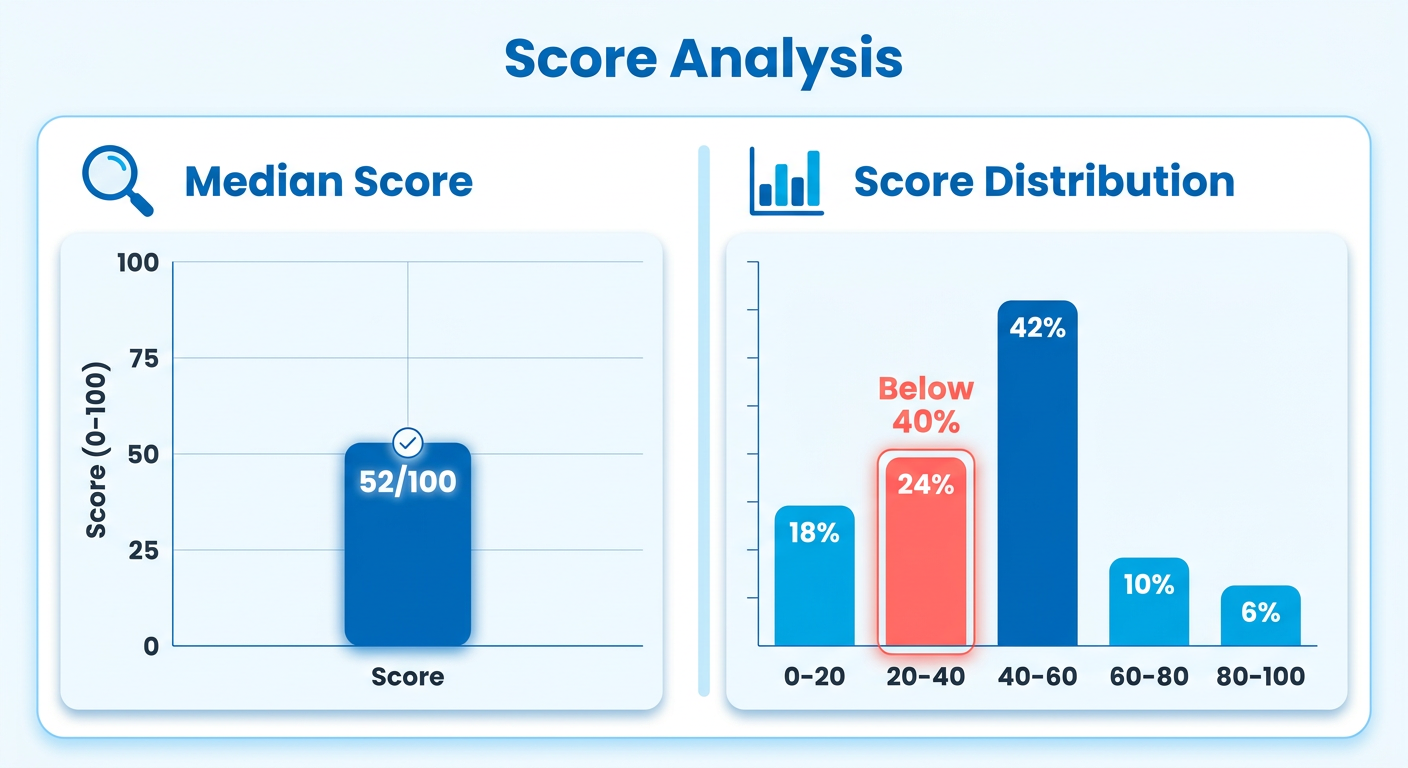
Here's the number that should reset expectations. The median top-3 page scores just 52/100 on originality, and 24% score below 40. That means nearly a quarter of page-one winners are mostly shared content. Originality isn't required to rank, but it separates ranking from being cited by AI answer engines.
What Actually Drives an Information Gain Score?
Original quantitative evidence is the strongest correlate of originality. Pages with 15 or more unique data points average 62/100, while pages with one or zero unique figures average just 40/100. The mechanism is measurable: Information Gain Score is calculated as 1 minus the maximum cosine similarity between your page's embedding and those of the top-ranking competitors.
The practical move is simple: fill the gaps everyone else leaves open. In 90% of SERPs, at least one common topic question went unanswered by every scanned top-3 page. Those unanswered questions are your fastest path to net-new information.
Expert quotes are another strong lever. Industry research shows that direct quotes from subject matter experts can significantly boost visibility across AI Overviews, search assistants, and organic rankings. Studies have also measured substantial lifts in position-adjusted word count from adding quotations and statistics to content.
Why AI Content Struggles Here Unless You Engineer Against It
This is a mathematical limitation of large language models. Because they minimize cross-entropy loss by predicting standard word sequences, their default output reflects the statistical mean of training data. That averaging suppresses the high-variance, non-obvious insights search engines look for when judging originality. To break out of that loop, the generation process must integrate external, unstructured data sources before drafting begins.
By anchoring generation to a specific, localized voice, you introduce highly specific semantic vectors that don't exist in public training data. That proprietary context forces the model to combine concepts instead of repeating standard definitions. The final output becomes a primary document, not a generic summary, and search crawlers can recognize it as distinct.
Does Ranking Still Matter If Originality Wins?
Yes, and the sources look contradictory until you sequence them. One study argues AI engines prioritize unique contributions over authority or backlinks. Another found 76% of AI citations come from pages already ranking in Google's top-10.
Both are true. Top-10 organic ranking is the eligibility gate. Information Gain is the differentiator among pages that clear it. Authority gets you into the candidate pool. Originality gets you cited. This is where an end-to-end approach pays off: our voice-driven drafts target local-search rankings and citation-worthy uniqueness at the same time, so you're not choosing between them.
Before you publish, run the "does this need to exist?" test. If AI can already answer the query by stitching existing sources together, add a unique data point or skip it.
E‑E‑A‑T Alignment for AI‑Generated Pages
Search engines evaluate content through a multi-layered trust framework that checks real-world accountability. That means automated systems look beyond the text to assess the site's publishing infrastructure. The core challenge is proving that page claims are backed by recognized credentials and traceable real-world entities.
What E‑E‑A‑T Signals Actually Mean for Automated Content
Experience shows up as the practical details that come from real work. Generic AI can list standard steps, but it cannot naturally produce specific troubleshooting steps, edge cases, or first-person observations from real practice. Search systems look for these subtle markers, such as the tactile feedback of a tool or the emotional friction of a client interaction, to verify direct familiarity with the subject.
Expertise means domain knowledge. If you're publishing on a topic that requires specialized understanding—medical advice, financial planning, legal guidance—the content needs that depth. For most business blogs, expertise shows up as accuracy, specificity, and the ability to explain why something works, not just that it works.
Authoritativeness is external validation. Does your site have backlinks from credible sources? Are you cited by others in your field? Do you publish regularly enough that search engines recognize you as an active voice? Authority isn't self-declared. It's earned through consistent, high-quality output and third-party recognition.
Trust is the sum of transparency signals: clear author bios, citations to verifiable sources, contact information, and signals that show who's behind the content. A trustworthy page should give readers clear ways to verify the publisher's credentials, so the site stands behind its claims with real accountability.
How AnyPost Builds Content That Reflects Your Voice and Business Context
We treat E‑E‑A‑T as a content-generation requirement, not a post-production checklist. Our Persona Engine captures your brand's voice and business context so every post sounds like you wrote it, carrying the Experience signal AI usually lacks. When a roofing contractor writes about storm-damage claims, the AI doesn't invent generic advice. It draws from the contractor's own messaging about customer situations and audience priorities.
For Expertise, we cross-reference claims against trusted sources and surface citations inline. A legal-services post explaining statute-of-limitations rules will link to the relevant state code, not just state the deadline. A B2B SaaS post comparing integration methods will reference the API documentation, not guess at capabilities.
Authoritativeness comes from maintaining deep topical coverage across your domain. Our system maps your existing content architecture to identify gaps in topical authority, so new articles naturally link to and support your core service pages. That structure tells search engines your site is a comprehensive resource, not a collection of isolated keyword posts.
Industry research consistently shows that adding expert attribution and verifiable sources to blog posts improves trust signals and domain authority. The content may not change much, but transparent sourcing and clear authorship make the difference. That's the Trust pillar at work.
The 10-Item E‑E‑A‑T Audit Checklist
Before you publish any AI-generated post, verify these signals are present:
- Visible author information with name and credentials—not "Admin" or "Marketing Team."
- First-hand examples or direct quotes that prove the author has done the work. Generic advice doesn't count.
- Inline citations to authoritative sources for any factual claim, statistic, or technical detail. Link to the original study, not a blog post summarizing it.
- Structured data markup for articles, authors, and organizations. Use Google's Structured Data Testing Tool to confirm it validates.
- Clear disclosure if AI assisted with drafting. Google's guidance says transparency is expected "when reasonably expected," and for editorial content, it's expected.
- Contact information visible on every page—email, phone, or form. Trustworthy sites make it easy to reach them.
- Original images or data where possible. Stock photos and recycled charts don't build authority. A proprietary benchmark or screenshot does.
- Recent publish date and last-updated timestamp. Outdated content ranks poorly because it signals the site isn't actively maintained.
- Internal cross-links to related posts and foundation content. Isolated pages look like spam; a connected site looks like a knowledge base.
- External backlinks from credible sources in your industry. You can't manufacture these, but you can create content worth citing—original research, case studies, and data-driven analysis.
The difference between automated content that ranks and content that gets ignored comes down to whether these ten items are present. Search systems evaluate whether the final output looks like someone with expertise, experience, and accountability put their name on it. AnyPost automates the writing and helps you maintain the signals that matter.
The Helpful Content System: Making AI Content 'Helpful' to Users
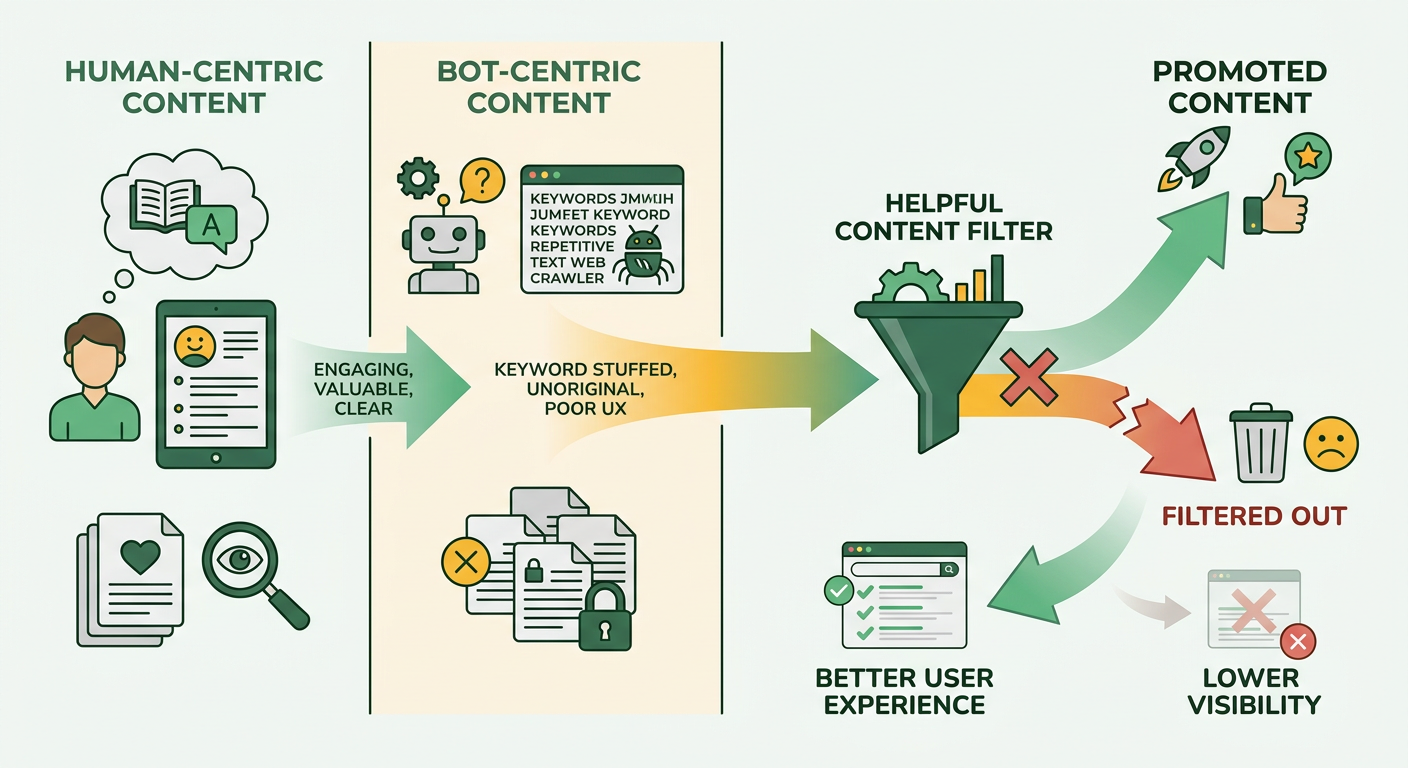
The Helpful Content System works as a site-wide classifier that identifies and deprioritizes search-first content. Rather than analyzing individual words for machine signatures, it evaluates the domain's overall usefulness, filtering out pages that offer little value beyond what's already on the web.
This system targets pages designed to capture search traffic without satisfying the user's intent. For modern search optimization, that means moving away from rigid word-count targets and keyword-density metrics. Instead, the generation process must resolve the user's query as efficiently and completely as possible, so they don't need to return to search results for a better answer.
What Google's Helpful Content Filter Actually Evaluates
The system scores pages on purpose, depth, and intent match. A page passes when it delivers what the searcher expected after clicking. A page fails when it delivers what the keyword implies, not what the person behind the keyword needed.
Here's what that looks like in practice. A searcher types "best CRM for real estate agents." A helpful page walks through CRM features that matter specifically to agents—auto-follow-up on cold leads, MLS integrations, transaction pipeline views—and explains why each matters. An unhelpful page lists fifteen CRMs with two-sentence summaries and affiliate links. Both target the keyword. Only one satisfies the intent.
Depth means answering follow-up questions the reader hasn't asked yet. If someone searches "how to fix a leaky faucet," a thin page says "turn off the water and replace the washer." A helpful page adds what type of washer to buy, what happens if the valve seat is corroded, and when to call a plumber instead. You're not writing longer. You're writing further into the problem.
Originality lifts a page from a standard search result to a primary source. Standard search algorithms may let similar pages compete based on domain authority, but conversational search engines and AI Overviews select pages that introduce unique perspectives, proprietary data, or distinct professional methods.
How to Steer AI Output Toward User-Centric Content
Generic prompts produce generic content. "Write 1,000 words on X" yields the median of the training data—exactly what the Helpful Content System flags. The fix is purpose tagging at the prompt level.
We classify every article by intent before the model writes a word. Informational queries ("what is X") need definitions, examples, and context. Transactional queries ("best X for Y") need comparison criteria, tradeoffs, and a clear recommendation. Navigational queries need the specific resource the searcher wants, not a category overview. When the system knows the intent, the output matches it.
Prompt engineering for helpfulness means telling the model who is reading and what decision they're trying to make. Instead of 'write about project management software,' we prompt 'explain how a 10-person marketing team decides between Asana and Monday.com when they've never used either.' The output shifts from feature lists to decision frameworks.
The same logic applies to depth. We don't prompt for word count. We prompt for the next three questions a reader would ask after the first answer. That mirrors how Google evaluates follow-through: does the page anticipate the natural follow-up, or does it stop at the surface answer and force the reader back to search?
The Seven-Question Helpfulness Checklist
Before you publish AI-drafted content, run it through this filter. If you can't answer yes to all seven, rewrite or kill the page.
1. Does this page exist because a person needs it, or because a keyword has volume? If you wouldn't send this page to a friend who asked the question, don't publish it.
2. Would someone who read this page leave satisfied, or would they immediately search again? Bounce-back behavior is the clearest signal the page didn't deliver.
3. Does the page answer follow-up questions the reader didn't explicitly ask? Depth means you've already handled the "but what about..." objections.
4. Does it include first-hand detail that isn't in the top five results? If every sentence could've been copied from page one, you're not adding information gain.
5. Is there a clear author signal—byline, bio, credentials—and does the content read like that person wrote it? The Helpful Content System cross-checks E-E-A-T. Faceless content gets deprioritized.
6. If you removed the SEO keyword, would the structure and conclusions stay the same? Helpful content is written about a topic. Unhelpful content is written around a keyword.
7. Does the page commit to a position, or does it hedge on every claim? Helpful content says "do X in this situation, skip it in that one." Thin content says "results may vary, consult a professional."
Rewriting AI drafts to satisfy these seven questions doesn't make the content longer. It makes it more useful. That's the difference between a page that captures a click and one that satisfies the searcher. AnyPost bakes these SEO optimizations in from the start: keyword-optimized content, search-intent-aligned headings, and semantically correct HTML built to rank.
Where Automated Engines Survive the Helpful Content Filter
To survive automated quality filters, a site's content library must avoid structural uniformity. If every article follows the same heading layout, intro hook, and conclusion, search systems flag the pattern as programmatic generation. Real resilience requires dynamic templating—varying article structures, using different media formats, and making each piece of content fit its specific topic rather than a rigid template.
This is why integrating real-world business insights directly into the generation loop works well. By feeding the system actual customer inquiries, sales objections, and operational challenges, the resulting articles naturally address the highly specific long-tail queries people search for. That keeps the content grounded in actual business operations and aligned with what users find helpful.
In practice, that collapses "avoiding penalties" and "earning rankings" into one requirement: net-new, first-hand content. The defensive move and the offensive move are the same. You're not gaming the system. You're giving it what it was designed to reward.
Avoiding Rank‑Gaming: Detecting and Eliminating Mass‑Produced AI Content
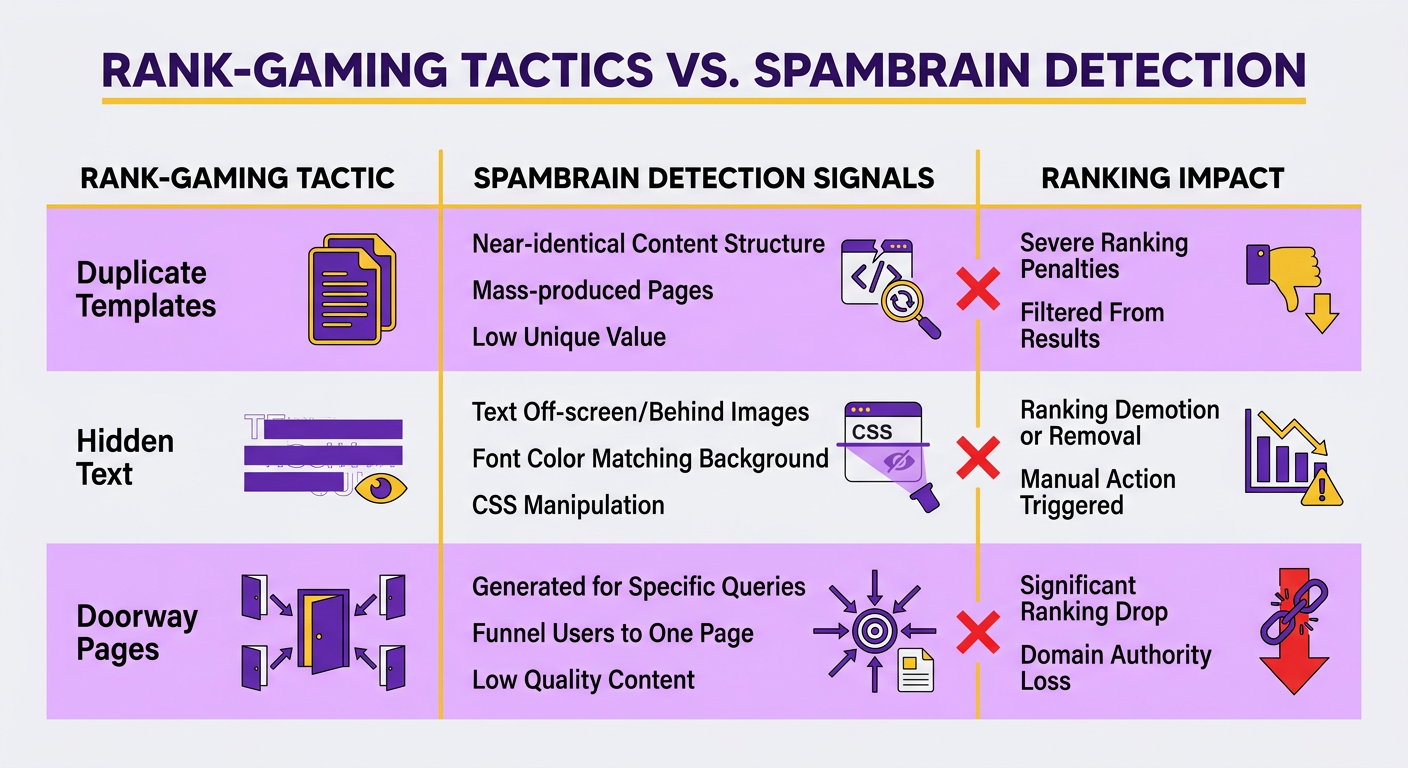
Rank-gaming means scaling content solely to manipulate search engine algorithms rather than serving user needs. Google's spam policies explicitly target tactics like duplicate templates, hidden text, and doorway pages designed to capture search real estate. When content production prioritizes volume over utility, it triggers automated quality systems built to identify and suppress low-effort, programmatic networks.
The underlying challenge is how search engines group similar documents. Algorithms use clustering to identify near-duplicate content across the web, filtering out pages that offer no distinct value. If your automated content relies on the same templates and phrasing as existing pages, it gets grouped with those competitors and hidden from search results. To prevent that, each page must use unique structural layouts, distinct subtopics, and varied media elements.
What Counts as Rank-Gaming in Google's Eyes?
Rank-gaming: content created primarily for search bots rather than people, using automation to scale thin or deceptive pages. It's not about AI authorship. It's about intent and pattern.
Doorway pages, near-identical templates swapped only by city name, and pages padded to hit a word count are the classic signals. Google's phrase-based indexing works against these directly. Documents get indexed on meaningful phrase patterns, so a network of pages sharing the same phrase skeleton reads like one page wearing a hundred masks.
What Are the Statistical Red Flags of a Content Farm?
Three metrics expose a farm quickly: high inter-page similarity scores, low unique word count, and uniform meta data across dozens of URLs. When your titles and descriptions differ only by a swapped keyword, that's a fingerprint Google reads instantly.
To avoid these footprints, our SERP Competitor Analyzer dynamically evaluates the top-ranking results for each target query. Instead of using a rigid template, it generates a custom outline and unique metadata tailored to fill the information gaps in that SERP. That gives every published page a distinct structural signature and keeps automated footprints from triggering site-wide quality flags.
For example: a programmatic network pushed over 10,000 thin pages in a burst and lost roughly 85% of traffic inside two weeks. That's the shape of a pattern penalty, and it shows why volume without information gain fails.
How Do We Catch and Recover From a Penalty?
Watch for three early signals: a sudden traffic drop, a manual action notice, and unusual SERP volatility on pages that were stable. AnyPost surfaces your performance straight from Google Search Console, so instead of an agency telling you what they did, you see what changed in your impressions and clicks.
The response workflow is direct. Identify flagged pages, run a forensic audit, then rewrite or add real depth instead of deleting and hoping. Where the audit shows genuine improvement, request reconsideration. Reinstatement timelines vary with the severity of the original pattern, so focus on demonstrable improvement rather than a fixed calendar.
Prevention beats recovery every time. Keep version control on published pages, back up original drafts so you can compare and roll back, and run continuous E-E-A-T checks so every page carries an author, evidence, and a reason to exist.
Best‑Practice Blueprint: Writing AI Content That Consistently Ranks on Page One
Scaling search visibility with AI requires a structured editorial workflow. Raw model output should be treated as a foundation, not a finished draft. Below is the process our team uses to keep every piece aligned with search quality standards.
Here's the tension you have to design around. Two gates decide whether a page gets cited, and they fire in order. Retrieval pulls candidates from pages that already rank; selection then rewards the one that adds something new. Our view: those aren't competing signals. They're sequential filters. A ranking position gets you into the candidate pool. Information gain decides who gets cited. So an ai content generation system has to win both gates, or it wins neither.
What Does the Full Workflow Look Like, Step by Step?
Step 1. Topic and intent research. Cluster keywords by search intent, then remove anything AI already answers well. The test is blunt: does this page need to exist? If a model can already answer the question by synthesizing existing sources, you're probably better off not publishing. Our Taxonomy Researcher analyzes your unique business context and surfaces low-difficulty, high-intent keywords tailored to your niche, so you chase rankings you can actually win. Segmenting by industry isn't optional either. A 2025 report on 300 B2B SaaS sites found segmented content drove 15.7X higher organic traffic growth.
Step 2. Prompt design with E-E-A-T cues baked in. Your prompt sets the information gain target before a word is written. Most competitive 2026 topics need 5 to 7 distinct insights to compete in AI search. Feed the model unique data sources and instruct it to hit that count. This is also where voice matters: a first-hand expert quote produces roughly a 400% lift in citations, and voice-personalization is how you create that signal instead of scraping generic commentary.
Step 3. Draft plus content-gap enrichment. Generate the draft, then benchmark it against the top-ranking competitors to add what they missed. Gaps usually cluster in three places: an unaddressed sub-question, a missing comparison, and a claim nobody backed with data. During this phase, manually insert proprietary metrics, internal case study results, or specific industry benchmarks to ensure the draft contains verifiable, non-templated evidence.
Step 4. Human-in-the-loop review. A tight checklist beats a vague "does this read well":
- Does it answer the searcher's actual question in the first paragraph?
- Are claims attributable, with real data and a named voice?
- Does the tone match your brand, not the model's default?
- Have you cut anything that just restates the consensus?
Step 5. SEO structure. Optimizing body text alone can hurt visibility during retrieval and reranking. Structure carries the payload. Schema, meta tags, semantic headings, and internal linking are necessary; information gain is what earns the citation once you're retrieved.
How Do You Recover After a Core Update?
Step 6 and 7. Publish, distribute, monitor, iterate. Automated publishing and backlink distribution get the page live and into that top-10 candidate pool. Then watch Search Console and re-optimize quickly.
Recent core updates have leaned harder into factual accuracy and source credibility, and low-information-gain AI pages are the first to slide. Our fix is a focused re-optimization sprint: pull the pages that dropped, run each against its live top-3, and add the net-new insights they lack. Consensus content is your baseline. Original data is your recovery lever. That distance from the consensus is the only thing that reliably moves a page back up.
Frequently Asked Questions
1. Will an AI detector flag my content and hurt my Google rankings?
Google's ranking systems evaluate the utility and originality of content, not how it was produced. Automated quality filters target pages that offer no unique value or simply repeat existing search results. The main risk is publishing derivative, low-effort material that doesn't help the user, whether it was written by a human or an AI model.
2. How many unique data points does my content actually need?
There is no hard numerical requirement, but original quantitative evidence strongly correlates with search performance. Including proprietary metrics, survey results, or specific industry benchmarks helps distinguish your page from competitors. Verifiable, first-hand figures make your content much more likely to be cited by search engines and AI answer assistants.
3. Do I need to rank in Google's top 10 before AI engines will cite my page?
A high organic ranking is generally a prerequisite for appearing in AI-generated summaries and search overviews. Search engines typically pull citation candidates from the top organic results before deciding which page offers the most unique and relevant answer. So you need to optimize for traditional ranking factors while also providing the high information gain needed to win the citation.
4. I already published thin AI content. Can I recover from a penalty?
Yes, recovery is possible by systematically upgrading the quality of your existing pages. Start by identifying which URLs have lost traffic, then enrich them with unique insights, expert commentary, and updated data. Once the content has been significantly improved to meet modern quality standards, search engines will naturally re-evaluate and re-index the updated pages during later crawl cycles.
5. Should I disclose that AI helped write my content?
Transparency about your editorial process supports trust and credibility. If AI tools assist with drafting, disclosing that can be part of a broader effort to show readers how your content is produced. More importantly, make sure your pages include clear author profiles, verifiable citations, and accessible contact details to demonstrate real-world accountability.
6. How does AnyPost add the first-hand experience that generic AI lacks?
Our platform integrates directly with your existing business assets to ground the generation process in your actual operations. By analyzing your product documentation, customer communications, and brand guidelines, the system generates highly tailored content that reflects your specific industry expertise. This ensures that every article published is highly relevant to your target audience and aligned with your brand's unique perspective.
7. Is word count still a useful target for content?
Focusing on arbitrary length targets often creates unnecessary filler that hurts user experience. Instead, prioritize comprehensive query resolution by anticipating and answering the logical follow-up questions a reader might have. Clear, concise, actionable answers are far more effective for search performance than padding a page to meet a specific word count.
