
Why AI Repurposing Breaks at Tone, Not Generation

Key Takeaways
- Most AI repurposing tools nail generation and choke on tone. They flatten a distinct voice into generic copy.
- The real test: push one blog post into five formats and see if it still sounds like you wrote it.
- Two axes decide the winner: tone fidelity and content volume.
- High-volume generators win on raw output. They also drift off-brand fastest across formats.
- Voice-modeling tools hold your register well but often cap how much they'll produce at once.
- Manual editing plus templates gives you the highest tone fidelity and the lowest volume. Fine for small teams with a few high-stakes pieces.
- Marketers praise Claude for account strategy and post ideation, not high-volume format conversion.
The Quick Version
Automation handles generation mechanics just fine. A consistent brand voice is where it breaks. The real test of any AI content repurposing tool is whether it can turn one long-form article into several formats without losing your perspective or flattening the copy into generic corporate mush.
So we judge these platforms on one trade-off: voice preservation versus output capacity. Most tools force you to choose between scale and style. The ones worth paying for try to narrow that gap.
Which tool fits your trade-off?
Start by naming your bottleneck. If you need a sprawling multi-channel calendar filled, choose differently from a brand protecting a strict editorial standard. Here's how the main approaches stack up.
| Approach | Tone Fidelity | Content Volume | Best For |
|---|---|---|---|
| General LLM (ChatGPT, Claude) | Medium (needs prompting) | High | Ad-hoc drafting and ideation |
| Repurposing-focused SaaS | Medium-High | High | Turning one asset into many formats |
| Voice-modeling SaaS | High | Medium-High | Brand-consistent multi-format output |
| Manual editing + templates | Highest | Low | Small teams, few high-stakes pieces |
Claude gets specific praise on the ideation side. As one Reddit user in r/SocialMediaMarketing put it, "for account strategy and post ideation, I use Claude now. I find both of them are among the AI tools that actually think from a human perspective."
What actually separates these tools?
Voice modeling, not feature count. Generation is commoditized. Nearly every tool can spin a blog into a thread or newsletter. Whether the output survives a brand review is the real difference.
Tone fidelity: how closely the output matches your register across formats. This breaks first when you scale, because most tools regenerate from scratch each time instead of anchoring to a voice profile.
Content volume: how many formats and pieces you get per source asset. One blog can become threads, a newsletter, and video scripts. The catch is that more formats usually means more drift.
Consolidation matters too. One r/SocialMediaMarketing commenter noted the value of "tools that handle both the generation AND the scheduling in one place, rather than using separate" apps. Fewer handoffs mean fewer places for your voice to slip.
How does pricing compare?
Pricing splits along the same volume-versus-fidelity line. Cheap tools sell raw generation. Premium tiers sell consistency and workflow. We won't quote numbers because most vendors gate them behind demos and adjust per seat.
General LLMs run cheapest per token, but they shift the tone-editing cost onto you. Repurposing SaaS charges more and bundles format automation. Voice-modeling services like AnyPost.ai price around your content velocity, and their Persona Engine matches your tone across channels so output needs less cleanup.
Skip the premium tier if you publish a handful of pieces a month. At low volume, manual editing gives you the highest fidelity for the lowest software cost. The math flips once you're repurposing weekly across three or more formats, where drift becomes the expensive problem.
Why bother with these tools at all
Most teams reach for an AI content repurposing tool to solve a volume problem. They have one blog post and need it live as five posts, three emails, and a LinkedIn thread by Friday. Real need. Wrong problem to lead with.
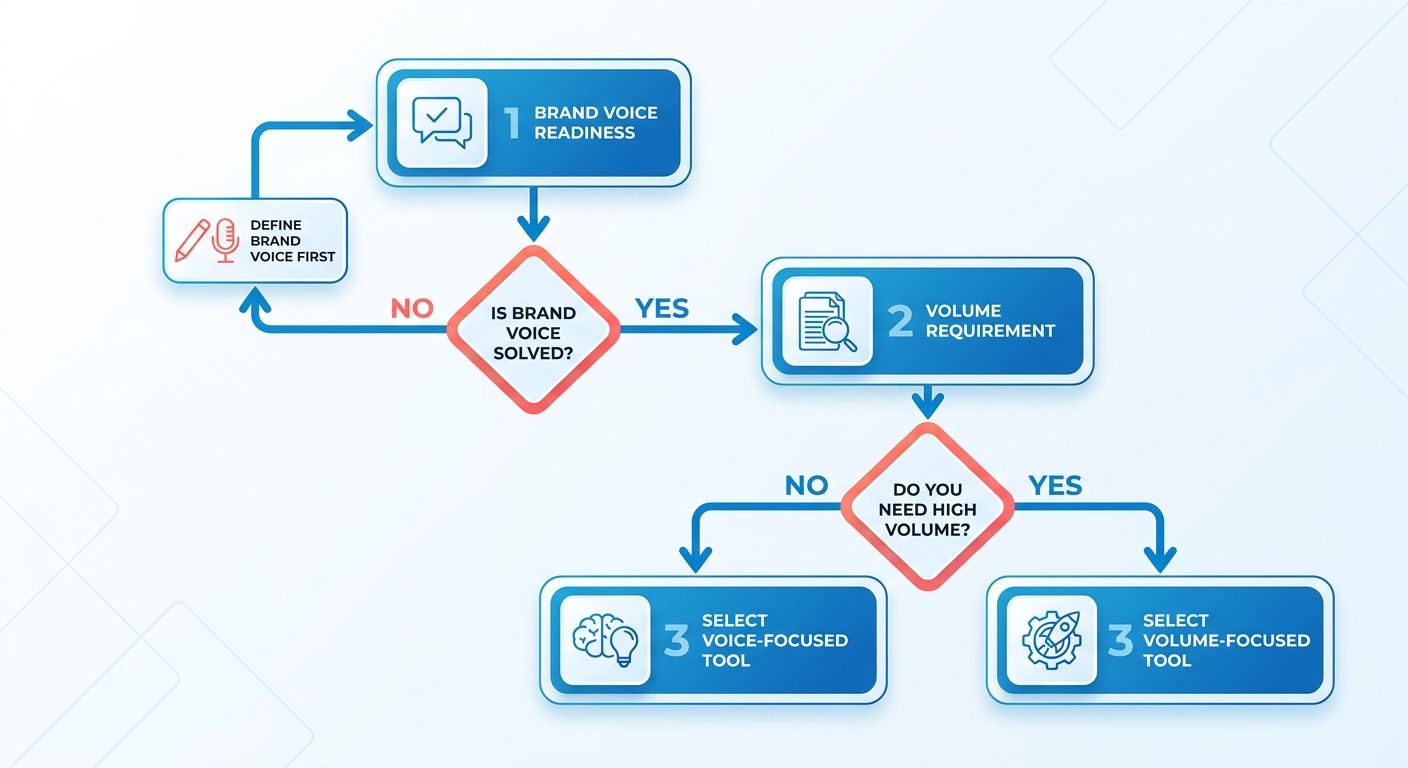
The question underneath is whether you should be repurposing at scale at all. If your voice isn't solved yet, more output just means more off-brand copy to clean up. Speed becomes a liability. Below, who actually benefits, and what to weigh before you buy.
When does a repurposing tool actually pay off?
When you have a proven voice and a distribution engine that can absorb the extra assets. The 3–5x output gain enterprise teams cite only lands if tone fidelity comes first. Otherwise you scale noise, not reach.
Our honest read on fit:
- Best fit: Teams with an established voice, multiple active channels, and a calendar that already outpaces their writing capacity.
- Decent fit: Solo operators and freelancers juggling several client accounts. One Reddit social media manager described their stack of Gemini, Canva, ChatGPT, and Sora getting "a little out of control." Consolidation helps.
- Skip it: Brands still figuring out their voice, or anyone publishing to a single channel. You don't have a volume problem yet. Fix positioning first.
Teams skip that last carve-out constantly. They automate before they have anything worth automating.
Which selection factors actually matter?
Two decide the outcome: tone fidelity and content volume. Everything else, like templates, integrations, and scheduling, is secondary. Weight those two against your real bottleneck, not the feature list on a pricing page.
| Selection Factor | Why It Matters | When To Prioritize It |
|---|---|---|
| Voice modeling | Keeps every format sounding like you wrote it | You publish across 3+ channels |
| Output volume | Raw formats per source asset | Your calendar is the bottleneck |
| Editing overhead | Time spent fixing off-brand drafts | You have limited review capacity |
| Format range | Blog, email, social, script coverage | You repurpose into many mediums |
Our take: if you can only pick one axis, pick voice modeling. You can always generate more. You can't easily unflatten a voice once a tool has stripped it out.
What common needs do these tools address?
Three recurring ones: turning long-form into short-form, keeping voice consistent across mediums, and cutting the manual reformatting grind. Most tools stop at the last one. The first two are where they earn their keep.
We built our Persona Engine around that gap. It learns your register from your existing work, then holds it across every format so a thread and a newsletter read like the same author. That's the difference between an assistant and a copy machine.
AnyPost takes that voice-first approach to publication: we crawl your entire site to build a Business Context Graph of your products, messaging, and audience, then generate SEO-optimized articles in your voice and auto-publish across channels like WordPress, LinkedIn, and X. Decide your voice-versus-volume trade-off first. Then let the tool grind.
Feature Comparison
Push a single blog post through an AI content repurposing tool and two things happen at once: the semantic core compresses cleanly, and the voice starts to drift. Different problems. Most tools only solve the first.
AI handles meaning extraction well. It pulls the core argument from a 2,000-word post and renders it as a LinkedIn hook or email intro without losing substance. Where it breaks is the stylistic surface: register, sentence rhythm, and the specific way your brand signals authority or warmth. Raw generation doesn't equal controllable style transfer. Without a structured way to capture brand-specific voice markers, LLMs default to a generic register that erases the tone making your content sound like you. That's the gap our Persona Engine is built to close.
How do the leading tools actually compare?
They split into two camps: volume-first generators that maximize output across formats, and voice-first platforms that treat register consistency as the primary constraint. Neither is wrong. They solve different bottlenecks.
| Feature | Volume-First Tools | Voice-First Tools | AnyPost.ai |
|---|---|---|---|
| Output formats | 10+ | 3-6 | WordPress, LinkedIn, X |
| Voice modeling | Minimal or prompt-based | Style guide input | Persistent voice engine |
| Register consistency | Low across formats | Medium | High across formats |
| Setup overhead | Low | Medium-high | Low after initial calibration |
| Best for | One-off campaigns | Agencies with defined brand docs | Teams scaling a proven voice |
That table reflects a structural difference, not just a feature gap. Volume-first tools treat every repurposing job as stateless: each output starts from scratch with no memory of how your brand sounds. Voice-first tools improve on this but often make you re-upload brand guidelines per project. Our approach encodes voice as a persistent model that travels with every output job, so calibration happens once instead of per piece.
Where each type breaks down
Skip volume-first tools if your voice is differentiated and your audience is sharp enough to notice when it goes flat. The output gain is real, but it amplifies whatever register the model defaults to, usually a competent-but-generic professional tone. Fine for commodity content. A liability for brands where voice is a competitive asset.
Skip voice-first tools if your team lacks the bandwidth to maintain detailed brand documentation. These tools are only as good as the style inputs you feed them. Without that investment, they revert to the same generic output as volume-first generators.
The gap we keep seeing: teams assume the bottleneck is generation speed. It isn't. It's style governance. Applying a consistent register across formats without per-piece human review. That's the architectural problem a voice-modeling engine solves, and why we built AnyPost.ai around register persistence rather than raw format count. By mapping your existing content ecosystem, the system establishes a baseline of your brand's stylistic DNA so outputs align with your editorial standards.
One honest caveat: if you're a solo creator with small, consistent output, the overhead of voice calibration may not pay off. A simpler tool with manual editing is the right call there.
Performance Comparison
Speed and scale are the easy part of any AI content repurposing tool. Generation throughput has been solved for years. The real performance question is whether your output stays on-brand as volume climbs, because tone fidelity doesn't scale on its own.
Here's the trap. Teams benchmark tools on how fast they spin one blog post into ten assets. Then they spend the saved hours rewriting off-brand copy. The bottleneck moved. It didn't disappear.
Does faster generation mean faster output?
No. Raw generation speed is a vanity metric if voice control is missing. A tool that outputs 15 assets in a minute but drifts on register just hands you 15 editing jobs. Real throughput gets measured after human review, not before.
The research is sharp on this. Xinchen Yang and Marine Carpuat found that despite strong general rewriting ability, LLMs still struggle with arbitrary style transfer. Raw capability doesn't equal controllable style. Speed without style governance produces volume, not usable volume.
Their register-analysis prompting method changes the math. By generating accurate target style descriptors up front, it improves style transfer strength while preserving meaning. As Carpuat put it:
"Using Biber's register analysis provides a structured way to generate accurate target style descriptors for LLMs." - Marine Carpuat
How do the tools compare on real throughput?
The honest comparison factors in cleanup time. High-volume generators post fast raw numbers, then drain their lead in the review queue. Voice-first tools generate a touch slower but land closer to publishable on the first pass.
| Performance Axis | High-Volume Generators | Human-Reviewed Workflow | AnyPost.ai |
|---|---|---|---|
| Raw generation speed | Very fast | Fast | Fast |
| Tone fidelity at scale | Drifts | High (manual) | High (modeled) |
| Cleanup burden | Heavy | Moderate | Light |
| Resource cost per asset | Low compute, high labor | Low compute, high labor | Low compute, low labor |
| Scales without adding editors | No | No | Yes |
Our approach encodes brand register once, then reuses that voice model across every format. That's the architectural difference. Human oversight is the current industry answer to voice drift, and it works. But it charges you per piece. A voice-modeling engine pays the cost once at calibration, then holds the line automatically.
Where scale becomes a liability
Scale distribution before your voice is stable and you introduce real operational friction. Expand your publishing footprint without a settled brand voice and you just accelerate the production of inconsistent content. That builds an immediate backlog of material needing manual correction, which cancels out any efficiency you thought you gained.
Resource usage tells the same story. Compute is cheap. Editor hours aren't. A tool that keeps compute low but forces manual review on every asset has quietly moved your cost from servers to salaries.
Our Persona Engine addresses this by setting a persistent stylistic profile before any content is generated. Instead of analyzing assets in isolation, the platform references your broader digital footprint to understand how your products and messaging get framed. That baseline lets you distribute across multiple channels while holding a unified editorial standard.
Pros and Cons
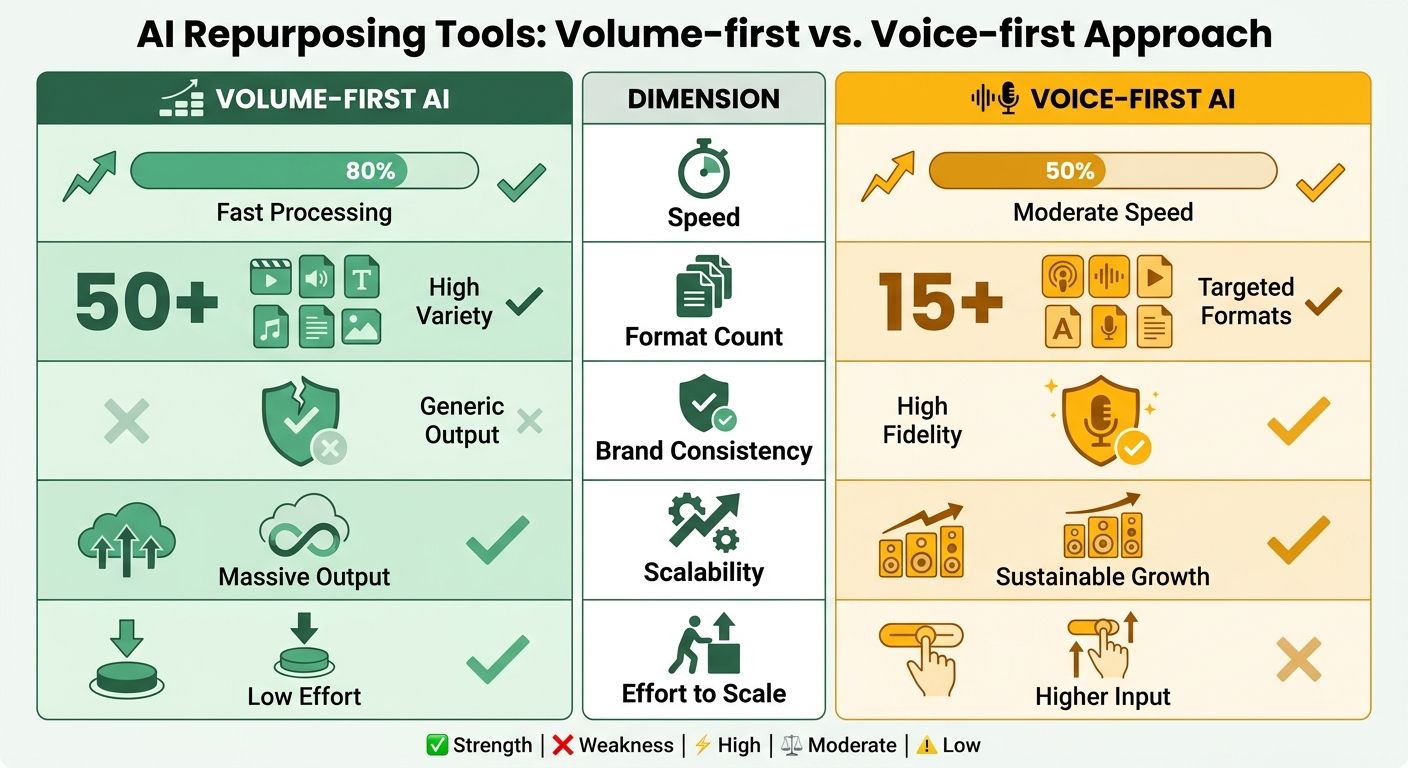
Every AI repurposing tool sits somewhere on a trade-off between how much it outputs and how faithfully it holds your voice. Volume-first generators win on speed and format count. Voice-first tools win on consistency but make you work harder to scale. No free lunch, and pretending otherwise is how teams end up with a pile of off-brand assets.
Below, the strengths and weaknesses of each category, so you can pick based on your actual constraint, not the marketing. The right AI content repurposing tool depends on whether your bottleneck is output speed or voice control.
What do high-volume generators get right and wrong?
High-volume generators: tools built to spin one input into many formats fast, optimized for throughput over register control.
The strength is obvious. Paste a blog post, get ten assets in under a minute. For teams drowning in a distribution calendar, that raw speed is real value. It also eases the tool-fatigue common among multi-channel marketers stuck managing a fragmented software stack. One interface, less overhead.
The weakness is tone drift. Without a structured way to capture your voice markers, these tools default to a generic register. You save an hour generating and lose two rewriting. That's the trap flagged earlier: the bottleneck moves to editing, it doesn't vanish.
Where do voice-first tools win and lose?
Voice-first tools: platforms that model your brand register first, then generate, trading some raw volume for on-brand output.
The win is fewer editing passes. When a tool applies register analysis to steer output toward your voice, the copy comes back closer to publishable. Our approach at AnyPost.ai leans this way. The voice-modeling engine captures how your brand signals authority and warmth, then holds that across formats instead of flattening it. For teams with a settled voice and a real distribution engine, that alignment is what makes automated scaling actually workable.
The weakness is setup cost and, on some tools, tighter volume caps. You have to feed the system enough of your writing to model the voice. Try this before you have clear editorial guidelines and it backfires, because modeling an inconsistent voice just automates the inconsistency at scale.
Pros and cons at a glance
| Factor | High-Volume Generators | Voice-First Tools (incl. AnyPost.ai) |
|---|---|---|
| Raw output speed | Excellent | Good |
| Tone fidelity | Weak, drifts on register | Strong, holds brand voice |
| Editing burden after generation | High | Low |
| Setup effort | Minimal | Moderate (voice modeling) |
| Best for | Teams needing many formats fast | Teams with a proven voice scaling distribution |
Our honest take: if you have no distribution engine and no settled voice, neither category pays off yet. Fix the voice first. Once your register is solid, a voice-first tool is worth the setup because it protects the tone that makes your content yours. If you genuinely just need bulk drafts for a human editor to rewrite anyway, a high-volume generator is cheaper and fine. Match the tool to your real bottleneck, not the demo.
Use Cases and Ideal Users
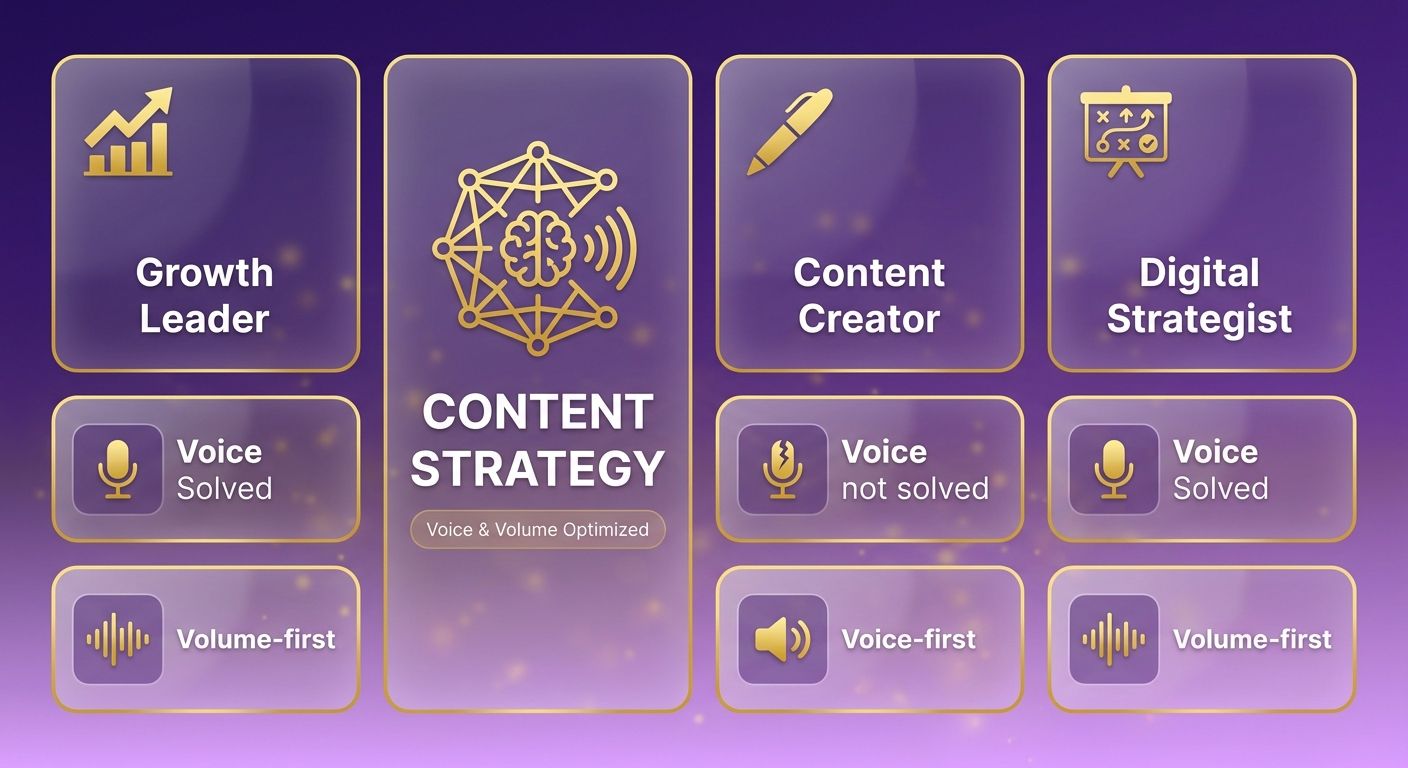
The right tool comes down to one variable: whether your brand voice is already solved. If it is, a high-volume generator can flood your calendar. If it isn't, you need a voice-first engine that holds register before you scale. Match the tool to your actual bottleneck, not the marketing.
Below, three user profiles mapped to the tools that fit them. Each sits at a different point on the tone-versus-volume trade-off. An AI content repurposing tool only earns its keep when it matches where you actually are.
Who should pick a high-volume generator?
Best for: teams with a proven voice, heavy distribution needs, and editing capacity to spot-check output.
If you already know what on-brand sounds like and you have people who can catch drift, a throughput-first tool works. Many formats, fast. The catch is real: raw generation doesn't equal controllable style transfer. LLMs rewrite text well but stumble when you ask for a specific target style.
So this profile only works when a human backstops the register. If your team can absorb that review load, the volume gain is worth it. If not, you're buying editing debt.
Which users need a voice-first engine?
Best for: solo marketers and lean teams who can't afford per-piece review of every asset.
This is where a voice-modeling engine changes the math. Generic prompting tends to produce generic output. A tool built to hold register keeps your tone consistent while preserving meaning. That's exactly what AnyPost's Persona Engine is designed to solve.
Our approach encodes your brand register once, then reuses it across every format. By analyzing your existing published assets, the system establishes a baseline of your messaging and audience framing. That replaces per-piece review with a one-time voice calibration. For a freelancer juggling multiple client accounts, that's the difference between a manageable workflow and operational chaos, no more toggling between prompting strategies for each account.
If that's you, a tool that holds voice automatically saves more than time. It saves the rewriting hours that eat your margin. AnyPost is built around this calibration step, generating ready-to-rank content in your voice and auto-publishing across platforms.
When should you skip these tools entirely?
Skip repurposing at scale if your brand voice isn't defined yet. Volume amplifies whatever you feed it. Off-brand in, more off-brand out.
Hold off on automated distribution if your core messaging is still fluid. Cranking up output volume under those conditions just amplifies the inconsistencies, and you end up with a fragmented brand presence that needs extensive cleanup.
The efficiency gains larger marketing teams report depend on a stabilized editorial standard. Without that foundation, rapid generation is a liability, not an asset. Refine your core voice before you scale its distribution.
| User Profile | Best Tool Type | Deciding Factor |
|---|---|---|
| Enterprise team, proven voice | High-volume generator | Editing capacity to catch drift |
| Solo marketer, lean team | Voice-modeling engine (AnyPost.ai) | No budget for per-piece review |
| Startup, undefined voice | Skip automation for now | Voice not solved yet |
| Agency, many client tones | Voice-first with per-client calibration | Register must switch cleanly |
The pattern holds across all four rows. Sort out register first. Then let output scale.
What I'd actually do
The choice of AI content repurposing tool comes down to one question you should answer before you touch any tool: is your volume ambition set correctly for your current tone fidelity? Teams that flip that order, targeting output volume first and worrying about voice later, end up with more assets and weaker brand equity. We've watched it happen repeatedly. Set the tone bar first. Then decide how much you can safely produce.
Which tool wins for your situation?
| Scenario | Best Fit | Why |
|---|---|---|
| Proven voice, heavy distribution needs | High-volume generator | You have the editing capacity to catch drift; throughput is your real constraint |
| Voice still being defined | Voice-first engine | More output just multiplies the problem |
| Both volume and voice matter | AnyPost.ai | Persona Engine holds register as output scales |
| Small team, one or two formats | Either category | The trade-off barely shows at low volume |
Document and test your brand voice across multiple formats by hand before you bring in automation. Technology can't resolve ambiguity in your messaging. It'll only accelerate its distribution.
Our honest take on the trade-off
High-volume generators are the right call when your bottleneck is genuinely throughput and your team has the editorial bandwidth to review output. Don't pay for voice-modeling features you won't use.
Voice-first tools, including what we've built at AnyPost.ai, earn their keep on the highest-register-delta format pairs in your mix, like turning a technical whitepaper into a conversational social thread. That's where generic LLM output is most obvious to an audience, and where our Persona Engine does its most important work, anchoring the output to your brand identity across every channel.
The honest ceiling: even a strong voice-modeling engine won't save you if the source content is weak. Garbage in, on-brand garbage out. The framework only works when the original asset is worth repurposing.
The framework in one decision
Measure tone fidelity on your hardest format pair first. If it holds, scale volume. If it drifts, fix the voice model before adding formats. That sequence is the whole decision. Any tool that asks you to commit to volume targets before you've run that test is selling you the wrong metric.
Frequently Asked Questions
1. Can I switch a voice-first tool between different client brand voices?
Voice-first tools with per-client calibration can hold distinct registers for multiple accounts. Each client's voice gets modeled separately, so an agency switching between accounts keeps every brand sounding authentic. The deciding factor is whether the tool lets register switch cleanly rather than blending voices across projects.
2. Does a general LLM like ChatGPT work for repurposing if I write detailed prompts?
General LLMs handle repurposing at medium tone fidelity but require heavy prompting to stay on-brand. They excel at ad-hoc drafting and ideation with high volume, yet shift the tone-editing cost onto you. Without a persistent voice profile, each output regenerates from scratch, so drift returns every session.
3. How much of my existing writing does a voice-modeling tool need to learn my register?
Voice-modeling tools require a representative sample of your existing work to map your stylistic patterns. AnyPost.ai analyzes your published content library to understand your specific product positioning, audience framing, and vocabulary. This initial calibration replaces the need for per-piece prompting, making it highly efficient for teams with an established editorial footprint.
4. Why does tone drift get worse when I produce more formats from one blog post?
Tone drift worsens with volume because most tools treat each format as an isolated generation task. While the core factual information is preserved, the subtle stylistic markers such as sentence pacing, vocabulary choices, and level of formality tend to degrade. As you generate more formats, the model defaults to its baseline training data, resulting in a generic corporate register.
5. Is a high-volume generator ever the smarter choice over a voice-first tool?
High-volume generators are ideal when your primary goal is producing rough drafts for a human editorial team to heavily rewrite, or when you want to simplify your software stack. They offer rapid, low-cost drafting for broad campaigns. However, the trade-off is a higher post-generation editing burden, as your team must spend significant time correcting stylistic drift.
6. I only publish a few pieces a month. Do I need any repurposing tool?
If your publishing schedule is light, specialized automation is rarely necessary. Handling the adaptation manually or using basic templates ensures complete control over your brand voice without software overhead. Automated solutions only become cost-effective when your weekly output volume across multiple channels makes manual review a significant operational bottleneck.
7. Why is compute cost misleading when comparing repurposing tools?
Compute cost only accounts for the raw generation phase, ignoring the labor required for quality control. A tool that produces high volumes of content cheaply but requires extensive manual editing simply shifts your expenses from software to payroll. True efficiency is measured by the volume of publishable content produced per hour of human oversight.