
Why AI Repurposing Compounds or Cannibalizes Your Rankings: The Internal Linking Logic

Key Takeaways
- Each new AI-generated page competes with existing content. More pages create more chances for overlapping search intent.
- AI repurposing tools turn one blog post into twelve assets quickly. That speed can dilute rankings when linking falls behind.
- Rapid expansion carries a hidden double risk. Internal link equity spreads across too many pages at once.
- Anchor diversity separates content that builds authority from content that undermines it.
- Topical-family rules keep links inside the right cluster. This prevents mixed signals for search engines.
- Good auto-linking algorithms constrain link destinations. They do not place links wherever possible.
- This intermediate guide takes 12 to 15 minutes. It assumes knowledge of internal linking and search intent.
Quick Overview
Scaling content with AI creates one difficult problem: managing more internal links. Publishing faster makes clean site architecture harder to maintain. This guide examines that tension.
Automated workflows solve the production bottleneck. They often overlook your site's structural health. Without a deliberate internal linking strategy, fast publishing can weaken existing search positions. The sections below explain how growing catalogs can support SEO instead of undermining it.
What Does This Guide Cover?
We examine content volume and search-engine crawling. We also cover link equity distribution and cluster organization. Finally, we explain how to automate linking without damaging rankings.
| Section | What You'll Learn | Why It Matters |
|---|---|---|
| The Compounding vs. Cannibalizing Split | How automation helps or hurts | Frames the core tradeoff |
| Why Fast Content Dilutes Link Equity | The hidden risk of rapid expansion | Explains the mechanism |
| Anchor Diversity as the Deciding Factor | How varied anchors preserve authority | Details the solution |
| Topical-Family Linking Rules | How to keep links inside clusters | Prevents mixed signals |
| Auto-Linking in Practice | What algorithms should constrain | Applies the approach to workflows |
This guide targets practitioners who manage site architecture. It assumes you understand crawling and indexing.
Why Should You Care About This Tradeoff?
Ignoring this tradeoff can cost real rankings. Keyword cannibalization sends mixed signals when pages target the same intent. Authority can also shift between pages unexpectedly. Publishing faster without a plan multiplies these conflicts.
Many teams miss one important point. Cannibalization often resembles a duplicate-content problem. Search engines evaluate the topic a page addresses, not isolated keywords. Two different AI-generated posts can still compete when their intent overlaps.
Link volume alone provides little value. Internal linking works when the right pages connect within the right family. That principle also guides our SERP Competitor Analyzer. It studies top-ranking articles to build a structure instead of chasing raw volume.
What Makes the Linking Logic Work?
The answer is programmatic constraint. An effective system restricts link destinations. Automated additions can then resemble editorial decisions.
Without those restrictions, authority flows toward competing pages. That can contribute to cannibalization. With them, teams save substantial manual work.
This is where our Business Context Graph helps. It crawls your site to understand products, messaging, and audiences. AnyPost then keeps internal links relevant to each page's topic. For teams building automated repurposing pipelines, this approach works with AnyPost's multi-channel publishing.
The sections ahead explain the mechanics.
Why This Guide Matters
As publishing velocity increases, manual architecture reviews become impractical. You need a framework that protects structure without slowing production.
Scaling across channels also increases structural risk. This section explains how that decay happens. It also covers prevention for high-volume operations.
What Will You Actually Learn Here?
You will learn how to set programmatic link-placement rules. Strict boundaries help preserve clean crawl paths as page counts grow.
Search engines group pages by semantic intent. They do not rely only on exact-match phrases. Two articles with different copy can still compete. This happens when they answer the same underlying query.
The practical takeaway is direct: preventing cannibalization beats fixing it after rankings decline. First, review your existing topical structure. Then publish new assets.
Why Does AI Expansion Make This Riskier?
Fast publishing divides your internal link budget more quickly. Adding dozens of URLs without changing your strategy spreads authority across a wider footprint.
Every automated publishing pipeline needs structural constraints. Without them, a growing library can dilute signals from valuable pages.
Used correctly, internal linking reinforces topical relationships. It helps Google understand how pages connect. Pillar and cluster pages can then support each other instead of competing.
Who Is This Guide For?
This guide is for B2B marketers, content strategists, and growth leaders. It suits teams publishing at volume across multiple formats.
Set this linking logic before scaling. These rules help multi-channel assets support primary search positions.
Skip this guide if you publish rarely and manage links manually. With a few pages each month, cannibalization is easier to spot. Anchor diversity also develops naturally.
The guide provides two outcomes: a rule for evaluating new pages and a system for managing automated link distribution.
Fundamentals
Every internal link signals which page matters. AI-assisted publishing creates thousands of those signals quickly. Careless linking can split authority across pages that should support one another.
Understand these mechanics before adding automation. Keyword cannibalization and link dilution often occur together. AI expansion can accelerate both.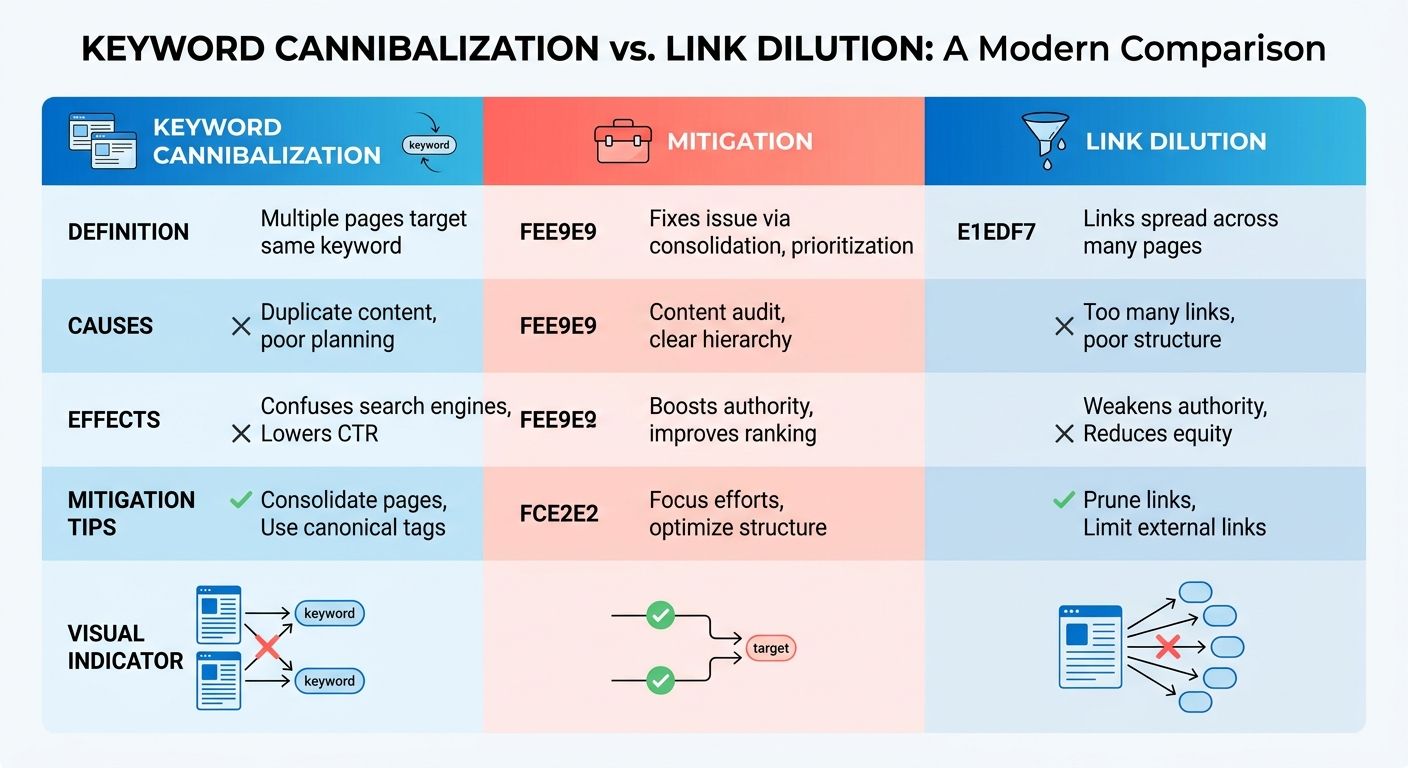
What Is Keyword Cannibalization?
Keyword cannibalization occurs when multiple pages compete for the same search intent. Ranking signals then split between those pages instead of concentrating on one.
Google typically shows one URL per query. When three pages target one intent, backlinks and internal links scatter. Relevance signals scatter too. Search engines evaluate how well each page matches the whole query.
The damage can be significant. Organic traffic may fall within affected keyword clusters. Sometimes a weaker page outranks a stronger one. In that case, every competing URL can lose visibility.
Does Cannibalization Actually Hurt Rankings?
The impact depends on intent overlap. Not every keyword overlap causes harm. Cannibalization is often fixable and may be less severe than expected. Two low-competition pages with different intent can coexist.
Some sources appear to conflict here. Google has said cannibalization does not prevent discovery or ranking. Other sources note that it can split authority and crawl budget. Both points can be true.
Separate discoverability from ranking efficiency. Google may still find your pages. However, it may struggle to choose the strongest URL. That uncertainty can reduce rankings even when indexation remains healthy.
How Does Internal Linking Distribute Authority?
Internal links pass authority and show which pages matter. When links mainly come from one topical family, they reinforce that page's authority.
Links between unrelated pages can dilute topical authority. AI-scaled content can create this problem quickly.
The central challenge is keeping link equity concentrated. Adding pages without a strict hierarchy scatters authority across too many endpoints. This reduces the ranking power of primary assets.
A content system should read your existing link structure first. Links without a structural plan create noise. They should reinforce established topical hubs.
Case studies in this area show a consistent pattern. Concentrated link equity can support stronger rankings. Scattered equity can contribute to cannibalization.
Getting Started
Before connecting an AI repurposing tool to your CMS, build an internal linking framework. Automation will not create that framework for you. Without it, each new asset can scatter authority.
A common pattern repeats across teams. They enable auto-publishing, triple page counts, and later find Google ranking the wrong pages. This often happens within six weeks. The issue is not always content quality. It can involve weak anchor diversity and poor topical-family discipline.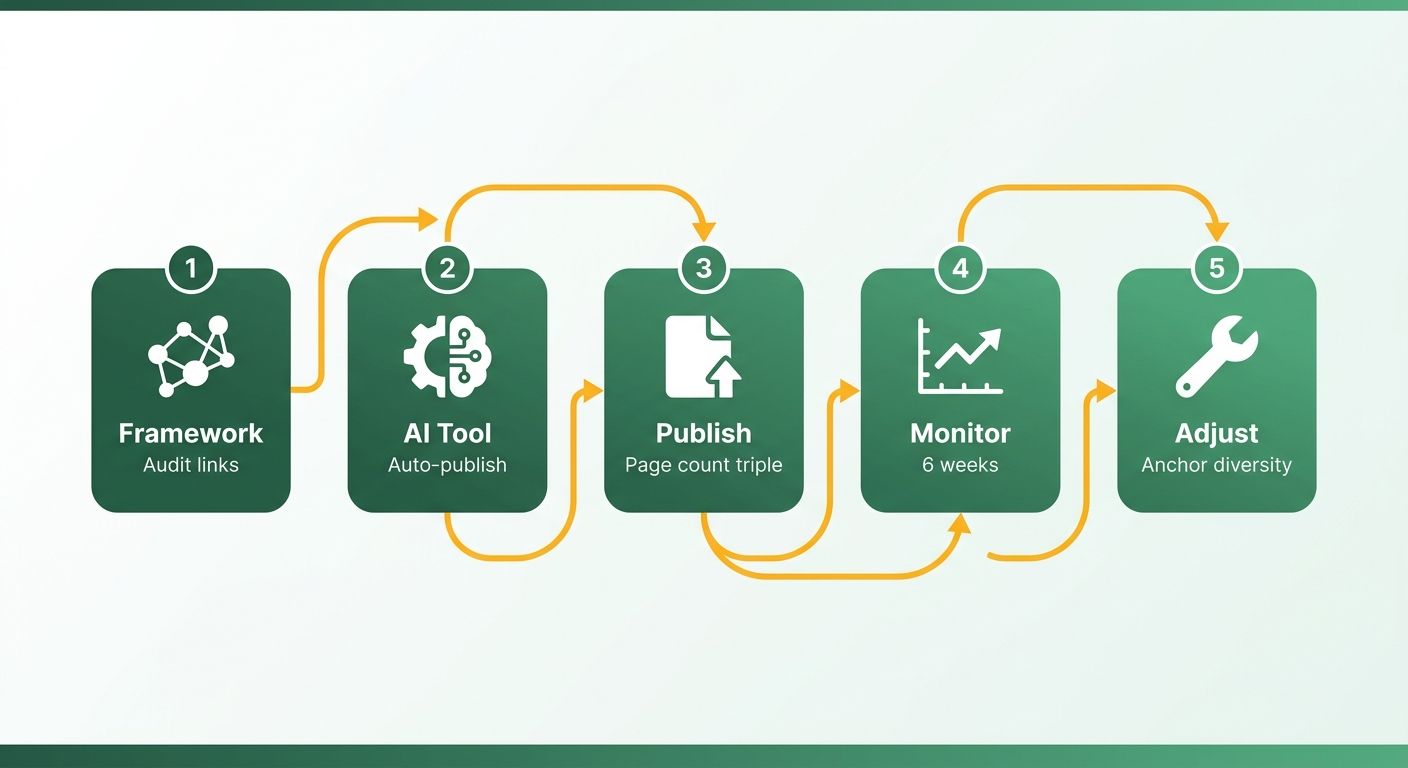
Audit Your Existing Internal Link Structure
First, identify pages that already carry internal link equity. Pages with fewer than three internal links often receive fewer clicks from Google Search. Pages with many internal links can receive more traffic. Run a crawl to find orphaned pages, which have zero internal links. Search engines may struggle to find and index them.
Look for two failure patterns. First, find important pages without internal support. Second, find pages competing for the same intent. One SEO agency recorded a 110% organic session uplift after consolidating competing real estate content. This illustrates the potential recovery from early consolidation.
Keep a crawl depth of three clicks or less for important pages. Pillar pages four or five clicks from the homepage may not accumulate enough authority.
Map Topical Families Before You Scale
Every internal link signals which page matters. Without topical-family constraints, those signals can scatter across unrelated pages.
Group pages into families that share core search intent. One marketing agency used a "Content Marketing Strategy" pillar page. It linked to supporting articles within that topic. The pillar became the single, clear destination for that intent. Related articles linked back using varied anchor text.
Focus on the overall topic a page addresses, not individual keywords. Linking an internal linking guide to a keyword research page can create topical confusion. Keep at least 75% of each page's internal links within its topical family. The other 25% can point to related categories or conversion pages.
Set Anchor Text Rules That Prevent Cannibalization
Anchor-text discipline affects whether internal linking compounds or cannibalizes. Using the same anchor text for different URLs creates competing signals. Search engines may struggle to interpret those links.
Before enabling automation, define anchor diversity rules for each family. A pillar page might collect varied anchors such as "internal linking guide," "how to structure internal links," and "linking best practices." This presents a broader topical match.
Supporting articles should link to the pillar with anchors reflecting their specific angle. They should not always use the pillar's exact target keyword.
One automated internal linking tool reported 47% traffic gains and 237% more Googlebot crawls on revenue pages. Those results followed enforcement of anchor diversity and topical-family constraints. The tool connected pages by shared intent, not keyword overlap alone. New pages therefore reinforced existing ones instead of competing. Manual linking cannot match the pace of AI content expansion. Without anchor rules, teams may lose rankings to competitors.
Core Features
Many AI tools publish quickly but scatter authority across new pages. Without a linking plan, this creates keyword cannibalization at scale. New assets then compete with existing content.
Internal linking determines whether expansion strengthens or dilutes rankings. Speed helps only when links preserve anchor diversity and respect topical families. Without both, new links can weaken existing pages.
What Should Internal Linking Actually Do?
Strong internal linking connects new content to existing pages. It uses shared search intent, topical family, and anchor text diversity. As your site grows, identify which URLs should receive links. Then vary anchor text so Google sees reinforcement rather than manipulation.
Internal links pass ranking signals through anchor text and placement. A footer link generally carries less weight than a contextual body link. Topical alignment should guide every link. A new LinkedIn post about content strategy should link to its content-strategy pillar, not an unrelated product launch.
This is where AnyPost's approach helps. The platform maps existing semantic relationships across your site. It then aligns generated content with your topical hierarchy. This helps prevent scattered, unrelated links across the site.
How Anchor Diversity Prevents Cannibalization at Scale
Publishing related assets creates many chances to link to pillar content. Teams often repeat the same anchor text. Google may interpret that pattern as over-optimization. If every asset also targets the pillar's keyword, the pages can form a cannibalization cluster.
Vary anchors across semantically related phrases. A "content repurposing" pillar might receive anchors such as "turning blogs into multiple formats," "repurposing workflows," and "multi-channel content strategies." Each phrase supports the same topic without repeating one exact term.
Placing links high in the page's HTML can also help discovery and indexing. This reduces intent collision, where pages chase one query and split authority.
The Topical-Family Discipline You Need Before Automation
Automation accelerates your existing structure. Without topical families, links may rely only on keyword overlap. The result can be a spaghetti link graph where every page links to every other page.
Before enabling auto-publishing, map content into topical families. Group pages by the intent they serve, not keywords alone. A page about "AI content tools for social media" serves a different intent from one about "AI content tools for email." They should link to each other sparingly, if at all.
HubSpot's topic cluster strategy provides a useful reference. It uses one pillar page per topic and several supporting pages. Cluster pages link back to the pillar. Unrelated clusters remain separate. This helps Google understand those relationships.
Teams often skip this planning step. They may then publish 200 AI-generated pages in one month and see rankings fall. The automation did not fail. The structure was missing.
Smart internal linking can support organic growth after you audit existing links. It also requires clear topical boundaries.
Before automating, answer one question: which page should receive the most links from your next ten assets? If every page receives equal priority, authority may dilute across the site.
Advanced Topics
Cannibalization does not usually prevent indexing. Search engines can still crawl and index competing URLs. The damage affects ranking efficiency and user experience instead.
This distinction matters. New pages may still get crawled. Ranking signals split across them, while internal link equity spreads thinner. Both effects can remain hidden until traffic stalls.
How Severe Is Cannibalization, Really?
Severity depends on intent overlap. It is not a simple binary condition. Pages with different enough intents can rank beside each other. Genuine intent collisions are more serious. Organic traffic can drop 30 to 50% across an affected keyword cluster.
The honest answer is that impact varies. Not every keyword overlap causes harm. Performance and search intent determine the effect. Often, adjusting internal link anchors can resolve the conflict. Content changes may not be necessary.
Do not merge pages just because they share a keyword. First, confirm that they serve the same intent. If they do not, keep them separate.
What Determines Whether Links Compound or Dilute?
Internal links within one topical family reinforce authority. Links between unrelated pages can dilute it. As a working principle, higher family alignment creates stronger topical signals.
This principle guides effective auto-linking. An algorithm that simply adds more links may worsen cannibalization. One that uses topical families and varied anchors can turn link volume into reinforcement.
High-volume publishing creates several practical concerns:
- Crawl budget constraints. Search engines may spend time crawling duplicate variations instead of primary pages.
- Anchor text decay. Automated systems may default to generic or repetitive anchors, which can look manipulative.
- The fix must match the growth rate. Manual anchor audits cannot keep pace with daily publishing.
This is why linking rules should connect directly to the publishing engine. Anchor and topical-family logic can run at publishing time instead of during monthly cleanup.
When Should You Consolidate Instead?
Consolidate when two pages genuinely share one intent and one clearly performs better. Before merging, confirm the overlap. Check ranking URLs for the shared query in Search Console. Also check whether Google keeps switching between them.
Do not consolidate pages with different intents or funnel stages. Avoid deletion and deindexing as default fixes. Those actions can harm organic performance more than cannibalization.
Use 301 redirects to direct authority to the primary page after merging. Use canonical tags for true technical duplicates. Then rebuild internal links to the consolidated page. This keeps its topical family strongly connected.
Best Practices
As page counts rise, internal linking becomes critical. Teams have tripled publishing velocity and then lost core rankings. New URLs scattered link equity instead of reinforcing topical families.
The solution is not necessarily slower publishing. Place links that respect anchor diversity and topical relevance from the start.
Use this rule: every internal link should strengthen a topical family or stay out. Related pages can reinforce one another. Unrelated links may dilute authority.
One SaaS company reorganized its help center around topical clusters. It cut average time-to-index from nine days to under three. The change relied on related pages reinforcing crawl priority.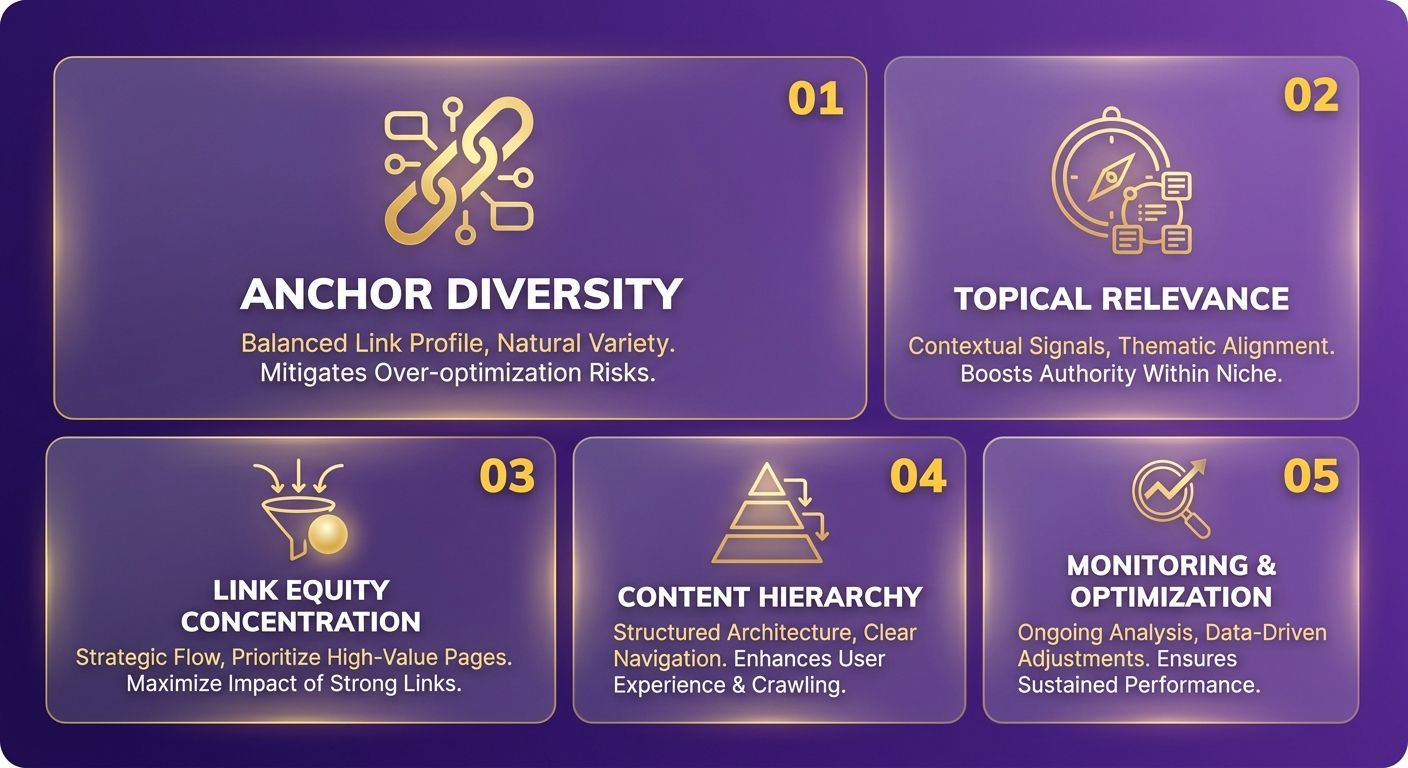
Keep Internal Links Within the Family
Treat your topical-family threshold as an ongoing constraint. When the link ratio falls below your benchmark, topical signals may weaken.
We define a topical family as pages sharing core search intent and subject matter. A content marketing pillar and articles about distribution, headline testing, and analytics belong together. A product comparison and unrelated company news do not. Their shared blog category is not enough.
Audit link sources every quarter. Export internal links pointing to top-performing pages. Then tag each source by topical family. Remove links from unrelated pages or replace them with relevant alternatives.
One B2B publisher used this process to consolidate 40 scattered links into 12 related sources. Its pillar page rose from position 14 to position 4 within two months. Search engines could better understand the pillar and cluster relationships.
Diversify Anchor Text to Avoid Over-Optimization
Anchor diversity helps avoid over-optimization while signaling relevance. Ten identical, keyword-rich links can look manipulative. Search engines may penalize patterns that appear engineered.
The recommended distribution is 40% exact-match anchors, 30% partial-match variants, and 30% branded or natural-language anchors. For "AI repurposing tools," that means four exact-match links. Three could use variants such as "AI repurposing platforms" or "content automation tools." Three could use phrases such as "our repurposing workflow" or "the platform we built for this."
Diversify complete phrases, not individual words. Avoid "learn more," "click here," and "read this" for the final third. These phrases add little topical meaning. Use contextual descriptions instead, such as "how we handle anchor diversity in auto-linking."
Prioritize Crawl Depth and Link Placement
Pages deep in your architecture may receive fewer crawls and less authority. Automated publishing can place new pages far down the directory tree. Search engines may then find and rank them later.
Place high-value pages within two clicks of your homepage. Use main navigation, footer links, or sidebars for conversion pages and competitive keywords. Unlinked URLs are difficult for crawlers to find.
Placement within each page also matters. Main-content links generally carry more weight than footer or sidebar links. Search engines treat in-content links as editorial signals. Favor article body links when choosing internal-link locations.
Audit and Remove Links That Cause Cannibalization
Not every internal link helps. Links between pages targeting the same keyword or intent can split ranking signals. One ecommerce category site found 18 product guides competing for one head term. After consolidating links, the strongest guide absorbed more internal equity. Its search click-through rate nearly doubled, while weaker duplicates were redirected.
To find these conflicts, review queries where multiple site URLs appear in top results. Choose the preferred page for each query. Then audit links pointing to competing URLs. Remove or redirect links supporting the wrong page.
When pages cover different aspects of one topic, use anchor text differentiation. Link to the broad overview with anchors such as "complete guide to X." Link to the deep dive with anchors such as "how to solve Y within X." This clarifies their different intents.
Automate Link Maintenance as Content Changes
Manual internal linking breaks down beyond a few hundred URLs. Outdated links remain live, new pages receive no incoming links, and topical families drift. Managing everything manually becomes an operational bottleneck.
Set clear maintenance triggers. After archiving or merging a page, check for dead links. After publishing, require related content to link to the new page. When rankings shift, review the page's topical family. Search intent can change over six months.
Automated checks help maintain link architecture as the site grows. They prevent authority from scattering across competing URLs.
Troubleshooting
When AI content scales, trouble may appear as a slow traffic flatline. Page counts rise while core keyword traffic stalls or falls. This pattern can indicate cannibalization.
Google may still find and index every new page. The problem is ranking efficiency. Signals split, and Google may rank a weaker page instead. Position volatility can also appear. A target keyword may switch between URLs from day to day.
Start with diagnosis before deleting content.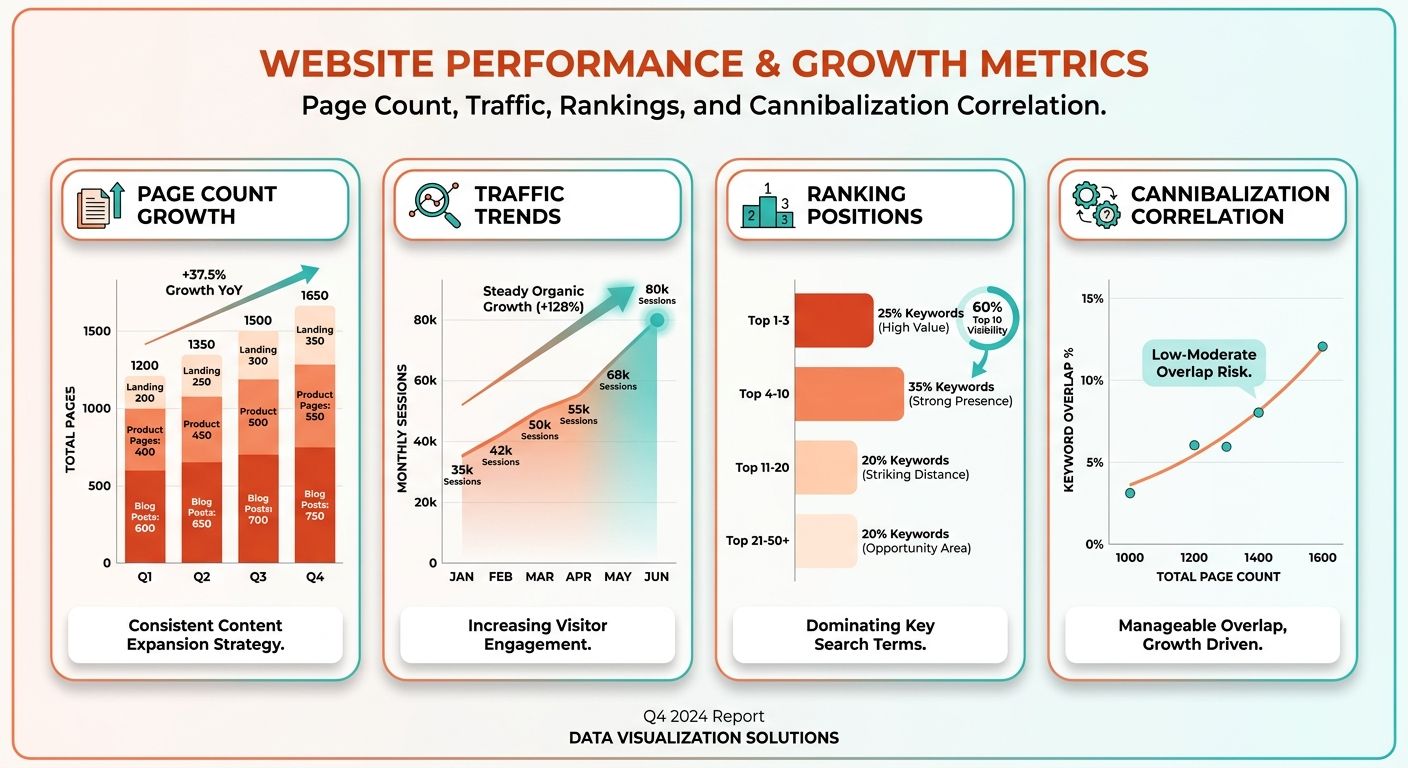
How Do You Diagnose Cannibalization Fast?
Isolate high-priority keywords and review their historical ranking URLs. If pages switch positions for one query, an intent conflict may divide link equity.
For a systematic review, crawl the site and map URLs to target keywords. Overlaps become easier to identify. This mapping is essential for high-volume sites.
Not every overlap creates a problem. Low search volume or distinct buyer stages can support multiple ranking pages. Review actual traffic impact before changing the structure.
When Should You Merge Versus Re-Link?
Merge pages when they serve the same intent and neither wins. Consolidate the content into one authoritative page. Then use a 301 redirect to direct authority there. This sends external backlinks and internal equity toward one URL.
Merging is not the best first move for most AI-scaled overlaps. Removing pages from the index too early can cost secondary keyword rankings. Keep both pages when they serve distinct user needs. Adjust their internal links instead.
At scale, re-linking is often the better default. Adjust the architecture to show which page represents the primary authority for the topic.
What If Traffic Keeps Sliding After You Fix It?
Review anchors first. If new pages all use identical anchors for one target, they may create another dilution problem. Confirm that anchor distribution follows your target ratios. Also confirm that links remain contextually relevant.
Internal links remain your strongest lever. John Mueller called internal linking "one of the biggest things that you can do on a website to kind of guide Google and guide visitors to the pages that you think are important." Anchor diversity and topical discipline turn link volume into reinforcement.
Resources and Tools
The tools for managing AI expansion fit three categories: diagnosis, automated linking, and structural auditing. You do not need every tool. However, high-volume publishers need at least one from each category.
If you publish one post monthly, most tools are unnecessary. A spreadsheet can handle manual mapping. These tools become useful when page counts outpace manual link tracking.
What Tools Diagnose Cannibalization?
Two diagnostic methods help identify intent conflicts. Review query-level performance data for competing URLs. You can also crawl the site and map target keywords to live URLs.
Review Search Console weekly for core keywords. It provides an early-warning system. When two URLs trade impressions for one query, investigate the collision.
For enterprise sites with hundreds of competing URLs, dedicated tracking can justify its cost. The key principle remains consistent: search engines evaluate semantic intent. Map intent, not terms alone.
Which Automated Linking Tools Actually Preserve Rankings?
Automated internal linking tools connect related pages through shared intent. They can also adapt as content changes. Their value comes from enforcing structural rules, not simply increasing link volume.
Industry studies show meaningful traffic improvements when high-value pages receive targeted internal links. Automation can also reduce manual link-management work by 90%. This gives teams more time for content quality and site maintenance.
These results depend on topical boundaries. An algorithm linking every page to everything can scatter equity further. Automated links must follow strict topical constraints. They should resemble editorial decisions.
For high-volume publishing, place these structural rules inside the content-generation workflow. New articles can then reinforce existing architecture instead of competing with it.
Where Should You Go Next?
Start with structure, then automate. Audit existing links first. Ensure that published content remains reachable by crawlers.
Keep valuable resources close to the root directory. This helps maximize their authority.
Your next steps, in order:
- Map intent to one destination page for each core keyword. Every important intent needs one clear target.
- Fix orphans and deep pages before adding more content.
- Enable automated linking only after establishing the framework.
The tools change, but the logic remains. A proactive linking framework helps rapid expansion support your site.
Frequently Asked Questions
1. Can two AI-generated pages target the same keyword without cannibalizing each other?
Yes, when they serve distinct search intents. Cannibalization depends on intent overlap, not keyword matches. An informational guide and a transactional product page can coexist. They satisfy different user needs.
2. How many internal links should a page have before it ranks well?
There is no magic number. A page needs enough internal visibility for crawling and indexing. Pages with minimal internal links may be overlooked. Relevant topical-cluster integration matters more than a specific link count.
3. What's the difference between cannibalization hurting discoverability versus ranking efficiency?
Discoverability means search engines can find and index pages. Cannibalization rarely prevents indexation. Instead, it reduces ranking efficiency. Search engines must choose between competing URLs, often lowering their positions.
4. When should I consolidate competing pages instead of leaving them separate?
Consolidate pages when they target the same user query and split organic traffic. If multiple URLs regularly change positions for one term, merging them may help. The result should be one comprehensive resource.
5. What ratio of internal links should stay within the same topical family?
Most internal links should point to related content within the same cluster. Links to broader categories or conversion pages can remain. A high concentration of cluster-specific links clarifies the page's primary topic.
6. Why does manual internal linking fail once I scale content with AI?
Manual linking cannot match rapid content production. Frequent publishing makes anchor and cluster tracking difficult across hundreds of pages. This creates structural errors and missed optimization opportunities.
7. Does using the same anchor text repeatedly help my pillar page rank?
No. Repeating identical, keyword-rich anchor text can trigger over-optimization filters. A natural profile uses related phrases, partial matches, and contextual terms. This signals relevance without appearing engineered.
AnyPost is an AI-powered content repurposing platform that helps teams scale publishing across channels while maintaining SEO structure.