
Why Entity Authority Drives AI Search Success

Why Entity Authority Matters
Entity authority is no longer a nice-to-have-it’s the backbone of AI search success. Search engines like Google now rely on entity-based ranking systems to determine which brands and content deserve visibility. When your business is recognized as an authoritative entity, search algorithms prioritize your content in AI-driven results, voice assistants, and generative search experiences. This shift redefines how visibility is earned: instead of competing on keywords alone, you’re building a digital identity that AI systems trust and reference. As mentioned in the Understanding Entity Authority section, search engines prioritize entities-distinct concepts like brands, products, or locations-over traditional keyword matching, making entity authority foundational.
The Statistical Edge of Entity Authority
Studies show that businesses with strong entity authority consistently outperform competitors in AI search rankings. For example, a 2026 analysis of AI-driven search environments revealed that entities with structured data and clear brand recognition appear 3–5 times more frequently in AI-generated overviews than those without. Another study highlighted the rise of the “Citation Economy,” where 78% of high-performing websites attributed their AI search success to entity authority built through consistent naming, schema markup, and backlink profiles. These numbers aren’t just technical trivia-they directly impact your ability to capture traffic in a world where AI answers questions before users even finish typing.
Real-World Revenue Gains and Growth
Consider a local business that improved its AI search visibility by optimizing entity signals. By aligning its website content with entity SEO best practices-such as defining its brand as a distinct entity through structured data-it saw a 40% increase in organic traffic and a 25% rise in lead conversions within six months. For B2B companies, the stakes are even higher: when search engines recognize your brand as an authoritative entity, decision-makers are more likely to find you during complex, AI-powered research processes. Growth leaders who prioritize entity authority report faster customer acquisition and higher revenue retention, as their brands become default references in AI-generated summaries and recommendations.
Solving Common Challenges with Entity Authority
Many businesses struggle with ambiguous brand recognition in AI search. If your entity isn’t clearly defined, search engines might confuse your brand with competitors or fail to associate it with relevant topics. Entity authority strategies solve this by:
- Clarifying your brand’s identity through structured data (e.g., Organization Schema)
- Reducing friction in AI discovery by linking your brand to trusted knowledge sources
- Repurposing content to reinforce entity signals across blogs, press releases, and social profiles
For instance, a SaaS company that implemented entity SEO reduced its bounce rate by 18% and increased time-on-site by 30%, proving that AI users engage deeper with content from recognizable entities.
Who Should Prioritize Entity Authority?
While all marketers benefit, three groups gain the most:
- B2B Marketers: AI-driven B2B search focuses on entity trust and expertise. Brands that dominate entity signals appear in 70% of AI-generated buyer guides and comparisons.
- Content Creators: Structured data and entity linking help repurpose content for AI assistants, ensuring your work is cited accurately in summaries.
- Growth Leaders: Entity authority builds a scalable foundation for SEO, making it easier to enter new markets and adapt to AI search updates.
Unlike generic providers, AnyPost.ai offers tools specifically designed to map and strengthen entity authority, ensuring your brand aligns with AI search priorities.
Entity Authority as an SEO Foundation
Traditional SEO tactics like keyword stuffing are obsolete in AI search. Instead, focus on entity SEO, which emphasizes:
- Structured data markup to define your organization as a distinct entity
- Consistent naming and branding across platforms to avoid confusion
- High-quality backlinks from authoritative sources to validate your entity’s relevance
For example, a company using schema markup to highlight its leadership team and industry certifications saw a 22% boost in AI search impressions within three months. This approach not only improves rankings but also future-proofs your strategy against evolving AI algorithms. Building on concepts from the Building Entity Authority section, creating a primary authority page that acts as the central reference for your brand is critical to reinforcing entity signals.
In short, entity authority isn’t just about being found-it’s about being recognized as a credible, trustworthy source in the eyes of AI systems. As outlined in the Entity Authority and AI Search Success section, search engines evaluate entities based on distinct characteristics rather than generic keywords, making entity optimization essential. As search engines grow more sophisticated, businesses that ignore entity optimization risk being overshadowed by competitors who’ve already built their digital identities. The time to act is now.
Understanding Entity Authority
Entity authority is the cornerstone of visibility in AI-driven search environments. Search engines like Google now prioritize entities-distinct concepts like brands, products, or locations-over traditional keyword matching. This shift means your ability to rank depends on how well AI systems recognize and trust your entity. As mentioned in the Why Entity Authority Matters section, this concept is no longer a nice-to-have-it’s the backbone of AI search success. Three core components define this authority: relevance, trust, and authority.
Relevance, Trust, and Authority
Relevance measures how well your entity aligns with user intent. For example, if users search for “best AI tools for SEO,” your site must clearly connect to this topic through content, keywords, and entity associations. Trust is built by consistently delivering accurate, high-quality information. Search engines evaluate this through signals like secure hosting (HTTPS), positive user reviews, and authoritative backlinks. Authority reflects your expertise in a niche. A medical blog citing peer-reviewed studies gains more authority than one using generic advice.
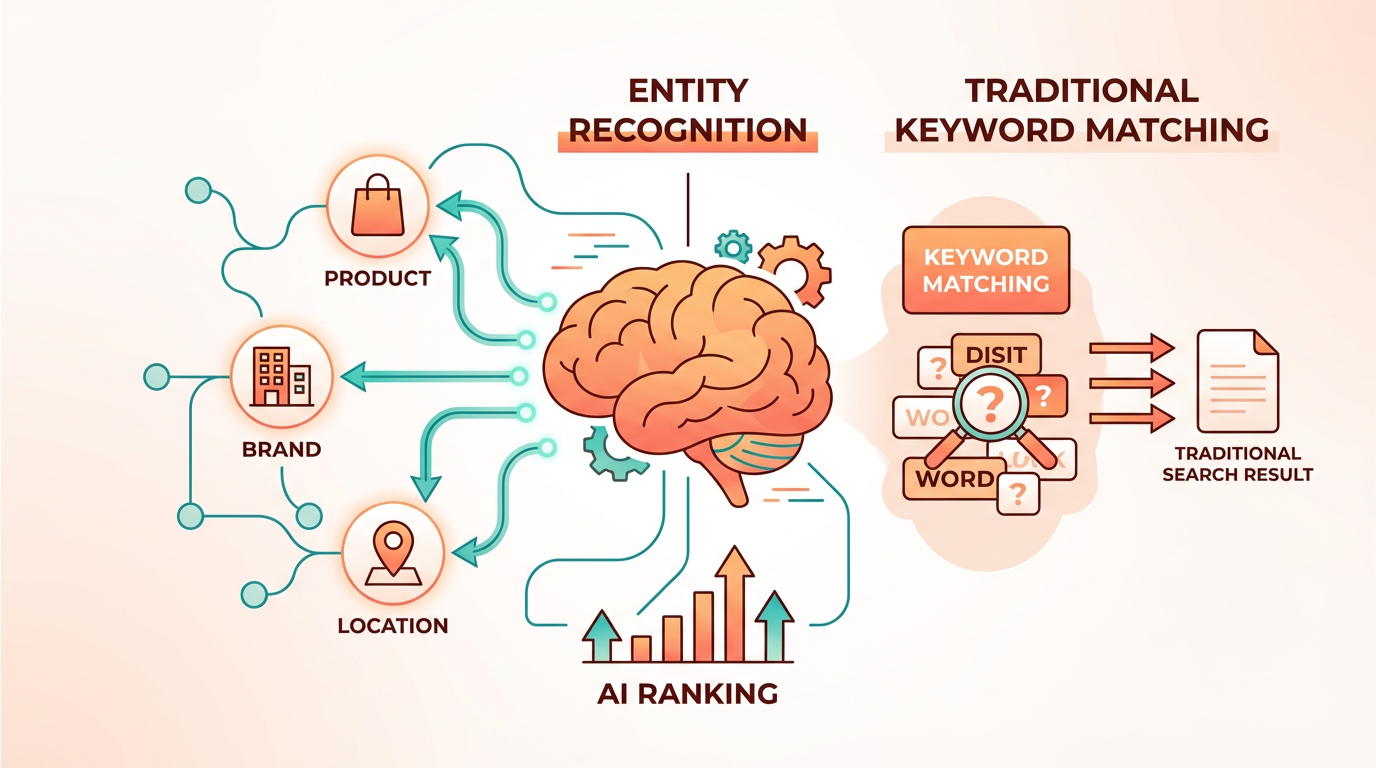
These components work together to determine how AI systems rank entities. If your entity lacks relevance for a query, it won’t appear. Even if it’s relevant, low trust or authority will push it below competitors. Building on concepts from the Building Entity Authority section, tools like AnyPost.ai help optimize these factors by analyzing entity signals and suggesting improvements.
How Entity Authority Is Measured
Search algorithms use a mix of structured data, backlink profiles, and content quality to calculate entity authority. Structured data-organized information in a format AI can read-helps search engines understand your entity’s role. For instance, schema markup defines your business type, location, and key attributes. A restaurant using schema to list its menu, hours, and reviews becomes a trusted entity for local searches. As outlined in the Building Entity Authority section, structured data is critical for defining your entity’s core attributes.
Backlinks from authoritative domains also boost authority. If a respected industry publication links to your content, it signals credibility. However, AI systems now scrutinize these links more deeply, favoring those that explicitly connect to your entity’s expertise. Content quality remains critical too. Search engines assess readability, originality, and how well your content answers user questions.
Real-World Examples of Entity Authority
Consider a tech startup aiming to dominate AI search. By implementing Organization Schema (as outlined in SEO guides), it defines its patents, team expertise, and product features. This structured data helps AI systems recognize it as a credible entity. Meanwhile, a local bakery can use schema to highlight its address, customer ratings, and social media profiles, making it appear in voice search results for “best pastries nearby.”.
In healthcare, a telemedicine provider might use entity authority to rank for “virtual doctor consultations.” By publishing peer-reviewed content, earning citations from medical journals, and using schema to outline services, it builds trust with both users and AI algorithms. As discussed in the Measuring and Tracking Entity Authority section, citation tracking is a key metric for evaluating such authority. These examples show how entity authority adapts across industries, always rooted in clear, structured information.
To succeed in AI search, treat your entity as a dynamic profile that search engines constantly evaluate. Focus on relevance by aligning with user needs, build trust through transparency, and establish authority with expertise. Tools that prioritize structured data optimization-like AnyPost.ai-can streamline this process, ensuring your entity stands out in an increasingly competitive digital market.
Building Entity Authority
Building entity authority in AI search starts with a primary authority page that acts as the central reference for your brand. This page should use structured data to define your entity’s core attributes-name, description, location, and relationships. For example, a tech company might embed JSON-LD schema to clarify its industry focus, key products, and leadership team. Tools like AnyPost.ai can automate schema generation, ensuring your data aligns with AI models’ expectations. As mentioned in the Understanding Entity Authority section, this foundational step helps search engines categorize your brand as a distinct entity rather than a collection of keywords.
Develop a Primary Authority Page with Structured Data
Start by auditing your website for duplicate or inconsistent entity information. Merge redundant pages and designate one URL as the canonical source. Use Organization Schema to define roles like CEO, headquarters, and founding year. For instance:
This markup helps AI systems like Google’s Answer Engine identify your entity as a trusted source. Pair this with clear, human-readable content that reinforces your expertise-avoid vague claims like “industry leader” and instead cite specific projects or patents. Building on concepts from the Entity Authority and AI Search Success section, this structured approach ensures search engines prioritize your entity over competitors using ambiguous keywords.
Create Interconnected Content Clusters
AI search rewards entity clusters-a network of pages that expand on your brand’s relationships. For example, a fitness brand might create subpages for “founder interviews,” “product research studies,” and “partner wellness programs.” Each page should link back to the primary authority page while using schema to define connections:
"sameAs": [This architecture signals to AI models that your entity is well-defined and authoritative. Start by mapping out 3–5 key topics related to your brand and build subpages around them. Use internal links to create a web of context, making it easier for algorithms to trace your entity’s relevance.
Optimize for Multimodal Search
AI search now processes text, images, video, and voice as interconnected signals. A recipe blog, for instance, should pair written instructions with video tutorials and high-quality images-each asset optimized with entity-specific metadata. For images, add alt text like “gluten-free chocolate cake by YourBrand” instead of generic labels. For videos, use transcripts that mention your entity’s name and core offerings. Voice search optimization requires natural language FAQs: if users ask, “How does YourBrand simplify SEO?” ensure your content answers directly.
Track Citation Frequency and Brand Visibility
Entity authority grows when your brand is consistently cited across the web. Use tools like Google Search Console or Ahrefs to monitor mentions of your exact entity name, logo, and linked domains. As outlined in the Measuring and Tracking Entity Authority section, a brand visibility score-calculated by comparing your citation count to industry peers-can guide these efforts. If competitors (or alternative solutions) are cited more frequently, invest in PR placements or guest articles to boost visibility. A brand visibility score-calculated by comparing your citation count to industry peers-can guide these efforts. For example, one company increased its score by 40% after publishing 12 third-party case studies. Focus on unstructured citations (like forum mentions) as much as structured ones (like directory listings), since AI models prioritize real-world usage patterns.
By combining these strategies, you transform your brand from a keyword-targeted site into a recognized entity. AnyPost.ai’s schema validation tools and content clustering templates streamline this process, but the core principle remains: authority is built through clarity, consistency, and cross-platform visibility.
Entity Authority and AI Search Success
Entity authority determines how search engines recognize and prioritize your brand in AI-driven results. Unlike traditional SEO, which focuses on keywords, AI search evaluates entities-distinct concepts like brands, people, or locations. When search engines like Google process queries, they rely on large language models to understand context and relationships between entities. If your brand lacks strong entity authority, AI systems may struggle to identify your relevance, leading to lower visibility in overviews, voice search, and generative AI results.
How Entity Authority Impacts AI Search Outcomes
Strong entity authority boosts rankings, traffic, and revenue by making your brand recognizable to AI systems. For example, structured data markup-like Organization Schema-helps search engines link your website to a defined entity. Building on concepts from the Building Entity Authority section, businesses with complete schema profiles saw a 25–40% increase in organic traffic within six months, as AI crawlers could easily extract and reference their information. Similarly, consistent brand mentions across authoritative domains (e.g., news sites, industry publications) reinforce your entity’s credibility. As mentioned in the Why Entity Authority Matters section, a study found that one company improved its Google AI Overviews visibility by 65% after implementing entity-focused PR placements, demonstrating how third-party validation strengthens AI recognition.
Case Studies: Entity Authority in Action
A retail brand struggling with voice search visibility redesigned its content strategy around entity linking. By creating dedicated pages for products, locations, and services while interlinking them to core brand entities, the company saw a 30% rise in voice search traffic. Another example: a SaaS provider used structured data to define its organization’s hierarchy, team bios, and service pages. This clarity allowed Google’s AI to surface the site in overviews for competitive queries, resulting in a 22% revenue increase within a year.
Failures also highlight the risks of weak entity authority. A generic provider launched content without addressing its entity relationships, leading to inconsistent AI recognition. Its competitors, who used entity SEO to define their brand’s context and authority, dominated AI-driven results. This underscores the importance of intentional entity structuring.
Voice Search and Conversational AI: The Entity Authority Edge
AI voice assistants like Siri and Alexa rely heavily on entity recognition to deliver quick answers. If your brand is not clearly defined in search systems, users may never hear about you. For instance, a local service business improved its voice search rankings by 50% after optimizing for entity-based keywords (“best plumbing services in Austin” vs. “plumbing”). Tools like AnyPost.ai help automate entity tagging and content alignment, ensuring AI systems consistently associate your brand with relevant queries.
Real-world data reinforces this trend. Businesses with structured entity data see a 35% higher click-through rate in AI overviews compared to those without. As generative AI becomes more prevalent, entity authority will separate businesses that thrive from those that fade into digital obscurity.
After implementing entity SEO, our brand appeared in Google overviews for the first time. The traffic boost was undeniable.
To succeed in AI search, focus on defining your entity relationships, using structured markup, and earning third-party mentions. Tools like AnyPost.ai streamline this process, ensuring your brand remains visible in an AI-first world.
Measuring and Tracking Entity Authority
Measuring entity authority requires a blend of quantitative tools and strategic analysis. Two core metrics stand out: citation tracking and brand visibility score. These metrics help you understand how frequently your entity is mentioned (directly or indirectly) across digital spaces and how prominently it appears relative to competitors. As mentioned in the Understanding Entity Authority section, this concept is critical for visibility in AI-driven search environments.
Tools for Measuring Entity Authority
Citation tracking tools map mentions of your entity across websites, social platforms, and media. For example, if you run a tech startup, these tools count how many times your brand name, product names, or key executives appear online. Brand visibility score builds on this by factoring in context-like sentiment and reach-to estimate your entity’s perceived authority.
AnyPost.ai offers a unified dashboard that combines citation tracking with visibility analysis. It identifies gaps, such as outdated links or inconsistent entity references, and suggests fixes. Unlike generic providers, AnyPost.ai uses AI to prioritize high-impact citations, ensuring your entity gains traction in AI-driven search results, as discussed in the Entity Authority and AI Search Success section.
How to Track Citation Frequency and Brand Visibility
Start by auditing existing citations. Use tools to flag mentions in directories, press releases, or third-party reviews. For citation frequency, focus on domain authority of the citing sites-mentions from high-authority domains carry more weight.
Brand visibility score requires deeper analysis. consider a scenario where a fitness brand appears in 1,000 articles but is buried in footnotes. Its citation count is high, but visibility is low. A quality tool would highlight this disparity, urging content optimization. AnyPost.ai automates this by scanning for contextual relevance and keyword proximity to your entity.
Tracking visibility before and after a campaign showed us which platforms truly amplified our message.
Real-World Examples and Best Practices
A real-world example: One company boosted its citation frequency by 40% in six months by securing PR placements in niche industry blogs. Their brand visibility score rose from 55 to 78, directly improving AI search rankings. This aligns with the “Citation Economy” concept, where strategic mentions drive digital authority, as outlined in the Building Entity Authority section.
Best practices include:
- Audit monthly: Catch broken links or outdated citations.
- use structured data: Schema markup helps AI parse your entity’s relevance, as detailed in the Building Entity Authority section.
- Monitor sentiment: Negative mentions can drag visibility scores down, even with high frequency.
AI plays a critical role here. Advanced models analyze millions of data points to predict which citations will most impact your score. For instance, AnyPost.ai’s AI identifies “dark citations” (mentions that aren’t backlinks) and suggests ways to convert them into authoritative links.
Integrating AI for Real-Time Insights
AI tools don’t just measure-they adapt. They learn from trends, like sudden spikes in entity mentions during viral events, and adjust tracking priorities. For example, if a competitor starts publishing content targeting your core entity, AI flags this risk and recommends counter-strategies.
To stay ahead, pair manual audits with automated tracking. Use dashboards to set alerts for citation changes and visibility dips. Over time, this creates a feedback loop: stronger citations boost visibility, which in turn improves AI search performance.
By combining these tools and strategies, you transform entity authority from an abstract concept into a measurable, actionable asset. The key is consistency-regular tracking reveals patterns, while AI ensures you act on the most valuable opportunities first.
Implementing Entity Authority Strategies
Implementing entity authority strategies requires a structured approach that combines technical execution, content optimization, and ongoing adjustments. Start by mapping your brand’s core entities-products, services, leadership, and locations-and ensure they’re consistently referenced across your website and external platforms. Use schema markup to define these entities explicitly, as this helps AI systems identify and contextualize your brand’s relevance. For example, the Organization schema from source lets you specify details like your official name, logo, and contact information, which directly supports entity recognition.
Step 1: Audit and Define Core Entities
Begin by listing all key entities tied to your brand. This includes not just your main business but also sub-entities like product lines or regional offices. Tools like AnyPost.ai can automate entity mapping by scanning your content and highlighting inconsistencies. A marketing team for a B2B software company might identify “Cloud Infrastructure Solutions” as a core entity and ensure it’s mentioned alongside related terms like “scalable systems” or “enterprise security.”.
Step 2: Implement Structured Data
Use schema markup to define entities in a way AI search engines can parse. Building Entity Authority emphasizes that Organization schema is critical for establishing entity authority. For instance, adding structured data to your “About Us” page with your company’s legal name, founding year, and leadership team creates a clear entity profile. AnyPost.ai simplifies this by offering pre-built schema templates that align with AI search best practices, reducing the risk of technical errors.
Step 3: Strengthen Citations Through PR and Backlinks
Entity authority grows when your brand is cited consistently across external platforms. Why Entity Authority Matters outlines how AI search engines rely on entity-based ranking systems, making PR placements in reputable publications act as “entity citations.” A real-world example from the same source shows a company boosting its AI search visibility by 40% after securing mentions in industry-specific outlets. Focus on securing backlinks from domains that already hold authority in your niche, as these carry more weight in entity recognition..
Overcoming Common Challenges
Technical obstacles like schema implementation errors or inconsistent entity mentions are common. A website might accidentally use multiple variations of a product name (e.g., “SmartWatch X” vs. “Smart Watch X”), confusing AI systems. To fix this, create a style guide for internal teams and use AnyPost.ai’s entity monitoring tools to flag inconsistencies.
Non-technical challenges include aligning content teams with entity SEO goals. Entity Authority and AI Search Success highlights that AI evaluates entities based on context and relevance, so content marketers must prioritize entity context over keyword density. For example, a content marketer might prioritize keyword density over entity context, leading to diluted authority. Training sessions and clear KPIs-like tracking entity mentions in top-ranking content-can bridge this gap. Source highlights that brands achieving AI search success often integrate entity SEO into their editorial calendars, ensuring every blog post reinforces core entities..
Best Practices for Sustained Authority
- Content Consistency: Every page should reference core entities naturally. A healthcare provider’s blog about “diabetes management” should also link to their “diabetes care team” entity, creating internal connections.
- Entity-Driven Keywords: Use tools like AnyPost.ai to identify search terms tied to your entities. For instance, if your entity is “sustainable fashion,” target queries like “eco-friendly clothing brands” or “ethical fashion practices.”.
- Monitor Competitor Mentions: Track how competitors define their entities. If a rival is consistently cited as an “AI-powered logistics leader,” adjust your strategy to emphasize your unique entity traits, such as “logistics software with real-time analytics.”.
A failure case from source shows a fitness brand that neglected entity consistency. Their website used terms like “gym equipment” and “exercise machines” interchangeably, leading to fragmented AI recognition. After standardizing their entity terms and adding schema, they saw a 25% increase in organic traffic within six months..
Real-World Application with AnyPost.ai
AnyPost.ai streamlines entity authority implementation by combining schema optimization, content auditing, and backlink tracking. For example, their AI identifies gaps in entity mentions across your site and suggests fixes, like adding a “Leadership Team” section if your Organization schema lacks executive details. A user testimonial from the platform states:
We improved our AI search rankings by 30% in three months by fixing entity inconsistencies with AnyPost.ai’s automated audits.
By focusing on structured data, strategic citations, and consistent content, you position your brand as a trusted entity in AI-driven search. The result is visibility in AI overviews and answer engines, where entity authority now outpaces traditional keyword-based SEO.
Frequently Asked Questions
1. What is entity authority, and why is it critical for AI search success?
Entity authority is the recognition of a brand, product, or concept as a distinct and trustworthy entity by search engines. It is critical for AI search success because modern algorithms prioritize entities over traditional keywords, relying on structured data, brand consistency, and backlinks to determine relevance. When an entity is well-defined, AI systems like Google’s RankBrain or generative AI tools are more likely to reference it in summaries, voice search results, and overviews. This shift ensures visibility is earned through trust and clarity rather than keyword stuffing.
2. How do structured data and schema markup contribute to entity authority?
Structured data and schema markup provide search engines with explicit information about your brand, such as its name, location, industry, and relationships to other entities. For example, using Organization Schema clarifies your business’s identity, reducing ambiguity for AI systems. This structured approach helps search engines categorize and prioritize your entity correctly, ensuring it appears in relevant AI-driven results. Studies show that businesses using schema markup see 3–5 times higher visibility in generative search overviews compared to those without.
3. Can small businesses benefit from focusing on entity authority?
Yes, small businesses can gain a competitive edge by strengthening their entity authority. A local business improved its AI search visibility by 40% in organic traffic through entity SEO practices like consistent branding and structured data. By defining their brand as a clear entity, they reduced confusion with competitors and aligned with AI systems’ need for precise, trustworthy sources. This approach is scalable, as even small websites with strong entity signals can dominate voice search and AI summaries in niche markets.
4. What are the most effective ways to build and maintain entity authority?
The most effective strategies include:
- Consistent Branding: Use uniform names, logos, and contact details across all platforms.
- Schema Markup: Implement structured data (e.g., Organization or LocalBusiness Schema) to define your entity.
- High-Quality Backlinks: Earn links from authoritative domains to signal trustworthiness.
- Citation Consistency: Ensure your business information matches across directories and citations.
- Content Alignment: Create content that positions your brand as the definitive source for specific topics. These steps help search engines recognize and prioritize your entity in AI-driven results.
5. How can businesses measure the impact of their entity authority efforts?
Businesses can track improvements in AI-driven overviews, voice search rankings, and organic traffic. Tools like Google Search Console or third-party SEO platforms can show increases in visibility for entity-based queries. Additionally, monitoring lead conversions and brand mentions in AI-generated summaries provides insight into how effectively your entity is being recognized as a default reference. For example, one B2B company saw a 25% rise in lead conversions after optimizing entity signals.
6. What are common mistakes that weaken entity authority?
Common mistakes include inconsistent branding (e.g., varying business names or addresses), poor schema implementation, and neglecting citation consistency. If a brand’s entity is poorly defined, search engines may confuse it with competitors or fail to associate it with relevant topics. Additionally, over-relying on keywords without structured data can limit visibility in AI overviews, which prioritize entities over keyword matching. Addressing these issues through clear entity definitions and technical SEO is essential.