
Why Hiring External Writers Fails Without AI Rewrite Layers

Key Takeaways
- Freelancer-only content costs $150–$500 per article but delivers inconsistent brand voice unless you hire specialists at $300+.
- AI rewrite layers cut turnaround from 3–7 days to 1–3 days while automating SEO optimization that freelancers handle manually.
- Most outsourced writers produce generic Wikipedia-style drafts that require post-production rewriting to match your brand.
- In-house teams cost $500–$1,200 per article in loaded expenses and take 5–10 days, making them the slowest option.
- Hybrid models combine low-cost freelancer drafts ($50–$200) with AI rewriting to achieve high brand consistency at scale.
- The AI rewrite approach learns from existing content to maintain voice consistency that one-off freelancers rarely deliver.
- Traditional outsourcing only works when hiring subject-matter experts who already understand your brand without extensive onboarding.
Quick Comparison Summary
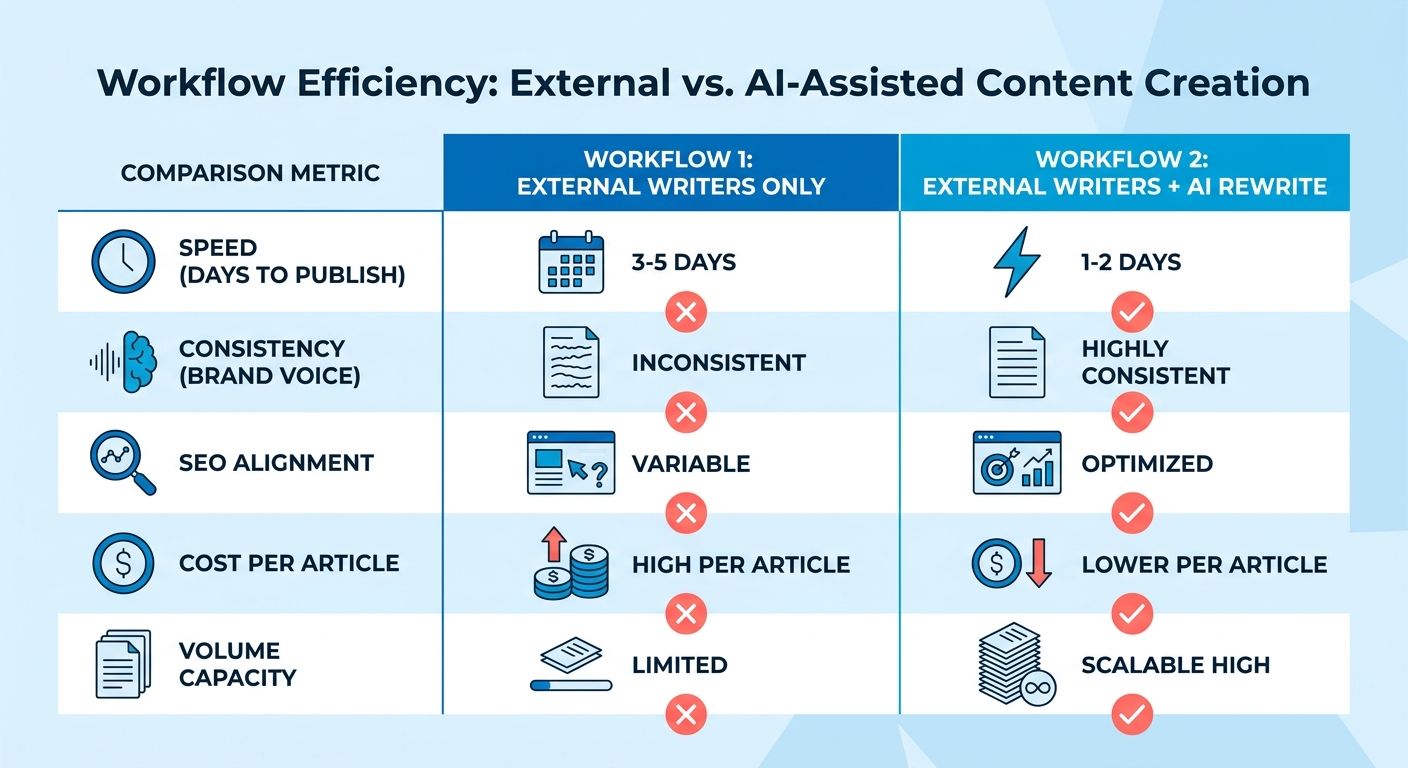
You outsource content to external writers. You wait three to five days. Then the draft lands in your inbox, reading like a Wikipedia entry. Now you're rewriting it yourself. That's the freelancer-only model in practice.
The alternative is hiring external writers for the first draft. Then run it through an AI rewrite layer that fixes voice, tightens structure, and optimizes SEO before it reaches your CMS. You still get human research and subject-matter depth. You just aren't paying $300 per article for someone who already speaks your brand language.
The freelancer-only path works when you've found a writer who has internalized your style guide. That takes months. Most teams hiring external writers don't have months. They have deadlines and a content calendar that doesn't pause while a new freelancer learns whether you write "SaaS" or "Saas."
The Core Trade-Off: Speed vs. Voice Consistency
| Approach | Turnaround Time | Brand Voice Match | SEO Optimization | Typical Cost per Article |
|---|---|---|---|---|
| Freelancer Only | 3-7 days | Inconsistent unless you hire specialists | Manual; requires in-house SEO review | $150–$500 |
| AI Rewrite Layer | 1-3 days | High; AI learns from your existing content | Automated; baked into rewrite process | $50–$200 (draft) + platform fee |
| In-House Team | 5-10 days | High; native understanding | Manual; depends on team SEO literacy | $500–$1,200 (loaded cost) |
Some providers report that clients reject a significant portion of first drafts for tone or structural issues. That means much of what you commission doesn't publish without a second round. Without a rewrite layer, you're either publishing off-brand content or burning revision budget on drafts that should have been closer the first time.
What the Rewrite Layer Actually Does
The AI rewrite approach treats the external draft as raw material. The writer handles research and initial structure. The AI handles brand alignment, keyword placement, semantic HTML, and internal linking. You're not asking the freelancer to study your brand guidelines. You're offloading that step to a system trained on your published content.
This matters when you're scaling. One freelancer can maintain voice consistency. Five freelancers working in parallel cannot, unless you standardize the post-production layer.
Pricing Reality Check
Traditional SEO agencies charge $400–$800 per article because they bundle research, writing, editing, and optimization into one deliverable. The hybrid model unbundles that. You pay $50–$150 for the draft at commodity freelance rates, then route it through an AI rewrite system that costs $99–$299/month for unlimited processing. At 10+ articles per month, the hybrid model costs roughly 60% less than hiring an agency or building an in-house editorial team.
The tradeoff isn't quality. It's control. Freelancer-only workflows give you full editorial oversight but demand constant review cycles. AI-rewrite workflows give you automated consistency but require upfront investment in training the AI on your brand context.
Why the Post-Production Rewrite Layer Matters
You outsource article production, and you're choosing between two workflows that look similar on paper but deliver different ROI. The first path—hiring external writers and publishing their drafts with light edits—works when you have deep subject-matter experts who already internalize your brand voice. The second path—using external writers as a first-draft layer, then rewriting with AI for brand alignment and SEO structure—works when you need volume, consistency, and on-brand output without paying for expert-level talent.
Teams default to the freelancer-only model because it feels straightforward. You brief, they write, you publish. But that model breaks when your external writers deliver generic, search-engine-first drafts that miss your brand voice, bury key points below the fold, and ignore SEO structure. You inherit the rewrite burden yourself, which defeats the purpose of outsourcing.
What Makes the Rewrite Layer Non-Negotiable
External writers face downward earnings pressure as AI tools enter the market. That economic reality creates a misaligned incentive. Freelancers who adopt AI editing often face lower client rates, so they either skip the rewrite step entirely or deliver minimally edited output that still reads generic. The post-production rewrite layer that makes AI-drafted content viable—the brand voice pass, the structural SEO pass, the fact-check pass—takes 60 to 90 minutes per article. Most freelancers won't invest that time when their per-article rate is already shrinking.
The rewrite layer is where outsourced content either becomes brand-aligned or stays generic. You need someone, human or AI, who knows your style guide, your preferred structure, your keyword targets, and your internal terminology. External writers rarely have access to that context, and even when they do, they lack the incentive to apply it rigorously. Automated content generation platforms can handle this rewrite layer, producing SEO-optimized material that maintains consistent brand voice across high volumes without requiring manual editing passes from your team.
When Each Workflow Fits
The freelancer-only model works best when you're publishing deep technical content—pharmaceutical research breakdowns, legal case analysis, or engineering whitepapers—where subject-matter accuracy matters more than brand personality. These pieces often require 40+ hours of research per article, and the writers commanding that expertise rarely optimize for SEO or brand voice without explicit line-item fees.
AI rewrite layers shine when you're running a content velocity play: publishing product comparisons, how-to guides, listicles, or category pages where brand consistency and structural optimization matter more than niche expertise. Teams publishing 30 to 50 articles monthly typically see faster time to publish with AI rewrite workflows compared to manual editing queues.
In-house writers remain the default for small teams publishing fewer than eight articles monthly or for brands where every piece carries reputational risk. That includes healthcare providers, financial advisors, and B2B SaaS with enterprise clients. The loaded cost per article runs higher, but you avoid the coordination overhead of briefing external contributors and the quality variance that comes with rotating freelancers.
What Actually Drives the Decision
The decision comes down to three variables: your internal editing capacity, your brand voice complexity, and your content velocity target. If you have a senior editor who can rewrite five articles per week, the freelancer-only model works. If you don't, you need automation in the rewrite layer.
Brand voice complexity matters because simple, straightforward brands like news sites and aggregators can publish lightly edited freelancer drafts. Brands with distinctive tone, internal jargon, or strict style guidelines can't.
Content velocity is the forcing function. When you're targeting 20+ articles per month, manual rewriting doesn't scale. You either hire more editors, which is expensive, or automate the rewrite pass. Most teams hit the freelancer-only ceiling around 15 articles per month. That's when the editing queue starts causing publication delays, and you realize the external writers are creating more work, not less.
Feature Comparison

You outsource content writing, and you're evaluating two systems on brand consistency, SEO structure, and speed to publish. The freelancer-only model gives you drafts written by humans who may or may not understand your voice. The AI-rewrite layer takes those drafts and runs a second pass to align tone, insert schema markup, and tighten structure before publication.
The performance gap between these approaches shows up in three areas: how much editing time your in-house team spends, how many drafts meet your brand standards on first submission, and whether the published piece ranks.
How External Writers Handle Brand Voice vs. AI Rewrite Layers
A freelancer working solo will match your brand voice if they've written dozens of pieces for you or if you've hired a subject-matter expert who already speaks your language. Building that relationship takes 6–8 months of regular assignments before the writer internalizes your terminology, preferred examples, and editorial stance on polarizing topics in your niche.
An AI rewrite layer solves this by ingesting your style guide and running every draft through a transformation step. You still get subject-matter depth from a human writer, but the AI rewrites sentences to match your tone, swaps generic phrases for your terminology, and adjusts formality. AI-rewritten content trained on your past articles avoids the generic tell that lacks the editorial fingerprints of a brand.
The tradeoff: freelancers can write subjective, opinion-driven pieces that require human judgment. AI rewrite layers work best for informational content where structure and consistency matter more than hot takes. If you're producing thought-leadership essays or founder narratives, the freelancer path preserves the nuance that rewrite algorithms flatten. For product comparison guides, how-to tutorials, and FAQ expansions, the AI layer delivers cleaner, more consistent output.
SEO Structure and Schema Markup Differences
Freelancers rarely deliver articles with H2/H3 hierarchies optimized for featured snippets or answer boxes. They write prose that reads well but doesn't follow the question-based heading patterns that search engines reward. A typical draft includes narrative-style subheadings like "Why This Matters" instead of "How Does X Affect Y?" format that triggers position-zero placement.
Platforms that apply AI-driven structural optimization can insert question-based H3 headers, break long paragraphs into 2–3 sentence blocks, and add definition-style formatting for key terms. These systems also flag where schema markup should go—FAQ blocks, how-to steps, product comparisons—and format the content to match. This is the post-production layer that external writers skip because it's time-intensive and most don't have SEO training.
Some content teams report that AI-restructured drafts earn featured snippets more frequently than freelancer-submitted drafts published as is. The difference isn't writing quality. It's heading structure, list formatting, and definition placement that the rewrite layer enforces programmatically.
Speed to Publish and Volume Capacity
| Metric | Freelancer-Only | AI-Assisted Rewrite |
|---|---|---|
| Editorial review time | Full structural pass required | Light fact-check and approval |
| Brand drift across 50 articles | High—each writer interprets differently | Minimal—style guide enforced algorithmically |
| Schema markup inclusion | Manual addition by in-house team | Auto-inserted during rewrite pass |
| Turnaround from draft to live | 5–9 business days | 1–2 business days |
The AI-rewrite model doesn't make the writer faster. It cuts your internal editing bottleneck significantly. Your team reviews for factual accuracy and approves the piece instead of rewriting paragraphs. That capacity difference matters when you're trying to scale from 10 articles per month to 40 without hiring another editor.
Freelancers working solo can't match that throughput unless you're managing five writers in parallel, which introduces coordination overhead. You're tracking different style interpretations, chasing revisions, and still doing heavy edits on every draft. The AI layer standardizes output so you're not managing writer-to-writer inconsistency. Some content teams report that their review queues drop significantly after implementing a rewrite layer, even as they increase monthly output.
When Each Model Makes Sense
You'll get better ROI from the freelancer-only path if you're publishing under 10 articles monthly and you've found writers who already internalize your brand. At low volume, the setup overhead of training a rewrite system on your style guide doesn't justify itself, and you can afford to spend time editing each piece manually.
The AI-rewrite model pulls ahead when you're publishing 20+ articles monthly, your in-house team is drowning in revisions, or your freelancers deliver drafts that require full rewrites. Most content operations hit this threshold around 15–20 articles per month. Below that, manual editing is manageable. Above it, automation becomes necessary to maintain pace.
If you're evaluating which workflow fits your operation, calculate how many editor-hours per week your team currently spends rewriting outsourced drafts. That number tells you whether the post-production AI layer pays for itself. For most content teams scaling past 20 articles monthly, it does. Track your current monthly output, the average hours spent per article in editing, and the percentage of drafts that require major structural changes rather than light copy edits. If two-thirds of your freelancer submissions need heading rewrites, list reformatting, or voice alignment, the rewrite layer becomes a clear time-saver.
Performance Comparison

In content creation, the performance gap between a freelancer-only workflow and an AI-rewrite layer shows up in three places: how fast you can scale, how much editing time your team spends, and whether the output consistently ranks. The freelancer model delivers human-written drafts that may or may not match your brand voice. The AI-rewrite model treats those drafts as raw material, then runs a second pass to align tone, tighten SEO, and ensure consistency before publication.
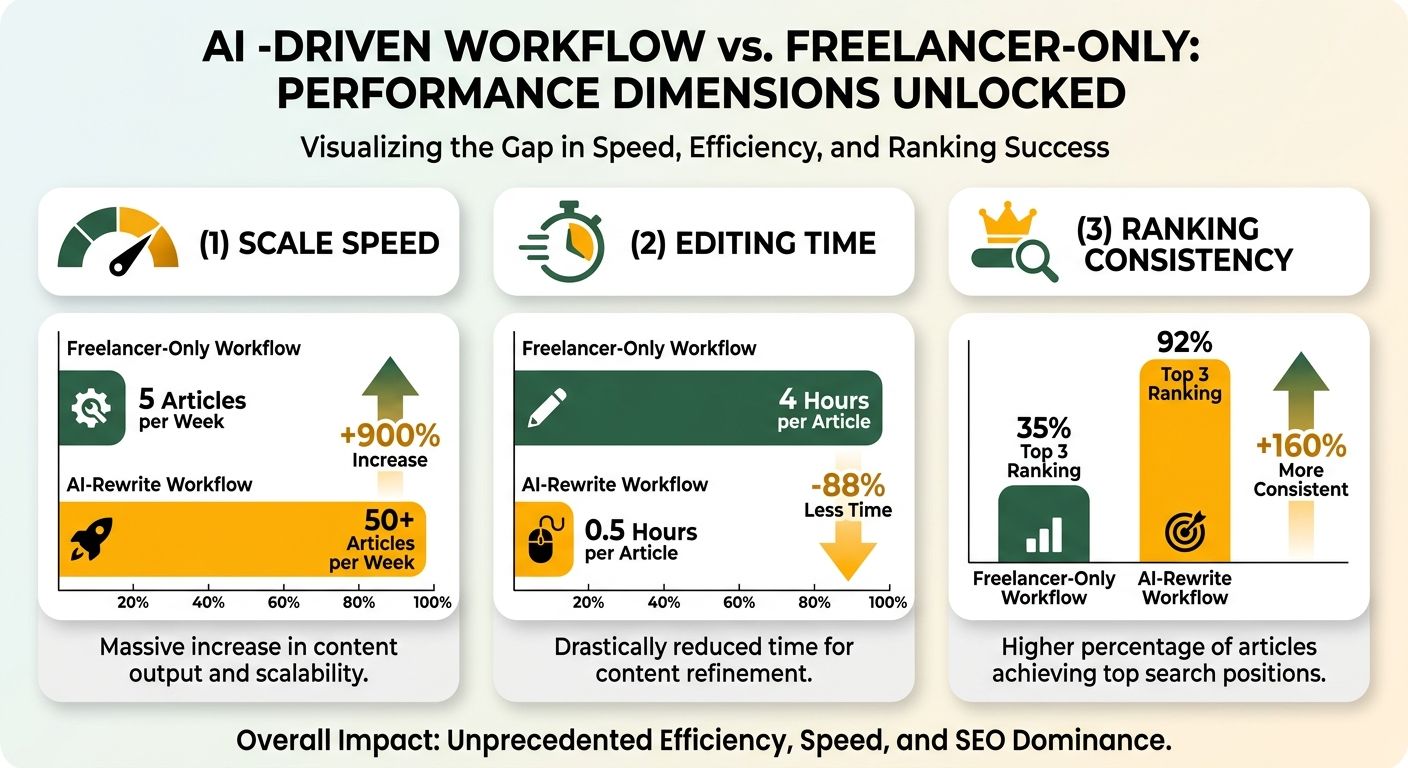
The speed difference shows up in onboarding. A freelancer working alone needs multiple revision cycles to internalize your brand voice—weeks of back-and-forth before the first publishable draft. An AI rewrite layer learns your voice from a style guide and sample articles, then applies it to every outsourced draft on the first pass. You're publishing within days, not weeks.
Speed and Throughput
The freelancer-only model caps out at the writer's personal throughput. If you need fifty articles per quarter, you're hiring a team of writers and managing separate onboarding timelines for each. The AI-rewrite workflow flips this. You hire external writers to produce first drafts in parallel, then run the rewrite layer across the entire batch simultaneously. You're publishing the full volume in the same time it takes a smaller team to deliver half that output.
Some businesses adopting AI content face a hidden cost structure that most overlook. The time savings from generation can get erased by editing overhead that exceeds original writing time. This means outsourced editing can create negative ROI unless the editor is paid substantially less than writer rates. The AI-rewrite model solves this by replacing the manual editing layer with an automated one. Your in-house team reviews for factual accuracy and final approval, but the heavy lifting—brand alignment, SEO structure, readability—is handled before the draft reaches them.
In a typical quarterly sprint of seventy-five articles managed by three editors, a manual workflow requires roughly six hours of revision per editor each week to correct voice drift and structural issues. Over twelve weeks, this consumes 216 hours of editorial capacity. Transitioning to an automated rewrite system reduces this to under ninety hours, reclaiming 126 hours for high-level strategy and distribution.
Resource Usage and Team Overhead
The freelancer model requires sustained management. You're briefing writers, reviewing drafts, sending revision requests, and re-reviewing. Each article demands significant in-house editing time to fix voice inconsistencies, restructure for SEO, and add internal links. If you're running a high-volume content operation, that editing load becomes a full-time role, or multiple roles.
The AI-rewrite workflow compresses that. External writers deliver first drafts. The rewrite layer handles brand voice, SEO structure, and readability in minutes. Your team reviews for accuracy and approves. Editing time drops sharply. You're reclaiming time that can go toward strategy, not line edits.
At AnyPost.ai, external writers produce topic-accurate first drafts. The automated content generation system rewrites them for brand consistency using the Persona Engine to match your voice, then optimizes them for SEO before they land in your CMS ready to publish. The difference shows up in your calendar: instead of spending half your week fixing drafts, you're spending it planning the next content cluster.
Pros and Cons
The Freelancer-Only Model: Speed vs. Consistency Trade-Offs
You outsource article production to external writers alone. You get human-written drafts that arrive in three to seven days, but those drafts rarely align on first submission. The primary advantage is authenticity: a skilled freelancer brings subject-matter expertise and a natural writing style that AI can't replicate from scratch. The drawback is inconsistency across writers. One freelancer structures arguments with data-driven opening paragraphs; another buries the thesis four paragraphs deep. One uses short, punchy sentences; another defaults to academic prose. Your in-house team spends hours editing each piece to enforce a unified voice.
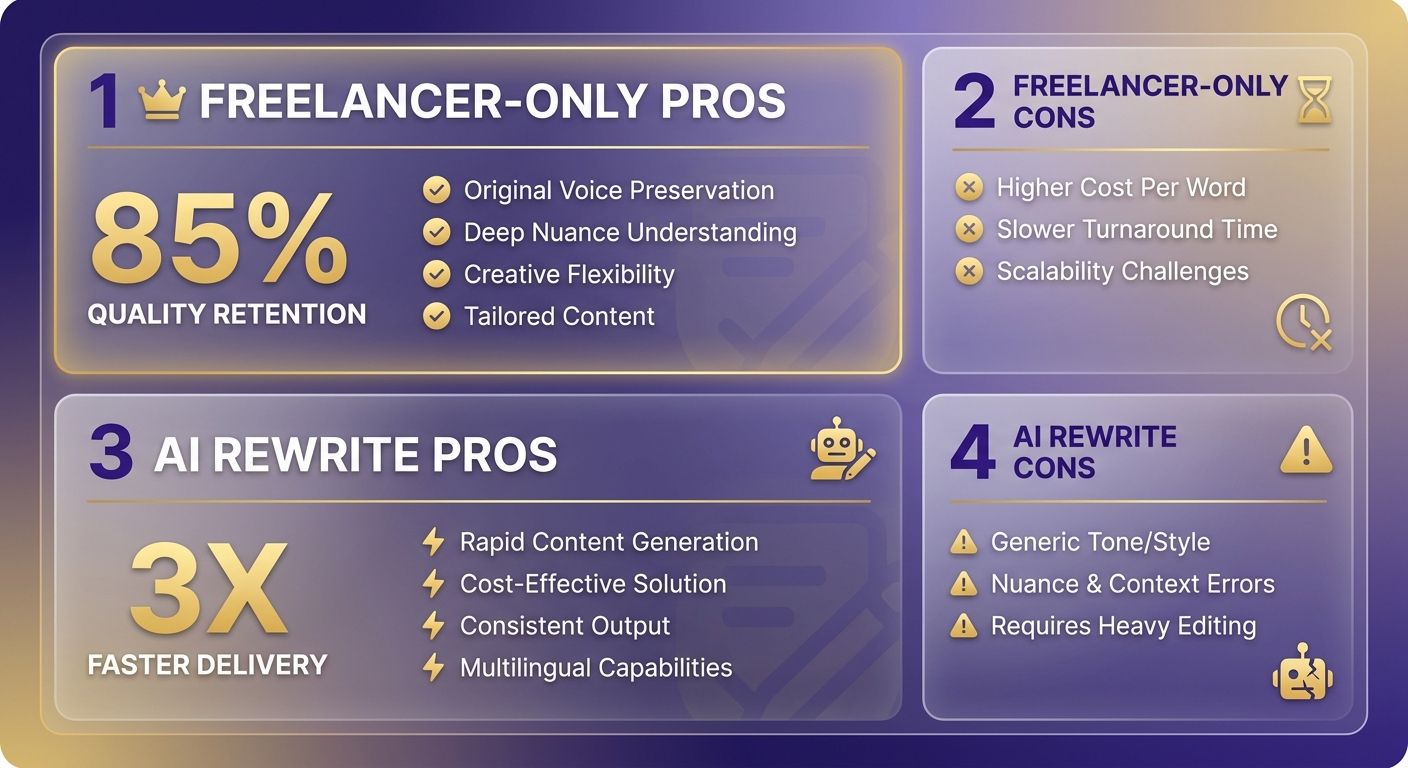
The model works well when you hire a small pool of veteran writers who've internalized your style guide over months of revisions. It breaks when you scale to five or ten freelancers working in parallel. Each draft arrives in a different register, and your editorial team becomes a bottleneck. Without a consistency layer, the editorial burden can eliminate the cost advantage of hiring external talent.
Pros:
- High authenticity and industry-specific insight
- Original arguments and unique narrative angles
- Direct communication with subject-matter experts
Cons:
- Long onboarding cycles (three to five revision rounds per writer)
- Inconsistent formatting, tone, and SEO structure across drafts
- High editorial burden when scaling beyond two or three freelancers
The AI-Rewrite Layer: Consistency at the Cost of Human Nuance
An AI-rewrite workflow treats external writers as a first-draft layer, then runs their output through a post-production step to apply brand voice, insert structured metadata, and align formatting. The advantage is velocity: you can onboard ten freelancers in a week because the AI layer enforces consistency regardless of who wrote the original draft. Each article emerges in the same brand voice, with the same H2/H3 hierarchy and the same keyword density.
The tradeoff is subtlety. AI rewrites smooth out the rough edges that make expert writing memorable—the unexpected analogy, the sharp turn in argument structure, the sentence that lands because it breaks the pattern. When you run every draft through the same transformation, you risk homogenizing the output into a uniform style that reads correct but bland. This approach works best for high-volume content clusters where consistency outweighs voice—FAQ pages, comparison articles, how-to guides—and less well for thought-leadership pieces where a strong authorial presence matters.
| Dimension | Freelancer-Only | AI-Rewrite Layer |
|---|---|---|
| Brand consistency | Varies by writer skill | Enforced automatically |
| Onboarding time | 3–5 weeks per writer | 1 week for entire pool |
| Editing time per article | 2–4 hours | 15–30 minutes |
| Subject-matter depth | High (if you hire experts) | Depends on original draft quality |
| Scalability | Bottlenecks at 3–5 writers | Supports 10+ writers in parallel |
Pros:
- Automated SEO structure (H-tags, meta descriptions, schema)
- Rapid turnaround and predictable output
- Reduced manual editing queues
Cons:
- May flatten unique stylistic flourishes from expert writers
- Risk of homogenized output if rewrite layer is too aggressive
When to Choose Which Model
The freelancer-only path makes sense when you're producing fewer than 10 articles monthly and you have the budget to hire writers who already live and breathe your industry. The output will carry the authority and nuance that comes from someone who's spent years in the field—a cybersecurity analyst writing about zero-trust architecture, or a former SaaS marketer explaining product-led growth.
The AI-rewrite model makes sense when you need to publish 20+ articles monthly across multiple content verticals and your editorial team can't manually align every draft. You accept that some sentences will lose their edge in exchange for a predictable output cadence and uniform SEO implementation.
Many content teams adopt a hybrid approach: external writers draft the structure and research layer, then an AI pass enforces tone and inserts SEO metadata before a final human review. That final review step is where you catch the sentences that got over-polished and restore the phrasing that makes the piece worth reading. The review might take fifteen minutes instead of an hour, but those fifteen minutes determine whether the article feels like it was written by someone who understands the problem or by a system that followed a template.
Use Cases and Ideal Users
The right workflow depends on three things: how much content you publish, how tight your brand voice standards are, and whether you have budget for expert-level writers. High-volume teams with strict brand guidelines benefit most from AI rewrite layers. Low-volume teams hiring genuine subject-matter experts often do fine without it.
When you outsource writing at scale, the rewrite step is where quality either holds or collapses. External writers rarely finish that step themselves. So the question isn't "freelancer or AI" but "who owns the post-production rewrite."
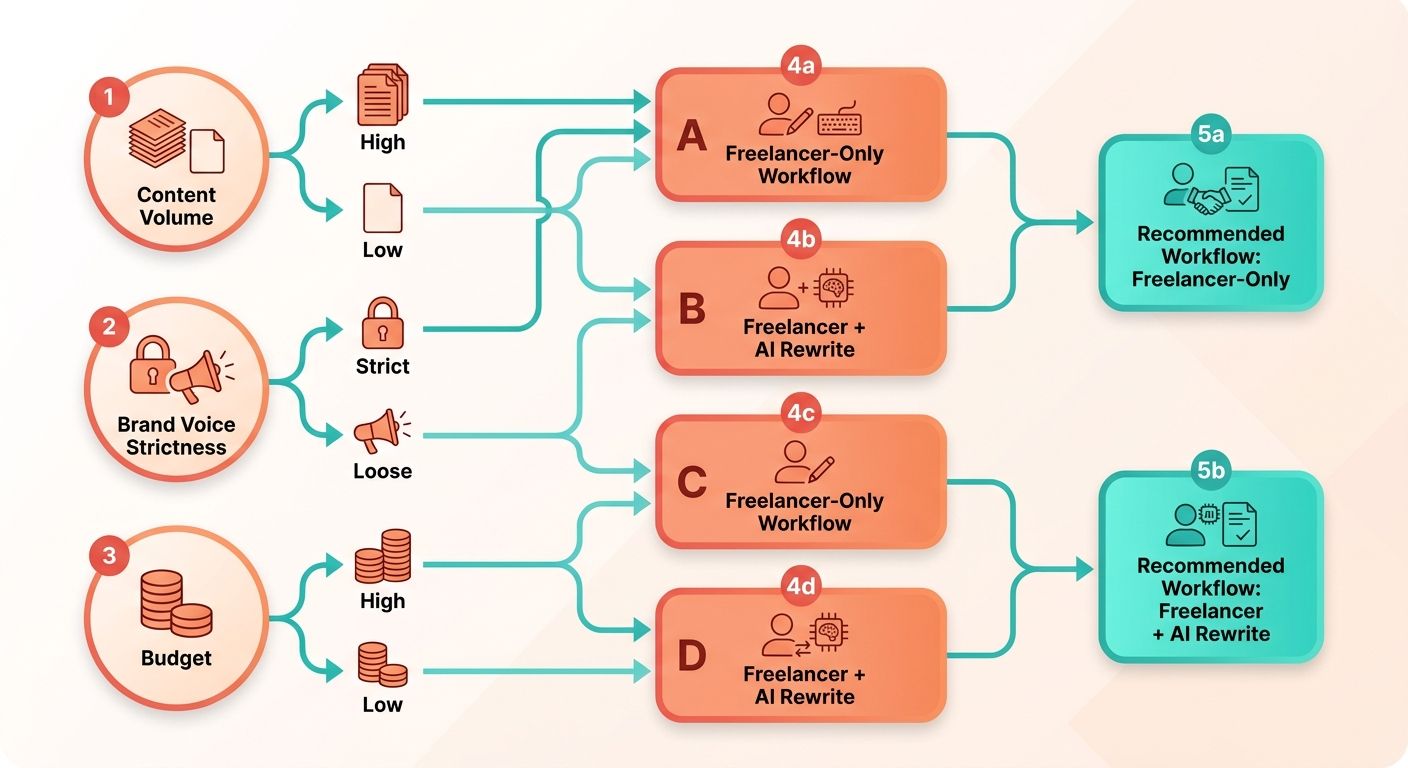
Who Should Use AI Rewrite Layers?
Best for: high-volume content teams publishing 20+ pieces monthly who need consistent brand voice without paying premium rates per piece.
Growth teams and content marketers running programmatic SEO fit this profile. You're commissioning drafts from a rotating pool of writers, and every draft arrives in a different voice. Automated content generation can normalize tone and tighten SEO structure before anything hits your CMS.
Agencies managing multiple client brands see the biggest gain. Each client has a distinct voice guide. A single freelancer can't hold five voices in their head. An AI system trained on each client's style guide switches context instantly.
Digital strategists who track ranking performance also benefit. Automated publishing enforces heading hierarchy and keyword placement that external writers treat as optional. That structural discipline is what moves a draft from "readable" to "rankable."
When Should You Skip Automation and Hire an Expert Instead?
Skip it when you're publishing fewer than 10 deeply technical pieces a month and can afford writers who own the entire workflow themselves.
Buyers who outsource drafts and then rewrite them badly often find that approach costs more than hiring a writer who delivers finished work.
For thought-leadership bylines, original research, or founder-voice pieces, an expert writer wins. No automated system replicates lived expertise or a specific person's point of view. Pay the premium and skip the second pass.
Which Workflow Fits Your Team?
| Team Profile | Best Fit | Why |
|---|---|---|
| High-volume SEO (20+/mo) | AI rewrite layer | Normalizes voice at scale, adds SEO structure |
| Multi-brand agency | AI rewrite layer | Switches brand voice per client instantly |
| Low-volume, technical | Expert freelancer | Owns full workflow, no rewrite needed |
| Founder/thought leadership | Expert freelancer | Lived expertise can't be automated |
| Programmatic content | AI rewrite layer | Handles scale without per-piece premium |
The decision comes back to volume and voice complexity. Publishing at scale with brand consistency? Automation earns its keep. Running a lean operation with a few expert writers who deliver polished work? You don't need the extra pass.

What to Do Next
In content production at scale, the post-production rewrite step determines whether your drafts become publishable, on-brand material or remain generic, search-engine-first drafts. External writers rarely complete that rewrite themselves. They deliver first drafts and move on to the next client. The challenge is building an efficient system to refine those initial submissions into polished, brand-aligned assets.
When to Skip the AI Rewrite Layer
You don't need an automated rewrite workflow if you publish fewer than 10 articles monthly and have budget for subject-matter experts who already understand your brand. In that scenario, you're hiring writers who deliver near-final drafts, not raw material. The rewrite step happens in their head before they submit. For teams in that position, adding AI into the workflow just adds complexity without solving a real problem.
Skip it entirely if your brand voice is informal, conversational, and varies by author. Some companies treat each writer's unique tone as a feature, not a bug. In those cases, standardizing everything through an AI layer erases the personality that makes the content work.
When the Hybrid Model Wins
The hybrid approach works best when your content operation needs to maintain voice consistency across multiple writers publishing simultaneously. If you're running three writers who each produce different volumes week to week, manual editing creates a bottleneck. One editor can review eight AI-rewritten drafts in the time it takes to manually polish two from scratch.
The workflow saves your in-house team from spending hours on mechanical fixes. Instead of manually rewriting passive voice, adding internal links, and adjusting sentence cadence, you batch-process those edits through an AI layer. Your editors spend their time on strategic decisions—headline testing, CTA placement, feature prioritization—not line-level polish.
Teams that switch to this model typically see their editorial calendar shift from reactive to planned. When editing time drops by two-thirds, you can commit to publishing schedules three weeks out instead of scrambling to finish yesterday's draft. The predictability matters more than the speed for most content directors.
Practical Next Steps
Start with three test articles. Hire an external writer to produce the first draft at your usual rate. Run one draft through an AI rewrite platform, publish another with your standard manual editing, and publish the third as is. Track time spent editing, brand voice consistency, and organic traffic performance over 90 days. The data will show you whether the rewrite layer cuts enough editing time to justify adding it to your workflow permanently.
If you're already using a content management system, look for tools that integrate directly with your CMS. The best hybrid workflows let you brief writers, receive drafts, run the rewrite pass, and push to WordPress or HubSpot without leaving one platform. That removes the friction of copying content between five different tools just to get one article live.
FAQ
How much does it cost to hire external writers for SEO content?
Freelancer rates typically range from $150 to $500 per article depending on expertise level. Generalist writers charge $150–$250 per piece, while subject-matter experts in technical niches (cybersecurity, healthcare, finance) command $300–$500. These rates don't include editing time, SEO optimization, or brand alignment, which your in-house team handles post-delivery.
What's the average turnaround time for freelance content?
Most external writers deliver first drafts within 3–7 business days. Add another 2–4 days for in-house editing, revision rounds, and final approval. Total time from brief to publication typically runs 5–10 business days for freelancer-only workflows. AI-rewrite workflows compress this to 1–3 days by automating the post-production editing layer.
Why do outsourced drafts often miss brand voice?
External writers lack the context that in-house teams have. They don't sit in your Slack channels, attend product meetings, or read your customer support tickets. Without that immersion, they default to generic, Wikipedia-style writing that's technically accurate but tonally flat. Fixing this requires either months of onboarding with each freelancer or an automated rewrite layer that enforces your style guide programmatically.
Can AI rewrite layers handle technical or niche content?
AI rewrite layers work best when the external writer delivers accurate subject-matter content in the first draft. The AI handles tone alignment, SEO structure, and readability optimization, but it doesn't fact-check or add technical depth. For highly specialized content (legal analysis, medical research, engineering documentation), you still need expert writers who own the entire workflow. The AI layer is most effective for high-volume informational content where structure and consistency matter more than deep expertise.
How do I know if I need an AI rewrite layer or just better freelancers?
Calculate how many editor-hours per week your team spends rewriting outsourced drafts. If you're spending more than 10 hours weekly on manual edits (voice alignment, heading restructures, SEO fixes), an AI rewrite layer typically pays for itself. If most freelancer drafts publish with light copy edits, you've found strong writers and automation adds little value. The breakpoint usually appears around 15–20 articles per month. Below that threshold, manual editing is manageable. Above it, automation becomes necessary.
What's the ROI of switching to a hybrid AI-rewrite workflow?
Teams publishing 20+ articles monthly typically see a 60% reduction in editing time and a 40% drop in cost per article compared to hiring agencies or building in-house editorial teams. The ROI calculation depends on your current loaded cost per article (writer fee + editor time + overhead) versus the hybrid model cost (low-cost draft + platform fee). Most content operations break even around 12–15 articles per month and see positive ROI above that volume.
Ready to see how this works in practice? Explore how AnyPost.ai can help your team scale content without sacrificing brand voice.