
Why Most Marketing Automation Stops at Scheduling, Not Writing

What You Need to Know
- Most marketing automation tools stop at distribution — they move finished posts between platforms but ignore the expensive work of producing content.
- Content automation manages editorial calendars and asset handoffs through CMS integration. Marketing automation governs lead lifecycle and conversion funnels via CRM connections. They aren't interchangeable.
- The gap between scheduling and writing needs a clear framework for when AI should draft versus when human judgment protects brand voice.
- Automation that touches creation, not just scheduling, reclaims hours lost to repetitive drafting and reformatting for teams publishing content at volume.
- Teams publishing fewer than a dozen pieces weekly across blog, social, and email won't see meaningful payoff from complex automation frameworks.
- Behavioral triggers enable real-time reactions for send timing but struggle to replicate authentic voice that builds reader trust at scale.
- Scaling personalization through data-driven branching works for template customization, but rule-based logic fails when authentic human voice carries the message.
The Gap Nobody Talks About
The part most teams underestimate isn't scheduling posts. It's deciding where a machine should write and where a human has to step in.
Most tools that promise to automate your content marketing workflow move a finished post from one platform to another. The harder, more expensive work of producing the words still swallows whole afternoons.
That's the gap we keep running into with the teams we work with. You can automate when a post goes out. You can't automate authentic brand voice without a clear rule for when AI drafts and when a person edits. This guide maps that decision, then shows how to build an automated content marketing workflow around it.
What Does This Guide Cover?
This guide walks through the full gap between scheduling and writing. We start with why most automation stalls at distribution, move into the decision framework for AI versus human work, then get practical with workflow setup. Expect real numbers, honest scope limits, and a clear path you can apply this week.
| Section | What You'll Learn | Difficulty |
|---|---|---|
| Scheduling vs. True automation | Why timing a send isn't the same as running a workflow | Beginner |
| The AI-write vs. Human-edit framework | When to let AI draft and when voice demands a person | Core |
| Building the workflow | Connecting creation, review, and distribution | Intermediate |
| Measuring what matters | Tying content to results, not just output volume | Intermediate |
Time to read: around 18 to 22 minutes for the full guide. Difficulty: mostly intermediate. If you've never run any automation, start with the first two sections and come back for the rest.
Why Separate Scheduling From Writing?
Scheduling sets a time and sends a message to a list. Automation runs workflows that react, branch, and adapt as behavior changes. One is a timer. The other is a system. Confusing the two is why so many teams buy a tool, automate their posting calendar, and still feel buried in work.
The savings come from drafting and coordination, not from the scheduled send. If your automation only touches distribution, you're leaving the biggest cost on the table.
What Makes This Guide Different?
We focus on the decision almost no scheduling guide addresses: the line between AI output and human judgment. Behavioral triggers prove software can decide when to send. They can't decide how to write in a voice readers trust. That's a human call, and it's the one that protects your brand as volume grows.
So we don't just hand you a workflow. We give you a rule for where to draw that line, because scaling content without it tends to produce more posts that sound like nobody.
Why the Line Between AI and Human Matters
Here's the thing most buyers get wrong when they shop for a tool to automate their content marketing workflow: they assume the hard part is coordination. It isn't. Coordination is annoying, but it's solvable. The expensive problem is the writing itself, and that's exactly where the decision gets murky.
We built this guide because that murk costs teams real money. You can wire up triggers, approvals, and cross-platform posting quickly. Deciding where a machine should draft and where a person has to hold the pen is the judgment call that protects your brand voice. Get it wrong and you scale weak thinking faster.
What Will You Actually Learn Here?
By the end, you'll have a working rule for when AI drafts and when a human edits. Not a vague "use your judgment" shrug. A concrete framework tied to the type of content, the stakes, and how much your brand voice carries the message.
You'll also learn how to evaluate software by the bottleneck it actually solves. Some platforms organize production. Others manage prospects and campaign movement. They may sit beside each other in a stack, but they do not replace each other. Buying the wrong category is a common, costly mistake we see because the demo language often sounds similar.
And you'll see what's really at stake. Automation becomes valuable when it removes repetitive drafting, formatting, routing, and review friction from the work your team already has to do. That payoff only shows up if your workflow addresses both coordination and content generation.
Who Is This For?
This is for marketing teams, agencies, and SaaS companies producing content at volume. If blog posts, social variations, newsletters, landing-page updates, and nurture assets are all moving through your team at the same time, the coordination tax is already eating your week. You feel the firefighting.
Skip this guide if you publish one newsletter a month by hand. The framework is overkill at that scale. The payoff only kicks in once production volume makes manual handoffs a genuine bottleneck. Be honest about where you sit.
Why the AI-Versus-Human Line Matters So Much
The problem is not that automation lacks speed. It has plenty of speed. The problem is that speed magnifies whatever quality level you feed into the system.
If your content has a clear structure, a known message, and low reputational risk, AI can often create a useful first pass. If the piece depends on conviction, nuance, founder perspective, customer sensitivity, or sharp positioning, the drafting decision matters more than the workflow diagram. That's where the human-versus-AI line becomes a brand protection issue rather than a productivity preference.
Our position: mechanical content is not fixed by buying faster triggers. You fix it by deciding, upfront, which pieces earn a human edit and which can ship machine-drafted. That rule is what the rest of this guide builds.
Fundamentals: Scheduling Isn't Writing
Most teams who set out to automate their content marketing workflow start by mapping the wrong thing. They map the handoffs. Who approves, who schedules, who posts where. That part is real, and it matters. But it's the cheap problem to solve. The expensive problem sits one step upstream, in the actual writing.
When you automate a content marketing workflow without a rule for where AI drafts and where a person edits, you don't get efficiency. You get faster mediocrity, pushed out across more channels than before. So before any of the architecture makes sense, you need to separate two things that get lumped together.
Scheduling Moves Finished Work. Automation Produces It.
A scheduler assumes the asset already exists. It's useful, but it's downstream. It does not help your strategist clarify the argument, your writer create the draft, your editor preserve the voice, or your subject-matter expert correct weak claims.
A true workflow reaches further upstream. It can help initiate drafts, route reviews, manage versions, connect briefs to final assets, and push the finished piece into the right channels. That's why a tool can look impressive in a calendar view and still leave your team exhausted. If the writing burden remains manual, the calendar only makes the backlog more visible.
Content Automation and Marketing Automation Are Not the Same Machine
People use these terms interchangeably, and that confusion leads to buying the wrong thing. Content automation manages the production side. Editorial calendars, drafting, version control, asset handoffs between writers, designers, and reviewers. It connects to your CMS, your design tools, your social platforms, and your asset libraries.
Marketing automation governs the customer journey. Lead scoring, segmentation, triggered email sequences, conversion funnels. It needs deep CRM integration, not design tools.
A content system is where a draft becomes a finished, on-brand piece. A marketing system decides who receives it and when. You can run a triggered sequence the instant someone engages with an asset. Impressive, and genuinely a step past scheduled sends. But the trigger does not solve the voice, argument, or quality of the message itself.
The Trust Ceiling That Scales With Volume
This is the tension the whole guide turns on. Automation can personalize pieces of an experience: the offer shown, the audience segment, the content block, the channel, the follow-up path. Those choices matter. They make campaigns more relevant than one-size-fits-all blasts.
But relevance is not the same as voice. Readers can feel when a piece has been assembled from rules rather than written with a point of view. That difference becomes more obvious as volume rises, because every generic post reinforces the last one. Automate the timing, the routing, the repetitive logistics without hesitation. Guard the voice.
Core Features: What Actually Matters
Most tools that promise to automate your content marketing workflow show you the same feature list: a visual builder, cross-platform scheduling, behavioral triggers, analytics. Those matter. But they answer the cheap question, when does a post go out, and skip the expensive one: who writes it well enough to publish?
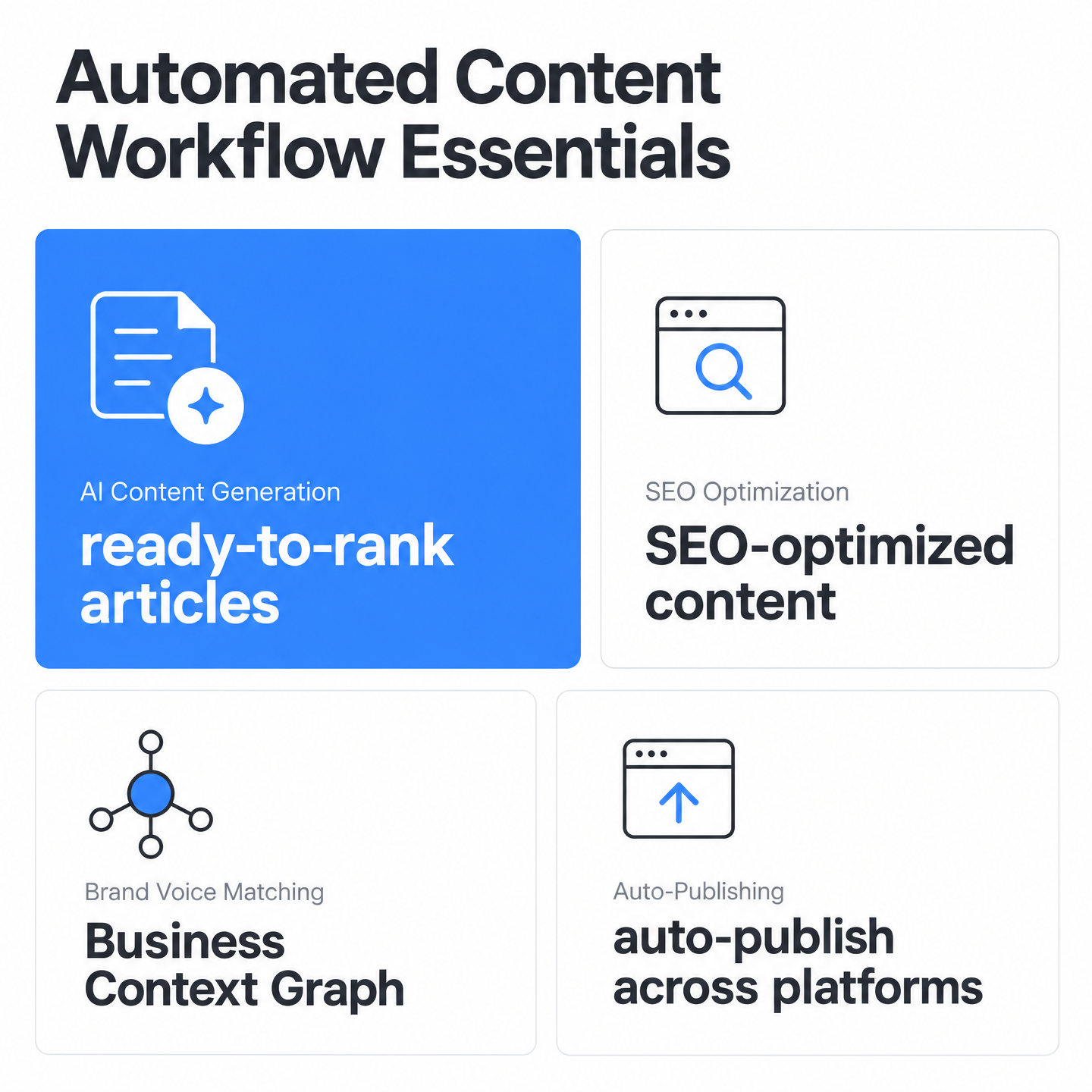
So we organize our core features around a different spine. We generate SEO-optimized content that matches your brand voice, then auto-publish it across platforms without forcing you to rebuild workflows manually.
What Does Automated Content Generation Actually Deliver?
We create ready-to-rank articles at scale using your existing site content, brand messaging, and audience data to train the voice model. That matters because a blank AI prompt is not a content system. It's a text generator. The useful layer is the context: what you sell, who you serve, how you explain the problem, and what claims your brand should or should not make.
In practice, automated generation is strongest when it starts from defined inputs: target keyword, angle, audience, internal links, service positioning, and examples your team already trusts. From there, AI-generated content can handle high-volume streams like SEO articles, newsletter updates, and social media posts. Voice-critical content like a founder's announcement or a sensitive customer reply still benefits from human review before it goes live.
That split is the whole game. The quality of the draft determines whether speed comes at the cost of brand coherence.
How Does This Protect Brand Voice at Scale?
Brand voice protection starts before the draft. We build a Business Context Graph from your site, products, and messaging so every article has a better source of truth than a generic prompt. The system learns the vocabulary your team uses, the categories you care about, the audiences you serve, and the claims that should be emphasized or avoided.
That does not remove the editor. It makes the editor more valuable. Instead of rewriting generic copy from scratch, the human reviewer can focus on sharper judgment: whether the argument is strong, whether the tone sounds like the company, whether the examples fit, and whether the piece should go deeper before publication.
You keep the efficiency without flattening the writing.
What Can You Set Up First?
Start with one high-volume stream, not the whole operation.
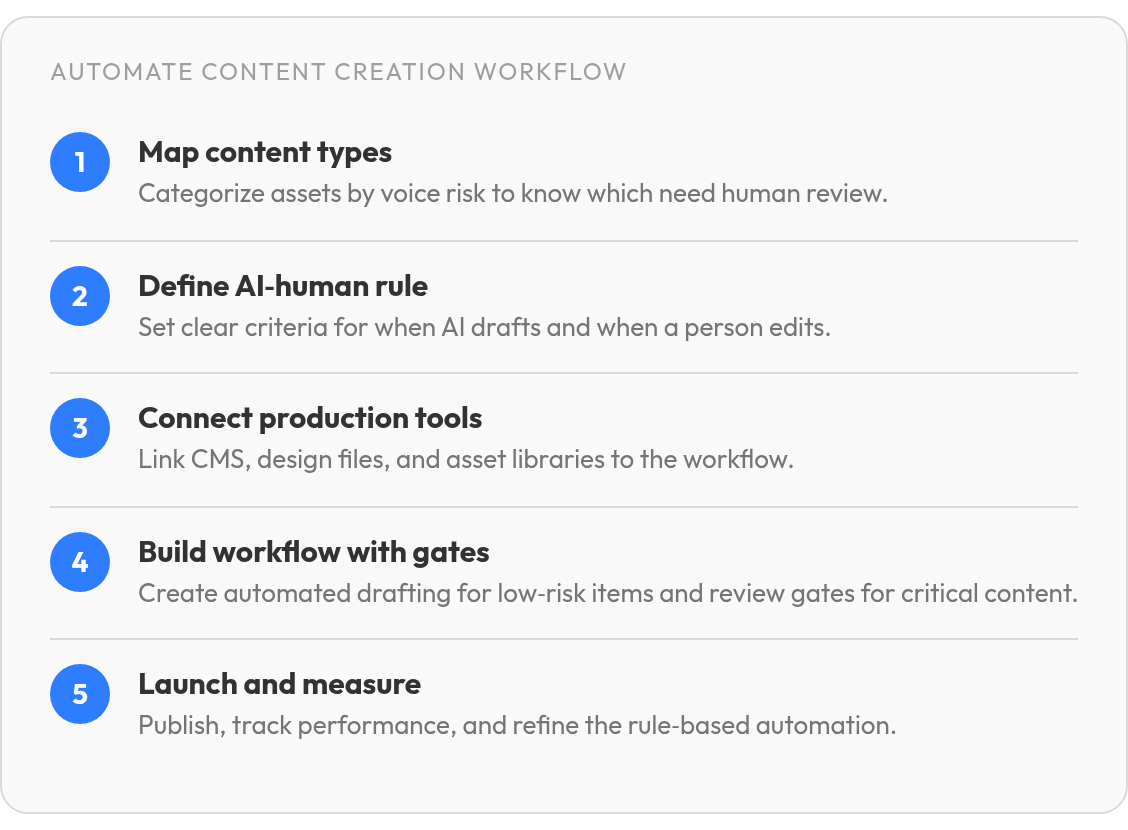
- Map your content types by voice risk, then decide which streams can run fully automated and which need review gates.
- Connect your tools on the production side: your CMS, design files, and asset library, not just a CRM.
- Set review gates on voice-critical content so nothing brand-defining publishes unedited.
Marketing teams often spend significant time on manual coordination and drafting. We handle the logistics so you can focus on strategy and judgment.
Best Practices: Where Machines Draft, Where Humans Edit
The best teams we work with don't try to automate their content marketing workflow all at once. They start by drawing a line between the work a machine should own and the work a person has to touch.
Here's where most buyers get stuck. The tools got genuinely good at reacting in real time. Automation platforms can swap finished creative into reusable blocks based on member data, or branch onboarding flows based on whether someone downloaded free content first. Impressive. But notice what the machine does in both cases: it chooses a path. The message still needs a writer's judgment.
Rules Decide Timing. People Decide Voice.
A platform can fire the right message at the right second and still produce copy that feels mechanical, because sophisticated branching isn't the same as understanding context. The more you scale automated sends, the more that mechanical feel compounds. Trust erodes faster than reach grows.
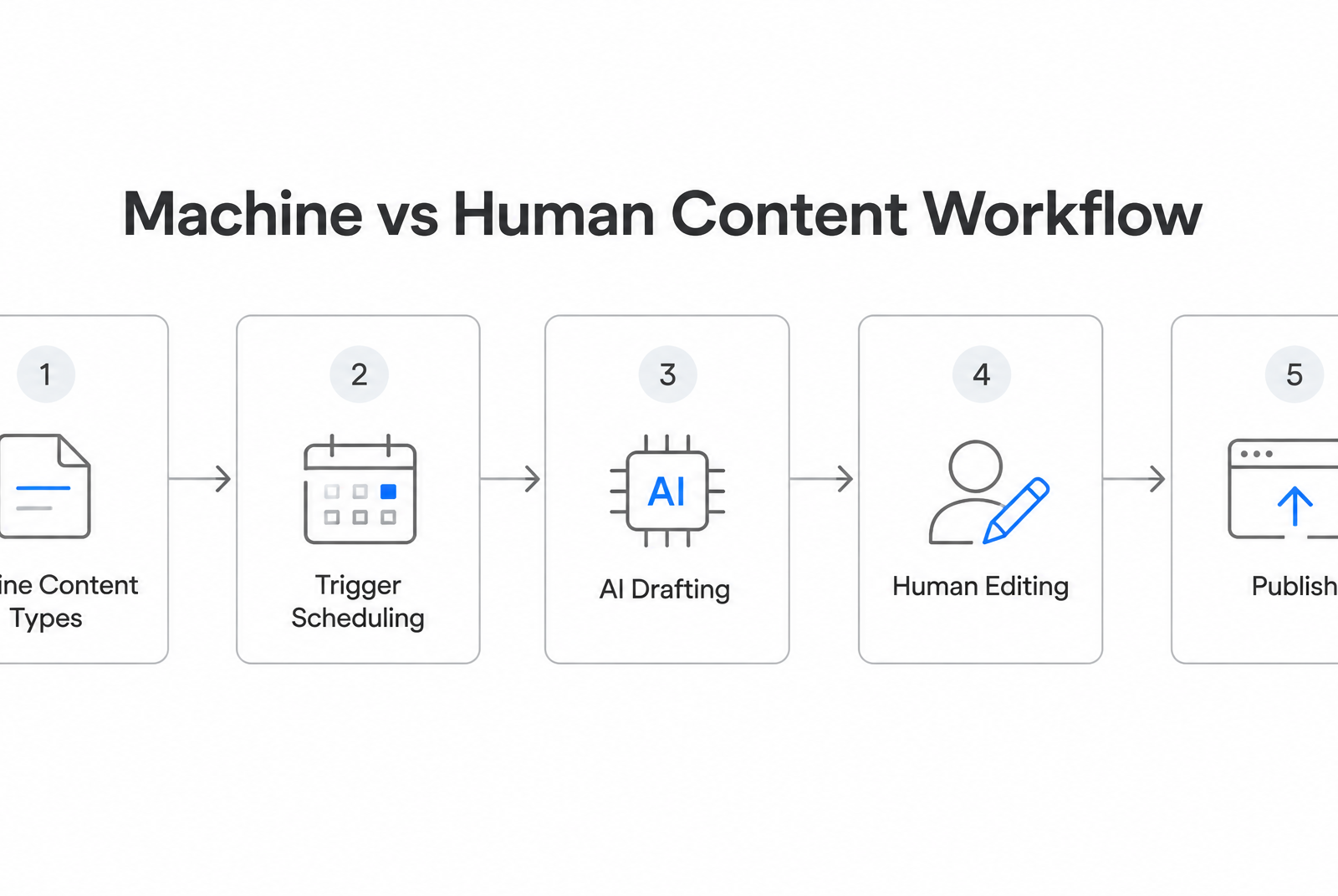
So we hold a simple pattern. Let automation own the repeatable, high-volume drafts where structure matters more than nuance: product update blurbs, templated nurture steps, first-pass social variants. Keep a human on anything that carries opinion, positioning, or emotional weight.
The reclaimed time should fund editing, not disappear into more volume. That's the difference between using automation to improve throughput and using it to flood channels with copy nobody is proud of.
Content Automation And Campaign Automation Aren't The Same Tool
A trap we see often: teams buy a campaign automation platform expecting it to fix their writing problem. The demo looks powerful because the journey map is elegant. The audience rules are clean. The analytics are persuasive. None of that guarantees the content inside the flow is worth reading.
If your bottleneck is approvals bouncing through email threads, a workflow builder helps. If your bottleneck is producing publishable copy at volume, you need generation plus a human editing gate. Diagnose which one hurts before you buy. Otherwise you end up with a polished distribution engine attached to an unchanged production problem.
Skip Full Automation Where Judgment Is The Point
Don't hand a machine your thought leadership, your crisis responses, or anything touching a sensitive customer moment. The evidence on this is mixed in the trade press, but our read is clear: scale amplifies whatever quality you feed it. Automate the floor, not the ceiling.
A smaller team with a tight niche can run almost everything through a human pass and still move fast. A team publishing 20 pieces a week can't, and that's exactly where a written AI-versus-human rule earns its keep. Start with one high-volume process, measure the time saved against the voice retained, then expand.
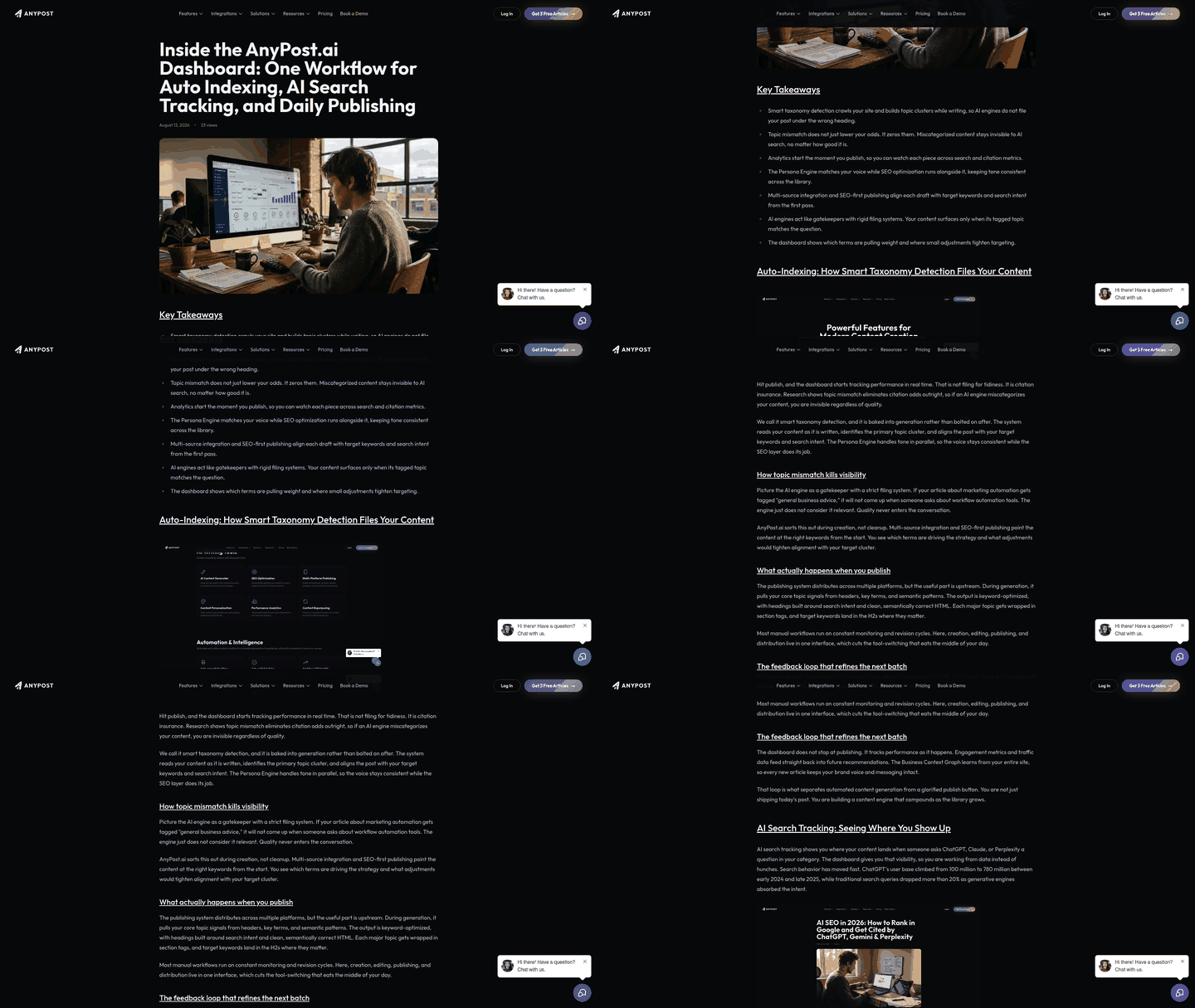
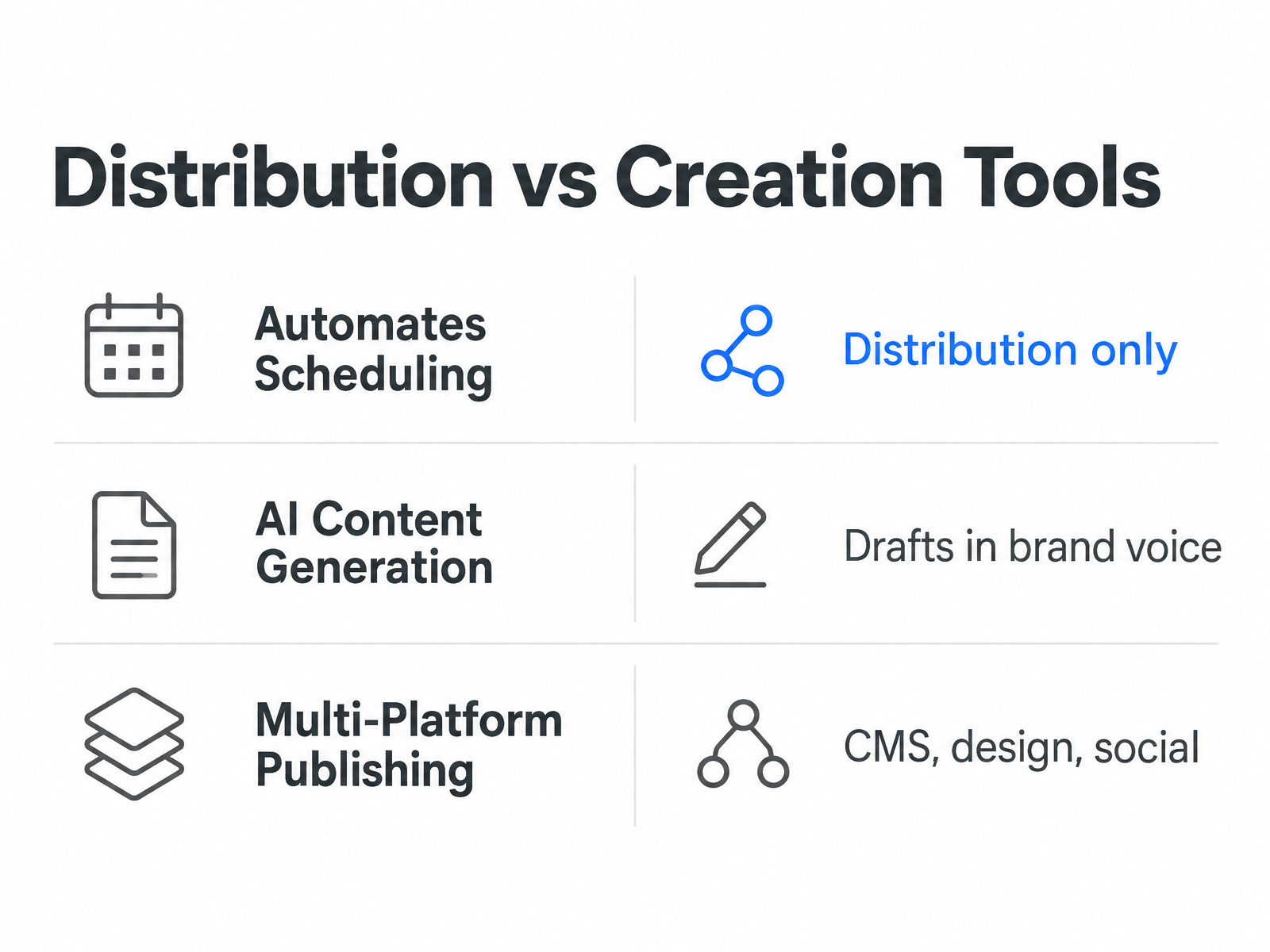
Comparing Workflow Tools: Distribution vs. Creation
Most tools you'll compare in this category split into two camps, and knowing which camp you're looking at tells you more than any feature list. When you set out to automate your content marketing workflow, you're really choosing between tools that move finished work and tools that help produce it. Those are different jobs, and most buyers don't notice until the trial ends.
Pick the wrong camp and you'll bolt a lead-scoring engine onto a problem that was really about getting words written and approved.
Behavioral Triggers Prove Reaction, Not Authorship
The strongest general automation platforms are genuinely good at reacting. Dynamic segmentation can refresh audiences as customer behavior changes. Journey orchestration can branch based on user actions. Live customer profiles can trigger messages when specific conditions are met.
Strong results often follow when timing and routing align with customer intent. But that's still not authorship. The system can choose the next step in a campaign; it cannot invent a credible point of view for your company from scratch. If the source copy is thin, the trigger only delivers thin copy more efficiently.
The Personalization Argument Both Sides Get Half-Right
The practical test when you compare alternatives is simple: ask whether the tool improves the message itself or only moves the message around. Scheduling-first tools stop at distribution. They leave the content creation itself untouched, which is where the real effort lives.

Our approach starts from the other end. We generate the draft in your brand voice first, then route it, because the writing is where the hours actually go. If you only need to move finished posts between platforms, a lighter scheduling tool can be plenty. But if the content itself is swallowing your afternoons, a distribution-only tool just makes mediocre writing travel faster.
The decision framework for when AI drafts and when a person edits is what separates the two, and it's the part most comparisons skip.
Resources: Distribution, Lifecycle, or Creation?
The tools you'll reach for split by the job they do, and most buyers only find the gap after they've bought. When you set out to automate your content marketing workflow, you end up assembling different toolkits that rarely live in the same dashboard. Confusing them is how teams end up paying for speed they can't use.

Here's the split we lean on when teams ask what to actually buy. The real decision in any automated content marketing workflow isn't which scheduler to pick. It's where you draw the line between the work a tool owns and the work a person has to touch.
Which Tools Handle Distribution Versus Creation?
Distribution tools are useful when the bottleneck is movement: publishing to the CMS, preparing social posts, keeping creative assets organized, and making sure reviewers are working from the right version. They reduce the chaos around finished or nearly finished work.
Lifecycle automation tools are useful when the bottleneck is follow-up. They help teams react to prospect behavior, segment audiences, and move people through sequences without manually sending every message. Powerful, but they operate after the content exists.
Creation tools sit earlier in the chain. They help generate the draft, adapt it to the channel, and keep the writing aligned with brand context. For teams buried in blank-page work, this is the missing layer.
What's the Common Issue Nobody Warns You About?
The debugging you'll actually do isn't technical. It's voice drift. When output starts sounding off-brand, resist the urge to tune the campaign triggers first. The triggers may be working exactly as designed. The problem is often upstream, in the drafting layer, where weak inputs and generic prompts lead to generic writing.
That's why a creation workflow needs review logic, not just publishing logic. Editors should know which pieces require a close pass, which only need a quick factual check, and which can move straight through after the system has proven reliable.
Here's the honest scope limit: if your output is three posts a month, you don't need a creation-automation layer at all. A scheduler and a good writer will serve you better. The decision framework only earns its keep once content volume outpaces what your team can hand-write without burning whole afternoons.
A Quick Reference for Building Your Stack
Use this to sort any tool you're evaluating:
- Does it connect to your CMS, social, and design tools? That's a distribution tool. Judge it on handoff speed.
- Does it connect to your CRM and score leads? That's lifecycle automation. Judge it on segmentation and branching.
- Does it draft in your actual brand voice? That's the creation layer, the expensive gap most stacks leave open.
- Does it give you a clear rule for AI-draft versus human-edit? Rare, and the one worth paying for.
Map your tools against that last question first. Everything else is logistics.
Where to Start This Week
So here's where we land after walking through all of it. The teams who win at this don't ask "how do I automate my content marketing workflow faster." They ask a sharper question first: where does a machine draft, and where does a person have to hold the pen? Scheduling was never the hard part. Deciding that line is.
Everything we've covered points back to one gap. Most tools that promise to automate a content marketing workflow stop at distribution, moving finished work from one place to another. The expensive problem, the ongoing effort your team puts into producing the words, stays untouched. That's the part automation keeps dodging, and it's the part that decides whether your brand voice survives scale.
What Should You Actually Do Next?
Start by drawing the line on paper before you touch a single tool. List the content types your team ships, then mark each one: machine drafts first, or human writes first. High-stakes, voice-heavy pieces earn a human draft. High-volume, pattern-driven pieces can start with AI and get a human edit.
Then wire the timing and routing around that rule, not the other way around. Let software handle workflow movement, review notifications, channel preparation, and repeatable production steps. Keep a person close to the language until the voice model proves it can hold your register without constant correction.
One caveat worth stating plainly: if your team publishes a handful of pieces a month, this framework is overkill. Draft by hand, schedule the output, move on. The decision rule earns its keep when volume climbs past what a human can personally write, and that's exactly when the voice-drift risk gets real.
Where the Human-Versus-AI Line Really Matters
The line matters most anywhere the reader is judging more than information. A basic update may only need accuracy and clarity. A positioning piece needs taste. A founder note needs conviction. A sensitive reply needs empathy. A strategic article needs an argument that sounds like it came from someone with a real view of the market.
That's why the same automation setup can be safe for one stream and risky for another. The question is not "Can AI write this?" The better question is "What would be damaged if this sounded generic?" When the answer
Common Questions
If I only publish a few blog posts a month, is marketing automation still worth setting up?
Usually, no. At low publishing volume, the setup and maintenance can take more effort than the workflow saves. A simple scheduler, a clear content calendar, and a reliable writer will usually be enough until production becomes a recurring operational bottleneck.
What's the difference between content automation and marketing automation platforms?
They sit at different points in the content-to-customer path. A content platform helps the team create, organize, review, and publish assets. A marketing platform helps decide which audience or lead receives those assets as part of a campaign. If the pain is slow production, start with the content layer. If the pain is follow-up and segmentation, look at the campaign layer.
Can behavioral triggers write content in my brand voice, or do they only control timing?
They mainly control campaign logic. A trigger can respond to an action, choose a branch, or send a prepared message, but it does not guarantee that the underlying copy sounds like your company. Voice quality comes from the drafting system, the brand context behind it, and the human review rules around it.
How do I know which content streams are safe to fully automate versus which need human review?
Sort content by risk. Routine, pattern-based assets can often begin with automated drafting. Anything that carries executive perspective, market opinion, customer sensitivity, or a major brand claim should go through a human gate before publishing.
What happens when automated content starts sounding mechanical or off-brand?
Treat it as a content quality issue, not a scheduling issue. Revisit the source context, examples, prompts, and review criteria feeding the draft. Then tighten the human-editing rules for the streams where tone and positioning matter most.