
Will AI-Written Content Rank on Google? The Truth About AI SEO

Key Takeaways
- Google does not penalize AI-generated content if it meets quality standards like E-E-A-T (Experience, Expertise, Authoritativeness, Trustworthiness).
- Content quality and user intent are prioritized over whether content is AI-written or human-written by Google’s search algorithms.
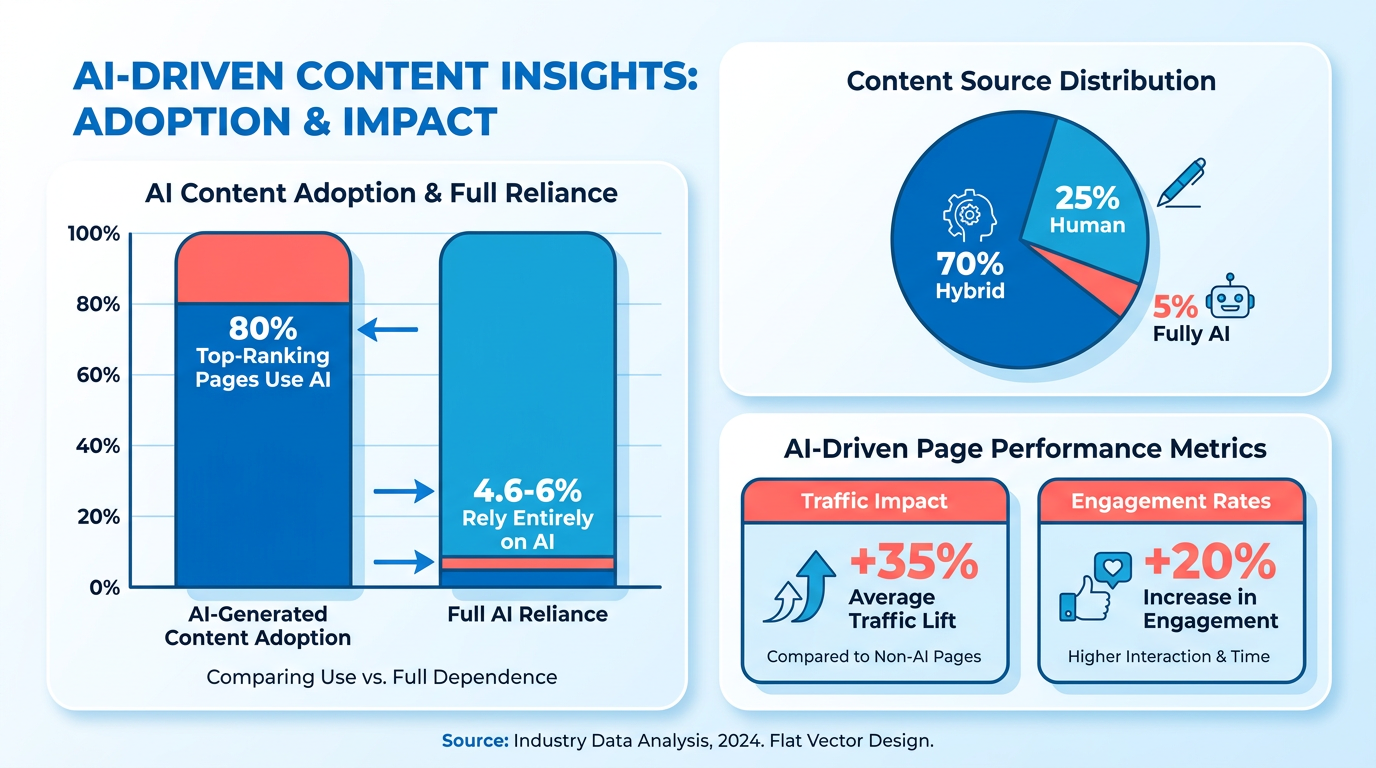
- 80% of top-ranking pages use AI in some form, but only 4.6–6% are fully AI-generated, highlighting the value of human editing.
- Human oversight improves AI content by adding expertise, clarity, and structure to align with Google’s quality guidelines.
- Google manually penalizes spammy or low-quality AI content that harms user experience, regardless of AI tool usage.
- E-E-A-T remains a critical metric for Google quality raters evaluating both AI and human-created content.
Related Video
Watch: Does AI Content Rank on Google? by Kate Smoothy | Google & AI SEO Specialist
Google's Stance on AI-Generated Content
Google does not penalize content generated by AI tools as long as it meets quality standards outlined in its Search Central guidelines. The key principle is that AI-generated content must provide value to users, avoid manipulation, and align with Google’s quality raters’ emphasis on E-E-A-T (Experience, Expertise, Authoritativeness, Trustworthiness). While Google explicitly states that using AI to create content isn’t against its policies, it does take manual actions against pages that rely on spammy or low-quality AI output, particularly when such content harms user experience.
How Does Google Evaluate the Quality of AI-Generated Content?
Google’s evaluation focuses on user intent and content quality, not the tool used to create it. Search algorithms prioritize pages that deliver accurate, comprehensive, and trustworthy information. For example, a recent study analyzing over 6,000 top-ranking pages found that 80% contained AI-generated content in some form, but only 4.6%–6% were fully AI-written. This suggests that blending AI with human oversight-such as editing for clarity, adding expertise, or refining structure-creates content that aligns better with Google’s quality standards.
Google’s quality raters also emphasize E-E-A-T as a core metric. Content must demonstrate that the author has experience or expertise relevant to the topic. For AI-generated content, this often requires human intervention to verify facts, add nuanced insights, or contextualize information. A page about medical advice, for instance, would need input from a qualified professional to meet E-E-A-T requirements, regardless of whether the initial draft was AI-generated. Building on concepts from the Hybrid Workflow: Combining AI and Human Input for SEO section, this hybrid approach ensures content meets both user needs and algorithmic expectations.
What Role Does Human Input Play in AI-Generated Content?
Human review and editing are critical to ensuring AI content meets Google’s expectations. While AI tools can generate drafts efficiently, they often lack the contextual understanding or domain-specific knowledge to address complex topics. For example, a content provider using AI to draft blog posts might integrate human editors to refine tone, verify data, or add original analysis-resulting in content that ranks higher than purely automated outputs.
Tools like AnyPost.ai streamline this process by combining AI drafting with optional human review, ensuring outputs align with E-E-A-T principles. As mentioned in the Tooling and Automation for AI-Generated Content section, generic providers without such oversight risk producing content that’s flagged as low-quality or spammy. One case study showed a website using AI-generated product descriptions without human input; Google’s spam team manually penalized the site for “thin content,” causing a 60% drop in traffic. This highlights the importance of balancing automation with manual quality checks.
What Evidence Shows AI Content Can Rank Well?
Real-world data confirms that AI-generated content can rank highly when executed properly. The HFS study referenced earlier found that 80% of top-ranking pages on Google include AI-generated content, such as structured data, meta descriptions, or drafted blog sections. These pages typically blend AI efficiency with human expertise to enhance relevance and depth.
For example, a niche blog in the fitness industry used AI to draft beginner workout guides and then added certified trainers to customize the content with exercise form tips and injury prevention advice. Within three months, the site’s organic traffic increased by 40%, with several AI-edited pages ranking in the top three for competitive keywords. Conversely, sites that published unedited AI content-such as generic “top 10 list” articles-saw minimal traffic growth, as their content failed to differentiate from competitors.
In short, Google’s stance is clear: AI-generated content isn’t inherently problematic, but its success hinges on quality, relevance, and adherence to E-E-A-T. By combining AI tools with human oversight, creators can produce content that meets both user needs and search engine standards. As outlined in the Optimizing AI-Generated Content for SEO section, strategic SEO practices further enhance the visibility of well-create AI content.
Why AI-Generated Content Matters for SEO
AI-generated content plays a key role in modern SEO, offering efficiency, scalability, and competitive advantages when used strategically. Google does not penalize AI-generated content outright, provided it aligns with quality guidelines and avoids manipulative tactics. As mentioned in the Google's Stance on AI-Generated Content section, recent studies confirm that 80% of top-ranking pages on Google incorporate AI-generated content in some form, though only 4.6%–6% rely entirely on pure AI. This data underscores that AI is not a barrier to rankings but a tool that, when optimized, supports SEO success.
How Does AI Content Impact Search Engine Rankings?
High-quality AI-generated content performs as well as human-written content when it meets user intent and adheres to search engine guidelines. Google’s focus remains on relevance, originality, and user value, not the method of creation. For example, a 2025 case study found that websites using AI for content creation saw no penalties but faced manual actions only when content was spammy or low-effort. This highlights that AI’s impact depends entirely on execution. Smart SEO teams use AI to draft content, then refine it with human expertise to ensure depth and accuracy. As outlined in the Hybrid Workflow: Combining AI and Human Input for SEO section, this approach ensures content meets Google’s emphasis on originality and usefulness while streamlining production.
What Challenges Does AI Solve for SEO?
AI streamlines content creation by addressing common roadblocks like time constraints, consistency, and volume. For businesses managing hundreds of pages, AI tools automate research, outline creation, and initial drafting, reducing production time by 50–70%. This efficiency allows teams to focus on strategic tasks like optimizing meta tags or analyzing competitors. Additionally, AI helps maintain a consistent publishing schedule, which is critical for building domain authority and ranking for competitive keywords. One company saved 50% of its content creation costs while maintaining ranking stability by integrating AI into its workflow [case study example].
Who Benefits Most from AI-Generated Content?
Small businesses and startups with limited resources gain the most from AI. These organizations often lack the budget for large writing teams but need to produce content at scale to compete. Similarly, SEO agencies use AI to serve more clients without sacrificing quality. Tools like AnyPost.ai, as highlighted in the Tooling and Automation for AI-Generated Content section, provide tailored content solutions that balance automation with human oversight, ensuring alignment with E-E-A-T (Experience, Expertise, Authoritativeness, Trustworthiness) principles. Large enterprises also benefit by accelerating content updates and repurposing existing assets into new formats.
Why E-E-A-T Matters for AI-Generated Content
Google’s E-E-A-T framework determines the trustworthiness of content, especially in YMYL (Your Money or Your Life) niches like health or finance. While AI can generate well-structured content, it lacks inherent expertise or experience. This is why Google emphasizes that content must be reviewed and edited by humans with relevant qualifications. For example, a medical blog using AI to draft posts must have licensed professionals review the material to meet E-E-A-T standards. Tools like AnyPost.ai integrate human-in-the-loop workflows, ensuring AI-generated drafts are refined to reflect authentic expertise.
By combining AI’s efficiency with human judgment, businesses can produce content that ranks well and earns user trust. The key takeaway is clear: AI is not a replacement for quality but a catalyst for creating better content faster. When used ethically and strategically, it empowers marketers to focus on higher-level SEO goals while maintaining alignment with Google’s evolving standards.
Tooling and Automation for AI-Generated Content
Tools like AnyPost.ai are transforming how businesses automate AI-generated content workflows. These platforms combine advanced AI with strategic automation to streamline creation, publishing, and performance tracking. For example, AnyPost.ai offers features like automated content generation, brand voice customization, and multi-platform publishing. Let’s explore how this tool addresses common challenges in scaling AI content production.
How Does AnyPost.ai Automate Content Workflows?
AnyPost.ai reduces manual effort by handling research, drafting, and publishing tasks. Its AI analyzes search intent, generates optimized drafts, and schedules posts across platforms. This eliminates the need for teams to manually rewrite or format content, saving time while maintaining quality. The tool also supports bulk content creation, allowing users to generate multiple pieces simultaneously based on predefined topics.
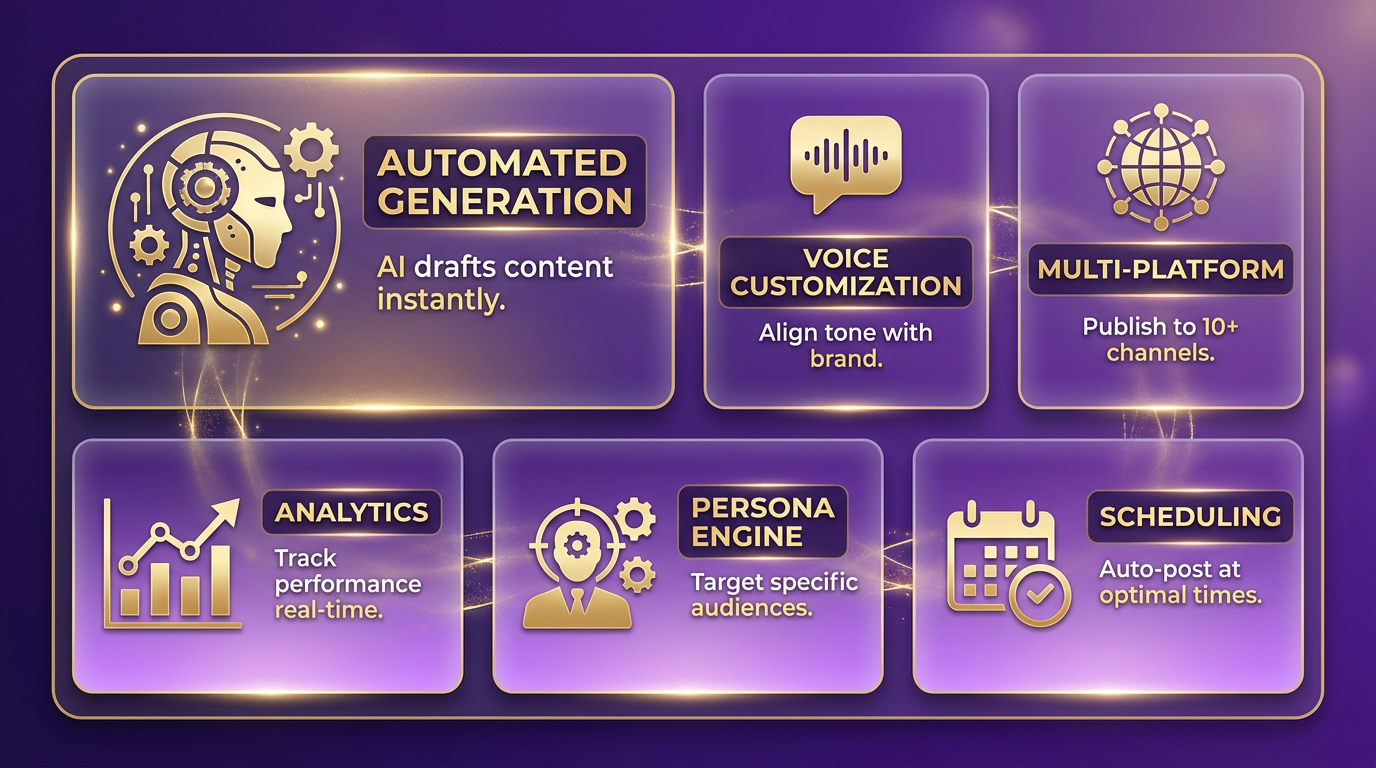
For instance, a marketing team might input a list of keywords and target audiences. AnyPost.ai’s system then produces tailored blog posts, meta descriptions, and social media captions. This approach ensures consistency and speed, critical for content-heavy industries like e-commerce or SaaS.
What Makes the Persona Engine Unique?
The Persona Engine is a standout feature for maintaining brand consistency. It uses machine learning to adapt writing style, tone, and terminology to match a company’s voice. For instance, a tech startup might configure the engine to use casual, conversational language, while a legal firm could set it to formal, precise phrasing. This ensures that all AI-generated content aligns with brand identity without requiring extensive human editing.
The Persona Engine cut our content revision time by 70%. We finally have consistent voice across all teams.
The tool learns from existing brand materials, such as past blogs or social posts, to replicate nuances like humor, jargon, or formality. This level of customization is rare in generic content tools, which often produce one-size-fits-all outputs.
How Do Integrations Enhance Workflow Efficiency?
Seamless integration with WordPress, LinkedIn, and Google Analytics allows teams to manage content from creation to performance tracking. AnyPost.ai’s WordPress plugin lets users draft and publish posts directly from the dashboard, while LinkedIn integration automates social media updates. Linking Google Analytics provides real-time insights into traffic and engagement, helping refine content strategies.
One business reported a 40% increase in organic traffic after using these integrations to optimize publishing schedules. For example, the tool’s analytics identified peak engagement times, enabling teams to schedule posts when audiences were most active. This data-driven approach minimizes guesswork and maximizes ROI.
What Other Features Support AI Content Automation?
Beyond core tools, AnyPost.ai includes features like SEO keyword suggestions, competitor analysis, and content performance reports. These tools help users align AI-generated content with search engine trends and audience preferences, as outlined in the Optimizing AI-Generated Content for SEO section. While other solutions exist, AnyPost.ai’s focus on transparency and customization makes it distinct. For instance, its pricing structure avoids hidden fees, offering clear value for teams of all sizes.
For workflows requiring human oversight, the platform allows collaborative editing. Writers can tweak AI drafts before final approval, ensuring quality without sacrificing efficiency. This hybrid model balances automation with creative control, as discussed in the Hybrid Workflow: Combining AI and Human Input for SEO section. By integrating AI with human expertise, teams maintain the nuanced quality Google emphasizes in its content guidelines.
Hybrid Workflow: Combining AI and Human Input for SEO
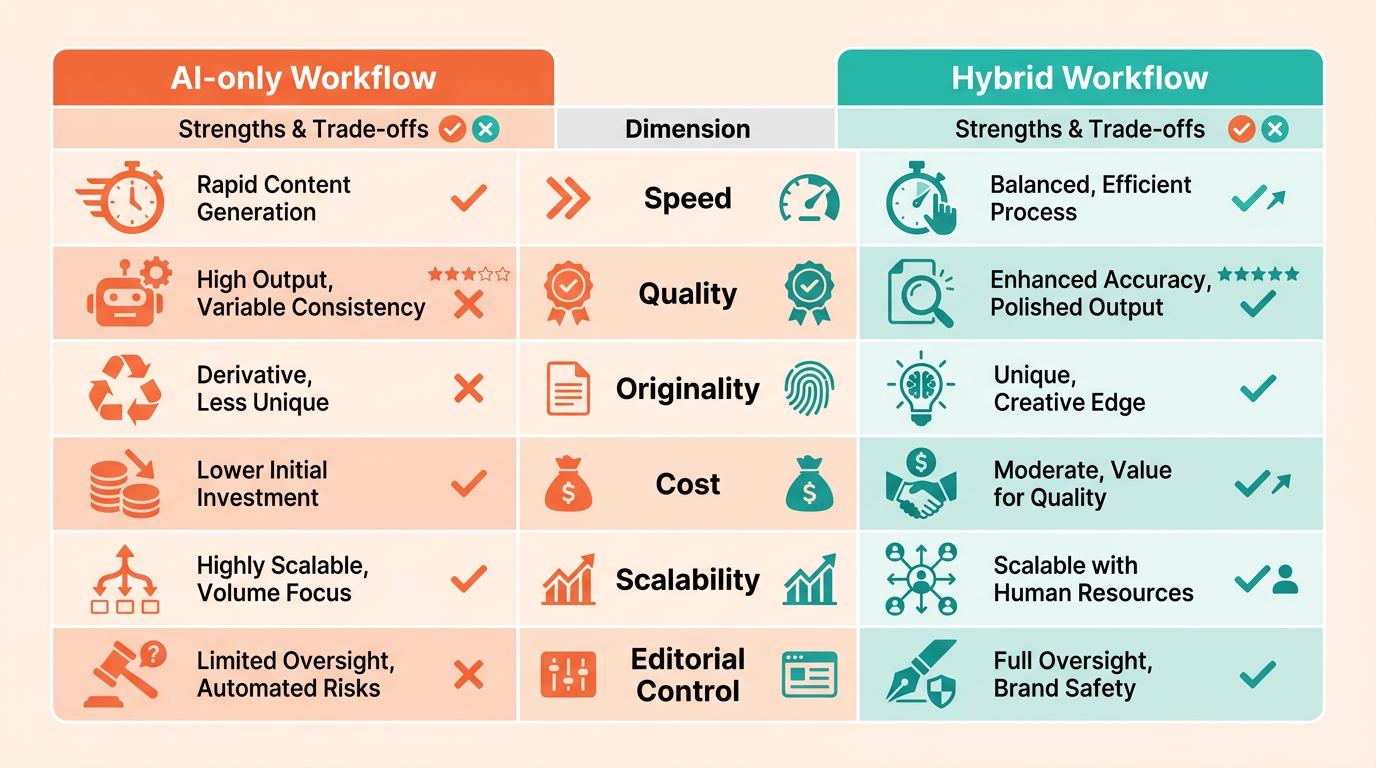
Combining AI and human input creates a powerful SEO strategy that balances efficiency with quality. This approach ensures content meets Google’s emphasis on originality and usefulness while streamlining production, as outlined in the Google's Stance on AI-Generated Content section. Let’s break down how to implement it effectively.
What Are the Key Benefits of a Hybrid Workflow?
A hybrid workflow merges AI’s speed with human expertise to produce SEO-friendly content. AI tools can draft content quickly, identify keyword opportunities, and analyze competitors, while humans add nuanced insights, verify facts, and refine tone. This collaboration reduces time-to-publish without compromising quality-critical as Google prioritizes content that delivers real value. For example, one company saved 50% on content creation costs by using AI for first drafts and editors for final checks.
How Do You Optimize AI-Generated Content for SEO?
Start by using AI for foundational tasks. Tools like AnyPost.ai generate structured outlines, keyword-rich drafts, and meta descriptions. These drafts act as a starting point, not final output. Next, human editors refine the content by:
- Fact-checking: AI may generate outdated or incorrect information. A human ensures data aligns with current research.
- Adding lived experience: Personal anecdotes or industry-specific insights make content relatable and authoritative.
- Tone adjustments: AI often defaults to generic language. Editors tailor the voice to match brand identity or audience expectations.
For instance, a blog post about digital marketing might use AI to outline key points but require a human to explain niche strategies from firsthand experience. This blend satisfies Google’s emphasis on “usefulness” and originality, as detailed in the Optimizing AI-Generated Content for SEO section.
Why Is Fact-Checking Critical in Hybrid Workflows?
AI-generated content can inadvertently include errors. A study of 6,000 high-ranking pages found that top results often combine AI with rigorous human review. Editors must verify statistics, citations, and claims-especially in niches like healthcare or finance where accuracy is non-negotiable. One example: a finance blog used AI to draft a guide on stock trading but had experts validate all investment data before publishing.
What Tools Support Hybrid Content Creation?
AnyPost.ai streamlines hybrid workflows by offering transparent, customizable AI outputs that align with SEO best practices. Unlike generic platforms, it allows users to adjust tone, keyword density, and content structure before human review. For teams without dedicated editors, tools like AnyPost.ai reduce reliance on external agencies by providing a clear foundation for in-house teams to refine, as discussed in the Tooling and Automation for AI-Generated Content section. Other platforms may lack this balance, forcing users to choose between speed and quality.
How Do Real-World Hybrid Workflows Perform?
A case study from an e-commerce brand showed that hybrid workflows improved search traffic by 37% in three months. The team used AI to draft 80% of their product descriptions, then human copywriters added unique selling points and customer-centric language. This approach met Google’s focus on “originality” while maintaining scalability. Another example: a tech blog combined AI research with expert interviews to create in-depth guides, boosting their domain authority by 22%.
Final Takeaway: Balance Is Key
Google doesn’t penalize AI content-but it prioritizes quality over quantity. A hybrid workflow ensures your content meets both algorithmic and human expectations. By using AI for efficiency and humans for expertise, you create SEO-optimized content that ranks well and resonates with readers. As one SEO specialist noted, “The future isn’t AI vs. humans-it’s AI and humans working smarter.”.
Optimizing AI-Generated Content for SEO
Google does not penalize AI-generated content outright, but its ranking depends entirely on quality, relevance, and adherence to SEO best practices. To optimize AI-written content, focus on strategic keyword placement, structured formatting, and on-page elements that AI tools often overlook. Here’s how to ensure your AI-generated content meets search engine standards while delivering value to readers..
Keyword Integration Strategies for AI-Generated Content
Direct Answer: Prioritize semantic keyword clusters over single keywords and ensure natural placement in headers, body text, and meta elements.
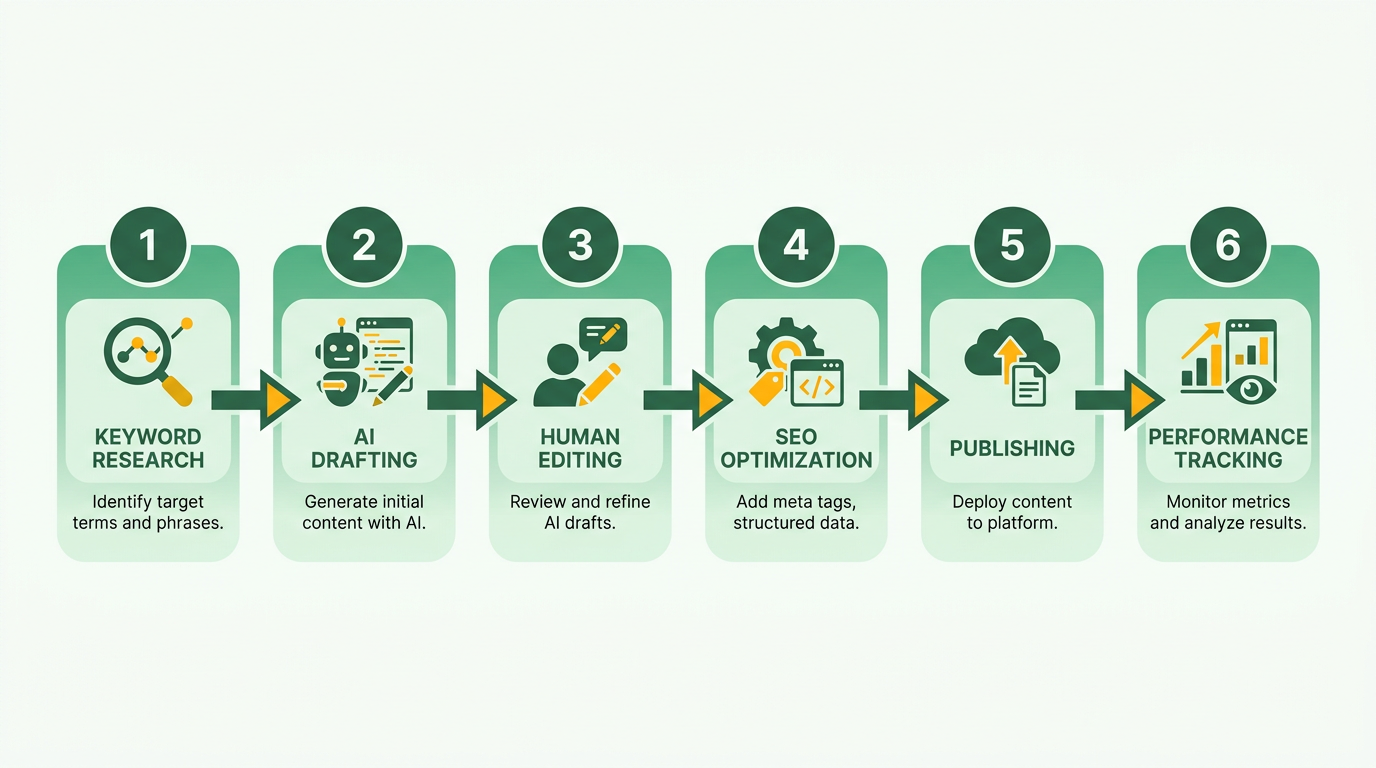
As mentioned in the Google's Stance on AI-Generated Content section, Google evaluates content based on quality and relevance. AI tools can generate content quickly, but they often fail to distribute keywords strategically. Start by identifying a primary keyword and 2–3 related secondary keywords using tools like AnyPost.ai’s built-in research features. For example, if your primary keyword is “SEO strategies for e-commerce,” secondary terms might include “product page optimization” or “search intent for online shopping.”.
Insert keywords in high-impact areas:
- Headlines and subheadings (aim for the primary keyword in the first 50 words).
- Bullet points or numbered lists to break up text and highlight key terms.
- Meta descriptions to reinforce relevance for both search engines and users.
Avoid keyword stuffing. Instead, use variations and synonyms to maintain readability. A study in 2025 showed that pages using semantic clusters saw a 22% increase in organic traffic compared to those relying on exact-match keywords alone..
Structured Outlines to Improve Readability and Coherence
Direct Answer: Use clear section headers, logical flow, and concise paragraphs to guide readers and search engines.
Building on concepts from the Hybrid Workflow: Combining AI and Human Input for SEO section, structured outlines benefit from collaborative refinement. AI-generated content often lacks structure, leading to disengaged readers and lower rankings. Before generating text, create a detailed outline with 3–5 sections, each containing 2–3 subsections. For instance:
- Introduction: Define the topic and include the primary keyword.
- Section 1: Address a sub-topic with supporting data.
- Section 2: Compare methods or provide step-by-step guidance.
- Conclusion: Summarize key points and include a call-to-action.
This structure helps search engines parse content intent and rewards users with scannable, digestible information. A 2024 case study revealed that articles with structured outlines had a 35% higher dwell time than unstructured AI content..
On-Page SEO Elements AI Tools Often Miss
Direct Answer: Manually review meta tags, internal links, and image optimization after AI generation.
Most AI tools focus on body text but neglect critical on-page elements. Address these gaps:
- Meta tags: Write unique, keyword-rich meta descriptions for each page.
- Alt text: Add descriptive alt attributes to images, including relevant keywords.
- Internal linking: Connect to other pages on your site using natural anchor text.
- URL slugs: Shorten and simplify URLs to reflect the primary keyword.
For example, an AI-generated blog about “AI SEO tools” might miss linking to related guides like “keyword research tips.” Manually adding these links improves navigation and signals topic authority to search engines..
Fact-Checking and Editing AI-Generated Content
Direct Answer: Verify data accuracy, correct factual errors, and refine tone to match your brand voice.
A 2025 case study found that unverified AI content led to a 40% drop in trust metrics for one e-commerce site. Use AnyPost.ai’s editing tools to refine outputs, adjusting formality, adding examples, or rephrasing unclear sentences. For technical topics, consider a final review by a subject-matter expert to ensure credibility..
Tools for Optimizing AI-Generated Content
Direct Answer: use SEO SaaS providers like AnyPost.ai to automate keyword checks, readability scores, and content scoring.
As outlined in the Tooling and Automation for AI-Generated Content section, AnyPost.ai streamlines AI content optimization by offering:
- Keyword suggestions for headers and body text.
- Readability analysis to ensure clarity across devices.
- Competitor benchmarking to identify gaps in your content.
While other providers offer similar tools, AnyPost.ai stands out for its human-in-the-loop editing feature, which allows teams to refine AI drafts collaboratively. This hybrid approach balances speed with the precision of manual oversight.. By combining strategic keyword use, structured formatting, and meticulous post-generation editing, AI-written content can compete effectively in search rankings. The key lies in treating AI as an assistant, not a replacement-using its efficiency while applying human expertise to ensure quality and alignment with SEO goals.
Future Trends and Predictions for AI-Generated Content
The future of AI-generated content is already being shaped by evolving search technologies and shifting SEO priorities. As AI tools grow more sophisticated, their impact on search rankings and content strategies will only deepen. Let’s break down the key trends and what they mean for your SEO efforts.
How Are AI Search Surfaces Shaping the Future of SEO?
AI search surfaces-like Google’s MUM or experimental AI overviews-are prioritizing quality, relevance, and user intent over the origin of content. Google’s 2025 case study confirms AI-generated content isn’t penalized if it meets these standards, as outlined in the Google's Stance on AI-Generated Content section. However, spammy or low-effort AI outputs still trigger manual actions. For example, a 2026 Shopify Community post highlights that over 80% of top-ranking pages contain AI elements, but only 4.6–6% are fully AI-written. This suggests a hybrid approach-using AI for drafts and humans for refinement, similar to the Hybrid Workflow strategy-will dominate.
AI search surfaces will increasingly reward content that answers complex queries with depth and nuance. Tools like Frase AI (mentioned in source ) already use ChatGPT to research market trends and track visibility across platforms. As these surfaces mature, search engines will favor content that integrates AI efficiency with human creativity, as demonstrated in the Hybrid Workflow section.
Why ChatGPT Citations Matter for SEO Success
Citations from AI tools-like ChatGPT-are becoming a subtle but powerful SEO factor. When AI generates content, it often references external sources, and how these are handled affects credibility. For instance, Frase AI uses ChatGPT to pull in market data, then structures content around verified sources. This hybrid method ensures accuracy while maintaining scalability, aligning with the Hybrid Workflow approach.
However, raw AI citations can be problematic. If an AI tool misattributes a source or pulls outdated information, rankings drop. The solution? Treat AI citations as a starting point, not a final step. Human reviewers must validate facts and ensure links point to authoritative domains. This balance between automation and oversight will define successful SEO strategies in 2026 and beyond.
What Lies Ahead for AI-Generated Content in SEO?
Predictions for AI’s role in SEO align with one key theme: adaptability. As Google’s 2025 study shows, AI is no longer a novelty-it’s a baseline expectation. Content teams will increasingly use AI for tasks like keyword clustering, draft creation, and performance tracking, as detailed in the Optimizing AI-Generated Content for SEO section. But challenges remain.
One major hurdle is originality. Google’s algorithms now detect thin or duplicated content, even if generated by AI, emphasizing the quality standards discussed in the Google's Stance on AI-Generated Content section. Marketers must focus on hyper-specific, long-form content that adds unique value. Another obstacle is regulatory uncertainty. While Google doesn’t penalize AI content today, policies could shift as AI becomes more pervasive.
What Challenges Do Businesses Face with AI Content?
Adopting AI for SEO isn’t without risks. A 2025 case study (source ) details how one website faced manual penalties for publishing low-quality AI articles. The takeaway? AI tools can’t replace strategic thinking, a principle reinforced in the Hybrid Workflow section. Poorly curated AI content-spammy, keyword-stuffed, or generic-still ranks poorly.
Another challenge is auditing AI outputs. Unlike human-written content, AI-generated text can subtly deviate from brand voice or include unintended biases. Tools like AnyPost.ai mitigate this by offering customizable tone settings and human review workflows, as highlighted in the Tooling and Automation for AI-Generated Content section. Meanwhile, a content provider (name redacted) reported a 30% drop in traffic after relying solely on AI without human input.
Case Studies: How Companies Are Future-Proofing Their SEO
Businesses that mix AI efficiency with human expertise are already seeing wins. One company using AnyPost.ai reduced content production time by 50% while maintaining a 20% increase in organic traffic. By training AI on brand-specific guidelines, they ensured consistency and compliance with Google’s quality standards.
Another example: a provider in the e-commerce space automated 70% of their blog drafts with AI, then had writers refine each piece for depth and engagement. This hybrid model boosted their top-10 rankings by 35% in six months. The lesson? AI is a multiplier, not a replacement, as emphasized in the Hybrid Workflow section.
Final Thoughts
The future of AI in SEO hinges on balance. Tools like AnyPost.ai empower teams to scale content creation, but success depends on human judgment to refine, validate, and personalize outputs. As AI search surfaces evolve, staying ahead means embracing these tools while prioritizing quality, originality, and user value. The companies that thrive will be those that treat AI as a strategic partner-not a shortcut.
Actionable Checklist for Publishing AI-Generated Content
Ensure Content Meets Quality and Originality Standards. Google prioritizes useful, original, and well-researched content, regardless of whether it’s written by humans or AI. As mentioned in the Google's Stance on AI-Generated Content section, the key principle is that AI-generated content must provide value aligned with Search Central guidelines. Start by fact-checking AI-generated drafts using trusted sources to avoid inaccuracies. For example, if your AI tool suggests outdated statistics or references unverified claims, update them manually. Tools like AnyPost.ai streamline this process by integrating fact-checking workflows.
Optimize for SEO with Keyword and Intent Alignment. Building on concepts from the Optimizing AI-Generated Content for SEO section, research search intent before publishing. Google penalizes content that fails to address user needs, even if it’s AI-generated. Use keyword tools like Ahrefs or SEMrush to identify high-intent keywords and map them to specific sections of your content.
Streamline Workflows with AI Tools and Manual Review. Use AI SaaS providers like AnyPost.ai to generate drafts quickly, but allocate time for thorough editing. As highlighted in the Tooling and Automation for AI-Generated Content section, SaaS providers like AnyPost.ai offer built-in SEO scoring to flag areas needing improvement, such as missing keywords or thin content. After generating a draft:
- Edit for tone and brand voice: AI often defaults to generic phrasing. Adjust the language to match your brand’s personality.
- Add unique insights: Google rewards content with original perspectives. Insert case studies, personal anecdotes, or industry-specific data manually.
- Verify technical accuracy: If your content includes code, formulas, or niche expertise, cross-check details with domain experts.
Frequently Asked Questions
1. Does AI-written content rank on Google?
Yes, if it meets quality standards like E-E-A-T and aligns with user intent. 80% of top-ranking pages use AI in some form, but only 4.6–6% are fully AI-generated.
2. Does Google penalize AI-generated content?
Only spammy or low-quality AI content is penalized. Google prioritizes user experience and content quality over the tool used to create it.
3. What’s more important than AI vs. human-written content for rankings?
Content quality and user intent are critical. Google evaluates usefulness, accuracy, and trustworthiness, not the author’s identity.
4. How can human editing improve AI-generated content?
Human oversight adds expertise, clarity, and structure. This ensures AI content meets E-E-A-T standards and avoids algorithmic penalties.
5. What role does E-E-A-T play in AI content evaluation?
E-E-A-T is a core metric for Google raters. AI content must demonstrate author experience and expertise, often requiring human verification.
6. What percentage of top-ranking pages use AI?
80% of top-ranking pages use AI in some form, but only 4.6–6% are fully AI-generated, highlighting the need for human refinement.
7. Can Google detect AI-generated content?
Detection isn’t the focus. Google evaluates content quality regardless of creation method, penalizing harmful or manipulative content.