
WordStream’s Best SEO Tools List Misses the Hard Part: Turning Blog Posts Into X Threads, Newsletters, and YouTube Scripts

What You Need to Know
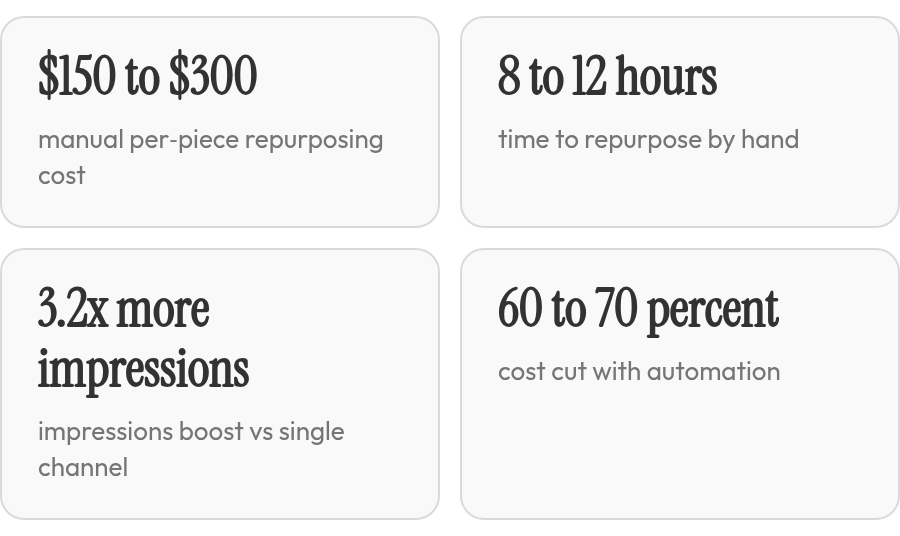
- Manual repurposing of a long-form post into multi-channel assets can consume a full workday or more. Automated pipelines can compress the work substantially.
- Repurposing costs vary by format, channel, and provider. Manual format conversion tends to be expensive, while automation usually lowers the cost per finished asset.
- Posts repurposed across multiple platforms often generate greater reach than single-channel publishing. The strongest results usually come from original content that is substantial and evergreen.
- Most SEO tool stacks stop at publication and rank tracking. They leave distribution untouched, including threads, newsletters, and scripts.
The Part Most Teams Miss
The expensive stage isn't writing the blog post. It's everything after you hit publish.
Most SEO tool roundups stop at keywords, on-page scores, and rank tracking. The repurposing stage turns a ranked post into an X thread, newsletter, or YouTube script. That gap swallows afternoons.
Many teams treat an SEO workflow as the finish line. It is really the handoff. A blog post ends the SEO job and starts distribution. Below is what repurposing costs in time, skill, and return.
What Does Each Repurposing Channel Cost You?
Here's the quick reference. Manual adaptation across channels tends to be the slowest step. Automated pipelines can produce comparable volume much faster.
| Channel | Skill Level | What It Enables |
|---|---|---|
| X thread | Beginner | Immediate social reach and discovery |
| Email newsletter | Beginner | Direct audience touchpoints |
| YouTube script | Intermediate | Video reach and further clip potential |
| Social carousels | Intermediate | Standalone discovery slides |
The economics behind that shift are straightforward. Per-piece cost is highest when separate writers, scriptwriters, and social copywriters build from scratch. It is lower when automation handles format conversion. That difference often determines whether teams repurpose anything at all.
Which Posts Are Actually Worth Repurposing?
Not every post earns the effort. One camp argues an average SEO blog post won't travel far once you slice it up. Another shows a substantial pillar post spinning out multiple platform-native pieces and pulling more impressions than single-channel publishing.
Both are right. A thin, trend-chasing post repurposed is just more thin content in more places. A deep, evergreen post that already proved its value on Google is the one that compounds. Design the original asset as a repurposing system from the start, and the multiplier shows up. Treat every post as repurposable by default, and you waste afternoons on low-return output.
Two things to hold onto:
- Repurposing is reformatting, not reposting. A video script needs a hook in the first few seconds and visual cues; a carousel slide needs to stand alone in a compact block of copy. Generic "rewrite this" prompts produce content audiences scroll past.
- The gap is the opportunity. Automated pipelines can materially reduce repurposing costs when they handle the format conversion, but most rank trackers won't write your YouTube script. The sections ahead walk the full pipeline, channel by channel.
Why the Repurposing Step Matters
A ranked blog post is an asset most teams underuse the moment it goes live. The typical SEO tool stack handles keyword research, on-page scoring, and rank tracking, then quietly ends at publication. Nothing in that stack turns the post into an X thread, a newsletter, or a YouTube script.
That handoff is where money leaks. When your SEO workflow treats the published post as the finish line, you leave most of its reach on the table. A strong article can become source material for several distribution moments, each tailored to how people consume information in that channel.
The Manual Repurposing Tax
Repurposing by hand is expensive in the one resource content teams never have enough of: time. A solid blog post already takes research, drafting, editing, and optimization. Adapting it into video scripts, carousels, an email edition, and social posts adds a second production cycle after the SEO work is done.
That's why the work often gets delayed or skipped. The source asset may be good, but the team still has to decide what to extract, how to reshape it, and how to keep each output from sounding like a pasted excerpt. Automated workflows matter because they make this distribution layer repeatable instead of occasional.
Not Every Blog Post Deserves Repurposing
Not all content travels well. A thin, keyword-stuffed post has nothing worth slicing up. The multiplier only kicks in on posts built with real frameworks, data points, examples, and distinct ideas inside them.
BrandLume's own guidance warns that news-based content feels stale by the time it reaches a new platform. The best candidates meet three conditions: the topic is evergreen or data-backed, the post already proved itself on its original channel, and it was written with enough substance to split into standalone pieces.
Search-First Content Is the Right Foundation
A post that already ranks has done the hardest part. It survived keyword research, matched search intent, and earned organic trust. That makes it the strongest possible seed for distribution.
The gap is clear: most marketers reuse content selectively, yet the SEO tools they rely on don't help with the reuse step at all. The stage is exactly where a repurposing automation platform can help—brand-voice threads, newsletters, and YouTube scripts generated from the post you already ranked, in one workflow. If you want the broader tooling picture, our SEO automation tools roundup covers where this fits.
The Repurposing Gap in Traditional SEO Tool Lists
Pull up almost any SEO tool roundup and you'll see the same shape. Keyword research, on-page scoring, backlink audits, rank tracking. The categories repeat because the job they describe ends at one moment: publication.
WordStream's SEO tool list, like most roundups of its kind, clusters around keyword research, on-page SEO, technical auditing, link building, and rank tracking. Those are all pre-publication or search-performance stages. The post-publication stage—turning a ranked article into distribution-native assets—doesn't appear as a distinct stage in that list. That is where AnyPost.ai fits after publication.
A typical SEO tool list treats the ranked post as the deliverable, and the list stops there. That framing leaves a hole. Teams finish an SEO workflow, hit publish, and then stall because nothing in the stack turns that post into an X thread, a newsletter, or a YouTube script. The tools optimized the asset for search. None of them moved it into distribution.
The Roundups Cover Creation, Not Conversion
The tool lists and the repurposing guides usually live in different tabs, owned by different parts of the content operation. One set of articles tells you how to find keywords and polish pages. Another tells you how to promote or reuse what you already made. The missing piece is the workflow between them.
One AIOSEO guide opens with its author stuck in a loop of writing, publishing, and promoting across a blog, a newsletter, and social, week after week, until he realized he had posts sitting idle that could be reused. That exhaustion is the gap made personal. The SEO tooling got him to a ranked post. The repurposing work was still manual, still his, still unaccounted for in any tool stack.
As WordStream's Rob Glover frames it, content marketing is "a machine that needs a constant input of new content to get a linear output of views, visits, and leads. It's hard to scale results without an equal amount of work." Repurposing is how you get more output from the input you already paid for.
Not Every Post Is Worth Repurposing
The same judgment call applies inside any repurposing system: repurpose posts that already proved value and were built with depth, and skip trend-chasing filler. Weak source material produces weak threads, weak newsletters, and weak scripts. Companies that build depth into cornerstone pieces—educational sessions, data-backed guides, comprehensive how-tos—create assets that can be sliced into multiple formats and still hold value. The judgment call matters more than the tool.
The Fragmentation Tax Hides in the Handoff
This is the piece the roundups rarely price. To go from ranked post to live thread, newsletter, and video script, you stitch together a writing assistant, a scheduler, a video tool, and sometimes a transcription or formatting tool. Each one is a separate login, a separate rewrite, a separate export.
The solution isn't adding more tools to the list. It's building a system where repurposing and distribution happen effectively and consistently. A traditional SEO list hands you the search-side tools and leaves an empty space between publication and audience development.
That empty space is exactly the stage purpose-built repurposing automation can address. One ranked post, one workflow, out come the thread, the newsletter, and the script in your brand voice. If you want the broader tooling picture first, our SEO automation tools roundup maps where this fits.
Turning a Blog Post into an X Thread
The hard part of a thread isn't the writing. It's the decision-making that happens before you write a single tweet. Which parts of the post become the hook? Which get cut? What order keeps people reading?
Most SEO tool stacks never touch this stage, so teams end up copy-pasting paragraphs into tweets and wondering why nothing lands.
The workflow matters more than the tooling. A ranked post already has the raw material. The job is reshaping it into something native to X, not shrinking a blog into character-count fragments.
Pull the Content Atoms Before You Write Anything
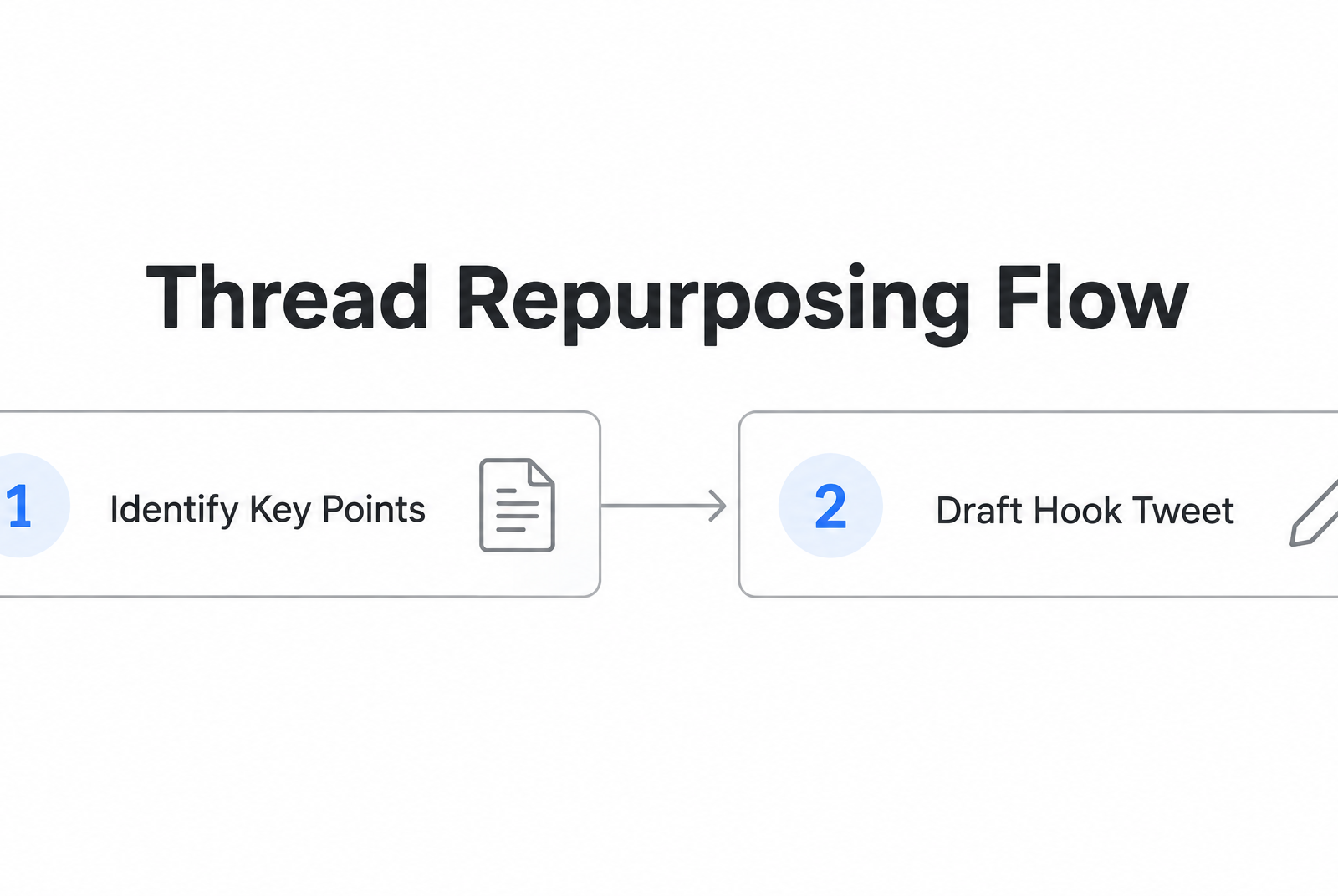
Before drafting, break the post into self-contained knowledge units. Think of the article as a collection of usable parts: the opening claim, the framework, the proof points, the examples, and the how-to steps. Each one maps to a job inside the thread.
The hook atom becomes tweet one. The framework atom becomes the thread's spine. Data atoms become the standalone tweets people save, quote, or screenshot. This is the step where most manual attempts fall apart. People try to compress the whole post instead of extracting the few ideas strong enough to stand alone.
Build the Hook, Then Sequence for Momentum
Thread structure that works tends to follow a tight shape: a scroll-stopping hook, a logical flow through your key points, and a clear call to action at the close. Draft a second hook for testing, since the first tweet decides whether anyone reads the rest.
Keep the thread focused. Most blog posts contain enough useful material for a tight sequence without padding. If your post only has a few strong atoms, write a compact thread rather than stretching weak material to hit an arbitrary count.
One honest caveat: skip the thread entirely if the post was only ever an average SEO piece written to rank. Trendy or thin content won't carry a thread. The multiplier effect tends to show up with pillar posts and data-backed pieces, not every URL you've published.
Where Automation Replaces the Copy-Paste Tax
This is the step that turns repurposing from a good intention into an actual workflow. Manually identifying atoms, drafting hooks, and sequencing posts asks for editorial judgment and platform fluency. Automation can handle the first-pass extraction and formatting so the human editor can focus on taste, accuracy, and voice.
That speed only matters if the output sounds like you. Generic rewrites read like a bot. The win is a workflow that pulls your ranked post, extracts the atoms, and drafts the thread in your voice, then hands you a near-final draft to tighten rather than a blank page.
Research shows that marketers repurpose content multiple times because republishing the same message across formats consistently drives more reach than one-and-done publishing. We cover the broader stack in our SEO automation tools roundup if you want to see where thread generation fits.
From Blog to Newsletter
A newsletter is where repurposing stops being about reach and starts being about relationships. A thread earns you a glance. A newsletter lands in an inbox someone chose to open. That shift from borrowed attention to owned attention is why the email edition tends to be the highest-value output of any repurposing run.

The gap many teams keep bumping into is structural. A typical SEO tool stack ends at the ranked post. It never carries that post into the inbox, so the nurture sequence that turns a reader into a lead gets built by hand or skipped.
The Blog-to-Newsletter Workflow Runs on Atoms, Not Paragraphs
Don't paste the whole post into an email and call it a newsletter. A long-form post holds several self-contained knowledge units. For an email edition, you pull one. The sharpest data point, the clearest framework step, or the counterintuitive claim becomes the spine of the issue.
A useful workflow builds each newsletter in three moves. Pick the single atom worth a reader's time. Wrap it in a conversational intro and a clear call to action. Then point the rest of the email back to the full post for anyone who wants depth.
That structure matters because inbox writing has its own rhythm. The subject line has to earn the open, the first line has to reward it, and the body has to make one useful point quickly. You're writing for the inbox, not shrinking a blog to fit it.
Open Rate, Click-Through, and Conversion Tell Different Stories
Three numbers tell you whether an edition worked, and they're not interchangeable. Open rate judges your subject line and sender trust. Click-through judges whether the body earned the trip back to your site. Conversion judges whether that visit did anything useful.
Click-through deserves the most weight for repurposed editions. A strong open rate on a weak body just means your subject line wrote a check the content couldn't cash. When click-through climbs, the atom you picked was the right one.
One honest limit: not every post deserves a newsletter. Content that only ranked because it was trendy tends to feel stale by the time it hits the inbox. Reserve the email funnel for evergreen or data-backed posts that already proved their value in search.
Automation Collapses the Afternoon Into Minutes
Doing this by hand adds another editorial pass after the article is already complete. You still have to select the right idea, rewrite it for an inbox, format it, and keep the CTA connected to the original post. That friction is why many teams know they should use email more often but don't.
This is the stage an automated repurposing workflow can cover. One ranked post goes in. A brand-voice newsletter comes out alongside the thread and the YouTube script, no separate copywriter per channel. If you're mapping which parts of your stack to automate first, our rundown of SEO automation tools covers where the email funnel fits.
Repurposed content creates more touchpoints and more chances to convert. The newsletter is the touchpoint that brings readers back on purpose.
Generating YouTube Scripts from Blog Articles
A YouTube script is where most repurposing workflows quit. Threads and newsletters feel close enough to text that teams attempt them by hand. A video script feels like a different creative discipline, so it gets skipped.
That hesitation is the opportunity, because video content is often the best format for product education, service explainers, and framework-led teaching. A standard SEO workflow gives you the ranked post and stops. It does not turn that post into a timed script with a hook, a body, a close, and editor-friendly notes.
Script Structure Is the Whole Game, Not the Word Count
A video script is not your blog post read aloud. It needs a fast hook, conversational phrasing, and a clear call to action at the end. The proven shape is simple: hook, then problem, then solution, then proof, then CTA.
Strong scripts pull the opening statistic or provocative claim from the post to anchor the hook, then let the article's framework carry the body. Length should follow watch behavior, not your article word count. Pick one path per post and lean toward a focused explainer for teaching content, because clarity beats completeness on video.
Visual Cueing Separates a Script From a Transcript
A script needs to tell the editor what to show, not just what the presenter should say. Effective scripts pair each spoken beat with a suggested B-roll prompt, so a line about a framework arrives with a cue for an on-screen diagram, and a data point arrives with a cue for a chart.
This is the step manual repurposing almost always drops. Writing narration is one task. Adding visual notes, timing, and transitions is what makes the script usable for production. Without that layer, you have a transcript in reverse, not a video asset.
Speed Is What Makes This Repeatable
Hand-adapting a blog into a full video script adds enough effort that many teams save it for only their biggest campaigns. Automation changes the behavior because it turns the script into a standard output of the content workflow rather than a separate creative project.
One caveat worth stating plainly: skip the video script for thin, time-sensitive posts. If the piece only ranked because the topic was briefly trending, a script built from it may age out before it earns meaningful attention. Save the script step for evergreen posts that still hold value in search. If you want the broader automation picture, our guide to SEO automation tools covers where this fits.
Integrating SEO Tools with Repurposing Automation
Here's the handoff that breaks most stacks. Your keyword research tool exports a target. Your rank tracker confirms the post climbed. Then the data just sits there, because nothing in a typical SEO tool stack knows how to turn a ranked post into an X thread, a newsletter, and a YouTube script.
A closed-loop way to think about this is one system, not a toolbox. Research tools feed the top. An automation engine works the middle. Multi-channel output comes out the bottom. The point of linking an SEO workflow to repurposing automation is to stop re-keying the same post into five different tabs and let one trigger fire the chain.

How Do You Connect SEO Tools to the Automation Layer?
Most research platforms expose either an API or a connector you can wire into an automation tool. That's the bridge. When a post hits a target rank or a tracked keyword moves, that event becomes the signal that kicks off repurposing instead of a reminder you'll ignore.
Documented automation workflows can extract an article from a URL and generate platform-ready pieces—threads, newsletter copy, video scripts—from existing blog content. The question stops being "can we afford to repurpose" and becomes "why is this still manual."
Where Do Pipelines Actually Break?
The bottleneck is rarely the tools. It's the gap between them. SEO data lives in one system, drafts live in another, and a human copies between the two. That handoff is where work disappears.
The fix is designing the original asset for reuse before you publish, not slicing it afterward as an afterthought. One camp argues you should build pillar content as a repurposing system from day one. Another sells retroactive transformation of posts you already have. Both work, but at different quality tiers.
A practical approach is to plan upfront for flagship pieces and automate the transformation on everything else. Designed-for-reuse assets like webinars yield richer output than post-hoc blog slicing, so reserve the manual care for those.
One more trigger worth respecting: repurpose what already proved itself. Your rank tracker and analytics already tell you which post earned a second life. Let that data pick the input.
Skip the full automation chain for thin, trend-chasing posts. The payoff shows up on evergreen, data-backed content that keeps earning. For teams mapping which pieces fit, our rundown of SEO automation tools covers where the connectors live. Build the loop once, and the published post stops being a dead end.
Measuring the ROI of Repurposed Content
Most teams can tell you what a blog post ranked for. Far fewer can tell you what that post earned once it left the page. That gap is where ROI measurement falls apart, because a typical report follows the asset until publication and goes dark after.
Rank, traffic, on-page score. Then silence.
The better measurement model follows the asset across channels. An SEO report captures the search performance of the blog post, but it usually misses the downstream pull from the thread, the inbox edition, and the video created from that same source. The whole journey matters, not just the first stop.

Track Different KPIs For Each Channel, Not One Vanity Number

Each repurposed format answers a different question, so each needs its own metric. Lumping them into one dashboard average hides where the return actually comes from.
For X threads, watch impressions, profile clicks, and reply depth. For the newsletter, open rate and click-through tell different parts of the story. For video scripts, watch retention, watch time, and click-through to the original post or offer. The key is to avoid a single blended metric; it hides whether the thread drove discovery, the newsletter drove owned traffic, or the video did the teaching.
A Four-Row Dashboard Model
A concrete dashboard can track each layer without inventing benchmarks:
| Layer | What to Watch |
|---|---|
| Cross-platform impressions | Total impressions per repurposed asset, plus the original post's search impressions, to see whether distribution expands total reach. |
| Traffic lift | Referred sessions from each asset back to the original post or core site page, segmented by thread, newsletter, and video. |
| Cost reduction | Hours or spend per finished asset before and after automation, so the team can see whether the handoff is becoming cheaper to run. |
| Quality-degradation signals | Bounce rate, unsubscribe rate, comment sentiment, or time-on-page for repurposed assets; if these weaken, the automation is producing volume at the expense of fit. |
This model treats the original post as the baseline. If cross-platform impressions rise but traffic lift stays flat, the distribution assets are visible but not pulling people through. If cost reduction improves but quality-degradation signals worsen, the workflow is over-optimizing for output. The dashboard's job is not to report one number; it's to show whether repurposing is compounding the asset or diluting it.
Quick Questions, Straight Answers
1. What if my blog post is only 800 words—is it too short to repurpose?
Short posts can work if they contain distinct, self-contained ideas worth isolating. The signal is depth, not length. A focused 800-word post with a clear framework, a data point, and an example can still produce a useful thread or newsletter. Thin posts at any length won't travel well across channels.
2. Do I need to repurpose every single blog post I publish?
No. Use performance and substance as the filter. If the post has lasting value, clear ideas, and enough structure to support platform-native outputs, it belongs in the repurposing queue. If it was written only to catch a short-lived query, leave it out.
3. Can I repurpose old posts I published months or years ago?
Yes, if the content still answers the question well today. Older posts with frameworks, teaching depth, and durable examples often make good source material. Before repurposing, check whether the article needs a refresh so you are not distributing outdated advice in a new format.
4. What happens if I repurpose a post that never ranked well in search?
Repurposing won't fix a weak source asset. If the article missed intent, lacked substance, or failed to earn trust, turning it into more formats usually spreads the same problem. Improve the original post first, then decide whether it deserves distribution.
5. How do I know which channel to prioritize first when starting to repurpose?
Start with the channel closest to your business goal. If you want owned-channel nurturing, build the newsletter workflow first. If you need discovery, start with X threads. If education and trust-building matter most, prioritize YouTube scripts. The best long-term system connects all three, but the first channel should match the outcome you need most.