Zapier vs Gumloop in 2026: Automate Social Titles, Descriptions, and Hashtags

Key Takeaways
- Zapier fits small businesses publishing finished social copy. Gumloop fits workflows where AI reasoning stays inside.
- Zapier connects 8,000 to 9,000+ apps and 500+ AI tools. Gumloop offers 100+ native integrations plus 100+ MCP servers.
- Zapier's task-based pricing starts at $19.99/mo. Gumloop's credit model runs roughly $37/mo at entry.
- Zapier launched in 2011 and has processed over 81 billion tasks. Gumloop, an April 2023 startup, sits around 950 million.
- If an upstream AI-voice engine already wrote your titles, descriptions, and hashtags, Gumloop's reasoning is wasted.
- Zapier holds 99.9% uptime. Gumloop, being newer, leans on SOC 2 compliance as its main security credential.
- Gumloop charges 1 to 60 credits per action, so per-post cost is harder to forecast than Zapier's flat task counting.
The short version, before you scroll
One takeaway if you don't read further: Zapier wins for small businesses that just need to publish finished social copy. Gumloop pays off when you want AI reasoning built into the workflow. The best no-code tool for generating and optimizing social media titles, descriptions, and hashtags depends on one thing: where the AI work happens.
Our read: if your titles, descriptions, and hashtags are already written by an AI-voice engine upstream, Gumloop's reasoning goes to waste. You just need reliable pipes to push finished posts to LinkedIn, X, Instagram, and TikTok. For most copy-less teams, that points to Zapier.
Zapier vs. Gumloop, side by side
Zapier: task-based automation with 8,000 to 9,000+ app integrations and a long enterprise track record. Gumloop: AI-first, built around agent workflows, with a smaller native library extended through the Model Context Protocol.
| Feature | Zapier | Gumloop |
|---|---|---|
| Founded | 2011 | April 2023 |
| Integrations | 8,000–9,000+ apps, 500+ AI tools | 100+ native apps, 100+ MCP servers |
| Pricing model | Predictable, task-based | Credit-based (1–60 credits per action) |
| Entry price | $19.99/mo (Professional) | ~$37/mo |
| Tasks processed | 81 billion+ | ~950 million |
| Uptime | 99.9% | Newer platform, SOC 2 compliant |
| Best for | Broad connectivity, predictable cost | AI agents that reason through steps |
A caveat on the integration numbers. Sources disagree on Zapier's exact app count, 8,000+ in some, 9,000+ in others, and it keeps climbing. Gumloop's tally depends on how you count too: one source lists a flat 130+, another splits 100+ native apps from 100+ MCP servers. Whether MCP connectivity counts as a "real" integration is a judgment call. For pushing social posts, native connections to your actual platforms matter more than the headline total.
Which pricing model fits a small business?
Zapier's flat task pricing is the safer bet. Gumloop actions burn anywhere from 1 to 60 credits, which makes your per-post cost hard to predict. Zapier charges per task, so a known publishing volume means a known monthly bill.
That predictability matters more to you than to an enterprise with a finance team. When the owner handles every dollar, a variable credit meter is a real risk. Publishing a steady stream of AI-generated posts each week? Budgeting on Zapier's model is dead simple.
Adoption backs the reliability case. Over two-thirds of Fortune 1000 companies run on Zapier's infrastructure. Gumloop, the newer entrant, is still building its enterprise footprint but has picked up fast among early adopters.
When Gumloop is the right call
Pick Gumloop when AI reasoning needs to live inside the automation. It's built for cases where agents reason through complex processes and adapt as the workflow runs.
Skip it if your copy is already generated and optimized before it hits the workflow. At that point, you're paying for adaptive reasoning you never use. Zapier's broad, predictable connectivity does the simpler job: moving finished titles, descriptions, and hashtags to your channels without the credit-cost guesswork.
Why these two even make the shortlist
Picking a no-code tool for generating and optimizing social copy starts with one question: where does the AI writing happen? If your copy is already written upstream by an AI-voice engine, you need pipes, not more reasoning. That single distinction reshapes the whole decision.
For small-business owners without a copywriting team, this matters more than any feature list. You build content with AnyPost.ai's AI-voice engine, then push finished titles, descriptions, and hashtags to social platforms through Zapier or Gumloop. The automation tool's job is delivery, not generation. So the real comparison comes down to reliability, cost, and connection breadth.
What actually deserves your attention
Three things matter: integration breadth, pricing predictability, and where the AI lives. The practical question is how each platform extends its reach. Zapier has a large native app library built over more than a decade. Gumloop is much newer.
App-count numbers vary by source, but the core distinction is architectural. Zapier gives you a massive, plug-and-play native library. Gumloop leans on the Model Context Protocol to extend its reach, so some connections need extra setup instead of one-click integration.
That difference shapes maintenance too. A native integration tends to break less and updates automatically when a platform changes its API. An MCP connection can offer more flexibility, but it usually asks more of whoever configures it. That is a real cost for a team without technical staff.
Why predictable pricing matters for small teams
Cost predictability decides this for owners without a finance team. Zapier's task-based model means the same publishing volume costs the same every month. Gumloop's credit system charges a variable rate per action, so your per-post cost swings based on how hard the AI has to work.
That variability is fine for enterprises testing adaptive agents. For a bakery or a two-person agency scheduling twenty posts a week, an unknowable bill is a real problem. And when your AI copy is already generated, you're paying Gumloop for reasoning you don't need.
When you'd skip Zapier
Skip Zapier if the AI decision-making genuinely belongs inside the workflow. Gumloop earns its price when an agent has to reason through changing conditions mid-flow, not just move finished content. If your workflow depends on agents that adapt as they run, that's where Gumloop fits.
Our take: for copy-less small businesses, that reasoning is redundant. The AI-voice engine already wrote your optimized titles and hashtags. You want broad, predictable connectivity to publish them, which tilts most teams toward Zapier. For a deeper look at automating the SEO side too, see our guide to the best automated SEO platform tools in 2026.
Feature comparison: connection engine vs. reasoning engine
The whole thing hinges on one question: do you need the tool to write the copy, or just deliver it? Zapier and Gumloop split cleanly here. Zapier is a connection engine. Gumloop is a reasoning engine.
For small-business owners running finished copy through a content engine, that split settles the question fast. If your upstream tool already handles the creative work, you need broad, reliable pipes to social platforms. Gumloop's AI reasoning sits idle. Zapier's connectivity gets it done.
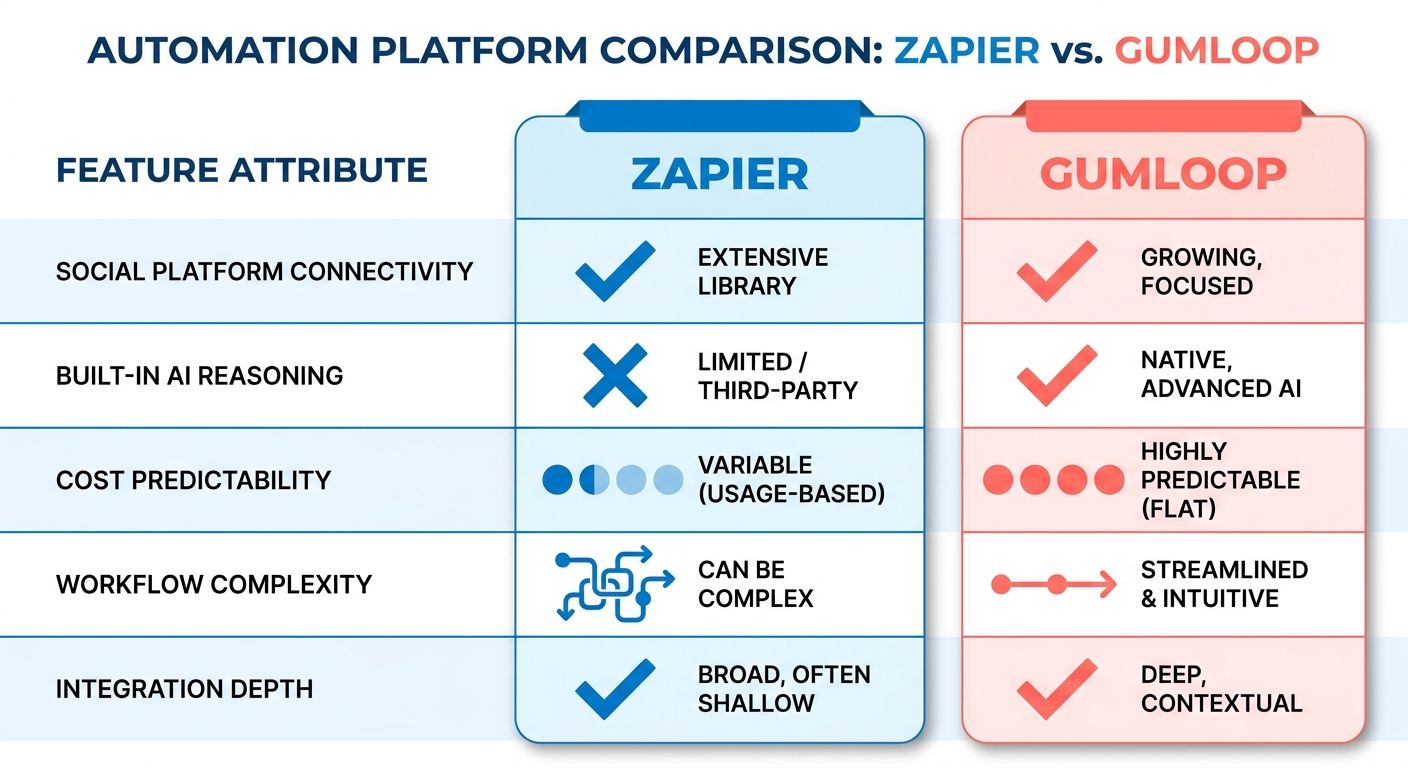
How integrations and scale compare
Integration breadth is the widest gap between these two. Zapier connects with thousands of platforms. Gumloop's native library is much smaller.
Exact counts vary depending on how you measure active integrations, but Zapier's library is vastly larger. It covers nearly every mainstream SaaS tool on the market, which makes it the default for a standard business stack.
Gumloop's ecosystem is growing, but it relies heavily on developer-centric protocols to bridge the gap. That extensibility is powerful for engineering teams. It lacks the plug-and-play simplicity a business owner wants for straightforward social publishing.
For social publishing specifically, Zapier's breadth means native support across every major network plus the scheduling, analytics, and CRM tools that live alongside them. Gumloop's thinner catalog means you'll hit gaps faster and patch them with custom builds.
| Feature | AnyPost.ai | Zapier | Gumloop |
|---|---|---|---|
| Core job | Brand-voice content generation | App connections | AI reasoning workflows |
| Publishing | Publishes directly to LinkedIn, X, Instagram, TikTok, YouTube | Vast library of apps and AI tools | Focused native library |
| Pricing model | Included with plan | Task-based, predictable | Credit-based, variable |
| Setup difficulty | No-code | No-code | Some technical steps |
| Best for | Content generation | Broad publishing pipes | In-workflow AI reasoning |
Which pricing model fits a copy-less team?
Zapier's task-based pricing wins for budgeting. You pay per task, finished-post publishing is one predictable task each time, and you know the cost before you commit.
Gumloop runs on credits, where different actions consume different amounts. That makes your per-post cost harder to calculate in advance.
That variability matters more for a small business than an enterprise. If you're pushing the same posts every day, credit-based pricing turns a simple bill into a guessing game. Owners without a finance team can't budget around swings in resource usage.
When you'd actually pick Gumloop
Pick Gumloop when the AI work happens inside the workflow. It's designed for multi-step reasoning where the automation itself has to evaluate and modify the data.
But that's the carve-out, not the rule for this use case. If your copy is already written upstream, Gumloop's reasoning is a feature you pay for and don't use. Zapier gives non-technical teams the pipes to run publishing themselves, no IT required. For pushing AI-generated titles, descriptions, and hashtags to social, that's the fit.
Performance: speed, scale, and the surprise-bill problem
For copy-less small businesses, performance comes down to two things: how fast the tool pushes finished posts, and whether the cost stays predictable as you scale. The winner is the one that moves your AI-written copy to LinkedIn, X, Instagram, and TikTok without surprise bills.
The raw throughput picture: Zapier runs multi-step workflows in parallel and fires actions within seconds of a trigger. Gumloop, built around AI-heavy node execution, takes longer per run as reasoning steps stack up. That timing gap matters when your posting schedule can't afford a dropped webhook or a delayed publish.
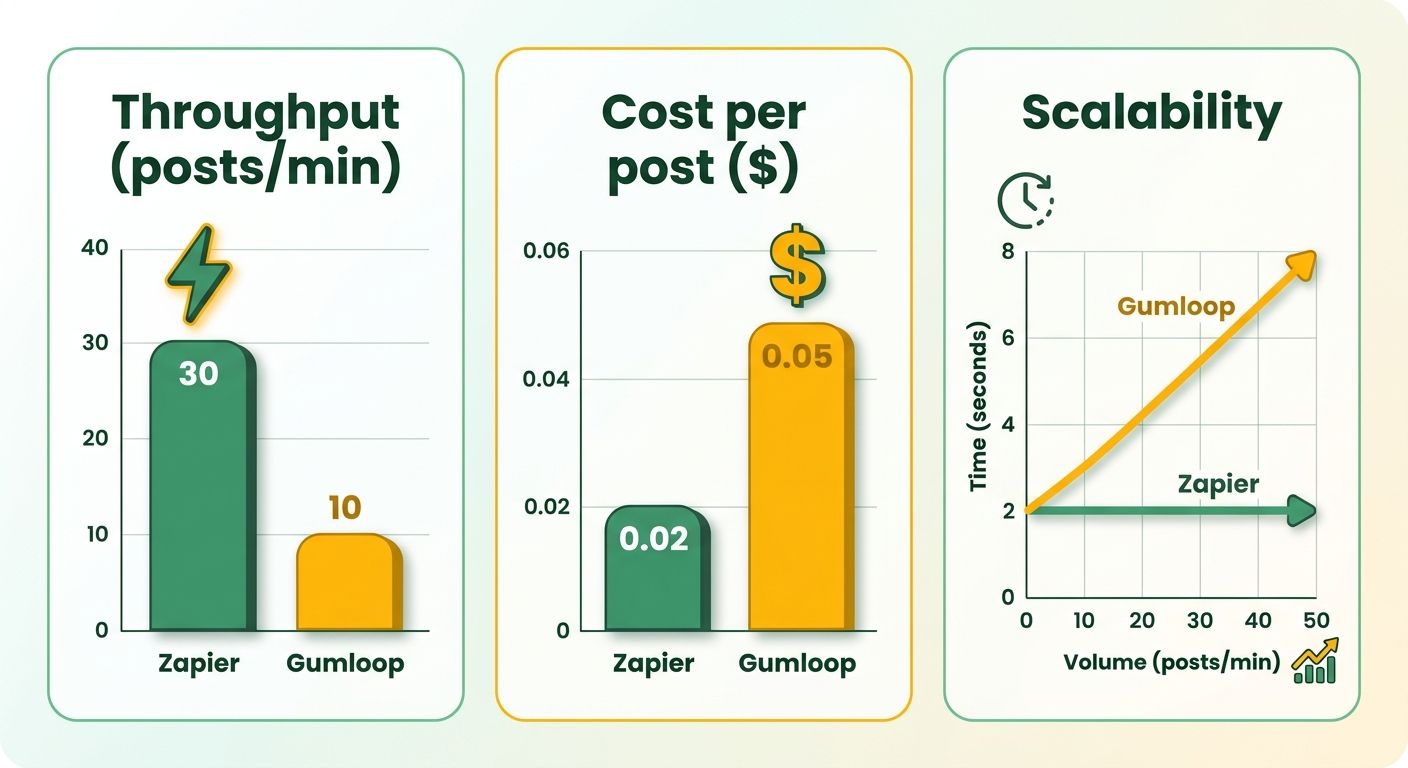
Which tool scales better for publishing?
Zapier scales better for pure publishing volume thanks to its integration ecosystem. Gumloop has a more focused set of native integrations, which can limit your options if you use niche platforms.
That integration count is your ceiling. When your titles, descriptions, and hashtags are generated upstream, you don't need complex AI reasoning during delivery. You need pipes that reach every platform you post to. Broad connectivity wins. Some content engines can even handle multi-platform publishing directly, skipping the middleman entirely.
Adoption backs the reliability claim. Zapier runs across marketing, sales, and ops teams at companies of every size, from solo founders to enterprises. Per Zapier's own case study, Slate Magazine lets non-technical teams build and manage workflows without leaning on IT.
How cost scales per post
Cost predictability is where the two split hardest. Zapier uses a flat, task-based model. Gumloop's credit billing means your per-post cost can fluctuate with the complexity of each run.
For an owner without a finance team, that variance is the real risk. Ten posts a day on Zapier is a budgetable line item. The same volume on Gumloop swings with how heavy each action turns out to be. A single post that runs image generation plus several reasoning steps can burn many times the credits of a plain text push, so heavy-content days quietly inflate the bill.
| Metric | Zapier | Gumloop |
|---|---|---|
| Execution speed | Seconds per action | Slower on AI-heavy runs |
| Parallel workflows | Yes | Limited |
| Integrations | Extensive library | Focused native library |
| Pricing model | Flat, task-based | Credit-based |
| Cost per post | Predictable | Variable |
Does MCP close the integration gap?
Partly, but not for most small businesses. Gumloop leans on the Model Context Protocol to extend past its native library. That's genuine reach, but it asks for more setup than clicking a pre-built connector.
Our take: MCP extensibility is a developer's answer to a small-business problem. If you just want copy pushed live on schedule, Zapier's ready-made connectors and flat pricing do the job with less to manage. An all-in-one content engine can also automate generation and multi-platform publishing end to end, turning your content into social assets without stitching separate tools together. Skip Gumloop here unless you're building agent logic you actually need.
Pros and cons
The choice splits along one line: Zapier wins on connectivity and cost predictability, Gumloop wins on built-in AI reasoning. Run finished posts through an AI-voice engine, and that trade-off usually settles in Zapier's favor.
The honest carve-out: if you have no upstream content engine and want the automation tool itself to think through your copy, Gumloop's strengths matter. But when your titles, descriptions, and hashtags arrive already written, its AI layer sits idle while you keep paying for it.
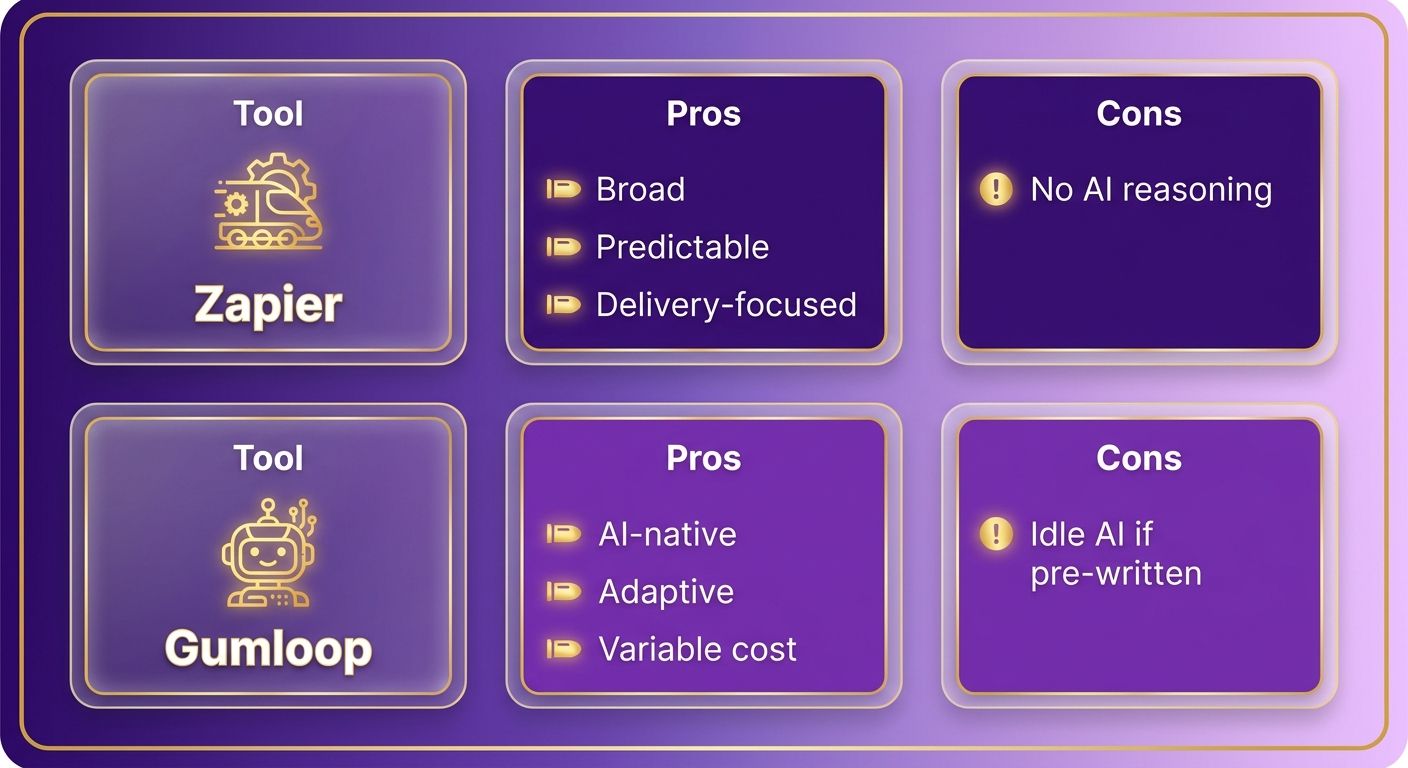
The trade-offs at a glance
Zapier: broad, predictable, delivery-focused. Gumloop: AI-native, adaptive, but variable in cost. The right pick depends on where the writing happens. Think of it this way: Zapier is the freight rail that moves your finished cargo reliably, and Gumloop is the factory that builds the cargo mid-transit. If your cargo is already built, you're paying for an idle factory.
The deciding question isn't which tool is stronger overall. It's whether the writing happens inside the automation or before it starts.
Where Zapier wins, and where it falls short
Zapier's biggest advantage is reach and reliability. Its two-step trigger-and-action model has been battle-tested at scale, and its uptime record means your posts actually publish when scheduled. For a solo operator, that removes a whole category of worry.
The cost angle deserves a stance. For a small-business owner without a finance team, variable billing makes per-post cost highly unpredictable. Zapier's flat task model is something you can forecast. That predictability is decisive when every dollar gets watched.
Zapier's weakness? It doesn't reason. It moves data; it doesn't write or adapt copy. If you need the tool to make judgment calls mid-workflow, you'll hit its ceiling fast.
When Gumloop is the better pick
Gumloop earns its place when AI reasoning belongs inside the workflow. The guidance from most comparisons is simple: choose Gumloop if you need dynamic, multi-step decision-making built directly into your runs.
Its drawback is the smaller native library and the definitional fuzziness around integrations. Whether Model Context Protocol connectivity counts as a real integration is a fair debate. Our take: MCP extends reach, but it's not the plug-and-play breadth a non-technical owner wants. When a connector requires you to understand what a server does before wiring it up, it has stopped being no-code in any practical sense.
How an AI-voice engine changes the math
A dedicated content engine reframes the whole comparison. The writing is handled before publishing ever begins, which shifts the automation tool's role entirely from creation to distribution.
That makes Gumloop's reasoning redundant for this workflow. The AI work is already done upstream. So the choice collapses to connectivity and cost, and Zapier's broad, budgetable pipes take the win for copy-less teams. Because your upstream system integrates with your website and publishes directly, the whole pipeline stays automated.
Use cases and ideal users
The right pick depends entirely on who you are and where your copy comes from. Already write posts with an AI-voice engine? You need Zapier. Want the automation tool itself to do the thinking? You need Gumloop.
For small-business owners without a copywriting team, that distinction settles the whole question. When you generate finished titles, descriptions, and hashtags upstream, the choice becomes a matter of fit, not features.
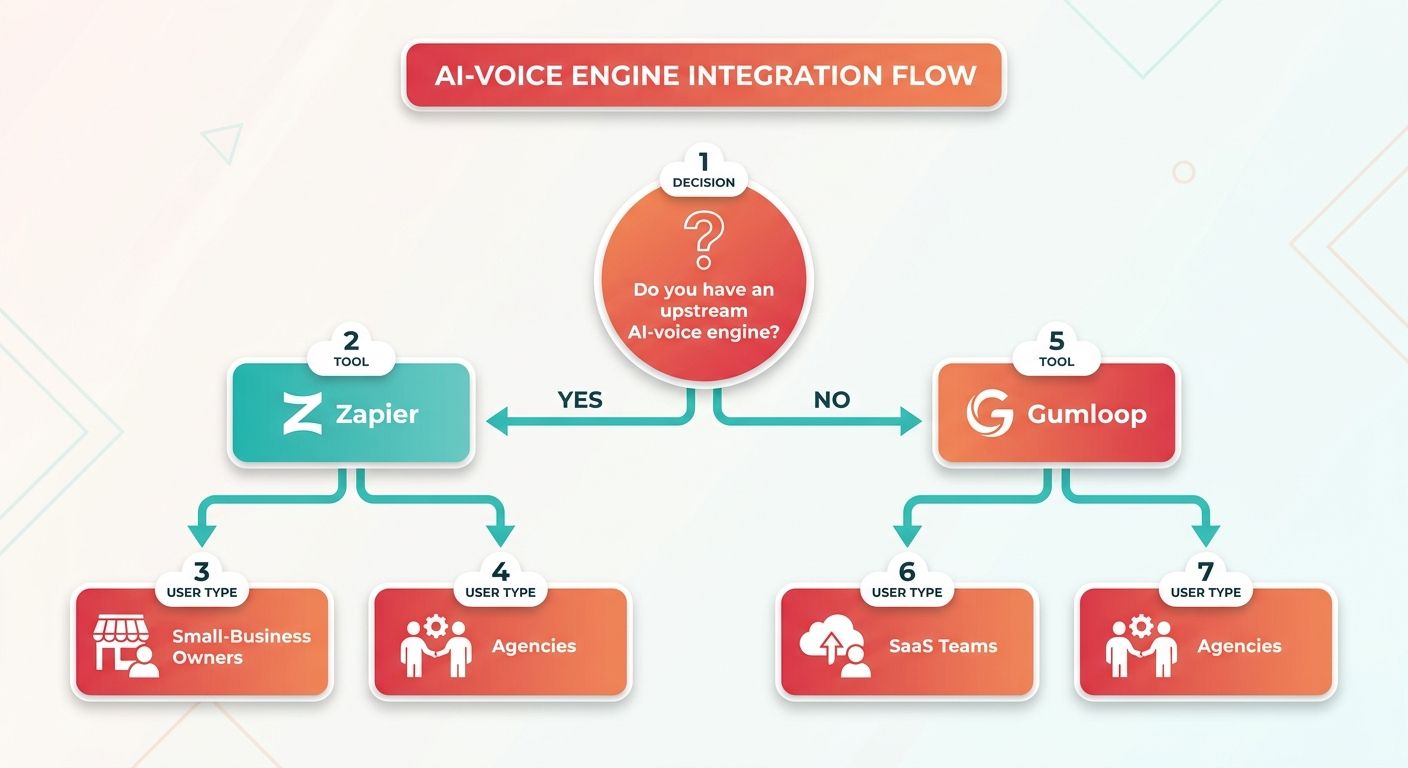
Who should pick Zapier?
Zapier fits copy-less small businesses that need reliable publishing pipes. If your posts arrive already written in your brand voice, Zapier's job is pure delivery. Its connection library means you can route finished copy to LinkedIn, X, Instagram, and TikTok without stitching together fragile workarounds.
The predictability seals it for owners without a finance team. Because each publish maps to a single, countable action, you can forecast a posting month before it starts. That certainty matters when you're running the business and the marketing at the same time, and it takes the guesswork out of scaling from a handful of posts to a full weekly calendar.
Zapier also earns trust through sheer breadth of use. Its template library and pre-built Zaps mean a non-technical owner can stand up a working publishing flow in an afternoon. That self-serve design lets marketing teams create and manage workflows independently, without leaning on IT.
When Gumloop makes more sense
Gumloop fits teams that want AI reasoning baked into the workflow, not upstream. If you have no content engine and want the automation tool to adapt copy on the fly, its agent-first design earns its keep.
But that strength is exactly what makes it wrong for this use case. When your titles, descriptions, and hashtags are already generated, Gumloop's reasoning layer sits idle. You'd pay for thinking that's already done.
The cost model carries real risk for small teams. Because credit draw shifts with how much reasoning each step performs, a single post can cost far more than a similar one the week before. Our take: for a fixed posting schedule, that variability makes per-post cost unknowable — a hard sell for anyone budgeting by hand.
Which tool fits which user?
| User Profile | Best Fit | Why |
|---|---|---|
| Small business using an AI-voice engine | Zapier | Copy is done; you need predictable delivery pipes |
| Solo marketer with no content engine | Gumloop | AI reasoning writes and adapts copy in-flow |
| Agency scaling many client accounts | Zapier | Extensive integrations, flat task pricing |
| Team building custom AI agents | Gumloop | Agent-native design, MCP extensibility |
Skip Gumloop if your copy is already written — you'd pay for an AI layer you never touch. Skip Zapier only if you genuinely need to reason through content itself.
For a fuller look at automating the writing side too, our guide to the tools covers where copy generation fits into this stack.
What I'd actually recommend
The honest answer: neither Zapier nor Gumloop writes your copy well enough on its own. The automation tool's real job is delivery. Once your titles, descriptions, and hashtags come out of an AI-voice engine already polished, you need pipes, not a second brain.
That reframes the whole comparison. When your content engine handles generation and multi-platform publishing automatically, the AI reasoning happens upstream. In that setup, Gumloop's built-in intelligence sits idle while you keep paying for it. So the best no-code tool for pushing optimized social copy usually comes down to reliable connectivity and predictable cost.
Which tool wins?
Zapier wins for most owners without a copywriting team. Its flat, task-based pricing makes per-post cost budgetable, while Gumloop's credit model leaves that number floating. For a solo owner tracking spend by hand, a knowable bill beats a variable one every time.
There's a practical failure point worth weighing too. When a scheduled post misfires, you want error alerts and retry logic that catch it before your feed goes quiet. Zapier's built-in retry paths and failure notifications mean a broken step surfaces fast, so you can fix a stalled LinkedIn or Instagram publish without finding out days later. That operational safety net matters more for a one-person team than raw feature counts.
When Gumloop still makes sense
Pick Gumloop when the workflow itself needs to do the thinking. If you have no upstream system to reason through your copy, its AI-first design earns the credit spend. Gumloop is often positioned for teams that need agents to adapt to changing conditions.
But that's exactly the scenario copy-less owners avoid. When your upstream engine already turns content into ready-to-publish posts, paying for redundant AI reasoning makes no sense.
Final recommendation
It breaks down cleanly along one question: do you already have finished copy? If your titles, descriptions, and hashtags arrive polished from your content engine, your automation tool only needs to publish reliably and bill predictably. That points to a lightweight delivery setup, not a second AI layer.
If instead you need the workflow to write and adapt on its own, Gumloop's AI-native reasoning is worth the credit spend. And if you're an enterprise weighing scale, Zapier's track record of billions of automated tasks signals the reliability large operations depend on.
Our recommendation is simple. Generate your titles, descriptions, and hashtags with a dedicated AI-voice engine, then let it publish content directly across your social channels. That pairing gives small businesses optimized copy without a copywriter and reliable publishing without a variable bill.
Skip Gumloop for this exact job. Its AI layer solves a problem you've already solved upstream, and you'd pay for the privilege of watching it run idle. A unified content engine turns your website and social channels into an automated marketing engine — content creation, SEO, and multi-platform distribution in one place.
FAQ
Is Zapier or Gumloop better for publishing AI-generated social posts?
For most small businesses, Zapier. If your titles, descriptions, and hashtags are already written by an AI-voice engine, you just need reliable pipes to your platforms — and Zapier's task-based pricing makes the monthly cost predictable. Gumloop's AI reasoning is redundant when the copy is already done.
Why is Gumloop's pricing harder to predict?
Gumloop bills by credits, and different actions consume anywhere from 1 to 60 credits depending on how much reasoning each step performs. A text-only post costs far less than one running image generation plus multiple AI steps, so heavy-content days can quietly inflate the bill. Zapier charges a flat rate per task, so a known publishing volume means a known cost.
Does Gumloop's MCP support close the integration gap with Zapier?
Partly. The Model Context Protocol extends Gumloop's reach beyond its 100+ native apps, but MCP connections generally ask more setup than Zapier's one-click connectors. Whether that counts as closing the gap depends on your team's technical comfort. For a non-technical owner, Zapier's plug-and-play library is the easier path.
When does Gumloop actually make more sense than Zapier?
When the AI reasoning needs to live inside the automation — an agent evaluating and adapting data mid-workflow, not just moving finished content. If you have no upstream content engine and want the tool itself to write or reshape copy on the fly, Gumloop's agent-first design earns its cost.
How reliable is Zapier for scheduled publishing?
Zapier holds 99.9% uptime and has processed over 81 billion tasks since 2011, with over two-thirds of Fortune 1000 companies using its infrastructure. It also offers retry logic and failure notifications, so a stalled publish surfaces fast rather than going unnoticed for days.