3 Things to Lock Down Before AI Repurposes Your Content

Key Takeaways
- Hand content to AI without guardrails, and you can lose on four fronts: legal standing, search rankings, brand voice, and conversions.
- Under current U.S. copyright rules, purely machine-generated content is not protectable.
- That leaves derivative work exposed to copying.
- You need documented human involvement at both ends: who wrote the source, and who edited the AI output.
- Slapping an "AI-generated" label on a piece can quietly waive your copyright claim.
- Your labeling policy is a legal decision, not a formatting one.
- Pick a lane per asset: defend it under fair use or license it as training data.
- Commercial use weakens the fair-use side, so you cannot have both.
- Sequence the risk work worst-first, legal before SEO, and you avoid patching a tone problem while a copyright claim builds.
Why You Lock This Down Before AI Touches It
Hand your content to an AI tool without a plan, and the losses stack up on all four fronts: legal exposure, SEO rankings, brand voice, and conversions. The ai content repurposing tools you run are only as safe as the guardrails you set before they run.
So work the risks in order, worst first: legal → SEO → brand perception → conversion. Get the sequence backwards, and you'll fix a tone problem while a copyright claim quietly builds against you.
Why ownership breaks the moment AI touches your work
Copyright attaches where there's real human creative contribution. Purely AI-generated output cannot be copyrighted under U.S. law. So the instant a tool repurposes your work, the new piece may have no protectable owner, while your original loses none of its standing.
The "monkey selfie" case settled the principle: only humans hold copyrights. One artist who hand-drew a sketch and then used AI to enhance it got copyright only on the human-contributed part.
Our take: document human authorship at both stages. Log who wrote the source. Log who edited the AI output. Do it before the tool runs, not after a takedown notice lands.
- Record human authorship for every source asset so ownership survives repurposing.
- Log a named editor on each AI output, capturing meaningful human changes, not cosmetic tweaks.
- Decide your "AI-generated" labeling policy on purpose. Labeling content as AI-made can forfeit your ownership claim, so this is an ownership decision and an attribution decision at once.
License or defend? Pick one lane
Don't straddle fair use and licensing. The U.S. Copyright Office's guidance, 108 pages in its third report on AI, ties commerciality to the activity, not the entity. If your repurposing produces a financial benefit, it counts as commercial, which weakens a fair-use defense.
That same financial angle can cut the other way. If your content earns money, you can license it as high-quality training data instead of only playing defense. Both readings hold. The commercial nature that hurts you on defense is exactly what you monetize when you license.
Our position: choose your lane per asset and write it down. Transformativeness, as the Copyright Office put it, "is a matter of degree; it depends on the functionality of the model and how it is deployed." Mechanical reuse does not clear that bar.
- Clear rights on third-party assets before AI reuses them. Taking whole works wholesale weighs against fair use.
- Tag each asset "license" or "defend" so your team never argues both at once.
- Lock down SEO metadata before repurposing so every derivative still targets the ranking it was built for. Skip this and duplicate-content warnings pile up fast.
Who actually needs this lock-down?
Best fit: B2B SaaS marketers, agency teams, and enterprise content hubs publishing at scale. The more you repurpose, the more each unchecked run compounds risk.
Skip the full rights audit if you publish rarely and own every asset outright. The 2-to-4 week investment is not worth it for a handful of first-party posts. For everyone else, start by inventorying every asset you plan to repurpose, then build your checklist from there.
1️⃣ Secure Legal Rights & Ownership Before AI Rewrites
Before AI touches a single asset, sort every piece into three buckets: owned, licensed, and user-generated. That sort is the foundation of a keyword-safe repurposing plan. Most ai content repurposing tools will happily rewrite an asset regardless of its permissions, which is how compliance problems start.
Clear boundaries mean your team only feeds legally cleared material into automated workflows. Instead of guessing which files are safe, a systematic audit gives you a clean repository of approved source texts.
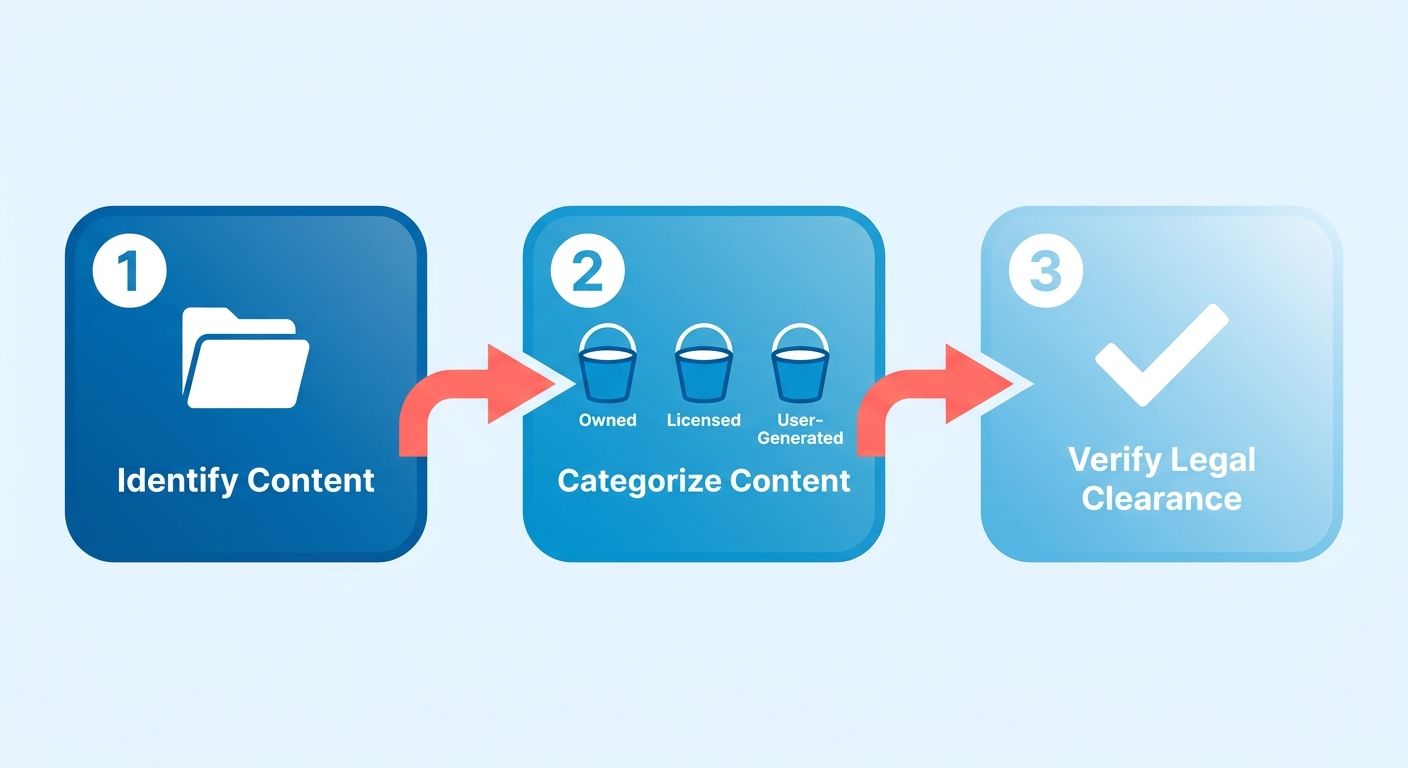
Sorting owned, licensed, and user-generated content
Owned: content your team created with clear human authorship. Safe to repurpose, but still tag the human contribution so the output stays protectable. Licensed: stock, data, or media you paid to use under specific terms. User-generated: quotes, reviews, and community submissions you may not fully control.
Run each category through a Rights-Clearance Matrix. Keep the columns tight so an AI tool can check it before pulling any asset.
- Asset. Name the file, article, or quote so it maps to a single row.
- Source. Where it came from and who created the human portion.
- License Type. The exact terms, not a vague "we bought it."
- Expiration. Licenses lapse, and repurposing a lapsed asset revives old liability.
- Attribution Needed. Flag anything requiring credit before it hits a repurposed piece.
For a medium library of roughly 2,000 articles, budget 15 to 20 hours to build this matrix. That's a real cost. It's still cheaper than pulling a ranking page after a copyright claim.
The rights pitfalls that sink teams
Two things catch teams fast. First, stock-photo licenses that prohibit AI generation. Plenty of image terms explicitly ban feeding assets into AI models. Second, third-party quotes used without permission, which carry over into every repurposed derivative.
There's an operational risk in how you handle disclosure, too. If your workflow auto-applies standard tags, you might quietly change the legal status of the asset. Set a protocol for when and how these tags get applied, so your team makes those calls manually, based on the level of human editing involved.
- Verify each stock license permits AI use before any image or dataset enters a repurposing workflow.
- Confirm written permission for every third-party quote so no derivative inherits an unlicensed claim.
- Set manual review protocols for disclosure tags so they accurately reflect human editorial involvement.
Making the rights audit run in production
Once your assets are categorized, assign clear operational tags to guide the content team. Rather than debating legal theory mid-production, editors check the matrix to see whether an asset is cleared for commercial modification or restricted to its original format.
That clarity kills bottlenecks and keeps unvetted material out of the generation pipeline. Track two metrics through the audit: percentage of assets cleared and the number of copyright warnings before versus after. Keep the cleared-asset list as the single source your generation workflow draws from, so a bad row cannot slip into a live page. Pair this rights work with a full content audit so your legal clearance and ranking review run off the same asset list.
3️⃣ Protect SEO Equity & Structured Data Before Repurposing
SEO equity is the ranking power your existing pages already earned. Protect it before AI touches anything, because repurposing without SEO guardrails is the fastest way to make two of your own pages fight for the same query. Most ai content repurposing tools will happily spin out five near-duplicates that split your authority instead of concentrating it.
To keep search engines from filtering out your new assets, each repurposed piece has to target a distinct search intent. If your workflow just replicates the structure of the source, search engines flag the new pages as duplicate content, and your domain authority gets diluted.
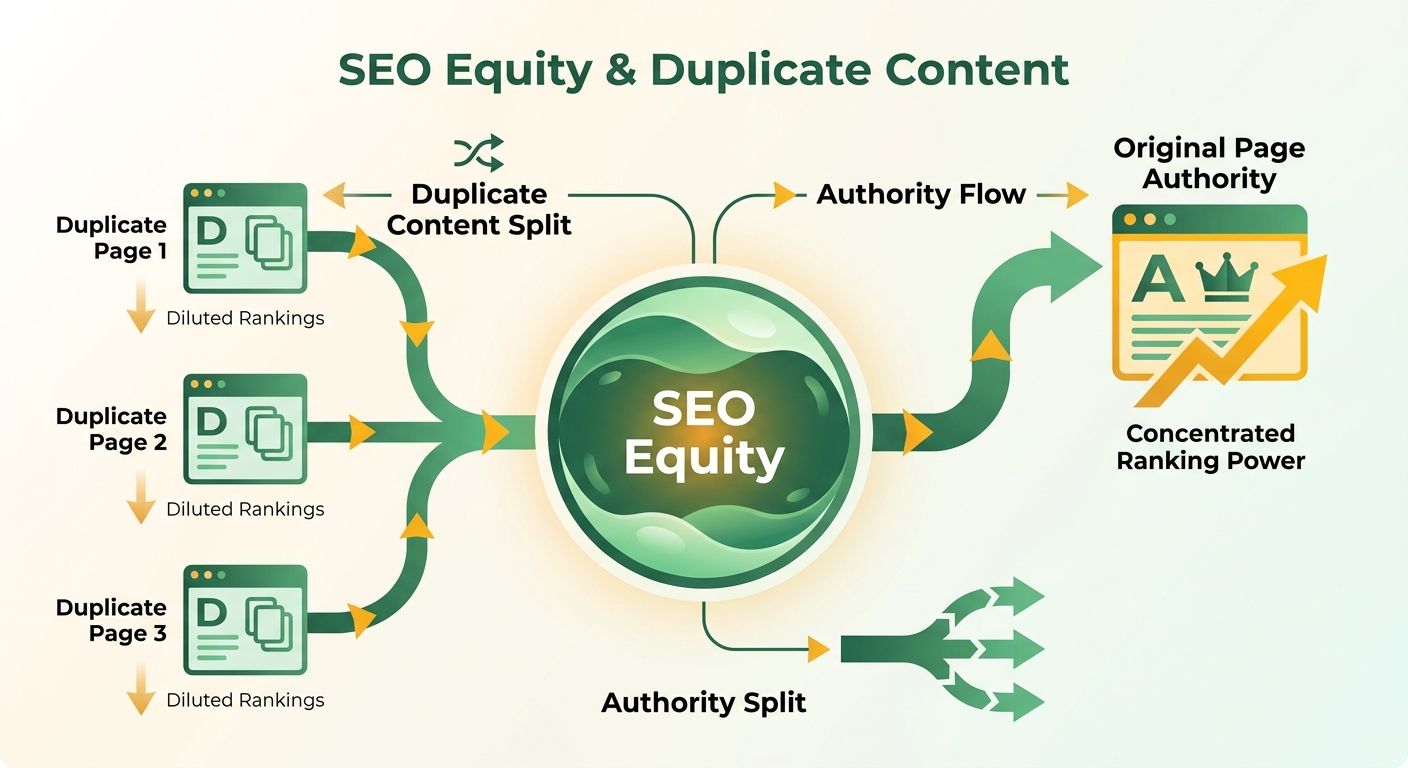
Audit your SEO health before you repurpose
Start with a crawl to see what you already have and where it overlaps. You cannot map keyword intent onto content you have not inventoried. Our take: never hand AI a topic you have not first proven has a clean, single canonical target.
- Run a full site crawl with a crawler like Screaming Frog or Sitebulb to map every canonical tag and flag duplicate-content hotspots before AI creates more of them.
- Map keyword intent per URL so each existing page owns one query and one intent label. This is the audit that tells AI which page to protect and which angle a repurposed piece has to take instead.
- Flag near-duplicate clusters where two pages already chase the same term. Fix or consolidate those first. Repurposing on top of existing overlap multiplies the problem.
AnyPost supports this step by crawling your whole site to build a Business Context Graph of your products, messaging, and audience, so you can see how your content maps together before AI creates anything new.
What belongs in your SEO metadata blueprint
An SEO Metadata Blueprint is a per-asset spec that locks the ranking signals AI has to preserve. Build it once, and every repurposed piece inherits the same rules. This is what stops AI from rewriting a title into something that ranks for nothing.
- Lock the title, meta description, and H1-H2 hierarchy as fields in the blueprint so the repurposed version keeps its structure and target term.
- Assign a target keyword and intent label to each asset. Without an intent label, AI guesses, and guesses cannibalize.
- Auto-populate meta fields at publish so the blueprint fills the metadata during publishing instead of a manual step you'll skip under deadline.
Does every repurposed asset inherit the right schema?
It should. Structured data is a ranking signal that AI rewrites will strip unless you enforce inheritance. Match schema to format: an Article gets Article JSON-LD, a tutorial gets How-To, a Q&A block gets FAQ.
- Attach the correct JSON-LD type to each repurposed format so answer engines can still parse it.
- Track organic traffic share per content type before and after the lock-down. This is the metric that proves the audit worked.
With semantically correct HTML elements and search-intent-aligned headings baked into every article, AnyPost keeps these signals intact through publishing, straight into your real-time analytics view. Plan 12 to 14 days for a 500-page site audit and blueprint. Skip the lock-down only if your site is under a dozen pages with zero keyword overlap. Everyone else pays for it later in lost rankings.
Putting It All Together: The 3‑Step Pre‑Repurposing Checklist
Three lock-down areas. One checklist. Run all of it before a single asset touches an AI repurposing tool, and you protect your rights, your voice, and your rankings in one pass. Below is a copy-paste version you can adopt.
The sequence matters. Legal clearance sets the baseline permissions, then brand voice alignment, then SEO metadata. Aim for ≥ 90% checklist compliance before your first AI-repurposed publish.
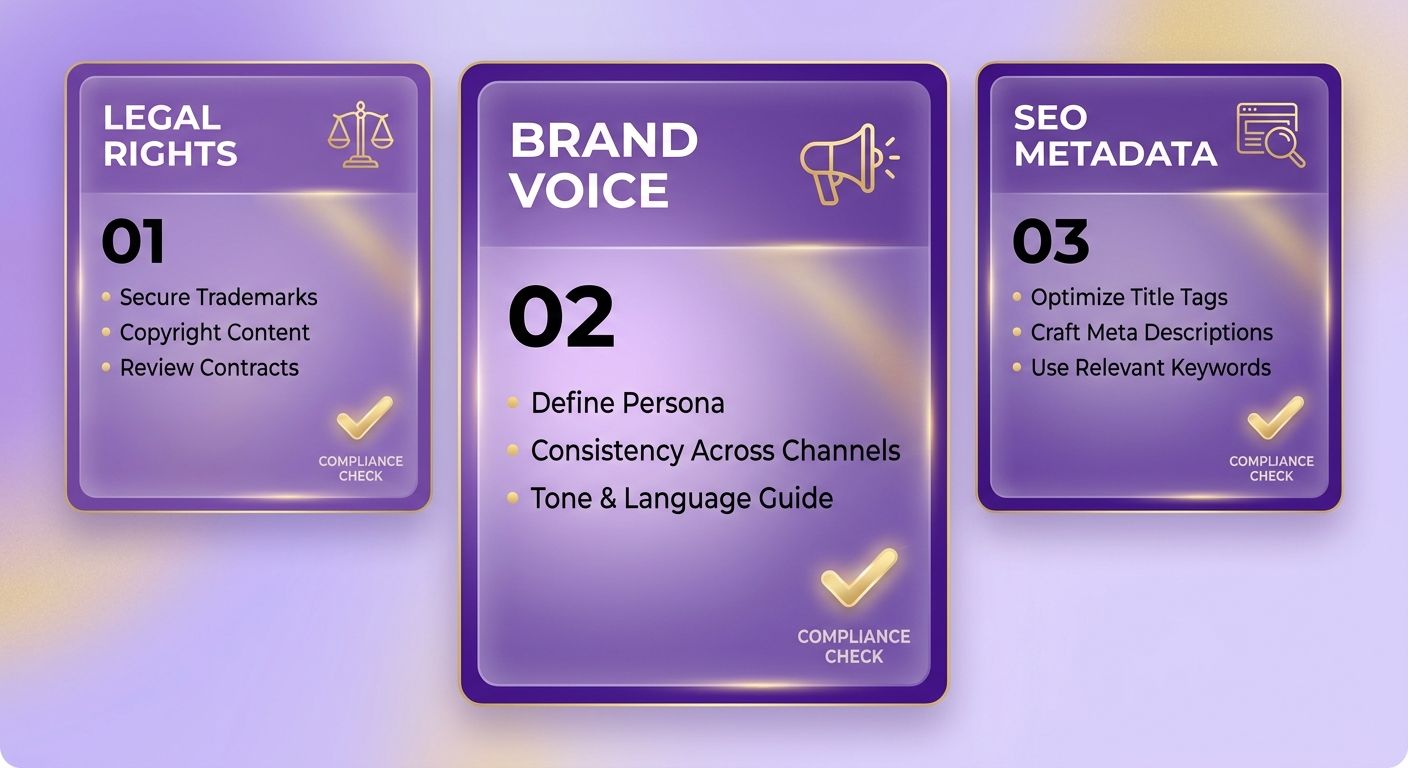
What goes on the pre-repurposing checklist
Each category has an owner and a hard completion bar. Work top to bottom.
✅ Legal Rights (owner: Legal)
- Sort every asset into owned, licensed, or user-generated before generation runs.
- Confirm 100% of rights are cleared on the source material. No exceptions.
- Set a disclosure-tag policy from your legal team's guidelines, and make sure default settings get overridden.
✅ Brand Voice (owner: Brand/Content)
- Attach an approved voice guide to the repurposing brief so tone survives the rewrite.
- Require voice similarity ≥ 85% against your reference samples before sign-off.
- Verify the output offers real editorial value and unique insight, not minor phrasing swaps.
✅ SEO Metadata (owner: Growth/SEO)
- Assign one target query per repurposed piece so two pages never fight for the same term.
- Verify the canonical tag points where the ranking equity should concentrate.
- Preserve structured data and internal links from the source. Map these before you remix so nothing breaks in the handoff.
Who owns what: the RACI in plain English
Confusion over ownership is what kills these rollouts. Keep it simple.
Legal is Responsible and Accountable for the rights audit. Brand/Content owns the voice guide and the similarity check. Growth/SEO owns the keyword blueprint and canonical verification. Everyone is Consulted on the disclosure policy, since it hits legal standing, brand perception, and search guidelines all at once.
Go-live and post-launch rules
Go-live sign-off needs three green lights: 100% rights cleared, high voice similarity, canonical tag verified. Miss one, and the piece waits. No partial launches.
After you publish, keep watching. Repurposing failures show up in the data weeks later, not on day one.
- Run a weekly AI-output audit to catch drift in tone or near-duplicate spin-outs.
- Review a monthly KPI dashboard: organic traffic, leads, and duplicate-content warnings side by side.
- Re-run the keyword check if a repurposed page's rankings slip toward a sibling URL.
For a typical B2B SaaS content hub, plan 4 to 6 weeks for full rollout. Most of that goes to the rights audit and building your voice reference set. The SEO blueprint moves faster once those two are locked.
Skip the whole protocol for a single throwaway social snippet. It's overkill there. Run it in full for anything that carries a target query, an internal link, or your brand's name on the byline.
Bonus Resources & Next Steps
The templates below turn each lock-down area into a repeatable process. Grab them once, and your keyword-strategy audit stays consistent every time you feed content to AI repurposing tools, instead of getting reinvented per project.
Standardizing this way keeps your legal, editorial, and SEO teams on the same steps, so nothing critical gets missed during high-volume production.
Which templates to download first
Start with the three that map to the three lock-down areas. Each one exists so you never audit from a blank page.
- Rights-Clearance Matrix. Sort every asset into owned, licensed, or user-generated before AI touches it. Tracks the origin and licensing terms of your source material so compliance stays intact.
- Voice Pillar Sheet. Lock your tone rules in writing so repurposed output does not drift. Without a written reference, you're grading voice from memory, which no two reviewers do the same way.
- SEO Blueprint. Map target keywords and intent to each source asset before repurposing. Stops two of your own pages from splitting authority on the same query.
Which tools support each lock-down area
Match the tool to the risk it controls. You do not need all three for every project; pick based on which lock-down area is weakest for your team.
- Duplicate detection. Run repurposed drafts through a plagiarism checker before publishing so the final copy has unique phrasing and structure search engines will index favorably.
- Brand-voice analytics. Score output against your Voice Pillar Sheet so tone drift shows up as data, not opinion.
- Keyword intent mapping. Confirm each repurposed piece targets its intended query and intent, not a near-duplicate that cannibalizes an existing page.
Before you scale any AI workflow on top of your site, know your baseline. AnyPost integrates directly with your CMS to map your existing content footprint, so every new asset aligns with your established messaging.
What to read and watch next
Regulatory shifts move your content strategy whether you track them or not, so plan for them.
- Emerging regulation review. Track the EU AI Act and how it treats automated content. Rules here move faster than most editorial calendars, so build a quarterly re-check into your process.
- Commercialization strategy guide. Learn how to evaluate your content library for data-licensing opportunities, turning your archives into a direct revenue stream.
- Recorded webinar. Watch a session on AI-safe repurposing to see the full checklist run end to end.
One last carve-out: if you're publishing purely internal content that never competes for search, skip the SEO Blueprint step. The ranking risk is not there, and that audit time is better spent on the legal matrix.
Want to pressure-test all of this on your own content? Get 3 free articles with AnyPost, no credit card required, and see how automated, SEO-optimized repurposing runs in your voice from a single dashboard.
Frequently Asked Questions
1. Does editing AI output enough make the whole piece copyrightable?
No. Legal protection is strictly limited to the specific elements created by a human. If a machine generates the core structure and a human editor merely polishes the phrasing, only those specific editorial changes are protected. To secure broader rights, the human contribution must represent the primary creative force behind the work.
2. My stock photos are properly licensed. Can I still feed them into AI tools?
Not necessarily. Standard commercial licenses often exclude the right to use assets as inputs for machine learning models or generative tools. You must review the specific terms of service for each provider to ensure your agreement covers automated modification and derivative creation.
3. Should I label my repurposed content as "AI-generated"?
This decision should be guided by your legal counsel and platform guidelines. While transparency builds trust with readers, applying broad disclosure tags can sometimes be interpreted as a disclaimer of human authorship, which may impact your ability to defend the work against unauthorized copying.
4. Why should legal clearance come before the SEO audit?
Optimizing content that you do not have the full rights to modify is a waste of resources. If a licensing dispute forces you to take down a page, any search equity or ranking power built on that URL is lost. Establishing legal clearance first ensures your SEO efforts are spent on permanent assets.
5. Can repurposing content that just reshuffles sentences hurt me in two ways?
Yes. If an automated tool merely rearranges existing text, the output lacks the originality required for search engines to index it as a distinct, valuable page. At the same time, it fails to meet the legal standard of transformation required to establish a strong defense against copyright claims from the original source.
6. Is this full lock-down process worth it for a small blog?
For sites with minimal content footprints and complete ownership of all published material, a comprehensive audit is rarely necessary. You can scale down the process by simply verifying that your source texts are entirely original and ensuring your new pages target unique search queries.
7. How can commercial content both weaken and strengthen my legal position?
Using copyrighted material to generate commercial revenue makes it much harder to claim fair use if a dispute arises. However, if you own the rights to your content, that same commercial value makes your library highly attractive for licensing agreements with AI developers looking for high-quality training data.
