7 Signals Your AI SEO Content Generator Is Working Beyond Rankings

Quick summary
Rankings are the easiest number to watch and the slowest to pay the bills. For a lean team, the real test of an AI SEO content generator is whether it moves the numbers your pipeline depends on: attention, sharing, sign-ups, authority, output, clicks, and time.
The table maps each of those to a KPI. Fill in the blank columns with your own data before you judge any results.
| Signal | KPI | Baseline | Target | Timeframe |
|---|---|---|---|---|
| Engagement | Avg. Time on page or scroll depth | |||
| Social reach | Social shares or social referral traffic | |||
| Conversions | Assisted conversions or sign-ups | |||
| Authority | New referring domains | |||
| Publishing scale | Pages published per week | |||
| Search appeal | CTR trend | |||
| Efficiency | Hours saved per month |
Bottom-of-funnel pages, the ones written for readers close to a buying decision, tend to show their value in sign-ups first. That effect often gets stronger once other sites start linking to them. Treat it as a pattern to test, not a promise.
How to read each signal
Watch the direction of each number over a review window you set yourself, and compare it against its own baseline. A single good week tells you very little. What you want is a signal that holds or improves after the content has had time to get indexed and shared.
- Engagement: Deep scrolls mean readers stay past the intro.
- Social reach: Shares show the content earns attention outside search.
- Conversions: Sign-ups are the number your finance team asks about.
- Authority: New referring domains mean other sites consider you worth citing.
- Publishing scale: Steady weekly output beats a burst followed by silence.
- Search appeal: A rising CTR means your titles match what searchers want.
- Efficiency: Saved hours show what the tool gives back to your team.
Why a top-three ranking can still produce zero sign-ups
A page can climb to position three and never produce a single sign-up. Rankings and visits tell you people found your content. They say nothing about whether anyone took the action your pipeline depends on, so judging a generator on positions alone can leave you paying for traffic that never turns into revenue.
Sign-ups are a different kind of number. A finance lead can weigh a sign-up count against content spend. A ranking report gives them nothing to weigh.
What automation still leaves to you
Automation gives you scale. It can't tell you whether a sign-up came from the pillar page or the follow-up email, or whether long time on page means interest or confusion. In our experience, those calls still need someone who knows the funnel.
Our recommendation is to settle three things before you start tracking the signals beyond clicks:
- Name the one action that counts as a conversion for you, such as a trial sign-up or a demo request. Every other signal should tie back to it.
- Agree on an attribution rule with whoever owns pipeline numbers. Credit disputes get much harder to settle once the results are already in.
- Assign one person to review engagement data each month. A tool can collect the data, but someone has to interpret it.
One exception: if your site gets only a handful of visits a month, start with rankings. Outcome signals need volume before they mean anything.
Signals 1–2: Do readers stay, and do they share?AI content rarely fails first in the rankings. It fails when readers bail halfway down the page because every paragraph sounds like the same template. A generator earns its keep when people read further and pass the piece along, and both of those signals tend to move before positions do.
We group engagement and social reach because they share a cause. Content that sounds like your team holds attention on the page. That same voice is what makes the social posts cut from it worth sharing.
Is your brand voice holding readers?You can't judge voice from one post. The pattern only shows across twenty or so, when the generic-sounding ones quietly lose readers.
- Compare average time on page and scroll depth for voice-matched posts against older generic drafts. A gap between the two shows whether the voice work is changing how people read.
- Track returning blog visitors over a quarter. People come back to a voice they recognize. A flat line suggests your content still reads as interchangeable.
Are social posts sending people back?Automated carousels for LinkedIn or X cost little to publish. The cheap part isn't the question. The question is whether they bring anyone back to your site.
- Check social referral traffic in the first 48 hours after each article goes live. That window shows whether the posts prompted clicks or just scrolls.
- Count comments and shares per post, not only impressions. Impressions measure the feed. Comments show someone cared enough to reply.
If your buyers rarely use these channels, skip the social half and put the effort into on-page engagement instead.
Signals 3–4: Which pages bring leads, and which bring links?
The pages that win sign-ups often look unremarkable in a traffic report. They target fewer searches, but the people running those searches are already comparing tools. That's why we judge a generator by what each page sends into your pipeline and treat visitor counts as secondary.
Pillar pages built on bottom-of-funnel keywords, such as competitor-alternative roundups and "best CRM software" lists, tend to pull more sign-ups when they also earn high-quality backlinks. We read those two as a pair, which is why we run backlinking alongside content generation. The keyword finds the buyer. The links give the page enough visibility to actually reach them.
Which pages are producing leads?Attribution is how you tell whether content contributes to deals or just fills the blog.
- Tag every sign-up and demo request with its first and assisted landing pages. An assisted conversion means the page showed up in the visitor's path before they converted, even if it wasn't the last click.
- Rank pages by revenue or sign-ups per session, not raw sessions. A low-traffic page with high value per visit deserves your next keyword update before a busy page that converts nobody.
Is authority feeding future leads?Links tend to build up slowly. Track them page by page instead of staring at one domain-wide total.
- Log new referring domains for each bottom-of-funnel page every month. Pages cited in resource lists can keep sending qualified visitors long after you publish them.
- Compare lead quality before and after a page gains links. If sign-ups rise but sales rejects most of them, the links brought the wrong audience.
If your forms aren't tracked yet, skip this cluster and fix tracking first. Without it, none of these numbers mean anything.
Signals 5–6: Scale that search engines actually index
Page count is the signal teams trust least, and they have good reason. Hundreds of thin pages can eat your crawl budget (the limited attention search engines give your site) while adding nothing a buyer would read. Scale counts only when output climbs and quality holds at the same time.
We apply that test to any generator running programmatic pages. These are long-tail pages built from a shared template and filled with varied data. A manual content stack tends to stall at a few posts a week. An automated engine can publish far more, but you need proof that the extra pages earn impressions.

Is publishing scale adding real coverage?
Check volume against indexing and search demand before you celebrate the page count.
- Compare pages published per week against pages indexed. A widening gap means search engines are skipping your output.
- Track long-tail impressions for new pages over their first months. Rising impressions suggest the template matches what people actually search for.
- Spot-check a sample of pages for near-identical wording. Lookalike pages tend to compete with each other for the same queries, which is a fight you lose twice.
What CTR trends say about relevance
Click-through rate (CTR) is the share of searchers who click your result after seeing it. In practice, it tells you whether your titles match what the searcher wanted.
- Watch CTR next to average position in a live dashboard. If position holds steady while CTR falls, the title often no longer fits the query.
- Review position drift weekly. A slide you catch early costs an afternoon of fixes instead of a quarter of lost clicks.
If your product serves one narrow set of queries, skip programmatic pages altogether. A few strong pillar pages will do more for you.
Signal 7: The hours you get back, priced in dollars
Most teams can't say how long one article takes. The hours scatter across several people and tools. Research can swallow whole afternoons, and SEO checks and formatting add a quiet tax at the end that nobody logs.
Until you measure that time, any claim that a generator saves hours is a guess. We don't lean on product averages here, including our own. The baseline a finance lead will trust is the one built from your team's logs.
If you publish only a handful of posts a quarter, skip this signal. The savings will be too small to measure cleanly.
How to measure time saved per article
Track the same stages before and after automation so the comparison holds up.
- Log hours per article for research, writing, editing, SEO, and publishing. Splitting the work by stage shows where automation cuts time and where review time grows.
- Timestamp comparable pieces before and after the switch. Match length and funnel stage, since a comparison roundup and a short update won't compare fairly.
What the reclaimed hours are worth
Saved time only counts once you name where it goes.
- Multiply hours saved by a loaded hourly cost, meaning salary plus benefits and overhead. That gives you a dollar figure to set against content spend.
- List the strategy, testing, or product work the freed capacity could fund. This opportunity-cost view often makes the stronger case, because a backlog of untested ideas can cost you more than the hours themselves.
How to run all seven signals in an afternoon a month
The dashboard is rarely the hard part. Agreeing on what counts as a lead before the numbers arrive is. A generator can raise your publishing output quickly while your CRM still files every new sign-up under "direct," and then nobody can prove anything.
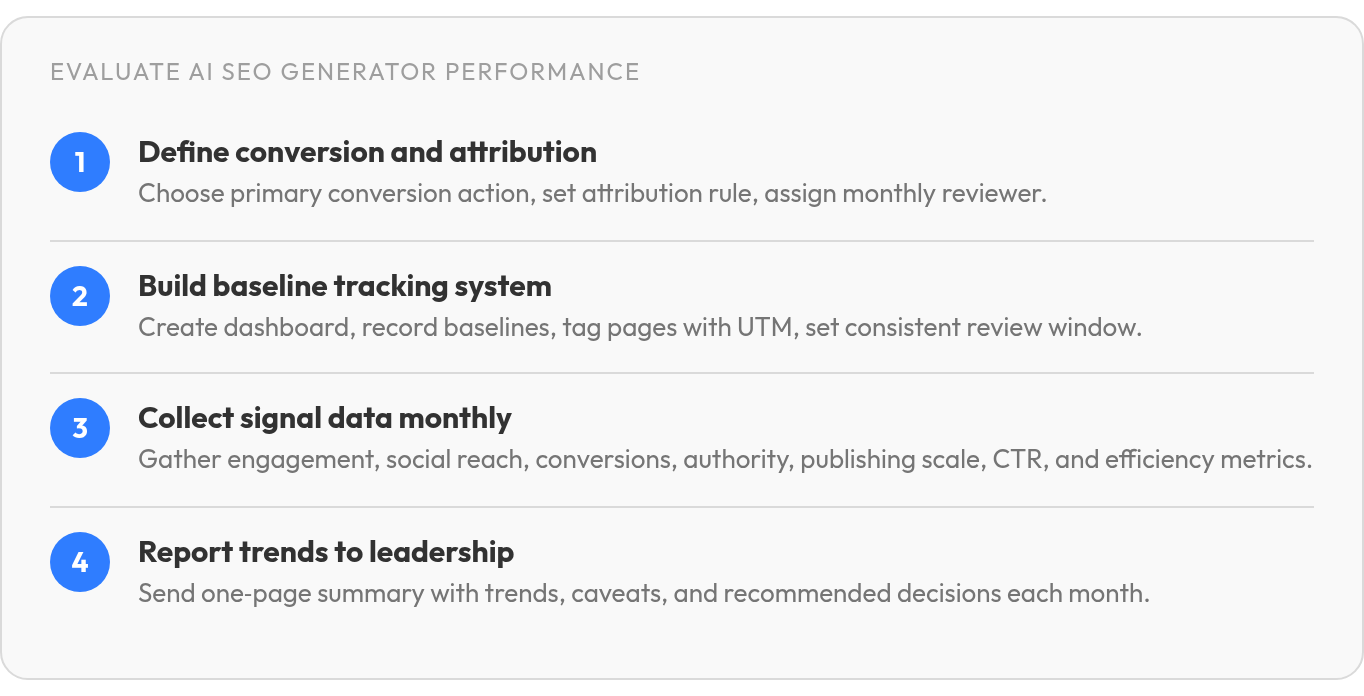
We keep the setup small enough that one marketer can run it in an afternoon a month.
Set up baselines and attribution first
Every later chart depends on this plumbing, so build it before you publish at volume.
- Build a spreadsheet or analytics dashboard with one row per signal and columns for baseline, current value, target, and review date. A single view keeps the signals from scattering across separate tools.
- Record a baseline and keep the same reporting window each month. If your volume is low, stretch the window. No fixed collection period fits every signal.
- Tag content landing pages with UTM parameters, capture the content ID in your forms, and agree on lifecycle-stage definitions. Without shared definitions, assisted-conversion analysis turns into an argument.
What leadership should see each month
Leadership wants decisions, not a gallery of charts.
- Send a one-page report covering traffic, engagement, conversions, referring domains, publishing output, and hours saved. Add a methodology note wherever attribution has gaps, so nobody mistakes a partial number for a full one.
- Lead with trends, caveats, and the decision each one supports. When a change shows up, state what you changed, what moved, and over what time window. A finance lead can act on a result framed that way.
- Expect some months to be inconclusive. Low volume, slow indexing, and messy attribution can all blur a trend, and saying so plainly builds more trust than forcing a story out of thin data.