6 Signals Beyond Clicks That Prove Your AI Blog Posts Work

The Short Version
- Qualified conversion rate—ICP-matched leads divided by content-attributed leads—carries more weight than engagement metrics when proving content ROI.
- AI summaries now intercept readers before they click through, creating a zero-click visibility gap and attribution blind spots that traditional pageview tracking cannot capture.
- Repeat-visit frequency, calculated as returning users divided by total users in a 30- or 90-day window, signals authority growth most teams overlook.
- Posts holding readers past 75% scroll depth but converting poorly indicate CTA placement or offer problems, not content quality issues.
What Actually Matters
The first metric teams report is often the least useful. Raw pageviews can rise even while lead quality deteriorates, and zero-click visibility can grow without a single click, so traffic volume should never stand alone as proof of performance.
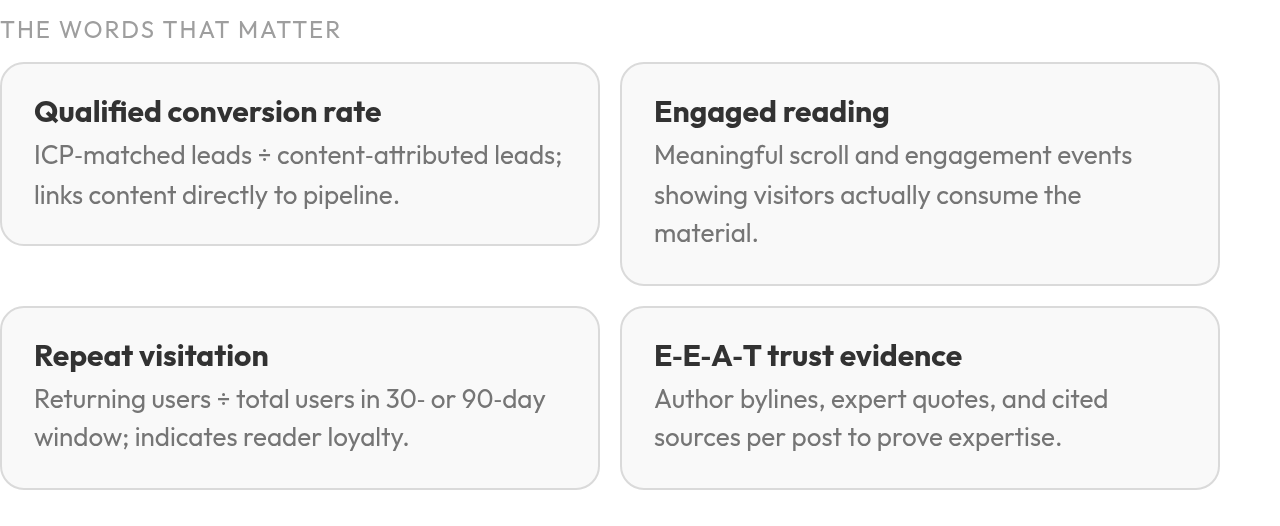
Treat an ai blog post generator as valuable only when results tie to business outcomes. The matrix below covers seven signals across conversion, engagement, authority, trust, zero-click visibility, and operational efficiency. Establish a baseline from your historical data rather than borrowing one from an unrelated vertical.
Weight the scorecard according to business value. Pipeline contribution and downstream results belong at the top; behavioral data helps diagnose the reasons behind those results.
| Signal | Why It Matters | Calculation / Source | Your Baseline | Quick Action |
|---|---|---|---|---|
| Qualified conversion rate | Ties content directly to pipeline | CRM attribution and ICP qualification data | Rolling average from your CRM history | Cut posts driving unqualified volume |
| Engaged reading | Reveals whether visitors consume the material | Meaningful scroll and engagement events in GA4 | Average across your recent post history | Rewrite intros on high-entry, low-scroll posts |
| Repeat visitation | Shows whether readers choose to return | URL-level returning audience share in GA4 | Cohort average over a consistent time window | Add newsletter CTA to high-repeat posts |
| Referring-domain quality | Earned links transfer authority | New relevant linking domains from Ahrefs or GSC | Prior-period average from your link data | Refresh posts earning zero links |
| Zero-click visibility | Captures AI-summary mentions and citation frequency that pageview tracking misses | AI-summary citations and answer-engine references where available | Prior period from your search data | Add source evidence and query-relevant definitions |
| E-E-A-T trust evidence | Supports quality evaluation and citation eligibility | Author bylines, expert quotes, and cited sources per post | Set a minimum floor; audit quarterly | Add credentials and one primary source per post |
| Production efficiency | Captures real time ROI | Comparable workflow logs for manual and AI-assisted posts | Manual benchmark recorded before AI adoption | Sample posts consistently and recalibrate as the workflow matures |
Normalize each signal against its corresponding historical baseline, then assign the greatest weight to the outcome your business values most. Treat zero-click visibility as an authority signal rather than a conversion outcome: it can show citation influence, but it should not be credited as pipeline until a CRM event confirms it.
Why Clicks Tell You Almost Nothing
Clicks describe arrival, not impact. They don't show whether a visitor fits your ideal customer profile, reads enough to understand the offer, returns for more, links to the article, trusts its authorship, or enters the sales pipeline. In zero-click search, a page can shape an AI answer without ever producing a pageview.
That distinction matters more when evaluating AI-assisted publishing. Faster production can create more indexed pages and more traffic without improving commercial performance. Ranking and citation authority are separate outcomes. A post can rank and still never be cited by AI search. A narrowly targeted article may attract a modest audience while influencing stronger opportunities, earning citation authority, or appearing in an AI-summary answer without a click. Judging both posts by pageviews rewards the wrong one.
A practical measurement framework needs layers. Start with business outcomes, use engagement behavior to investigate performance, examine authority, trust, and zero-click visibility indicators for longer-term value, and measure production economics separately. This prevents a rise in one category from masking deterioration in another.
Attribution will never be perfect. CRM records, analytics platforms, backlink tools, and workflow logs each capture a different part of the journey. The goal isn't to force them into one supposedly precise number—it's to assemble enough consistent evidence to make better publishing decisions.
How Users Actually Interact With Your Content
Posts from an AI blog post generator can drive on-page activity while contributing nothing to pipeline. We recommend using behavioral metrics to locate friction: they can reveal whether the introduction, structure, CTA, or offer needs attention, but they can't establish commercial success on their own.
Engaged time and scroll depth are most useful when reviewed together at the URL level. Strong reading behavior paired with weak response suggests the conversion path is out of alignment; early abandonment points to a mismatch between the headline promise and the opening paragraphs.
Segment these patterns before acting. A mobile visitor arriving from informational search won't behave like a desktop subscriber opening a bottom-funnel article from an email. Without that context, a blended average can make a healthy post look weak—or conceal a genuine problem.
The Per-Post Dashboard That Actually Works
Build each URL report around five categories: active reading time, progressive scroll events, engagement or bounce behavior, returning audience share, and conversions. The value comes from comparing the pattern across the group rather than treating one metric as a verdict.
For return behavior, select one stable user identifier and one fixed reporting period. Changing either between reports makes the trend unreliable. Review the metric by article and by topic cluster; repeated visits across related posts may indicate readers see the site as a continuing resource rather than a one-off answer.
Set separate behavioral ranges for content type, intent, device, and acquisition channel. An educational guide, a comparison page, and an offer-led article serve different jobs. Requiring identical engagement patterns from all three produces poor editorial decisions.
Privacy controls also leave part of the audience unmeasured. Treat analytics as a directional record of observable sessions, not a complete census of every interaction with your ideas or brand.
Authority and Trust: What Actually Transfers Value
Posts from an AI blog post generator may retain organic visibility without demonstrating the expertise that answer systems need before using a source. That distinction makes authority broader than rankings: it includes both visible editorial evidence and the way credible sites reference the work.
What Trust Signals AI Systems Look For
Systems interpreting content look for experience markers—first-hand evidence, transparent authorship, and original reporting. Useful trust elements include named authors with verifiable expertise, case evidence, dated and attributed sources, clear editorial ownership, and a visible corrections policy. These are also the signals that make an article eligible for citation in AI summaries.
Audit those elements as editorial infrastructure, not decorative additions. A credential should explain why the author is qualified to address the subject. A citation should support the claim beside it. Original evidence should make its method and limitations understandable. Merely placing a biography or source list on the page doesn't guarantee that either one strengthens the article.
Backlinks function as contextual authority signals, but link count by itself is a weak measure. Record whether a new referring site is relevant to the article's subject, whether the link appears naturally within the body, and whether the source demonstrates topical credibility of its own. A smaller set of well-matched editorial references can be more useful than broad directory distribution.
Allow enough time for discovery before evaluating earned links. Then compare articles with similar scope and intent so topic demand doesn't distort the result. If a post attracts no references, review its audience targeting and promotion before assuming the writing itself failed. It may answer a useful question without offering anything distinctive enough for another publisher to cite.
Time Saved and Production Scale
Productivity claims often focus only on draft speed. That omits the downstream work that determines whether an AI blog post generator truly improves operations: research, fact-checking, SEO implementation, editing, internal approval, revision, and publishing.
Document each stage for a representative sample of posts. Include the friction created by writer-editor handoffs, repeated revision requests, and meetings needed to resolve unclear briefs. Measure both hands-on labor and elapsed cycle time; a task can require little active work yet still delay publication while it waits in a queue.
Calculate Fully Loaded Cost Per Piece
Raw hourly rates understate publishing costs. Fully loaded cost includes salaries, contractor or agency fees, software licenses, creative production, and allocated overhead. A calculation that excludes the CMS, image licensing, or project-management effort will overstate the economic benefit of automation.
Map the manual and AI-assisted workflows side by side. Mark which tasks disappear, which become shorter, which remain unchanged, and which create new review demands. Research and first-draft preparation may contract while quality control expands, so total savings should come from recorded workflow data rather than assumptions about generation speed.
Calendar reliability deserves its own line on the scorecard. Compare missed deadlines, rescheduling, and revision activity across equivalent reporting periods. A calendar that moves from 16 scheduled posts with 11 delivered to 16 scheduled with 15 delivered has reduced operational churn, even before considering revenue. Keep that improvement separate from cost and lead results to avoid counting one benefit twice.
For a full efficiency calculation, use:
[(Gross profit or lead value attributable to the change + labor savings) − (AI tooling cost + implementation hours)] ÷ (AI tooling cost + implementation hours)
Document the assumptions behind every input. Lead value should come from the same attribution rules used elsewhere, while labor savings should reflect actual loaded costs. This makes it possible to distinguish a workflow that merely produces more drafts from one that creates publishable work with less total effort.
Frequently Asked Questions
If my blog posts show high scroll depth but low conversions, what should I fix first?
Inspect the conversion path for friction. Check whether the CTA matches the reader’s intent, whether its wording makes the next step clear, and whether the landing experience fulfills the promise. Change one element at a time so the test identifies the actual constraint rather than producing an ambiguous result.
How do I track repeat visitors for a single post without expensive analytics tools?
Use Google Analytics 4 to create a URL-level audience view, then apply the same identification and reporting settings to every comparison. Consistency matters more than sophisticated tooling. Also annotate major promotions or email sends, since they can temporarily alter the returning-audience pattern.
Why would a post with zero backlinks after several weeks still rank but never get cited by AI search?
Ranking and citation are different outcomes. Review whether the article contributes identifiable expertise or evidence that another system can confidently attribute. Also assess whether the page has received enough relevant distribution; limited discovery can suppress both editorial references and citation opportunities even when the page satisfies a traditional search query.
Should I count faster draft generation as ROI even if my editing time stayed the same?
Count only the net change across the complete workflow. Compare total labor, elapsed production time, software expense, and publishable output for equivalent article types. If one stage accelerates while another absorbs the saved capacity, describe that as a shifted bottleneck rather than an across-the-board productivity gain.
What's the actual baseline I should use for qualified conversion rate if industry benchmarks don't match my vertical?
Use a rolling period from your own CRM that reflects a normal mix of traffic, offers, and sales activity. Keep qualification criteria and attribution rules stable, record unusual campaigns, and compare new content with similar intent. Your historical performance is more actionable than a generic benchmark built from different deal sizes and buying cycles.