8 Platforms That Automate Content Marketing Strategy by Bottleneck

What this comparison covers
The part most teams underestimate isn't writing the content. It's the stage that quietly stalls everything after it, whether that's ideation, approvals, scheduling, or reporting. So the options in this guide are sorted by the bottleneck they target, not by feature count.
When approvals take four days, faster drafting only lengthens the review queue. Most lost hours sit between steps: drafts waiting on sign-off, assets reworked for each platform, and Friday reports rebuilt by hand every week. And no reliable time-savings figure exists yet for content marketing automation.
We won't claim any tool delivers brand-safe, SEO-ready, all-channel publishing out of the box. Treat vendor claims as starting points to verify during a trial.
Six checks that beat any feature list
Every tool here gets held to the same six checks: the bottleneck it targets, how pricing scales, which channels it publishes to directly, what it automates that others skip, how painful setup is, and how much control you keep. A feature list that ignores your actual stall point tends to mislead.
| What to check | What to look for | What to verify yourself |
|---|---|---|
| Primary bottleneck | Ideation, workflow, publishing, SEO, or analytics | Does the demo solve your stall point? |
| Pricing model | Free tier, starter, enterprise, usage-based | What happens to cost when output doubles? |
| Channel coverage | LinkedIn, X, Instagram, TikTok, YouTube | Direct publishing, or export-and-paste? |
| Unique automation | Persona tone matching, programmatic SEO pages, automated backlinking | Does it run without babysitting each step? |
| Setup and support | Ease-of-setup and support ratings on G2 or Capterra | Do recent reviews mention onboarding time? |
| Brand control | Tone settings, approval steps | Can you review before anything goes live? |
One limit no tool gets around: if your real bottleneck is deciding what to say, software won't fix it. We cover where automation should stop in our guide on how to automate content marketing strategy without losing control.
Why automating content marketing strategy starts with the handoffs
Automation tends to pay off when it removes small interruptions and leaves editorial judgment with the team.
Since there's no clean benchmark, your own workflow is the reference point to trust.
| Handoff | Where the time goes | What automation can change |
|---|---|---|
| Approvals | Chasing sign-off through email threads | Drafts can move to the next reviewer without manual follow-up |
| Reformatting | Reworking the same asset for each platform | One piece of content can become social posts and carousels automatically |
| Deadlines | Scrambling when a bottleneck holds up the queue | Scheduled publishing keeps the calendar moving |
Where should you start when you automate content marketing?
Find the step that swallows whole afternoons and start there. Speeding up a downstream task while that constraint stays untouched piles more unfinished work around it.
Once the constraint is handled, connect the repetitive steps where the handoff is predictable. Marking a blog post as Published, for example, can automatically trigger scheduled LinkedIn and X posts, so nobody is copying links between browser tabs. A human still owns the message and the final sign-off. Choose the tool built for your stall point, not the one with the longest feature page.
AnyPost.ai: one engine for when the bottleneck keeps moving
An all-in-one platform earns its place when congestion shifts from one part of the funnel to another. If approvals stall one month and SEO briefs stall the next, stitching single-stage tools together becomes its own hidden tax: more logins, more permissions, more places for a handoff to break. We built AnyPost.ai for that situation, for businesses, agencies, SaaS companies, and marketing teams that want steady leads without managing content, SEO, and social media by hand.
The flip side matters too. If one stage is the problem and the rest runs fine, a specialist aimed at that stage will often serve you better than any suite, ours included. When you do need to automate content marketing strategy across the whole funnel, hold us to the same stage-by-stage test you'd apply to anyone else.
Run every stage through a trial before you trust it
| Stage | Bottleneck it should remove | What to check in your trial |
|---|---|---|
| Ideation | Blank-page planning meetings | Do topic suggestions match your audience and offer? |
| Brand voice | Rewriting generic drafts | Do drafts sound like you without heavy edits? |
| SEO | Manual keyword and brief work | Can you see why a keyword was chosen? |
| Publishing | Reformatting and posting per channel | Which channels publish directly, and which need exports? |
| Workflow | Chasing sign-off | Can a human approve before anything goes live? |
| Analytics | Rebuilding reports by hand | Do reports connect posts to leads, not just views? |
Don't take a feature page on faith, ours or anyone's. Run one real brief from idea to published post. Compare plan limits against your expected posting volume, and time how quickly support answers a setup question. Then decide, before the trial ends, which calls stay with your team.
The other platforms, grouped by where work jams
Most tool roundups sort by brand. We sort by where the work jams, because two tools with near-identical feature pages can fix completely different problems. If you want to automate content marketing strategy without paying twice for overlap, group every candidate by the single stage it claims to clear first.
That grouping keeps trials honest. A drafting tool that writes in seconds won't help much if finished posts sit in a reviewer's inbox for a week.
Each stuck stage has its own kind of tool
| Bottleneck stage | Tool category | What to verify in a trial |
|---|---|---|
| Ideation and drafting | AI writing assistants | Whether drafts keep your brand voice after edits |
| Approvals and calendars | Workflow and work-management platforms | Whether sign-off moves forward without someone chasing it |
| Publishing | Multi-channel schedulers | Which networks it posts to directly, not through reminders |
| SEO | On-page optimization tools | Whether recommendations match the search intent you're targeting |
| Reporting | Analytics dashboards | Whether insights arrive without a manual export |
| Whole funnel | AnyPost.ai | Whether content, SEO, and social run without manual management |
Prices and integrations belong in your trial notes
We've left prices and integration lists out on purpose. Check the vendor's current plan page, then test the one integration your workflow actually depends on.
For a closer look at each stage, see our breakdown of platforms that automate each stage of your content pipeline.
How to weight the checks for your bottleneck
The trap in most platform decisions is scoring every tool on every feature. A platform can lead on integrations and still be the wrong buy, because your pain sits in one stage. Rank five checks in the order your bottleneck demands: feature fit, cost fit, scalability, integration breadth, and ease of use.
The weighting changes the answer. An SEO-heavy team can often accept a steeper learning curve in exchange for deeper keyword and brief tooling. A team buried in reformatting needs wide direct publishing more than depth in any single channel.
Which capabilities should you prioritize first?
| Main bottleneck | Prioritize first | Tradeoff you can accept |
|---|---|---|
| Drafting stalls | Brand-voice controls that survive edits | Narrow channel coverage |
| Approvals stall | Ease of use for non-marketing reviewers | Lighter AI writing |
| SEO briefs stall | Specialized search depth | Fewer publishing integrations |
| Cross-posting stalls | Integration breadth | Shallower SEO analysis |
| Reporting stalls | Data connections to your analytics stack | Weaker content creation |
| The bottleneck shifts month to month | Coverage across stages, which is where we built AnyPost.ai to sit | Less depth than a specialist at any one stage |
Cost fit deserves its own test. Per-seat pricing tends to punish agencies adding clients, while volume-based pricing tends to punish high-output teams. Model your bill at double today's output before you sign.
Think about who will actually operate the system, too. A tool with impressive coverage can underperform if reviewers can't make sense of its queues, permissions, or approval prompts. Keep the judgement calls with people and let automation handle the repeatable movements between them.
How to run your first 30-day pilot
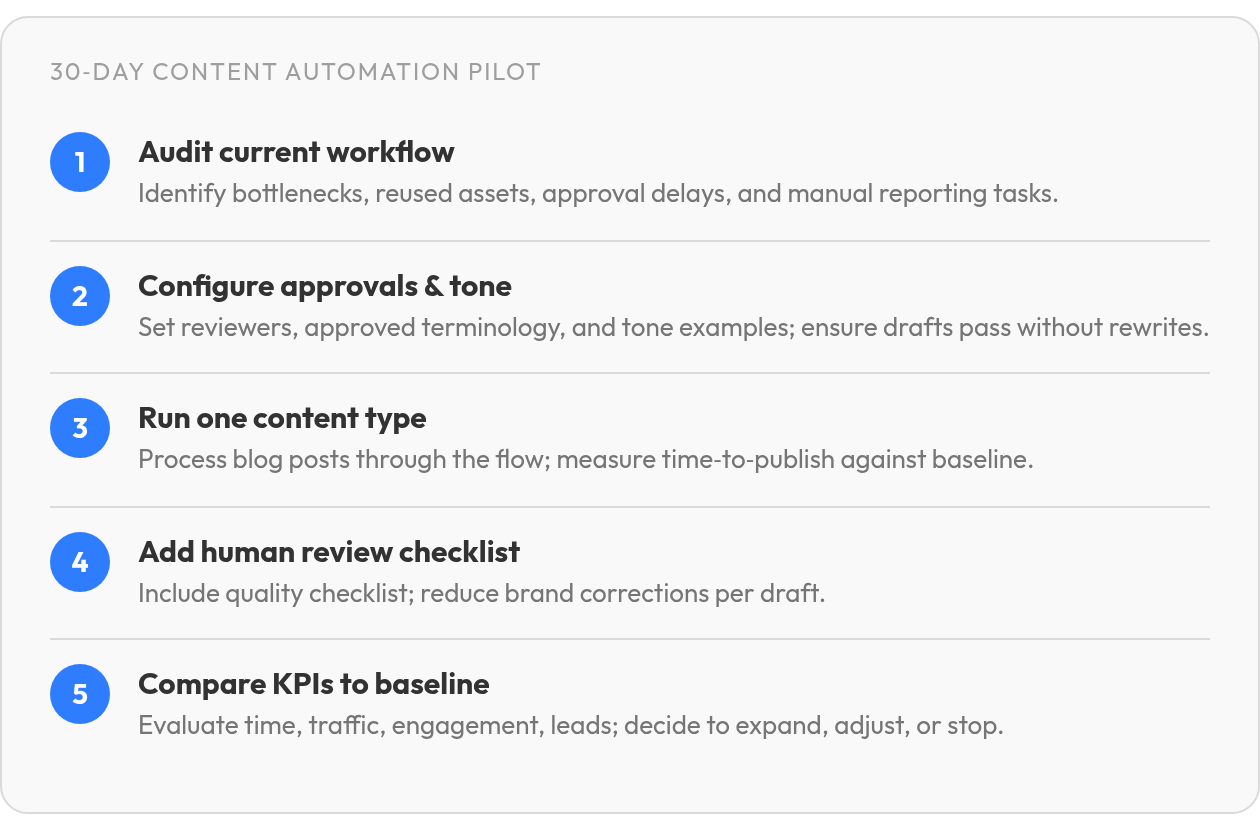
The pilot that fails tends to be the one that tried to fix everything at once. Pick one stage, give it 30 days, and measure it against a baseline you wrote down before switching anything on. That way you aren't betting the whole calendar on an untested tool.
Start with an audit. Note which assets get reused, which approvals stall, and which reports someone rebuilds by hand. That audit becomes your baseline for time-to-publish, production time, organic traffic, engagement, and lead conversion rate.
What should the four weeks look like?
| Week | Focus | Go/no-go signal |
|---|---|---|
| 1 | Set approvals, approved terminology, tone examples | Reviewers accept test drafts without rewrites |
| 2 | Run one content type, such as blog posts, through the flow | Time-to-publish drops against baseline |
| 3 | Add human review and a written quality checklist | Fewer brand corrections per draft |
| 4 | Compare all five KPIs to baseline | Expand, adjust, or stop |
Review results every week. Traffic and conversions may trail the production gains, so read those numbers alongside the operational changes you logged during the pilot instead of calling it early.
How do you get the team to actually use it?
Name one owner for the workflow and one for brand rules. Train the pilot group first, then roll out to other content types once the checklist holds. Tell the team early what's changing and why. Silent tool swaps tend to breed workarounds.
Hold off on expanding if reviewers still rewrite most drafts. That's a brand-rules problem, and more volume will only spread inconsistency faster.
Frequently Asked Questions
How can you tell which stage is actually your bottleneck?
Your bottleneck is the stage where work waits longest, not necessarily the one with the most visible activity. Follow several recent pieces from idea to live post and record the queue, owner, and dependency at each step. That record gives you a more reliable diagnosis than a general impression that the team is busy.
Should you pick an all-in-one suite or a specialist tool?
Look at the stability of the problem before choosing. A focused product is easier to assess when the same task repeatedly causes trouble; broader coverage becomes more useful when responsibility shifts among planning, production, distribution, and measurement. In either case, compare the workflow you would actually run rather than the size of the feature list.
What if traffic stays flat after a 30-day automation pilot?
Separate operating improvements from outcomes that need more time to appear. Check whether the new process produced cleaner handoffs, fewer corrections, or more consistent publishing, then continue monitoring audience and lead measures on their normal cycle. A pilot can reveal a workflow issue even when the immediate audience numbers remain unchanged.
Is content marketing automation worth it for a solo publisher?
Consider the number of handoffs you personally perform. If the work is already simple and infrequent, a complex system may add administration instead of removing it. Automation becomes easier to justify when recurring distribution, approvals, or reporting tasks take a meaningful share of your publishing routine.