
Ahrefs Reporting Software vs Search Atlas in 2026: Which Gives Agencies Better White-Label SEO Reports

Key Takeaways
- White-label reporting helps agencies show their own branding.
- Databox found 70% of marketers rate SEO as more effective than PPC.
- Agencies using AgencyAnalytics recover 4 to 8 hours per client monthly.
- Ahrefs Report Builder ships scheduled reports and a built-in rank tracker.
- Search Atlas gets praise for clean, easy-to-read analytics.
- The real gap is client delivery, not data quality.
- Generic reporting tools waste time when work stays split apart.
Why White-Label Reporting Is How You Prove Your Worth
White-label reporting is how agencies show their value each month. A branded, data-rich report keeps your name in front of clients. It also frames ranking gains as your work. Skip it, and you forward raw numbers from someone else's dashboard.
That difference matters more than most agencies admit. Put Ahrefs reporting software next to tools built for client delivery, and the gap isn't in the data. It's in who gets the credit. A report carrying your logo, colors, and voice makes you the expert. A generic export makes the tool the expert.
Why do clients pay a premium for branded reports?
Branded reports build trust and justify retainers. Databox found that 70% of marketers rate SEO as more effective than PPC, so SEO reporting carries weight at renewal time. A polished, on-brand deliverable signals competence before clients read a single metric.
Retention follows presentation. Agencies using Ahrefs report better client retention tied to its reporting depth, and mid-sized agencies on Search Atlas cite its clean, easy-to-read analytics as the reason clients stay engaged. The pattern holds: better reports, longer relationships.
What do agencies lose with generic reporting tools?
Time and margin. Agencies using AgencyAnalytics save 4 to 8 hours per client per month once reporting is consolidated. That number shows how much manual assembly generic tools force on you when data lives in one place and the client deliverable lives in another.
Ahrefs' own Report Builder offers scheduled reports and a built-in rank tracker, yet third-party testers judge its white-label depth too thin for full client-facing use. Ahrefs is strong at internal data delivery and limited as a fully brandable client deliverable. Search Atlas leans the other way, prioritizing presentation over raw backlink depth.
| Reporting Aspect | Ahrefs Report Builder | Search Atlas | AnyPost.ai |
|---|---|---|---|
| Data depth | Deep backlink/keyword data | Solid, user-friendly | Focused on content output |
| White-label branding | Limited per testers | Customizable | Brand-voice content |
| Finished client content | No | No | Yes, ready to publish |
| Manual assembly needed | High | Moderate | Low |
Why does no reporting tool close the loop?
Every tool stops at data. None turns that data into finished, client-ready content. Reddit users testing multiple platforms agree that no single tool cleanly combines data sources into one cohesive report. That's the gap the whole category leaves open.
This is where our approach differs. AnyPost.ai generates SEO-optimized content aligned to a client's brand voice, so it reads like the client wrote it. Instead of a client seeing three new ranking keywords and wondering what to do next, AnyPost produces short, publish-ready content in their voice that tackles the keywords the report just surfaced.
That closes the loop between insight and action. AnyPost turns your Business Context Graph into ready-to-rank content and auto-publishes it across your existing website and social channels. If your agency already stitches Ahrefs data into manual reports, pairing that analysis with automated content collapses two jobs into one. For a closer look at automating that pipeline, see our guide on how to automate SEO reporting with Ahrefs Content Explorer.
The Seven-Point Checklist for a Modern Reporting Tool
A modern white-label reporting platform needs seven things: complete data sources, real automation, deep branding control, flexible customization, multi-client scale, 2026-era AI features, and airtight compliance. Miss one, and you're either stitching tools together or handing clients a report that doesn't look like yours.
Here's the benchmark we use when weighing Ahrefs reporting software and its alternatives against actual agency delivery. We built this checklist after mapping where reporting pipelines break down at scale.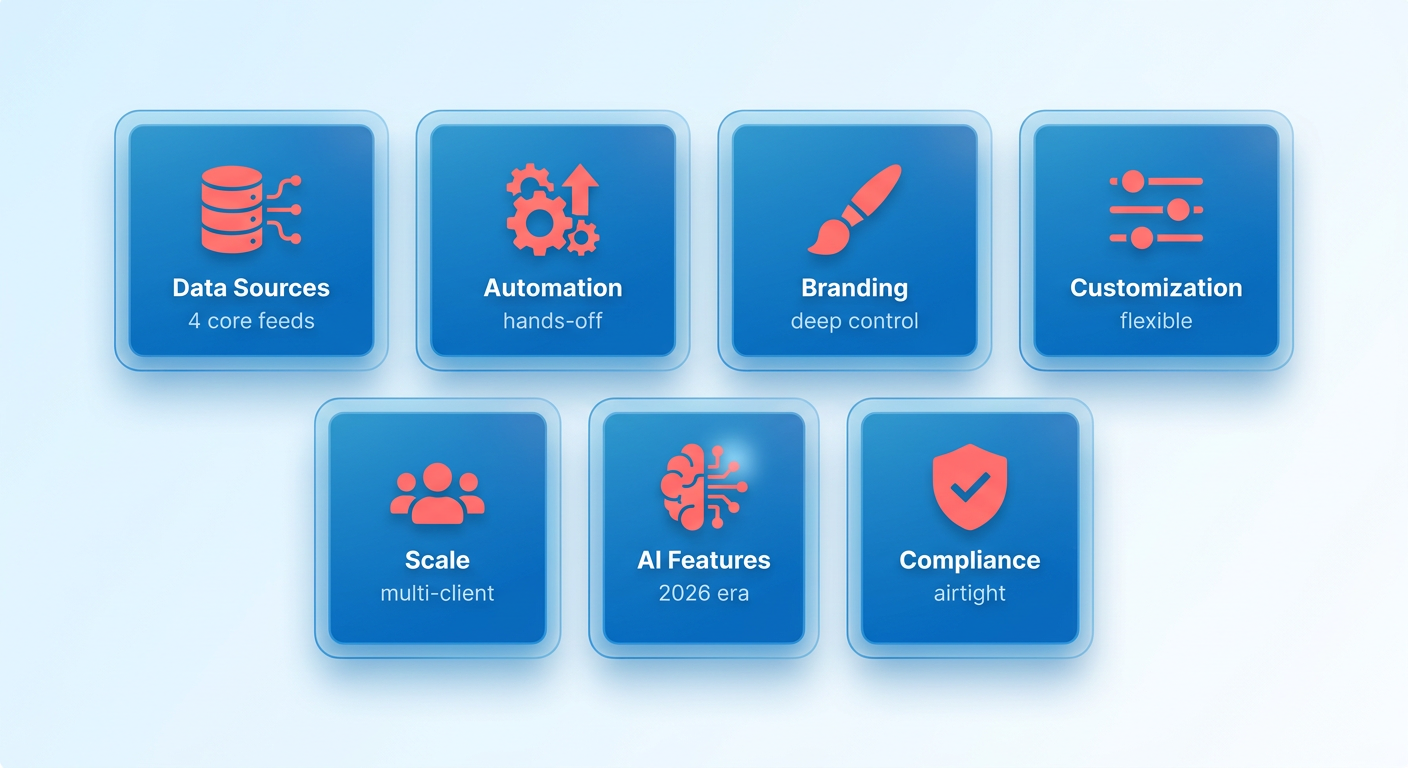
What data sources and automation should a tool cover?
The baseline: four core data feeds plus hands-off automation. You want SERP tracking, a backlink index, a keyword rank tracker, and an on-page audit engine feeding one report.
Ahrefs sets the data bar high. It tracks 35 trillion backlinks and crawls 5 million pages daily. For raw depth, few match it.
Automation is where team capacity is won or lost. Scheduled report generation, API-driven data pipelines, and alert triggers keep account managers from repeating the same admin work across every retainer cycle. When dashboards update on their own, account teams can shift from pulling spreadsheets to actual strategy.
How much branding and customization is enough?
Full branding means custom logos, color palettes, client-specific domains, and a choice between PDF and interactive dashboards. Anything less, and the tool gets the credit, not you.
This is where Ahrefs has room to improve. Independent reviewers regularly note that the native Report Builder runs smoothly for internal analysis, but its visual customization falls short of a bespoke agency presentation.
Customization depth matters as much as branding. Look for drag-and-drop widgets, custom metric formulas, and client-level permissions so each account sees only its own data. Search Atlas leans into this with branded templates.
The feature no reporting tool actually ships
Traditional platforms stay strictly analytical. Metrics, widgets, audit checks, and rank tracking show what happened, but none turns those findings into finished, brand-voice assets ready to publish.
Here's the everyday version. A monthly audit flags declining organic visibility across several cornerstone service pages. Standard reporting tools plot the dip on a line chart, but they can't draft the updated copy needed to win those positions back. AnyPost.ai works that bottleneck directly. By scanning a client's digital footprint to build an internal picture of their products, value proposition, and tone, it drafts targeted articles in that brand voice and pushes them live.
| Capability | Ahrefs | Search Atlas | AnyPost.ai |
|---|---|---|---|
| Backlink & data depth | Excellent | Good | Not a data source |
| Full white-label branding | Limited | Strong | Full voice controls |
| Scheduled automation | Yes | Yes | Yes |
| Brand-voice content generation | No | No | Yes |
| Data-to-published content | No | No | Yes |
What about scale and compliance?
Non-negotiables: multi-client handling, reseller tiers, stable performance under heavy query volume, plus GDPR, SOC-2, and data-residency support. Skip any tool that can't hold up across dozens of client accounts at once.
If you're running a couple of accounts, a lightweight setup might do. But as client volume grows, bridging analytics with automated, on-brand publishing becomes the thing protecting your margins. Streamline that workflow, and reporting insights feed straight into content updates without a bottleneck in between.
Ahrefs Reporting Software: What It Nails and Where It Stalls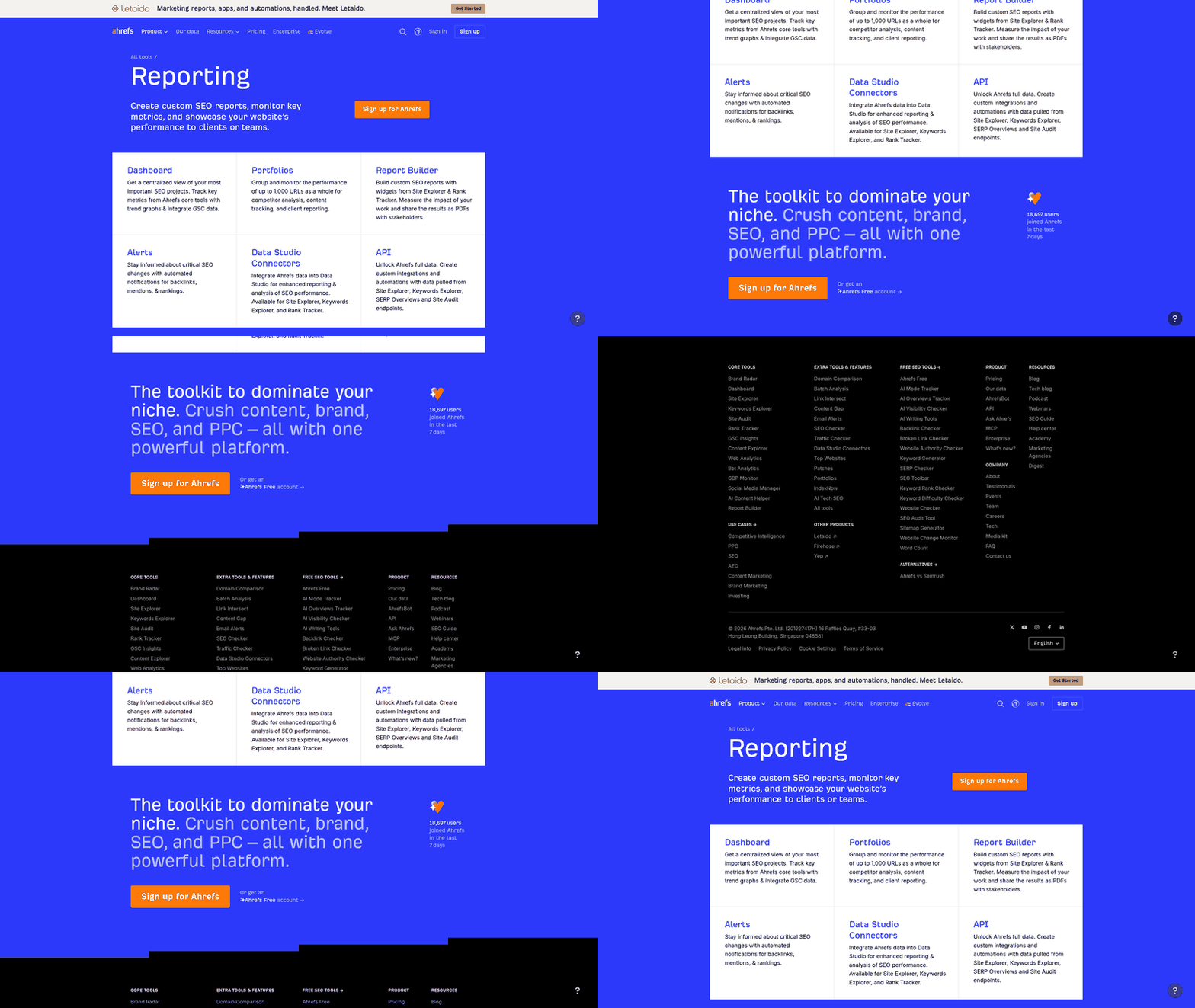
Ahrefs reporting software sits on the strongest data foundation in the industry, but client-facing delivery is where the cracks show. In our testing, it wins on raw numbers and loses on presentation polish. That split decides who it's right for.
Use Ahrefs for deep investigative analysis, and handle the presentation tailoring elsewhere.
What are Ahrefs' core reporting strengths?
The strength is data depth. The platform monitors a web index no competitor matches, with continuous crawling that keeps link intelligence fresh.
That backlink dominance turns into results agencies can actually show clients. Ahrefs surfaces new and lost referring domains within hours, so teams can flag toxic links or grab fresh placements before competitors react. As one consultant put it, "If link building is central to your agency's services, Ahrefs is non-negotiable."
The Report Builder adds real reporting muscle. You get 15+ metric widgets, scheduled delivery from hourly through quarterly, and reports that reach up to 50 recipients without any of them needing an Ahrefs account. You can drop rich-text commentary right inside a report, which helps frame the numbers.
For teams that want to trim data-extraction overhead, structured automated pulls can cut a lot of manual export work.
Where does Ahrefs fall short for white-label delivery?
The limitation is branding depth. Reviewers note that Ahrefs lacks comprehensive reporting capabilities, pushing agencies toward separate presentation software.
That creates a real problem for growing agencies. Ahrefs markets its Report Builder as an end-to-end client solution, but the interface gives you limited control over typography, custom domain mapping, and white-label design.
Stitching together multiple specialized tools introduces ongoing overhead, as most agency practitioners will tell you. When raw metrics can't be cleanly packaged inside the source software, staff end up exporting spreadsheets, reformatting charts in design suites, and reconciling data sets by hand before every client meeting.
How does the data-to-content gap affect agencies?
Analytical dashboards spot problems without solving them. SEO telemetry flags lost keywords and technical warnings, but turning those signals into published work still takes real copywriting hours.
| Capability | Ahrefs Report Builder | AnyPost.ai |
|---|---|---|
| Backlink & keyword data | Industry-leading | Pulls from data sources |
| Scheduled report delivery | Flexible widget library | Yes |
| Deep white-label branding | Limited | Full brand-voice control |
| Data-to-published content | No | Yes, embedded |
Ahrefs delivers premier intelligence. Closing the gap between raw data and client deliverables means turning competitive research directly into ready-to-publish SEO copy that hits keyword opportunities right away.
If link audits and competitive intelligence are your only deliverable, Ahrefs works fine on its own. But if clients expect their retainer to produce fresh content that captures the opportunities you found, raw data is only the opening step.
Search Atlas: What It Nails and Where It Stalls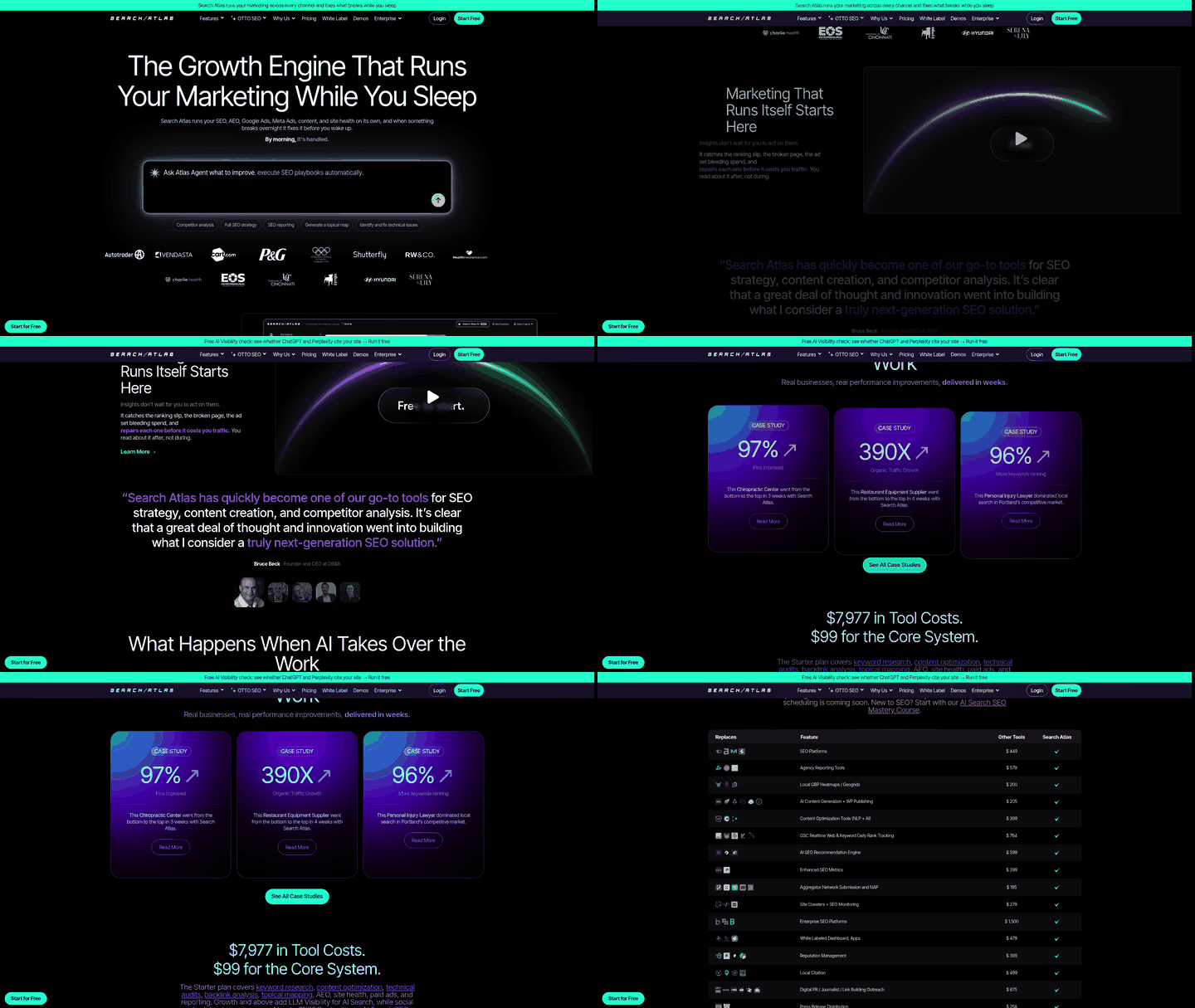
Search Atlas flips the Ahrefs script. Where Ahrefs wins on data and loses on delivery, Search Atlas wins on automation and execution while asking you to accept more operational risk. The DIY AI review scores it 9.0/10 overall, and that number tells the whole story once you break it apart.
The platform earns its highest marks in Technical SEO & Automation (9.8/10) and AI Writing & Workflow Automation (9.6/10). For agencies weighing this against traditional Ahrefs reporting software, the split is clear: Search Atlas is built to do the SEO work, not just measure it.
What makes Search Atlas different from Ahrefs?
Search Atlas is execution-led; Ahrefs is intelligence-led. The DIY AI review puts it plainly: "Ahrefs is preferred for backlink intelligence and competitor analysis, while Search Atlas excels in execution-led SEO workflows." OTTO SEO can push approved changes to titles, metadata, and headings straight onto live sites.
That matters for reporting because a tool that implements changes can also document them. You show the client the audit finding and the fix in one view. For agencies handling implementation, that's a genuine time saver.
But the automation cuts both ways. OTTO scales good decisions and bad ones at the same speed.
How reliable is Search Atlas for agency reporting?
Capable, but it needs governance. The high overall rating reflects broad feature integration, yet feedback across practitioner communities points to occasional inconsistencies in reliability and support.
That's a dynamic you manage with clear protocols. Autonomous execution speeds up optimization, but unmonitored scripts can publish weak meta structures or site updates across client properties. Strict human review checkpoints before deployment protect client assets while you still get the automated speed.
Search Atlas gives you a 7-day free trial, which makes a structured pilot on a non-critical domain the smart first move before you hand it automated access across your full client roster.
Search Atlas vs Ahrefs vs AnyPost.ai
| Feature | Search Atlas | Ahrefs | AnyPost.ai |
|---|---|---|---|
| Core strength | Execution & automation | Backlink data depth | Brand-voice content in reports |
| White-label reporting | Higher tiers only | Report Builder | Built for agency delivery |
| On-page automation | OTTO SEO (live changes) | No | No |
| Best for | Implementation-heavy agencies | Competitor analysis | Client-ready published content |
Good agency reporting is more than static charts or unattended site edits. It hinges on turning performance insights into real content. Search Atlas automates on-page adjustments, but agency workflows do best when AI content creation includes editorial oversight instead of hands-off deployment.
That distinction shapes the modern production stack. Search Atlas gives you broad execution tools that demand external supervision. Pair editorial approval directly with brand-voice content generation and agencies can drop polished, campaign-aligned assets straight into client deliverables.
If your focus is deep link-network analysis, Ahrefs is still the standard. Search Atlas gets compelling when your team handles hands-on site updates and wants automated implementation logs, as long as human oversight guards production.
Feature by Feature: Ahrefs vs. Search Atlas vs. AnyPost.ai
The fastest way to read this whole comparison: the data winner and the delivery winner are rarely the same tool. Put Ahrefs reporting software next to Search Atlas and next to a content-generation workflow like ours, and each one peaks in a different column. The matrix below makes that obvious.
We built this table against the seven-point checklist from earlier. Every cell comes from a vendor claim, a tester benchmark, or our own hands-on read. Where the evidence is thin, we say so instead of inventing a rating.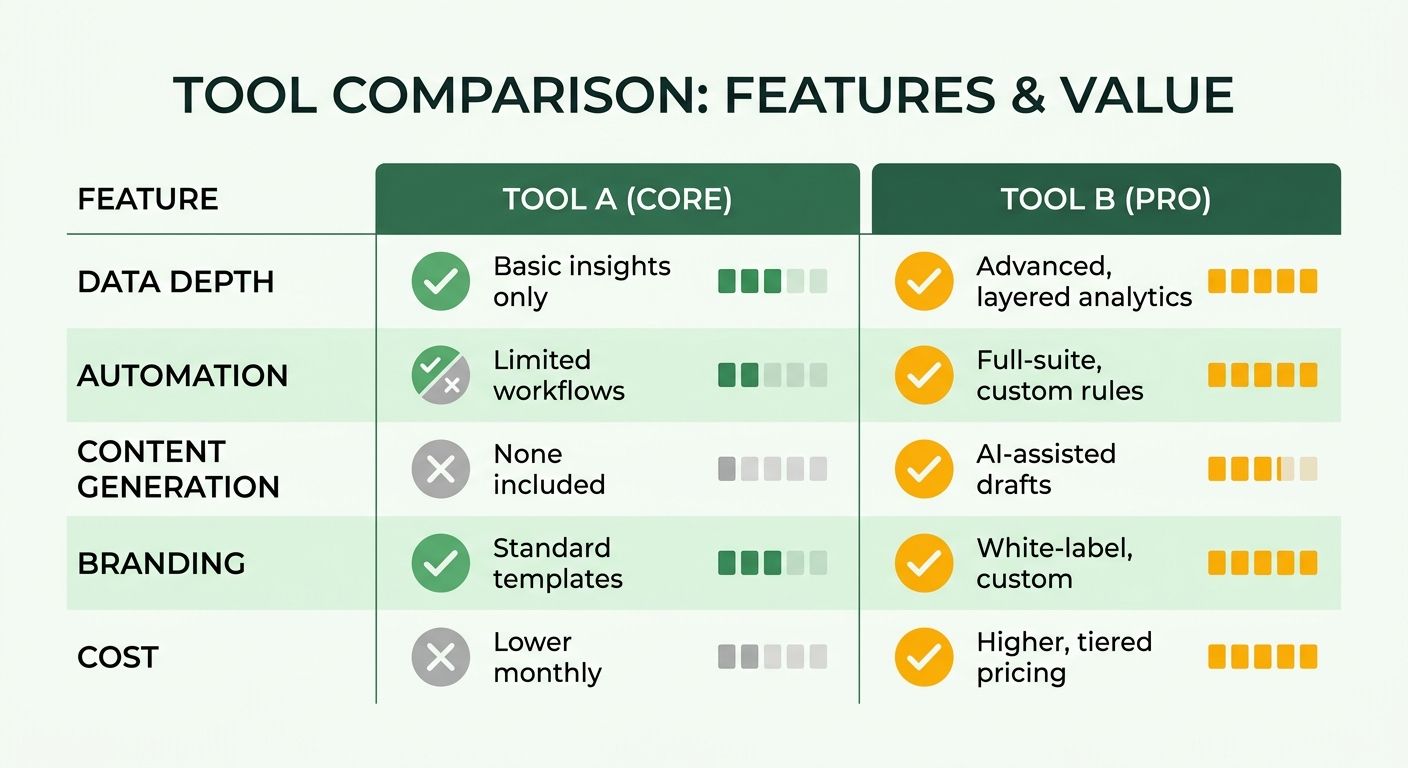
How do the three tools score side by side?
Short answer: Ahrefs owns data accuracy, Search Atlas owns automation, and our platform owns content creation, the step nobody else covers. Here's the full matrix.
| Feature Set | Data Accuracy | Automation | Custom Branding | Scalability | Pricing | Best For |
|---|---|---|---|---|---|---|
| AnyPost.ai | Multi-channel site modeling | Autonomous article generation and multi-platform publishing | Full brand-voice alignment in every article | Multi-client content at scale | See plan pages | Generating and publishing brand-voice SEO content |
| Ahrefs | Industry-leading link index and crawl scale | Scheduled report delivery (hourly to quarterly) | Functional internal layouts, limited white-label | Multi-recipient external sharing without logins | From $99–$129/mo | Backlink intelligence and raw data |
| Search Atlas | Strong, execution-focused | Direct on-page automation via OTTO SEO | Branded templates on higher tiers | Built for agencies and publishers | Pilot trial available | Automated SEO execution |
Where does each tool actually win?
Ahrefs wins on analytical depth. Its reporting interface gives you customizable widgets and broad recipient sharing without external client logins. But its visual styling and white-labeling controls are geared toward operational data review, not high-end agency presentation.
Search Atlas wins on autonomous site execution. Its strong writing and technical workflow tools let OTTO SEO deploy on-page changes like meta tags and structured schema straight to target sites. The catch, again, is supervision: account managers should validate automated recommendations in a controlled sandbox before full rollout.
Ahrefs is an exceptional engine for competitive research, but agency deliverables often need extra design formatting to match client branding.
What sets AnyPost.ai apart?
It bridges the gap between data discovery and published copy. Conventional SEO platforms track metrics, crawl errors, and ranking swings, but they leave the content drafting untouched. AnyPost reads existing site architecture to learn brand tone, generates fully formatted, search-optimized articles, and distributes them across CMS platforms and social networks.
Plenty of marketing teams burn hours compiling ranking drops and then writing the remedial blog posts by hand. Automating that whole cycle clears the repetitive drafting out of the way.
For content-driven agencies, that shifts the production economics: instead of writing every client article from a blank page, teams generate and distribute high-ranking assets from one system at a fraction of the usual cost.
Best for, in one line each: Ahrefs for backlink data, Search Atlas for automated execution, and our platform for generating and auto-publishing ready-to-rank, brand-voice SEO content.
Pricing, ROI, and Total Cost of Ownership
The pricing gap between these tools is real, but it's the smaller half of the cost story. What actually drains an agency's margin is the labor of turning raw exports into finished deliverables. Price out Ahrefs reporting software against Search Atlas and our own content workflow, and the subscription line is where most agencies stop looking. That's the mistake.
The subscription fee alone never tells the full financial story. Platforms that cut out labor-intensive manual steps return far more.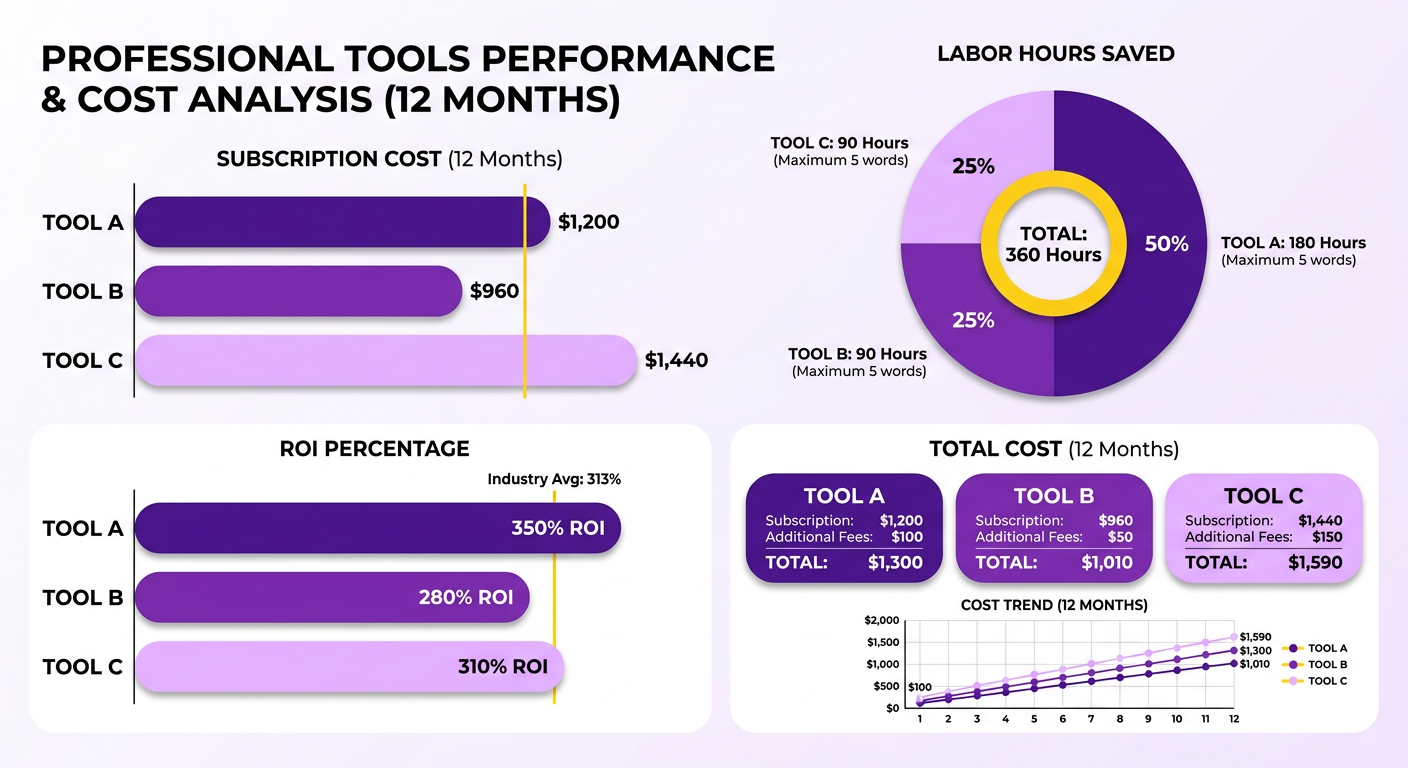
What do these tools actually cost per month?
Subscription fees are just the visible tip of your monthly spend. The number on the invoice tells you almost nothing about what a tool costs to run week to week. Two platforms at identical price points can differ wildly once you factor in setup time, training, and the manual work each one leaves on your plate.
Think in terms of loaded cost per report, not sticker price. If an analyst earning $50/hour spends three hours assembling a single client report, that's $150 of labor riding on top of whatever the tool charges. Run that across a dozen clients monthly, and the labor line dwarfs the subscription line every time.
Platforms that bundle reporting into one plan save you from stacking a second subscription, but bundled features only matter if they cut the hours. A widget-rich report builder that still needs manual export-and-paste hasn't saved you anything real.
Where are the hidden costs?
The real operational expense comes from fragmented software stacks and redundant data handling. When an agency runs one platform for raw metrics and another for client deliverables, staff burn billable hours exporting spreadsheets, reformatting charts, and cross-referencing dashboards.
Paying for multiple SaaS subscriptions adds up, but the labor to bridge disjointed tools is what erodes margins. One agency cut its monthly reporting cycle in half by moving to an integrated, customizable presentation workflow.
Search Atlas adds a separate operational cost: ongoing quality control. Because its automated features can push changes straight to client sites, agencies have to budget staff time for regular checks to keep those updates on brand.
How fast does each tool pay for itself?
ROI depends on recovered billable capacity, not feature lists. When an agency runs ten or more accounts, centralizing client reporting creates immediate efficiency gains.
Consolidated dashboards streamline data assembly, but they still leave the deliverable unfinished when the retainer includes content creation.
AnyPost.ai changes the equation by automating the writing and deployment stages. It pulls product context and messaging cues from a client's existing web properties, generates search-optimized articles, and distributes them across channels like WordPress, LinkedIn, and X. The ROI math moves past a basic reporting-software comparison and into the full elimination of freelance writing and editorial assembly costs.
For a boutique consultancy with one or two accounts, manual reporting and bespoke writing stay manageable. Once the roster grows, though, unautomated reporting and content creation become the main drain on profitability.
Set up an automated pipeline between keyword discovery and content execution, and reporting insights translate directly into revenue-generating deliverables.
Decision Guide: Which Tool Is Right for Your Agency?
Picking the right tool starts with one question: do you need better data, better automation, or ready-to-publish client content? Each tool wins a different answer. Ahrefs owns data depth, Search Atlas owns execution, and the content-generation layer wins the step both leave unfinished.
Match your agency's size, client count, and priorities to the platform that removes your biggest bottleneck. Below is the decision path, followed by a scenario matrix.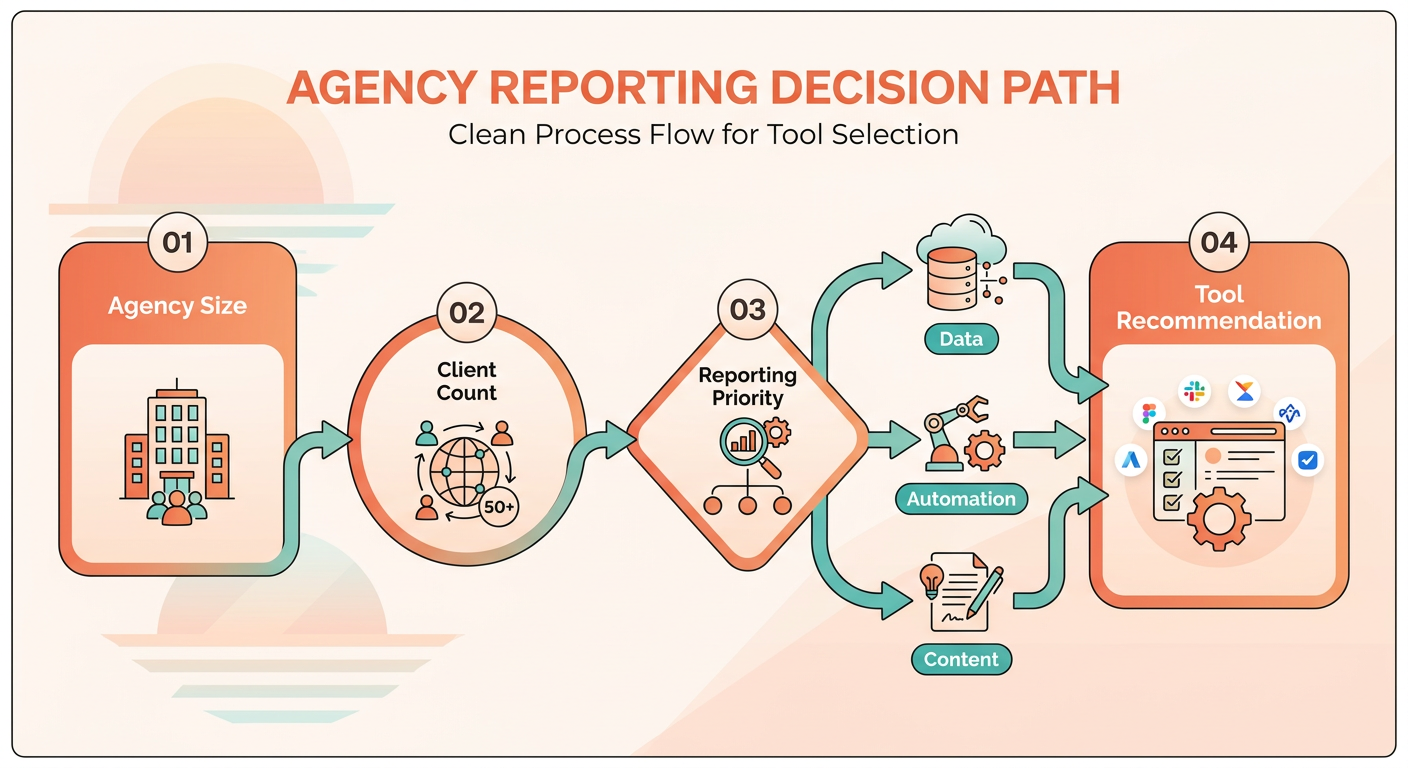
Which tool fits your agency size and client mix?
Match the tool to your bottleneck, not your budget. Small agencies with fewer than five accounts usually prize raw data depth above all. At that tier, account managers can comfortably export charts from Ahrefs and write bespoke summaries by hand.
Mid-size agencies hit a different wall: administrative reporting drag. At ten or more clients, assembling monthly updates by hand drains real staff capacity. An automated client-delivery layer lets account teams compile multi-source data without the repetitive formatting.
Search Atlas fits agencies that provide turnkey technical execution. Its autonomous site changes speed up on-page work, but plan for a two- to three-week onboarding ramp to configure approval rules. Stagger your account rollouts to prevent unintended sitewide changes and keep governance intact across client properties.
When does AI-driven content reporting win?
An automated content workflow pays off most when retainers require regular content production based on SEO findings. Traditional reporting platforms are great at surfacing ranking shifts and crawl diagnostics, but they leave the actual fix to your copywriting team.
Closing that gap changes how the agency runs. Instead of delivering a PDF that says a competitor is outranking the client for high-intent terms, your team can deliver the fully researched, brand-aligned article built to capture that search volume. AnyPost.ai does this by turning site-level context into search-ready articles and publishing them straight to the client's CMS.
Agencies running blended SEO and content marketing retainers can raise margins by connecting keyword opportunities directly to finished editorial.
Best-for matrix and next steps
| Agency Scenario | Best Tool | Why |
|---|---|---|
| Under 5 clients, tight budget | Ahrefs | Deepest backlink data, manual reporting is manageable |
| Backlink-heavy link building | Ahrefs | Comprehensive link graph, best for competitor and gap analysis |
| Wants SEO execution automated | Search Atlas | Advanced autonomous workflows, but requires governance protocols |
| Reporting drag at 10+ clients | Dedicated reporting layer | Consolidates multiple data sources into automated reports |
| Content + reporting in one deliverable | AI content workflow | Turns report data into publish-ready, brand-voice articles |
Before you commit to enterprise tiers, test each platform in practice. Run Ahrefs on your most link-intensive account, evaluate Search Atlas in a controlled environment to see how it handles automated rules, and run an automated content workflow against an active content gap to measure the real production time saved. Scaling the system that removes your team's biggest bottleneck delivers the fastest payoff.
Frequently Asked Questions
1. Can I use Ahrefs for client reporting if I'm already paying for the subscription?
Ahrefs Report Builder is suitable for direct data sharing and internal stakeholder updates, but agencies seeking bespoke visual themes, custom domain hosting, or pixel-perfect client portals will find its native design options restrictive. To deliver a polished, agency-branded experience, many teams export Ahrefs metrics into specialized presentation tools or client dashboard software.
2. What happens when OTTO SEO in Search Atlas makes a mistake on a live client site?
Because OTTO SEO can write updates directly to production environments, unapproved algorithmic modifications can alter live title tags, heading hierarchies, or structured data. To prevent unintended site changes, agencies should enforce strict manual approval gates within the platform and run initial tests on staging or non-critical domains before enabling automated publishing across main client sites.
3. How much time does manual SEO report assembly actually take per client?
Manual reporting typically consumes multiple hours per account each billing cycle when account managers must pull exports, format graphs, write analytical commentary, and email static PDFs. For agencies managing dozens of accounts, this non-billable overhead quickly burns through staff hours that could otherwise be dedicated to high-level strategy and proactive client communication.
4. Why doesn't any reporting tool generate finished content from the data it surfaces?
Traditional SEO software was engineered for performance telemetry and site crawling rather than editorial production. When a report detects keyword decay on core commercial pages or identifies content cluster gaps, standard reporting platforms can only highlight the deficit. Bridging that insight requires a content generation engine capable of modeling brand voice and producing publish-ready articles.
5. Which tool should I choose if backlink analysis isn't my agency's main service?
If backlink auditing is secondary to your offerings, investing heavily in specialized link intelligence platforms may be unnecessary. Teams focused on technical execution and automated on-page fixes will get more mileage from Search Atlas, while agencies whose core deliverables center on regular organic content production and multi-channel publishing are better served by an automated content engine.
6. Does white-label branding actually affect client retention rates?
Agency-branded reporting reinforces perceived authority during monthly retainer reviews. When clients receive unbranded exports or third-party tool links, they attribute analytical value to the software provider rather than your team's strategic expertise. Polished, custom-branded reporting packages your insights as proprietary agency deliverables, strengthening client confidence during contract renewals.