
Ahrefs vs Ninja Reports for Keyword Gap Analysis: Best Pick for Small SEO Teams

Key Takeaways
- Keyword gap analysis finds searches your competitors rank for, and you don't. For a small team, that turns a limited content calendar into proven-demand priorities.
- Ahrefs' Content Gap walkthrough surfaced 120 keywords Moz ranks for that a rival doesn't. That's 120 ready-made content briefs.
- Ahrefs lets you filter out branded and irrelevant terms. You get a bounded, exportable set instead of an unworkable dump.
- Free methods and manual SERP checks hold up for occasional low-volume work.
- Crozdesk's comparison gives Ahrefs the edge on raw depth as frequency and scale increase.
- Two-person SEO teams with no spare hours lean on gap analysis to decide which pages to write next.
- SE Ranking notes the process surfaces lower-competition long-tail keywords and supports smarter resource allocation for time-strapped teams.
Why gap analysis is a shortcut, not a luxury, for small teams
Keyword gap analysis finds the searches your competitors rank for that you don't. For a small team, that data is a shortcut. It tells you which pages to write next instead of guessing.
That precision is why the NinjaReports vs Ahrefs question matters for resource-strapped teams. You're not picking a tool for fun. You're picking the engine behind your content calendar.
Why do small teams need gap analysis at all?
It matters most when you have limited hours and need priorities. It shows untapped keywords, saves wasted effort, and points your writing at proven demand. Every piece you produce targets a term with established interest, which is the point when writing time is scarce.
Ahrefs makes the payoff concrete. Side-by-side domain comparisons instantly generate hundreds of viable content ideas. Instead of brainstorming from scratch, a lean team gets a structured list of topics competitors already pull traffic from.
You can also filter and refine that list, cutting branded terms and irrelevant topics. That leaves you with a bounded, exportable set rather than an endless dump.
Do you actually need a paid tool for this?
Not always. On a shoestring budget, manual SERP inspection can reveal basic gaps. Checking competitor rankings by hand works when you only need a handful of high-priority terms.
The picture flips when frequency and scale enter. A larger database gives you the raw depth to find hidden opportunities manual searches miss. Our take: budget isn't the real dividing line; automation ambition is. Manual work breaks when you want recurring gap audits feeding a pipeline.
So here's the honest carve-out. Skip the paid tool for a one-off audit on a tiny local site. The free route is fine. Reach for depth when gaps become a repeatable input to your production system.
Where does the real bottleneck sit?
Finding gaps has never been the hard part. Acting on them is. Research tools surface far more keyword opportunities than a small team could act on, yet most published pages get little to no organic traffic. The limiting factor isn't discovery. It's production capacity.
This is where a gap export becomes fuel instead of a to-do list that rots. An exported gap keyword maps cleanly onto one content brief. That structure turns discovery into finished work.
Once you know which keywords to target, AnyPost.ai generates SEO-optimized articles at scale in your brand's voice and can publish them straight to your existing site. Each gap keyword becomes a published article, not a line in a spreadsheet you'll reopen in three weeks.
| Factor | Ahrefs | Ninja Reports | AnyPost.ai |
|---|---|---|---|
| Core strength | Deep keyword database, Content Gap tool | Gap and reporting data | Turning target keywords into published articles |
| Focus | Keyword and gap research | Reporting-focused | Automated content generation and publishing |
| Output | Keyword list to act on | Reports and gap insights | Finished, ready-to-publish content |
| Best for | Data depth and audits | Client reporting | Small teams short on production capacity |
The two research tools answer what to write. Our platform answers who writes it. That handoff is what most reviews never examine.
For agencies juggling multiple clients, e-commerce sites with thin category pages, and SaaS firms chasing bottom-funnel terms, that throughput gap is the whole game. See our breakdown of SEO platforms with customized reporting for how the reporting layer fits alongside this.
Ahrefs: what the depth actually buys you
Ahrefs runs gap analysis on its own crawler plus clickstream data, feeding from a database of over 8 billion keywords and 421 billion indexed pages. That scale is the whole argument for Ahrefs in this debate. More index coverage means fewer missed opportunities when you compare your domain against rivals.
For a small team, that depth only matters if you can act on it. Millions of keywords do nothing for your traffic unless you have a systematic way to write and publish against them. That's where automated content generation changes the math.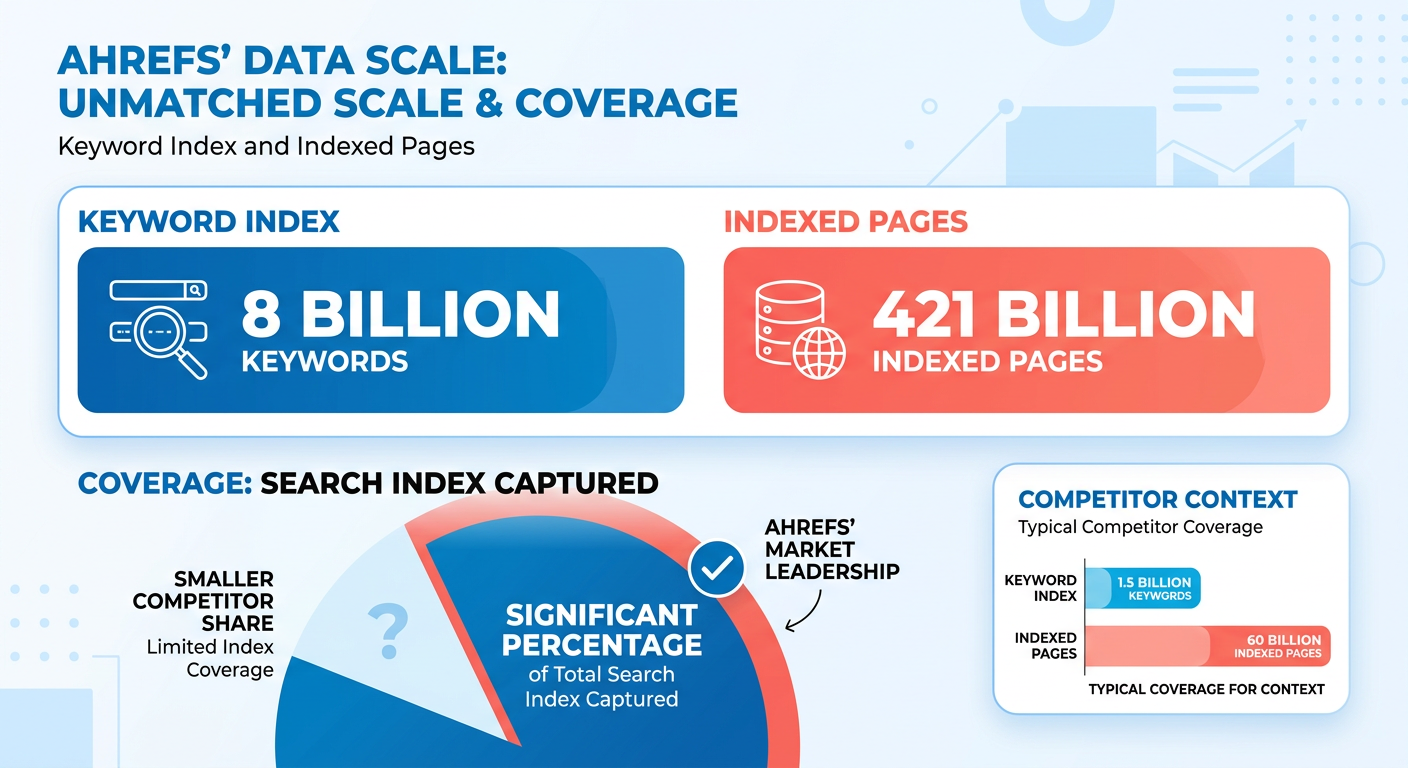
What data and filters does the Content Gap tool give you?
The Content Gap tool compares your domain against up to 10 competitor URLs at once and returns the keywords they rank for and you don't. You filter by location, time frame, Keyword Difficulty, and Traffic, so the output is a scoped, ranked list instead of a data dump.
The metrics you tune shape what happens next. Search volume tells you demand. Keyword Difficulty flags how hard the SERP is. Traffic potential estimates the upside. Ahrefs also surfaces SERP features, so you know whether a keyword is worth chasing or already buried under a featured snippet.
Ahrefs' own documentation shows how these filters isolate low-hanging fruit. Target terms where multiple competitors rank in the top 10 but your site is nowhere, and you find content opportunities that need minimal ranking effort.
How do you get the data out and into a workflow?
Ahrefs exports gap results as tables and CSV, and offers API access plus scheduled reports. Those export options are what make automation feasible for lean operations. A bounded list of gap keywords maps cleanly onto a one-keyword-one-brief pipeline.
Here's the structural point competitors miss. Keeping the export finite and predictable prevents analysis paralysis. Once you have a scoped list of target keywords, AnyPost.ai's Taxonomy Researcher surfaces low-difficulty, high-intent keywords tailored to your niche, and its content engine turns those into ready-to-rank articles in your brand voice. AnyPost doesn't reinvent the gap analysis. It takes over the production step, generating and publishing drafts automatically.
Is Ahrefs actually the right pick for a small team?
Ahrefs wins on data depth, but "best pick" depends on your workflow. A small agency reportedly saw stronger organic growth after keyword research, which shows the case for scale.
The counterpoint is real too. Search Atlas argues tool choice comes down to budget, ease of use, and required depth, not one tool being universally better. We agree with the nuance. Ahrefs' depth pays off when you run recurring gap analysis and feed the output into automated production.
| Feature | Ahrefs | Ninja Reports | AnyPost.ai |
|---|---|---|---|
| Keyword database | 8B+ keywords | On-page focused | Taxonomy Researcher for high-intent keywords |
| Competitor analysis | Up to 10 URLs per gap | N/A | SERP Competitor Analyzer |
| Core strength | Gap + keyword depth | 55-point on-page audit | Keyword-to-published articles |
| Automation | API, scheduled reports | API integration | Auto-generates and publishes drafts |
Skip the manual approach if you run gap analysis monthly. At that frequency, Ahrefs' export plus automated production beats eyeballing SERPs by hand every time.
Ninja Reports: an audit tool wearing a gap-tool costume
Ninja Reports takes a different path than Ahrefs. Instead of a massive keyword index, it leads with a 55-point on-page SEO scan built to catch errors that hurt rankings. For the gap analysis question, that focus changes what job the tool actually does for you.
The honest read: Ninja Reports is an audit-first tool, not a gap-discovery engine. Its strength is checking pages, not mapping the keywords your competitors own and you don't. That matters for a small team deciding where each dollar goes.
What data and metrics does Ninja Reports actually give you?
Ninja Reports centers on on-page health, surfacing technical and content errors rather than leaning on a deep multi-competitor keyword database. It scored well in third-party comparisons. That gap reflects raw data depth, not usability.
The scan is genuinely useful for a lean team. One startup ran a full audit through Ninja Reports and saw stronger traffic after fixing the flagged issues. That's a real result, but notice what drove it: cleaning up existing pages, not discovering new keyword targets.
Ninja Reports also ships an API for integration with other tools. That single detail is the most interesting part, and we'll come back to why.
How does Ninja Reports fit an automated content workflow?
Ninja Reports works best as a validation layer, not the front end of gap discovery. Pair its audit strength with a deeper gap source and you get two tools doing two different jobs in one pipeline, instead of competing for the same slot.
The flow looks like this. Ahrefs feeds the gap keywords. Those keywords get ingested into our content engine and turned into ready-to-publish articles that ship with baked-in SEO optimizations, keyword-aligned headings, and semantically correct HTML. From there, an audit-first tool like Ninja Reports serves as a post-publish check on on-page health.
That reframes the whole "which tool wins" debate. For pure gap depth, Ahrefs is the stronger pick. For post-publish quality control, Ninja Reports earns its keep.
Which tool should a small team pick?
It depends on frequency and automation, not budget alone. Manual methods fall apart the moment you want a recurring workflow feeding a content calendar.
| Factor | Ahrefs | Ninja Reports | AnyPost.ai |
|---|---|---|---|
| Primary job | Gap discovery | On-page audit | Turns gaps into published articles |
| Data depth | 8B+ keywords | 55-point scan | Ingests external gap data |
| Best stage | Front-end research | Post-publish validation | Content generation |
| Third-party score | 92% | 84% |
Here's where automation flips the math. When gap data flows straight into our engine and becomes finished drafts, your marginal cost per gap-driven article drops sharply. That's the argument the free-tool crowd misses. A paid gap tool pays for itself when a lean team can act on its output automatically.
Best for: Ninja Reports if your priority is auditing what you already publish. Ahrefs if raw gap depth drives your calendar. And if the goal is turning those gaps into published pages without manual writing, that's the stage our platform is built for.
Usability, learning curve, and how the tools actually collaborate
For a small team, the real usability question isn't which tool has the prettier dashboard. It's how fast you get from a gap keyword to a published page. That's where the choice gets interesting, because neither tool closes that loop on its own.
Ahrefs earns its reputation for accessibility. Ninja Reports leans on a friendlier, audit-first interface built around technical diagnostics, which non-technical marketers pick up quickly.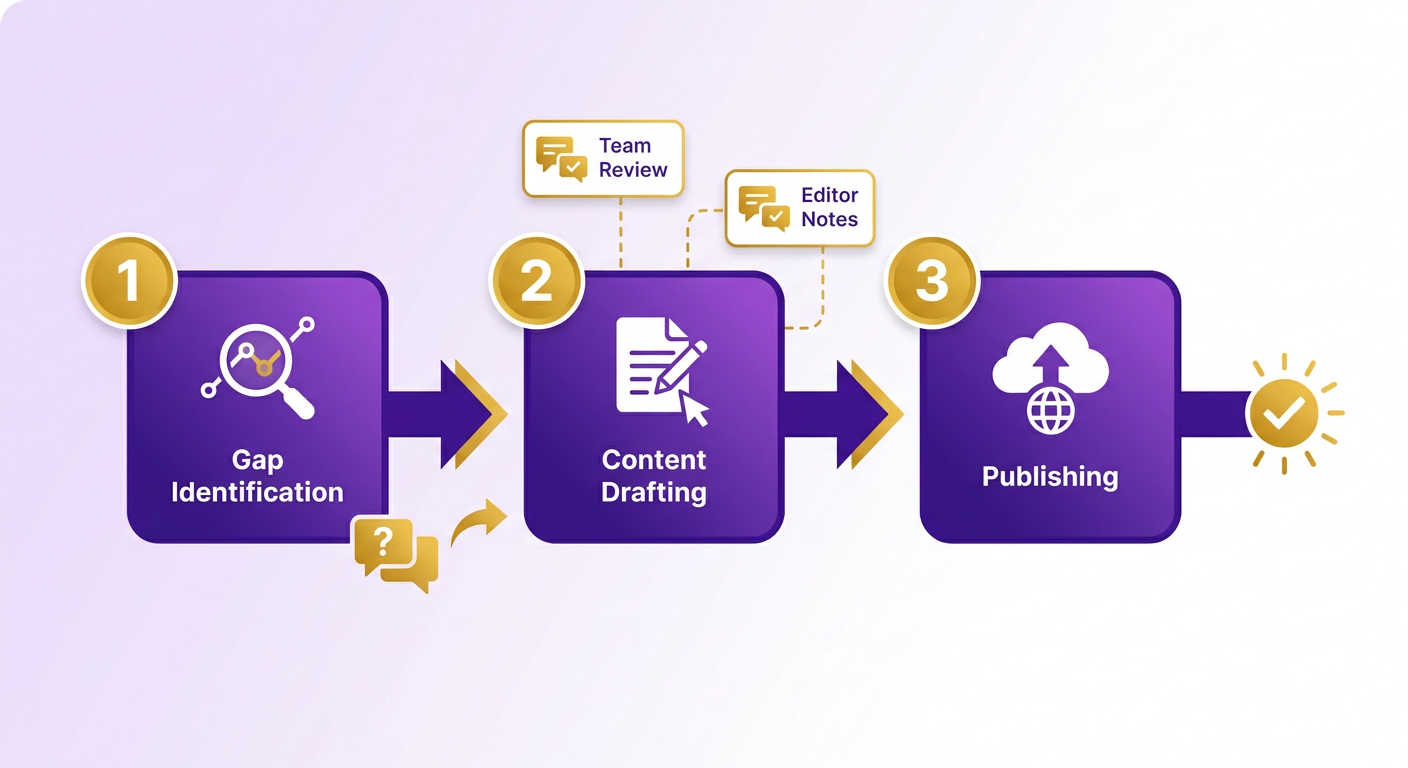
Which tool has the gentler learning curve?
Ninja Reports is easier to learn. Ahrefs is deeper but takes longer to master. Small teams with limited SEO experience get value from Ninja Reports fast because its scan surfaces fixable errors in plain language. Ahrefs asks more upfront but rewards the effort with far broader keyword data.
The tradeoff shows up in onboarding time. Most users report getting a usable Ninja Reports audit running in under an hour, no training needed. Ahrefs sits at the other end: teams typically spend a week or two before the Content Gap and filtering options click, and many lean on its tutorial library to get there. The payoff is a workflow you can push much further once it does.
How does the gap data feed into an automated pipeline?
Our approach connects analysis to publishing, so the gap tool is only step one. Once you've identified the keywords worth chasing, AnyPost.ai's Taxonomy Researcher analyzes your business context and surfaces low-difficulty, high-intent keywords in your niche. Those inform a content brief shaped by our Persona Engine, which then produces a ready-to-publish SEO article in your voice. No manual rewrite from spreadsheet to draft.
This changes the ROI math of manual research. Manual SERP observation works for occasional spot-checks, but it becomes a massive bottleneck when scaling. For recurring, at-scale content off those gaps, manual work stops paying and automated production wins.
And here's the collaboration angle other reviews miss. Ninja Reports and Ahrefs aren't strictly rivals in this setup. They fit different stages of one workflow.
| Stage | Tool | Job |
|---|---|---|
| Gap discovery | Ahrefs | Find keywords competitors rank for, you don't |
| Content production | AnyPost.ai | Turn gaps into briefs and published articles |
| Post-publish audit | Ninja Reports | Run the 55-point scan on new pages |
Read that table as a team play. Ahrefs feeds the front end. Our engine handles the middle, where lean marketing teams usually drown. Ninja Reports validates the output after publishing.
When should a lean team skip the paid gap tool entirely?
Skip a paid gap tool if you publish rarely and have hours to spare on manual SERP checks. Free methods surface real opportunities for occasional analysis, and the evidence there holds up for low-volume work.
But that carve-out flips the second automation enters. When your keyword targets flow straight into brief generation and multi-channel publishing, your marginal cost per article drops hard. For a lean team chasing consistent output, that's the case for a paid gap feed, not price alone. See our breakdown of SEO platforms with customized reporting for how the data layer connects.
Integration, automation, and where the handoff breaks
The integration story is where this debate actually gets decided for small teams. Neither tool publishes your pages. What matters is how cleanly their data leaves the dashboard and lands somewhere useful. That handoff is the part most reviews skip.
Ahrefs' Content Gap tool gives you a bounded, exportable dataset. It compares your domain against competitor URLs and hands back a concrete list of keywords your rivals rank for and you don't. That structure matters more than it looks.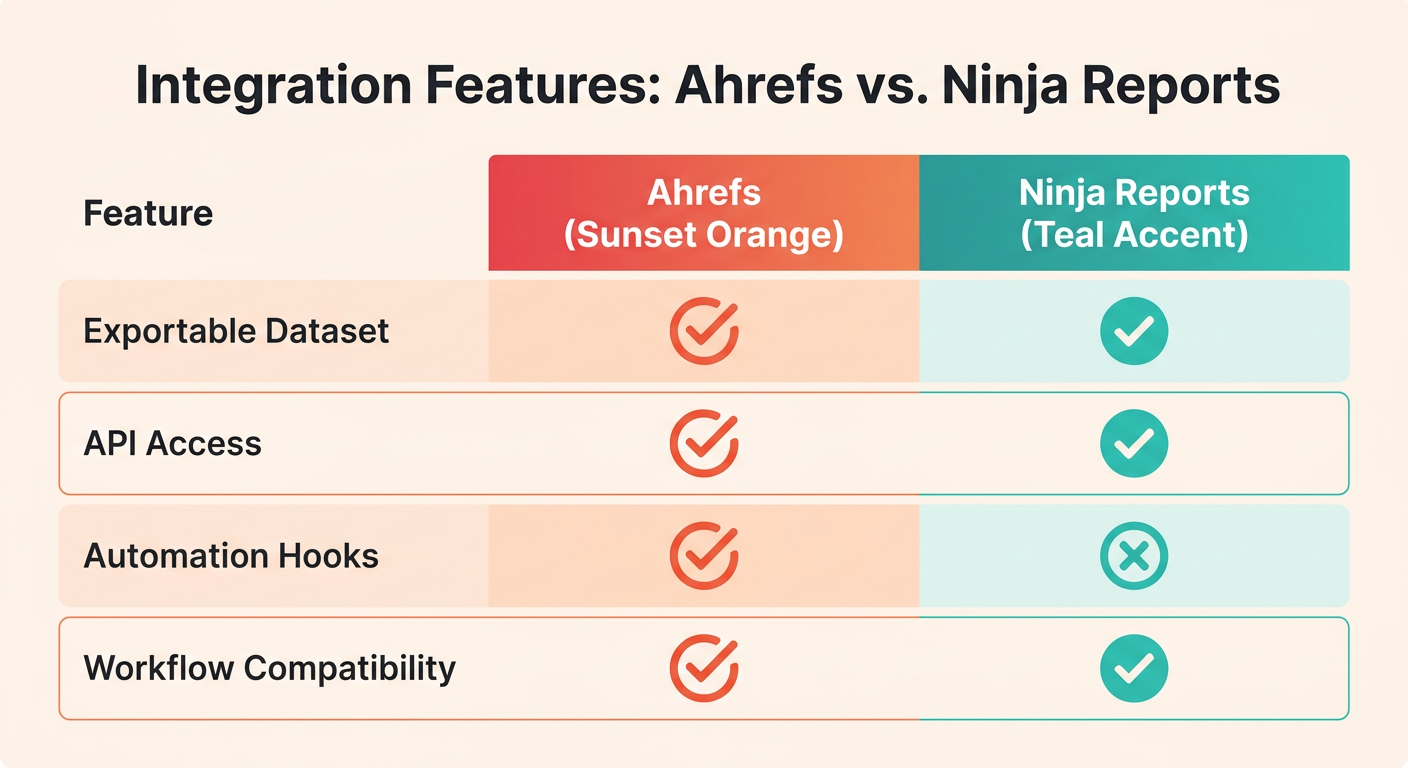
How does gap data flow into an automated content pipeline?
Each gap keyword can become one content brief. That's the mechanical insight that makes automation feasible. Once you have a clean list of missing keywords from Ahrefs, each one maps neatly to a single article topic. The messy part, turning a keyword into a finished draft, is where AnyPost.ai comes in: our engine generates ready-to-rank, SEO-optimized articles in your voice at scale.
This is the loop small teams never close on their own. They pull the gap report, stare at hundreds of missing keywords, and write maybe three. With AnyPost.ai generating drafts across your target keywords, the bottleneck moves from writing to reviewing, and you can auto-publish to your existing platform once approved.
Ninja Reports plays a different role here. Its on-page scan isn't a discovery engine, so it doesn't feed the front of the pipeline. It fits better as a post-publish validation layer. Ahrefs finds the gap, AnyPost.ai writes and publishes the page, Ninja Reports audits it. Three stages, one workflow.
Which tool wins on automation and integrations?
Ahrefs feeds discovery. AnyPost.ai closes the publishing loop. Ninja Reports covers audit. Treating these as pure alternatives misses the point. For a lean team, the real win is stitching them into one chain instead of picking a single winner.
The honest limitation: gap exports are bounded datasets, not live feeds. You still decide which keywords to feed into generation. The discovery step doesn't run itself on a schedule. For most small teams pulling gap reports monthly, that cadence is fine.
Feature and Automation Matrix
| Feature | Ahrefs | Ninja Reports | AnyPost.ai |
|---|---|---|---|
| Primary job | Keyword gap discovery | On-page audit | End-to-end content generation |
| Competitor comparison | Multi-competitor comparison | Single-page focus | Content built from your keywords |
| Export format | Exportable keyword list | On-page scan report | Ready-to-publish drafts |
| Automation role | Front-end data source | Post-publish validation | Brief-to-published pipeline |
| Best for | Finding the gaps | Checking page health | Writing the pages |
The pricing math is what small teams should weigh. A gap tool that surfaces hundreds of missing keywords is only worth its monthly cost if you publish against those keywords. Buy Ahrefs, export a massive list of gaps, publish only four, and your cost per acted-on insight is brutal. That's the case for pairing discovery with automated generation instead of buying a bigger dataset you can't process.
Our recommendation: use Ahrefs for the gap, AnyPost.ai to turn those keywords into published pages, and Ninja Reports to audit what ships. Skip Ninja Reports for front-end discovery. That's not its job, and forcing it there wastes budget a small team can't spare.
What I'd actually recommend, with a checklist
For a small SEO team, the right pick depends less on which tool scores higher and more on what happens after you get the data. Ahrefs wins on raw gap discovery. Ninja Reports wins on post-publish auditing. Neither turns a gap keyword into a live page on its own.
Here's the resolution to the contradiction running through this comparison. One camp says small teams need a paid tool like Ahrefs, with its massive keyword index, to find real opportunities. The other says free SERP observation is enough. Both are right, at different frequencies. Manual methods work for a one-off audit. In a recurring, automated content pipeline, paid depth pays for itself.
Which tool wins on what?
| Tool | Strongest Advantage | Best Stage in the Pipeline |
|---|---|---|
| Ahrefs | Data breadth (massive keyword index and page database) | Front-end gap discovery |
| AnyPost.ai | Gap-to-published automation | Middle: draft generation |
| Ninja Reports | On-page audit, agency-ready reports | Post-publish validation |
Our take: these aren't three rivals. Ahrefs feeds the front of the workflow, an automated content engine turns those gaps into drafts, and Ninja Reports audits what gets published. Different stages, one pipeline.
Pros and cons at a glance
Ahrefs
- Pro: Deepest keyword index; clean exportable gap lists you can feed downstream.
- Pro: Filters isolate low-difficulty gaps competitors already rank for, so you prioritize winnable terms first.
- Con: Steeper learning curve, and it stops at data. It doesn't write anything.
Ninja Reports
- Pro: White-label reports let agencies rebrand audit output before sending it to clients.
- Pro: Flags on-page issues in plain language a non-technical stakeholder can act on.
- Con: Audit-first, not gap-first. Thin as a discovery engine on its own.
AnyPost.ai
- Pro: Turns each gap keyword into a published, SEO-optimized article in your brand voice.
- Pro: Collapses tool sprawl by handling generation and publishing in one place.
- Con: Still needs a gap source like Ahrefs feeding the front end for best results.
Why AnyPost.ai is the best overall for small teams
The automation angle rewrites the ROI math. The free-tool argument assumes every gap keyword costs hours of manual writing. Once that step is automated, the marginal cost per gap-driven article collapses. That's what justifies a paid gap tool for a lean team, not budget alone.
Implementation checklist
Ready to adopt or switch? Work through this in order:
- Trial evaluation: Run Ahrefs' Content Gap tool against 3-5 competitors and export the keyword list. Note the export format (CSV).
- Data migration: Map each gap keyword to a content brief. Watch for encoding mismatches; clean the CSV headers before import to avoid broken rows.
- Pipeline setup: Feed the cleaned gap list into your content engine so each keyword becomes a draft.
- Team training: Assign one editor to approve drafts. Keep humans on the approval gate, not the writing.
- Post-publish audit: Run Ninja Reports' technical scan on published pages to catch on-page errors.
- Workflow integration: Set a recurring cadence so gap analysis and generation repeat monthly, not once.
The main migration snag is format mismatch between an Ahrefs export and your import schema. Fix it by standardizing column names first. Get that handoff clean, and the whole loop runs on its own.
Frequently Asked Questions
1. Can I use Ahrefs and Ninja Reports together instead of choosing one?
These tools fit different stages rather than competing for one slot. Ahrefs handles front-end gap discovery, finding keywords competitors rank for that you don't. Ninja Reports works as a post-publish validation layer, checking technical health on pages after they ship. They serve separate jobs in one workflow.
2. How many competitors can I compare at once in Ahrefs' Content Gap tool?
Ahrefs' Content Gap tool compares your domain against multiple competitor URLs simultaneously and returns keywords they rank for that you don't. This keeps the export finite and predictable, producing a bounded, scoped list rather than an unworkable data dump you'll never process.
3. Why does the article say finding gaps isn't the real problem?
The real challenge lies in execution. While research tools quickly surface thousands of opportunities, most small teams struggle to write and publish content fast enough to target them. The limiting factor is production capacity, not discovery, which is why automating the writing process is essential.
4. When is it actually fine to skip a paid gap tool?
If you only publish content occasionally and have the time to manually check search results, you can bypass paid software. Spot-checking rankings works well for small, localized sites. However, the math flips once you want recurring audits feeding a content pipeline at scale.
5. What's the biggest snag when moving Ahrefs data into a content workflow?
Data alignment is often the trickiest step. You can prevent broken rows and import errors by standardizing column headers and cleaning the CSV before importing it into your content management system, ensuring a clean handoff downstream.
6. How do the third-party scores compare between Ahrefs and Ninja Reports?
In Crozdesk comparisons, Ahrefs scored higher than Ninja Reports. This difference reflects raw data depth rather than usability. Ahrefs draws from a massive global index of keywords and pages, while Ninja Reports focuses on technical page diagnostics rather than a deep keyword database.
7. Does AnyPost.ai replace the need for Ahrefs?
AnyPost.ai still needs a gap source like Ahrefs feeding the front end for best results. Ahrefs answers what to write by surfacing gap keywords; AnyPost.ai answers who writes them, turning each keyword into a ready-to-publish, SEO-optimized article in your brand voice, then publishing directly to your site.