
AI Backlink Building Automation Without Penalties: 7 Rules for Outreach, Anchors, and Link Quality

Key Takeaways
- In AI search, topical relevance beats domain metrics.
- Filtering prospects for subject fit is the most important safety step.
- Automation breaks the roughly 10-link-per-month ceiling.
- Vet targets for at least 300 organic visits a month.
- Check for a clean link neighborhood before pitching anyone.
- Automatic anchor text diversification helps avoid over-optimization.
- Three numbers show whether the program is healthy.
- Watch backlink velocity, anchor diversity score, and outreach rejection rate.
- A human should approve every final outreach email.
- That helps avoid recognizable spam patterns.
- On-page context and anchor relevance keep quality intact.
Why penalty-free backlink automation is worth getting right
Scaling link acquisition balances speed and risk. When automation targets entity alignment and contextual placement, you gain durable search visibility without triggering an algorithmic filter.
The core rules worth automating
These are the non-negotiables for any safe program. Everything else is a nice-to-have.
- Filter every prospect for topical relevance before outreach. In AI search, relevance outranks domain metrics.
- Automate outreach and follow-ups to clear the manual productivity ceiling.
- Vet each target for real organic traffic (300+ visits a month) and a clean link neighborhood.
- Diversify anchor text automatically so you don't drift into over-optimization.
- Keep the context around every live placement aligned with your topic.
An automated engine needs guardrails from the start. If you want the full setup mechanics, our guide on what backlink automation is and how to scale it walks through it step by step.
Rule 3: Keep a human on the send button
The decision to send an outreach email should still pass through a person. Even when AI wrote the draft, that checkpoint separates a campaign that performs from one that trips email filters. Automation handles the volume. A person handles the judgment.
This matters more now that 86% of SEO professionals had folded AI into their workflow by 2024. When everyone drafts with the same tools, the messages start to rhyme. A human reviewer breaks that sameness and catches context a model may miss.
Why a person should approve the final send
Because contextual judgment is still hard to scale with AI. A model can match a prospect to your topic and personalize the opener. It can't always tell when a site's tone, timing, or recent content makes an ask land wrong.
Treat the reviewer as your relevance backstop. Unvetted outreach scales weak placements fast, and with 93.05% of site traffic coming from Google, low-value links are exactly what you can't afford to pile up.
- Route every AI-drafted email through one human approval before it sends, so someone catches tone and context errors the model can't see.
- Flag any prospect the AI scored as a weak topical match for manual review instead of auto-sending.
- Keep a reviewer on the post-win step too, checking that the anchor and surrounding copy still read naturally after the link goes live.
What spam filters actually flag
Repetition, volume spikes, and low engagement. Fully automated outreach that fires identical templates at hundreds of inboxes trips all three. The fix isn't slower automation. It's varied, human-checked automation that behaves like real correspondence.
Verified contact data helps. Pulling accurate email addresses and company details before sending, the way API-based prospecting tools do, cuts bounce rates and keeps your sender reputation clean. Behavior-triggered follow-ups also beat blind sequences, because they respond to what a prospect actually did.
- Vary subject lines and opening sentences across your sequence so filters can't pattern-match your sends.
- Verify email addresses before outreach to protect sender reputation and reduce bounces.
- Use behavior-based follow-ups instead of fixed-interval blasts. Bots that react to prospect activity tend to earn higher response rates.
How big your prospect pool should be
Big enough to support steady outreach, curated enough that every target clears a relevance bar. As Rebecca Barnatt-Smith, Content Manager at Solvid, puts it:
"AI is redefining the outreach process, allowing marketing teams to send messages to double the number of prospects in half the time." - Rebecca Barnatt-Smith, Content Manager at Solvid
Double the volume only helps if the list is clean. That's the human's job at the top of the funnel: pruning AI-generated prospects down to the ones worth a real message.
- Have a reviewer trim AI-built prospect lists for genuine topical fit before outreach begins.
- Spread your pool across sites and content types so your link profile grows naturally, not in suspicious clusters.
Rule 4: Build anchor diversity with AI-generated contextual phrases
Anchor text diversity is the safest lever in AI backlink building automation, because it helps avoid over-optimization patterns search engines flag. The goal is simple: let AI suggest natural, context-driven anchor variations that match the target page's topic, then keep that mix balanced. Exact-match anchors stacked too high look manufactured. A spread of branded, generic, and descriptive phrasing reads like the web writing about you on its own.
Google's own link guidance is blunt about this. Descriptive anchor text that gives readers context is preferred, and generic phrasing like "click here" is discouraged. AI-generated contextual phrases fix both problems at once. They pull descriptive language from the target page's actual content, so the anchor stays relevant and the profile stays varied. That's where automating the anchor step earns its keep.
How to generate a safe seed list with AI
Feed AI the target page's content and let it produce anchor candidates grouped by intent: branded, exact-match, partial-match, and generic. Then test each against the destination topic for relevance before it reaches a placement.
Relevance is the filter that matters most. One good guest post on a relevant DR 35 site can outperform ten thin posts on DR 70 content mills. The same logic applies to anchors. An anchor that fits the page's entity and topic carries more weight than one padded with your money keyword.
- Generate anchor candidates from the target page's real content, not a static keyword list, so each phrase reflects the page topic.
- Score every candidate for topical relevance before use. Relevance beats domain rating, traffic, and raw authority.
- Cap exact-match anchors deliberately and let branded and descriptive variants carry the bulk of the profile.
Process automation vs. placement automation
Process automation handles the work around the link: generating anchor variations, drafting content, scoring prospects. Placement automation drops the link itself. Conflating the two is where teams get burned. Automating placement creates quality risk. Automating the process just speeds up execution safely.
Automating outreach solves the volume problem, since 73% of marketers get fewer than 10 links a month. But the payoff only lands if AI is aimed at relevance matching too. So automate the process and keep placement human. Let AI create and score, then have a person approve where anything actually goes live.
- Automate the process step (anchor generation, content, prospect scoring) but keep final placement under human control.
- Audit your existing anchor profile for exact-match clustering. That's the clearest over-optimization signal there is.
- Refresh anchor relevance after each win, updating on-page context so the surrounding text still lines up.
Rule 5: Vet publishers for authority, trust, and editorial fit
Vetting a publisher means judging its editorial standards, topical fit, and link history before you pitch, not just glancing at a domain score. This is where AI backlink building automation either pays off or backfires. Point it at relevance and history, and you filter out the junk. Point it only at metrics, and you'll accumulate poor targets faster than a human ever could.
There's a real gap between raw domain popularity and actual SERP performance. The top result in Google's SERPs carries more backlinks than positions two through ten. Volume is an output of quality, not a target. Authoritative, relevant sites accumulate links on their own, so chase the relevance and the volume follows.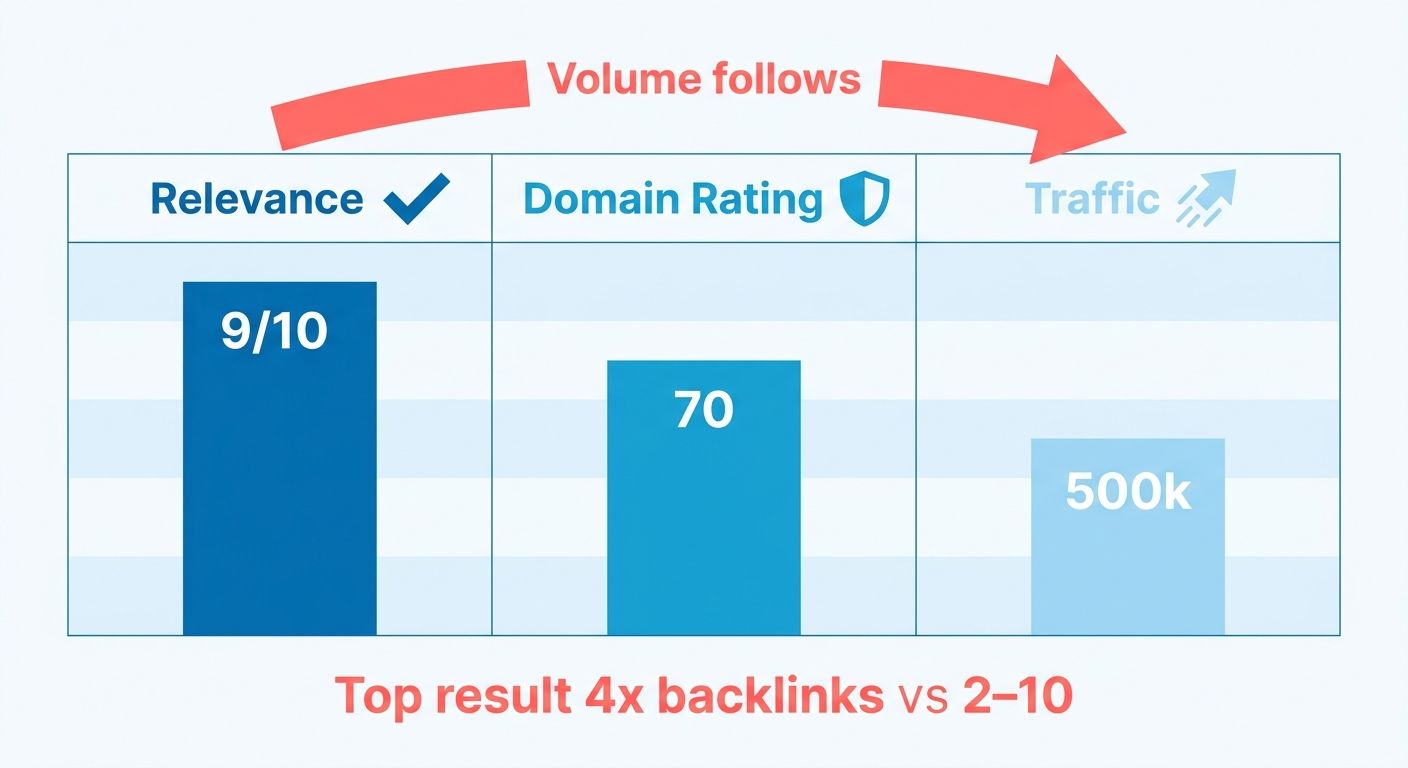
What belongs on a publisher vetting checklist
A strong checklist evaluates editorial reality, not vanity numbers. Google's link guidance favors editorially placed, descriptive links, so your automation should confirm each target actually publishes real editorial content.
- Confirm topical relevance to your page before anything else. Relevance outranks domain rating for link value.
- Verify real organic traffic above 300 visits a month, the line that separates a live site from a shell.
- Check that links sit editorially inside content, not stuffed in footers or sidebars.
- Prioritize niche authority over raw metric size for true semantic value.
That last point reframes how most teams rank prospects. A high domain score on an off-topic site is worth less than a modest score on a site your audience actually reads.
How to spot a bad link neighborhood
Red flags show up in a domain's behavior over time, and that's exactly what automation can watch for. The signals are historical: sudden spikes in outbound links, pages buried under ads, link patterns that don't match a genuine editorial calendar.
- Scan historical outbound link volume for sudden spikes that suggest a site selling links in bulk.
- Flag ad-heavy pages where your link would sit among dozens of unrelated commercial placements.
- Review the domain's archived versions to catch a site that flipped from real content to a link farm.
- Rule out any site whose neighboring outbound links point to spam or unrelated verticals.
An automated crawl of a domain's link history catches the pattern a one-time metric check misses. A site can show a clean score today and a messy trail behind it.
Vet for entity and brand signals, not just links
Search interest in entity SEO has grown recently, and unlinked brand mentions can now rival traditional backlinks in value. So your vetting should ask one more question: does this publisher reinforce your brand as a recognized entity in its niche?
- Favor publishers that already cover your topic area, so the placement strengthens your entity signals.
- Value nofollow links and image links on relevant sites. Both can carry weight in AI search.
In practice, that means building long-term topical fit across your content graph. Mentions on authoritative nodes solidify search engine trust across the themes you're targeting.
Rule 6: Run continuous QA, monitoring, and penalty detection
Monitoring is the safety net that catches problems your outreach automation can't see coming. A link that looked clean at acquisition can decay when the host page changes, gets deindexed, or slides into a spammy neighborhood. Continuous QA in AI backlink building automation means watching link health on a schedule, not checking in once a quarter when rankings tank.
Performance needs active oversight. When you audit live URL status and context after indexation, you catch drift early and fix it before an algorithmic drop hits. The automation that won the link should keep watching the page it landed on.
What your backlink monitoring dashboard should track
Referring domain counts, anchor text distribution, link trust signals, and any sudden shifts in either direction. Real-time visibility is the point. A weekly rollup misses the fast drops that signal a problem worth acting on today.
- Watch referring domains for sudden gains or losses. A spike can mean a negative SEO attack; a drop can mean links got removed.
- Flag any rise in low-trust or off-topic links, since irrelevant links dilute your profile fast.
- Track anchor text ratios against your target mix so exact-match anchors never creep past a natural spread.
- Check whether host pages still carry the entity and brand context that made them relevant when you won the link.
How often to run QA audits
Lightweight automated checks daily, a deeper manual audit monthly. The daily pass catches emergencies. The monthly audit is where a human reviews anchor drift, re-scores publisher relevance, and decides which pages need a content refresh.
Set your alerts to fire on movement, not noise. A single lost link isn't worth a notification. A sudden, sustained drop in referring domains is. Same with anchors. If descriptive and branded phrasing shrinks while exact-match grows, that's the over-optimization pattern you want to catch before an algorithm does.
Manual action: a penalty applied by a Google reviewer, reported directly in Search Console with the affected URLs and the reason. Check Search Console weekly. It's the one place Google tells you plainly that something is wrong.
What rapid remediation looks like
Remediation starts with triage: confirm the issue, isolate the offending links, then act. For toxic or irrelevant links, disavow or request removal. For links that simply lost relevance, refresh the anchor and the surrounding copy instead of killing the link.
Speed decides how much a problem costs you. A manual action left sitting for weeks compounds ranking losses, while a reconsideration request filed after cleanup often sees a response in a few weeks. Build a remediation runbook so triage doesn't stall: assign an owner, set a 48-hour window to isolate the affected links, and log every disavow or removal request with a timestamp.
Skip aggressive disavowing for links that are merely low-DR but on-topic. Pruning relevant links to chase metrics does more harm than the links ever did.
Rule 7: Use AI for content matching and pitch personalization
The smartest move in AI backlink building automation is pointing the machine at the match first, the message second. AI should score your existing content against a publisher's niche before it drafts a single pitch. Get the topical fit right and the pitch nearly writes itself, because you're offering something the editor actually wants.
This is also where personalization stops being a gimmick and starts protecting quality. When AI matches a genuinely relevant article to the right publisher, the link lands in context that fits your topic. Accurate matching up front builds lasting authority without tripping spam filters.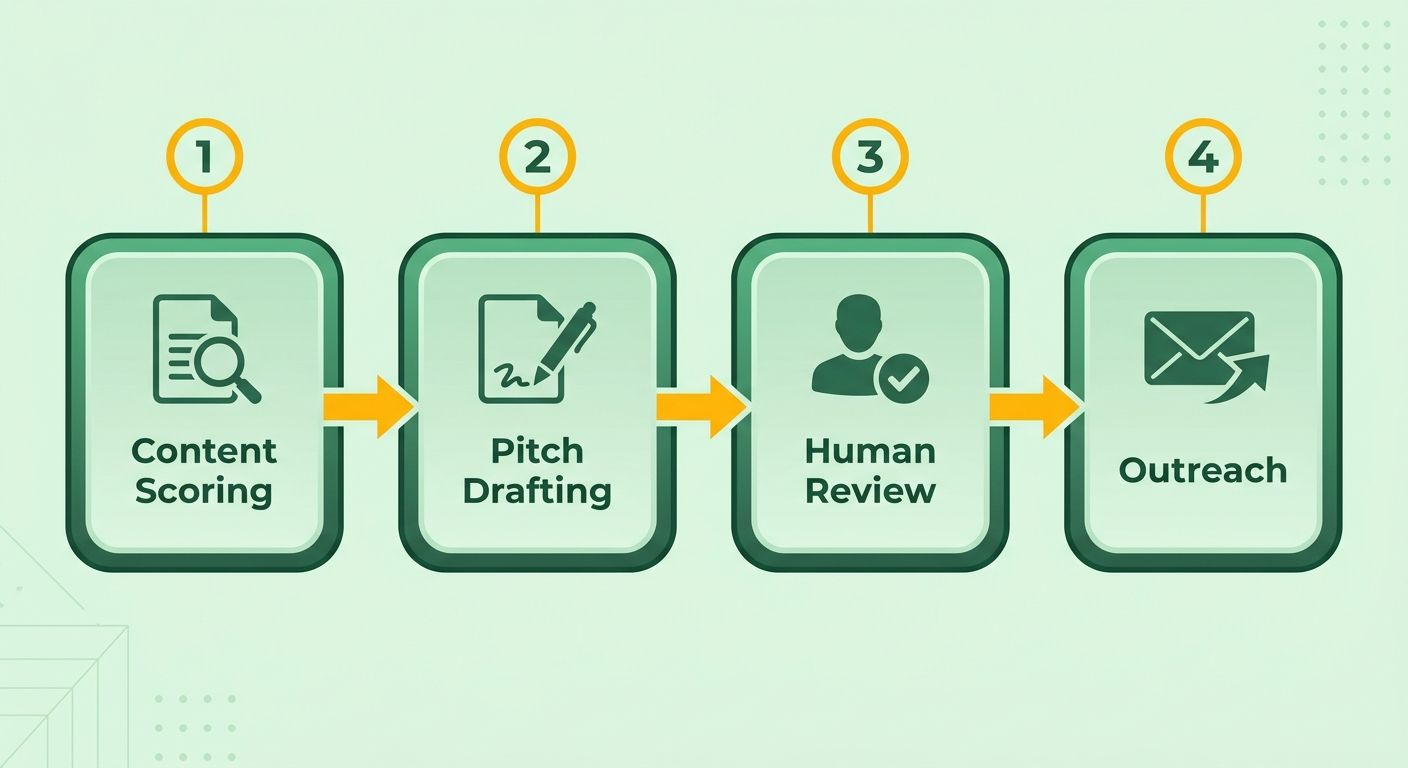
How AI matches content to the right publisher
By scoring the semantic overlap between your article's topics and the publisher's editorial focus, then ranking prospects by fit. The higher the topical alignment, the more natural the placement and the anchor around it.
Call it relevance-first prospecting. The trap most teams fall into is chasing domain authority scores while ignoring whether the site actually writes about their subject. A high-DA placement on an off-topic page passes weaker signals than a mid-DA link inside a closely related article. Run your semantic match before the outreach bot fires, so fit drives the list instead of vanity metrics.
- Score every content asset against the publisher's actual topic clusters, not just its domain metrics, so placements read as natural fit.
- Rank prospects by topical overlap so your best-fitting article goes to the publisher most likely to accept it.
- Confirm the target page context supports your intended anchor, so relevance holds after the link goes live.
What makes an AI pitch convert
A pitch converts when it pairs a relevant content offer with a tone that matches both the publisher and your own brand voice. Personalizing the opener is the baseline now. The differentiator is a pitch that reads like a real person from your team wrote it.
Tuning the message to the recipient keeps responses steady without sacrificing voice. Feed the model your brand tone and it adapts each pitch instead of slipping into the generic template patterns spam filters learn to flag.
- Feed brand persona data into pitch generation so tone stays consistent across hundreds of sends.
- Personalize the opener with a specific detail about the publisher's recent work, not a mail-merge field.
- Automate behavior-based follow-ups so non-responders get a relevant nudge without manual tracking.
Which metrics prove the match is working
Track reply rate and link acquisition speed as your leading indicators, then editorial acceptance rate as the quality check. Verified-contact prospecting tools have shown better targeting and higher response rates, and automated follow-up bots lift engagement while cutting manual work.
Watch acceptance rate closest. A rising reply rate with flat acceptances means your matching is off, not your copy. When both climb together, the content-to-publisher fit is doing its job, and the links you win will hold their relevance long after the pitch lands.
Frequently Asked Questions
1. Do nofollow links still help in AI-powered search?
Modern search and generative engines map entity relationships across the entire web graph, meaning nofollow links and unlinked brand mentions provide essential co-occurrence signals. When an authoritative site in your niche references your brand, search algorithms recognize that contextual association regardless of standard link attributes.
2. Should I disavow low domain-rating links to protect my profile?
Do not disavow placements simply because a site has a lower domain score. Search engines naturally expect a diverse profile containing smaller niche sites. Disavowal tools should be used selectively for clear webspam, broken redirects, or unnatural link networks that present genuine penalty risks.
3. What's the difference between backlink velocity and anchor diversity as health metrics?
Backlink velocity measures the rate at which your domain acquires new links over time, ensuring growth stays steady rather than spiking unnaturally. Anchor diversity evaluates the balance of branded, descriptive, and exact-match text across your link graph to prevent over-optimization flags.
4. How do I tell if a publisher is a shell site versus a real one?
Evaluate audience engagement and traffic consistency across historical analytics. A legitimate publisher maintains steady organic search impressions and active readership, whereas a shell site often exhibits volatile traffic dips, lack of editorial voice, and excessive outgoing commercial links.
5. My reply rate is up but links aren't landing. What's wrong?
When open and response numbers rise without a corresponding gain in live links, the disconnect usually stems from semantic relevance rather than subject line phrasing. Review how closely your pitch topics align with the target site's current editorial strategy to ensure your content provides true value to their readers.
6. Can AI fully automate outreach without any human involvement?
Relying entirely on autonomous software risks sending inappropriate pitches when subtle contextual nuances are missed. Human oversight at the campaign approval stage ensures brand alignment, verifies recipient suitability, and maintains natural messaging variance across all prospect communications.
7. How quickly should I respond to a Google manual action?
Address Search Console notifications immediately upon receipt. Establish an emergency workflow to identify bad links, request removals or submit disavow files, and submit a detailed reconsideration request after cleanup to minimize long-term organic search suppression.