AI SEO Content Generator: 5 Checks Before Unattended Publishing

Key Takeaways
- Rankings and indexation often look strong through month two, then algorithms correct in month three once they've mapped the patterns.
- HubSpot's 2026 State of Marketing report found 80% of marketers now use AI for content creation.
- SE Ranking gates AI output twice: brief validation before generation, mandatory editing before publish.
- Default caps at two posts weekly keep sites below the volume thresholds where Google's scaled content abuse policies kick in.
The Part Most Teams Miss: What Happens After You Hit Publish
Teams treat AI content like a throughput problem. Generate faster, publish more, let the tool run while you work on strategy. That logic holds until you check what's actually happening three months out.
HubSpot's 2026 State of Marketing report puts AI adoption at 80% across marketers. The tools are mainstream. The gap isn't adoption anymore—it's the distance between what teams assume AI delivers and what search algorithms reward past the honeymoon period.
The pattern when AI runs unchecked
SEO experiments tracking AI content show the same arc. Month one: solid indexation, decent impressions, rankings appear for target queries. Month two: continued growth as search engines process the material. Month three: correction.
Rankings that looked stable start sliding. Pages that indexed fast get buried deeper. Not deindexed—deprioritized. Algorithms identify the patterns separating editorially reviewed work from bulk output. Early indexation doesn't guarantee lasting visibility when content lacks the signals that distinguish intentional publishing from scaled noise.
Domain authority buys some algorithmic forgiveness, but newer sites can't rely on trust alone to offset the patterns flagging unreviewed, mass-generated material. The difference between AI content that sustains performance and AI content that collapses after two months is the safeguards built into the workflow.
How SE Ranking gates their own content
SE Ranking uses two mandatory checkpoints. First gate: brief stage. Someone confirms the automated analysis makes sense and adds their own angle. Second gate: post-draft. The team reviews, edits, decides whether the piece deserves to exist.
Automation handles production between those gates. Judgment stays human at both ends. That split turns an AI generator into a publishing system that scales without collapsing three months later.
How We Built Friction Into the Workflow
Most teams building AI content generators optimize for speed. We optimized for the opposite: what friction prevents AI slop from reaching your site at scale?
The answer came from watching what breaks when automation runs unchecked. An automated pipeline scales mistakes as efficiently as everything else. Without gates, you get the honeymoon period SE Ranking documented—strong indexation for two months, algorithmic trust collapses in month three. We built our workflow to prevent that collapse before it starts.
Editorial gates you can't skip
Two human checkpoints anchor the publishing process, borrowed from SE Ranking's internal content operations.
-
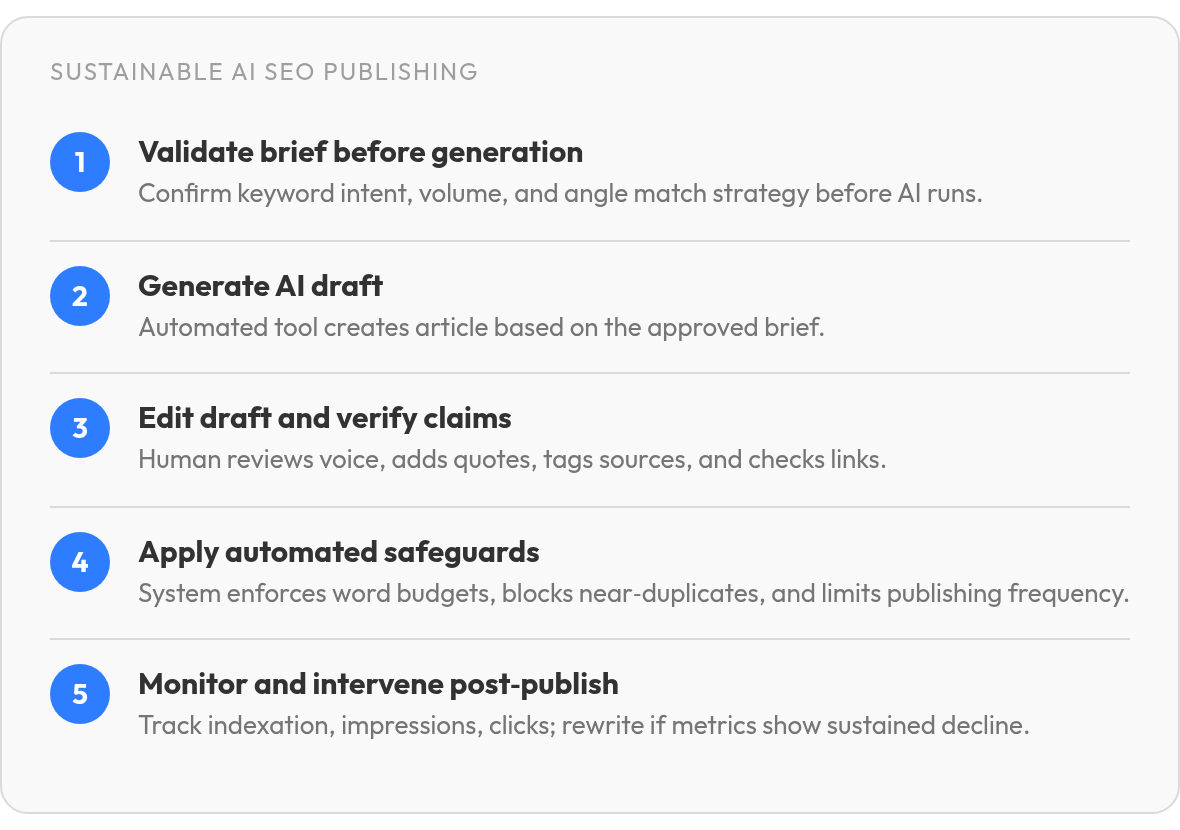
Review the brief before generation. You confirm the keyword analysis, search intent read, and angle make sense together. Automated research suggests topics. You decide if they're worth creating.
-
Edit the draft before publish. The system blocks publishing until someone opens the draft and saves changes. This isn't optional friction—it's the moment you add what only you know and catch claims that need qualifying.
Automated safeguards running silently
Between those two human gates, technical controls handle safety work you shouldn't do manually.
-
Word budgets enforce depth. Sections are measured against target lengths and expanded when short, so you get long-form articles instead of thin summaries that read like Wikipedia stubs.
-
Similarity fingerprinting blocks near-duplicates. Every published post gets a fingerprint. If a proposed draft sits too close to existing content, creation stops before you waste generation credits on redundant work.
-
Publishing defaults to measured output. Two posts weekly, not daily. Speed limits give you room to actually read what gets created, and they keep your site within the volume thresholds where Google's scaled content abuse policies start applying domain-wide.
-
Claim-by-claim source tracking. The verification checkpoint keeps each claim, its source, and your editorial decision together in one record. A retained example from real use contains 22 rows—20 approved claims, one qualified with context, one flagged to investigate before publishing.
Walking Through a Real Workflow: SaaS Blog Edition
The fifteen minutes between "generate" and "publish" separates AI velocity from AI slop.
Say we're publishing "How to scale onboarding with automation" for a mid-market SaaS blog. Search Console shows impressions for variants of that phrase. We've validated it's informational intent, not comparison-shopping. An AI generator can draft this in under five minutes. The work starts after that draft lands.
Validate keyword and topic fit first
Before touching the AI tool, we confirm search intent. Keyword Planner shows high competition and a top-of-page bid range—advertisers care about this term. That bid data approximates the 20th and 80th percentiles of historical ad auction behavior, not organic ranking difficulty. We cross-check Search Console to see if related queries already drive impressions. If "onboarding automation tools" generates clicks but zero content targets it, that's the green light.
The human gates
The AI delivers a 1,200-word draft. We spend ten minutes adding a customer quote and a specific CTA. Then we run the brand-voice check. AI content often carries patterns readers notice, particularly when writing lacks the specific details and direct language that make a piece feel grounded in real experience. We scan for hedge words, passive constructions, generic SaaS jargon. If a paragraph opens with "It's worth noting that" or "this means," we rewrite it.
Claim verification follows. Each factual statement gets a keep-or-investigate tag. We preserve the claim, source, and decision together in a working document so nothing drifts during edits. Link checks come last: verify each destination still exists, anchor text reads naturally, we're not linking to a competitor's affiliate scheme.
After publish: the monitoring window
We track this post in Search Console and watch impressions, clicks, average position, and indexation daily for two weeks. AI content can face performance shifts on newer sites as algorithms assess quality and relevance over time. We're not waiting weeks to find out. If impressions stall or the post drops significantly by week four, we flag it for a human rewrite before algorithmic trust collapses.
What to Track and When to Step In
The numbers that matter aren't the ones your AI generator shows in real time. They're the ones revealing whether Google still trusts what you published three months ago. Most teams track indexation rate and stop. That tells you content reached Google's crawlers, not whether it earned a ranking worth defending.
We monitor six layers across every automated publishing run: indexation status first, then impressions and clicks from Search Console, query coverage to see which terms actually triggered the pages, top-100 visibility as a proxy for algorithmic trust, engagement signals like time-on-page and bounce rate, finally ROI tied specifically to AI-generated content. The timeline separating signal from noise is longer than most teams expect. In controlled observations, AI pages often index quickly and show early ranking momentum. That can look like validation. But the pattern that matters emerges over months: pages that initially rank can lose algorithmic trust while remaining technically indexed, dropping out of meaningful visibility even as they stay in Google's index.
Track deterioration patterns, not single-day drops
Your intervention trigger shouldn't be a fixed threshold like "10% CTR decline in 48 hours." It should be sustained deterioration across multiple metrics over weeks. When impressions fall while indexation holds steady, you're watching algorithmic trust erode in real time. When clicks drop faster than impressions, your titles or snippets stopped matching intent. When new pages stop ranking past position 50 within their first month, your content brief or voice alignment likely drifted.
One export artifact we learned the hard way: Search Console displays some unavailable values as ~ or - in the interface, but those same cells export as literal zeros. If you're piping GSC data into dashboards without that context, a formatting quirk looks like a traffic collapse. Confirm the decline in the web interface before you rebuild your entire workflow.
Where to gate the workflow
Automation velocity only holds value when periodic human audits catch drift before it scales. The checkpoints that matter: brief approval before generation starts, post-draft claim and voice review before anything publishes, pre-publication originality screen to block near-duplicates. Retained automation handles drafting, duplicate detection, routine measurement. The judgment calls stay with your team.
Common Questions
1. When should you intervene on AI content that's losing rankings?
Intervene when you see sustained deterioration across multiple metrics over weeks, not single-day drops. If impressions fall while indexation holds steady, algorithmic trust is eroding. If clicks drop faster than impressions, your titles stopped matching intent. If new pages consistently fail to rank past position 50 within their first month, your content brief or voice alignment has drifted and needs correction.
2. How much time do the two human review gates actually require?
The brief validation before generation typically takes a few minutes to confirm keyword analysis and search intent align. The post-draft edit runs closer to ten to fifteen minutes, where you add specific details and customer quotes, scan for AI patterns like hedge words and passive constructions, and verify claims. That combined time per post prevents the algorithmic trust collapse that shows up in month three.
3. Can high-authority sites publish AI content more frequently than twice weekly?
Domain authority provides some algorithmic forgiveness, but it doesn't eliminate the patterns that flag bulk-generated material. The two-post weekly limit keeps sites within volume thresholds where Google's scaled content abuse policies start applying to entire domains. Established sites might handle slightly higher volume, but the safeguard exists because early indexation and strong month-one rankings don't guarantee lasting visibility.
4. Why does Search Console sometimes show traffic zeros that aren't real drops?
Search Console displays some unavailable values as tildes or dashes in the web interface, but those same cells export as literal zeros in spreadsheet downloads. If you pipe GSC data into dashboards without accounting for that formatting quirk, a data display issue looks like a traffic collapse. Always confirm apparent declines in the web interface before changing your workflow.