5 Questions That Separate AI SEO Content Generators From Draft Factories

Why automation stops too early
Most teams blow their AI budget on drafts, then spend hours per post doing what should have been automated: metadata entry, internal linking, CMS publishing, distribution. The draft arrives in minutes. Publishing it takes the rest of the afternoon.
That's not efficiency. That's a draft factory that still requires manual assembly.
The traffic spike that doesn't stick
Sites that publish many AI pages quickly may see early traffic growth followed by steep drops. The March 2024 scaled content abuse policy wasn't targeting AI text specifically—it was targeting thin pages that never developed the engagement signals real content accumulates. External links, social shares, sustained traffic. Those don't materialize when you're publishing at scale without distribution infrastructure.
The algorithm doesn't detect AI. It detects the missing footprint.
Where the real time sink lives
Teams that publish more content without adding headcount aren't generating drafts faster. They're automating the execution layer: publishing to CMS, building internal links, writing metadata, pushing to social channels. That's where hours disappear in manual workflows.
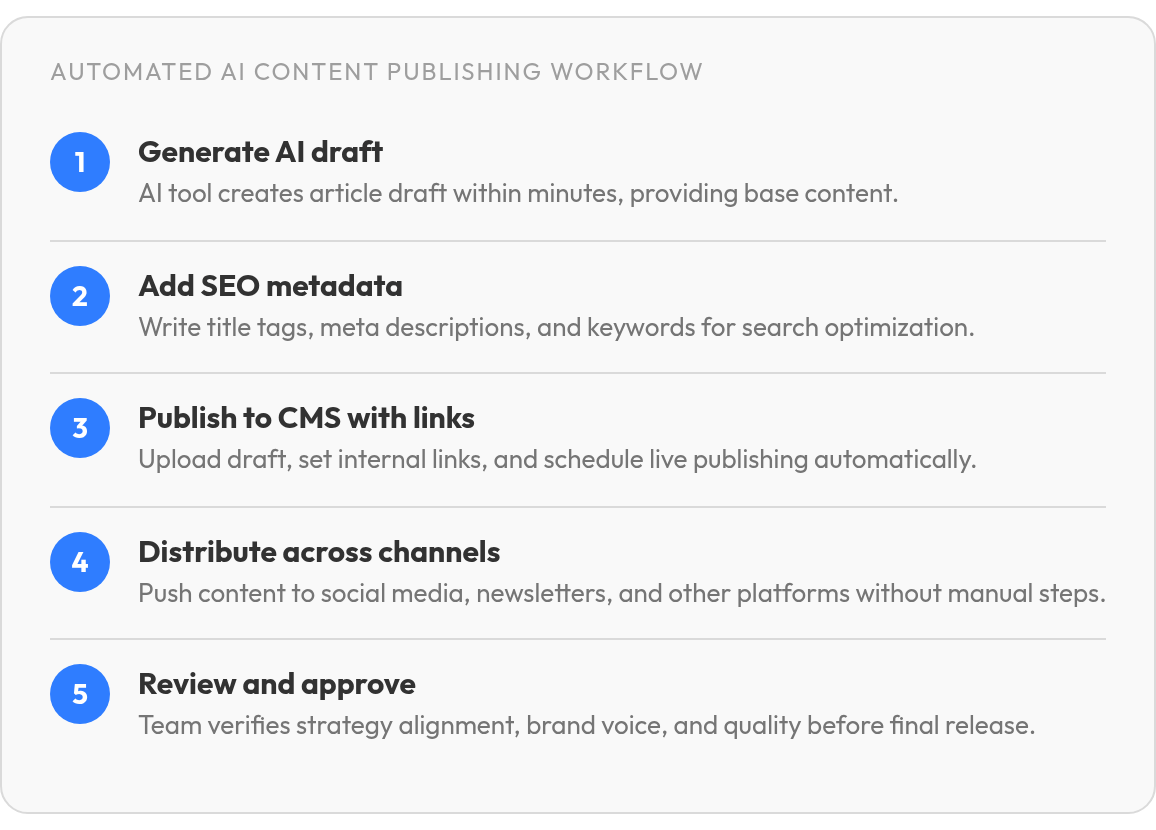
We automate the stage most teams still handle by hand. Generate the draft, write the SEO metadata, publish to your CMS, build internal links, distribute across channels. Your team reviews strategy and approves work instead of copying meta descriptions into twelve fields. That gap—between draft tools and full-stack workflows that maintain local voice while scaling output—is where real efficiency shows up.
Key Takeaways
-
Drafts arrive quickly, but formatting, metadata entry, and publishing can consume the rest of the day—turning speed tools into time sinks.
-
Google's scaled content abuse policy targets thin pages lacking external links, social shares, and sustained traffic patterns.
-
Real gains come from automating metadata, internal linking, CMS publishing, and distribution—not faster drafts.
-
Many B2B marketers use generative AI for content, but confidence in output quality often remains low across industries.
Scaling SEO without spreading thin
The part teams underestimate isn't generating content. It's what happens after. We see companies buy an ai seo content generator, publish 200 posts in three months, then watch traffic collapse six months later.
Skip mass page generation if your business doesn't support it. A restaurant website doesn't need 100,000 pages. Those compact keyword landing pages fail because they solve for coverage instead of value. Google's March 2024 policy specifically targets this pattern.
Automation that actually scales
The efficiency gain comes from automating the execution layer, not the drafting layer. Teams using structured AI workflows publish more content without adding headcount. The work they automate: metadata entry, internal linking, CMS publishing, distribution. That's where the time sink lives.
Automating routine tasks—publishing across platforms, distributing to social channels, managing internal links—removes the manual handoff that swallows whole afternoons. We built our workflow around this. Our automated publishing pushes content directly to your website, then turns that content into social media carousels and distributes it across LinkedIn, X, Instagram, TikTok, and YouTube without manual steps.
Pricing matters here. AI drafting tools handle drafting well. But without automated distribution, your team still spends hours per post moving content from tool to live site. That's the hidden tax most pricing calculators miss.
The difference in time savings comes down to workflow maturity. Ad-hoc AI usage delivers modest gains. Full-stack automation that covers publishing and distribution delivers more.
Keeping your brand voice consistent
The trust gap explains why most teams can't hand an AI SEO content generator the keys and walk away. Many B2B marketers have adopted generative AI for content, but confidence in output quality often remains low. Not a tool problem. A consistency problem. AI drafts don't automatically match your brand voice, your audience's sophistication level, or the tone that converts for your business.
The pattern repeats across industries: a team adopts an AI content tool expecting to cut writing time in half, then discovers the real bottleneck isn't drafting speed. It's editing. Practitioners testing multiple AI content tools consistently report that time savings shrink once you account for hours spent rewriting robotic transitions, fixing tone mismatches, and fact-checking claims the AI confidently stated without sources. Editing remains a required human step before AI drafts become publishable, and the faster the draft, the more that step matters.
AI detection adds pressure you can't ignore
Brand consistency now carries an additional technical constraint: AI detection tools. Some detection tools flag content based on linguistic patterns common in AI-generated text. Content detected as heavily AI-generated may face ranking challenges, even though search engines don't officially penalize AI content. The risk is real enough that editorial teams now factor detection avoidance into their workflow.
The editing burden isn't just about making content sound better. It's about making it sound like you. That requires detailed brand-specific briefs that tell the AI what vocabulary to favor, what sentence structures your audience expects, and what tone mistakes to avoid. Even then, human review remains the gate. We allocate editing time not as a polish step but as required quality control, because no AI tool delivers brand-consistent drafts without it.
Proving real business impact
The part teams measure wrong isn't how fast they publish. It's whether that content still drives traffic six months later. Most companies tracking an AI SEO content generator celebrate operational wins—more articles per month, faster publishing—without monitoring the metric that predicts collapse: traffic retention beyond the first few months.
If your impact reporting stops at volume and early traffic spikes, you're measuring the boom phase of a boom-bust cycle.
Track retention, not just early wins
The workflow maturity gap explains the contradiction in reported time savings. Editing time can offset much of the drafting speed gain. Teams running structured workflows with automated distribution, metadata entry, and CMS publishing report meaningful time savings on routine tasks.
The difference isn't the tool. It's what you automate. AI writing tools handle drafting. Real efficiency comes from automating the execution: title and meta description updates, internal linking structure, distribution tasks that swallow whole afternoons when done manually.
Calculate real monthly cost beyond the tool price
A low-cost chatbot subscription becomes the most expensive option if turning each draft into a published, optimized page takes hours of skilled labor. Real monthly cost includes tool subscription plus editor time, SEO research, CMS publishing, technical SEO work, content refreshes, and opportunity cost of targeting wrong keywords. Traditional SEO agencies can be expensive for the same reason.
Track organic sessions by publish cohort (comparing early traffic to sustained performance for the same batch of posts), keyword ranking stability, lead-to-sale conversion ratio, and content quality scores from your editing workflow. A content operation that produces more volume but lower conversion rates didn't improve impact. It just moved faster toward the wrong goal.
Common Questions
1. How long does it take to see if AI-generated content will hold its traffic?
Most sites show the pattern within the first six months. You'll see early traffic growth as pages index and rank, then steep drops when algorithms detect missing engagement signals like external links and sustained visit patterns. Track organic sessions by publish cohort—comparing early performance to month-four and month-six numbers for the same batch of posts—rather than celebrating total traffic spikes that mask individual page decay.
2. How do I know if my existing AI content is at risk under Google's scaled content abuse policy?
Check whether your pages attract external links, social shares, and sustained traffic beyond the first few weeks after publishing. The March 2024 policy specifically targets thin pages lacking those distribution signals, not AI text itself. If your content shows early ranking followed by steady traffic decline without accumulating backlinks or social traction, that's the pattern Google detects as scaled content abuse.
3. Should I replace my current AI writing tool with a full automation platform?
That depends on where your team actually loses time. AI drafting tools handle drafting well, but if your team spends hours formatting and publishing what the AI drafted in minutes, the subscription cost isn't your real expense. Calculate total monthly cost including editor time, CMS work, and metadata entry. Switch when automating the post-creation execution layer—not faster drafting—becomes your efficiency bottleneck.
4. What should I automate first if I'm just starting with AI content workflows?
Start with the post-creation execution layer that consumes whole afternoons manually: metadata generation, internal linking, and CMS publishing. These tasks are repetitive and time-intensive but don't require creative judgment the way brand voice editing does. Automating distribution and technical optimization can save meaningful time, while editing for brand consistency remains a required human review step regardless of workflow maturity.