AI Writing Tools Need a Brand Voice Brief Before They Draft
Quick summary
A brand voice brief tells an AI writer what to do. It doesn't just describe how the brand should feel. The briefs that work tend to share a few traits. They use two or three annotated samples of past copy instead of tone adjectives. They list banned phrases next to preferred swaps. They set channel rules, such as email subject lines under eight words. They also have one named owner who versions every change.
The risk grows with volume. Going from five posts to fifty means a voice slip can repeat in every draft. A small pilot batch catches that early: three articles, two newsletters, and six social posts drafted from one brief and scored against a checklist.
Why AI writers drift without a brand voice brief
Most teams assume the drafting step is the hard part. In practice, drafting is often the easy part. An AI writer can turn out a clean, grammatical article in minutes. The harder part is getting that article to sound like you and not like every other SaaS blog in your category.
Without a brief, the model fills gaps with defaults. You get the safe opener, the vague benefit, and the three-adjective sentence. Your reviewers then fix the same problems by hand, draft after draft. That rework is a hidden tax, and it can swallow whole afternoons once you're publishing at volume.
We recommend treating the brief as the operating document for your content engine, not as a branding exercise you file away. Write it before you scale output. Make it specific enough that a reviewer can point to a rule when a sentence feels off. Then put it in front of every stage, from first draft to approval.
What every AI brand voice brief needs
A useful brief gives an AI writer decisions it can apply. A list of adjectives it has to interpret won't do that job.
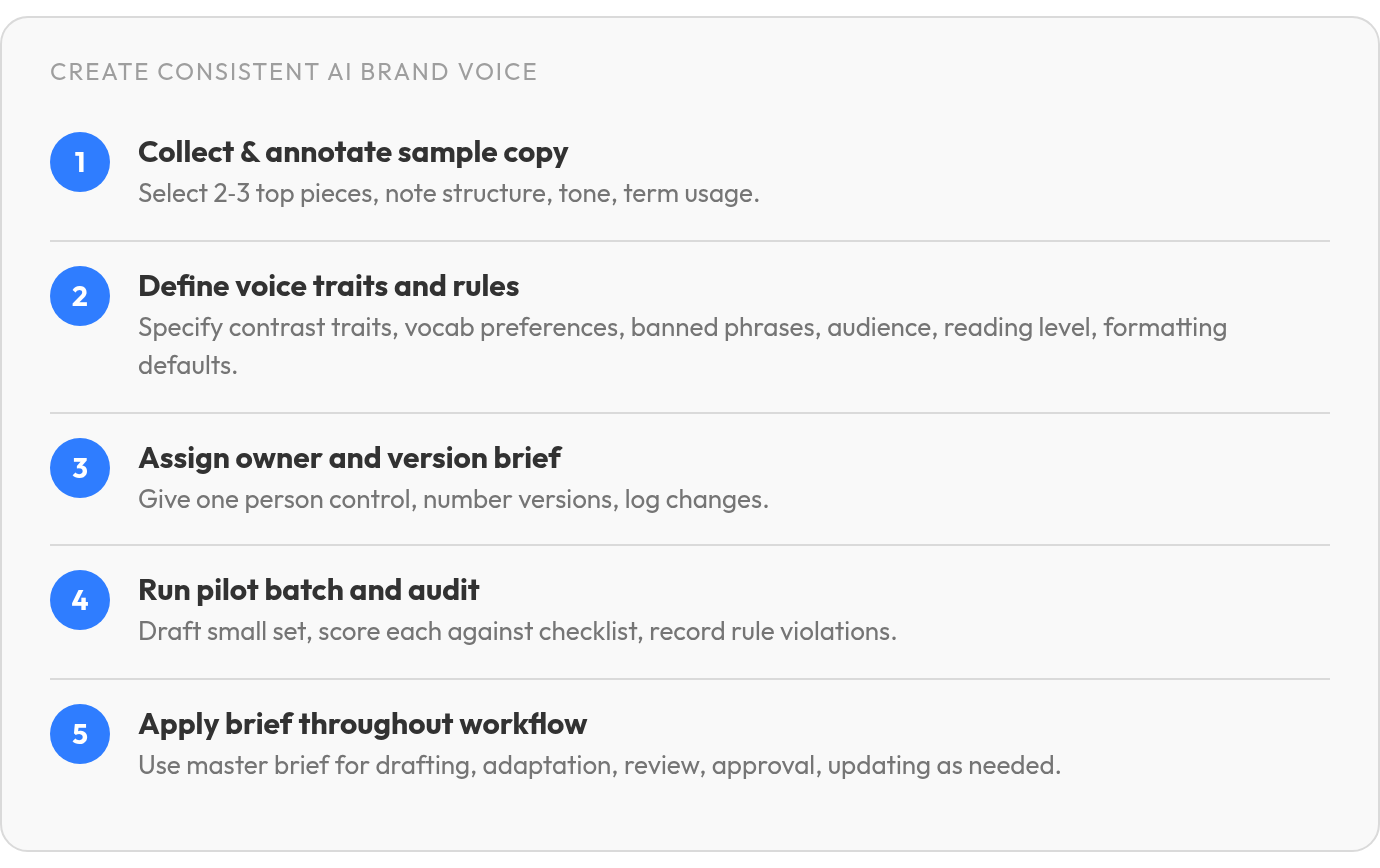
Start with voice traits written as contrasts, such as "confident but not pushy" or "plain-spoken but not casual." Pair each trait with one sentence that fits it and one that breaks it. The broken example often teaches more than the good one.
Next, set vocabulary rules:
- Preferred product and category terms, for example "pipeline" instead of "funnel"
- Phrases the brand never uses, each paired with a replacement
- Which jargon you define for the reader and which you assume they know
Then define audience and reading level. Name who you're writing for, what they already know, and what they need from each piece. A RevOps lead and a first-time founder want very different amounts of setup.
Include formatting defaults:
- Sentence length targets
- Where benefits go in a paragraph (front-loaded or built up to)
- How intros open, for example naming the problem in the first sentence
- Channel-specific limits, such as subject line length Finally, add two or three annotated samples of on-brand writing. They give reviewers a fixed reference point when output starts to drift.
Building the brief in AnyPost.ai's Persona Engine
Our Persona Engine is built for tone matching, so output sounds like your brand rather than a template. It does its best work when you're precise about what that voice is. Examples tend to carry that precision better than adjectives do.
Tell a model to "write conversationally" and you'll often get generic copy. Show it a few paragraphs from your best-performing newsletter, with notes on why each sentence works, and it picks up the rhythm, specificity, and structure that convert.
What goes into a working brief
Start with sample copy. Pull two or three snippets that performed well, such as a newsletter intro that drove clicks, a product description that closed deals, or a social post that sparked replies. Annotate each snippet with the structural choices behind it: sentence length, where the benefit lands, how one idea hands off to the next, and which terms go undefined.
Boundary rules come next. List the exact phrases the brand avoids, such as "modern," "best-in-class," and "solutions." Supply the alternatives you want instead: "new," "effective," "tools."
Then document channel differences. LinkedIn posts end with a question to invite comments. Blog intros name the problem in the first sentence. Email subject lines stay under eight words. These notes matter because AnyPost.ai publishes across LinkedIn, X, Instagram, TikTok, and YouTube, and repurposes content into newsletters and social carousels. One brief keeps the voice consistent across all of those formats. It also helps to decide which offer each piece leads with—a free trial or a demo—so drafts point at the action you want.
Before and after
A generic draft might open with "Many businesses struggle with content creation." The same topic, written to the brief, opens with "Your content calendar shows three blank slots this week. You're writing from scratch again."
The second version uses "you," starts with a concrete detail, and skips the throat-clearing. When you review drafts, check for ruled-out phrases and confirm the preferred language reads naturally. If a draft still sounds flat, the fix is usually a sharper sample. Adding more adjectives rarely helps.
Keeping the brief alive after the first draft
The part most teams underestimate is the hand-off between stages. A brief can guide the first draft and then quietly drop out of editing, channel adaptation, and approval. An AI SEO content generator can produce a solid article fast. If the reviewer checks it against memory instead of the brief, the voice drifts anyway.
Our approach is to make one master brief the input at every stage: Master brief → Drafting → Channel adaptation → Voice review → Approval → Publication The drafting step pulls the brief's sample copy and preferred terms. The voice review step uses its tone boundaries as a checklist, so "off-brand" becomes a specific rule rather than a gut feeling.
How channel rules change the draft without changing the voice
Shared rules cover vocabulary, terminology, and banned phrases. Channel rules cover length, pacing, and how much context the reader needs.
Take one article adapted twice. The LinkedIn post opens with the business problem and keeps a professional register. The TikTok script runs shorter and sounds like someone talking across a table. Both use the same product terms.
The tradeoff is real. Every channel rule you add makes the brief harder to apply consistently, and with enough exceptions you're back to five voices.
Who keeps the brief current?
A brief without an owner goes stale. Give one person ownership, number each version, and log change dates and approvals. Keep a single authoritative copy and archive old versions so nobody drafts from last quarter's file.
To spot drift, track two signals: revisions per piece and which checklist items reviewers flag as off-voice. When those counts climb, look at the brief before you blame the writers.
Pilot small before you scale the brief
The riskiest week often comes right after the first good draft, when you scale from five posts to fifty. A voice slip a reviewer catches once can repeat in every piece that follows. AI SEO content generators copy patterns faithfully, including the wrong ones.
We start with a pilot batch drafted from one brief. A reviewer scores each piece against the checklist below and logs every mismatch with the exact sentence and the rule it broke.
A brief-audit checklist that forces specific notes
| Check | Met / Not met | Note | Required revision |
|---|---|---|---|
| Sample-copy alignment | Not met | Intro opens with a definition; samples open with a tension | Rewrite from the reader's problem |
| Preferred language | Met | Uses "pipeline," not "funnel" | None |
| Tone boundaries | Not met | Promises "guaranteed rankings" | Replace with a hedged, specific claim |
| Channel rules | Met | LinkedIn post stays within length rule | None |
The mismatch log is where the brief improves. When the same miss shows up three times, the rule or the sample is usually at fault. Fix it once in the brief instead of hand-editing every draft.
Set governance before you scale
Set approval gates early. Our rule is that new jargon, positioning claims, and offer language need sign-off from a named owner before they go live. A human approves every piece until the pilot runs clean.Refresh the brief whenever your positioning, audience, offers, terminology, or channel strategy changes, and schedule periodic reviews on top of that. Nobody has shown that one review cadence works for every team, so pick one yours will keep. This week, a good first step is to pull your three best-performing pieces, annotate them, and draft the pilot batch from them.