Automated Content Creation That ChatGPT Cites: Short Claims, One Brand Description

Key Takeaways
- Retrieval into a model's context window is distinct from citation; clearing retrieval does not guarantee that a page will be quoted.
- Effective brand descriptions contain self-contained, verifiable claims with explicit figures rather than vague statements like "more efficiently" or "many clients see results."
- Answer-engine optimization depends on tracking whether published pages earned citations, then using that feedback to refine the next content brief.
- We recommend reusing one canonical brand description so pages state the same verifiable facts; whether that consistency improves citations still needs testing.
The part most teams underestimate isn't writing the content
You spin up a generator, feed it a topic, and ship the draft. That loop feels complete. It isn't.
The actual bottleneck shows up after the page goes live. Answer engines retrieve your content, but they cite only a small fraction of what they pull. Research into competitive answer-engine optimization found that topical relevance and list position influenced which source won the first citation in controlled comparisons. That does not establish where your page sits in a real retrieval set, or that structure and specificity have the same effects outside the test.
Retrieval is not citation
Getting pulled into the model's context is one gate. Getting cited in the answer is another.
Pages that earn consistent citations tend to share a structural profile: moderate length, short paragraphs that answer sub-questions cleanly, internal links that reinforce topical authority, and images that support the claims. Those are correlations among pages already retrieved and cited, not a proven retrieval floor or a rule for winning citations.
Automation that assumes more output equals more visibility can miss whether individual pages earn citations. The question isn't whether you can generate content at scale—it's whether each page carries claims specific enough to compete with other retrieved sources.
The measurement loop most workflows skip
We see automation workflows that end at publication. The draft is live, the task is closed, and the next piece starts. That's a handoff with no feedback.
Real automation closes the loop: you track whether the page earned a citation, in which answer engines, and for which queries. That result—cited or not—feeds the next decision. If your own tests show that a claim with an explicit figure outperforms a vaguer version, you encode that pattern into the next brief.
The gap isn't in generating drafts faster. It's in building a system that learns whether those drafts actually get cited, then uses that signal to refine what you automate next.
Write one brand description, then use it everywhere
Most automated content creation treats the brand description as setup text—a few sentences of boilerplate that sit at the top of every page. Teams write one generic paragraph, then let the generator spin variations of it across hundreds of articles. That approach misses how answer engines actually cite content.
We recommend a brand description that is self-contained, specific, and built to be quoted. It should state your core promise, name the audience you serve, signal tone in the first few words, and include at least two verifiable claims with explicit figures. That is a practical brief format, not a tested guarantee of citation.
One canonical description beats fifty vague ones
Here's a weak description that wastes the opportunity:
"Our platform helps businesses create content more efficiently. We offer a range of tools designed to streamline your workflow and improve results. Many clients see better engagement after using our system."
That paragraph contains no facts an answer engine can extract. "More efficiently" is unmeasurable. "A range of tools" names nothing. "Many clients" is a hedge without evidence. If this text appears on 50 pages, the model sees 50 pages of vague claims.
Now the same description rewritten with citation factors in mind:
"AnyPost.ai is a content generation platform that automates SEO-optimized content creation and publishes directly to your website, LinkedIn, X, Instagram, TikTok, and YouTube. We serve SaaS companies, marketing agencies, and multi-location businesses that need consistent content without hiring writers or managing separate tools."
The revision states what the platform does, names the audience, and removes hedged language. That gives the model something concrete to extract. We recommend reusing it so pages state the same brand facts; whether that repetition improves citations is a hypothesis to test, not an established result.
If every article links back to a canonical brand page that carries this description, that page becomes a shared reference point. Even when a specific article doesn't win a citation, it can still put your brand claims in the model's context.
Build a short workflow with measurable endpoints
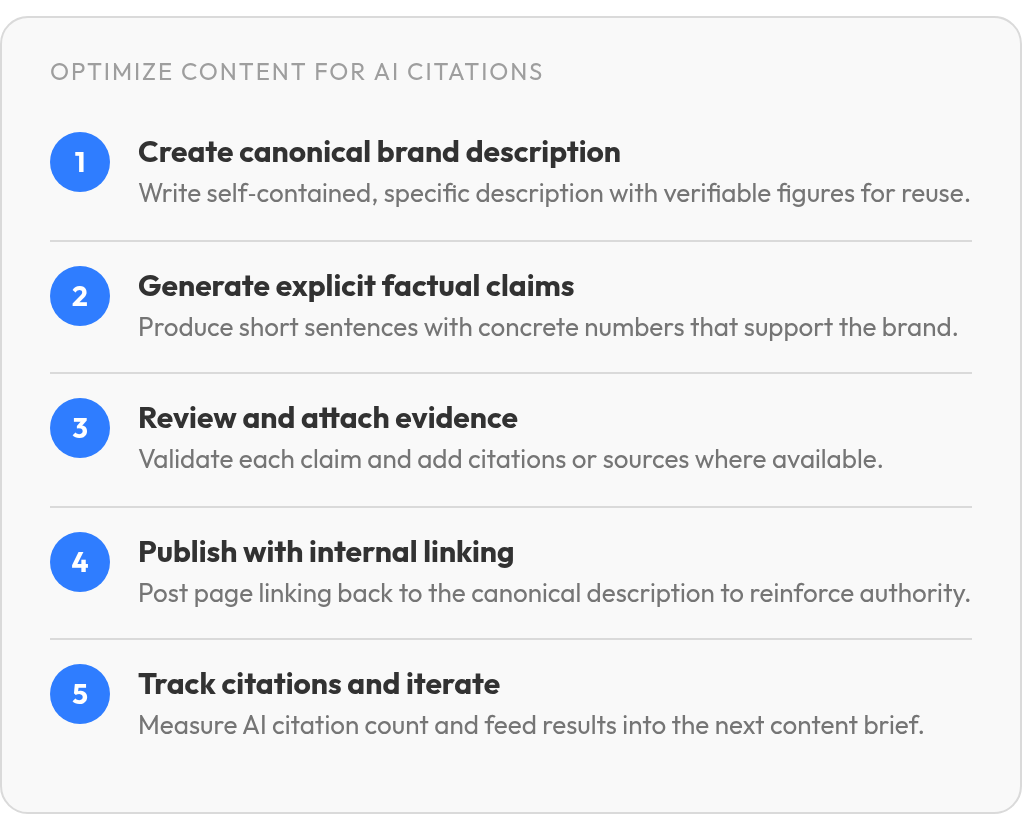
A practical workflow has five stages: before drafting, require each brief to list its claims, explicit figures where the facts support them, supporting evidence, and timestamps; write or refine the brand description; review each claim and attach citations where available; publish the page with internal links to the canonical brand page; and track whether the page appears in answer-engine outputs.
Citation count is the easiest signal to automate, but it's incomplete. A page can be cited without shaping what the answer says, and content can shape an answer without being linked. The better check is whether your brand description and specific claims appear in the answer text, not just whether the page earned a link.
Observational data from cited pages shows consistent structural patterns, but those patterns do not establish a retrieval floor. Write the description once, make it dense with verifiable facts, and repeat it across pages if that consistency serves your readers; test whether it improves citations rather than assuming it does.
Write claims that survive extraction
Most automated content creation asks the model to write about a subject, then ships the result. Building content around one tested brand description and a library of short, verifiable claims tends to work better when the goal is to get extracted and cited.
Self-contained sentences with explicit figures
We recommend self-contained claims with explicit figures. Pages that ChatGPT cites most often use sentences that average around 17 words, but that average is descriptive, not a target proven to cause citations. When you have a number, state it plainly. You can test whether a claim with an explicit figure earns more citations than a hedged version on your own pages; the research does not establish a universal winner.
Break compound claims into separate sentences. If a paragraph covers two ideas, split it. Each sentence should stand alone as a unit of evidence an answer engine can lift without surrounding context.
Test wording changes, not just topics
Most teams treat optimization as topic selection: write about the right thing and the page will perform. Testing how a claim is worded can matter just as much as whether it appears.
That creates a practical workflow: write the page around your brand description and a few core claims, then test variants of those claims with different phrasing. One version uses a percentage, another uses an absolute figure. One states a benefit, another states a mechanism. You're not rewriting the whole page—you're testing whether one factual phrasing outperforms another when both versions are accurate.
Treat the structural profile of cited pages as formatting context, not a checklist or a proven retrieval floor. Those patterns describe pages that were already retrieved and cited; they do not show that matching the medians will improve retrieval or citation.
Track whether it works, then test what matters
Most teams ship automated content creation once and move on. We measure whether it works, then test what we can improve without rewriting everything.
Define a working measurement set
Start with four metrics: organic sessions, click-through rate from search, publishing frequency, and AI citation count. Track organic sessions and CTR through Google Search Console or your analytics platform. Publishing frequency is the number of articles your system produces each week or month. AI citation count is how many times answer engines reference your pages when you spot-check queries in your category.
These are not industry standards. Research into competitive answer-engine optimization tested 18 content factors across 252,000 trials, but those trials measured which of two sources wins the first citation in a controlled setting, not whether your real pages rank or convert. We treat the four metrics above as a starting measurement set because they surface whether content reaches readers and whether answer engines pull it into responses. You can add conversion events or lead-attribution data when your stack supports it.
Check baselines before you change anything. Run the measurement set for two weeks so you know what normal looks like. Your current organic sessions and CTR anchor the next round. When you test a wording change and sessions improve, you have a reference point.
Test one factor, hold everything else constant
The GEO study constructed paired comparisons: two sources differing in exactly one of 18 factors while holding the rest constant. Brands were anonymized so pretraining familiarity would not bias results, source order was counterbalanced across trials, and the team manually reviewed a sample to confirm no unintended differences crept in.
You can apply that discipline without running 252,000 trials. Pick one variable—timestamp freshness, confident versus hedged phrasing, or whether you state an explicit price—and prepare two article variants that match everywhere else. Publish both to separate URLs, let them index for a few weeks, then compare their organic sessions and citation appearances. If your content system supports query paraphrases, test the same topic under three related searches so position bias averages out.
Formatting-only edits had little impact in the controlled tests, so changing heading styles or adding a bulleted list without touching the claims themselves tends not to move the citation needle. Topical relevance and list position ranked among the biggest drivers in those comparisons; list position should not be read as your page's slot in a live retrieval set. Including explicit price information and a recent timestamp also helped consistently. Completeness and trust cues added smaller gains. When you iterate, prioritize factors the research showed matter, test them one at a time, and skip changes that only redecorate the page.
Frequently Asked Questions
1. What happens if my automated content gets retrieved by ChatGPT but never actually cited?
Retrieval puts your page into the model's context window, but it does not guarantee citation. Test specific, self-contained claims with explicit figures against your current wording, then use your own citation results to refine the next brief.
2. Should I write different brand descriptions for different page types, or use one canonical version everywhere?
We recommend starting with one canonical description so your pages state the same verifiable facts. Treat reinforcement across retrieved pages as a hypothesis, and test it rather than presenting it as a proven citation benefit.
3. If newer model versions cite fewer sources, does that mean I should publish less content?
The premise is not supported by the evidence cited here, so don't use it to set publishing volume. Track whether pages earn citations and refine the next brief from that feedback instead of assuming more output guarantees visibility.
4. How long should I wait before I know whether a published page will earn citations?
Let the page index for two to three weeks, then spot-check queries in your category to see whether answer engines reference it. Track organic sessions and click-through rate during that window as baseline context. If the page hasn't appeared in citations after a month and organic traffic stays flat, test a variant with more explicit figures or confident phrasing.
5. Do I need to hit the exact structural profile—941 words, 28 internal links—for every page my system generates?
No. Those medians describe pages already retrieved and cited; they are not a proven retrieval floor or citation checklist. Use your own retrieval and citation measurements to decide which structural changes are worth testing.
