Automated Rank Tracking Software: 7 Advantages That Make SEO Automation Faster for Lean Teams

Quick Summary
Most teams track rankings. Fewer can move fast when one drops.
The real test isn't whether your rank tracker emails you a red-flag alert. It's whether that alert can trigger a content brief, route it to someone who can fix it, and push an updated draft toward staging without three Slack threads and a spreadsheet. That's where manual processes fall apart—not in the tracking itself, but in everything that happens after.
Daily rank monitoring is standard. What separates reporting dashboards from operational systems is what happens when position 3 becomes position 9. Some tools stop at the alert. Others can call an API, fire a webhook, or start an internal workflow that doesn't require someone to manually translate "keyword dropped" into "writer assigned, brief drafted, update scheduled."
The platforms that close this gap refresh rankings daily or on-demand, expose data through APIs other systems can consume, and support alert conditions beyond basic email alerts. Tracking frequency matters less than whether a position change can begin a content revision without manual handoffs.
Why This Actually Matters
Manual rank checking's cost isn't the two minutes you spend in a dashboard. It's the accumulated overhead of pulling data from three tools, reconciling conflicting numbers, deciding which movements warrant action, and routing that context to whoever writes the fix. For lean teams managing multiple sites, these steps can consume hours every week.
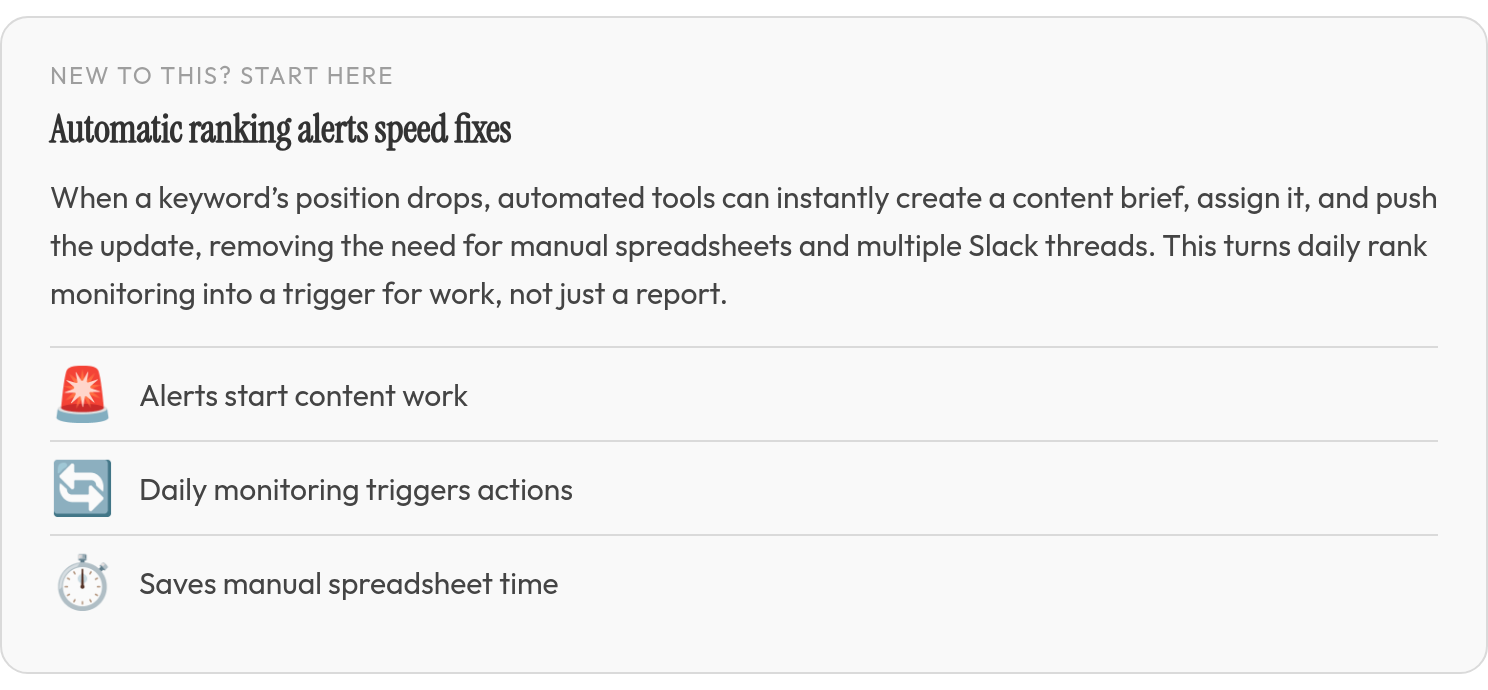
That workflow shift matters more than raw time savings. Manual tracking gives you periodic snapshots of what happened days or weeks ago. Automated tracking with daily refresh gives you a current view, so you can investigate changes while the SERP context and business conditions are still relevant. Automation doesn't write content, but it shortens the distance between identifying an opportunity and addressing it.
Fragmented dashboards also force people to reconstruct context every time they check in. A consistent automated signal gives the team a shared starting point, reducing the need to revalidate data sources before prioritizing work.
The 7 Advantages That Show Up in Your Calendar
Automation's value appears in recovered time, not just cleaner dashboards. When rank monitoring runs on schedule instead of whenever someone remembers to check, your team stops losing hours to position lookups and spreadsheet maintenance.
These are the recurring tasks automation handles:
1. Alerts That Start Workflows, Not Just Emails
Rank changes flagged by automated alerts can become content-audit tasks the same day. Configurable thresholds let you decide which movements need immediate attention and which can wait for a weekly digest, aligning notifications with your team's actual review capacity.
2. Dashboards That Stay Current
Auto-refreshing dashboards pull current rankings without CSV exports or manual table updates. Stakeholder reports that once required assembly work can refresh on schedule and reach inboxes with less production effort.
3. Rank Changes That Feed Content Briefs
When a keyword cluster shows sustained movement, that signal can feed a content-refresh workflow. Rank data identifies the opportunity; a writer evaluates whether the page needs updating and decides how to handle it.
4. Monitoring That Scales Past Human Limits
Automated tracking makes it practical to monitor broad keyword sets on a recurring basis. Manual checking hits a point where the time required to inspect every term outweighs the value of reviewing each one. Automation keeps coverage broad while letting people focus on exceptions.
5. Reporting That Shrinks Week Over Week
After initial setup, automated reporting reduces the recurring effort needed to produce SEO deliverables. Time previously spent gathering data and formatting comparisons can support analysis, planning, and stakeholder conversations instead.
6. On-Page Fixes That Surface Faster
Content optimization platforms can surface on-page improvements—missing meta descriptions, header tag gaps—without manual page-by-page audits. That reduces the effort involved in locating and implementing technical changes across multiple pages.
7. Gains That Compound Across Projects
Rank-tracking alerts can recover meaningful time for teams managing several sites. The gains add up across projects. Combined with audit reports and scheduled checks, those gains accumulate across the production cycle. Human review still needs to stay in place for content quality, accuracy, and strategic calls.
What a Hybrid Workflow Actually Looks Like
Many lean teams skip mapping which stages need a human and which do not. When a ranking change appears, automated tracking flags it immediately. The question is whether someone manually gathers SERP data, writes a brief, assigns it, and tracks completion—or whether those steps begin automatically while a writer reviews and approves the work before it ships.
The Mechanics of a Triggered Workflow
A hybrid workflow turns daily monitoring into a chain of triggered actions. A meaningful drop—position 3 becomes position 9—sends a signal to a content-brief tool, which analyzes current SERPs and prepares an outline. A writer reviews the brief, edits the AI-generated draft, and moves it to staging. Publication stays behind an approval gate, so automation speeds production without removing editorial accountability.
The workflow divides responsibilities. Keyword discovery, SERP analysis, and draft generation can run with minimal manual input. Briefs surface for review, writers adjust the material for accuracy and voice, and an approver checks the final version before it goes live. Each automated step removes a repetitive task; each human checkpoint protects quality.
The stack matters less than the handoff points between tools. Some teams route alerts into project-management tools. Others deliver briefs directly to writers through integrated dashboards. The shared pattern: triggered actions replace routine scheduled tasks, while people step in for judgment calls.
How Much Can a Small Team Actually Ship?
Output increases when automation handles repeatable mechanics such as keyword discovery, SERP analysis, draft generation, and publishing steps. The constraint then shifts from production capacity to editorial review, making review standards and approval queues more important than raw drafting speed.
Which Setup Makes Sense for Your Team
The key decision is reaching the volume threshold where automation pays for itself. Teams publishing at scale can offset the labor involved in manual reporting and analysis, but the investment makes less sense when there isn't enough recurring work to automate. The software should address a real production bottleneck, not add another dashboard to maintain.
The strongest use case treats rank tracking as an event source. A meaningful ranking change calls an API, starts an analysis, and prepares a content update for human approval. Monitoring becomes connected to action instead of remaining an isolated reporting function.
Budget Reality Check
SEO analysts can spend hours each week on reporting across multiple clients. When automation removes that overhead, the investment becomes easier to justify as project count grows.
Where to Start This Week
Begin with a focused keyword group across desktop and mobile rather than automating every tracked term at once. Connect alerts to Slack or email for meaningful drops, then separate urgent notifications from items better suited to a weekly digest.
Build one test workflow: ranking change detected → SERP analysis drafted → human approves recommendation → content update published. Measure the time saved on that loop before expanding to the full keyword set. The biggest gains typically come from automating the handoffs around the work, not from eliminating editorial judgment.
Quick Questions, Straight Answers
1. When does automated rank tracking actually pay for itself compared to manual checking?
Automation becomes easier to justify when manual reporting across several sites takes enough recurring staff time to approach the software cost. The relevant comparison is not the number of keywords alone; it is the hours spent collecting, reconciling, and formatting ranking information that could otherwise support strategy or production.
2. How do you tell if a rank drop comes from an algorithm update versus outdated content?
Check whether the movement coincides with a confirmed algorithm update and examine what changed among competing pages. SERP analysis can show whether competitors introduced stronger or fresher material, or whether your page appears to have aged without a broader search-result disruption. Those findings point toward different responses.
3. What threshold setting prevents alert fatigue when monitoring hundreds of keywords?
Reserve immediate alerts for priority terms and meaningful movements. Smaller changes can go into a scheduled digest, while high-value pages or strategically important queries receive faster attention. The right threshold depends on how many alerts the team can genuinely review, not on the maximum number the platform can generate.
4. Can you automate too much of the content workflow and sacrifice quality?
Yes, if publication happens without an editorial checkpoint. Automation is most useful for repeatable mechanics such as keyword discovery, SERP analysis, and initial drafting. Writers still need to review the brief and edit for accuracy, relevance, and voice, while an approval step protects the quality of the published work.