Before You Repurpose to LinkedIn, X, Instagram, TikTok, YouTube: Voice-Drift and Native-Fit Checklist
In short: The same asset cross-posted to five channels underperforms on all five — repurposing means repackaging ideas, not reposting identical files. Many creators struggle to maintain consistent output across platforms, which tracks: per-channel adaptation takes real work. One Instagram account scaled from 100k to 520k followers in a year by concentrating on saves and shares over posting frequency. On Instagram, the metric to watch is saves and shares, not likes. Watch time and click-through rate tell you more about YouTube performance than raw view count alone. Platform-specific repurposing correlates with measurable gains across follower growth, impressions, brand-search volume, and referral traffic — copy-paste cross-posting doesn't.
Why Most Repurposing Falls Flat
The failure point isn't writing the content. For most teams, it sits at distribution: every platform runs on different user behaviors, different ranking signals, and a different definition of what a good post looks like. Publishing the same asset everywhere quietly undermines the work. Repurposing means reshaping the same idea until it feels native to the channel where it lands.
The table below maps each channel to its native-fit risk, the adaptation it needs, a rough effort rating, and the metric worth tracking.
| Channel | Voice-Drift / Native-Fit Risk | Core Adaptation | Effort | Metric to Watch |
|---|---|---|---|---|
| Posts without a first-line hook lose reach; casual tone undercuts authority | Hook in line 1; skimmable structure; storytelling arc | Medium | Impressions, comments, saves | |
| X | LinkedIn-length text reads as a wall; threads need deliberate structure | Punchy one-liner or 3–5 post thread; strip narrative | Low | Reshares, link clicks |
| Text-heavy images and generic captions suppress saves; Reels need native pacing | Carousel design; Reel with platform-native hook; short caption | High | Saves, shares (not likes) | |
| TikTok | Repurposed clips without a hook-first structure lose retention in seconds | Hook-led script in first 3 seconds; short-form native edit | High | Watch time, shares |
| YouTube | Weak thumbnails and a slow open kill click-through before depth matters | First-10-second hook; thumbnail built for search; full-length structure | High | Watch time, CTR |
That adaptation burden explains why teams stall after the original article, webinar, or podcast goes live. A LinkedIn rewrite may only need sharper framing and cleaner structure. A TikTok version may need a new opening line, a tighter script, captions, edits, and a retention-focused cut. When that work isn't planned upfront, teams either publish inconsistently or fall back on one-size-fits-all distribution.
The upside is that native-fit work gives you more ways to win. A carousel may prove an idea is save-worthy. A thread may reveal which claim people repeat. A LinkedIn post may earn qualified discussion. A YouTube video may show whether the topic can hold attention past the opening.
LinkedIn and X: Two Platforms, Two Social Contracts
The professional tone that earns credibility on LinkedIn can read as dry corporate copy on X. These platforms don't just attract different audiences — they run on different social contracts. And LinkedIn has a longer shelf life than most teams account for, so the opening framing matters beyond the first feed impression.
What Makes a LinkedIn Post Actually Work
LinkedIn rewards depth, but depth without readable formatting loses people before the algorithm can help you.
- Hook before the fold: most readers decide in the first line whether to keep reading. Your opening sentence must stand alone and invite more reading.
- Short paragraphs, not blocks: readable chunks keep readers moving. Dense walls of text signal "skip this" before anyone processes the content.
- Front-load your topic term: opening with your subject matter helps the post stay coherent outside the immediate feed context.
- Keep hashtags focused: treat them as topic tags that extend shelf life. A handful of relevant tags usually outperforms a spray of generic ones.
- Choose native formats: carousels, documents, and native video tend to earn more reach than posts pointing readers off-platform.
- Tone should be expert and warm: define jargon as you use it. Aim for the authority of experience, not the register of a whitepaper.
Why X Threads Punish Overthinking
X rewards speed and specificity. Polish, in most cases, is a liability.
- Lead with the claim: open with the provocative point or the number before you earn any context.
- Keep hashtags intentional: use them only when the topic draws active searches, and err on the side of fewer. Too many read as noise rather than signal.
- Write every post as standalone: readers drop into threads mid-scroll. Each post should deliver value without requiring the ones before it.
- Keep the first post clean: lead with the claim, and if you need a link, place it later in the thread once context is earned.
- Rewrite tone, don't resize text: LinkedIn's storytelling register is too slow for X. Native-fit repurposing means a full rewrite, not a trim.
Instagram, TikTok, and YouTube: Not One Visual Bucket
The trap we see most often: teams treat Instagram, TikTok, and YouTube as a single visual category, then wonder why the same clip flops on two of the three. These platforms share visual formats, but the viewing intent is not interchangeable. Instagram often rewards usefulness people return to or send to someone else. TikTok punishes delay almost immediately. YouTube requires packaging and pacing strong enough to earn the click and keep the viewer.
Your creative brief has to change before editing starts. A blog introduction may become a carousel promise on Instagram, a direct pattern interrupt on TikTok, and a search-led title-and-thumbnail package on YouTube. The source idea stays consistent. The entry point changes.
Reshaping Blog Content for Instagram Carousels
Carousels can convert long-form content well, but the structure has to match the platform.
- Keep slides to 6–10. The first slide is your hook, and the last is your CTA. Every slide between must carry one idea.
- Write short, punchy captions. Most readers won't expand collapsed text, so your opening line has to earn the save.
- Design for saves, not likes. Utility content like checklists, comparisons, and step-by-step breakdowns gives readers a reason to come back later.
- Let text anchor each slide. Imagery supports the message; it doesn't replace it.
We handle the layout translation from long-form copy, so your team isn't rebuilding slides from scratch.
What TikTok and YouTube Actually Need
Volume helps on some channels, but short-form and long-form video need more than output. The edit has to earn attention before the viewer decides to leave.
- Hook in the first few seconds on TikTok. The opening should make the viewer understand the payoff immediately.
- Keep on-screen text short and high-contrast. Treat it as scannable, not readable.
- Restructure your blog intro for YouTube's opening segment. Front-load the promise; bury it, and viewers leave before the argument develops.
- Treat the thumbnail as the headline. High contrast and one readable phrase tend to outperform clever design.
We keep the gap between published article and YouTube-ready script small enough for one person to manage.
The Repurposing Workflow That Actually Closes the Loop
The step most teams skip sits between "content exists" and "content is live across five channels." A solid repurposing strategy doesn't just decide what to adapt — it sequences how that work gets done.
Start with a single SEO-optimized article or webinar transcript as your source asset. Before splitting it into channel formats, run a quick persona check on each platform.
LinkedIn professionals want depth and credibility. TikTok audiences want a fast, specific hook. Those audiences aren't identical, and your opening line shouldn't be either.
The Five-Step Repurposing Checklist
Work through these in order. Skipping the persona audit early creates drift that compounds fast.
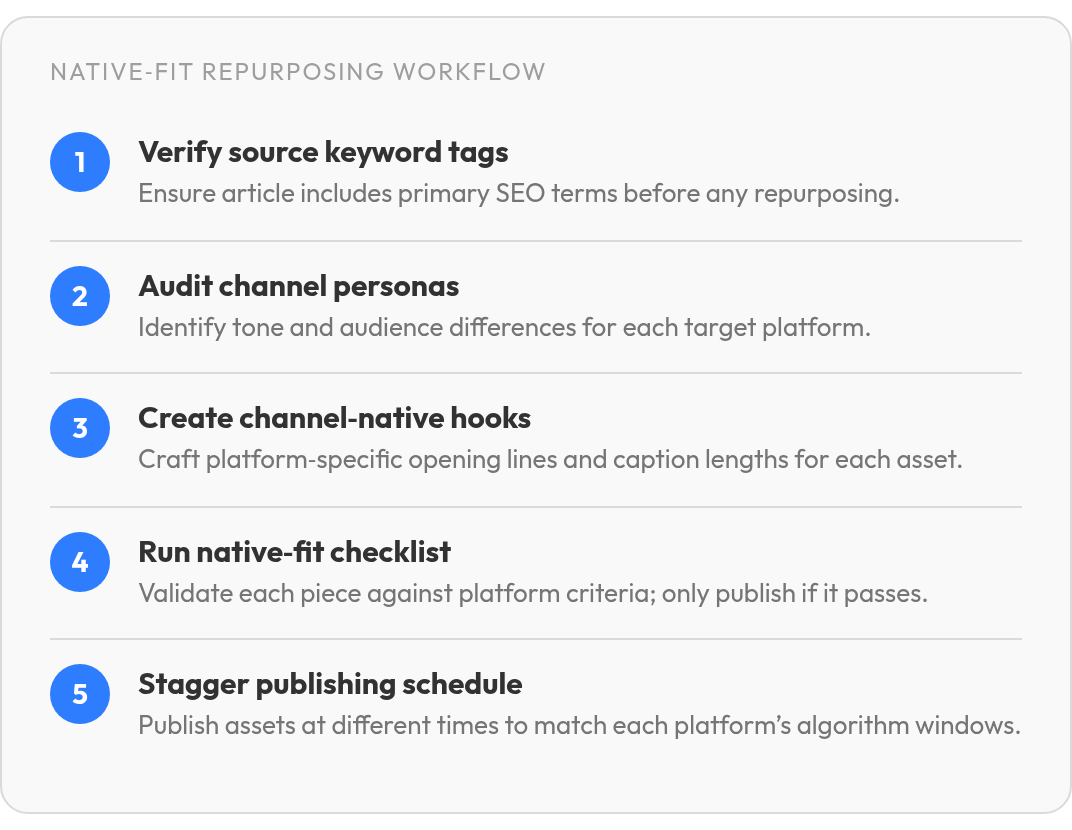
- Confirm the source asset carries keyword tags that match your primary search term before repurposing begins. Search discoverability starts with the original, not the derivative.
- Audit the persona for each target channel. Note the tone gap between your most formal and least formal platform.
- Generate each channel asset with a channel-native hook and the right caption length. A LinkedIn hook and a TikTok hook serve different readers, so don't treat them as swappable.
- Run each asset through the native-fit checklist for that platform before scheduling. If it hasn't passed, it doesn't go live.
- Stagger publishing times. Give each platform its own publishing window rather than posting everything on the same day.
Pick Two or Three Metrics Per Channel and Stay There
Choose a small metric set for each channel and act on those signals rather than tracking everything. For some posts that may mean conversions; for others it may mean retention, saves, shares, comments, or referral behavior. The point is to decide the metrics before the post goes live, so you're not retrofitting success after the fact.
A low-reach post can still be valuable if the people who see it save it, discuss it, or click through with intent. A high-reach post can be less useful if it produces no durable behavior after the initial spike. That distinction matters most when teams are trying to separate algorithm moments from content that actually delivers lasting value.
Watch off-platform data too. Search referrals to your source article confirm the full-funnel workflow is delivering. When repurposed social content pulls readers back to the original, you've closed the loop.
For a step-by-step breakdown with channel examples, see our guide on turning one article into five posts.
Still Wondering?
1. If posting frequency doesn't drive results on TikTok or YouTube, should I reduce how often I publish there?
Not automatically. A lighter cadence can help if it gives your team time to improve the opening, edit, packaging, and story arc. But the real decision is quality control. Publish when the asset is shaped for the platform, not simply because the calendar says another post is due.
2. My audience overlaps across LinkedIn and X. Can I trim the same post for both, or do I need a full rewrite?
You need more than a trim. LinkedIn gives you room to build credibility through context, examples, and a clearer expert point of view. X moves faster, so the claim has to arrive sooner and each post in a thread should carry value on its own. The audience may overlap, but their mindset changes by platform.
3. Likes are the most visible Instagram metric. Why should saves and shares matter more to my strategy?
Likes are easy to see, but they are often a shallow signal. A save means the post was useful enough to revisit. A share means it was relevant enough to pass along. For repurposed content, that usually points you toward practical formats: checklists, comparisons, frameworks, and concise step-by-step explanations.
4. What should I do if a repurposed asset fails the native-fit checklist right before it's scheduled to publish?
Hold it. A half-fit post can dilute the value of the original idea and teach the wrong lesson about what your audience wants. Fix the specific gap, whether that's the hook, format, caption, thumbnail, or CTA, then move it into a later publishing window.