Does Your AI Blog Post Generator Sound Like You? 4 Checks Before Scaling
Key Takeaways
- Voice-matching setup gets skipped, and teams burn editor hours fixing the same tonal problems in every AI draft.
- AI text defaults to neutral, grammatically clean output that sits visibly wrong next to content your team wrote last quarter.
- Voice drift shows up as minor wording quirks or brand-damaging mismatches — formal corporate language in casual DTC content, or the reverse.
- AI generators produce polished drafts containing invented statistics, nonexistent studies, and confident claims with no source behind them.
Why Voice Matching Matters
Brand voice is the consistent personality you present across channels. It shapes word choice, directness, context level, and whether your writing feels authoritative, conversational, playful, or restrained.
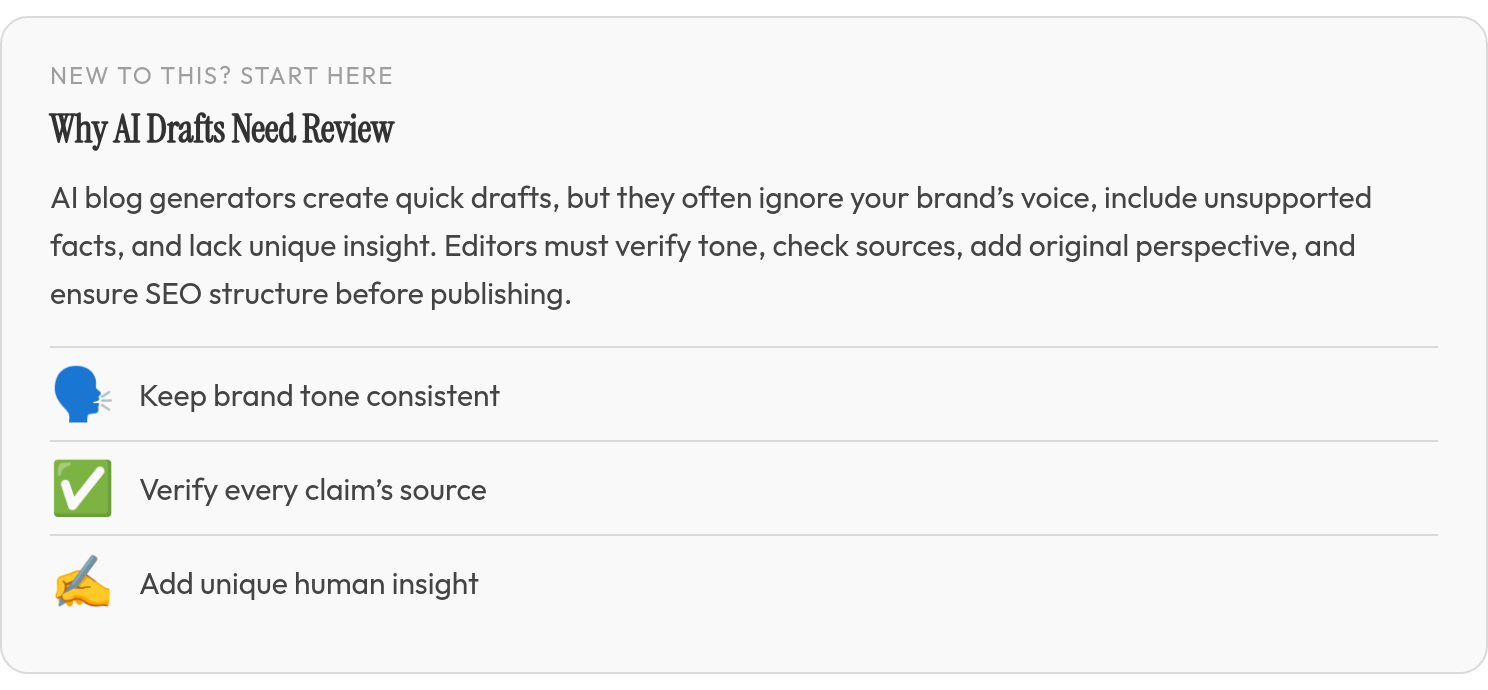
An AI draft may cover the topic without preserving that personality. If the language could appear on any competitor's site, the tool generated usable subject matter — not publish-ready brand content.
What Generic AI Output Actually Costs You
An AI blog post generator can produce a draft quickly, but generation speed is one part of the workflow. A better measure is time from brief to approved article, including review, source checks, structural edits, and final formatting.
Generic copy weakens differentiation: a technically competent post that could appear on any competitor's site fills a publishing slot without strengthening your market position.
That creates an opportunity cost: editors spend attention making basic copy distinctive instead of sharpening the argument or improving examples. Assess the full production process, not just a fast first draft.
How Voice Drift Shows Up in Practice
Review voice at several levels. Start with word choice: does the draft use terms your team avoids, overexplain familiar concepts, or introduce jargon without context? Then inspect rhythm. Sentence variety, paragraph length, contractions, punctuation, and transitions all contribute to how a brand sounds.
Perspective matters too: a company that normally speaks from direct experience may feel distant in an abstract third-person draft, and a practical brand can sound evasive when every recommendation is over-qualified.
Research on AI-disclosed brand communication suggests readers can accept machine-assisted text when it remains consistent with what they expect from the brand. Disclosure and authorship are separate questions from whether the finished article feels recognizable.
Check 1: Voice Consistency & Tone Alignment
Don't ask whether a draft is "good" or "professional." Those labels are too broad to guide an editor or improve the next prompt. Ask whether it follows the identifiable language patterns that distinguish your published work.
A useful voice review produces concrete instructions. "Make it warmer" leaves room for interpretation; "use contractions, address the reader directly, remove ceremonial transitions, and lead with the recommendation" gives the generator and editor something observable to follow.
Locate your existing voice markers before you brief
Pull three to five pieces your team published recently that represent your brand at its best. Choose work that reflects the voice you want now, not an old post that ranks well but no longer matches your editorial standards.
Read the samples for recurring decisions. Note how often you use humor or sarcasm. Determine whether sentences tend to run long with dependent clauses or stay short and punchy. Check whether you default to second person or first-person plural. Track how technical the vocabulary becomes and whether jargon is explained inline or left for an experienced audience.
Record formatting habits as well. Your brand may favor direct subheads, brief introductions, bulleted procedures, or conclusions that end with a firm recommendation. These structural choices are part of the voice because they influence how readers experience the argument.
Once the baseline is documented, audit the next draft against it. Compare the level of formality: does the copy say "one might consider" where your team would say "try this"? Look at cadence. If your published work alternates compact statements with longer explanations but the draft uses uniformly shaped sentences, flag the pattern. Check for vague verbs, excessive qualifiers, and transitions that sound imported from a generic business memo.
Use the findings to update the brief rather than correcting the same tendencies silently. Editorial feedback becomes more valuable when it improves future inputs.
- Score the draft against your voice markers, then log recurring corrections for the next brief.
Check 2: Fact-Checking & Source Verification
Polished prose can make an unsupported statement appear settled. Treat fluency and accuracy as separate dimensions: one concerns presentation, the other depends on evidence.
Assign verification responsibility before publication; otherwise questionable material survives every handoff. A clear owner and a visible review trail make the process safer.
Inventory every factual claim before you publish
Pull up the draft and highlight anything presented as verifiable information: percentages, research findings, product capabilities, expert quotations, historical events, and technical specifications. Opinions and recommendations may require justification, but objective statements should lead to evidence a reviewer can inspect.
Open each cited source rather than accepting the presence of a hyperlink. Confirm the page exists, identify its publisher and date, and read enough of the original material to understand its scope. Then compare the source's wording with the draft. A citation can be genuine while the sentence attached to it exaggerates, removes an important condition, or mistakes correlation for causation.
Check whether the evidence applies to the audience and context of the article. A narrow survey should not be treated as universal consensus, and a result from one industry may not transfer cleanly to another. Distinguish primary evidence from pages that merely repeat another publication's claim.
Keep notes during this review. Recording the source, relevant passage, publication date, and any qualification gives future editors a compact audit trail. It also makes updates easier when a post needs to be refreshed.
The three categories that need citation every time
The categories needing citation are statistics, quotations, research findings, and product or technical statements. Verify not only the figure or quote but what was measured, who was included, and the surrounding context. For product and technical statements, review current official documentation for feature availability, integrations, plan restrictions, API behavior, and version-specific instructions.

- Keep a claim inventory and verify cited URLs, quotations, product behavior, and dates before approval.
If credible support can't be located after a reasonable search, remove or recast the statement. You can present a clearly labeled opinion as an opinion; you shouldn't preserve an assertion merely because it makes the article sound authoritative.
Check 3: Human Insight & Originality
Once accuracy and voice are under control, ask whether the article contributes anything a reader couldn't get from a generic summary. AI is effective at organizing common knowledge, but organization alone rarely demonstrates experience, judgment, or a distinct point of view.
Human review should add substance, not just smooth sentences. The editor's role is to identify where the draft needs a decision, a boundary, an example, or a consequence that matters to the intended reader.
Identify what only you can add
Highlight passages that could appear unchanged on another company's site. For each one, decide what your organization knows that the paragraph doesn't yet express. The missing element often falls into one of five categories: a judgment based on experience, a constraint the reader should understand, a local or industry-specific example, proprietary data or an internal workflow detail, or an actionable next step connected to your product.
Don't add anecdotes merely for color. A useful example should clarify a decision: what the team tried, which constraint changed the approach, what failed, or why one option was chosen over another.
Reserve brief space for target reader, central argument, required evidence, exclusions, format, and the person responsible for supplying firsthand material. That prevents original insight from becoming an afterthought.
Also specify where the article must take a position; if the draft only lists possibilities, ask the subject-matter expert to rank them, explain the tradeoff, or state the conditions under which the usual advice doesn't apply.
Build a reusable add-on checklist
- Add at least one firsthand judgment, constraint, example, or next action before approval.
After publication, use engagement signals—time on page, scroll depth, conversion—to identify pages that may lack depth, then revise the weakest component against search intent. Metrics guide an editorial question; they aren't a general score for writing quality.
Check 4: SEO Readability & Structured Formatting
A strong article still needs a page structure that helps readers and search engines interpret it. SEO editing isn't a final exercise in inserting keywords. It involves aligning the title, headings, metadata, links, and body copy around a clear search intent.
Complete this review after the argument is stable. Optimizing a draft too early can preserve sections that should have been reorganized or removed.
Run through the on-page basics first
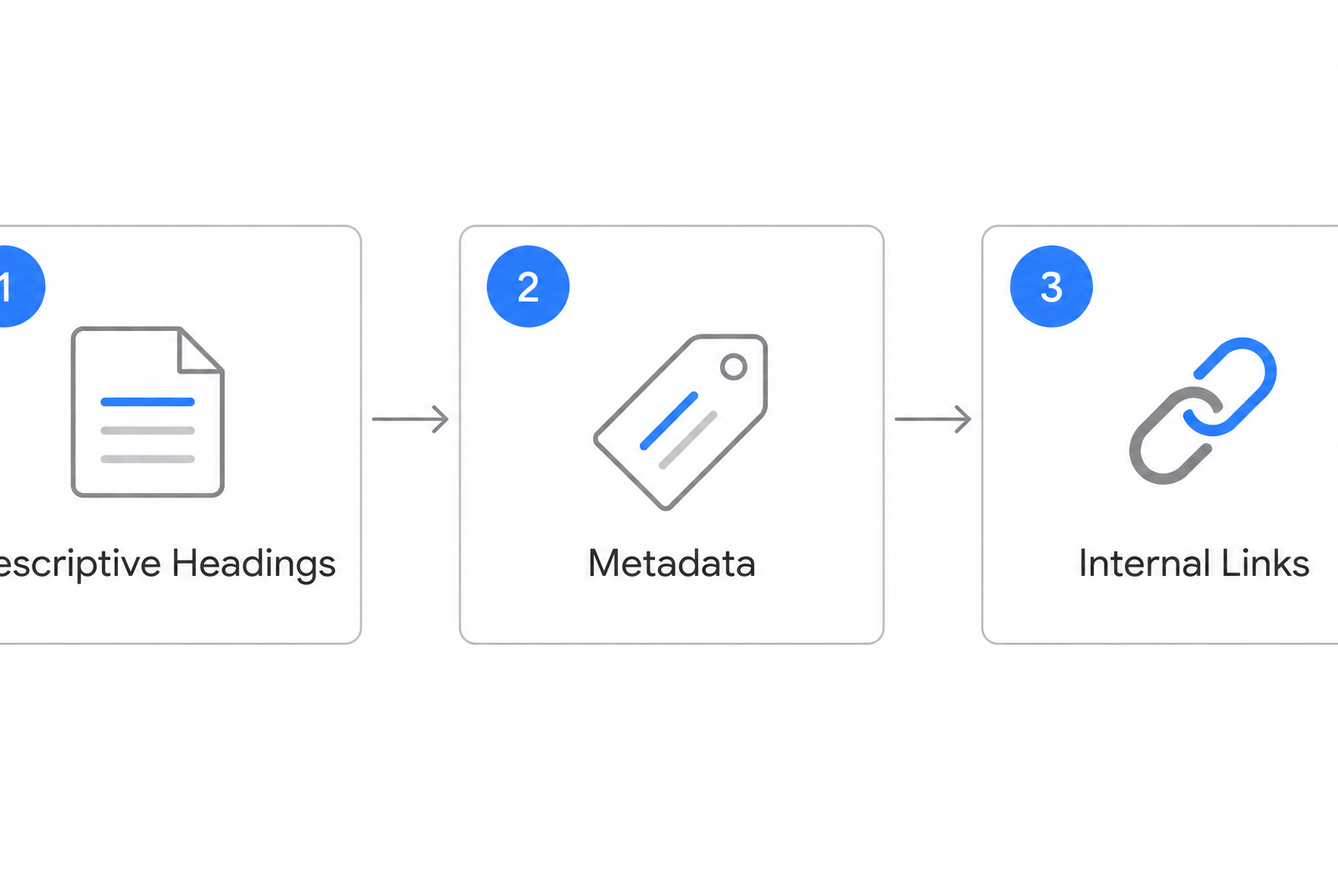
Scan the heading hierarchy. Every H2 and H3 should tell readers what the following section covers. "The Problem With Generic Content" is ambiguous; "Why AI-Generated Drafts Miss Brand Voice" identifies the subject and the question being answered. Clear headings also make the page easier to skim on a small screen.
Review the title tag next. It should reflect the primary topic and remain concise enough to communicate its value quickly in search results. Avoid stacking near-synonyms or adding promises the article doesn't fulfill.
Write the meta description as a useful preview rather than dramatic promotional copy. State what the reader will learn, include relevant context, and match the page's actual scope. Although the displayed snippet may vary, a precise description gives searchers a better basis for choosing the result.
Inspect internal links for both relevance and anchor text. Link to pages that deepen the current topic or help the reader take the next logical step. Anchors such as "click here" provide little context; descriptive wording tells people what awaits them and clarifies the relationship between pages.
Check the visual shape of the article. Break up dense passages where the argument allows, but don't turn every sentence into its own paragraph. Lists work best for genuinely parallel items, while nuanced explanations usually need prose.
Check readability with a formula you can measure
Readability tools identify sentence length, word complexity, and passive constructions, but scores are diagnostic, not absolute targets. Specialized audiences may require technical terms, and a long sentence can be perfectly clear.
Use results to find clusters: several sprawling sentences in succession may slow the reader, while repeated passive phrasing obscures who is responsible. Revise those areas, then read aloud. The goal isn't to maximize a score; it's to remove friction without flattening the brand's cadence.
Also examine referents and transitions: pronouns such as "this" or "it" confuse when the previous paragraph contains several possible subjects. A transition should show a real relationship—contrast, consequence, sequence, or qualification—not merely announce another paragraph.
- Check headings, title, meta description, internal links, paragraph density, and transitions in one pass.
Track a pilot batch before you scale
Before increasing production, test whether the entire workflow remains dependable across a batch of articles. Publication alone isn't evidence that the system works. You need records showing where editorial effort went, which problems recur, and whether the resulting pages support business goals.
Pull open a spreadsheet. Create one row per post and add columns for topic, publication date, voice score, factual corrections, human additions, readability issues, editing time, and the performance metrics your analytics system already tracks. This is a decision log, not a research dataset.
What belongs in your pilot tracking sheet
Classify each draft as acceptable, requiring minor edits, or needing substantial rewriting, and record the reason so the label can inform prompt changes.
Separate missing citations from inaccurate interpretations and outdated product details, then note the human material added during review—proprietary examples, client stories, operational constraints, or a stronger recommendation.
Log editing time from handoff to approval, divided among voice cleanup, verification, subject-matter input, and structural work. Total time tells you whether the process is efficient; the breakdown shows where to intervene.
Add the performance data your system already captures—organic sessions, average time on page, scroll depth, and attributed conversions—and compare outcomes with production effort so a low-cost article isn't automatically treated as successful.
Use a five-gate go/no-go score:
| Gate | Go threshold |
|---|---|
| Voice | Acceptable or minor-edit score; no substantial rewrites |
| Factual accuracy | Zero unresolved factual errors |
| Original value | At least one firsthand judgment, constraint, internal workflow detail, or specific recommendation |
| Editing time | Total and breakdown at or below your current baseline without quality loss |
| Performance | Organic sessions, time on page, scroll depth, or attributed conversions at or above the URL's baseline |
If a post misses a gate, revise the brief and run another controlled batch. Scale only when the process clears these gates consistently within the resources you can sustain. Increase volume gradually, keep the review checkpoints in place, and watch for deterioration as more writers, editors, or subject-matter experts enter the workflow.
FAQ
1. Can I train an AI blog post generator on my own published content to match my voice automatically?
You can use published content as reference material, but choose samples deliberately. Exclude outdated work, posts written by outside contributors, and articles whose performance came from search demand rather than strong brand expression.
Turn the patterns you find into explicit instructions and examples. Reference material gives the model context; a documented style guide makes the desired behavior easier to evaluate and reproduce. Continue reviewing outputs because source samples cannot anticipate every topic, audience, or format.
2. How long should I expect fact-checking to take for a typical AI-generated draft?
There is no reliable universal duration. The workload depends on claim density, subject complexity, source quality, and whether the article covers fast-changing products or regulations.
Estimate effort during the claim inventory: separate straightforward statements with primary sources from claims that require interpretation or specialist review. Track verification time by article type during your pilot, then use your own median as the planning benchmark. Drafts with weak sourcing should receive more time or be returned before line editing begins.
3. What's the difference between minor voice drift and the kind that damages my brand?
Judge the difference by impact and scope. Minor drift is localized: an odd transition, an unfamiliar word choice, or a sentence rhythm that can be corrected without changing the article’s position.
Serious drift affects how the organization presents itself. It may introduce promises the company would not make, use humor in a sensitive context, address the wrong level of expertise, or express certainty where the brand would normally acknowledge risk. Those issues require substantive review because they can change how readers interpret the organization, not merely how polished the prose feels.
