5 AI SEO Content Generators for Scale, Drafts, Refresh, Links, Local Pages: Tradeoffs Included

TL;DR
- Many AI SEO tools charge by credits or usage volume rather than seats, making bulk content exponentially more expensive without guaranteeing strategic quality.
- AI search engines systematically favor earned media and third-party citations over brand-owned content, creating a strategic gap most tools ignore.
- Teams consolidating thin pages into fewer differentiated guides often see better engagement and conversions despite publishing less total content.
- Real workflow integration requires cross-referencing Google Search Console impressions against competitor content structures, not just keyword-to-outline generation.
- Jasper users sometimes report tone drift, even with strict brand training, requiring manual revisions.
Quick Summary
Picking an AI SEO content generator means matching the tool to the workflow: Jasper for scale-first drafting, Writesonic for research handoffs, Surfer SEO for refresh and on-page structure, Semrush One for AI-search visibility, and AnyPost.ai for local-page automation. The research doesn't establish any single tool as uniquely superior across all five, and none of them replaces link-building or final editorial judgment.
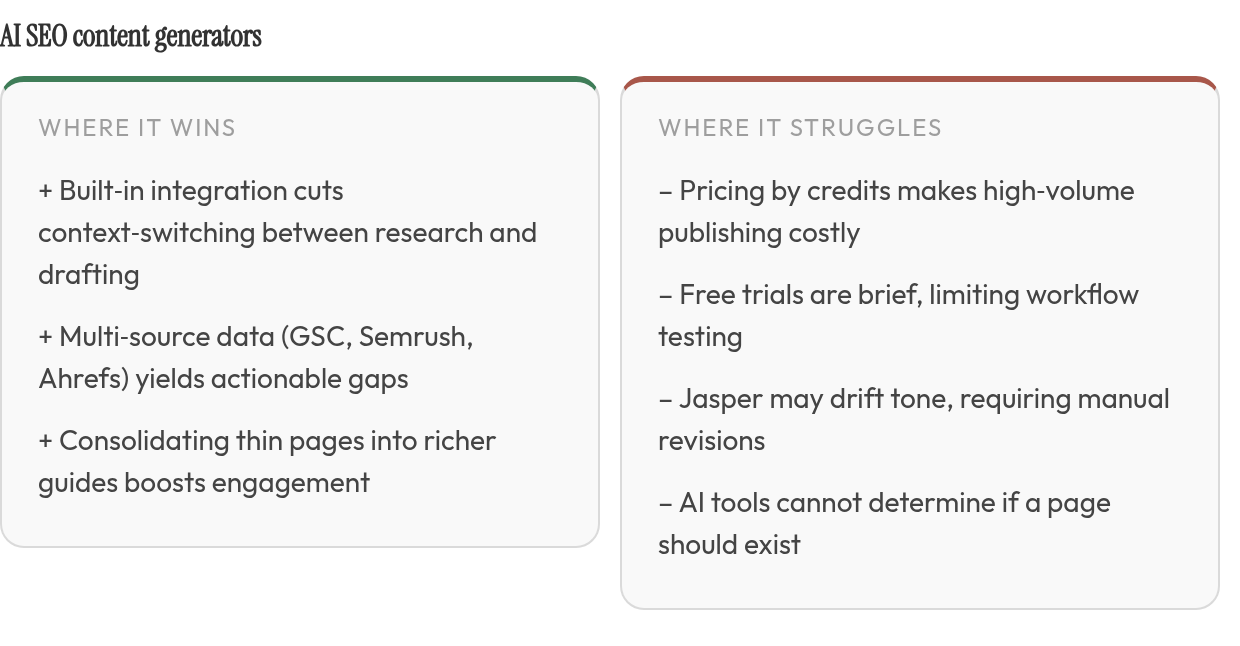
Many tools charge by credits, usage volume, or monthly allowances, not seats. That makes a larger publishing program more expensive without guaranteeing that the resulting pages have a distinct purpose. A brief, a review process, and a clear content map still matter more than the number of drafts a platform can produce.
Free trials are common, but real workflow integration takes longer than most trial windows allow. Writesonic is the clearest example here: it pulls data from Google Search Console, Semrush, Ahrefs, and Keywords Everywhere to surface structural gaps and competitive opportunities. Generic keyword-to-outline spinners get rejected quickly; tools that cross-reference your actual GSC impressions against competitor content structures deliver actionable direction.
A critical blind spot: AI search engines systematically favor earned media (third-party citations) over brand-owned content, yet most tools still optimize owned pages in isolation. As AI search continues to grow, this strategic gap will likely widen. Practitioners are adapting faster than the tools themselves.
Why Operational Friction Is the Real Bottleneck
Speed alone isn't why teams reach for an AI SEO content generator. The real bottleneck isn't writing—it's the handoffs. You research keywords, hop to a brief tool, draft in another tab, optimize in a third, link-build manually, then publish. Each step swallows whole afternoons and drops context. That friction is what keeps content generation one of the most time-consuming parts of the marketing workflow.
But the operational pain runs deeper. Most teams publish content that ranks nowhere because it missed the actual job the page needed to do. When you consolidate thin pages into fewer, richer guides, engagement and conversions often improve despite fewer total pages—volume without differentiation creates liability, not advantage.
An integrated AI SEO workflow changes the equation by supporting each stage where judgment matters least and human input matters most. The catch is that automation cannot decide whether a page deserves to exist. It can help execute a sound plan, but it cannot substitute for one.
Teams using AI for relevance-focused work tend to see stronger organic performance than those chasing word counts. Relevance and differentiation beat publishing volume.
Your success depends on choosing tools that support this workflow, not just faster drafting. Built-in integration matters because it reduces re-entry work between research, briefs, drafts, and optimization. A shared workspace also makes it easier for reviewers to see what data informed a recommendation and whether the final draft followed it.
The real win is publishing smarter, faster, and with fewer editorial cycles.
Jasper: Scale-First Drafting
Jasper positions itself as a scale-first drafting engine, designed for teams that need consistent brand voice across dozens of writers and channels. The platform aims to help teams save time on content production. But the research doesn't verify its throughput claims, bulk-publishing integrations, or whether those time savings hold for complex SEO workflows versus templated copy.
What Jasper actually does
Jasper stores your brand guidelines, tone rules, and key facts in a Company Knowledge hub, then applies them across multi-channel campaigns. You feed it a brief—keyword, angle, target audience—and it generates variations. The research doesn't verify how smoothly those drafts move into your CMS or optimization tools.
The collaboration features matter here. Strict approval workflows let you lock down voice consistency across remote teams before anything publishes. For agencies managing five writers across ten clients, that's genuinely useful—one senior copywriter's tone becomes replicable, not diluted.
The evidence gap
Here's where the sources stop being clear. We don't see published case studies measuring traffic lift from Jasper-generated content, nor do we see independent verification of its bulk-publishing speed or whether Enterprise plans truly enable the throughput teams expect. Some users report that Jasper can drift in tone, even with strict training, requiring manual revision that can reduce the practical benefit of automation.
Jasper's pricing structure may fit small teams better than high-volume automation, but the research doesn't confirm the exact cost model or whether it stays cost-effective at scale.
Skip Jasper if you're looking for one-shot efficiency for experimental bulk publishing. It's built for teams that already have writers and want to enforce consistency at scale, not replace the writing step itself.
Writesonic: Reducing Workflow Friction
Writesonic addresses a common workflow friction: bouncing between keyword research tools, SEO platforms, and your CMS, losing context at each handoff. The platform attempts to collapse that friction by combining drafting with multi-source SEO research into one interface.
What actually happens when you use it
Chatsonic (Writesonic's SEO-focused component) can connect to external SEO data sources like Google Search Console, Semrush, Ahrefs, and Keywords Everywhere. Instead of pulling data from each tool separately, the platform surfaces keyword gaps and structural opportunities directly in the drafting interface. An SEO manager reviewing a mid-ranking page can receive specific, actionable recommendations for improvement rather than generic optimization checklist items.
The strength is in the integration: the tool reads your actual ranking data and your competitors' structures, then flags concrete problems. The catch is execution. Post-draft, your team still needs to review the output and decide which suggestions fit your voice and strategy. The tool doesn't eliminate editing—it redirects the work upstream into research, which trades time against quality.
When it makes sense
Writesonic is best suited to routine editorial programs where the research layer is more difficult to manage than the prose itself. The platform typically offers a starting tier and free trial, allowing a team to test whether its connected-data workflow fits existing processes. It is less appropriate for thought leadership or nuanced positioning, which require custom research that drafting tools can't automate. It also isn't a link-building solution, so it won't identify outreach targets or find backlink opportunities your competitors own.
Surfer SEO: Matching Search Intent Through Structure
When most teams refresh existing content, they're thinking about word counts and keyword density. That's the mistake. Surfer SEO pivots hard: it studies what the top-ranking pages actually do—their structure, depth, topical coverage, intent alignment—and shows you where your existing content is missing relevance, not just volume.
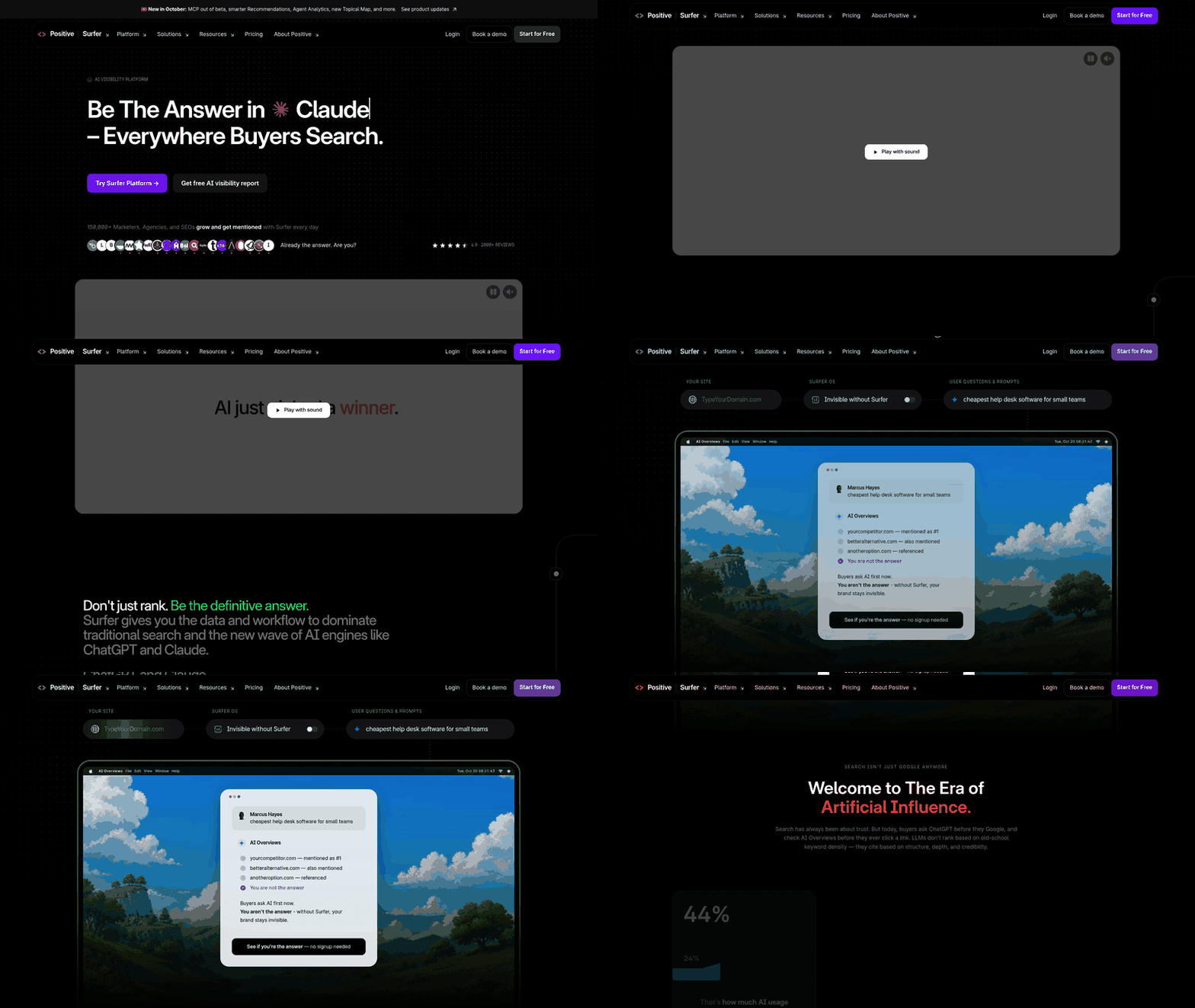
The platform connects to your site and your Google Search Console data, then surfaces specific gaps. If your page ranks for a keyword but misses the supporting subtopics competitors cover, Surfer flags it. If your intro is longer than the top 10 average, you get a concrete recommendation to trim it. The goal isn't to turn every page into an SEO checklist—it's to match what search intent actually demands.
What makes this approach work
Matching your content structure and depth to what searchers are actually looking for tends to outperform pure word-count padding. Teams that use Surfer's recommendations selectively—rather than following every suggestion robotically—often see tighter alignment between their pages and search results. Following every suggestion can produce over-optimized, stiff prose that reads like an SEO template instead of genuine insight.
When to use it
Refresh workflows make sense for pages already ranking in positions 5–20—the "almost there" zone where structural tweaks and topical depth often enable movement. Skip this for brand-new content or pages targeting ultra-competitive keywords where your domain authority itself is the bottleneck. Surfer can't fix that gap.
The tool sits in the optimization layer, not the ideation layer. You need solid content first; Surfer sharpens it. Pricing is accessible for solo practitioners and agencies alike, though high-volume refreshes across hundreds of pages can strain credits fast.
Semrush AI: Tracking Visibility Across AI Search
Semrush One merges traditional keyword data with AI-search visibility tracking in a single dashboard. Semrush's strength is visibility intelligence—tracking where your brand appears across traditional search and LLM answers, then surfacing which domains get cited most often in AI responses.
What actually ships
The platform provides research-grade visibility into what questions AI engines answer for your niche, monitoring shifts in how often your brand appears alongside competitors. You see which third-party sources AI engines cite most frequently and identify gaps where competitor domains rank in AI answers but yours doesn't. This is fundamentally different from backlink outreach: you're not building links, you're diagnosing visibility blind spots that traditional SEO dashboards miss entirely.
The practical value is prioritization. Instead of treating every possible link opportunity equally, a team can investigate the sources that already influence answers in its category. Semrush does not turn those findings into earned coverage automatically, but it gives content and communications teams a more focused starting point.
When this approach works
Use this if you're an agency managing multiple client portfolios or an in-house team tracking brand visibility across AI platforms. Skip it if your only goal is traditional Google ranking—Ahrefs and Surfer SEO often deliver faster ROI there. The prompt intelligence is genuinely novel, but acting on those insights requires content strategy work outside Semrush's scope; the tool surfaces opportunities, your team executes the positioning.
AnyPost.ai: Programmatic SEO and Local Publishing at Scale
The critical gap across most AI SEO content generators isn't what they can write—it's what they don't verify before you publish. Most platforms generate programmatic pages at volume without checking whether those pages will actually rank, convert, or fit into your site's structure. A large batch of local landing pages can become a ranking liability if the pages cannibalize each other or miss the intent your audience searches for.
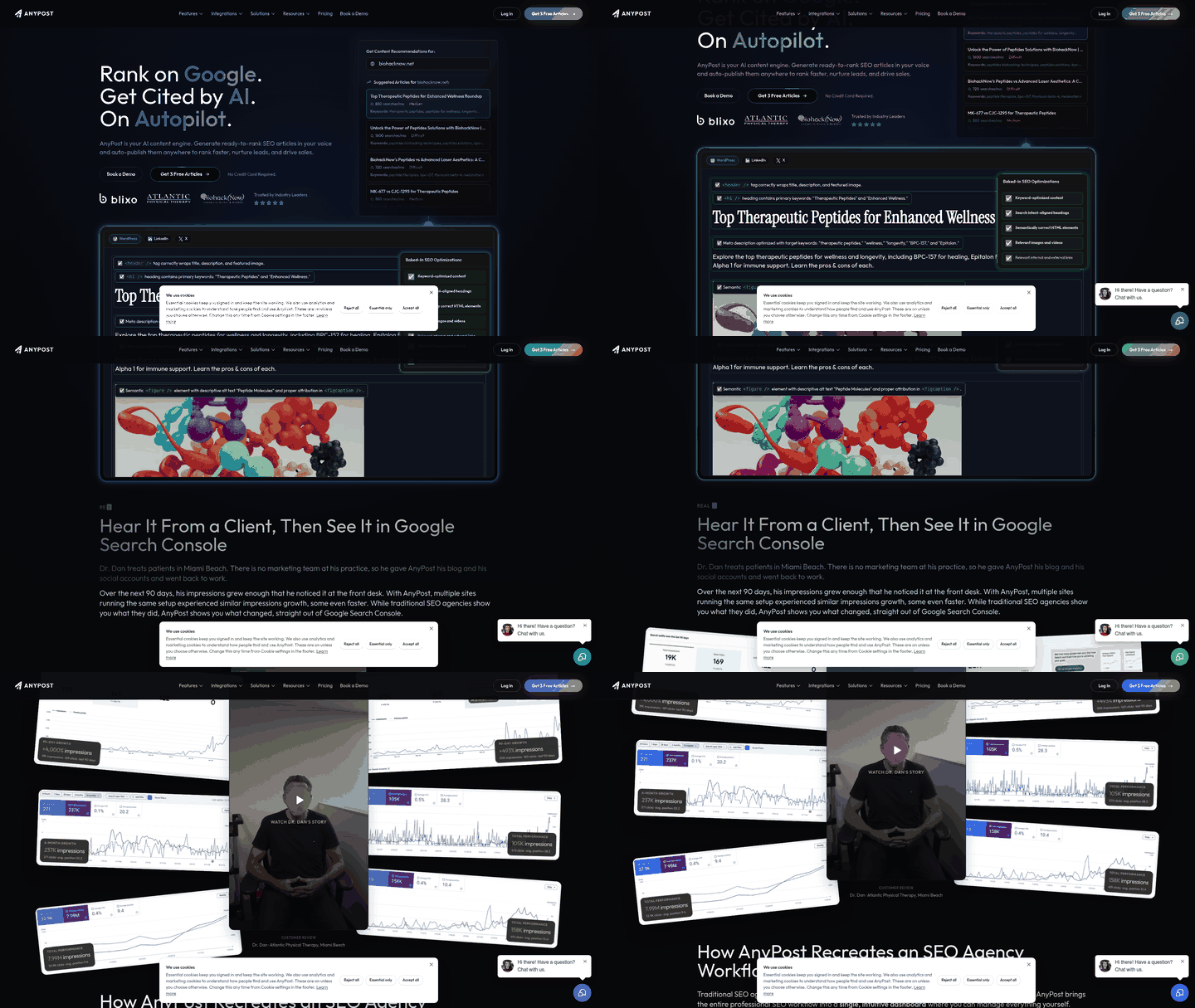
We built AnyPost.ai to handle both programmatic SEO and Google Business Profile management at scale. Rather than treating local pages and programmatic content as a pure volume play, we automate the creation, publishing, and distribution of SEO-optimized content that integrates with your existing site and local presence.
What happens inside the local page workflow
When you generate programmatic SEO pages or Google Business Profile content through our platform, the system pulls your actual business data and structures the content to match your brand voice across all locations. We handle the technical publishing, so local landing pages go live with consistent formatting and SEO elements already in place.
That matters because local search is where thin pages fail hardest. A dental practice that publishes two near-identical service pages for the same Seattle audience can leave Google uncertain about which URL to rank. The better defense is planning on the front end: deciding which pages to create, which keywords to target, and how each fits into your site architecture before hitting publish.
Content monitoring and refresh
Content doesn't age well in isolation. We monitor how your local pages and programmatic content perform over time, so you can update and republish when needed.
For teams running multiple locations, this scales content creation across your entire footprint. You can publish to Google Business Profiles, update local landing pages, and distribute content to your channels—all from the same platform that generated the original article.
The Review Workflow That Actually Prevents Disasters
We check every draft before publishing. That's not editorial theater—it's the line between content that ranks and content that creates support tickets because the AI confidently cited a product feature that doesn't exist.
The part most teams underestimate isn't the draft itself. It's the invisible work that happens after the AI SEO content generator finishes writing. A review process can expose weak evidence, unsupported comparisons, and missing context before those problems reach a customer.
A thorough pre-publication checklist typically covers five categories: factual accuracy, brand voice, on-page SEO, link relevance, and accessibility. Each category can reveal issues that looked fine at first glance—whether the draft came from Jasper, Writesonic, or AnyPost.ai. Surfer and Semrush can flag what to fix, but they leave the final verification to you.
Verify factual claims first
AI tools can state wrong facts with a straight face. That's the core risk. Drafts can cite pricing that changed six months ago, reference features that never shipped, and misstate regulations in YMYL-adjacent topics.
Verify every claim that matters: product specs, pricing details, legal statements, statistics, dates, and any number that could embarrass you if wrong. Keep a single source of truth for product information rather than trusting the AI's memory. Human enrichment—local regulations, real photos, and unique FAQs by neighborhood—also helps city pages avoid a copy-paste footprint.
Scan for voice drift
When pages sound identical, your site loses differentiation. The AI defaults to its training voice, not your brand voice.
Read three paragraphs aloud. If you cringe, your visitors will bounce. Look for robotic keyword repetition, awkward phrasing that prioritizes density over clarity, and corporate jargon that doesn't match how your team actually talks. AI content fails when it mimics authority without substance.
Check on-page SEO elements before publishing
Verify title tags, meta descriptions, heading structure, and internal links before you hit publish. AI drafts often forget that SEO is a site system, not a page game. You end up with orphan pages that never earn authority.
Link to one hub page and 2–4 supporting pages. Use internal anchors that describe outcomes, not generic "click here" text. Verify the target query matches search intent—someone searching "best payroll software for restaurants" wants comparisons and pricing ranges, not a generic overview. Add structured data where relevant, verify image alt text describes what's actually in the image, and test mobile usability before the page goes live.
Evaluate outbound links for legitimacy
AI tools suggest outbound links based on topical relevance, not editorial judgment. Drafts can link to competitor listicles, outdated resources, and low-quality directories that would dilute trust.
Review each suggested backlink for topical fit, legitimate editorial value, and audience relevance. Skip links that feel like SEO manipulation rather than genuine reader utility. If the link wouldn't help a smart friend solve their problem, cut it. Authority flows both ways—linking to spam signals that your page lacks editorial standards.
Use a sign-off form to catch patterns
Track reviewer name, target query, factual verification status, brand voice check, on-page SEO completion, link review, accessibility scan, and final approval. The form takes 90 seconds to fill out and catches mistakes that may otherwise surface weeks after publication.
Keyword volume deviations above roughly 15–20% warrant a second look—if your tool consistently misses that threshold, you may be optimizing for the wrong queries. Practitioners often reject tools that crash, give irrelevant suggestions, or require constant troubleshooting.
The checklist isn't about slowing down. It's about shipping content that works the first time instead of spending two hours cutting sections that belong on another URL. Drafting without a brief is the usual failure point, but publishing without verification is how you scale the wrong content and waste months of opportunity cost.
Pricing Models and What They Actually Cost at Scale
Entry costs are low across AI content tools—many start under $100 per month—but expansion gets expensive fast. Most tools charge by usage volume, credits, or monthly allowances rather than seats. That model can make a seemingly inexpensive pilot difficult to forecast once several workflows are active.
The real pricing mismatch sits here: many tools monetize by encouraging volume output, yet practitioners know bulk publishing without intent mapping and factual review is how you build a ranking liability instead of an asset. You save on the tool but may create recovery work when search performance deteriorates.
What pricing structures reveal about incentives
Entry-level plans often start around $40–$80, with higher tiers reaching several hundred dollars per month. Free plans are less common than free trials, making trial-led conversion the industry standard.
This pricing structure reveals what vendors expect: test quickly, start small, then expand usage. Expansion only improves ROI when each additional piece has a defined role in the content map. Otherwise, more credits simply produce more material for reviewers to evaluate.
Measuring actual ROI beyond word count
Pilot success depends on qualified organic sessions, conversions, content quality, factual accuracy, indexing, rankings, and review hours—not on word count or articles published. Track organic sessions and conversions per page, not total pages created. Monitor AI-search visibility alongside traditional rankings, since improving both channels simultaneously tends to outperform focusing on volume alone.
The rollout looks like this: audit your current ranking market, pilot 5–10 pages with a specific brief, measure the metrics above, then scale only the process that worked. If your pilot shows good conversion but poor factual accuracy, your tool choice or review process failed—scaling won't fix it. Track backlink acquisition quality and refresh completion rates as well; tools that help you improve existing pages often outperform tools that only draft new ones.
Common Questions
Do AI SEO content generators actually reduce the time spent on content creation, or just shift the work?
They usually shift part of the work. Initial drafting becomes faster, but editors still need to validate sources, resolve ambiguous instructions, and make the page sound specific to its audience. The useful comparison is not writing time alone; measure the full path from brief to approved, published page and include the time spent correcting avoidable errors.
Why do most AI content tools charge by usage volume instead of per seat?
Usage pricing reflects the computing and generation costs associated with producing drafts, analyses, or optimization recommendations. It also makes revenue rise as a customer activates more workflows. Buyers should compare the allowance with their review capacity, because an inexpensive plan can be poor value if it produces more drafts than the team can responsibly assess.
Can AI tools help with content that targets AI search engines like ChatGPT and Perplexity?
Some can measure visibility in those environments, but measurement is not the same as optimization or citation acquisition. Semrush One can measure visibility in those environments and identify sources that receive attention. A brand still needs useful, independently credible material and a distribution strategy before those findings can affect how it is represented.
What's the biggest mistake teams make when scaling AI-generated local landing pages?
They treat location as the only meaningful difference. A page should have a clear service purpose, accurate business information, and a reason to exist within the site's architecture. Before generating a batch, map each service-location combination, define the intended query, and remove pages that would compete for the same search intent.