Frizerly vs AirOps vs n8n: Which SEO Automation Tool Tracks AEO From Research to Publishing

Where visibility starts slipping
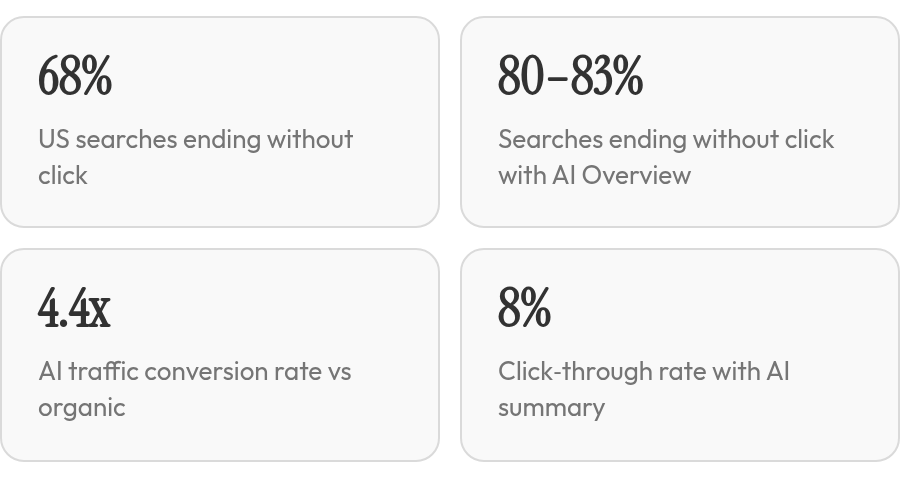
The part most teams underestimate isn't writing content. It's knowing whether any of it gets pulled into the answers ChatGPT, Perplexity, or Google's AI Mode actually show. Many US Google searches ended without a click in early 2026. When an AI Overview appeared, that rate climbed higher. A page can rank third and never get cited. A page stuck on page four can form the backbone of the answer. Tracking AEO closes that gap.
Three roles feel the blind spot most: content strategists publishing without knowing which pages the models extract, SEO analysts whose rank reports no longer tell them where customers actually see brand mentions, and growth marketers who can't attribute pipeline when nobody clicks. Google AI Overview sources from top-ten pages fell sharply, so rank alone stopped being a reliable proxy for discovery.
What tools automate an AI content pipeline from research to publishing with answer engine optimization tracking?
The workflow question behind that search phrase isn't about whether a dashboard exists. It's about what survives the trip from an AI answer to a reviewed, published page. Prime AI Visibility, Conductor, AirOps, and HubSpot each handle the handoff differently. Prime's sequence runs through Primey and Content Studio before export. AirOps embeds research-to-draft loops inside a broader workflow engine. Conductor and HubSpot tie AEO tracking to their existing content and CMS layers. The boundaries matter most: does the tool force a file download, a copied prompt, or a rebuilt brief between stages?
Traffic that arrives from AI can convert at a higher rate than traditional organic, but it still averages only a small share of total sessions. For teams closing high-value deals from search, that conversion lift can justify the tracking investment even when volume stays low. Brands that show up in AI-generated answers also tend to capture downstream clicks in organic and paid channels. That halo only appears in attribution models when you measure citation, not rank.
The hidden tax sits in manual handoffs. As zero-click searches keep climbing, parts of your editorial calendar can slip into AI summaries that never credit you. Automation reduces that tax by flagging which published pages already appear in answer engines, which need structural edits to become extractable, and which questions no page covers yet. With click-through rates dropping sharply whenever AI summaries appear, end-to-end tracking has moved from theoretical to operational.
What carries over
- AI summaries keep shrinking rank reports' usefulness as a visibility proxy.
- Citation measurement shows whether answer engines actually use and credit a page.
- AI-referred visitors tend to convert at higher rates, even though they're a small share of sessions.
- AirOps consolidates SERP data, AI citation logs, and Google Analytics into one workflow environment.
- Frizerly automatically generates briefs from Google Search Console queries and finds unranked gaps.
- n8n makes you build research ingestion workflows from APIs. It's flexible, but it lacks pre-built research logic.
The tools side by side
The moment you ask what tools automate an AI content pipeline from research to publishing with answer engine optimization tracking, you're asking which platforms close the loop. That means more than surfacing a visibility gap. It means moving that insight through to a live page someone can measure.

Most tools stop at the dashboard. They tell you where you're cited or invisible, then export a CSV. The question is what happens after the export, and whether an editor can act on it without rebuilding the entire brief from memory.
Research capture: the source of truth
AnyPost.ai pairs keyword research with multi-source content integration, so briefs draw on more than a single keyword list. The Persona Engine matches your tone from the start, which means research and voice tend to arrive together rather than as separate cleanup jobs. Programmatic SEO can then extend that research into larger sets of targeted pages that capture long-tail search traffic.
AirOps pulls SERP data, AI citation logs, and Google Analytics into a unified insights layer. Page360 consolidates rank, citation frequency, and on-page engagement so you can see which articles earn AI mentions and which sit unread. Research lives inside the same environment where you build content workflows, not in a separate analytics tool.
Frizerly connects to Google Search Console and reads the queries your site already attracts, identifies the topics you don't yet rank for, and generates blog briefs automatically. Research capture is passive: it watches your existing traffic and fills the gaps.
n8n requires you to build the research ingestion yourself. You can wire Google Sheets, Ahrefs API, or Semrush exports into a workflow, but the platform provides the plumbing, not the pre-built research logic. If your team already has a structured keyword database, n8n can read it and act on it. If you don't, you're starting from scratch.
| Platform | Research Capture | Intent Mapping | Content Generation | Publishing Workflow | AEO Analytics | Integration Ecosystem | Starting Price |
|---|---|---|---|---|---|---|---|
| AnyPost.ai | Keyword research + multi-source content integration | Programmatic SEO pages targeting long-tail queries | AI drafts with Persona Engine tone matching | Direct publishing to your existing website; multi-platform social distribution | Real-time analytics tracking (not a dedicated AEO citation tracker) | Works with virtually any website; publishes to LinkedIn, X, Instagram, TikTok, YouTube | 3 free articles to start, no credit card required |
| AirOps | Page360 consolidates SERP + citation + analytics data | Quill agent orchestrates intent-to-content mapping | Brand Kits enforce governance; templates support structured creation | WordPress, Webflow direct publish; human approval gates available | Offsite tracks citations across ChatGPT, Gemini, Perplexity, AI Overviews | API-first; connects to CMS, CRM, BI tools | Paid tiers; check vendor pricing |
| Frizerly | Google Search Console auto-sync | Identifies ranking gaps; no advanced clustering | Auto-publishes SEO blog posts weekly | One connected site; auto-posts to social, replies to reviews | Tracks Google rankings + AI mentions | Limited; focuses on GSC + WordPress/social | Paid subscription; check vendor pricing |
| n8n | Build your own via API connectors | Manual workflow design required | Integrates OpenAI, Gemini, Anthropic via API | Custom; supports WordPress, Google Docs, any REST API | No native AEO tracking; must wire external tools | Broad app integration library; fully open workflow builder | Self-hosted free; paid cloud plans available |
Content generation: where the voices split
This is where the platforms diverge hardest. Frizerly auto-generates and auto-publishes without human review. That can work for high-volume, low-stakes blog content, but it tends to break when brand voice or factual accuracy matters. A small business owner might appreciate the hands-off approach. A SaaS company with compliance requirements will often find it unusable.
AirOps gives you Brand Kits, which are governance rules that enforce tone, structure, and citation standards before a draft leaves the system. You can route content through approval gates, so legal or subject-matter experts review before publishing. The tradeoff is setup time: you're configuring workflows, not just toggling features.
AnyPost.ai matches your voice at the sentence level, not just the keyword level. The system learns from your existing content during onboarding, then applies that voice model to every draft. You're not editing out generic phrasing after the fact; the draft arrives in your voice. n8n lets you chain any LLM you want, including GPT-4, Claude, and Gemini, and define the exact prompt structure, research inputs, and revision loops. The workflow is yours to design, which means it's also yours to debug when a model returns malformed JSON or skips a section. Skip this unless you have engineering capacity to maintain it.
Publishing and AEO tracking: does the loop actually close?
A visibility report that ends in a spreadsheet is not a content workflow. The editor should be able to see the observed answer, understand why a change was proposed, and move that context into the publishing environment without reconstructing it.
AirOps connects directly to WordPress and Webflow, so a reviewed draft moves to CMS with one action. AEO tracking runs continuously via Offsite: you see which articles earned citations in ChatGPT, which lost ground in Perplexity, and which queries your brand should own but doesn't. The loop closes when you can tie a content change to a measurable shift in AI visibility.
Frizerly auto-publishes to one connected WordPress site and tracks Google rankings plus basic AI mention alerts. It's a set-it-and-forget-it system, which is both its strength and its ceiling. You won't get per-engine citation breakdowns or the ability to A/B test content changes against AEO performance. n8n can publish anywhere, including WordPress, Webflow, Google Docs, and Notion, but you're responsible for building the connector, handling authentication, and deciding what happens when the API call fails. AEO tracking requires wiring a separate tool like Profound, Otterly, or a custom Perplexity API monitor into the workflow. Integration flexibility is infinite; integration effort is non-trivial.
AnyPost.ai takes the publishing leg. Content goes directly to your existing website, then gets turned into social carousels and posts across LinkedIn, X, Instagram, TikTok, and YouTube, plus newsletters, so one article doesn't die on a single blog page. Real-time analytics tracking shows how that content performs. The tradeoff is that we don't position it as a per-engine citation tracker. If you need ChatGPT-versus-Perplexity citation breakdowns, pair AnyPost.ai with a dedicated AEO monitoring tool.
The hero feature for each tool
AnyPost.ai: Persona Engine voice matching that learns your brand tone at onboarding and carries it from SEO-optimized drafts through direct website publishing, newsletters, and multi-platform social distribution.
AirOps: Quill's autonomous workflow orchestration with Brand Kits for governance. It lets enterprise teams enforce compliance and approval gates without losing automation speed.
Frizerly: Fully autonomous weekly publishing, ideal for small businesses that want content volume without editorial overhead.
n8n: Infinite workflow customization with a broad app integration library and open-source self-hosting, built for teams with engineering resources who need control over every step.
Free-tier limits matter if you're testing before committing budget. Frizerly offers no free tier; it's a paid subscription tied to one connected site. AirOps is a paid platform, so check its current plans before you scope a pilot. n8n's self-hosted version is free, while cloud hosting is a paid option that scales with workflow executions. With us, you can start with three free articles and no credit card, which can tell you quickly whether the voice match holds up on your own content.
Pricing and the ROI math that gets skipped
The price gap
Most platforms bill you for the dashboard, not for what happens after you see the gap. AirOps has paid tiers, with task consumption tied to every workflow step—research, brief generation, content creation, and publishing each burn through your allowance. Frizerly bills per domain for each additional site you connect. n8n Cloud starts at a monthly fee billed annually for 2,500 workflow executions, but the open-source Community edition is free if you self-host and handle your own server, backups, and updates.
The hidden cost sits in what each platform makes you bring. n8n is infrastructure: you wire together your own research APIs, content generators, and publishing endpoints, so you'll need subscriptions to those services plus engineering time to maintain the workflows. AirOps and Frizerly include the content engine, but AirOps meters every action, so a 20-article monthly cadence can push you past the Solo tier fast. AnyPost.ai closes that loop: automated content generation, persona-matched drafting, and multi-channel publishing run inside one subscription.
| Platform | Entry Price | What's Metered | Self-Host Option | Support Tier |
|---|---|---|---|---|
| AirOps | $199/mo (Solo) | Task executions (research, generation, publish each count) | No | Email, Slack community, CSM on Pro+ |
| Frizerly | ~$19–104/mo per domain | Domains connected | No | Email support |
| n8n | €20/mo Cloud or $0 self-hosted | Workflow executions (Cloud); none if self-hosted | Yes (Community edition) | Community forum (free), priority support on Business+ |
The break-even math people skip
AirOps works when you're running hundreds of content variations and need granular task-level control, but the task meter means you hit Pro pricing faster than the sticker suggests. n8n's free tier looks unbeatable until you price DevOps time: one engineer spending four hours monthly maintaining workflows, debugging API changes, and handling server patches costs more than the €20 Cloud plan for most teams under 50 people.
Frizerly makes sense if you manage a portfolio of single-domain sites that each need steady blog output but don't share voice or workflow. The per-domain billing becomes the friction point the moment you want to centralize reporting or apply one brand voice across properties. We see teams evaluate ROI backward—they compare subscription prices without mapping the cost of the stage each tool skips. Content that earns citation in AI answers can convert at rates several multiples above traditional organic traffic, but that value disappears if you can't measure whether your published work is being surfaced in the first place.
Where the loop actually closes
The question teams actually search for (what tools automate an AI content pipeline from research to publishing with answer engine optimization tracking) points to a gap most tools don't close. They show you where you're invisible in AI answers. They don't fix it.
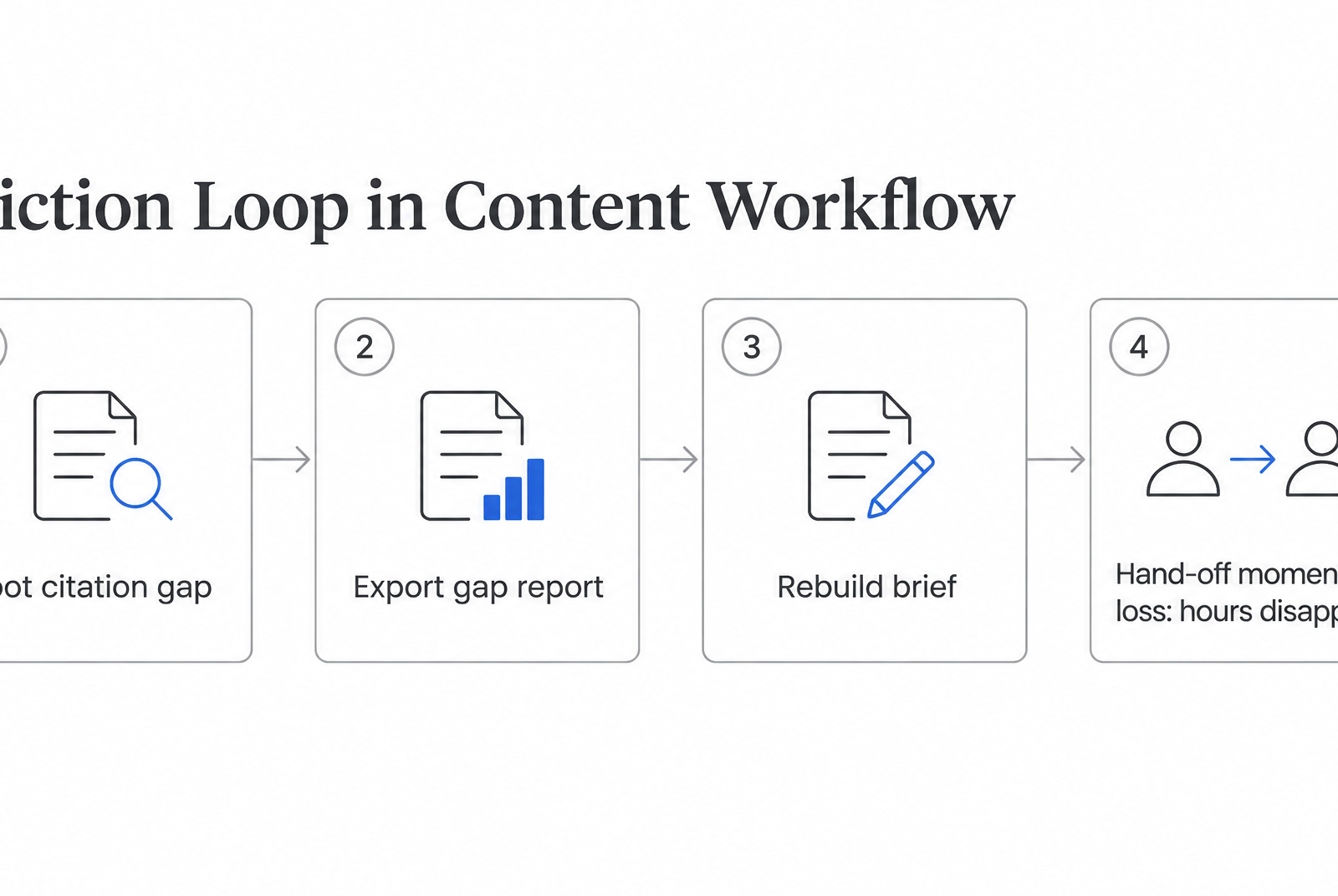
We see the same friction point repeatedly: a team spots a citation gap in its dashboard, exports a report, and then rebuilds the entire brief from scratch in a separate tool. Each handoff is where momentum dies and hours disappear.
Where the handoff disappears
Our workflow runs from keyword research through publishing to real-time analytics in one connected sequence. The Persona Engine captures brand voice before a word is written, not in a later edit round. The Multi-Hop Research Engine pulls from multiple source types so articles carry the depth AI systems tend to reward. Analytics track performance across the channels where your content lives, letting you see what's moving and what isn't.
That visibility matters because the search market has shifted. Pew Research Center found that users clicked less often when an AI summary appeared, compared to searches without one. Creating content that AI systems can extract and cite is no longer optional; it's the pathway to remaining visible. Closing the research-to-publishing loop is what puts your content in position to be that cited source.
The trade-offs are real: Frizerly is the cleaner choice for teams that need specialized research capture and plan to build their own downstream workflow. n8n makes sense when an engineering team wants maximum pipeline flexibility and can maintain a self-hosted setup. AirOps sits between them, with strong LLM workflow tooling and task-consumption pricing that compounds quickly at scale.
Best-fit summary
| Use case | Best fit | Hero feature | AEO tracking | Setup |
|---|---|---|---|---|
| Full-stack content automation | AnyPost.ai | End-to-end voice matching + analytics | Via third-party integration | Hours |
| Data-first pipelines | AirOps | LLM workflow builder | Partial | Days |
| Ultra-custom pipelines | n8n | Open-source flexibility | Via integration | Days to weeks |
| Specialized research | Frizerly | Keyword and intent data | Limited | Hours |
Our free tier includes three articles, enough to see voice matching and multi-channel publishing working in a live workflow before you commit. For teams mapping where their current setup breaks down, our semantic SEO automation overview shows how the research and publishing stages connect. A demo is the fastest way to see whether the full pipeline fits your setup.
Frequently Asked Questions
1. Can I measure which specific AI engine cited my content, or do most tools only show aggregated visibility?
AirOps Offsite tracks citations separately across ChatGPT, Gemini, Perplexity, and Google AI Overviews, so you can see which engine surfaces your brand and which ignores it. Frizerly offers basic AI mention alerts without per-engine breakdowns, while n8n requires you to wire external monitoring tools into your workflow manually.
2. What happens when a page ranks well but never appears in AI-generated answers?
A strong search position does not guarantee inclusion in an AI summary. Answer engines evaluate whether a page offers extractable, useful material, so teams need a citation view alongside conventional ranking data rather than treating position as the complete visibility report.
3. Do I need engineering resources to maintain n8n workflows, or can a content team manage them?
n8n workflows require building and debugging API connections, handling authentication, and patching when external services change their endpoints. Most content teams without dedicated engineering support find the maintenance effort exceeds the €20 monthly Cloud fee, making pre-built platforms a faster path to production for non-technical teams.
4. If AI-referred visitors convert more effectively than organic visitors, why does that traffic remain a small share of total sessions?
AI answer traffic can bring users with stronger intent, but conventional search still produces most sessions. That makes citation monitoring particularly useful for businesses where a small number of high-value inquiries matters more than raw traffic volume.
5. Can Frizerly handle multiple brand voices across different sites, or does it apply one tone to everything?
Frizerly bills per domain and auto-publishes without voice customization, so each connected site receives the same treatment rather than brand-specific tone matching. Teams managing multiple properties with distinct voices tend to hit friction when they need centralized reporting or consistent voice governance across domains, which is where persona-based systems like AnyPost.ai's engine become relevant.