
Report Tracking SEO Workflow: One System for Google and AI Search Performance

Key Takeaways
- A large share of informational queries now get answered by AI without a single click, which leaves a blind spot in every standard report.
- GA4 and Search Console don't track AI Overviews out of the box, so a meaningful slice of search activity never shows up in your reports.
- Many SEO pros report falling click-through rates tied to zero-click AI answers.
- Manual reporting breaks because AI visibility is probabilistic and needs both client-side and server-side data, which no single dashboard stitches together.
- A unified workflow measures Google and AI visibility side by side, so you don't mistake rising citations for falling relevance.
- Building custom measurement infrastructure by hand eats hours most content teams can't spare on data plumbing.
- Brand consistency slips when multiple people edit pages independently to chase citations.
Why Your Reporting Stopped Matching Reality
I'll put it plainly: most reports still measure a version of search that no longer exists. Old-school tracking counts direct browser requests. Search engines now assemble answers on the fly from cached data and external APIs. Your dashboards go quiet where more queries get resolved.
That's a real mismatch, not a rounding error. When the results page satisfies intent directly, session metrics can drop hard even while your brand visibility and citation volume climb. I've watched teams treat that dip as a loss of market position when it was the opposite. A unified workflow keeps you from making that call.
Why manual reporting can't keep up
Generative search moves too fast for hand-pulled exports. AI answers shift with the user's location, their search history, and real-time model updates, so a static snapshot is stale by the time you finish compiling it.
Two failure points show up fast. First, the admin load doesn't scale. Custom API integrations need ongoing engineering time, which pulls people off content strategy. Automate the collection and your team spends its hours acting on insights instead of assembling them.
Second, editorial quality frays. When several people rework pages for machine readability on their own, core messaging drifts. A centralized system keeps the tone consistent so structural fixes don't quietly wreck the writing.
Who gets the most out of this
B2B marketers, content creators, and growth leaders tend to benefit most, because they own big content libraries that need constant, prioritized updates. The unified report tells them which pages to fix first based on combined Google-and-AI performance, not a hunch.
Some research suggests AI results tend to favor earned content over branded pages, with certain verticals seeing earned citations outnumber brand content. That reads like bad news for owned pages. My take: it isn't. Winning a citation depends less on brand authority and more on being the easiest source for a model to justify pulling.
So point your effort at restructuring owned content, early direct answers, clean headings, schema, instead of pumping out volume. That turns the earned-media disadvantage into a fixable task.
One more inversion worth naming: with most informational queries answered click-free, raw traffic falls, but AI-referred clicks tend to convert higher. Make citation share and conversion quality your success KPI, not session count.
If you publish under 20 pages a quarter, skip the full custom-API build. Manual is fine at that scale. Above it, the unified workflow earns its keep quickly.
What Actually Wins Citations in Generative Search
Foundational SEO for generative search starts by changing what you optimize for. AI engines tend to pull from earned media and structurally clean content, not keyword-stuffed owned pages. Your workflow should measure whether a model can easily cite your content, not just where it ranks in blue links.
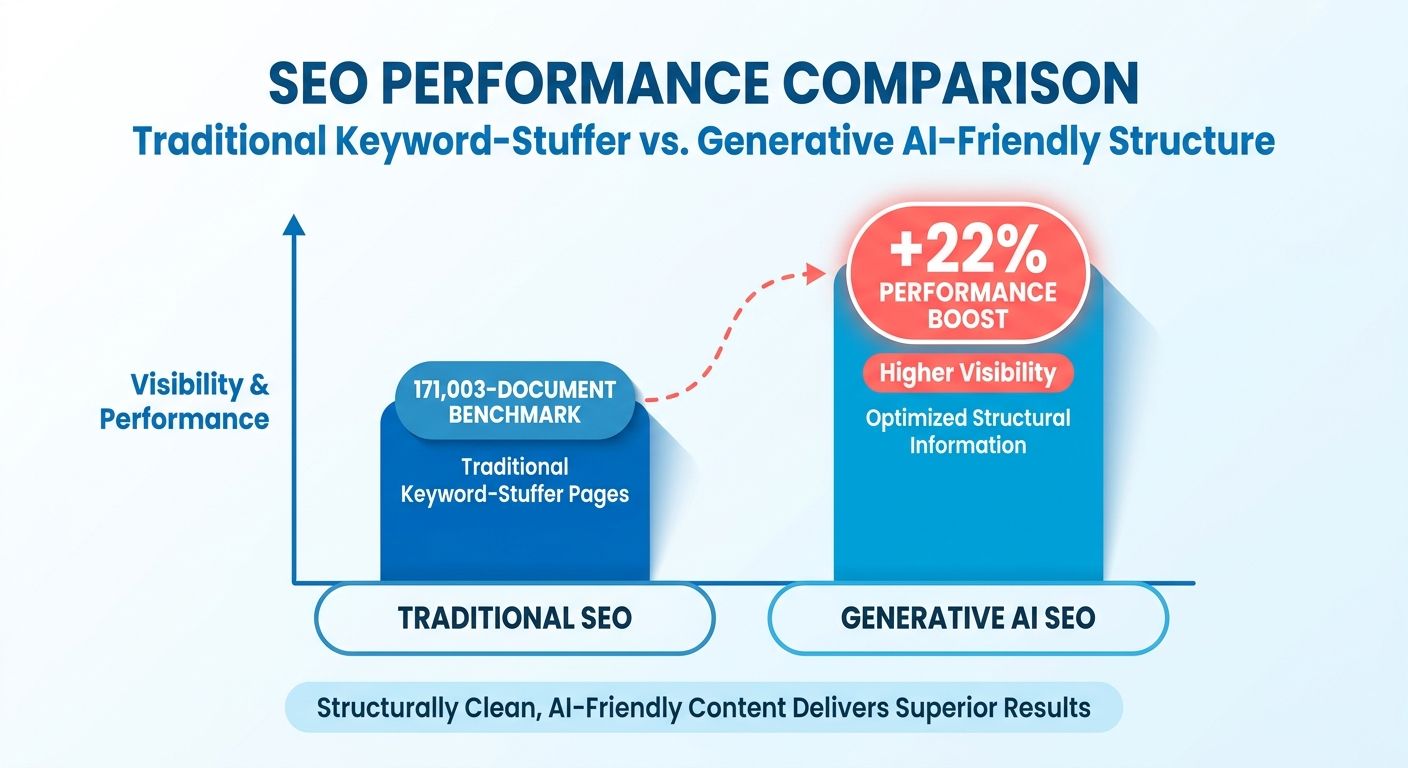
The mechanics reward structure over volume. A benchmark of 171,003 web documents across nine domains found that optimizing structural information gave a +22% boost in Hit Rate at the retrieval stage. Same content, restructured, gets pulled into more AI answers. Track that signal and you'll know which pages are actually retrievable, not just indexed.
Keyword research now maps to questions, not phrases
Research maps to questions and entities, not just phrases. AI Overviews are reported to run on a fine-tuned variant of Gemini trained on Google's own query data, so the system reasons about intent and how entities relate. Your research should surface the questions users ask and the entities they expect answered together.
The sourcing shift is sharp. When engines prioritize third-party reviews, comparisons, and independent forums over official brand sites, owned pages get less real estate in the answer. Counter it by mapping entity relationships and finding the informational gaps where your content can become the primary reference those external sources lean on.
Optimizing content for machine synthesis
Put the direct answer first. Generative search testing suggests that placing the direct answer in early paragraphs improves ranking position, and content that directly addresses the query's informational need tends to rank better. Lead with the answer, then elaborate.
E-E-A-T and entity-based optimization still anchor this. Schema markup for specs, reviews, and prices makes your content machine-readable. Clean structured data lets search models parse and validate your claims fast, which can raise the odds your site gets picked as the reference for a query.
This is where automated optimization tools earn their spot. Instead of spinning up new pages, update legacy content to meet these structural requirements. Format the key information for quick extraction and you can reclaim visibility on queries the AI summaries now dominate, while integrated tracking watches how those edits move your overall footprint.
Why technical audits still decide visibility
Crawlability and indexability are still non-negotiable. If AI crawlers can't reach your pages, entity optimization does nothing. Run technical audits to confirm crawl access, submit sitemaps, and verify serving status.
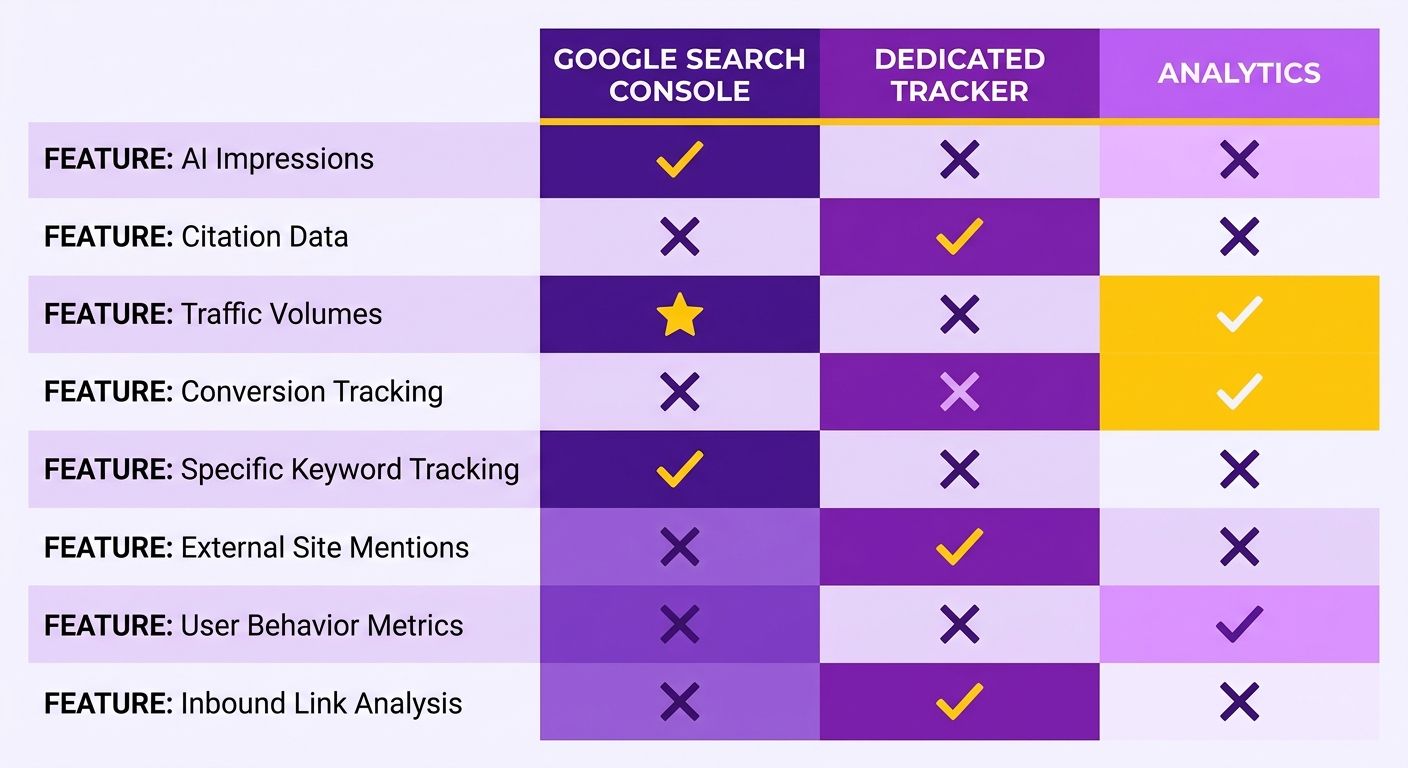
Here's the catch with Google's generative AI performance reports: they surface impression-level visibility but carry no click data and can't isolate how often you're cited in AI Overviews. Search Console gives you the trend, not the citation count. Separate citation-tracking approaches exist to fill that gap. You can skip a standalone tracker only if AI search is negligible in your vertical. For most teams, it isn't.
Measuring Performance and ROI in AI Search
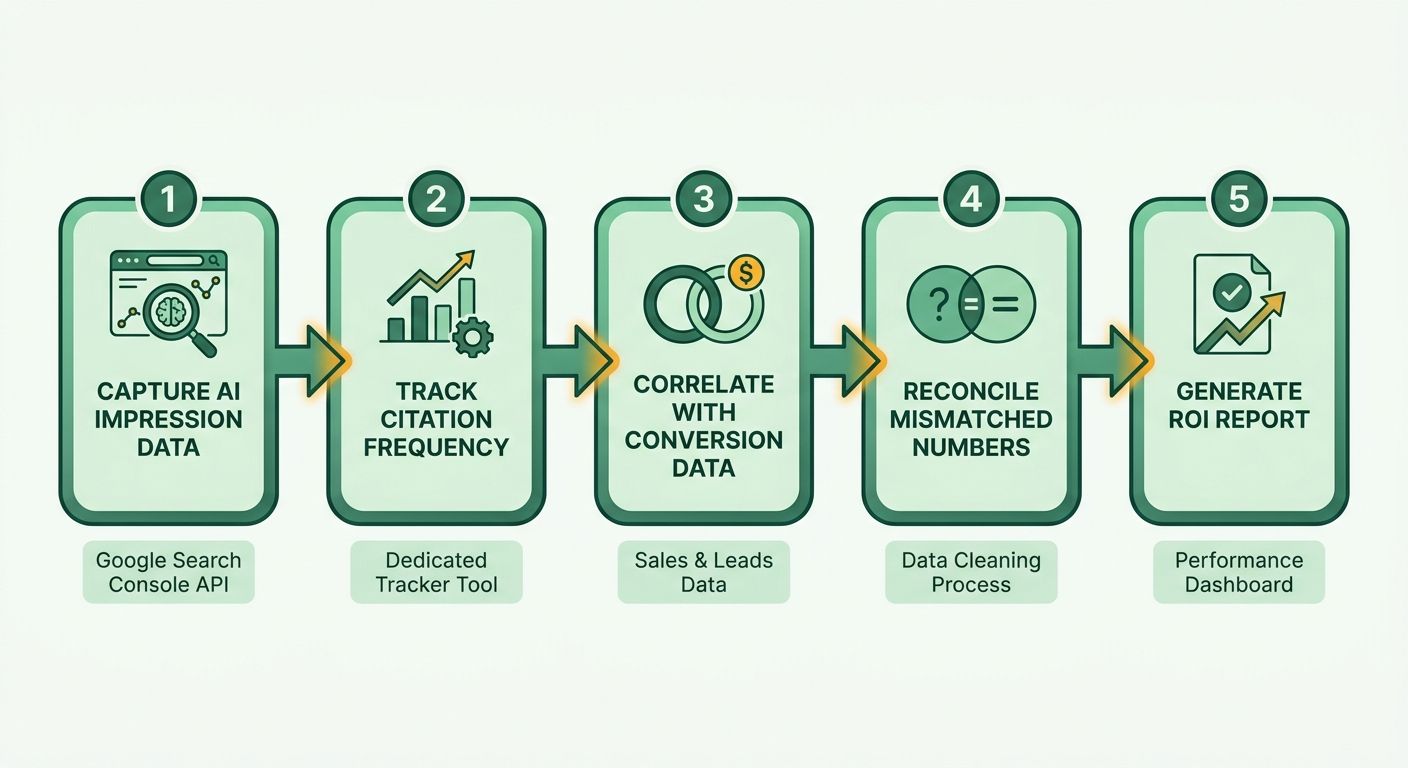
Teams burn weeks reconciling numbers that don't match because they're measuring two different things. A complete workflow layers high-level Search Console trends, citation frequency from dedicated trackers, and repeated sampling to handle AI volatility. No single dashboard gives you all three.
The metrics that actually matter
Start with citation frequency, not just a visibility score. Even the #1 organic result gets cited in AI Overviews only about 40% of the time, per an analysis of 5.46 million AI Overview appearances. A high visibility score means your page showed up in the answer panel. Citation frequency tells you whether the engine actually referenced your content as a source. Track both, because one without the other hides whether you're earning authority or just taking up space.
AI Mode adds a second shift: the follow-up query rate. AI Mode responses tend to generate more follow-up queries than traditional results, with many users asking at least one more question. Each follow-up may count as a distinct search in the newer attribution model, so session behavior can look inflated and your traditional funnel may misattribute the source. Treat follow-up chains as one user journey when measuring ROI, not as separate sessions. Otherwise your cost-per-acquisition inflates.
Conversion rate from AI sources often matters more than traffic volume. Visitors arriving from AI platforms may convert at a higher rate than organic search, which tracks, since they've already filtered through an AI synthesis step. Analytics tools like AnyPost can surface which AI sources drive qualified leads, so you can double down on the content that converts. That higher-converting channel is also why opting out of AI features, even though it may not hurt your traditional rankings, can cost you traffic that's already primed to buy.
Building a unified workflow without manual reconciliation
For a baseline, monitor overall visibility trends grouped by page, country, device, and date. Layer those trends with a dedicated tracker watching citation appearance across your target keyword set, and you'll see where you already hold authority and where competitors are earning citations your content isn't.
AI results are probabilistically unstable, with notable day-to-day source variation. A single snapshot will mislead you. Your page might appear in an AI answer one day and vanish the next on the same query. Run several measurement passes per prompt per day, and add passes when you need source-level coverage. Observation windows of a few weeks give you more stable estimates. That repeated sampling is what turns noisy AI data into a reliable signal.
Automate it by connecting Search Console to a tracker that samples AI citations daily, then feed both into a shared report. Most teams use spreadsheet automation or a reporting layer that pulls from multiple APIs. The goal is one view showing impression trends, citation frequency, and source stability without manual reconciliation.
Normalization is where these reports usually fall apart, so it's worth being deliberate. Search Console and Analytics don't count the same thing: GSC reports clicks and impressions keyed to a query and a page, while GA reports sessions keyed to a landing page. If you dump both into one table and start summing, you'll blend two incompatible units. Align them instead. Pick a shared key both sources agree on, usually the normalized page URL plus a date, and make that the primary key of your sheet or database. Then keep GSC clicks and GA sessions in separate columns against that key rather than merging them into one "traffic" figure. Standardize the URL format first (strip tracking parameters, force a consistent trailing-slash and protocol), because a mismatch there is what silently drops rows during a join. Once the key lines up, you can sit citation frequency next to impressions and sessions on the same row and compare trends without pretending the units are interchangeable. Tools like AnyPost bring that reporting into one place, so you can skip stitching together exports.
Why traditional ROI math breaks in AI search
Your cost-per-click formula assumes a click happened. When engines satisfy the user right in the answer panel, traditional attribution can miss the value completely. For example, a company might see organic CTR fall over a quarter while brand mentions in AI citations climb over the same window. The numbers would tell opposite stories, because one measures behavior and the other measures awareness.
Track citation share as a leading indicator of brand authority. If your content shows up as a cited source in, say, 15% of AI answers for your target keywords and a competitor hits 25%, you know where to prioritize. Pair that with conversion data from the AI traffic that does click through for a clearer ROI picture. The real cost of poor AI visibility isn't lost clicks. It's lost mindshare in the answer layer where buying decisions now start.
Turning AI Search Insights into Fixes
Plenty of teams sit staring at dashboards that don't talk to each other. The gap between visibility signals and actual optimization priorities is where most workflows fail. You need a system that layers high-level trends, citation frequency, and conversion signals into one decision map, not just another export.
What you prioritize first
Start with citation-frequency gaps where impression count is high but citation rate is low. If Search Console shows your page appeared, for example, 10,000 times in AI Mode last month but a citation tracker shows zero mentions, that page is structurally wrong for AI synthesis. Visible, but not referenceable. Flag these high-impression, zero-citation pages first, because they're the biggest missed opportunity. Fixing them doesn't need new content. It needs restructuring what's already indexed.
Pull the three highest-impression pages from Search Console's AI performance report. Run them through a citation tracker to see if they surface in AI answers for your core queries. If they don't, open the page and scan for direct-answer formatting. Does the first paragraph answer the query in roughly 40 to 60 words? Are there comparison tables, numbered steps, or schema markup a model can extract? Structured data can help pages surface in AI answers more often than plain-text pages, yet most high-traffic content carries no semantic tagging. This is the structure to aim for: each major topic wrapped in semantic <section /> tags, headings that include target keywords and their variations, and clean HTML models can extract without guessing. You're not creating new pages. You're making existing ones machine-readable.
Routing changes through your team
Because AI-platform traffic tends to show stronger intent, priorities should tilt toward AI-retrievable content. Most teams still allocate based on traditional rank drops. Push citation-gap fixes into the sprint queue ahead of rank-recovery work when the page already has high AI impressions. If your workflow doesn't surface citation gaps as their own action item, your team keeps optimizing for clicks that no longer happen instead of citations that drive conversions.
Set up a weekly sync that reviews three metrics together: AI impressions from Search Console, citation mentions from your tracker, and conversion events from Analytics filtered to AI-referred traffic. Rising impressions but flat conversions? That's your restructure candidate. Stable citations but declining conversions? That's a content-freshness issue or a landing-page problem downstream. The three-layer view tells you which kind of fix to make, not just that something's broken. Tools like AnyPost can support these restructure tasks with built-in SEO optimizations, so you can reformat existing pages for synthesis instead of rewriting from scratch.
Putting the Workflow to Work with AnyPost.ai
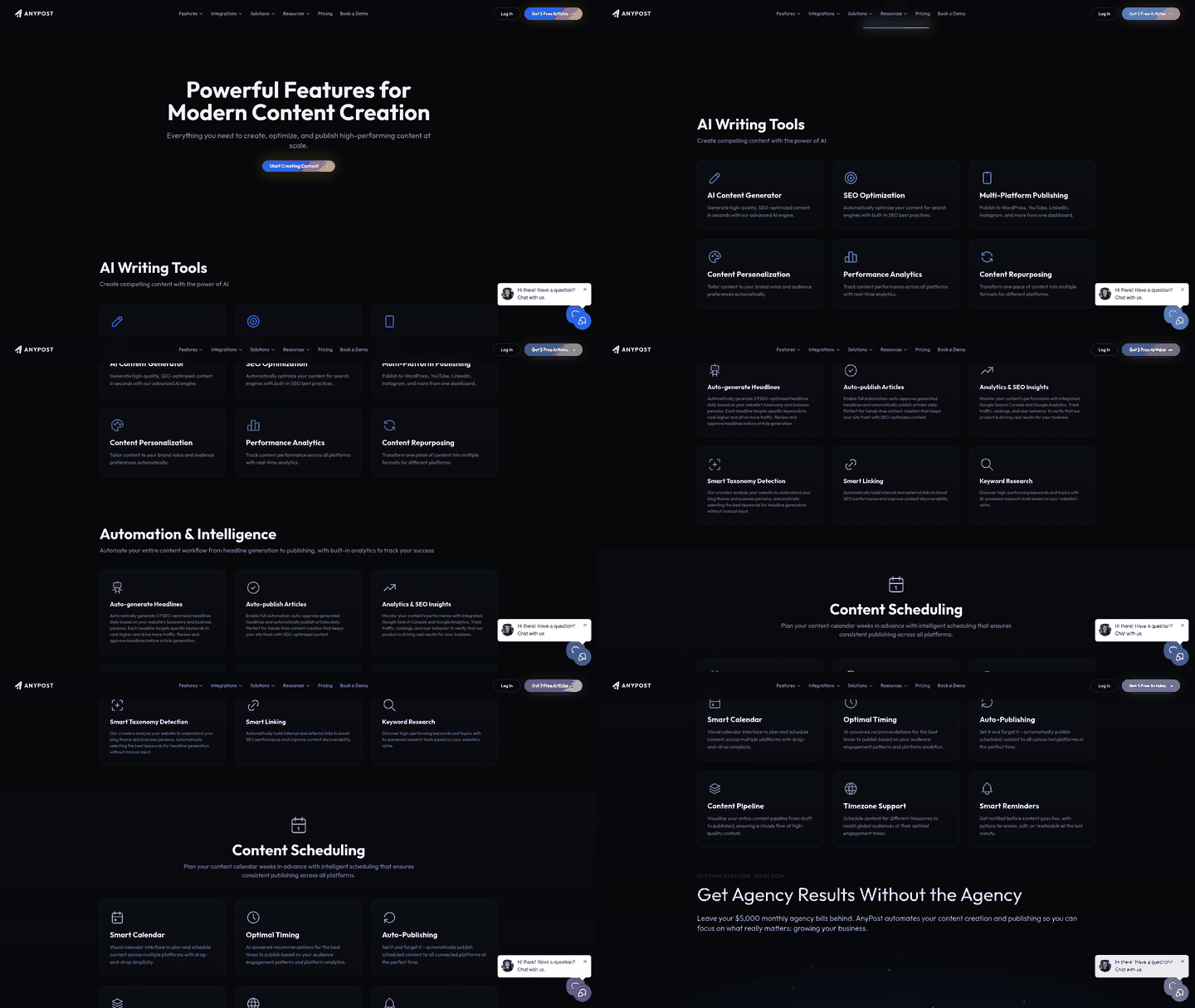
The real bottleneck isn't collecting data. It's deciding what to fix first once Google and AI numbers finally sit in one place. AnyPost is built to read your business context, spot content gaps, and generate SEO-optimized articles in your brand voice, so analysis turns into action instead of a pile of charts with no next step.
That last step is what most setups miss. A working workflow has to reconcile scattered data sources into an actionable queue, not leave teams with disconnected charts.
Configuring the data layer
Wire your measurement sources together before you touch content. Search Console for impressions and position, Analytics for conversion signals, and a dedicated AI Overview tracker for citation frequency give you the full view. Bringing those streams into one system cuts down the manual spreadsheet exports.
One useful detail from the tracking research: AI Overviews rely on server-side APIs that can return live or cached results. Citation data is volatile, so sample it repeatedly rather than trusting a single pull. If you'd rather see the manual version first, guides on automated SEO reporting walk through the moving parts.
What the prioritization queue targets first
Target pages that rank but don't get cited. This is often the highest-value gap in a unified report. A page can hold a strong organic position and still get skipped by AI answers, so separate "ranks and gets cited" from "ranks but isn't cited" and send the second group for rewriting first.
This gap is exactly where automated content generation earns its keep. Pages that answer specific intents but lack clear structure can get bypassed during retrieval. Restructuring a ranking-but-uncited page with explicit headings, concise answers, and semantic markup can capture those citation opportunities without new backlinks.
Here's the sequence:
- Extract context first. Crawl the whole site to build a business context graph of your products, messaging, and audience, so rewrites stay factually anchored.
- Match the voice. Align output with your brand guidelines, which matters when you're editing dozens of pages fast.
- Publish and re-measure. Content ships to WordPress, LinkedIn, or X through multi-channel publishing, then feeds back into the same report.
Where this actually moves rankings
The impact shows up when citation gaps close, not when word count grows. Our service work with SaaS companies has driven meaningful organic traffic increases by prioritizing retrievable, on-brand rewrites over volume.
For teams on a light publishing schedule, manual tracking still works. But once your report spans hundreds of URLs across Google and AI surfaces, a system that reads the report and generates ready-to-rank content in your voice beats any dashboard you export and forget.
Frequently Asked Questions
1. Why does my Search Console show AI impressions but my Analytics shows no traffic from those queries?
This discrepancy occurs because search engines generate answers dynamically on the results page, satisfying the user's intent without sending them to your website. While Search Console logs the impression because your content was used to build the response, Google Analytics only records a session if the user clicks a link. Layering citation tracking with impression data helps you identify when you are serving as a source versus when you are driving actual site visits.
2. If I already rank #1 organically, will I automatically get cited in AI Overviews for the same query?
No. High organic rankings do not guarantee citation. Generative models evaluate content based on how easily it can be parsed and synthesized to answer a specific query. A top-ranking page may be bypassed if its information is buried in long paragraphs or lacks the clear formatting, such as tables or bulleted lists, that retrieval algorithms tend to favor.
3. How many times should I check AI citation data before trusting the results?
Because generative search results are highly dynamic and vary based on real-time model updates, a single daily check will not provide an accurate baseline. Implement a multi-pass daily sampling strategy to account for this volatility. Aggregating these frequent checks over several weeks provides a more stable trend line that filters out daily fluctuations.
4. Should I stop optimizing for traditional Google rankings now that AI search is growing?
No. Optimize for both simultaneously through a unified workflow. Traditional rankings still drive traffic, and pages that rank well are more likely to get pulled into AI answers. The same structural improvements that help AI citation-direct answers, schema markup, clean headings-also strengthen traditional SEO performance without forcing you to choose one channel over the other.
5. Does opting out of AI Overviews protect my click-through rates from declining further?
While opting out prevents search engines from displaying your content in generated summaries, it also removes your brand from high-intent referral paths. Users who click through from synthesized answers have often had their query partially resolved, meaning they arrive at your site further along in the decision-making process. Focus on measuring citation share and downstream conversion actions rather than raw traffic volume.
6. Can I build a unified report tracking workflow with free tools, or do I need paid software?
For small-scale operations, manual setups using spreadsheet integrations and standard analytics exports are often sufficient. However, as the volume of tracked URLs grows, the labor required to pull, clean, and align daily citation data from different sources increases significantly. Larger sites generally require automated pipelines to merge impression trends, citation tracking, and conversion metrics into a single view.