
How Fintech Brands Are Winning AI Search

Why one tool almost never covers a regulated content program
The default move for most fintech teams is to pick one tool or one agency and commit. That's fine for a blog or a landing page. It falls apart the moment your content has to satisfy an AI answer engine and a compliance reviewer at the same time. That tension is the whole reason alternatives are worth looking at.
Most AI content generation platforms optimize for volume. They help you publish faster, not safer. For a regulated fintech, faster publishing means more pages carrying rate quotes, licensing claims, and fee disclosures that a compliance officer never signed off on. The risk scales right alongside the output.
Why does content velocity backfire for fintech?
Content velocity can work against you because AI answer engines pull from far more than your own domain. In financial services, a lot of what these engines cite comes from third-party publishers, user-generated content, and affiliate sites, not a brand's own pages. Flooding your domain does little to move those external citations.
Short-form fintech content is a contested area; some teams see it as useful, while others argue it adds noise. Some specialist agencies emphasize entity disambiguation for multi-product architectures and compliance workflow integration over raw volume. A common concern is that piling on pages faster than you can maintain them creates long-term upkeep problems. So volume adds compliance surface area to a library the AI re-reads every day, while doing little for the citations that actually come from third parties.
What should you compare before choosing?
Compare on compliance workflow, entity accuracy, and voice control. Not just price or output speed. The fintech brands that win in AI answers tend to share one trait: structured, factual, well-organized data. That's also the content class most exposed to compliance error. Get it right and accuracy becomes a competitive edge instead of overhead.
| Option | Best for | Key strength | Core focus |
|---|---|---|---|
| AnyPost.ai | Businesses scaling SEO content across channels | Persona Engine voice matching, automated SEO publishing | SEO-optimized content at scale |
| Enterprise GEO agencies (e.g. First Page Sage) | Established fintech lead generation | Lead-generation-focused GEO, portfolio depth | Human-led entity architecture |
| High-velocity content tools | Early-stage top-of-funnel growth | Speed and low cost | Publishing volume |
We built our engine around the gap those first two columns leave open. Agencies give you rigor but move at agency speed and price. Volume tools move fast and hand you the compliance risk. Our Persona Engine keeps every draft in your brand voice, and automated SEO optimization plus multi-platform publishing turns that content into ready-to-rank pages across your channels.
When should you skip a compliance-aware engine?
Skip it if you publish low-stakes content with no regulatory exposure. A media blog or a hobby project doesn't need audit trails. For those, a fast generic tool is the better fit, and cheaper too. Don't pay for review-friendly controls you'll never trigger.
But the calculus flips the moment your pages carry rates, codes, or disclosures. Nobody in this space can honestly claim certainty about how AI ranking will evolve. That uncertainty is the argument for fewer, structurally clean pages over a flood you can't defend later. Hold the playbook loosely, keep the accuracy tight. For a deeper tooling comparison, see our breakdown of 11 AI SEO tools tested for 2026.
Quick Answers
- Fintech AI-search visibility isn't won by publishing more pages alone. It depends on whether models can identify the brand, product, jurisdiction, and claim accurately.
- Compliance review should live inside the content system, not run as a cleanup step after a draft is already generated.
- The safest fintech content programs treat rates, routing codes, fee tables, and licensing details as governed data, not loose marketing copy.
- AnyPost.ai is strongest for SaaS, technology companies, agencies, and marketing teams that need repeatable publishing without losing brand voice.
- Specialist GEO agencies suit enterprise brands with confusing product architectures or entity problems that need senior consulting.
- Digital PR matters once the owned content foundation is clean, because external mentions can reinforce how answer engines understand a fintech brand.
- Generic content tools make sense only when the content has no meaningful regulatory exposure.
Alternative 3: An engine that bakes brand voice in at generation
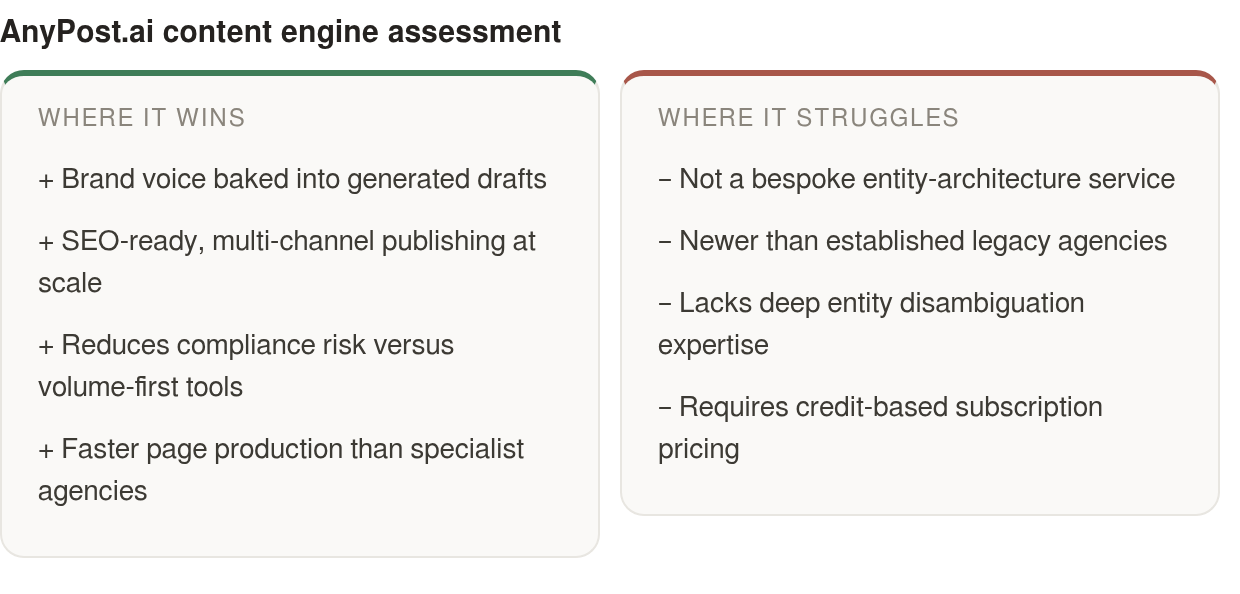
The third option flips the usual tradeoff. Instead of choosing between fast publishing and clean, on-brand output, an automated content engine treats both as one job. This is where AnyPost.ai sits in the lineup: an AI content generation platform built so teams can scale SEO-optimized search visibility without hand-producing every page.
The premise is simple. Most tools speed up output and leave the polishing for later. Our Persona Engine bakes your brand voice into the generation step, so what comes out already sounds like you rather than something you rewrite afterward.
What makes an automated content engine different?
Volume-first tools produce pages fast, then someone checks every financial claim after the fact. That review queue is exactly where fintech content stalls. Generating SEO-ready, context-aware articles from your own business knowledge is the whole point of the platform.
The deeper issue is library quality. Once a page is published, it becomes part of the material search systems can interpret later. If your archive holds vague product descriptions, mismatched terminology, or unsupported claims, adding more articles doesn't solve the underlying problem. It just gives the model more inconsistent material to reconcile.
The pages marketing teams most want to scale are usually the ones that require the tightest source control. Get them clean and consistent and your highest-risk content turns into an asset instead of a liability.
Who should pick this, and who shouldn't?
The fit is clear for SaaS and technology companies, agencies managing several client accounts, and marketing teams that need content, SEO, and social handled without hiring for each. If you run a single-product blog with no ongoing content cadence, a lighter tool will probably serve you fine.
The saturation problem is real across every field flooded with generated content. Undifferentiated output erodes trust, and readers increasingly reward content that feels genuinely human and specific. Voice-tailored output, shaped by your business knowledge library, is how you stay out of that noise.
| Approach | Best for | Content handling | Main tradeoff |
|---|---|---|---|
| Volume-first AI tools | Unregulated blogs, landing pages | Manual review after publish | Risk scales with output |
| Specialist GEO agency | Enterprise entity/architecture work | Built into service, high cost | Slower, project-based |
| Automated content engine (AnyPost.ai) | SaaS, agencies, marketing teams | Brand voice at generation | Consistent, on-brand pages at scale |
Pricing is a transparent, credit-based subscription. Plans run from the Basic plan at $399/month up to Enterprise at $5,000/month, scaled around how much content and how many channels you need. That structure suits teams replacing manual production rather than buying another seat-based tool.
The tradeoff comes down to this: velocity-first platforms optimize for raw speed, while an automated engine keeps your voice and quality consistent across the pages your prospects, reviewers, and search systems will all read.
Alternative 4: Hire a specialist agency to rebuild entity signals by hand
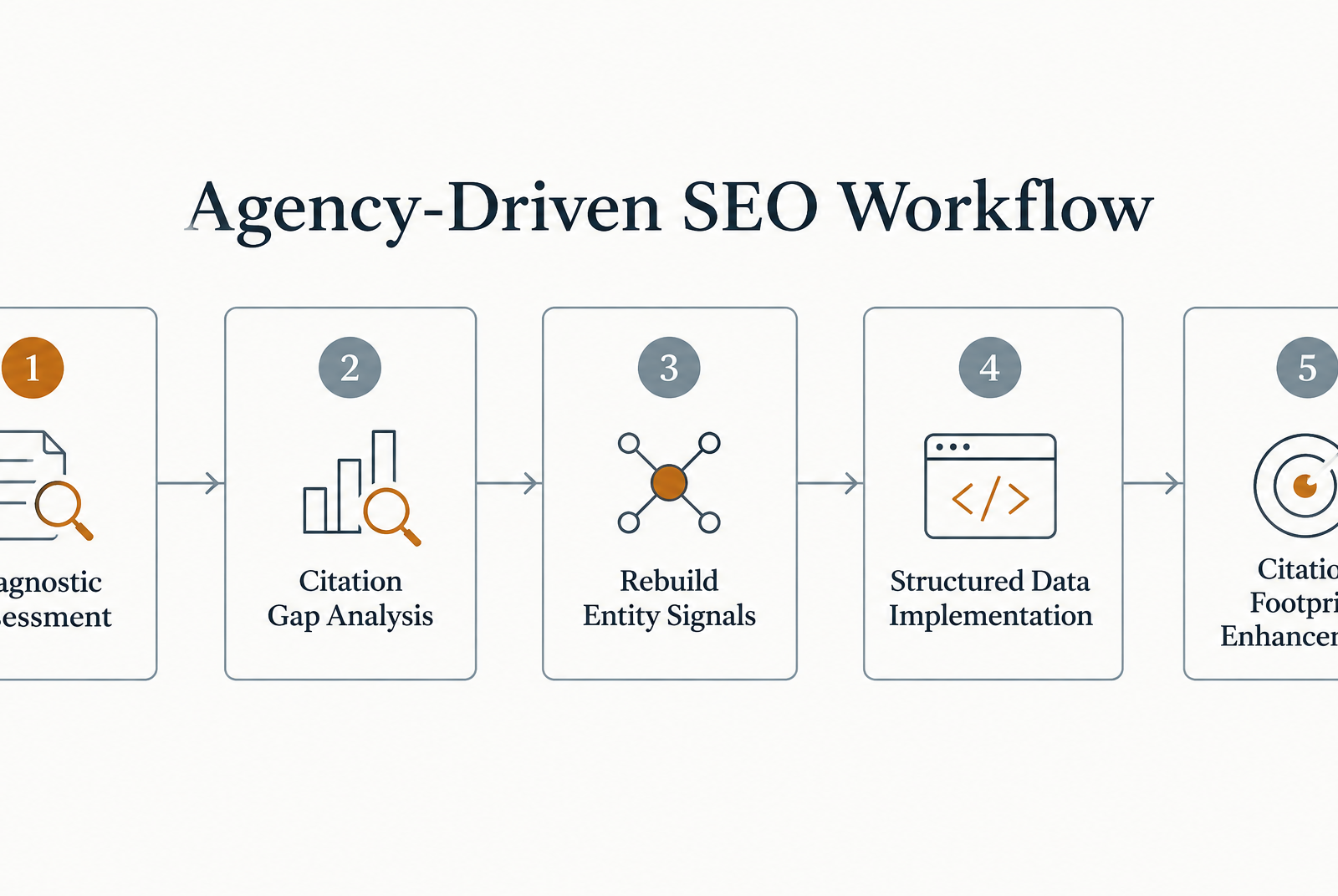
The fourth route drops the software entirely. Instead of running an AI content generation engine yourself, you hire a specialist agency to rebuild your entity signals, structured data, and citation footprint by hand. Onely sits at the front of this pack for enterprise fintech, and the approach is worth understanding even if you never sign a contract.
The pitch is diagnostic-first. Rather than opening with keyword volume, this kind of agency runs a citation gap analysis to find where and why your brand is missing or misrepresented in AI answers. That distinction matters for regulated finance, where the content feeding answer engines carries rate quotes and licensing claims a generic workflow would never flag.
The entity confusion agencies untangle by hand
Weak entity signals can leave an answer engine conflating your consumer lending product with your business credit line because the two look almost identical on your site. A specialist agency fixes this with structured data architecture that tells the model these are separate products with separate terms.
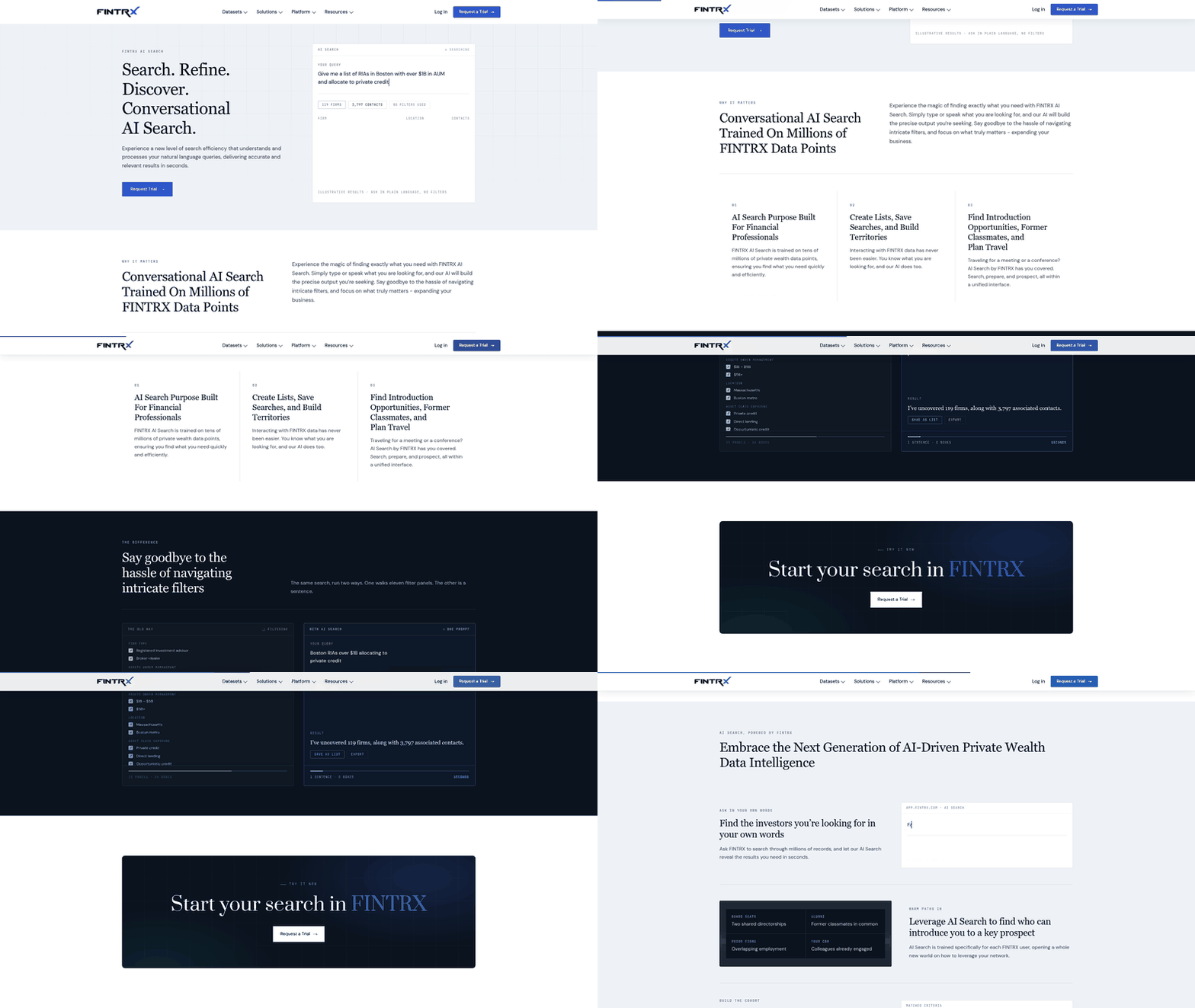
This is manual, senior-level work. It reads intent patterns through conversation-intelligence rather than keyword tools, which surfaces demand that volume data misses. For a multi-product fintech drowning in ambiguous entity signals, that hands-on disambiguation is the real value.
Where the agency model breaks down for fintech
Agencies are expensive and slow to scale. The strongest ones tend to retain clients over long stretches, which tells you the work is genuinely custom. It also tells you the engagement is a long, high-touch relationship, not a switch you flip.
The limitation is operational. Agencies are right to be skeptical of content velocity as the main AI SEO strategy for regulated, multi-product fintechs. But after the audit, roadmap, and schema work, someone still has to produce pages that match the new architecture. Many teams walk away with better foundations and the same publishing bottleneck.
That gap is where an automated engine like AnyPost.ai complements the agency model rather than competing with it. The platform scales SEO-optimized, voice-tailored pages through its Persona Engine while the agency handles the deep entity and structured-data plumbing. Some fintechs run both.
How the four alternatives compare
| Option | Best for | Key strength | Main tradeoff |
|---|---|---|---|
| AnyPost.ai (engine) | Scaling SEO-optimized pages | Voice-matched, SEO-ready output at volume | Not a bespoke entity-architecture service |
| Specialist AI SEO agency | Enterprise entity disambiguation | Manual citation gap analysis, structured data | Expensive, slow, thin content pipeline |
| Volume-first AI tool | High-output blogs | Speed of publishing | Compliance review debt scales with output |
| DIY in-house | Full control | No vendor lock-in | Needs GEO expertise you likely lack |
Pick the specialist agency if you're an established fintech with a genuine entity-confusion problem in AI answers and the budget for senior consulting. Skip it if your real bottleneck is producing enough clean, on-brand pages to support an already sound structure. That's a production problem, and no amount of hand-built architecture solves it by itself.
Agencies and content engines answer different questions. One fixes how models understand your brand. The other turns that understanding into a steady publishing system without forcing every article through a manual rewrite.
Alternative 5: Build structured pages programmatically, the Wise way
The fifth option is the one most fintech growth teams reach for first: build structured pages programmatically, at scale, and let volume carry the load. Wise is the example many fintech teams cite. The argument is that its structured library of banking-data pages gave AI answer engines clean, factual material to cite.
That's a genuine strategy, not a shortcut. The lesson from Wise isn't "publish more." It's that AI answer engines reward structured, factual, disambiguated data. The catch for regulated brands is that this same data (rates, codes, transfer fees, disclosures) is the content most exposed to error. Scale your AI content generation across thousands of template pages and you scale your review surface at the exact same rate.
The programmatic play Wise proved out
The mechanics are simple to describe and hard to execute cleanly. You take a factual dataset, template it, and generate one indexed page per entity. Each page answers a narrow, high-intent question an AI model can lift verbatim.
It works when the data layer is disciplined. Programmatic SEO fails when templates outrun governance: duplicated fields, stale source tables, unclear jurisdiction labels, or product names that are almost but not quite the same. Wise-style execution demands clean inputs before clever page generation.
Where content at scale breaks for fintech
The hidden cost is maintenance. A large programmatic build isn't finished when the pages go live. Every rate update, fee change, product renaming, or disclosure edit has to propagate cleanly through the system. If one template inherits the wrong field, that error repeats across the library.
That's the tradeoff most volume-first tools ignore, and it's where we position our approach differently. Our Persona Engine and Business Knowledge Library keep generated pages aligned to your voice and your source material, so scale doesn't cost you brand consistency. The fatigue toward generic, mass-produced pages is real too, and it reaches fintech buyers who quickly tune out content that reads like it was templated without care.
Skip the pure programmatic build if you lack the engineering to keep the dataset accurate daily. The strategy is only as safe as your slowest correction.
How the options compare
| Option | Core Feature | Pros | Cons | Pricing | Best For |
|---|---|---|---|---|---|
| Programmatic build (Wise-style) | Templated pages from structured data | Potential for direct fact extraction | Full accuracy burden on you; daily maintenance | Internal build cost | Data-rich teams with strong engineering |
| AnyPost.ai | Voice-tailored PSEO engine with Business Knowledge Library | On-brand, context-aware output; publishes to your existing site | Newer than legacy agencies | See pricing page | Fintechs scaling structured pages in a consistent brand voice |
The programmatic route earns its reputation. Just know that for a multi-product, regulated fintech, the winning move is controlled structure rather than raw page count. If you want that structure with content that stays on-brand and pulls from your own knowledge base, our voice-tailored, context-aware generation is built for exactly that gap.
Alternative 6: An analytics-led agency that ties content to revenue
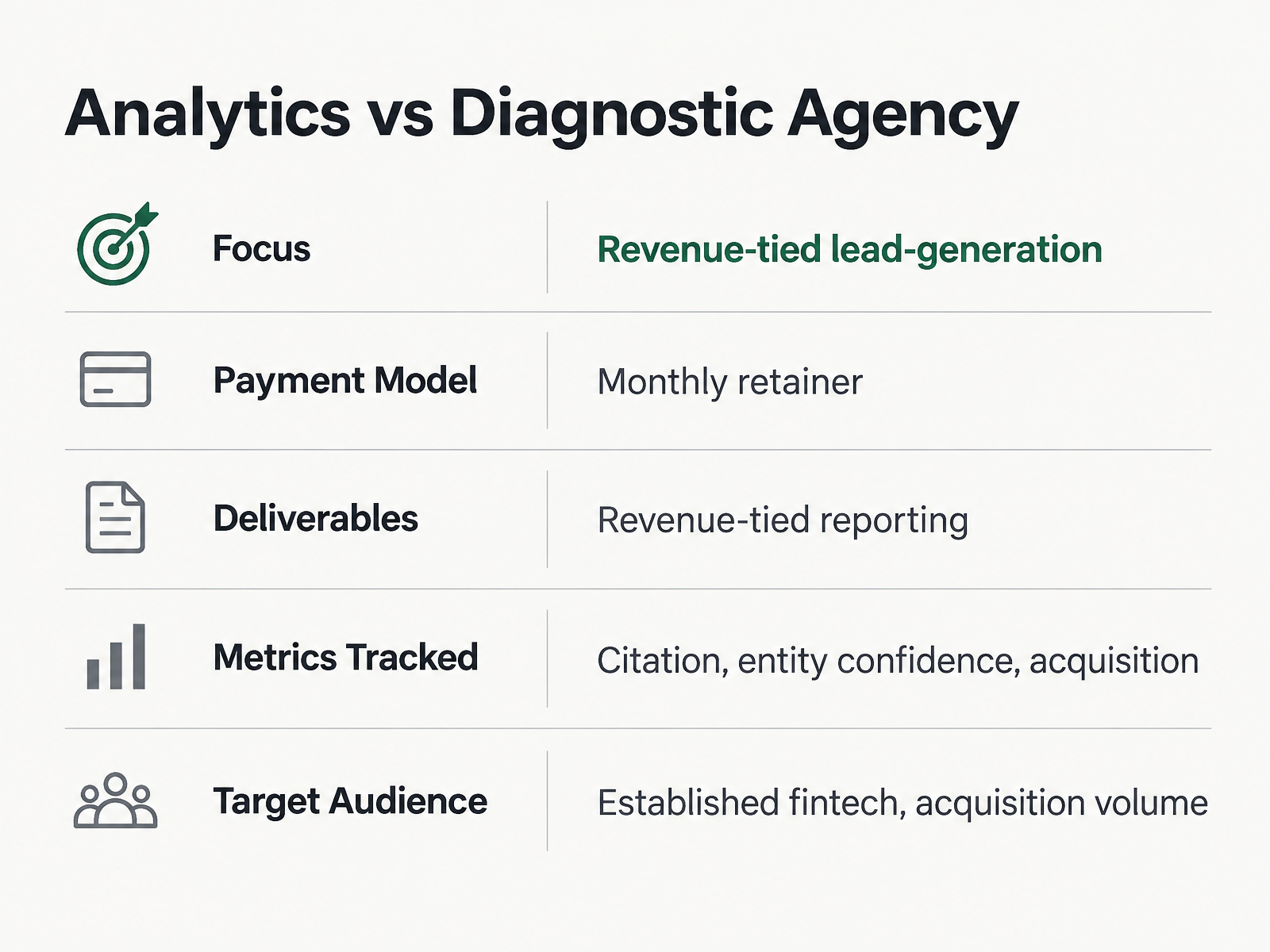
The sixth route keeps the agency model but swaps what you're actually paying for. Instead of a diagnostic-first shop, you hire a data-and-analytics team that lives inside your acquisition numbers. First Page Sage is one name in this category for established fintech, built around lead-generation-focused GEO rather than ranking reports. The appeal is that reporting ties back to revenue instead of rankings.
This route matters for AI content generation because the hard part in regulated finance was never producing pages. It was proving those pages moved sign-ups without tripping a compliance flag. An analytics-led agency measures output against citation frequency, entity confidence, and downstream acquisition, not the ranking proxies traditional SEO reports lean on.
The measurement trap nobody prices in
There's a real contradiction between the confident-metrics camp and the honest-uncertainty camp, and you should know about it before signing anything. Agencies in this tier prescribe firm KPIs: track citation counts, entity confidence scores, watch acquisition. Fair enough.
But many practitioners in the fintech content space counsel the opposite. Nobody can definitively say how to optimize for AI answer engines yet, and anyone claiming certainty deserves skepticism. Both camps are right. Measure rigorously, hold your optimization playbook loosely.
The distinction that matters is between measurement and certainty. A strong analytics partner can tell you whether visibility appears to be influencing pipeline, which pages correlate with better leads, and where branded prompts surface weak answers. It can't promise a permanent recipe for AI search, because the systems being measured are still changing.
Where this route fits, and where it doesn't
Hire an analytics-driven agency if you're an established fintech with real acquisition volume to attribute against and a compliance team already stretched thin. These engagements tend to hold up when the reporting connects to money.
Skip it if you're pre-revenue or running lean. The measurement machinery is overkill when you don't yet have acquisition data worth slicing, and the monthly retainer will outrun the value. At that stage, an automated content engine that produces fewer, structurally clean, SEO-optimized pages does more per dollar than a full analytics program.
How these options compare
| Option | Best for | Key strengths | Watch-outs |
|---|---|---|---|
| Analytics-driven agency (e.g. First Page Sage) | Established fintech with acquisition volume | Revenue-tied reporting, lead-generation focus, citation measurement | Retainer cost, overkill for early-stage teams |
| AnyPost.ai | SaaS and marketing teams scaling content and SEO | Voice-tailored generation via the Persona Engine, SEO-optimized articles at scale, real-time analytics | Newer category, less hands-on than a full agency |
The platform earns a row here for one reason: the most commercially useful AI-search assets are also the hardest to produce consistently under review. That makes an engine built for structured, SEO-optimized, disambiguated content a competitive weapon, not a cost center. If you want the analytics rigor without the retainer, automated content built for B2B lead generation closes more of that gap than most teams expect.

Alternative 7: Earn third-party citations through digital PR
The seventh route bets on everything outside your own website. Instead of pouring AI content generation into pages you own, a content-led digital PR agency earns mentions across the third-party sources answer engines actually quote. Siege Media anchors this category for fintech, built around editorial content and earned coverage rather than template pages.
This route exists because owned content is only part of the AI-search footprint. A fintech can have accurate pages on its own site and still lose visibility if respected publishers, comparison pages, forums, and affiliate properties describe the category without ever mentioning the brand. A content-and-PR agency is designed to influence that wider layer.
Earned coverage lives on sites you don't control
The logic tracks with how these engines read the web: entity relationships, structured data, and content architecture all matter, and they may be interpreted differently than in a traditional organic index.
A well-placed feature on a respected finance publication can strengthen your entity confidence in ways internal blog posts alone can't. The agency's job is producing linkable assets and pitching them until third parties carry your brand accurately.
The catch for regulated fintechs is that you lose direct control of the words. When a journalist paraphrases your rate structure or licensing status, no one on your team signs off first. Earned coverage builds reach, but it also scatters your claims across pages you can't edit.
Where this route fits and where it doesn't
Skip this option if your immediate problem is your own product pages being misrepresented in AI answers. Digital PR doesn't fix broken entity signals on your domain. It amplifies a foundation that already has to be clean.
It shines once your owned content is structurally solid and on-brand. At that point third-party reinforcement compounds. The two work as a sequence, not a substitute.
| Option | Best for | Core approach | Compliance control |
|---|---|---|---|
| Siege Media (content + PR) | Earned third-party citations | Editorial assets, digital PR outreach | Low (external editors control copy) |
| AnyPost.ai | Voice-tailored owned content at scale | Persona Engine and SEO-optimized publishing | High (owned, reviewable output) |
Pricing sits in the custom-retainer range typical of full-service content agencies, quoted against scope rather than published as a flat rate. These engagements often require a multi-month commitment before earned placements accumulate.
Pros: real reach into the citation sources you can't buy your way onto, plus brand authority that carries beyond search. Cons: slow to show results, no direct oversight of the final published wording, and it assumes your owned foundation is already correct.
The ideal buyer here is an established fintech with clean, disambiguated product pages and a brand story worth pitching. If your owned library still carries stale fee tables or conflated product lines, fix that first. We built our Persona Engine for exactly that owned layer, so the pages feeding both your site and any PR push already match your voice and stay reviewable before they publish. Earned coverage then reinforces a foundation you can actually stand behind.
Alternative 8: A multi-region agency for cross-border disclosure rules
The eighth route is built for fintechs that operate across borders. If you run products in the EU, the UK, and the US at once, every piece of AI content generation you ship has to clear three sets of disclosure rules, not one. Omnius sits at the front of this category, positioned for B2B SaaS fintech with European or multi-region operations.
The reason this deserves its own slot is simple. Multi-product complexity is hard enough on a single domain. Add multiple regions and your entity signals fracture across languages, legal entities, and regulatory regimes. A generic workflow treats those regional pages as interchangeable, but an answer engine reads them as separate entities, and so does a compliance reviewer in Frankfurt versus one in New York.
Multi-region disclosure multiplies your review surface
The core problem here is disambiguation at scale. When your lending product exists under several legal wrappers, weak entity signals let AI models blur them together, and the fee or licensing data they surface may belong to the wrong jurisdiction entirely.
That parsing gap is exactly what bites multi-region fintechs. An agency in this tier rebuilds structured data and entity architecture region by region, which is genuinely useful work. The catch is cost and speed. Agencies at this level rarely publish rates, engagements run long, and every regional variant still lands in a compliance queue before it goes live.
Skip the pure-agency route if your bottleneck is production volume rather than architecture. Paying agency rates to hand-build hundreds of regional pages is slow and expensive when the real need is region-specific pages at speed.
Where this route fits against a voice-tailored engine
| Option | Best for | Model | Content handling |
|---|---|---|---|
| AnyPost.ai | Scaling region-specific pages with Programmatic SEO | Voice-tailored content engine | Brand voice applied during generation via Persona Engine |
| Omnius | Multi-region B2B SaaS fintech | Agency, architecture-first | Manual review per regional variant |
The distinction that matters: an agency fixes your structure once, then you're back to producing content yourself. Our Persona Engine shapes each regional page to your brand voice during generation, so the output is already on-tone instead of waiting for a rewrite.
Pros of the multi-region agency route: deep entity architecture, jurisdiction-aware structured data, and specialists who understand European regulatory nuance. Cons: opaque pricing, long timelines, and a production bottleneck that returns the moment the engagement ends.
The ideal buyer for Omnius is an established multi-region fintech with budget for a long architectural rebuild and a compliance team ready to review each variant. If you instead need to publish region-specific pages fast at volume, an engine that generates on-brand content through Programmatic SEO and applies your voice at the generation step is the better economics.
The bottom line on fintech AI content generation
After walking through eight routes, the honest answer is that no single option wins for everyone. The right pick depends on your team size, your regulatory load, and whether you own the compliance risk that comes with every page you ship.
Here's how we'd match each option to a real situation. The choice tends to come down to one question more than any other: can you scale search visibility without turning your published library into an audit liability? That's what separates the budget picks from the enterprise ones.
Which option fits your budget and team?
| Option | Best For | Key Strength | Watch-Out |
|---|---|---|---|
| AnyPost.ai | Scaling on-brand content in-house | Persona Engine bakes brand voice into generation | Newer than legacy agencies |
| Programmatic (Wise-style) | Data-rich reference libraries | Structured, disambiguated entity pages | Scales your review surface at the same rate |
| Onely | Enterprise entity disambiguation | Citation gap diagnostics before writing | Diagnostic-first, slower to publish |
| First Page Sage | Established fintech tied to acquisition | Lead-generation focus, revenue-linked reporting | Analytics focus, premium cost |
| Siege Media | Earned third-party citations | Digital PR across sites you don't own | Slower, less control over output |
| Omnius | EU/UK/US multi-region operators | Multi-region disclosure handling | Built for cross-border complexity |
If budget is the constraint, an automated engine you run yourself beats retainer agencies on cost per page. You keep the output in-house and avoid turning every campaign into a scoped consulting engagement. The tradeoff is that you own the review workflow, so the tool has to keep your output on-brand by default, not as an afterthought.
What works best for enterprise fintech?
For enterprise brands with multi-product architectures, we lean toward diagnostic-first agencies. Onely's approach of running a citation gap analysis before touching a page makes sense when AI models are conflating your lending tiers or dropping your licensing data. That structural work is hard to replicate with volume alone.
The catch is speed. A diagnostic engagement won't fill your content calendar. Pair it with an engine that handles the ongoing publishing once the entity architecture is clean.
What we'd actually do
Skip high-velocity content flooding. It's the wrong move for regulated finance. It expands the amount of material compliance has to supervise without necessarily improving the signals answer engines rely on.
The winning pattern is narrower: structurally clean owned pages, disciplined source data, and earned reinforcement on sites you don't control.
That's where a voice-tailored generation engine earns its slot. For fintech teams that want to scale search visibility, we built AnyPost.ai to bake your brand voice into content at the generation step through its Persona Engine, not as a rewrite queue after the fact.
Whichever route you pick, measure against citation frequency and downstream sign-ups, not ranking position. And hold your playbook loosely. Nobody has fully mapped AI search yet, so treat any vendor claiming certainty with a healthy dose of skepticism.
FAQ
Does publishing more content help a fintech brand get cited more in AI answers?
Not by itself. A larger library only helps when the pages are accurate, differentiated, and easy for answer engines to interpret. For fintech teams, the better question is whether each new page clarifies the brand's entities, products, and claims. If it does not, publishing more can create more material to govern without improving search visibility.
Can I use a specialist SEO agency and an automated content engine together?
Yes. The pairing works when responsibilities are clear: the agency handles architecture, diagnostics, and entity cleanup, while the engine handles ongoing production in a consistent brand voice. That combination gives you senior strategic work without depending on consultants for every new page.
What happens if an AI answer engine confuses two of my products?
Product confusion usually points to weak naming, schema, internal linking, or page structure. The practical fix is to separate the products more explicitly across the site and make their terms, use cases, and eligibility rules easier to distinguish. For complex fintech architectures, that often requires specialist help before content scaling begins.
When is a cheap, generic content tool the smarter choice for a fintech?
Use a generic tool when the content is truly low stakes: no regulated claims, no product terms, no pricing details, and no disclosures that need review. Once your pages start carrying financial specifics, the savings can disappear quickly because every draft needs more careful checking before it is safe to publish.