How Search Console CTR Data Should Steer Your Automated SEO Pipeline

Quick Summary
Most automated SEO pipelines spend their time on keyword tracking and backlink monitoring. That’s not where the leak is. The part that gets missed is knowing which pages are bleeding impressions right now, and which levers actually move them.
When you automate content creation at scale, gut instinct can’t prioritize rewrites. Some pages pull thousands of impressions and convert almost none into clicks. Others rank well but stay functionally invisible. The fix for each is different, and your pipeline needs to tell them apart before it spends resources on either one.
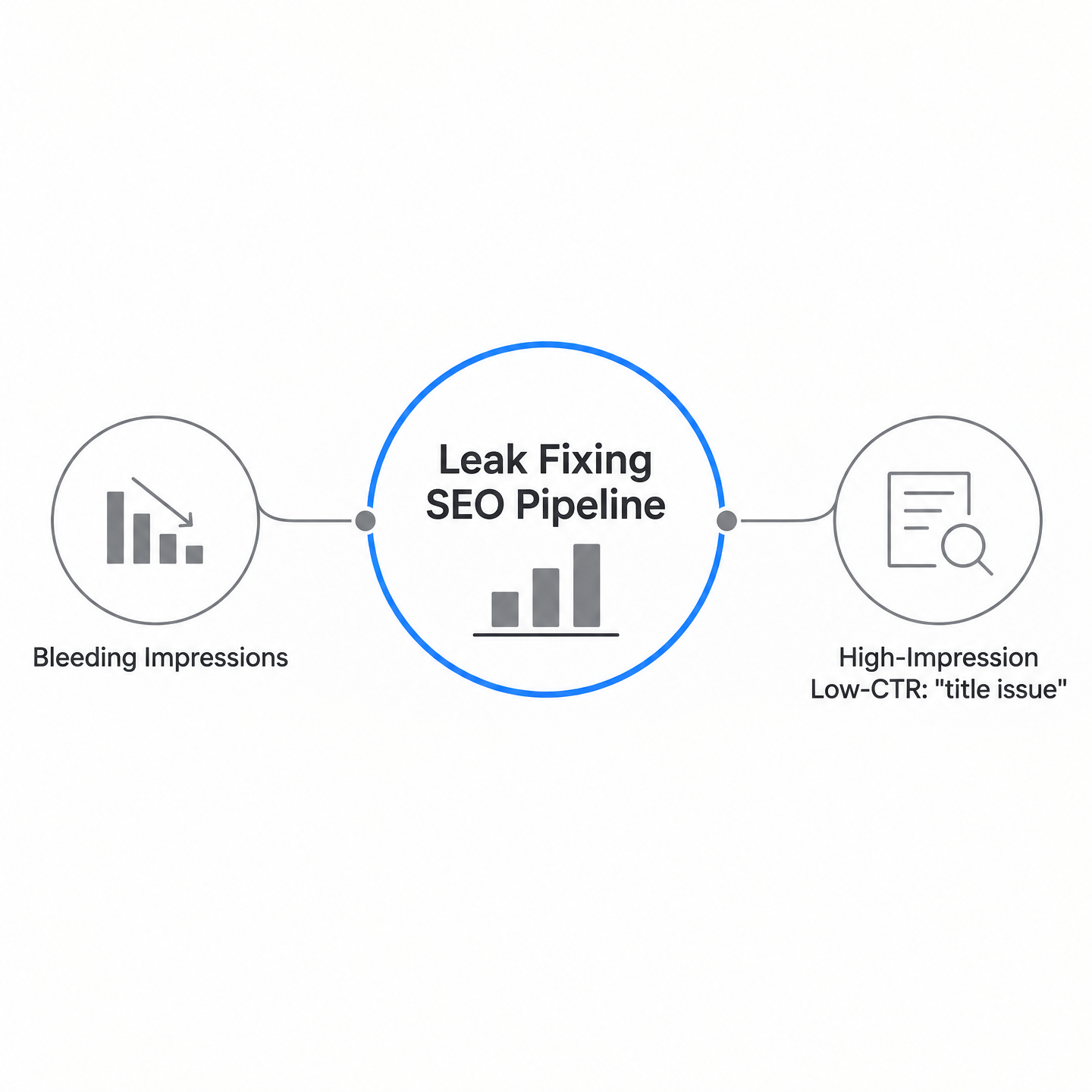
The GSC columns that steer automation decisions
Four metrics from Google Search Console drive most prioritization: Impressions (how often your page appeared in results), Clicks (how many people actually visited), CTR (clicks divided by impressions), and Average Position (where you ranked on average). Impressions and position tell you whether the page is visible. CTR tells you whether that visibility turns into traffic.
Use the SERP layout to choose the fix before applying a universal CTR cutoff.
| SERP type | Signal from Search Console | Automation rule |
|---|---|---|
| Clean organic | High impressions and low CTR; top three organic results capture roughly 68.7% of clicks, so weak snippet copy is the likely leak. | Rewrite the title or meta description first. |
| Featured snippet / answer box | Decent CTR at a lower position; answer-box framing can influence where people click first. | Treat it as a rank and visibility problem: content depth and backlinks, not snippet rewrites. |
| AI Overview present | High impressions and extremely low CTR; AI Overviews appear on about 31% of searches. | Citation-optimized opening paragraphs, because some users click cited sources inside the answer instead of the blue links. |
The numbers route the work.
Position-aware CTR tiers beat universal cutoffs
Universal CTR cutoffs are too blunt. A page near the top of the results with CTR below the typical benchmark for that position is underperforming on snippet quality. A page further down the rankings with the same CTR may be overperforming, and it needs rank help, not snippet rewrites.
When an AI Overview appears, the old CTR expectations shift. Pages with high impressions and extremely low CTR belong at the front of your rewrite queue, regardless of position. Those are the ones where snippet copy changes deliver immediate returns.
We see teams waste resources running heavy content updates on pages that only need better snippet copy. Pull Search Console data on a regular cadence, segment by whether an AI Overview is present, and sort by impression volume times CTR gap. The pages at the top of that list are your highest-return automation targets.
Quick Answers
- Pages with high impressions but low CTR usually need snippet rewrites. Low-impression pages tend to need content depth and backlinks to climb.
- The top three organic results capture roughly 68.7% of clicks. Position one alone pulls more than positions three through ten combined.
- When AI Overviews show up, position-one CTR drops well below what the same ranking would usually earn on a clean SERP.
- AI Overviews now appear on about 31% of searches, and cited sources inside them often outperform the traditional top organic results.
- Search remains one of the main ways buyers discover, compare, and vet companies before contacting sales.
- A ten-minute title rewrite on a high-impression page can add measurable clicks without changing rank, especially when the page has conversion potential.
- Position-aware CTR segmentation prevents wasted automation resources on pages that are already winning their search format, especially when AI Overviews are present.
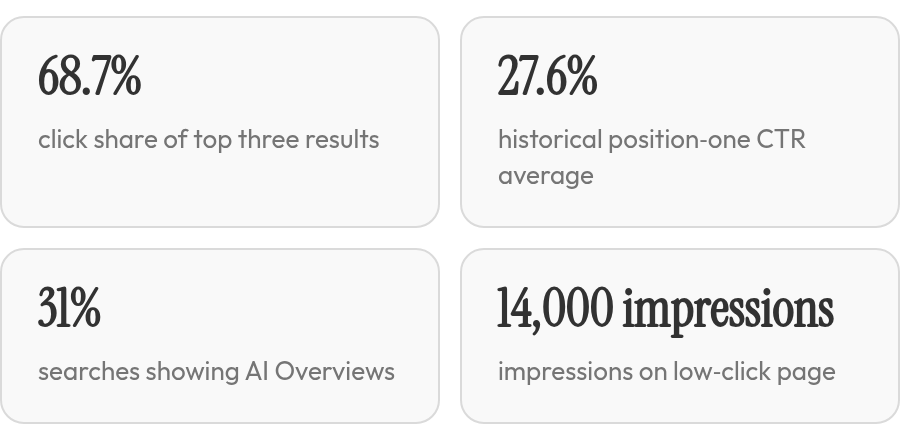
Why Search Console CTR matters
In SEO automation, you’re not fixing random pages. You’re fixing pages Google already shows thousands of times but nobody clicks. That’s the difference between wasted visibility and earned traffic.
CTR tells you whether searchers choose your result after Google shows it to them. A page with 14,000 impressions and 40 clicks looks more like a snippet problem than a ranking problem: the searcher saw the result but had no reason to click.
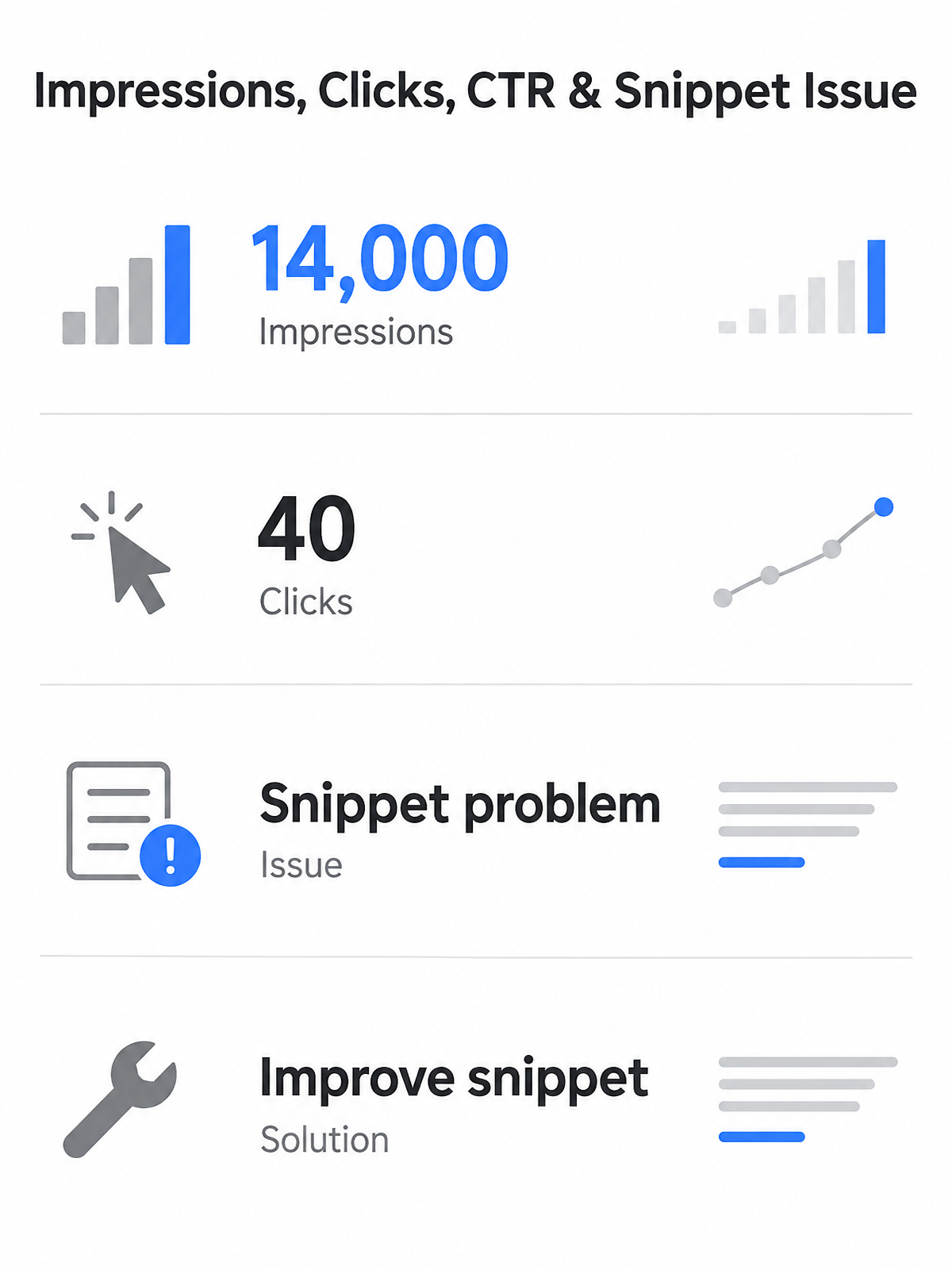
The click gap shows where automation should start
Click distribution is heavily concentrated at the top of organic search, but the old clean-SERP curve isn’t reliable anymore. A result can hold a strong position and still lose attention to newer search features that answer the query before the user ever reaches the blue links.
When an AI answer sits above your listing, the usual relationship between rank and traffic changes. Visibility still matters, but citation placement and answer-box framing can influence where people click first. In that layout, many users click cited sources inside AI Overviews rather than scrolling to standard organic listings.
That means your pipeline can’t treat CTR as one universal threshold. The same percentage can signal a serious problem on one search results page (SERP) and healthy performance on another. Segment reporting by SERP type, or you’ll trigger rewrites on pages that are already winning their format.
Revenue sits in the funnel you can’t see
Search remains one of the main ways buyers discover, compare, and vet companies before contacting sales. Most teams still don’t connect Search Console to pipeline reporting, so they treat CTR as a marketing metric instead of a revenue lever.
The math is blunt. When a page earns thousands of impressions but almost no clicks, even a modest CTR improvement can deliver measurable traffic. On commercial pages, that lift matters because the visitors you recover are already searching for the topic you serve. Teams that test title formats (especially those with specific numbers or clear value propositions on high-intent pages) often see CTR lifts substantial enough to justify the automation overhead.
Search Console shows which pages bleed impressions right now. Your pipeline should read that data consistently, flag the highest-volume underperformers, and route them to the right fix: title rewrites for strong-ranking pages with weak click appeal, content depth for URLs sitting just outside the strongest visibility zone, and citation-optimized first paragraphs for queries that trigger AI answers. The cost of ignoring CTR isn’t just lost clicks. It’s lost deals you never knew existed.
Decoding the CTR funnel: metrics that actually drive action
SEO automation needs more than a list of pages and rankings. You need a triage system that tells you which pages are worth the time, what kind of fix they need, and how much traffic the fix could bring. That system lives in your Search Console data, and the funnel it describes (impressions to clicks to conversions) determines where the pipeline spends energy.

What the impressions → clicks → position funnel actually tells you
Impressions show where Google already thinks you might be relevant. A URL with steady exposure isn’t invisible. It’s been given a chance to earn the visit. If that exposure produces only a thin trickle of clicks, the first question isn’t whether the article needs another thousand words. It’s whether the search result gives users a reason to choose it.
CTR is clicks divided by impressions, expressed as a percentage. Search Console pairs it with average position to show whether visibility is turning into visits. The math matters because small lifts compound fast. Even a modest improvement (moving from 0.5% to 1.2% on a page with 8,000 monthly impressions) adds 56 new visits per month. That’s traffic you earn without changing rank, building links, or publishing new content.
Position tells you how hard you need to work, but it doesn’t explain the entire result page. When generated answers, rich elements, shopping modules, videos, or other SERP features appear, the same ranking can produce a very different traffic outcome. Your pipeline should evaluate the page environment, not just the numeric rank.
The dropoff after the top results is sharp, but it isn’t uniform. Lower first-page positions often behave similarly, so a tiny ranking move may not change the business result. If you’re stuck near the bottom of page one, climbing one slot is rarely enough. You need to break into the higher-visibility band or chase a citation slot in the AI answer itself. The pipeline needs to detect which scenario applies before it decides whether to rewrite the title or rebuild the page.
Automating the low-CTR opportunity loop
The closed-loop workflow matters more than the individual tools in SEO automation. You need a system that spots underperforming pages in Search Console, assigns them a fix, executes that fix, waits for enough new data to judge the outcome, and feeds the result back into the next decision. The loop runs continuously, and each iteration gets smarter because it remembers what worked last time.
What does a low-CTR detection rule look like?
Start with a filter that pulls pages meeting three criteria: meaningful impression volume, first-page or near-first-page visibility, and CTR below the benchmark for that position. If a page gets strong exposure but almost no clicks, Google has already tested it in front of searchers. The weak point is likely the promise made in the result.
Your detection rule should group results by URL, attach the top five queries driving impressions, and assign an action type: title rewrite, meta refresh, intent review, or full content update.
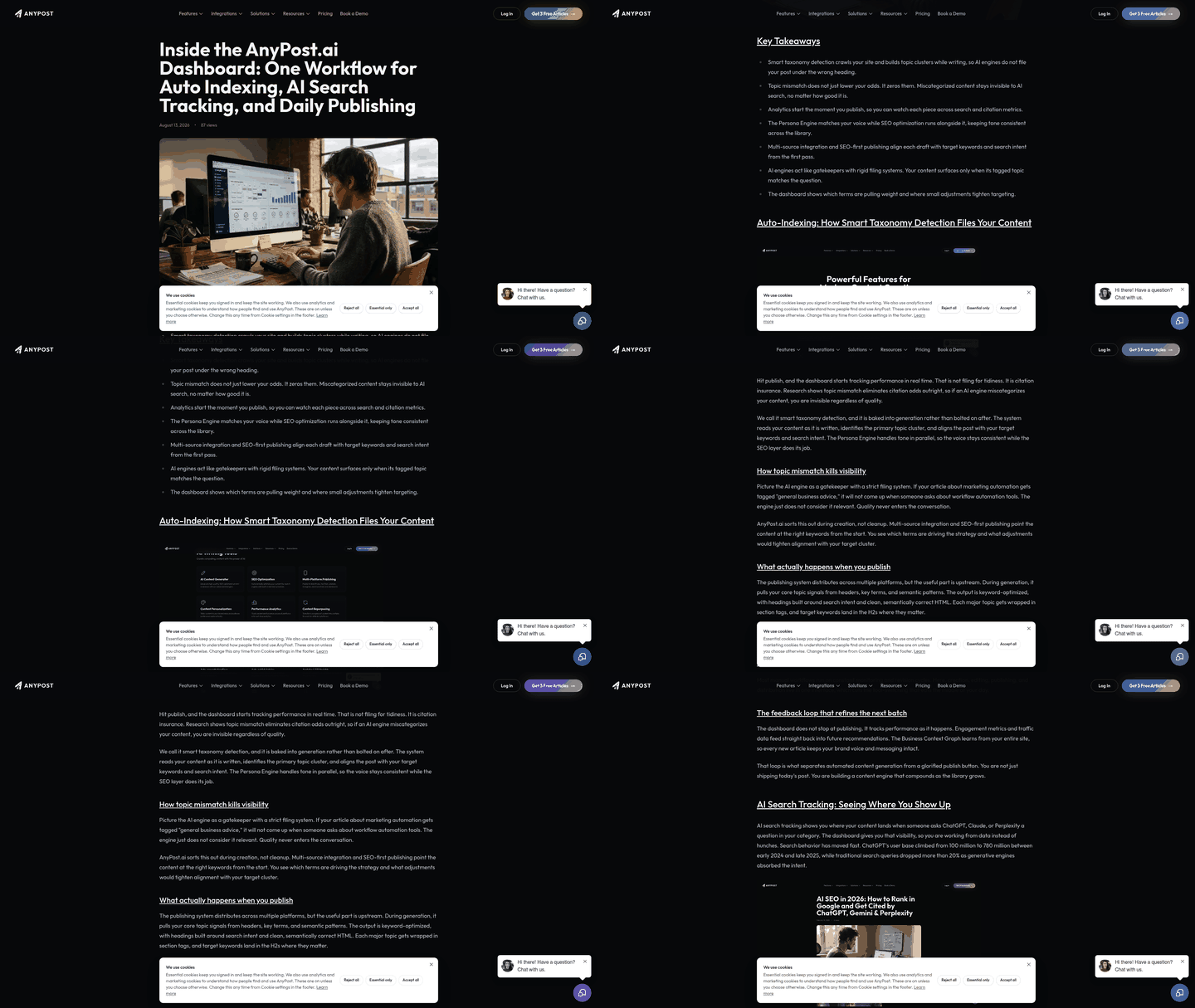
You don’t need a custom GSC API setup to make this work. Export a recent slice of Search Console data, apply thresholds for visibility and underperformance, then sort by impression volume descending. The highest-exposure rows become your first queue because they offer the clearest upside if the snippet improves.
How do you decide between a quick fix and a full rewrite?
Resource trade-offs drive the answer. A title or meta description change takes ten minutes. A full content refresh takes two hours. The decision hinges on whether the problem is presentation or substance.
If the page ranks well but the title is generic, boring, or missing the primary query, start with a title rewrite. Small changes to titles and meta descriptions can often lift CTR meaningfully when the underlying content already satisfies intent. If the page ranks poorly and the queries don’t match the content, you need a content update.
Use a simple expected-traffic formula before choosing a fix: current clicks = impressions × current CTR; expected clicks = impressions × expected CTR; incremental clicks = expected clicks − current clicks; then multiply incremental clicks by conversion rate for estimated conversions. A title rewrite takes ten minutes, while a full content refresh takes two hours, so compare those time costs directly. For example, moving from 0.5% to 1.2% CTR on 8,000 monthly impressions adds 56 visits per month before any rank change.
High-impression pages can be checked more frequently than lower-volume pages, which need additional time and fresh impressions before you can judge whether the last change helped or hurt. Build that wait logic into your queue so you’re not testing changes on noise. Track each experiment in a structured file with before-and-after CTR, position, and an outcome label: improved, flat, or regressed. The next suggestion reads that history and adjusts.
Keywords can behave unpredictably when removed or rephrased in a title. The history file flags regressions, and the next iteration tries a different format. That feedback loop is what separates a one-time optimization from a repeating pipeline.
Quick Questions, Straight Answers
What CTR should I expect if my page ranks in position one but an AI Overview appears above it?
Do not judge it against a clean-SERP benchmark. Compare it against pages facing the same result layout, then check whether your URL is cited in the generated answer or only listed below it. A top organic rank can still underperform if the AI block satisfies the query first.
How often should I pull Search Console data to catch underperforming pages before they waste more impressions?
Use a steady review cadence for high-exposure URLs and give quieter pages a longer measurement window. The key is not speed alone; it is collecting enough fresh impressions after each change to separate real movement from normal fluctuation.
When should I rewrite the title instead of rebuilding the entire page?
Rewrite the title when the page already has solid visibility and the content matches the query, but the result looks generic or unclear. Rebuild the page when rankings are weak because the content misses the intent, lacks depth, or attracts queries it does not properly answer.
How do I know if a title change actually worked or just rode a seasonal traffic spike?
Record the change date, compare CTR alongside position and impressions, and avoid judging the test until the page has enough post-change exposure. Label the result as improved, flat, or regressed, then feed that outcome back into the next optimization cycle so the pipeline learns which title formats work by page type.