
Is SEO Worth It? How to Calculate the ROI of SEO Investment

Key Takeaways
- SEO ROI is gain minus cost, divided by cost. Spend $10,000, drive $40,000 in revenue, and you've got a 300% return.
- You only need two real inputs: what SEO cost you, and what organic search actually earned.
- Costs are the easy side. Agency fees or salaries, software, content production, month over month.
- Lifetime value beats first-purchase value. A customer who renews for three years is worth far more than a single checkout.
- For recurring-revenue businesses, the ROI picture changes completely once you swap single-sale numbers for lifetime value.
- Revenue is where people fudge the numbers, usually on themselves. The arithmetic is trivial; the honest data isn't.
- Brand-awareness "wins" only count in the numerator if you can tie them to actual dollars.
Quick Summary
SEO ROI answers one question: does the money you put into organic search come back as more revenue than it cost? Take the revenue organic search generated, subtract your total SEO costs, divide by those same costs, multiply by 100. That's your return as a percentage.
We run this for our own content programs constantly, and the math is never the problem. Getting honest numbers into it is. So here's what matters before you touch the formula.
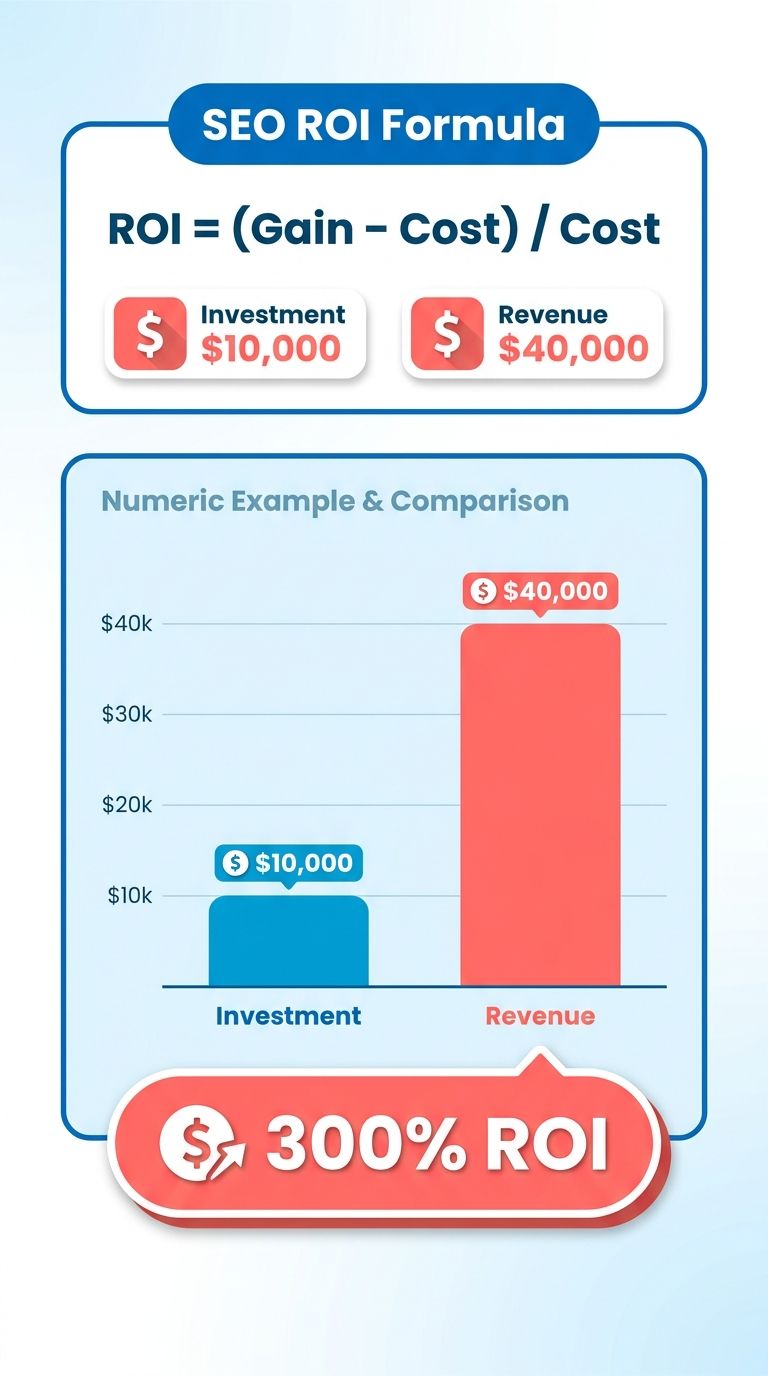
What you actually need to calculate it
You have to isolate organic search from every other channel. Track every dollar spent on search-related work, then match it against the conversions that work produced.
Expenses are easy to track. Attributing revenue accurately is where the discipline comes in. And use a customer's total lifetime value, not just their first transaction, if you want a realistic number. That's doubly true for subscription models, where the first conversion is just the start of the revenue stream.
The three things that carry the weight
- Know what you're measuring. ROI compares real gains against costs. Chase metrics that hit your bottom line, not soft indicators you can't attach a dollar to.
- Track costs and revenue separately, then combine. Log every dollar spent and every dollar earned from organic conversions. Attribution is the whole game.
- Pressure-test vendor promises. An agency guaranteeing a specific ranking or a fixed ROI by a fixed date is a red flag. SEO compounds over months, and nobody controls Google's algorithm.
How long it takes, and how hard it is
A basic ROI calculation is an afternoon of work once your analytics are set up. Pull organic conversions, sum your costs, run the formula. Low on math, high on data hygiene.
Here's how the common approaches stack up:
| Method | Effort | Difficulty | Best For |
|---|---|---|---|
| Basic formula (revenue − cost / cost) | ~1 hour | Easy | A fast, top-line read |
| Conversion-value model (searches × CTR × conversion × LTV) | Half a day | Medium | Forecasting before you invest |
| Full attribution with analytics platform | Ongoing | Hard | Mature programs proving incremental revenue |
Start with the basic formula to get a number you trust. Graduate to the conversion-value model when you're forecasting future spend. Skip full multi-touch attribution until your organic channel is big enough to justify the setup. For a five-page site with two blog posts, that machinery is overkill.
One caveat worth stating upfront: SEO ROI looks weak in month one and strong in month twelve. It's a long game. Judge it on a rolling basis, not a single snapshot.
Forecasting SEO Results
Forecasting means predicting the traffic, revenue, and ROI your organic search efforts will produce before you commit the full budget. You build the prediction from past performance, keyword data, and conversion math. About half of all marketers use forecasting to shape strategy, and for good reason: it turns a vague bet into a defensible number you can take to a CFO.
Two models worth knowing
Two approaches dominate: historical trend modeling and keyword opportunity modeling. The first projects forward from your own past data. The second builds a revenue estimate from search volume and conversion assumptions.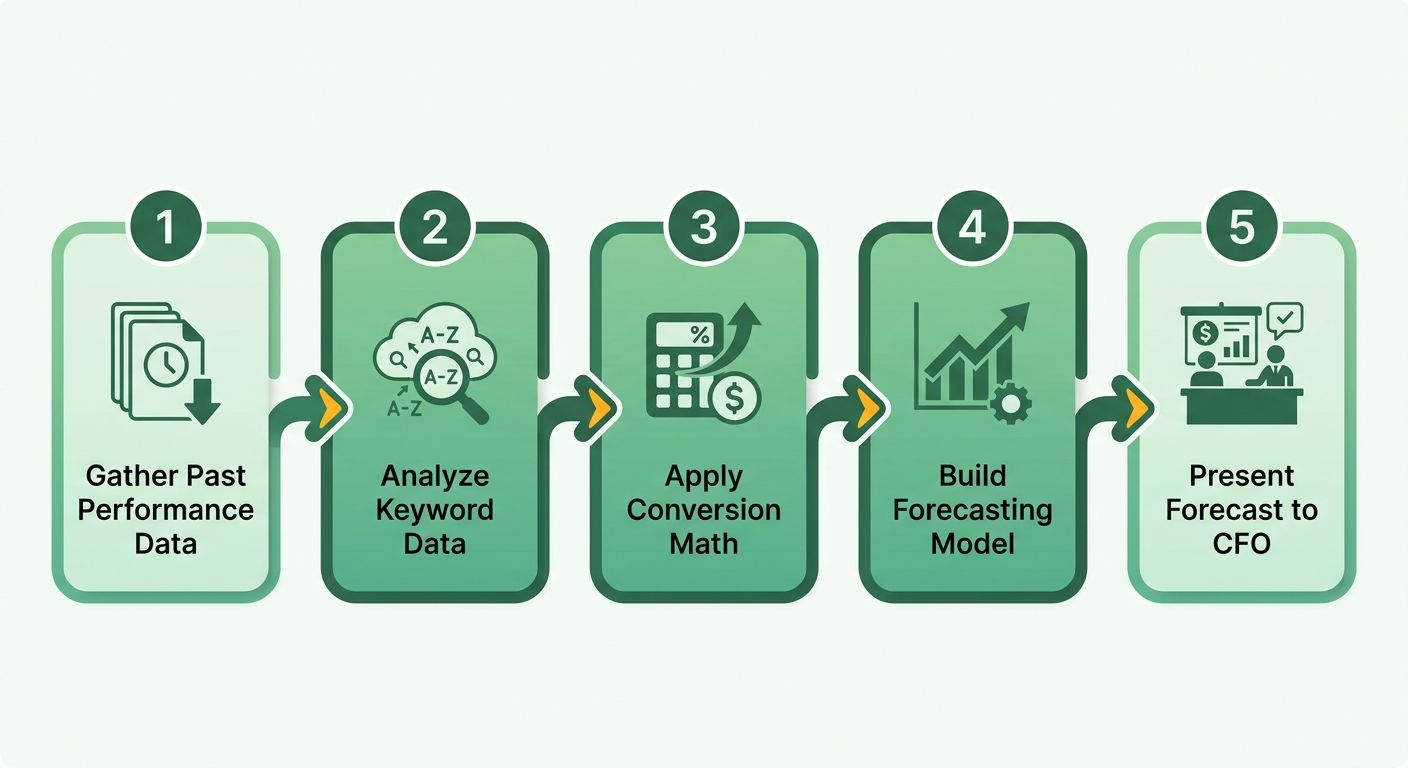
The keyword opportunity model maps search volume to expected user actions. You estimate how many searchers will click through, what percentage will buy or sign up, and the average value of those conversions over time. It projects revenue from market demand rather than history:
Projected revenue = Monthly searches × CTR × Conversion rate × Customer value
Historical trend modeling suits sites that already have traffic. Look at how rankings and organic revenue moved over the past several quarters, then extend the curve. Less useful for brand-new sites with nothing to anchor the projection.
Why historical data beats industry averages
Past performance is the most reliable input you have. Your real click-through rates, real conversion rates, real seasonal swings beat industry benchmarks every time. Feed actual numbers into a forecast and the output stops being a guess.
Pull 12 months of organic data if you have it. Look at which pages gained rankings, how traffic converted, where seasonal peaks landed. A retailer whose organic sales climb every back-to-school season will understate Q3 if the forecast ignores that pattern.
The catch: historical data assumes the future looks like the past. Algorithm updates and new competitors break that assumption fast. Treat your projection as a range, not a single point, and revisit it every quarter as fresh data arrives.
Forecasting isn't a one-time calculation. Semrush puts it plainly: predicting SEO results demands a deep understanding of your industry and shifting market trends, because the same keyword behaves very differently across sectors.
A worked example
A software company targets a keyword cluster with 10,000 monthly searches. They expect a 5% click-through rate from a top-three ranking, a 3% conversion rate, and an LTV of $1,200.
Run the math: 10,000 × 0.05 × 0.03 = 15 customers per month. At $1,200 LTV, that's $18,000 in projected monthly revenue, or $216,000 a year. If the campaign costs $60,000 annually, the forecast points to a strong return before a single article ships.
Use that number to decide which clusters get resourced first. High projected revenue plus low difficulty deserves priority. This is where forecasting earns its keep: it stops you spreading budget thin across terms that will never pay back. Paid channels deliver faster traffic, but the e-commerce research is clear that SEO wins on long-term returns, and forecasting is how you make that case up front.
Understanding SEO Costs
SEO costs fall into three buckets: content creation, link building, and tools. These feed the cost side of your ROI formula. Get them wrong and every ROI figure downstream is fiction.
Most teams underestimate the first bucket. Content is where the real money goes, and where the hidden hours pile up.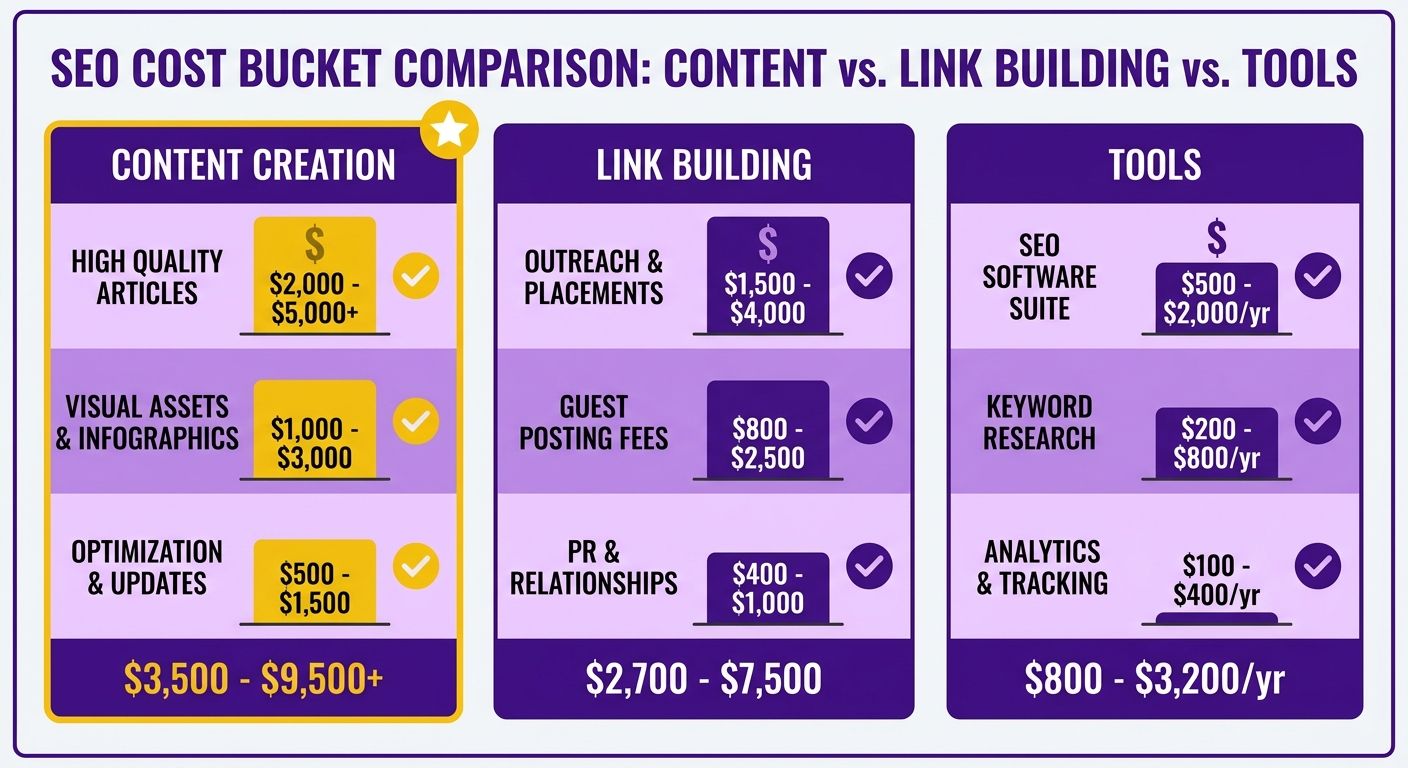
What content actually costs
Content is the largest recurring expense in most SEO programs. You're paying for research, writing, editing, and publishing. In-house, freelance, or agency, each article carries both a dollar cost and a time cost.
A single well-researched article can take several hours to a full day. Multiply that across even eight posts a month and the labor adds up fast. Which is why 60% of marketers name content creation as one of their top SEO challenges.
Costs scale with depth. A short blog post runs cheaper than a 2,000-word pillar page backed by original research and expert review. When you tally monthly SEO cost, count writer fees, editor time, and any images or design work per piece.
Where automation cuts the bill
Automation tools drop the per-article cost by speeding up drafting and research. Instead of paying for every draft from scratch, you generate a strong first version and spend budget on editing and fact-checking. That shifts hours away from the most expensive part of the process.
A team publishing 12 articles a month that halves its drafting time frees up hours for strategy and promotion, which lowers the effective cost per published piece. The AnyPost automation approach applies the same logic across formats.
What link building costs
Link building is the second major cost, priced per link or per campaign. You pay for outreach, relationship building, and sometimes the placement itself. A single quality backlink runs anywhere from a modest fee to several hundred dollars, depending on the authority of the linking site.
Time is the hidden expense. Outreach means sending emails, following up, negotiating placements. That labor competes directly with your content hours.
Strategies range from guest posting to digital PR to broken link building, each with a different cost-to-result ratio. Guest posting is cheaper per link but slower. Digital PR costs more upfront but can earn multiple links from one campaign.
What tools cost
SEO software is your fixed monthly cost, and the easiest bucket to calculate. Subscription fees for keyword research, rank tracking, and analytics. Most teams run at least one all-in-one platform plus a separate analytics tool.
Budget for three categories: keyword research tools, rank tracking software, and analytics platforms. A small team might spend a few hundred dollars a month; a larger operation with multiple seats spends more.
Add every subscription into your total. Skip tool fees and you inflate ROI on paper while hiding the true price of your program.
Why this calculation isn't optional
Most marketers treat SEO as a cost line they can't really justify. Wrong frame. Calculate SEO ROI and organic search stops being a vague brand activity and becomes a measurable revenue driver you can defend to any budget committee.
The stakes are real. Roughly 70% of marketers call SEO a crucial part of their overall strategy. Yet a large share of those same marketers can't tell you what their SEO program returned last quarter. That gap between commitment and accountability is exactly where budgets get cut.
Who pays for not measuring
B2B marketers, digital strategists, and growth leaders feel this most. Long sales cycles, messy attribution, executives who want numbers. Without an ROI calculation, every budget conversation becomes a defense of intuition instead of a presentation of data.
It gets worse with outside partners. No ROI framework, no real way to evaluate an agency or consultant. Set clear financial benchmarks upfront and both your internal team and external partners agree on what success looks like, which moves the conversation off vanity metrics and onto actual growth.
The three problems it solves
Budget allocation becomes defensible. Show that a specific content investment generated $X in organic revenue and you can make the case for more. You can also kill programs that aren't working. Without the math, you're guessing at both.
Vendor evaluation gets grounded. Instead of fixating on rankings, which don't pay the bills, an ROI framework forces you to look at conversion rates and customer acquisition costs. Easy to see whether a partner is delivering real value or just generating empty traffic.
Long-term vs. short-term trade-offs become visible. Research comparing SEO against paid channels consistently shows SEO delivers superior long-term ROI even when paid generates faster early traffic. Knowing your number lets you model that trade-off honestly instead of defaulting to paid because it's easier to attribute.
The real risk of skipping it
Skip the calculation and you're flying blind on two fronts. You don't know if SEO is working, and you don't know if it's worth scaling.
Data-driven decisions require actual data. Without attributing revenue to organic search and comparing it against total SEO costs, you're making channel calls on gut feel. That's a losing position when budgets tighten and every channel has to justify its spend.
The calculation also guards against misleading reports. A campaign might show huge growth in organic impressions or clicks, but if those visitors don't convert, it's a net loss. Ground your reports in financial return and you stop scaling campaigns that only look good on paper.
Calculating Revenue from Organic Search
Revenue from organic search is the dollar value that visitors from unpaid search results generate. You calculate it by multiplying three numbers: organic traffic, conversion rate, and value per conversion. That last figure is average order value for e-commerce, or lifetime value for lead-based and subscription businesses.
This number goes on the gain side of your ROI equation. Get it accurate and everything downstream holds up.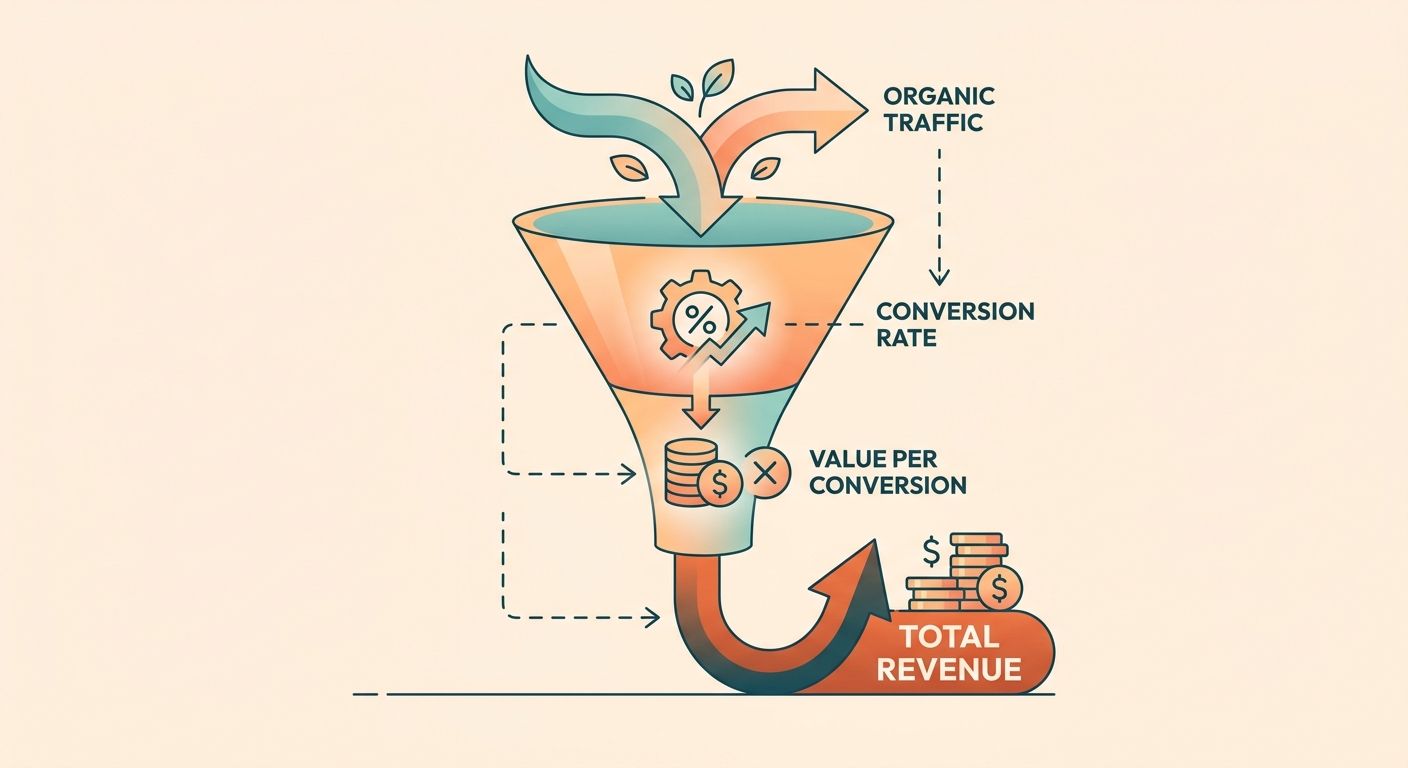
What conversion rates to expect
Conversion rate is the percentage of organic visitors who complete the action you care about. The action varies by business model. E-commerce counts purchases. Lead-gen counts form fills or demo requests. Subscription businesses count sign-ups.
The math is simple. Track how many users move from a search results page to a completed action, and you can assign a precise dollar value to your organic traffic. Each step of the funnel filters the audience down to paying customers.
A worked example. A keyword cluster sends 800 visitors to your site in a month. If 3% convert, that's 24 customers. Multiply by your average value per customer and you've got a monthly revenue figure you can defend.
One note on which value to use: for subscription and B2B models, long-term customer value accounts for recurring renewals and expansion revenue that standard transactional reporting usually misses.
Where average order value fits
Average order value is the mean dollar amount per transaction, and it turns raw conversions into revenue. Multiply your organic conversions by AOV and you get the organic revenue that feeds your ROI formula directly.
For e-commerce, this is the cleanest path to a revenue number. Say organic search drives 350 orders in a month at an AOV of $120. That's $42,000 in organic revenue. Drop it into the formula and the ROI writes itself.
Why AOV matters so much: organic search is a major revenue channel for online stores. Roughly 40% of e-commerce revenue comes from organic search. Don't measure it and you're ignoring nearly half your top line.
Why attribution is the hard part
Revenue attribution connects organic search to the sales it actually influenced across the customer journey. Google treats attribution as crucial to measuring SEO success, for a simple reason: organic search rarely acts alone. A visitor might find you through search, leave, and convert weeks later through another channel.
That delay makes attribution tricky. A customer reads your blog post today and buys next month after seeing a retargeting ad. Which channel gets credit? Without a model, organic search gets undercounted.
Targeted keyword research is how you tie attribution back to revenue. Rank for terms with clear commercial intent and you can trace visitors from a specific query through to a purchase. A company that identifies ten high-intent keywords, builds content around them, and tracks conversions from those exact landing pages knows the revenue those pages generate is directly attributable. No guessing.
Match your value metric to your business model, measure conversions from organic landing pages, and pick an attribution model before you run the numbers. Do that and you get a revenue figure that survives scrutiny from a CFO.
Putting it Together: Calculating SEO ROI with AnyPost
Automating your content, tracking your traffic, and measuring your return can live in one workflow. Connect those three and SEO ROI stops being a quarterly guessing exercise and becomes a number you can pull up on demand. Here's how the pieces fit.
Automating content production
Automating content means using software for the repetitive parts of writing, publishing, and scheduling, so your team spends time on strategy instead of formatting. It matters because content is the biggest recurring cost in most SEO programs, and every hour you cut off production drops straight to your ROI.
Roughly 25% of marketers already use automation tools to streamline their SEO. The appeal is simple math. Produce the same volume of articles at a lower cost per piece and the denominator in your ROI formula shrinks while your return climbs.
You can automate keyword-based drafts, publishing to WordPress, and internal linking. If you run your own site, learning to generate a WordPress application password is the small technical step that lets an automation tool push content live for you.
Tracking traffic and revenue together
Tie every organic visit to the dollars it produces, then feed both sides into one report. You need organic traffic, conversion data, and SEO cost in the same place. Without that, you're calculating ROI from three disconnected spreadsheets.
Define your goal first, whether that's form fills, purchases, or sign-ups. Then collect organic sessions and conversions over a fixed window. Finally, add up your investment: content, tools, and any agency or freelance spend.
The point of automating this tracking is consistency. When the same numbers update on their own, you catch a rising or falling campaign in weeks instead of finding out at budget review.
Calculating campaign success
Same core formula: SEO ROI = (SEO revenue − SEO cost) / SEO cost. A positive result means organic search paid for itself and then some.
A lead-based example. A B2B team spends $8,000 in a quarter on automated content and tracking tools. That content generates 200 qualified leads; at a 5% close rate and an average deal size of $4,000, they book ten new customers worth $40,000. Clear enough to justify next quarter's budget without a debate.
For businesses with recurring contracts, factoring in retention and renewals makes your success metrics reflect the true long-term impact of your organic acquisition pipeline.
Keep all of this in one workflow for one reason: speed of correction. Automated content lowers your cost, connected tracking gives you clean revenue, and the formula turns both into a defensible figure. When a campaign underperforms, you see it early and shift budget before the quarter closes. That loop is what separates SEO you can defend from SEO you just hope is working.
Frequently Asked Questions
1. How do I attribute organic revenue when a customer converts through multiple channels?
To handle multi-channel paths, implement a first-touch or position-based attribution model in your analytics platform. This ensures organic search receives credit for introducing the customer to your brand, even if they later return and convert via a paid ad or direct visit. Tracking the initial landing page of your converted leads is the most reliable way to establish this connection.
2. Should I use average order value or lifetime value in my ROI calculation?
Select the metric that aligns with your sales cycle. If your customers typically buy once and do not return, average order value is your best metric. For businesses that rely on repeat purchases, contract renewals, or monthly subscriptions, using customer lifetime value is essential to avoid underestimating the long-term profitability of your organic traffic.
3. When should I move beyond the basic ROI formula to full attribution?
Transition to advanced attribution models only when your organic traffic represents a significant portion of your overall revenue and you are running multiple active marketing campaigns simultaneously. For smaller websites with straightforward conversion paths, the administrative overhead of managing complex attribution software outweighs the analytical benefits.
4. How should I handle brand-awareness gains that don't directly generate sales?
Treat non-transactional metrics like impressions, social shares, or brand searches as leading indicators of SEO health rather than direct inputs for your ROI. While these metrics show that your brand footprint is growing, they should be kept separate from your financial return calculations until they result in trackable conversions.
5. What red flags should I watch for when hiring an SEO vendor?
Avoid agencies that focus exclusively on keyword rankings or traffic volume without discussing how those metrics translate into business revenue. A reliable partner will focus on search intent, conversion optimization, and aligning their content strategy with your actual sales funnel, rather than making promises about search engine algorithms they do not control.
6. Why does SEO ROI look weak early on, and how should I judge it?
SEO requires upfront investment in technical optimization and content creation before search engines index and rank your pages. Because of this lag, evaluate your program using a rolling six-to-twelve-month window. Look for steady upward trends in organic impressions and non-branded search traffic during the early stages as indicators of future financial return.
7. Can automation actually improve my SEO ROI, and how?
By streamlining repetitive tasks like initial drafting, formatting, and scheduling, automation significantly reduces the labor hours required to scale a content program. This reduction in production costs lowers your overall investment, making it easier to achieve a positive return on your search engine optimization efforts while freeing up resources for high-level strategy.