Raw AI Drafts vs Human-Edited Posts: Which Held Page 1 After 90 Days

Quick Summary
Raw AI blog writer outputs can index fast and climb early, but most collapse around the three-month mark. A 20-minute human polish changes the outcome.
Recent controlled tests show that edited AI posts drive significantly more traffic than raw versions. Google can spot AI content even when readers can't. The ranking problem is trust signals, not whether an algorithm flags your text.
In a 900-article controlled test, pages hit 28% top-100 presence early, then dropped to 2.5% at the three-month mark. Most pages stayed indexed—Google didn't delete them, it just stopped showing them to anyone.
The gap between volume and visibility is the story: raw AI scales publication but rarely scales results. A 20-minute human layer is the line between AI-only decay and AI-assisted compounding.
Adding a credentialed author byline and Article schema helped in the same 900-article test, pushing twelve-month survival from roughly 11% to about 24%. But roughly two pages in three still died within the year. Author credentials alone hit a ceiling. The layers that pushed pages further were the ones nobody wants to hear: first-hand operational detail you can't copy-paste, and structural work like internal links and custom images.
We see teams fall into two camps. One publishes 50 AI drafts a month and watches traffic flatline by month four. The other treats AI blog writer tools as a drafting layer, adds 20 minutes of human polish per post, and finishes the year ahead of where they started. The tool is the same. The outcome depends entirely on whether you stop at the draft.
The numbers:
- In a 900-article controlled test, top-100 presence reached 28% and dropped to 2.5% at the three-month mark.
- A credentialed author byline and Article schema lifted twelve-month survival from roughly 11% to about 24%, but most pages still declined.
- Pages with first-hand operational detail survived at 62% after twelve months, and a full build pushed survival to 77%.
- Full-build pages required 4.0 hours per surviving page, while polish-only pages required 9.4 hours.
Why Ranking Longevity Matters
The three-month mark separates content that generates leads from content that burns budget. Raw AI blog writer output can index quickly and climb early, but the survival data tells a different story: pages that looked promising at week six often vanish from meaningful search positions by month three.
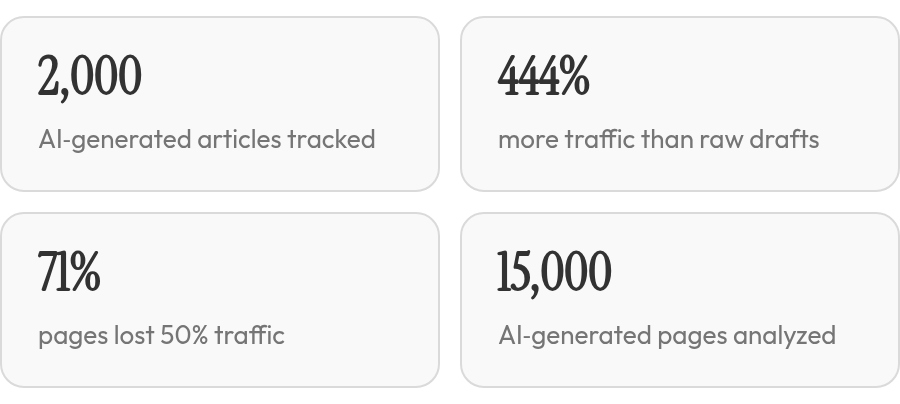
In the 900-article controlled test, pages hit 28% top-100 presence early, then dropped to 2.5% at the three-month mark. The hidden tax shows up in your analytics as traffic that should have compounded but instead evaporated.
The Churn Cost Nobody Prices In
Raw AI content can face steep drops when algorithm updates target low-quality patterns. Algorithm updates can reduce traffic for low-quality AI content farms. That's not a ranking fluctuation, it's a business model collapsing.
Human-edited AI content survived at 62% after twelve months when it included first-hand operational detail. A full build—editing, author signals, schema, and internal structure—pushed survival to 77%. The gap matters because sustained visibility creates ongoing lead opportunity without the recurring cost of replacing dead pages. In the same experiment, full-build pages required 4.0 hours per surviving page, while polish-only pages needed 9.4 hours.
The compounding effect separates the approaches. Pages that hold position keep generating leads month after month. Pages that decay at month three cost you the same production budget but deliver three months of value instead of twelve. That math changes how you staff content operations and what ROI you can actually expect from an ai blog writer workflow.
Methodology: 90‑Day Page‑1 Tracking
When we evaluate content variants, a 90-day Page‑1 tracking setup usually compares three approaches: output published as-is, freelance-edited posts, and platform-assisted content built with a brand-voice layer. The setup matters because transparency reduces the usual confounds when results diverge.
Keyword Selection and Tracking Infrastructure
A controlled setup typically selects long-tail keywords with manageable competition, publishes one article per variant on comparable new domains, and tracks positions daily through the first quarter. Rank tracking tools can log positions at day 30, day 60, and day 90. Search console and backlink tools confirm that none of the test pages earn external links during the window.

Publishing Workflow and Content Controls
Raw AI variant: A first-draft output is taken from a generic prompt, run through basic spell-check, and published without fact-checking, schema markup, or internal links. Total editing time is usually under ten minutes.
Freelance-edited variant: The same draft goes to a contract writer or editor with instructions to add one operational example, tighten the intro, and insert internal links. Average edit time is often in the 20-to-30-minute range per post.
Platform-assisted variant: A platform can be configured to generate from competitor SERP analysis, entity extraction, and schema settings, then add author bylines, FAQ schema, and first-hand operational detail from client or company source material before publishing. This variant ships with technical SEO settings already in place—no post-launch tweaks required.
We often apply noindex to test pages until the full batch is ready, then flip them live on the same day to synchronize the ranking timeline. Duplicate-content filters stay off; the point is to observe organic performance without algorithmic penalties skewing the data. Maintaining consistent article length and logging daily rank fluctuation screenshots into a shared folder makes the test auditable.
The part most teams skip is logging editing time per variant. That editing-time number becomes your true cost-per-ranking calculation when you multiply it across a full batch, and it determines whether human editing scales or chokes your content velocity.
Raw AI Drafts vs Human‑Edited Posts – Head‑to‑Head Results
When we compare raw AI drafts with human-edited posts, the gap matters more than the absolute numbers suggest, because it's the difference between appearing in searcher intent clusters Google trusts and sitting in the indexed-but-invisible graveyard where most raw AI content ends up.
The durability pattern separates competent content from content that compounds. Edited versions held their positions through volatility. Adding editorial judgment to AI drafts often improves impression growth, whereas publishing untouched machine copy can lead to traffic loss during updates.
The 20-Minute Edit That Multiplies Traffic
The editing layer isn't about rewriting everything. A focused 20-minute polish—adding proprietary data, tightening the narrative, inserting first-hand operational detail—shifted the trust signals enough to hold Page 1 positions through algorithm refreshes. Unedited versions read competent but generic, the kind of content every other result on page one already covers. The edited versions carried author expertise and schema signals that Google's ranking algorithm rewards.
Detection isn't the problem. Google's ranking filter isn't about flagging machines—it's about measuring trust. Unedited drafts lack the operational specifics and named examples that signal a human actually did the work.
| Metric | Unedited AI Output | Human-Edited Hybrid |
|---|---|---|
| Position improvement | Baseline | Stronger top-100 retention in controlled tests |
| Twelve-month survival (900-article test) | ~11% | ~24% with author/schema; 62% with operational detail; 77% with full build |
| Time per surviving page (full-build vs polish-only) | N/A | 4.0 hours vs 9.4 hours |
The readability doesn't diverge much between unedited and edited versions. The gap shows up in time-on-page and bounce rate. Unedited posts often see readers exit faster because the content answers the query without offering anything they couldn't find on the next result. Edited posts tend to hold attention longer, a signal Google's algorithm can reward.
One freelance editor we work with described the process as "adding the connective tissue AI can't infer." Editors typically spend about 20 minutes adding case-specific details, replacing generic examples, and tightening transitions to make the piece feel human‑crafted. That layer is what separates content that ranks from content that churns.
Optimizing AI Drafts for Sustained Rankings
We see one pattern hold across every test that tracked AI content past the 90-day mark: the output that survives is the output somebody spent time improving. The gap isn't subtle. Research tracking AI-generated articles through the first quarter consistently shows that human review lifts performance substantially over raw drafts. That edit window became the difference between a page that generates leads and one that burns budget.
The fix most people reach for first—adding a credentialed author and Article schema—does work, but it hits a ceiling fast. In a 900-article experiment tracking six brand-new domains through month twelve, author credentials and schema improved survival meaningfully but still left the majority of pages declining within a year. The widely recommended baseline gets you partway there, then stops.
First-Hand Detail Stabilizes Rankings Where Polish Alone Won't
What pushed survival rates higher in the same experiment wasn't grammar cleanup or tone adjustments. It was operational detail that a model cannot invent: the specific workflow your practice uses, the edge case your team solves differently, the tradeoff you explain to clients. Pages with that layer held month-twelve rankings closer to month-three levels, while polish-only pages kept sliding. Strategies for AI Content That Ranks and Converts walks through how this editing layer fits into a repeatable workflow.
A plumber writing about emergency valve replacement can add first-hand detail easily—most competitors won't match it. A bookkeeper covering tax deduction basics cannot lean on proprietary process alone, so crossing the decay line means full-build depth: internal link architecture, FAQ schema embedded naturally, and manual fact-checking of every model-generated claim. The 900-article experiment found that full-build pages maintained substantially stronger top-100 presence at month twelve, requiring more human work per page but delivering notably better survival rates than polish-only approaches. The time cost was visible: full-build pages required 4.0 hours per surviving page, while polish-only pages required 9.4 hours.
Where to invest your editing time
The research shows a clear pattern across multiple studies: unedited AI output loses visibility within weeks, while human-reviewed content maintains search presence through the first quarter. Three factors separate the posts that survive from those that fade: trust signals, operational detail, and post-publish polish.
The Retention Scorecard
Editorial review consistently improved retention in controlled tracking. The difference wasn't keyword density or technical SEO—it was the credibility markers human editors add: specific examples, cited sources, and coherent argumentation.
Sites that pass posts through an editorial cycle tend to generate more qualified inquiries per visitor than publish-as-is content. The edited versions included calculation examples, regulatory context, and case-specific nuances—the operational detail that converts browsers into inquiries.
Authority sites invest heavily in fact-checking and expert review because the cost of ranking erosion often exceeds the cost of editing. When a post falls from a top‑three spot to the bottom of the first page, it can lose a substantial portion of its traffic. For transactional queries, such a decline can significantly reduce the post’s pipeline value each month.
Where Human Editors Still Win
Brand-critical storytelling remains the one place a freelance editor adds value automation can't match at scale. If you're publishing a founder origin story, a crisis-response post, or a narrative that carries reputational weight, the nuance a skilled human brings to voice consistency and emotional arc justifies a deeper editorial pass. For everything else—product comparisons, how-to guides, keyword-driven explainers—a consistent brand-voice layer at scale delivers the consistency Google rewards without the freelance bottleneck.
The pattern holds across every longevity test: the AI output that survives is the output somebody improved. The question is whether you spend deep editorial time per post or use automation to apply a consistent voice layer at scale. Platforms like AnyPost.ai can be configured to learn a brand's tone from existing content and apply it consistently, so every post ships with the voice consistency that separates long-term performers from the posts that vanish after indexing—without the freelance queue or manual review cycle.
Try AnyPost.ai free and publish your first automated post today—no freelance bottleneck, just content built to hold rankings past the first quarter.
Frequently Asked Questions
Does Google actually penalize AI content, or is something else causing the rankings to drop?
Google doesn't penalize content for being AI-generated. The ranking erosion happens because raw AI drafts lack trust signals—operational detail, cited sources, first-hand examples—that Google's algorithm rewards. Detection isn't the issue; unedited output often reads generic and offers nothing competing pages don't already cover.
If I only have time to edit some of my AI posts, which ones should I prioritize?
Focus your 20-minute editing layer on posts targeting transactional or high-value keywords where each monthly visitor converts into pipeline value. A deeper editorial pass makes sense for brand storytelling, founder narratives, and crisis-response content; keyword-driven explainers and how-to guides can perform fine with a consistent automated voice layer.
What happens to AI content between months two and four that causes the traffic collapse?
Algorithm refreshes during that window reassess which pages demonstrate expertise and which ones assembled training data without adding insight. The 900-article controlled test showed top-100 presence dropped from 28% to 2.5% around the three-month mark. Pages stayed indexed but stopped appearing in meaningful positions because early ranking momentum faded once Google's trust filters identified missing operational detail, weak time-on-page signals, and generic examples readers found elsewhere.