
What Content Strategy Actually Means When AI Writes Half Your Posts

Key Takeaways
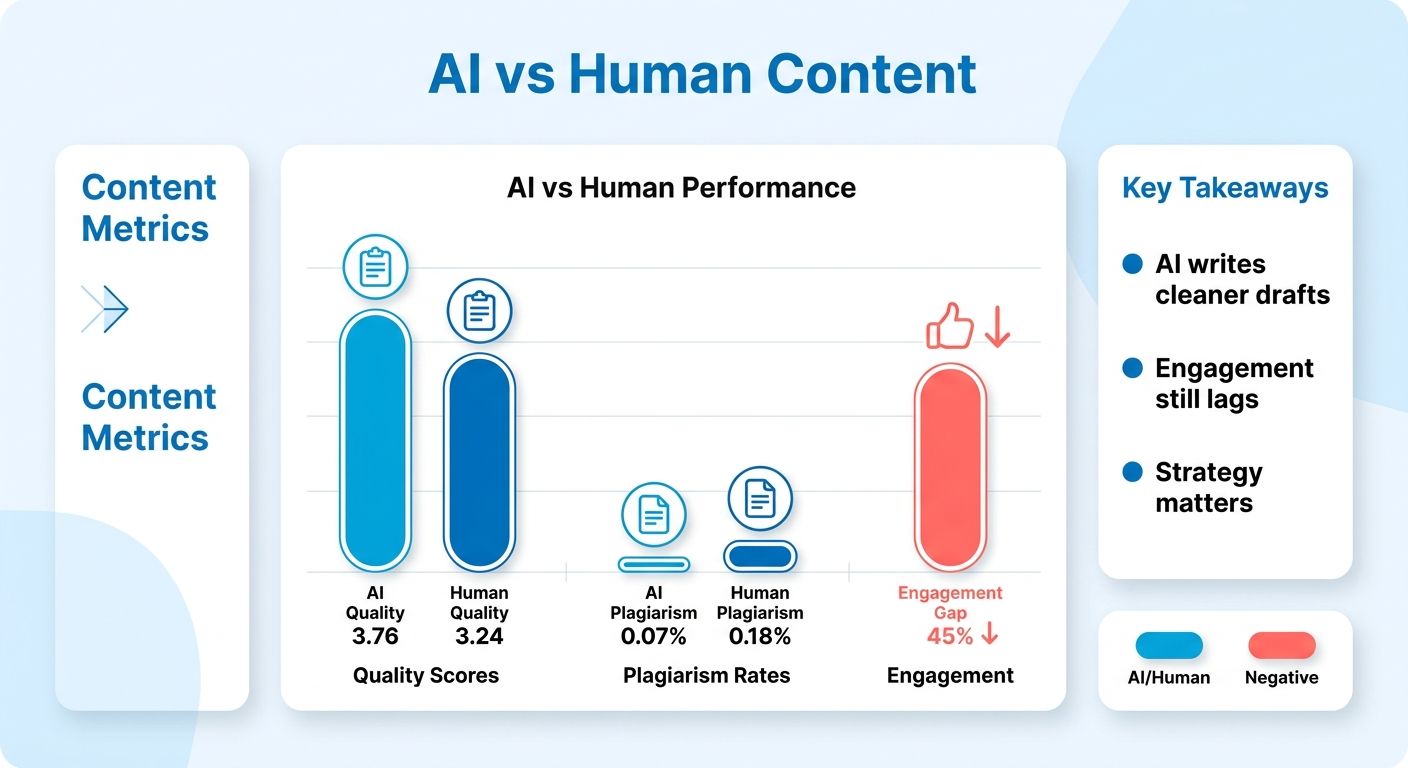
- AI marketing copy scored 3.76 on quality versus 3.24 for human copy, with lower plagiarism rates (0.07 versus 0.18).
- Yet AI-generated LinkedIn posts receive 45% fewer engagements than human-written posts. Cleaner drafts can produce worse results.
- Over 90% of marketers use AI somewhere, but only 40% to 47% maintain a documented content strategy.
- AI drafts take 30 to 45 minutes. Human writers need 4 to 6 hours. The bottleneck has moved.
- The hard part is no longer producing drafts. It is proving published content supports business goals.
- Polish is not the metric. Ranking, freshness, and trust signals appear after publishing.
- ROI comes from continuous optimization, not one draft-edit-publish cycle.
Why Strategy Matters More When AI Writes Half Your Posts
Consider a number that should change how you view AI content: AI-written marketing copy scores higher on measurable quality than human copy. A 2024 analysis of 500 marketing messages gave AI a quality score of 3.76, compared with 3.24 for humans. AI also had a lower plagiarism rate (0.07 versus 0.18). On paper, AI produces cleaner, more original drafts.
So why do AI-generated LinkedIn posts receive 45% fewer engagements than human-authored ones? Polish is not the KPI. That gap shows why deliberate strategy matters when machines write half your posts. Drafting is largely solved. Ranking, freshness, and post-publication trust signals are not.
More AI output makes strategy more important, not less
Volume without direction scales mistakes. Over 90% of marketers now use AI somewhere in their workflow. Yet only 40% to 47% have a documented content strategy. That mismatch creates the problem.
When AI produces a clean draft in 30 to 45 minutes, writers spend 4 to 6 hours. The bottleneck moves from “Can we make content?” to “Does this content support business goals?” Strategy connects AI output to lead generation, funnel stages, and buyer personas. Without it, teams may publish 50 posts that rank for nothing.
Most coverage misses this point. It treats AI content as a one-time event: draft, edit, publish, and finish. ROI cases tell a different story.
Where AI actually earns its keep
AI earns its keep through continuous iteration after publishing. The results below came from testing variations against real signals, not perfecting original copy.
| Case | Result | What drove it |
|---|---|---|
| JPMorgan Chase | 450% lift in click-through | Testing AI-generated copy variations |
| Vanguard | 15% higher conversions | Iterating on ad copy variants |
| Cushman & Wakefield | 50% less time on copy tasks | Freed writers for strategic work |
Our view: AI creates the most value through post-publication optimization. This stage receives little staffing. You re-rank published posts against live SEO signals instead of obsessing over drafts. That is where the 15-20% ROI gains from full AI integration come from.
What about brand voice and trust?
Disclosure does not automatically reduce trust. 75% of consumers want brands to disclose AI use, and 65% will not lose trust in a brand that discloses it. The penalty is real, but context matters.
Personal LinkedIn posts face more scrutiny when readers expect a human voice. 62% trust AI content less on that platform. Brand and corporate content can withstand disclosure. Audiences judge whether you faked a human voice, not whether a machine helped.
The greater risk is generic content that sounds like everyone else. One analysis summarized it this way: “AI does not erase brand voice; poor use of AI does.” Provide clear brand guidelines, keep humans involved, and treat freshness as ongoing work. That strategy holds when algorithms shift and competitors publish at the same machine speed.
If lead quality is your goal, pair this with an automated content workflow built for SaaS B2B lead generation.
The Content Loop That Replaces Plan-Write-Publish-Forget
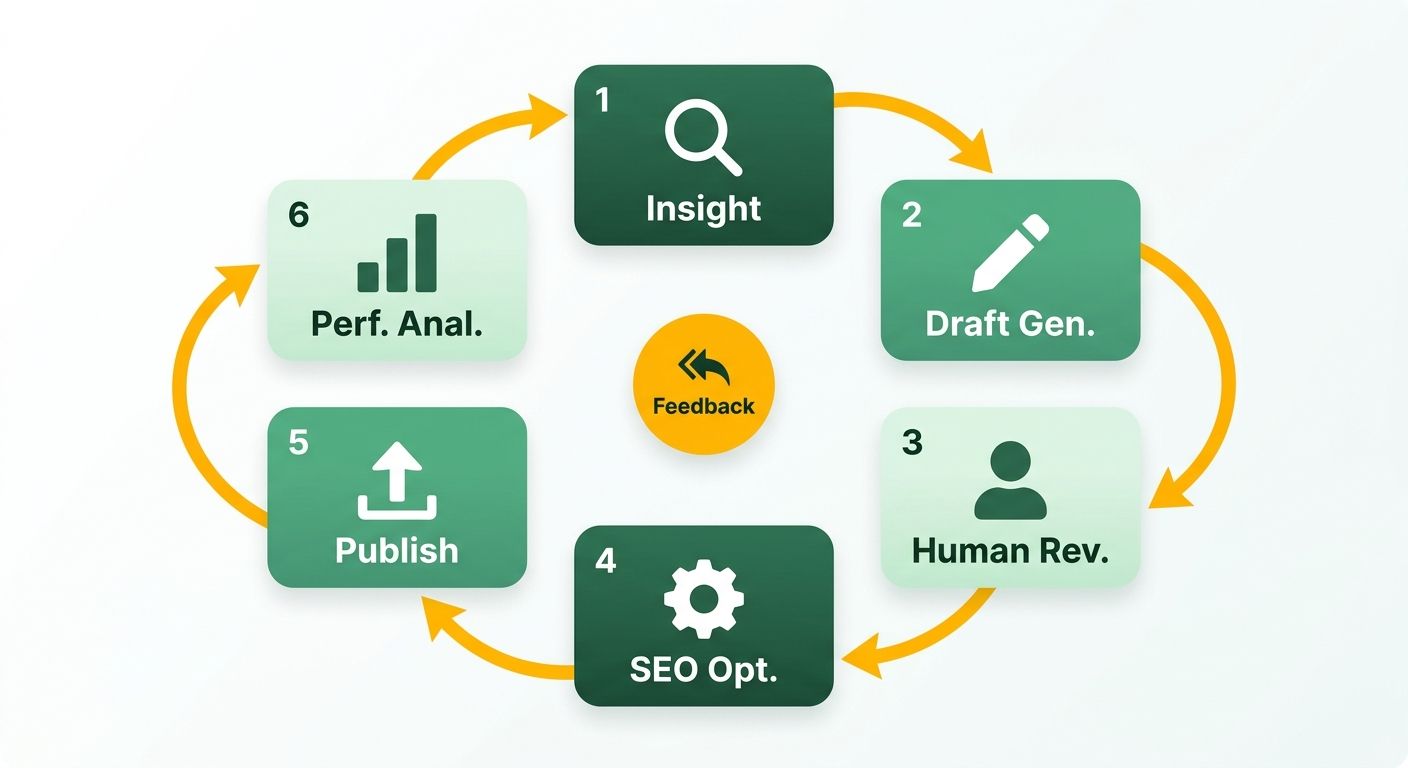
The linear model, plan, write, edit, publish, and forget, does not match how search works. Better frameworks treat publishing as a milestone, not the finish line. A continuous feedback loop lets you refine live assets using performance data.
Content becomes a loop: insight, draft, human review, SEO optimization, publishing, and performance analysis. Performance data then informs the next round. Most strategies skip that final stage. AnyPost focuses on it, showing changes directly from Google Search Console.
Why the loop beats the line
ROI proof comes from iteration, not the first draft. A single post rarely performs perfectly at release. Teams that re-optimize published pages see organic traffic climb over subsequent weeks. One HubSpot study found that updating and republishing old blog posts more than doubled organic views and increased leads by 106%. That gain came from revisiting, re-ranking, and refreshing live content.
The focus shifts from production metrics to long-term performance. Measure how well content adapts to changing search intent and user behavior. Real-time analytics provide signals for those adjustments.
Content also decays quickly. The average blog post loses meaningful traffic within two years if left untouched. Most teams publish and move on. That gap creates an opportunity.
Who owns each stage?
Four roles keep the loop accountable. Blurring them can stall teams.
| Role | Owns |
|---|---|
| Content strategist | Insight, persona mapping, calendar |
| AI prompt engineer | Prompt design, temperature and token settings |
| SEO specialist | Optimization, re-ranking, performance signals |
| Editor | Human review, brand voice, emotional resonance |
The prompt engineer and SEO specialist matter most here. The division is simple: machines draft the structure, while people add judgment. That principle also supports AnyPost’s Persona Engine. AI handles the heavy lifting while your voice and insight remain central.
How do you feed prompts that match a brand’s tone?
Start with a persona layer, not a blank prompt box. A persona engine reads audience intent and brand voice, then builds prompts that carry both into each draft. This is better than typing ad hoc instructions each time.
Ideation. Use AI for trend spotting and keyword clustering. Semrush data shows only 23.5% of marketers use AI for topic ideation. Most miss topics their audience already follows.
Prompt engineering. Embed brand voice and SEO goals directly into prompts. Use approved voice documents instead of vague adjectives. Vague inputs produce vague drafts.
Draft generation. Use lower temperature for factual, on-brand copy. Use higher temperature for ideation sprints. Set token limits to keep outputs concise. A structured prompt library beats one-off instructions. Standardized prompts can reduce revision rounds and speed delivery. AnyPost captures your brand’s DNA by crawling your entire site to build a Business Context Graph. It also auto-publishes to WordPress, LinkedIn, and X.
Track three metrics at each stage: prompt success rate, edit-time reduction, and SEO score. Real-time analytics read those signals and show what changed. You can then guide the next round. Without feedback, you scale first drafts that nobody re-ranks.
Keeping Your Voice When Half the Copy Is AI-Generated
The fastest way to damage automated re-optimization is to rewrite published posts in the wrong voice. Generic output usually comes from poor inputs. Poor inputs cause it. Unclear brand guidelines produce content that resembles every other blog. That failure can break re-ranking at scale.
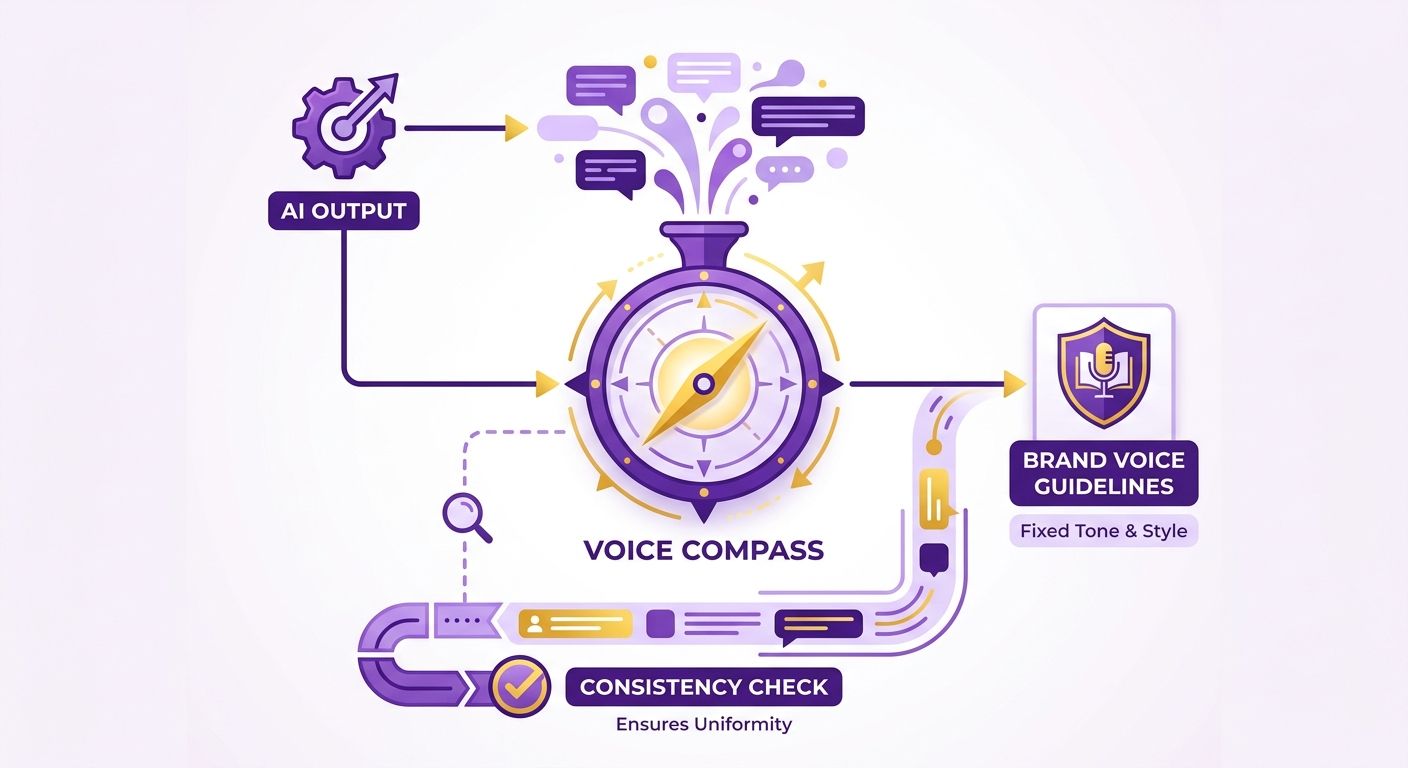
A clear voice baseline limits brand dilution during automated updates. When you refresh live content, the system should reference a central identity profile. This preserves stylistic consistency. Each optimization pass can then reinforce your positioning instead of weakening it.
How do you build a voice profile the AI can actually use?
A voice profile is a structured document containing tone descriptors, preferred terms, and prohibited words. AI reads it before each draft or update. It turns “sound like us” into machine-readable rules. Add approved brand documents and past content examples to reduce generic output.
Two assets do most of the work. First, create a focused knowledge base of terminology, claims, and positioning. Second, capture the writer’s style using real samples and correction feedback. Together, these assets help the system maintain editorial standards.
This pairing addresses two major failure modes. The knowledge base prevents factual errors and off-message claims. The style model reduces flat, anonymous prose. It supports on-brand optimization without manually rewriting every update.
Fine-tune a model, or control voice at the prompt level?
For most teams, prompt-level control works better. A reusable prompt library and voice profile provide consistent instructions without custom model training costs. Fine-tuning locks voice into a static snapshot. Messaging changes then require retraining. Prompt-level control lets you update one reference file and apply changes to future drafts immediately.
Keep humans involved as editors, not ghostwriters. Their role is to add team insights, not disappear. Route every automated update through a review workflow. This catches stylistic drift before publication.
The transparency trap in automated updates
Audiences respond to disclosure based on context. On owned channels, such as corporate blogs, readers expect a brand behind the words. A disclosed human-steward layer can preserve trust. On personal feeds, the same disclosure can signal absence. Engagement drops when a founder’s post feels machine-assembled.
The trust penalty depends on audience expectations. Corporate blog content can remain effective with transparent disclosure. Personal social updates need direct human input. Automated workflows should preserve a disclosed human-steward layer on brand channels. Individual profiles should retain genuine manual creation.
Pre-publish voice QA checklist:
- Does it match your tone descriptors and avoid prohibited words?
- A/B test the AI draft against a human-written benchmark before scaling.
- Confirm terminology matches the knowledge base, without invented claims.
- Update the voice profile whenever performance data shows drift.
- Verify that a human steward reviewed the final re-optimized version.
Run this loop to keep your voice consistent through re-ranking.
Human Oversight: Editing, Fact-Checking, and Real Authenticity
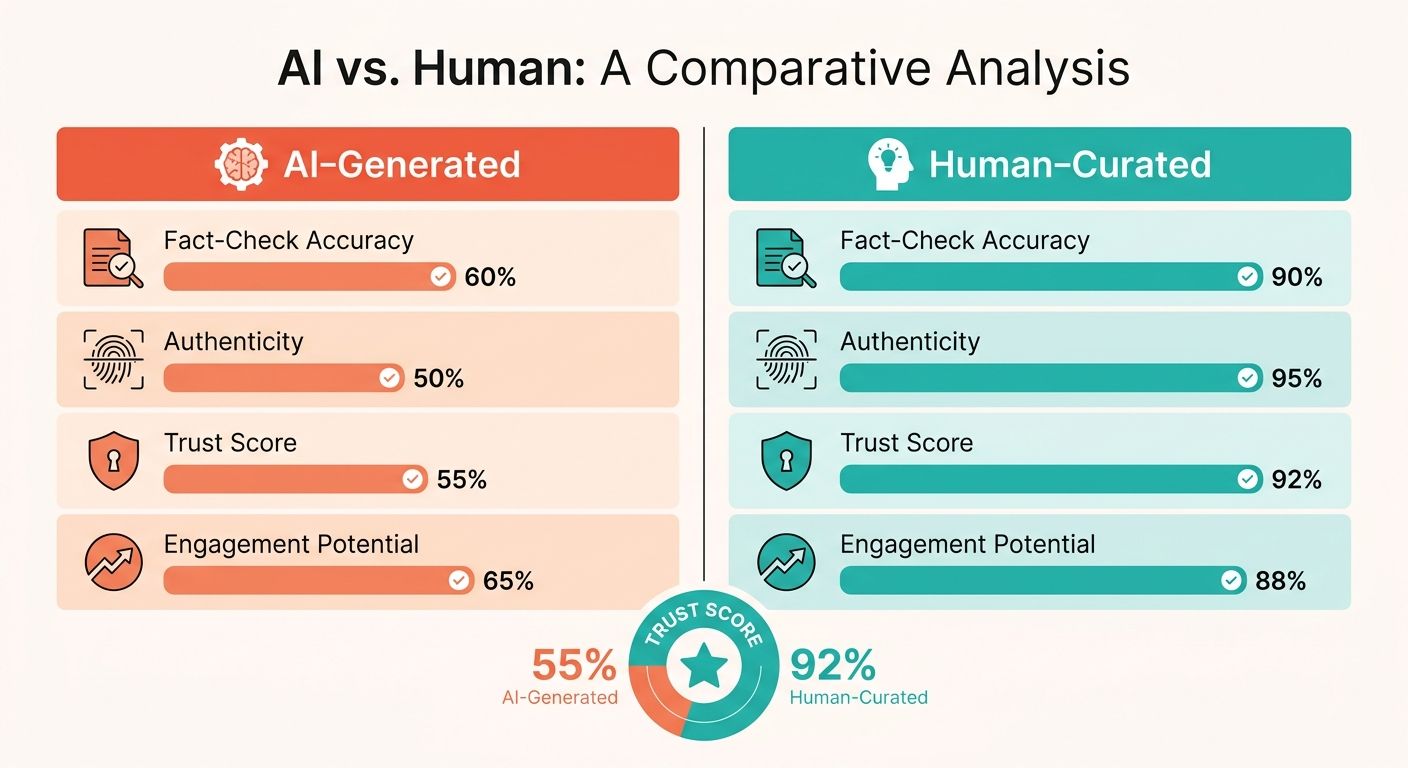
Readers trust content they believe a person supports, even when AI text scores higher on grammar, tone, and originality. Quality on paper is not the problem. Trust and relevance are.
That gap makes human oversight valuable. The best editors today are AI curators. They add two things machines cannot fake: verified facts and genuine authenticity.
What does a fact-checking protocol actually look like?
Fact-checking protocol: a fixed set of verification steps every AI draft follows before publication. These steps cover source verification, citation standards, and hallucination detection. AI writes fluent, confident sentences whether claims are real or invented. The protocol catches invented claims.
Run three checks on every draft. Trace every statistic and named claim to a reliable source. Confirm that the source supports the draft’s wording. Flag confident sentences without traceable origins. That final check catches many hallucinations.
Why bother when AI writes cleaner copy? A fabricated statistic damages trust faster than a typo. In one r/isthisAI thread, a user questioned a Facebook post partly because “I don’t see any news articles about the story.” Readers already check sources. Editors need to check them first.
How do you add authenticity without slowing down?
Add what AI cannot invent: your data, customer language, and specific brand experience. AI can localize campaigns across regions while maintaining brand tone and legal requirements. It cannot provide proprietary numbers or genuine customer quotes. That is the human layer.
A 15-minute human edit that adds one original statistic, one customer line, and one specific example can meaningfully increase engagement. The edit is not just polish. It shows that someone with real knowledge supports the post.
There is also a transparency payoff. Branded content combining a source citation with a first-party data point earns roughly twice the save rate of unsourced posts. Transparency works when real substance supports it. If you disclose AI assistance, add proprietary insight and a distinct perspective.
This is also why voice replication matters. A trained voice model and structured knowledge base help AI create on-brand content without line-by-line rewriting. Feed the system top-performing content, approved terminology, and a do-not-say list. Drafts then arrive closer to publication. Your team can focus on strategy and storytelling.
Your final human sign-off checklist
Before any post goes live:
- Every stat traced to a real, current source
- Every claim verified against what the source actually says
- One original element added: your data, a customer quote, or a specific example
- Voice matches your brand reference, not generic AI cadence
- AI use disclosed where your audience expects a human voice
- CTA placed and readable from beginning to end
Skip this for unpublished internal drafts. For customer-facing content, it is non-negotiable.
SEO and Search Visibility in an AI-Generated World
Google does not penalize content simply because AI created it. It penalizes content that fails E-E-A-T and Helpful Content signals, regardless of its author. The SEO goal is not hiding AI use. It is supporting ranking signals that keep published content relevant.
The strategies that improve rankings are not about drafts alone. They focus on post-publication work. AI can produce clean, keyword-aligned copy initially. Freshness, internal links, and search intent alignment decay unless someone maintains them.
What does Google actually reward in AI content?
E-E-A-T: the framework Google uses to judge Experience, Expertise, Authoritativeness, and Trust. AI drafts can present structured expertise and authority. They often lack firsthand experience and trust signals, however.
That is a signal problem, not a writing problem. The priority shifts from polishing drafts to improving post-publication signals. Keyword intent alignment, coverage depth, internal linking, and schema markup support rankings. Real-time analytics help track live-page performance.
Internal linking is often neglected. At scale, new posts can orphan older ones, while old links point to stale anchors. A structured linking strategy connects related posts as your library grows. A cluster on long tail keywords can then reinforce itself instead of decaying.
How does AI speed up topic clustering and gap analysis?
AI reads audience behavior across sources. It identifies uncovered topics and incomplete clusters. That is the fast part. The slower, higher-value work is preventing clusters from competing as output grows.
Duplicate content and keyword cannibalization create the main volume risks. Two posts targeting the same intent split authority. An AI-driven content calendar maps each piece to a distinct query before writing begins. This prevents internal SERP competition.
Successful campaigns improve through iterative variation testing, not initial drafts. SEO follows the same logic. Search visibility improves when teams re-optimize live pages against performance signals.
Why automated monitoring beats manual audits
Manual audits can find problems weeks after traffic declines. Automated monitoring can detect ranking drops or algorithm changes when they affect AI-heavy pages. Faster response improves the chance of recovery.
AnyPost includes SEO in every generated post: keyword-optimized content, search-intent-aligned headings, semantically correct HTML, and relevant internal and external links. Google makes thousands of ranking adjustments each year. Core updates alone can reshape entire content categories within days. The advantage will not come from adopting AI. It will come from automating continuous re-ranking for published content.
Skip heavy automation for a small set of foundation pages you tune manually. For larger volumes, manual SEO cannot keep pace.
Implementation Blueprint: From Planning to Scale
Roll out a hybrid model in phases, not through one big launch. Effective implementations prioritize post-publication work and continuous optimization. Start with a small pilot to validate the workflow.
Phased rollout limits risk. It exposes prompt drift, voice mismatches, and broken CMS hooks on a small set of posts. Each phase provides a checkpoint before the process expands.
What do the five phases look like?
Five stages provide clear exit criteria before the next stage begins.
- Phase 1 — Audit. Inventory published posts, flag decay, and identify AI-eligible topics. AI can spot gaps and thin pages quickly.
- Phase 2 — Tool setup. Onboard your platform, configure the voice engine against your brand reference, and connect your CMS for automatic re-ranking updates.
- Phase 3 — Pilot. Select 5 to 10 pillar posts. Run the AI-human loop and measure results against a baseline.
- Phase 4 — Refine. Adjust prompts, update the voice playbook, and train editors as AI curators.
- Phase 5 — Scale. Extend the loop to secondary channels after the pillars prove successful.
Keep your knowledge base succinct and non-duplicative during the audit. Dumping old PDFs and unstructured files into an AI system can hurt output quality.
How do you measure baseline vs. post-implementation?
Set a baseline before making changes. Then compare traffic, bounce rate, and conversions after the loop runs. Capture at least 90 days of pre-launch data. This helps separate seasonal changes from loop gains.
Choose KPIs that the post-publication loop can influence. Raw impressions are vanity metrics. Track freshness, ranking movement, and assisted conversions instead. These respond directly to re-ranking cycles and refreshed content.
| Metric | Baseline | Post-loop target |
|---|---|---|
| Organic traffic | Set from GSC | Rising per re-rank |
| Bounce rate | Current | Down on refreshed posts |
| Assisted conversions | Current | Up via iteration |
Cost-per-piece and governance
Run a simple cost model. Compare labor hours saved with subscription costs for each piece. Divide monthly tool spend by output volume, then account for remaining editor hours. Per-piece costs often fall when the loop manages refreshes instead of new drafts. This can help clear the subscription cost.
For governance, write SOPs covering version control, compliance, and escalation when re-ranking changes a claim. Be transparent about where and how AI affects content. When you push one pillar across multiple channels, maintain the same disclosure discipline. Keep messaging and brand voice consistent across platforms.
What’s Coming: Content Strategy as AI Advances
The future of AI-driven content involves maintaining and improving existing assets. As multimodal generation, real-time personalization, and automated governance mature, dynamic post-publication systems will keep content aligned with live search conditions.
Gartner predicts that by 2025, 30% of outbound marketing messages from large organizations will be synthetically generated. That is up from less than 2% in 2022. Drafting is becoming a commodity. Competitive advantage therefore moves downstream, to post-publication work.
What will multimodal AI and real-time personalization change?
Multimodal generation produces text, images, and video scripts from one prompt. It avoids stitching separate tools together. Combined with real-time personalization, one published asset can adapt its copy for each visitor segment. That matters because 71% of consumers expect personalized interactions, and 76% get frustrated without them.
Personalization at scale creates a challenge. Each variant must remain fresh and correctly ranked. Generating a thousand segment-specific versions is useless if they cannot adapt to changing search signals.
Multimodal outputs increase the number of assets requiring optimization. Automated post-publication systems will help teams manage that volume. Netflix credits its recommendation and testing engine with saving an estimated $1 billion a year in retention. That value comes from continuous iteration on live content, not static launch decisions. As testing expands, manual management becomes impossible.
How should metrics and governance evolve?
Editorial evaluation must move beyond basic readability scores. As automated generation becomes standard, success will center on trust, relevance, and freshness signals instead of surface polish.
AI content governance: the review workflows, disclosure rules, and authorship-labeling practices that keep automated content compliant as regulation tightens. Disclosure requirements and AI-authorship labeling may become standard. Building the review loop now avoids retrofitting it under legal pressure.
Localized, multi-region campaigns show why governance matters. Established review workflows help preserve brand tone and legal requirements across regions. The scalable model is automation for production and structured human review for compliance and authenticity.
Should you build an AI Center of Excellence?
Yes, if your content volume supports a dedicated function. An AI Center of Excellence is a small internal team that owns prompts, the brand voice reference, review protocols, and post-publication optimization. Skip it if you publish only a handful of posts each month. The overhead pays off at scale.
The shift is from “AI writes half” to “AI writes most, humans curate.” Automation handles repetitive production while teams provide strategic judgment. Curation becomes the main human task. The highest-value curation happens after publication, when SEO optimization can turn a static archive into a compounding traffic asset.
Frequently Asked Questions
1. Does Google penalize content just because it was written by AI?
No. Google’s search guidelines state that appropriate AI or automation use does not violate its policies. The search engine evaluates utility, depth, and alignment with E-E-A-T principles. Purely automated drafts may lack firsthand insights. Without human expertise, they can struggle under Google’s Helpful Content system.
2. Should I disclose that I used AI to write a post?
Transparency should reflect platform context and audience expectations. On corporate blogs and technical resource centers, readers generally accept AI assistance when information is accurate and verified. On personal social networks, automated disclosures can reduce engagement. Use human review to preserve authenticity before publishing.
3. Is fine-tuning a custom AI model worth it for brand voice?
For most marketing teams, prompt-level control is more practical and cost-effective. A structured brand voice profile avoids the resources required for custom model training. Fine-tuning creates a static model that requires retraining when messaging changes. Prompt-level control lets you update one reference document and apply changes to future content.
4. How much of my content budget should go toward drafting versus post-publish work?
As initial draft costs approach zero, budgets should shift toward distribution, analysis, and systematic updates. Instead of allocating 80% to writing and 20% to promotion, dedicate more resources to monitoring search performance, updating statistics, and refining live pages. These activities help maintain search visibility.
5. Can dumping all my old company documents into an AI improve output quality?
No. Uncurated legacy documents can degrade performance through outdated messaging, conflicting product claims, and redundant information. Build a curated, single source of truth instead. Include current positioning, approved terminology, and active brand guidelines. This gives AI a clear foundation.
6. What single edit adds the most value to an AI draft?
Adding proprietary data or unique first-party insight usually creates the most value. AI can synthesize public information, but it cannot generate internal metrics, unique case studies, or direct customer quotes. These elements increase credibility and turn a generic overview into authoritative thought leadership.
7. How long before published content starts losing traffic if left alone?
Most digital content begins experiencing natural search decay within 12 to 24 months. Competitor updates and changing search intent contribute to that decline. Instead of constantly replacing old traffic with new articles, refresh high-performing posts. Update outdated facts, fix broken links, and align content with current searches. This can sustain and grow organic search reach.