Repurpose Content for Search Intent, Not Format Count

Key Takeaways
- Google's recent core updates push purpose-driven relevance hard.
- Ten format variations mean nothing without matching search intent.
- Intent alignment comes before format selection.
- Mechanically spinning one post into many formats fails fast.
- A tweet for informational intent can miss transactional queries.
- Intent-first repurposing matches each asset to query goals.
- Search intent falls into four categories: informational, navigational, commercial, and transactional.
Related Video
Watch: Identifying Search Intent for Varied Audiences Daniel Morehead, BBC by Semrush
Why Repurpose for Search Intent, Not Format Count
Chasing format count is a losing strategy. Multiple versions do nothing when they miss what people search for. Google's recent core updates have pushed hard on purpose-driven relevance, rewarding pages that satisfy one clear user goal.
This shift changes how to repurpose content. The old approach was mechanical. Teams sliced long articles into social posts and graphics. They ignored the destination platform's search context. When you distribute assets without matching the user's state of mind, engagement drops. Distribution budgets get wasted.
Relevance must guide the process from the start. The final medium is a secondary choice.
Why Does Intent Beat Format Count?
Intent-first repurposing means matching each asset to the specific search goal behind a query before you pick a format. Knowing why people search matters more than volume. That principle sits at the center of an intent-driven approach.
Here's where two respected sources seem to disagree. One camp argues you avoid duplicate content by targeting different intents and keywords. Another argues the differentiator is creative format quality, pointing to an SEO checklist post that became a YouTube video with over 556k views.
Both are right, but in sequence. For competitive SERPs, changing the target intent prevents cannibalization. For platform-native discovery like YouTube or LinkedIn, format quality multiplies reach. The mistake is treating them as either/or. Match intent first, then let format do the amplifying.
Who Benefits Most From Intent-First Repurposing?
SaaS marketers, lead-gen teams, and content-heavy B2B firms benefit most, because they need qualified traffic, not vanity metrics. Brands that audit intent before repurposing tend to see higher conversion rates than those chasing format diversity alone.
Misaligned repurposing burns promotion budget, drives up bounce rates, and dilutes brand authority. You publish more, you convert less. As one content-marketing team framed it: it doesn't matter how many times you hit publish. What matters is how much impact the content creates.
This is why our Persona Engine matters. By crawling your site to build a Business Context Graph of your products, messaging, and audience, AnyPost generates content that stays true to your brand voice while targeting the right intent for each channel, whether that's WordPress, LinkedIn, or X. The lift comes from matching each asset to a distinct buyer-stage intent, not from the format itself.
What About Intent Decay?
Intent decay is the gradual drift between content you repurposed for today's SERP and the queries users actually run tomorrow. No standard guide names it, but the risk is structural.
AI tools are already reshaping how people phrase queries. Yoast documents users writing longer, more natural prompts that combine multiple intents at once. SERP signals keep shifting underneath your published assets. So content matched perfectly today slides out of alignment as search behavior moves.
Our take: post-publication intent monitoring isn't a refinement. It's a requirement. That's where AnyPost's real-time analytics help, pulling performance straight from Google Search Console so you can see what changed and keep your content aligned as search behavior moves. Treating repurposing as a one-time publish event is the quiet failure most teams never catch.
Audit Existing Content for Search Intent Alignment
An intent audit compares two things for every asset you own: the intent your content currently serves versus the intent the keyword actually demands. When those two diverge, you have an intent gap. Closing those gaps is the real work of figuring out how to repurpose content that already ranks but underperforms.
Start with the categories. Search intent falls into four buckets: informational ("what is X"), navigational ("brand login"), commercial ("best X"), and transactional ("buy X"). Under those sit sub-intents like how-to, comparison, and product-review. Yoast makes the point that Google now reads the meaning behind a query, not just the keywords in it. So your audit has to judge purpose, not word overlap.
How Do You Infer the Dominant Intent for a Keyword?
Read the SERP, not your assumptions. Type your target keyword into Google and study what already ranks. The "People also ask" box and featured snippets tell you exactly what intent Google rewards for that query. If the page-one results are all buying guides, the intent is commercial. Your informational blog post will not rank there, no matter how good it is.
Consider a concrete example: a user searching "best CRM for small business" is in a commercial-comparison mindset. They want side-by-side feature breakdowns, pricing tiers, and vendor limitations. If your repurposed asset is a beginner's guide to CRM concepts, it will not satisfy that query. The content is fine. The intent is wrong. Re-targeting the page to match buyer intent is what closes that gap. This is exactly the kind of analysis our SERP Competitor Analyzer supports, studying the top-ranking articles and identifying the structure and intent you need to match to take the top spot.
The goal is straightforward: when you understand what your audience is trying to accomplish, you can create content that genuinely helps them. That accomplishment is the intent you score against.
How Do You Score and Prioritize Each Piece?
Rate every asset on a 1-5 intent-match scale, where 1 means total mismatch and 5 means the content's purpose maps cleanly to the keyword's purpose. Build a simple intent-audit spreadsheet with columns for URL, target keyword, inferred SERP intent, current content intent, match score, and monthly traffic.
Then prioritize. Sort by traffic first, and pages with high-value keywords earn the top of your queue. But traffic alone misleads you. Pageviews measure reach, not influence.
Our take: weight backlink quality, time-on-page, and downstream conversion attribution alongside traffic. A viral-but-shallow post looks urgent in a pure pageview audit. An authoritative piece that quietly moves buyer decisions gets buried. Score both, or you will over-index on noise.
Building the Audit Dashboard
Your deliverable is a live dashboard, not a static file. Feed it keyword intent tags from your rank tracker, intent reports from Google Search Console, and match scores from an Intent-Matcher module. Google Analytics identifies your top performers as the raw input.
Here is the caveat no audit checklist mentions: search behavior is dynamic. As search engines evolve, user queries shift in complexity. A page that matches intent perfectly today can drift out of alignment. This requires a continuous review cycle, not a static, one-off project.
To address this, the audit should function as an ongoing monitoring loop. Track performance trends over time. Identify assets losing traction because of shifting search patterns. Update and refresh your content library systematically. That keeps every piece relevant to current search behavior.
Identify & Prioritize High‑Value Content for Repurposing
Not all content deserves a second life. The fastest way to figure out how to repurpose content with real returns is to score every asset against three data pillars, then rank them. Reach alone won't tell you where to spend your effort.
Those three pillars are traffic (organic sessions), conversion metrics (MQLs and sign-ups), and intent-gap severity (how far a piece has drifted from what its target keyword actually demands). Combine them and you get a defensible priority order instead of a gut-feel wishlist.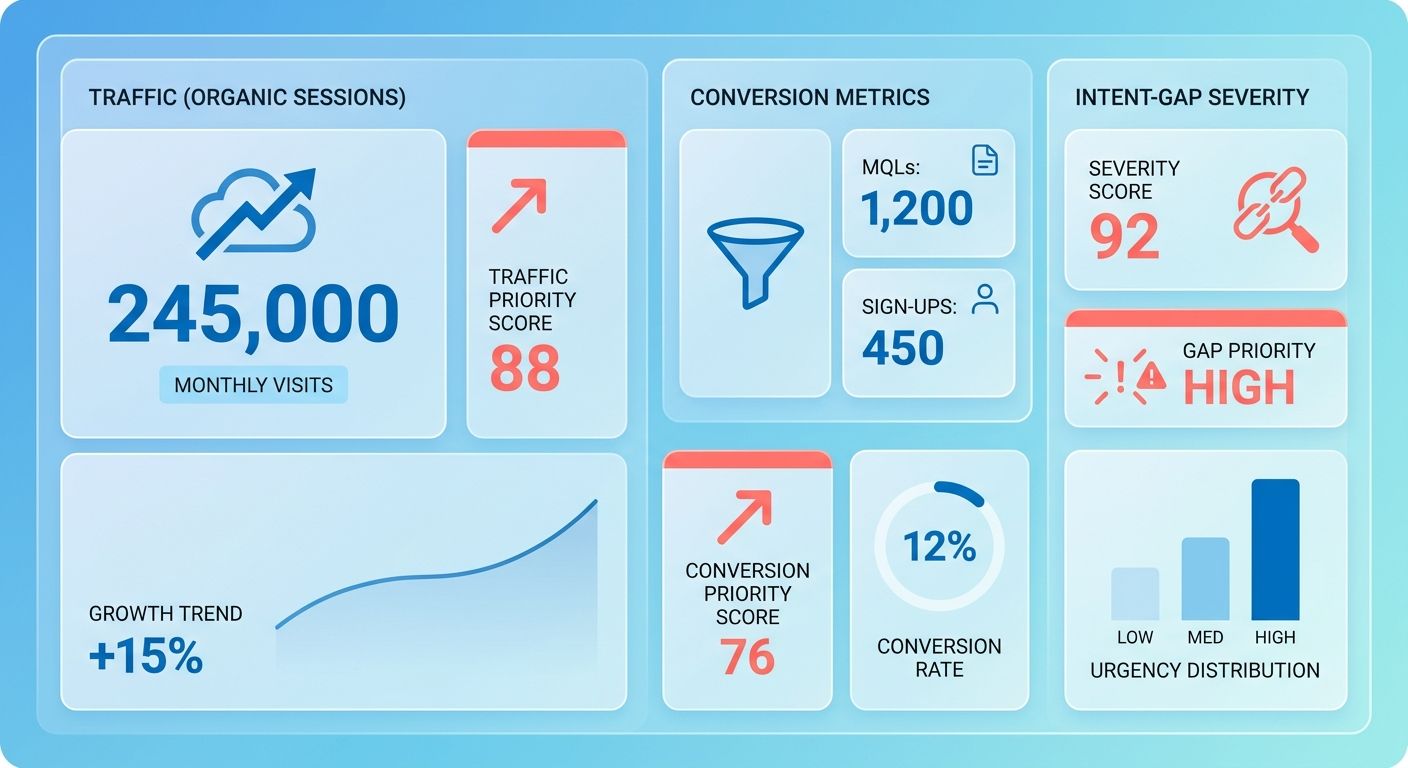
How Do You Build a Repurpose Score?
Repurpose Score: a weighted number from 0 to 100 that ranks each asset by its likely SEO and lead-gen payoff when reworked for the right intent.
A simple weighted model works well here. Blend traffic, conversion strength, and intent-gap severity. Give traffic and conversions the most weight, and intent gap a smaller share.
Normalize each input to a 0-100 scale first. A blog post with strong MQL attribution and a wide intent gap might land at a high score. That kind of score makes it the obvious first candidate to become a webinar and an FAQ.
When weighting these factors, do not over-value raw traffic. A high-volume page that fails to engage users can skew your priorities. Integrating deeper engagement metrics and conversion pathways ensures you focus on assets that hold genuine commercial value.
Where Does AnyPost Fit?
This is where automated discovery tools streamline the process. By mapping your existing content library against your core product offerings, you can instantly see which assets align with your current messaging. Accessing integrated search performance data directly within your workflow eliminates the need for manual spreadsheet exports. That gives you immediate clarity on which pages need attention.
Identifying these gaps requires analyzing search landscape shifts. By evaluating competitor structures and identifying underserved search queries, you can pinpoint exactly where your content falls short. Because search behavior is constantly changing, keeping a pulse on live search results ensures your updates are based on current user needs rather than outdated data.
How Do You Sequence the Work?
Split your ranked list into two tracks. Build a 30-day quick-win sprint from your top 5 highest-scoring pieces, then a 90-day strategic pipeline for the next 20 or more. Quick wins prove the model. The pipeline compounds authority.
Segment each piece by format opportunity, matched to where its audience already lives. People run multiple active social accounts on average, so one asset can feed several channels:
- Blog post → video script for platform-native discovery
- Whitepaper → LinkedIn carousel for decision-maker reach
- Podcast → tweet thread for quick-hit distribution
Set a concrete success bar before you begin. Choose a performance target that aligns with business goals, such as a specific lift in organic click-through rates or qualified leads. If a candidate for repurposing cannot realistically drive those outcomes, deprioritize it. The goal is to maximize the business value of every asset you modify.
Atomize & Reformat Content for Platform‑Specific Search Intent
Atomization means breaking a high-value asset into its smallest reusable parts, then rebuilding those parts into formats that match each platform's dominant search intent. The unit of work is not the blog post. It's the quote, the stat, the framework step, the visual hook.
This approach is critical for effective distribution. Rather than simply changing the file type, you must first ensure the underlying message addresses the specific user need on the target platform. Once that alignment is secured, high-quality production and creative execution can maximize your reach.
What Are the Four Atomization Building Blocks?
Atomization framework: every asset breaks into four block types. Core Idea, Supporting Data, Visual Hook, and Call-to-Action. Each becomes a standalone unit you can recombine per channel.
Take a 2,500-word guide. Pull out 5 key statistics, 3 actionable steps, and 2 expert quotes. Those ten fragments feed a LinkedIn carousel, a tweet thread, and a video intro without a single copy-paste of the original paragraph.
This distinction is critical. For instance, adapting a well-known SEO guide into a highly visual video format can generate hundreds of thousands of views. These results come from platform-native storytelling and unique visual assets, not from reading a blog post aloud. Direct, unedited copies fail to engage audiences and are ignored by platform algorithms.
How Do You Map Format to Platform Intent?
Each platform serves a different dominant intent, so the same source idea gets rebuilt differently per channel. Blog posts satisfy long-form informational intent. FAQ pages catch navigational queries. Short product-demo videos serve transactional intent.
The design specs follow the intent:
- Twitter/X: a 280-character hook that leads with the Supporting Data block.
- LinkedIn carousel: 3 to 5 slides, one Core Idea per slide, a Visual Hook on the cover.
- YouTube: an 8-minute script that opens on the strongest quote, then walks the actionable steps.
Our take: your optimization strategy must adapt to the channel. For traditional search engines, differentiate your keywords and angles to prevent your own pages from competing with one another. For social feeds and video platforms, success depends on native engagement and production value. Tailor your approach to the environment.
Why Automate Atomization and Voice Consistency?
Manual atomization is where teams burn out. AnyPost automates content generation across multiple platforms, pulling from your source material to produce ready-to-rank assets without hand-copying. That output flows straight into publishing on WordPress, LinkedIn, X, and more, all from one dashboard.
The primary risk when scaling this process is losing your brand's unique identity. When content is broken down and distributed across multiple networks, it can easily sound disjointed. Maintaining a unified editorial standard ensures that whether a user reads a short social post or a deep-dive newsletter, the tone remains unmistakably yours.
Furthermore, distribution is not a set-and-forget task. Because user search patterns and platform algorithms are constantly in flux, even perfectly atomized assets can lose relevance over time. Integrating performance tracking into your publishing workflow allows you to monitor engagement trends and update your distributed assets as audience behavior shifts. Atomization provides the building blocks, but continuous optimization keeps them effective.
The full loop runs Audit → Prioritize → Atomize → Format Templates → Review → Schedule → Publish → Track. For a deeper walkthrough, see our guide on turning one blog into six channels.
Measure, Iterate, and Optimize Repurposed Content for Intent
Measuring repurposed content starts with one rule: track KPIs by intent, not by format. An informational asset lives or dies on organic CTR and dwell time. A transactional one answers to conversion rate and assisted conversions. Judge them by the same yardstick and you will kill your best performers by accident.
This is where most teams stumble when they figure out how to repurpose content at scale. They report total traffic across every format and lose the signal. A better approach is to segment every metric by the intent the piece was built to serve, then trace results back to the original asset it came from.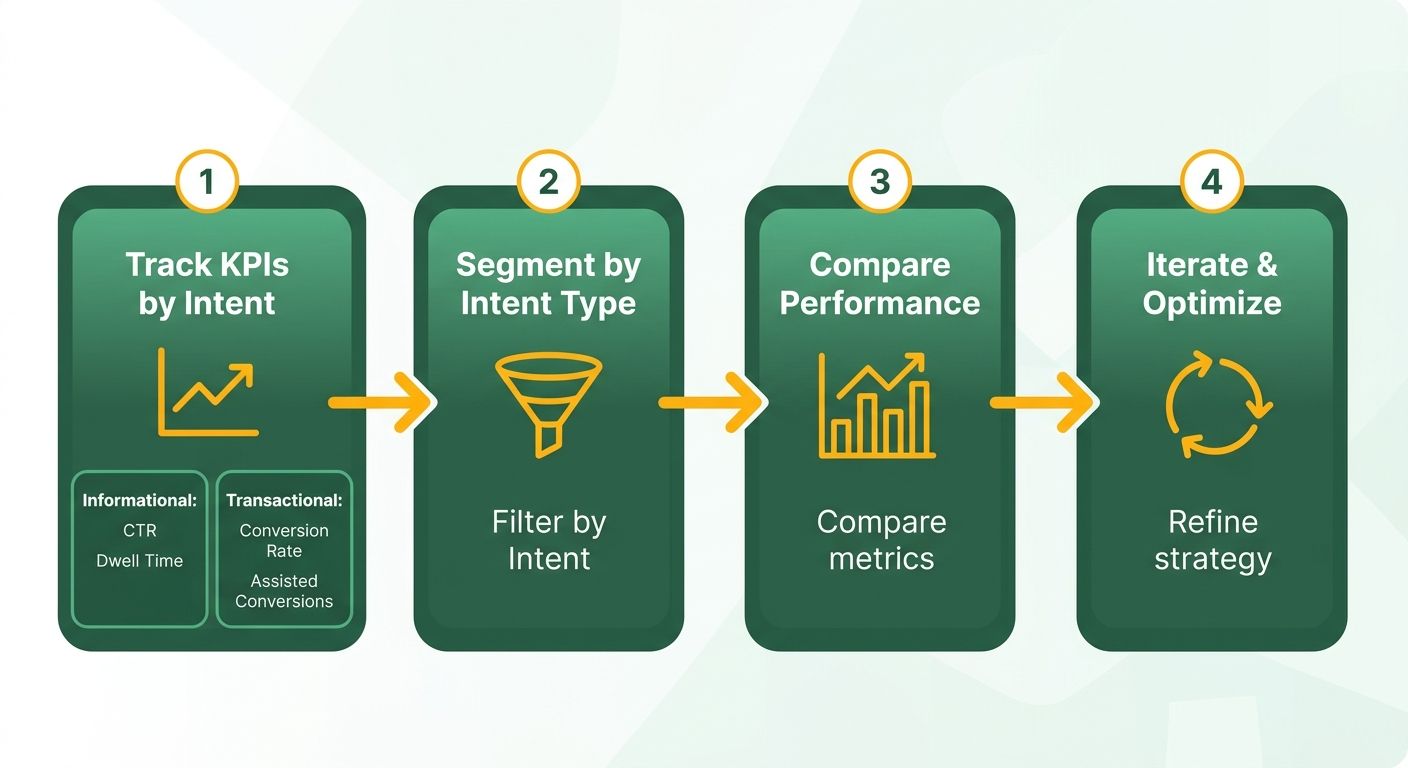
Which KPIs Match Which Intent?
Intent-matched KPIs: each intent type has two metrics that actually tell you whether the repurpose worked. Everything else is noise.
- Informational (how-to, explainer): organic CTR and dwell time. Are people clicking, and do they stay?
- Transactional (buy, sign-up): conversion rate and assisted conversions. Did the piece close, or feed a later close?
- Navigational (brand, product): bounce rate and page depth. Did visitors find what they came for and go deeper?
Pair Google Search Console's query data with an intent-performance view to see which formats rank for which query types. The gap between "ranks well" and "ranks well for the right intent" is where the money hides.
How Do You A/B Test Intent Matching?
Run the original asset against an intent-matched variant and let conversion data pick the winner. Tag each version with distinct URL parameters, then compare against the same goal. A generic blog post versus an FAQ rebuild is a clean test when both target the same query.
Here is how it plays out in practice. A webinar clip repurposed to YouTube and pointed back at its source blog is a solid test case. Give it two rounds of iteration rather than one. Measure the lift in organic traffic to the underlying post and any change in CPA after each pass. The first pass rarely matches intent perfectly, so the second round is where the real gains tend to show up.
There is a newer signal worth tracking separately: inclusion in AI-generated search answers. Repurposing can push a brand into those answers, and that placement behaves nothing like a blue-link ranking. Position, impressions, and CTR miss it entirely. Treat AI answer inclusion as its own intent-qualified metric, or you will under-count your real reach.
How Do You Scale the Winners?
Feed performance data back into your scoring model and re-prioritize the next batch. The pieces that beat their intent target get reworked first. The flops get retired. This closes the loop between measurement and your repurposing that preserves rankings.
Watch for high-flyer combos: specific intent-format pairs that outperform everything else, like how-to videos carrying informational intent. When one pairing keeps winning, consider putting a significant portion of your repurpose budget behind it. Concentration beats spreading thin.
Close every month with an intent-impact report: traffic, rankings, leads, and ROI broken out per format. Skip this cadence for a one-off campaign. The overhead is not worth it. But for an ongoing program, the monthly view is what turns scattered wins into a repeatable system.
Frequently Asked Questions
1. Can repurposing the same content for different intents cause duplicate content penalties?
Yes, if you simply copy and paste the same text across multiple pages. To prevent search engines from filtering out your pages, customize the angle, structure, and target keywords for each asset. Focus on platform-native versions that address different user needs rather than publishing identical copy in multiple places.
2. How do commercial and transactional intent differ when auditing content?
Commercial intent involves users researching options, often searching for terms like "best project management software" to compare features and pricing. Transactional intent indicates a user is ready to purchase, using queries like "buy project management tool license." A commercial page requires comparison tables and objective reviews, whereas a transactional page should feature direct sign-up forms and product demonstrations.
3. What should I do if my high-traffic page has strong reach but low influence?
Look beyond raw pageviews by analyzing deeper engagement and conversion metrics. Evaluate how long visitors stay on the page and whether they take action afterward, such as downloading a resource or signing up for a trial. Prioritizing assets that drive actual business outcomes, even if they have lower traffic, keeps your optimization efforts focused.
4. How many rounds of iteration should a repurposed asset get before I judge it?
Plan for multiple optimization cycles. Initial adjustments often require fine-tuning based on early performance data. Monitor traffic trends and acquisition costs over several weeks. Make incremental tweaks to the messaging and format before making a final assessment of the asset's success.
5. Should I count AI-generated search answer inclusion as a success metric?
Yes, because visibility in AI-driven summaries represents a major shift in how users find information. Since these placements do not follow traditional search engine results page dynamics, standard metrics like average position may not capture this exposure. Monitoring brand mentions within these summaries provides a more accurate picture of your modern search footprint.
6. What is intent decay and how do I prevent my repurposed content from drifting?
This refers to the natural misalignment that occurs as search engine algorithms and user search habits evolve over time. To prevent your content from losing relevance, establish a routine schedule to review search query reports. Identifying pages that are losing click-through rate despite stable rankings allows you to refresh the content to match current user expectations.
7. How much of my repurpose budget should go toward a winning intent-format pairing?
Allocate a significant portion of your resources to your top-performing combinations. Once you identify a specific format and intent match that consistently drives high engagement, focus your efforts there rather than diluting your budget across unproven channels. Use these insights to guide your future content planning.
