
Retainer or Project: How AI Search Changed SEO Scope in 2026

Key Takeaways
- Average monthly SEO spend sits near $2,917. Agency retainers run $1,500 to $10,000-plus; projects span $2,500 to $30,000.
- Roughly 58.5% of Google searches now end without a click, and AI Overviews cut position-one click-through rates by as much as 58%.
- Retainers earn their keep on continuous judgment work: relevance monitoring, strategic oversight, link building, and tracking visibility across AI answer layers.
- Only 14% of marketers track LLM citation visibility, even though 43% call AI optimization a core strategy and 89% of brands already show up in AI Overviews.
- If an agency can't show you before-and-after AI visibility, the retainer is a paid subscription to hope.
- The whole decision hinges on one split: which work needs continuous judgment, and which you can buy in a fixed burst.
The one question that settles it
The choice between an SEO retainer vs project scope comes down to a single question: which work needs continuous judgment, and which can you buy in a fixed burst? Get that split right, and you stop overpaying for results you cannot measure.
Mid-market SaaS brands feel the squeeze. Average SEO spend runs about $2,917/month, with retainers at $1,500 to $10,000+ and project pricing from $2,500 to $30,000. At the same time, 58.5% of Google searches now end without a click, and AI Overviews cut position-one CTR by up to 58%. You're being asked to pay more for a search result that sends fewer clicks.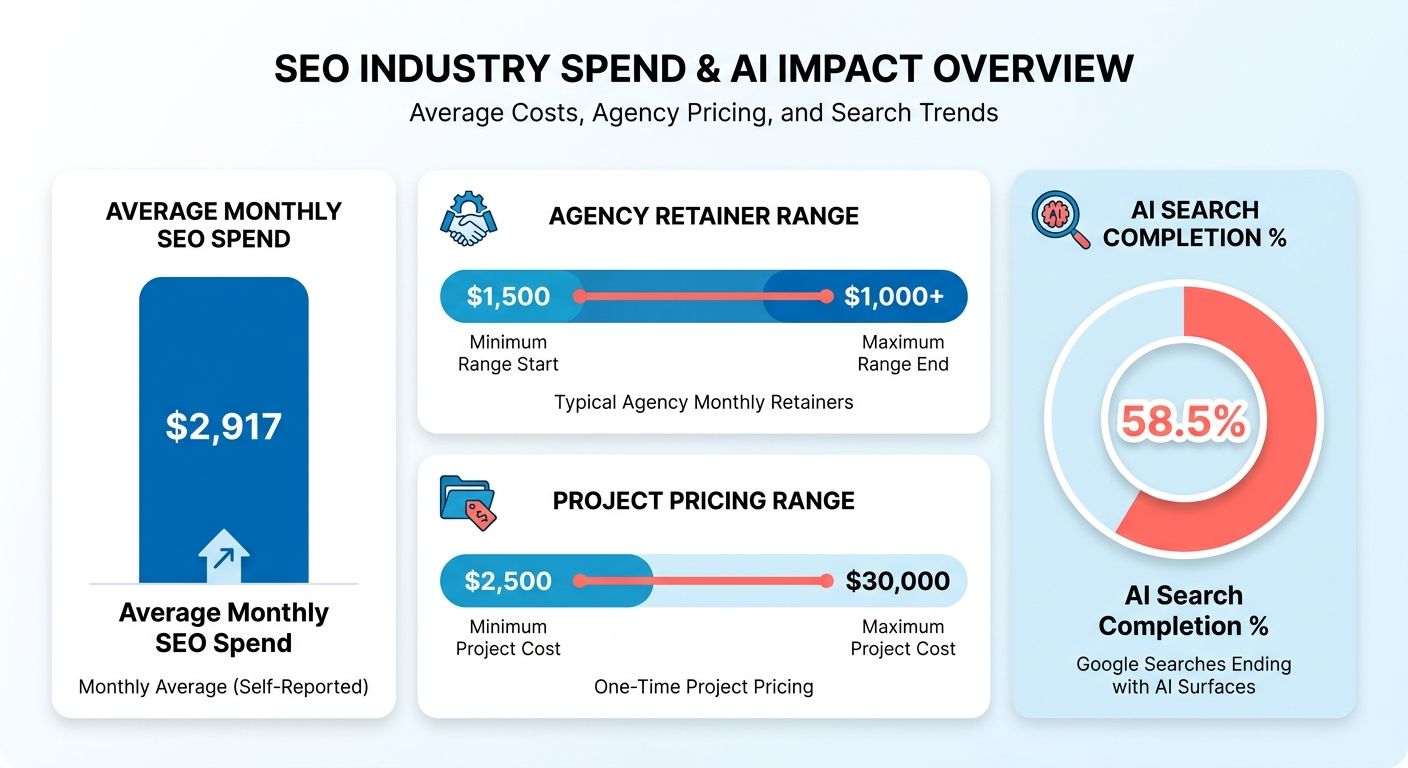
When a retainer actually earns its keep
A retainer is worth it for work that never stops: relevance monitoring, strategic oversight, link building, tracking your visibility across AI answer layers. Judgment work. And judgment doesn't ship in a box.
Traditional SEO agencies lean on this continuous model. Teams of technical specialists, content writers, link builders, and strategists, plus ongoing tool costs and months of consistent execution. On competitive terms, that's a real case for a monthly commitment.
But watch the measurement blind spot. 43% of marketers name AI optimization a core strategy, and 89% of brands already appear in AI Overviews, yet only 14% track LLM citation visibility. So if your agency can't show you before-and-after AI visibility, the retainer is a subscription to hope. AnyPost shows you what changed, straight out of Google Search Console.
When to scope a project burst instead
Scope a project when the work has a clear start and finish: AEO setup, schema markup, a content production sprint, a one-time citation audit. Measurable output you can verify, then walk away from.
This is where the make-or-buy split gets sharp. AI automation has crushed the cost of content production while raising the value of high-intent, low-difficulty targeting. Top-of-funnel content that AI can easily answer no longer performs the way it used to. So don't pay retainer rates for TOFU your competitors get for free.
The sources point the same way, and it's worth naming. Traditional agencies argue real results demand a continuous $1,500–$2,000/month floor. But burstable content work doesn't need those rates anymore. Continuous work stays retained; burstable work gets projected. If you want the freelancer-vs-agency math behind this, our freelance SEO vs agency cost breakdown lays it out.
How the options compare
| Factor | Long-Term Retainer | Project Burst | AnyPost.ai |
|---|---|---|---|
| Typical cost | $1,500–$10,000+/mo | $2,500–$30,000 one-time | Starter, Growth, or Enterprise tiers |
| Best for | Ongoing judgment, link building, monitoring | AEO setup, content sprints, audits | Automated, SEO-optimized content generation |
| Accountability | Harder to verify month to month | Clear before-and-after deliverable | Measurable output via Google Search Console |
| AI-search fit | Continuous LLM citation tracking | One-time AEO/schema build | High-volume production layer |
For automated content generation at scale, that's where AnyPost.ai sits. We built it for the production layer, where you need volume fast and still want content that ranks and sounds like you actually wrote it, thanks to our Persona Engine and Business Context Graph. Skip us for the retained judgment layer. Relevance engineering and month-over-month citation monitoring belong with a strategist, not a production engine. Match the tool to the layer, and your budget stops leaking.
Feature Comparison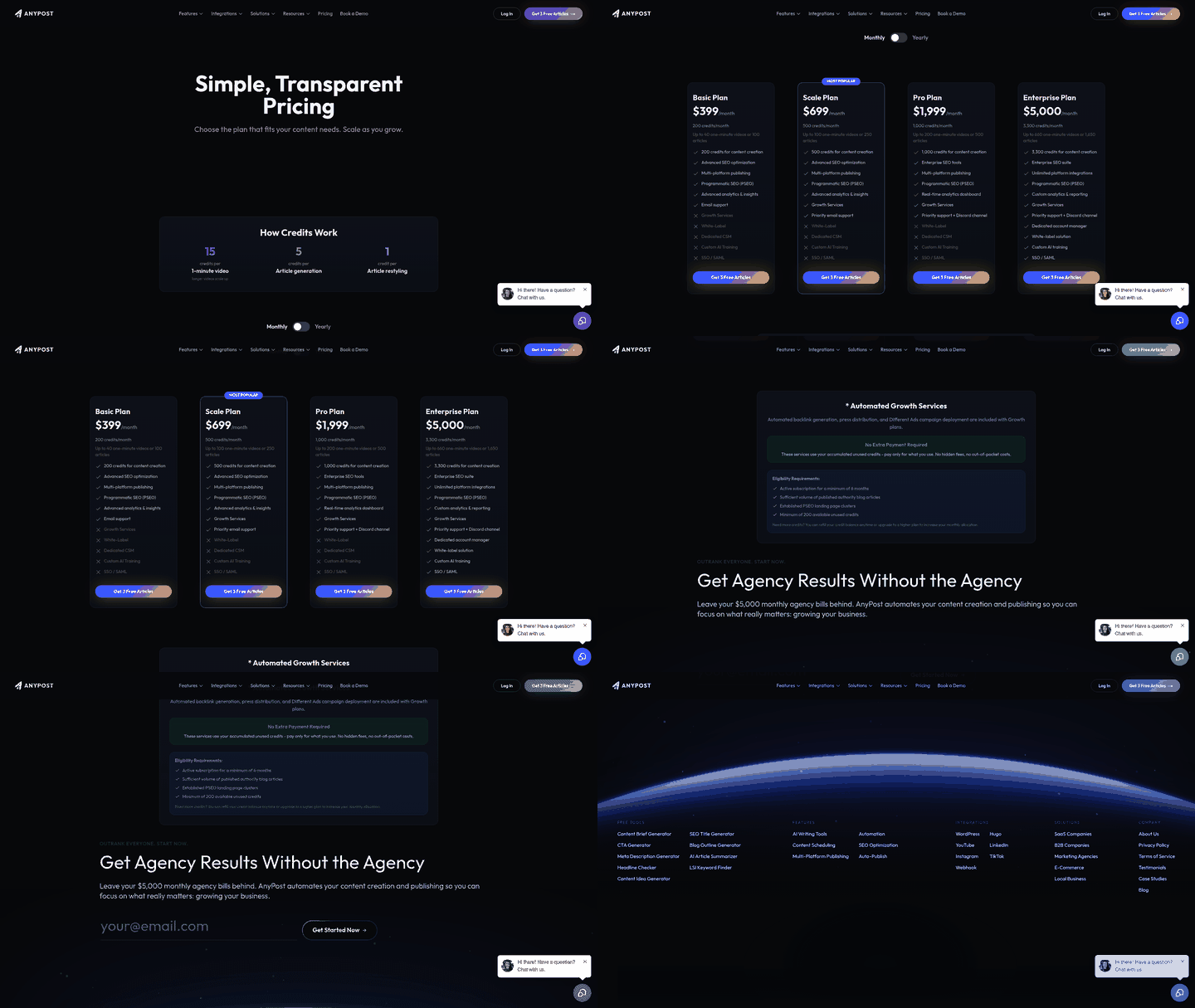
The feature that matters most in an SEO retainer vs project comparison isn't the deliverables count. It's whether the engagement covers AI search surfaces or only Google's blue links. That one gap decides whether you're paying for half your buyers or all of them.
Here's why we push it. Right now 51% of B2B software buyers start their research in AI chatbots, up from 29% just eleven months earlier. And 69% of them picked a different vendor based on what the AI told them. A retainer scoped only to organic rankings is optimizing for a shrinking slice of the surface.
What each model actually includes
Project burst: fixed-scope, priced by output. Best for one-time builds like schema markup, AEO foundations, or a content refresh. Retainer: ongoing monthly, priced by capacity. Best for continuous work like relevance monitoring and strategic oversight.
The pricing spread tells the story. Freelancers run $150 to $400 per hour. Standalone AEO tooling adds $500 to $5,000 per month on top of your base spend. Enterprise SEO can climb past $100,000/month at full complexity.
| Feature | AnyPost.ai | Retainer Agency | Standalone AEO Tool |
|---|---|---|---|
| Best for | AI-search content bursts | Continuous oversight | Prompt monitoring only |
| Pricing model | Subscription tiers | Monthly capacity | $500–$5,000/mo add-on |
| AEO coverage | Built in | Varies by contract | Core focus |
| Ongoing commitment | None required | 6–12 month lock | Month-to-month |
| Redundancy risk | Low | Medium | High |
Where redundant spending creeps in
The hidden cost isn't the retainer price. It's stacking a $3,200 average retainer, a standalone AEO subscription, and freelance overflow into three overlapping engagements. Conductor calls this the "redundant spending" trap, and mid-market brands fall into it constantly.
So the real cost-control question isn't retainer versus project at all. It's whether AEO lives inside one accountable engagement or gets bought as three duplicative line items. AnyPost brings the whole content workflow into a single dashboard on a subscription plan, so AI-search formatting is baked into the content you generate rather than billed as a separate add-on.
As Conductor puts it:
"The challenge isn't whether to invest in AI visibility; it's understanding the costs and justifying the budget."
Which model fits your stage
It depends on whether you've already built AI-search presence. No AI presence yet: front-load a project burst to establish schema, answer-engine content, and prompt visibility fast. Presence established: keep only a thin maintenance retainer for monitoring and relevance updates.
Skip the full retainer if your only goal is a one-time AEO foundation. You'll pay twelve months for work that took eight weeks. And skip the standalone AEO tool if your content platform already handles answer-engine formatting. Paying twice for the same coverage is the most common mid-market waste we see.
In-house teams can beat agencies on cost over time, per Conductor, but only if they own schema markup and prompt monitoring internally. Most mid-market brands don't, which is exactly why a scoped burst plus light retainer usually wins the math.
Pros and Cons
Simple to state, hard to execute: a retainer buys continuous judgment, a project buys finite output. Get the project scope wrong, and you either pay monthly for work that finished months ago, or you buy a one-time burst for work that needs constant attention.
The make-or-buy split keeps circling back. AI has crushed the cost of production tasks like content generation while raising the value of expert judgment like relevance monitoring and citation tracking. So the burstable layer is production and one-time AEO setup. The retained layer is ongoing oversight. That's your cost-control framework in one line.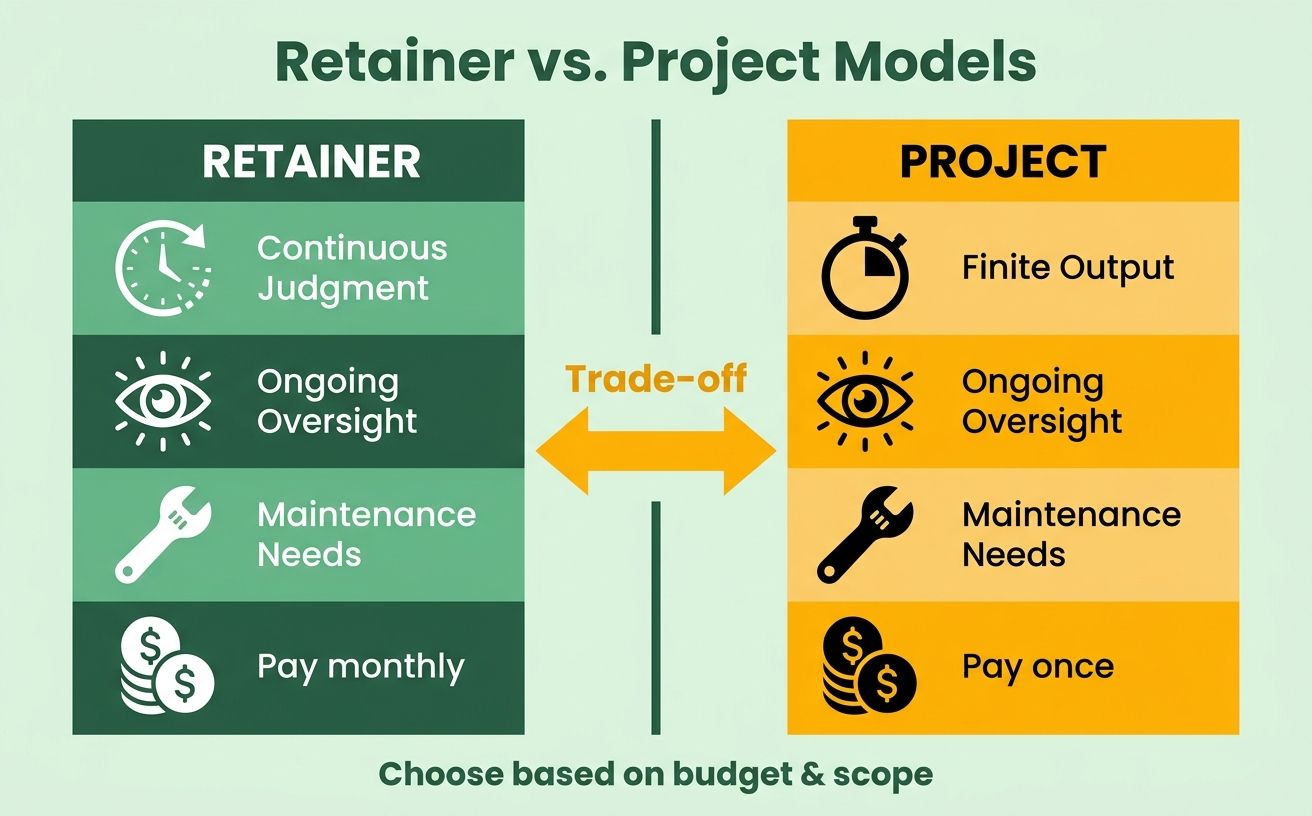
The strengths and weaknesses of each
Project burst: fixed-scope, priced by deliverable, best when the work has a clear finish line. Retainer: ongoing commitment, priced monthly, best when the work never stops needing a human call.
| Factor | Project Burst | Retainer |
|---|---|---|
| Best for | AEO setup, schema, content batches | Relevance monitoring, strategy, link building |
| Cost predictability | High (fixed scope) | Lower (recurring) |
| Speed to value | Fast, one-time | Compounds over months |
| Ownership | Ends at delivery | Continuous |
| Risk | Scope gaps, no follow-through | Paying for idle months |
A project's biggest strength is predictability. You know the price before you start, and spending stops once the deliverable ships. The weakness is follow-through. Ship an AEO foundation and walk away, and nobody's watching whether AI engines keep citing you. Roughly two-thirds of one-time SEO engagements stall out for exactly that reason: no one owns what happens after handoff.
When the retainer's weakness bites hardest
The retainer's weakness shows up when you're paying for maintenance months where nothing changed. Dead weight. But its strength is real for compounding work: sustained SEO draws on technical specialists, content writers, link builders, and strategists, plus ongoing tool costs and months of consistent execution. That's exactly the work you can't buy in a single burst.
The sources genuinely conflict here. The Digital Elevator argues real results demand a long-term retainer sustained over many months. Searchbloom counters with a hybrid model that hit 60% organic traffic growth in six months. These don't actually oppose each other. One defends continuous judgment; the other proves production bursts win when scoped right.
Run the production and one-time setup as projects, and retain only the judgment layer. That kills the two biggest failure modes at once. You stop overpaying for idle retainer months, and you stop abandoning AEO foundations with no one monitoring them.
Where our approach fits
We built our platform for the production side of this split. AI-generated content bursts let you buy the batch work outright instead of renting it monthly. The honest carve-out: skip the burst-only route if you have no one owning relevance and citation monitoring after the content ships.
That's the trap to watch. AI-generated content without expert oversight doesn't rank in 2026. Production is buyable. Judgment isn't. When you're sizing the human side, decide up front who owns that retained layer of ongoing monitoring and strategy.
Use Cases and Ideal Users
The right model depends on where your AI-search presence stands today. Brands with no footprint in AI answers should front-load a project burst to build it. Brands that already rank and get cited should retain only the maintenance layer. That's the core of the decision for mid-market SaaS.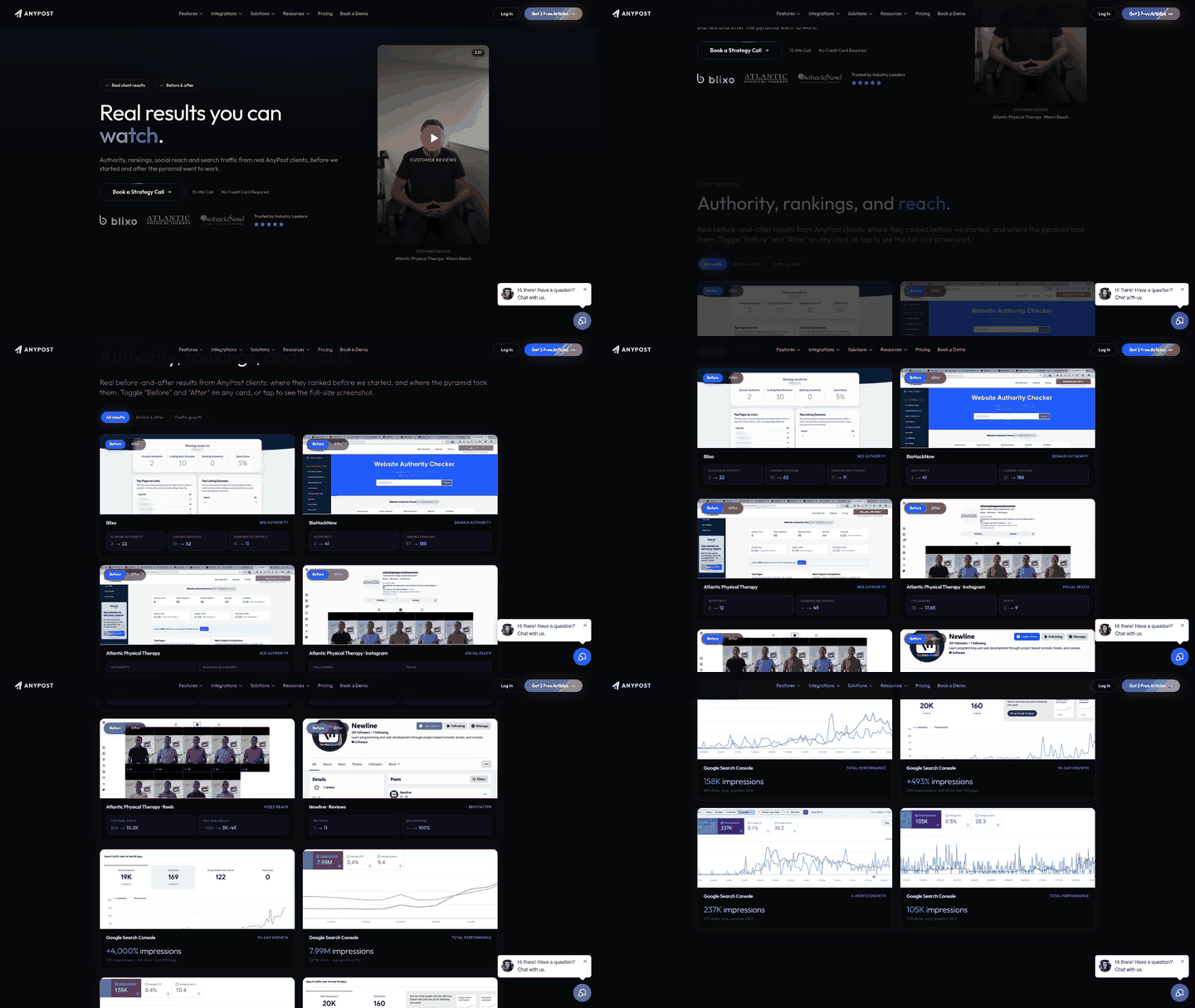
Here's the timing signal we watch. Searchbloom's research suggests organizations often find greater long-term cost efficiency by building internal capabilities and using external partners strictly for specialized execution. So the choice between models isn't ideological. It maps to whether you need ongoing strategic oversight or a targeted technical build.
Who should front-load a project burst
Best for: SaaS brands with weak or zero AI-search presence, one-time technical debt, or a fixed launch window.
If your buyers are asking chatbots about your category and getting competitors' names back, you have a coverage gap, not a maintenance problem. A project burst fixes that fastest. AEO foundations, schema markup, a content refresh built to be cited. A defined build has a clear finish line, so you scope the deliverables, ship them, and walk away with no open-ended commitment dragging on your budget.
Production is the cheapest it has ever been to buy in bursts. AI dropped the cost of content generation hard. AnyPost generates ready-to-rank, SEO-optimized drafts in your brand voice, so the burst delivers volume without sacrificing consistency. Buy the volume as a project; don't sign a retainer for it.
When a retainer fits the ideal user better
Best for: brands in competitive categories that need continuous relevance monitoring, citation tracking, and strategic oversight.
A retainer earns its keep when the work genuinely never stops. That's the judgment layer: watching how AI engines cite you, spotting relevance drift, adjusting quarter to quarter. Categories with fast-moving competitors see citation positions shift week to week, and someone has to own that vigilance. You pay for oversight, not output.
Conductor's research emphasizes that the real hurdle is aligning your internal budget with the specific search surfaces where your customers actually spend their time. Retain the layer you can't automate. Burst the rest.
Which model matches your profile
It comes down to a few practical questions. Is your gap a one-time coverage problem or an ongoing relevance problem? Do you need a fixed deadline or steady, compounding progress? Should your resource draw spike upfront and drop to zero, or stay predictable each month? A weak AI-search presence with a fixed build points to a burst. A competitive category needing constant oversight points to a retainer.
Where we land on the contradiction: the "retainer is the only real SEO" camp and the "hybrid bursts win" camp aren't fighting. They're describing different work. Continuous judgment belongs on retainer. Production and one-time AEO setup belong in a burst.
Our platform sits in that burst layer. AnyPost automates the creation and publishing of SEO-optimized content in your voice, generating the ready-to-rank volume a project scope needs. Pair that with a lean retainer for monitoring, and mid-market teams stop overpaying for finished work.
What I'd actually recommend
The decision in one line: retain the judgment, burst the production. That's the whole cost-control framework for a mid-market SaaS brand weighing an SEO scope in 2026. AI dropped the price of making content while raising the price of knowing what to make. So you buy the finite builds and keep the ongoing oversight.
The scope call isn't ideological, and it isn't about which model is "better." It maps to which work never stops. Relevance monitoring, strategic oversight, and citation tracking are continuous judgment. AEO setup, schema, and content production are finite output you can scope, price, and finish.
What to choose for your scenario
Match the model to where your AI-search presence actually stands.
| Your situation | Recommended scope | Why |
|---|---|---|
| Weak or zero AI-search footprint | Project burst first | One-time AEO build has a clear finish line |
| Ranking and getting cited already | Retain the maintenance layer only | The value is ongoing judgment, not new output |
| Fixed budget, one technical fix | Project burst | Priced by deliverable, no monthly drag |
| Continuous competitive pressure | Hybrid: retained oversight + project sprints | Buys judgment without paying for finished work twice |
For most mid-market SaaS brands, the hybrid wins. You retain a lean oversight layer and fire project sprints when a build genuinely needs doing. The trap to avoid is scope creep: a retainer with no defined deliverables quietly expands until you're paying for status calls and reports instead of measurable movement in AI answers.
When to skip a retainer entirely
Skip the retainer when your only real need is a one-time build. A fixed project has a start date, a finish date, and a bill that stops when the work ships.
Don't pay a monthly retainer for work that finished last quarter. That's the single most common way brands overspend. A retainer only earns its keep when there's genuine continuous judgment to buy month after month. Ask one question before you sign: what specifically changes in month three that didn't change in month one? If the honest answer is "not much," you're funding a project on a subscription plan.
One warning on cheap production
Cheap production has a catch. Automated content generation needs a human in the loop to verify accuracy and tone, so the output actually holds up to what modern search engines expect.
So the framework holds: automate and burst the production, retaining the strategic layer that decides what's worth producing and how it aligns with search intent. If you're building the production layer with automation, tools like AnyPost.ai handle the content generation, creating ready-to-rank, SEO-optimized articles in your voice while your retained resources focus on high-level strategy.
Spend your budget on continuous judgment, not on re-buying finished output. Get that split right and you stop paying premium retainer rates for a job a fixed project already closed out. AnyPost integrates directly with your performance dashboards, so you can track search footprint expansion without the manual reporting overhead.
Frequently Asked Questions
1. What question should I ask before committing to an SEO retainer?
Ask about the specific strategic decisions and adaptive tasks scheduled for the later stages of the contract. If the agency's roadmap shows repetitive task execution rather than active optimization based on search engine updates, you are likely paying a recurring fee for static work that should be scoped as a project.
2. Why does AI-generated content still need human oversight if production is so cheap?
While automation dramatically lowers the barrier to content creation, search engines prioritize unique insights and verified accuracy. Human editors are essential to inject proprietary data, refine brand voice, and ensure the material aligns with what LLMs look for when sourcing citations.
3. How do I avoid paying twice for AEO coverage?
Audit your existing tech stack and agency deliverables to identify overlapping services. Many modern publishing platforms natively structure content for LLM readability, meaning you don't need to purchase isolated optimization software or pay an agency extra for basic schema implementation.
4. Should mid-market brands handle AEO in-house instead of hiring an agency?
Managing this internally is highly efficient if your team possesses the technical skills to deploy structured data and track chatbot citations. If those specialized skills aren't present in-house, outsourcing the initial setup as a defined project is usually more cost-effective than hiring full-time specialists.
5. What happens to an AEO foundation after a one-time project ships?
Without active maintenance, your search footprint can degrade as algorithms update and competitors optimize their own pages. A project delivers a strong starting point, but you need a designated resource—either an internal owner or a light monitoring contract—to track ongoing visibility and make minor adjustments.
6. Is the hybrid model right for most mid-market SaaS brands?
A blended approach is highly effective because it matches the nature of modern search. You secure steady, high-level strategic guidance to navigate algorithm shifts while using targeted, fixed-cost sprints to handle heavy content production or technical overhauls as needed.
7. How does scoping for AI search differ from scoping for traditional Google rankings?
Traditional SEO focuses primarily on keyword optimization and page-one positioning on standard search engine results pages. Scoping for the modern landscape requires optimizing for conversational interfaces, ensuring your brand's data is structured for machine learning models, and verifying that your content is easily parsed by LLMs.