
Scalable AI Content Fails When You Skip Search Demand First

Key Takeaways
- Google doesn't ban AI-generated content. It penalizes automation whose main purpose is gaming rankings, which it treats as a spam-policy violation.
- Demand-first means proving real query volume exists before any draft does. Search interest is a hard gate, not a nice-to-have.
- The automation Google calls acceptable, sports scores, weather forecasts, and transcripts, all share one trait: they're fed by real data.
- Skip demand research and you get pages that rank for nothing, bounce hard, earn weak clicks, and drag down your site's quality signals over time.
- Zero-click results keep growing. Visibility now hinges on whether a model retrieves, synthesizes, and trusts your content, not on raw position.
- SaaS teams, agencies, and SMBs publishing at volume carry the most risk, because automation multiplies the waste from any bad topic list.
- Three metrics show a demand-first program is working: organic lift on new pages, ranking velocity for targeted queries, and leads converted from that traffic.
Chasing topics nobody searches is how content budgets die
Point your generator at topics nobody's actually searching for, and you'll produce pages that never get retrieved, never get cited, and never convert. That's the fastest way to burn a content budget. Demand-first flips the order: you confirm real query volume before a single draft exists.
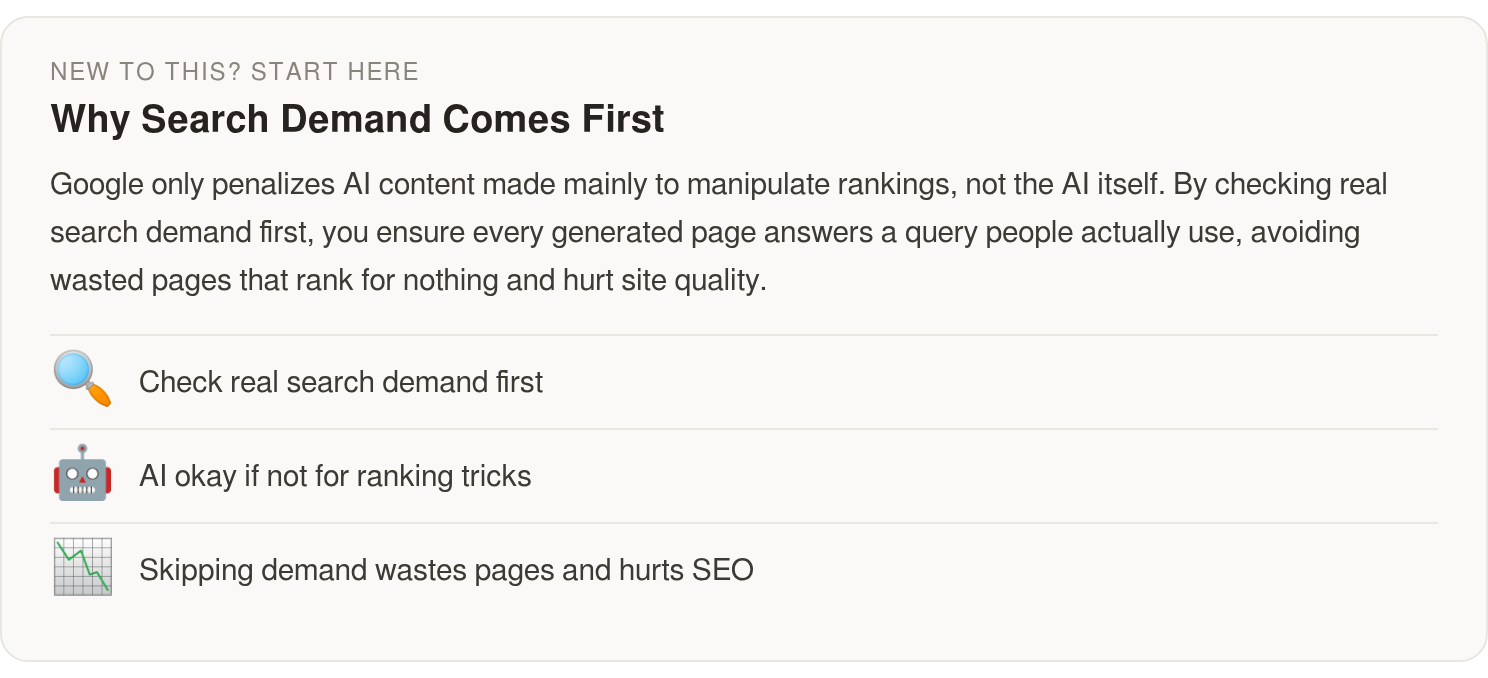
The tension worth sitting with is this. Google has said plainly it does not ban AI-generated content. Automation only crosses the line when the primary purpose is manipulating rankings, which Google files under spam-policy violation. So AI was never the problem. Scaling copy that maps to zero proven demand is.
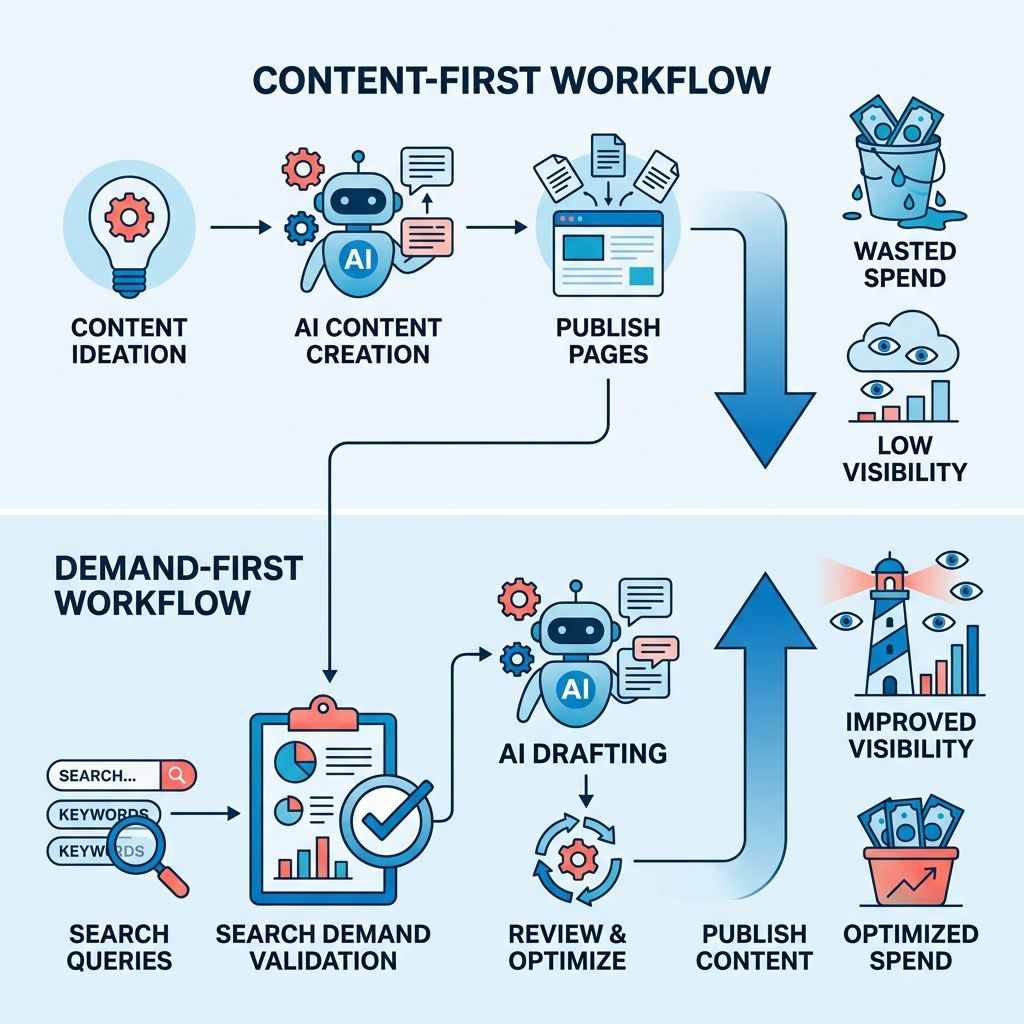
Why demand comes before generation
Demand goes first because it's the operational test that separates helpful automation from spam. Google's own examples of good automation, sports scores, weather forecasts, transcripts, all run on real data. Search-demand signals are that data feed for your content pipeline.
Google draws its line by intent. Content built to answer a real query is helpful. Content mass-produced for volume is the pattern that gets flagged. Real-time demand data tells you, before you generate anything, which side of that line a topic sits on.
Treat it as a gate, not a suggestion. If a topic can't show demand, it doesn't enter the queue. That one rule kills most of the low-value output that quietly erodes a domain.
What skipping demand research actually costs
You pay in pages that rank for nothing, high bounce, weak click-through, and a slow decay of your quality signals. Organic search is still one of the biggest acquisition channels most businesses have, so the upside is real. You only capture it when your pages answer questions people are actually asking.
There's a second layer now. AI-driven search is reshaping how people find things, and zero-click results keep climbing. Visibility today leans less on raw position and more on whether a model retrieves your content, synthesizes it, and trusts it inside its answer.
So two ideas collide. Google says quality is the gate to the index. But quality alone no longer guarantees you get surfaced in an AI answer. Matching verified demand is what bridges "good enough to rank" and "relevant enough to get cited." Quality is necessary. Demand-matching is what makes it pay.
Who gets the most out of going demand-first
SaaS teams, agencies, and SMBs publishing at volume gain the most, because they carry the highest risk of scaling irrelevant pages fast. The more you automate, the more a bad topic list multiplies your waste.
Three metrics tell you it's working: organic lift on new pages, ranking velocity for targeted queries, and lead conversion from that traffic. For a deeper build on that last one, our guide on SaaS B2B lead generation with automated content covers the pipeline side.
Your quick win: run a demand-gap analysis on your next planned batch and cut every topic that can't prove search interest before you generate a word.
QA isn't polish. It's the intent checkpoint.
Quality assurance for AI content isn't a coat of paint at the end. It's the checkpoint that proves each page still maps to the demand you validated before drafting. Skip it and you drift right back into the pattern Google flags: volume for its own sake instead of answers people search for.
The line is intent. Automation is fine, and it's quietly powered helpful content like sports scores, weather forecasts, and transcripts for years. The violation is using AI content generation "with the primary purpose of manipulating ranking in search results." A good QA process keeps every page on the right side of that line by tying it back to a real query.
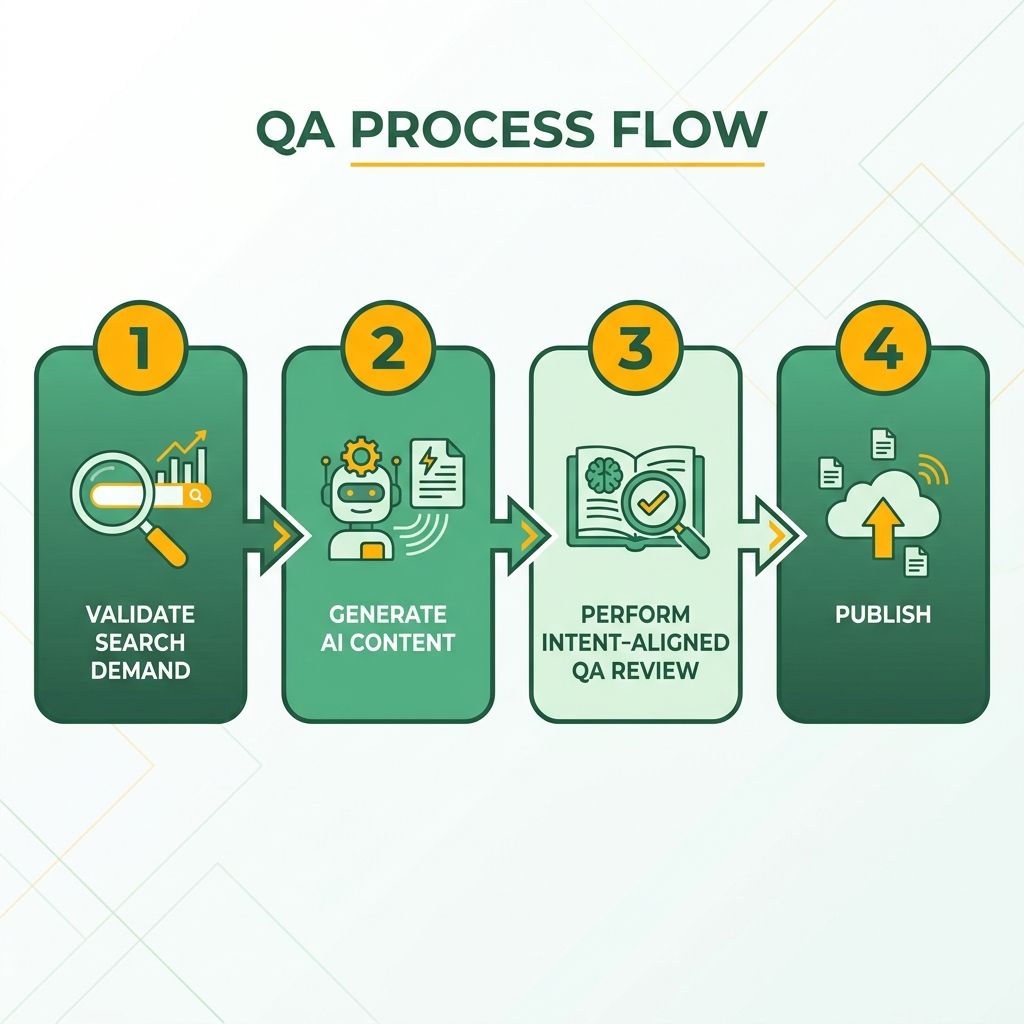
How you verify a page still matches search intent
Run each draft through a structured intent-alignment check before it publishes. The audit confirms the page answers the query it was briefed against, not some topic the model wandered off into.
AnyPost bakes SEO structure into every article it generates:
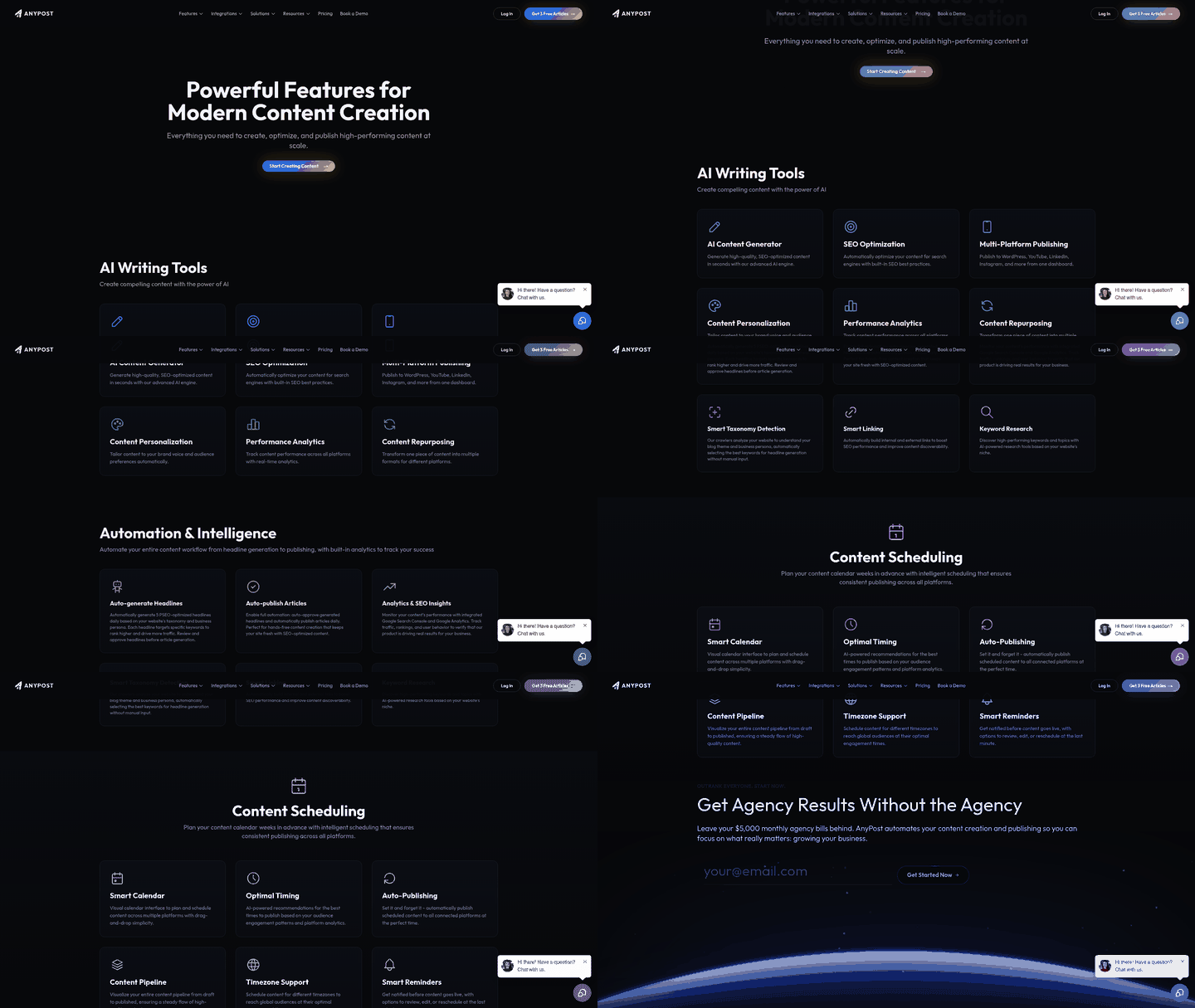
- Keyword-optimized content with search-intent-aligned headings that restate the target query and its close variants
- Semantically correct HTML, with each major topic wrapped in semantic
<section />tags
This matters more than it used to. Discovery is shifting as more searches surface answers directly, so getting indexed on quality is just the price of admission now. Getting retrieved and cited by the model is the new win, and structured, intent-matched pages are what get pulled into those answers. That's why AnyPost is built to rank on Google and get cited by AI.
What automated tooling should catch before a human ever looks
Let tools handle the mechanical failures so your reviewers spend their time on judgment. Automated checks flag missing H1 or H2 structure, thin word counts, and duplicate meta descriptions across bulk-published pages.
These are the errors that scale fastest and hurt worst. Publish at a demand-first cadence and one broken template can replicate across dozens of pages before anyone notices. Catching a duplicate meta description at generation time is far cheaper than fixing it after Google has crawled the whole batch.
Feed real-time demand data into the same pipeline and the tooling picks up a second job. It can flag pages whose target query has lost volume, so you catch irrelevant content before it ships instead of after it fails to rank.
Where the human reviewer earns their keep
Put a person on the last mile: confirming the page actually satisfies the searcher's intent and reads like something worth citing. Machines confirm structure. Humans confirm relevance and trust.
Here's the resolution to a real tension in the evidence. Google says quality is the gate, judged on how well content serves people. The retrieval-first view says getting cited by the model is what wins. Both are true, just at different stages. Quality gets you indexed. Demand-first targeting makes that quality relevant enough to get surfaced.
A human-in-the-loop cycle bridges the two. Your reviewer asks one question per page: does this answer the query we validated? If yes, it ships. If no, it goes back before it dilutes the program.
Measuring what actually matters after you scale
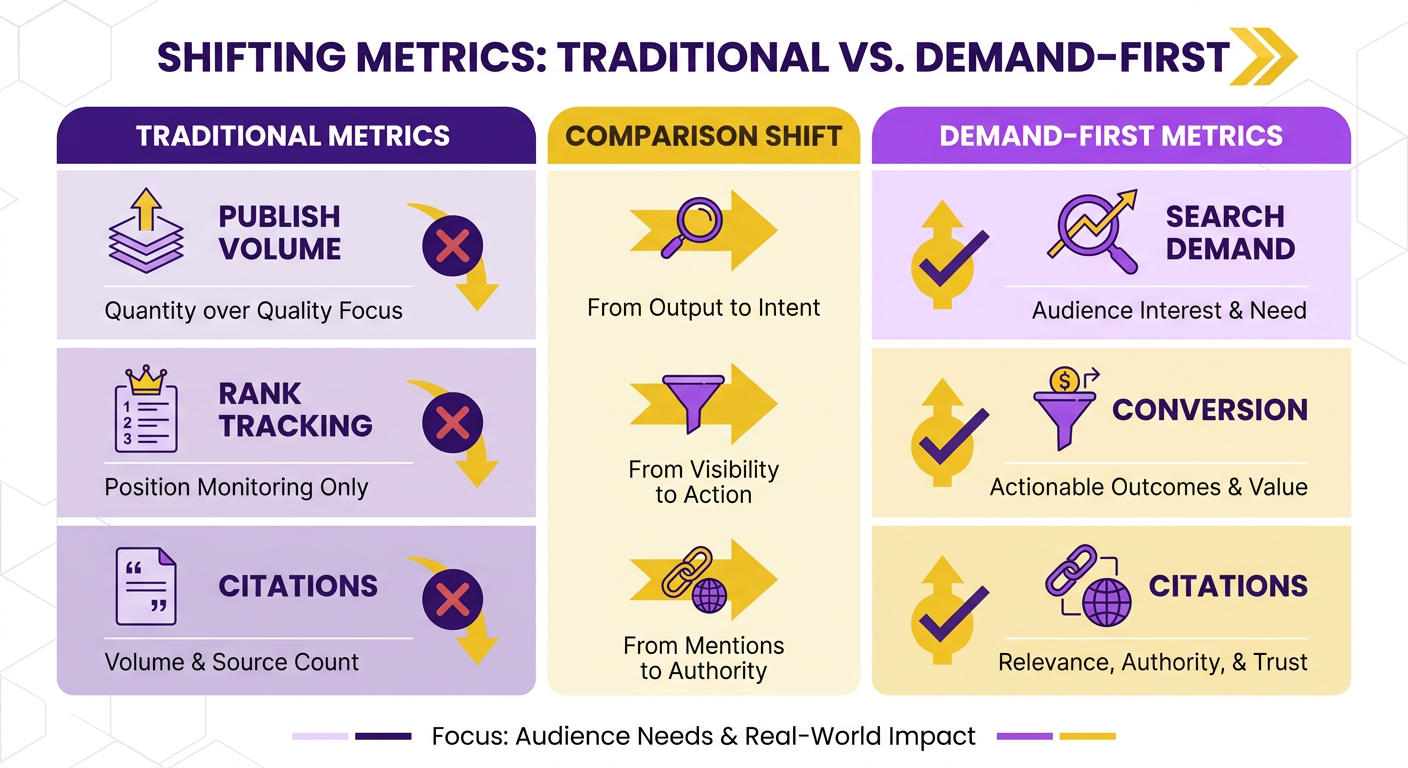
Most teams measure the wrong thing once they scale. They watch publish volume climb and call it progress. But a demand-first pipeline only earns its keep when the pages you validated actually get found, cited, and converted. The measurement job is to prove the link between demand and outcome, not to celebrate output.
That changes what you track. Traditional rank tracking tells you less every quarter as AI answers absorb more queries. Analysis of AI's impact on search shows how much retrieval now happens inside summarized answers instead of a blue-link list. At scale, the metric that matters is whether your demand-validated topics get pulled into those answers.
Citation rate beats rank position
Here's the shift on your dashboard. IPullRank frames success as retrieval, synthesis, and trust rather than a position number. Google, separately, keeps saying quality is the durable signal it rewards. Put those together and one metric rises above the rest: how often your pages get cited or included in AI answers for the exact queries you validated up front.
Track that citation rate per demand cluster, not per URL. If a topic you flagged as high-demand never shows up in AI answers, that's your signal to revise the page or retire the cluster. Raw traffic still matters for conversion, but inclusion is the leading indicator now.
Pair it with lead conversion by cluster. A page can rank, get cited, and still convert nobody. Connect demand data to closed leads and you see which validated topics deserve more content and which were vanity searches. That's the loop that keeps automated content tied to revenue instead of activity.
The dashboards that surface demand signals
You don't need ten tools. You need a few views that answer specific questions.
- Search Console: impressions and clicks per validated query, so you catch demand growing or fading before it hits traffic.
- Your generation platform's analytics: which demand clusters produced pages, and how those pages perform against the volume you validated.
- A conversion view: leads mapped back to the topic cluster that sourced them.
- An AI-answer inclusion check: manual or tracked queries confirming your pages show up in summarized results.
- Keyword velocity over time: how fast validated topics move, which tells you where to spend generation budget next.

Demand drift is your refresh trigger
Demand isn't static. Seasonal swings, product cycles, and shifting query language all move the ground under pages you already published. That drift is the refresh signal.
Feed measurement back into the demand-mapping stage on a set cadence. When a cluster's search volume shifts, or a query starts phrasing itself differently, that page goes back in the queue for regeneration against current demand. Skip this loop and your library slowly decays into the exact stale-at-scale problem demand-first was built to prevent.
One caveat, stated plainly. If your program is small and stable, weekly re-mapping is overkill. Quarterly refreshes catch most drift without burning cycles.
Real‑World Example: AnyPost.ai’s Demand‑First Scaling Playbook
Most content programs die at the same fork: someone picks topics from a brainstorm, then points the generator at them. We flipped the order. Real search-demand analytics sits in front of generation, so a topic has to earn its place before a draft exists.
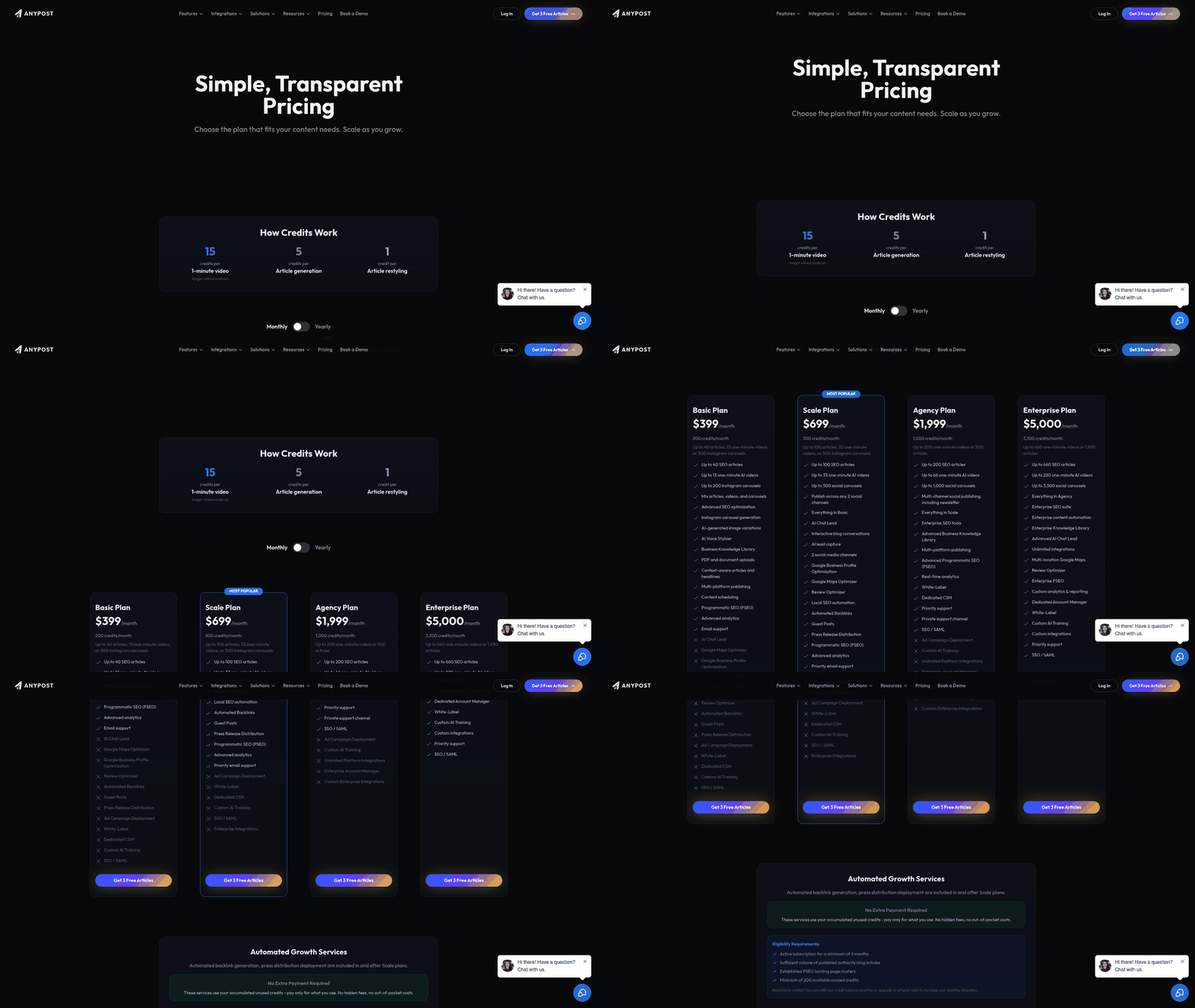
Here's how it runs end to end for the businesses we work with. We crawl your site first to build a business context graph of your products, messaging, and audience. Then our Taxonomy Researcher pulls the keyword universe for your niche and scores each query by volume, intent, and difficulty. Only the winners move into generation.
Demand research decides what gets written
The research view is where the demand-first logic lives. You see a ranked list of keywords with monthly volume, search intent, difficulty, and CPC side by side. A query like "seo content automation tools" shows how search volume and difficulty can guide the next step.
We filter hard here. Low-difficulty, high-intent queries get prioritized because they're winnable. The impossible-to-rank terms get parked. That single decision is what stops teams from scaling pages nobody searches for, the exact failure this whole article warns against.
From validated keyword to prompt configuration
Once a keyword clears the bar, it flows straight into the prompt setup. Our SERP Competitor Analyzer studies the articles already ranking for that term and builds a target structure around the gaps they left open. The generator inherits that structure, plus the brand voice we captured from your site.
So each draft is anchored to a proven query and a proven intent before generation starts. Headings map to the demand. Semantic HTML, internal links, and images get built in. You keep editorial control and approve before anything publishes.
For teams running programmatic SEO, the same pipeline scales to thousands of long-tail pages. The difference from typical bulk generation is that every page traces back to a validated query, not a template stuffed with filler.
The numbers behind a demand-first setup
We publish directly to your existing site and platforms, then report from Google Search Console rather than a vanity dashboard. One client, a physical therapy practice in Miami Beach, handed us a blog and social accounts with no marketing team behind them.
Over the first 90 days, impressions climbed sharply, reaching 19K impressions and 169 clicks. By the six-month mark that account showed 237K impressions at an average position around 20. Across its full run, the same setup logged 7.99M impressions, 32.9K clicks, and an average position of 9.4.
Other sites on the identical workflow saw comparable curves, some faster. The through-line holds: when the demand check comes first, the pages get found instead of buried.
A quick, honest scope note. If your target queries carry almost no search volume, or you need one bespoke thought-leadership essay rather than repeatable ranking pages, a demand-first scaling model is the wrong fit. This approach earns its keep when there's real, measurable demand to capture at volume.
Quick Questions, Straight Answers
1. Will using an AI writing tool put my site at risk of a Google penalty?
AI content itself is not the risk. Google's spam policy targets automation whose primary purpose is manipulating rankings. Pages built to answer a verified query stay safe, while content mass-produced for volume alone is the pattern that draws penalties.
2. What if my niche has almost no search volume, or I only need one thought-leadership piece?
A demand-first scaling model is the wrong fit there. It earns its keep when real, measurable demand exists to capture at volume. For a single bespoke essay or near-zero-volume queries, a manual, hand-create approach serves you better than a repeatable ranking pipeline.
3. How is demand-first different from just doing keyword research before writing?
Traditional keyword research usually validates topics you already chose from a brainstorm. Demand-first makes proven query volume a hard gate instead. If a topic can't show demand, it never enters the generation queue. That order flip stops teams from scaling pages nobody actually searches for.
4. How can I tell if my pages are being pulled into AI answers?
Run an AI-answer inclusion check using manual or tracked queries that confirm your pages appear in summarized results. Measure citation rate per demand cluster rather than per URL. If a high-demand topic never surfaces, that signals you should revise the page or retire the cluster.
5. How often should I regenerate content I've already published?
Refresh cadence scales with program size. Large, fast-moving libraries benefit from feeding measurement back into demand-mapping regularly, catching seasonal swings and shifting query language. A small, stable program can rely on quarterly refreshes, since weekly re-mapping burns cycles without catching meaningfully more drift.
6. What makes a keyword "winnable" in this kind of workflow?
A winnable keyword pairs low difficulty with high intent. AnyPost's Taxonomy Researcher scores each query by volume, intent, and difficulty, then prioritizes the reachable ones. For example, a term with monthly searches and a moderate difficulty score signals a target worth pursuing over impossible-to-rank alternatives.