
Search Atlas vs Ahrefs in 2026: Which Tool Supports Automated SEO Reports
The Short Version
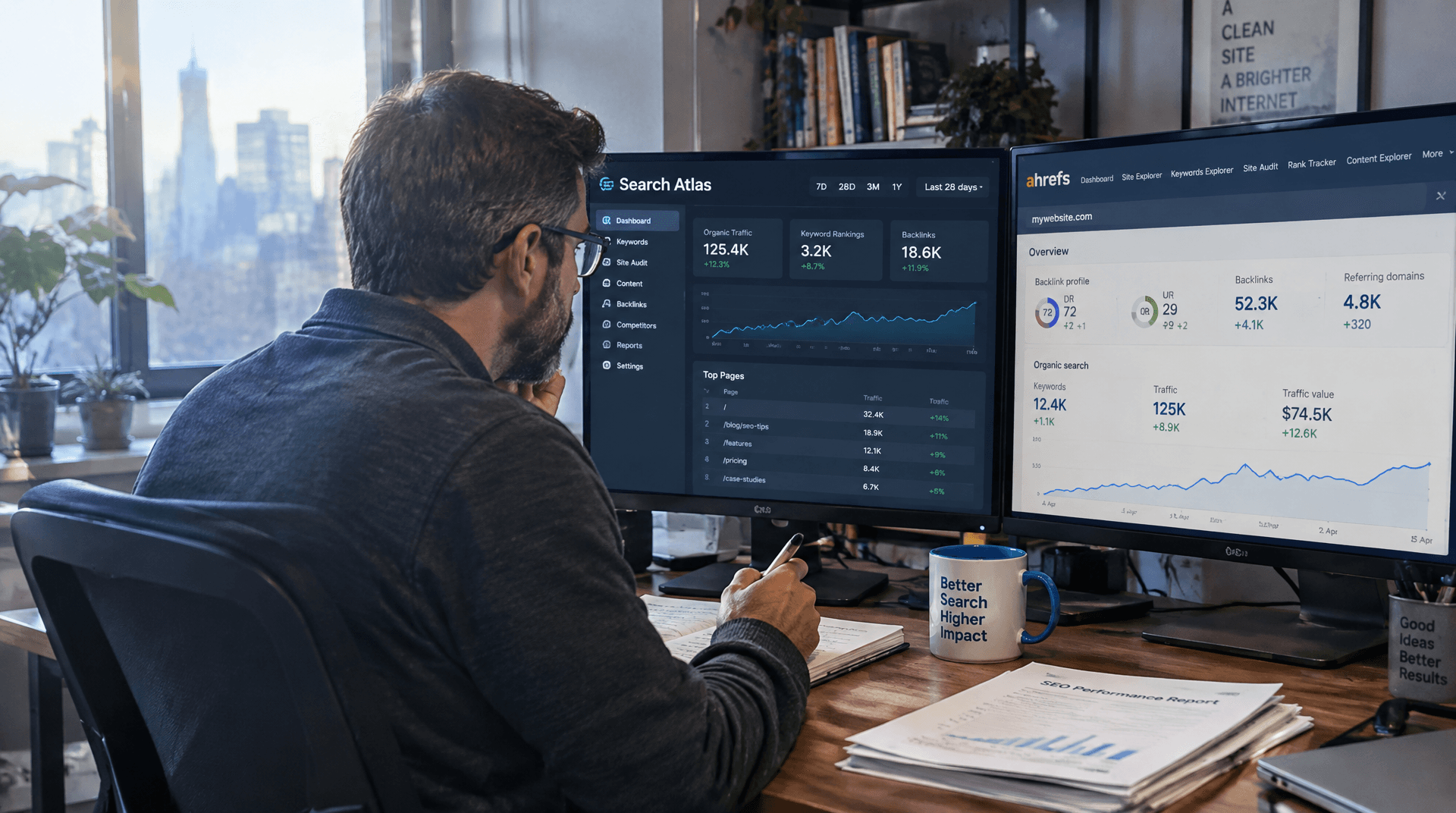
Search Atlas makes sense when your bottleneck is client-facing report assembly. Its Report Builder pulls GA4, GSC, backlinks, and rank data into one dashboard that refreshes daily without manual stitching. Ahrefs remains the stronger pick when your workflow depends on backlink forensics, competitive link-gap analysis, and API access to build custom reporting pipelines. The split is simple: Search Atlas ships a reporting product; Ahrefs gives you raw access to build your own.
Quick Summary
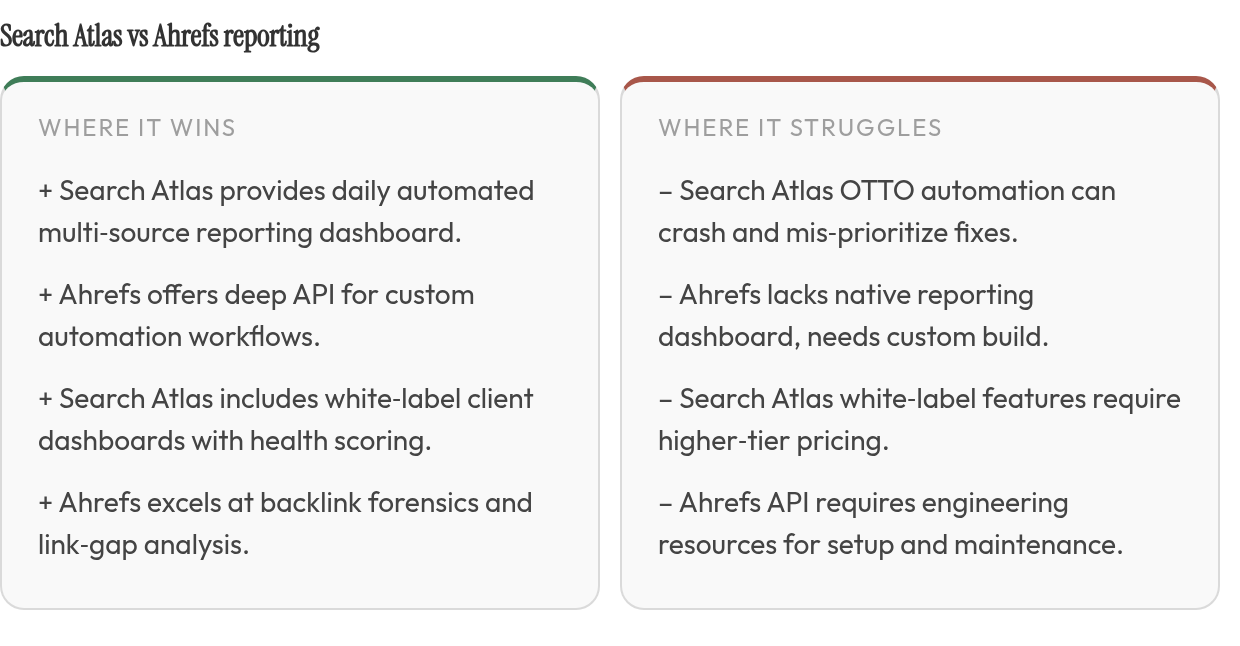
The evidence from 2026 shows Search Atlas built a complete reporting dashboard, while Ahrefs offers API access for teams that wire their own automation. The table below captures what each tool delivers.
| Feature | Search Atlas | Ahrefs |
|---|---|---|
| Documented Automation | Report Builder with daily refresh, week-over-week tracking, Portfolio Summary health scoring (0–100), OTTO automation for on-page fixes | API access for custom automation workflows |
| Dashboard/Reporting Type | Automated Report Builder with daily refresh and portfolio health categorization (Biggest Wins, Stable, At Risk) | API-driven; no documented native reporting dashboard |
| Documented Integrations | GA4, GSC, GBP, Rank Tracker, backlinks, local visibility, content performance | API access; external data requires custom builds or middleware |
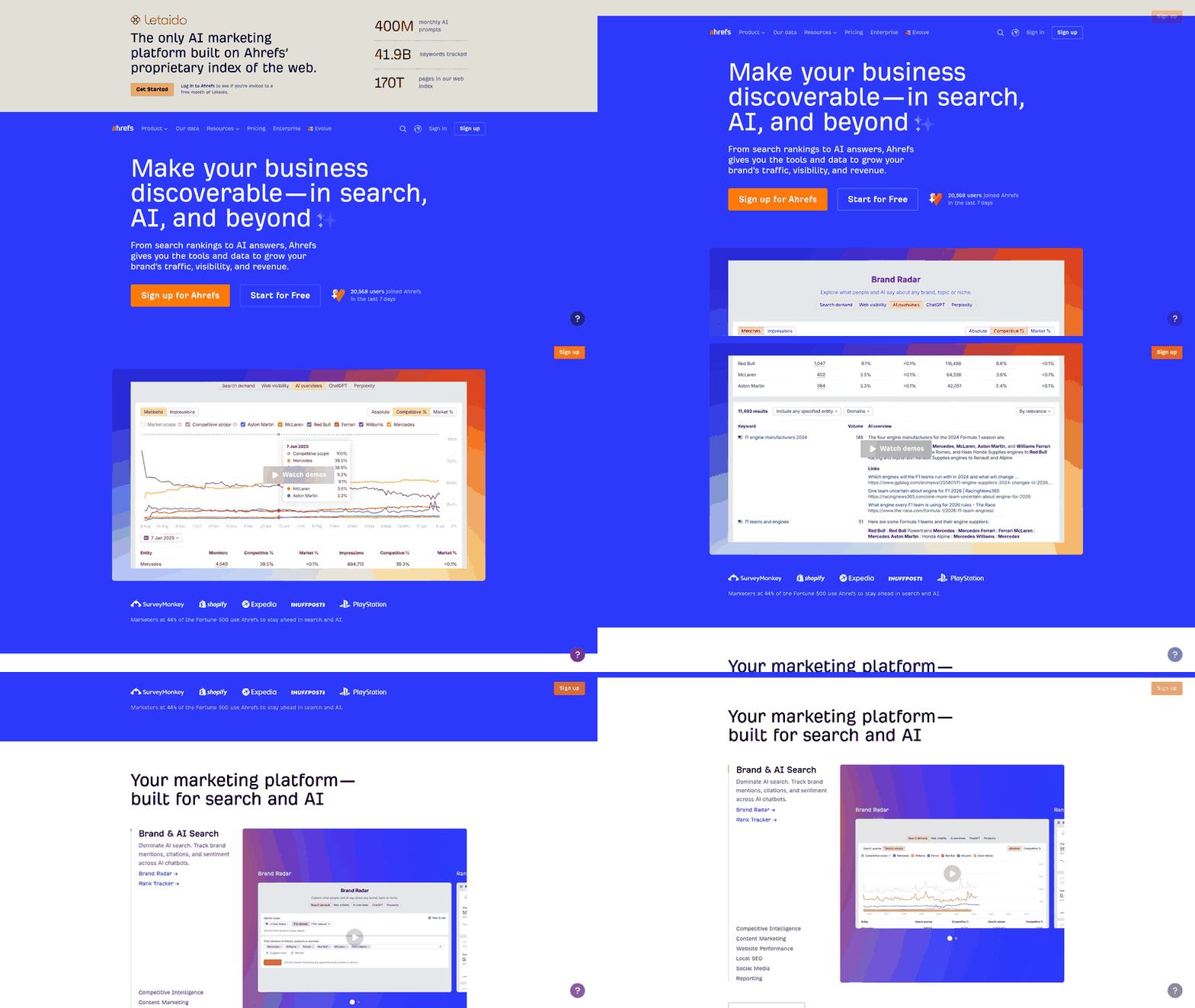
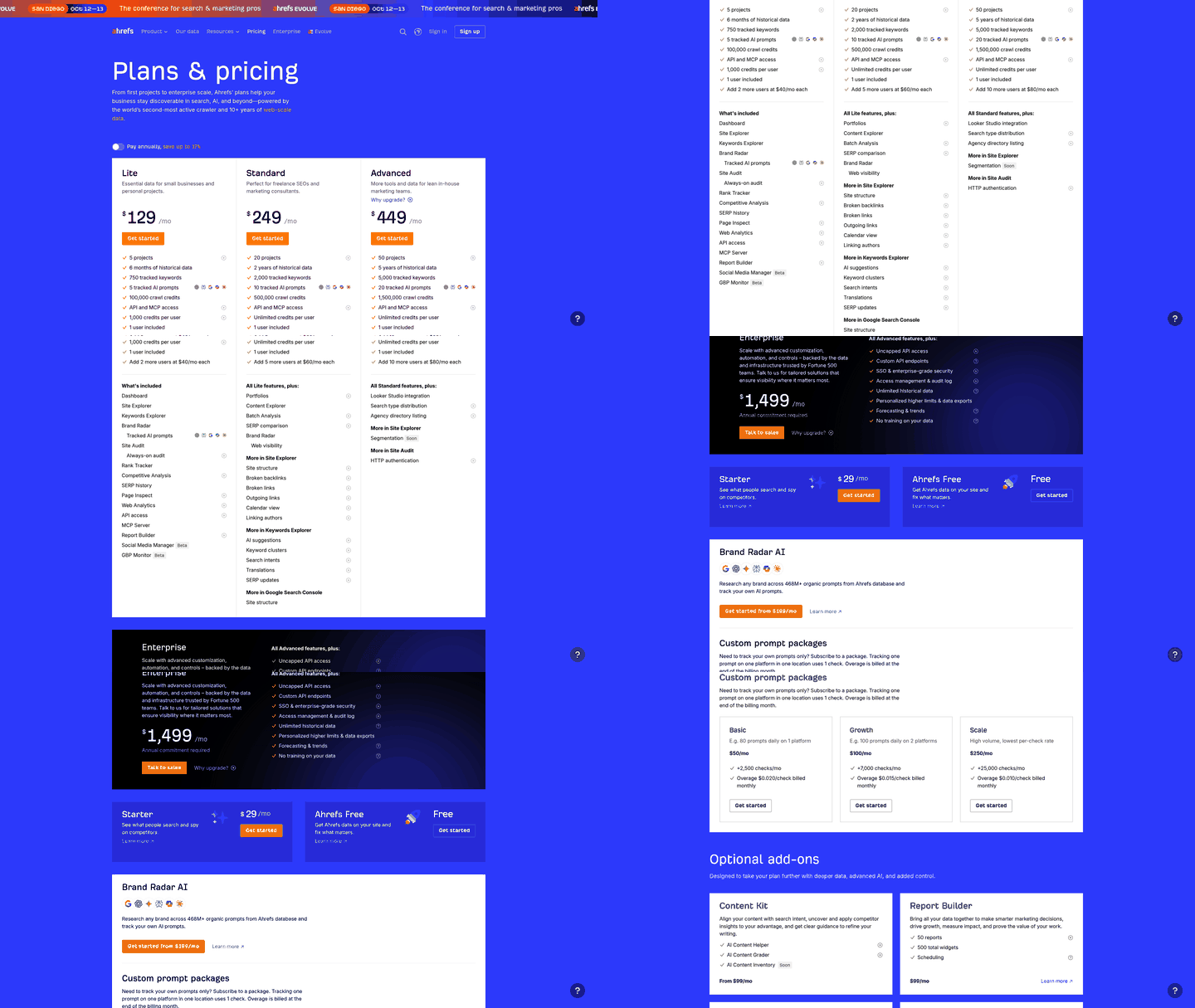
| Pricing Evidence (Monthly) | Documented tiers available; white-label reporting may require higher-tier plan | Not documented in provided sources |
| Setup Considerations | OTTO requires careful approval and quality control | Custom automation setup required for recurring reports |
| Performance Claims | Faster client reviews according to Search Atlas | Automation possible through API |
| One-Sentence Strength | Multi-source automated reporting plus SEO execution automation with portfolio health scoring | API access for custom automation workflows |
Search Atlas leads for client-facing portfolio reporting
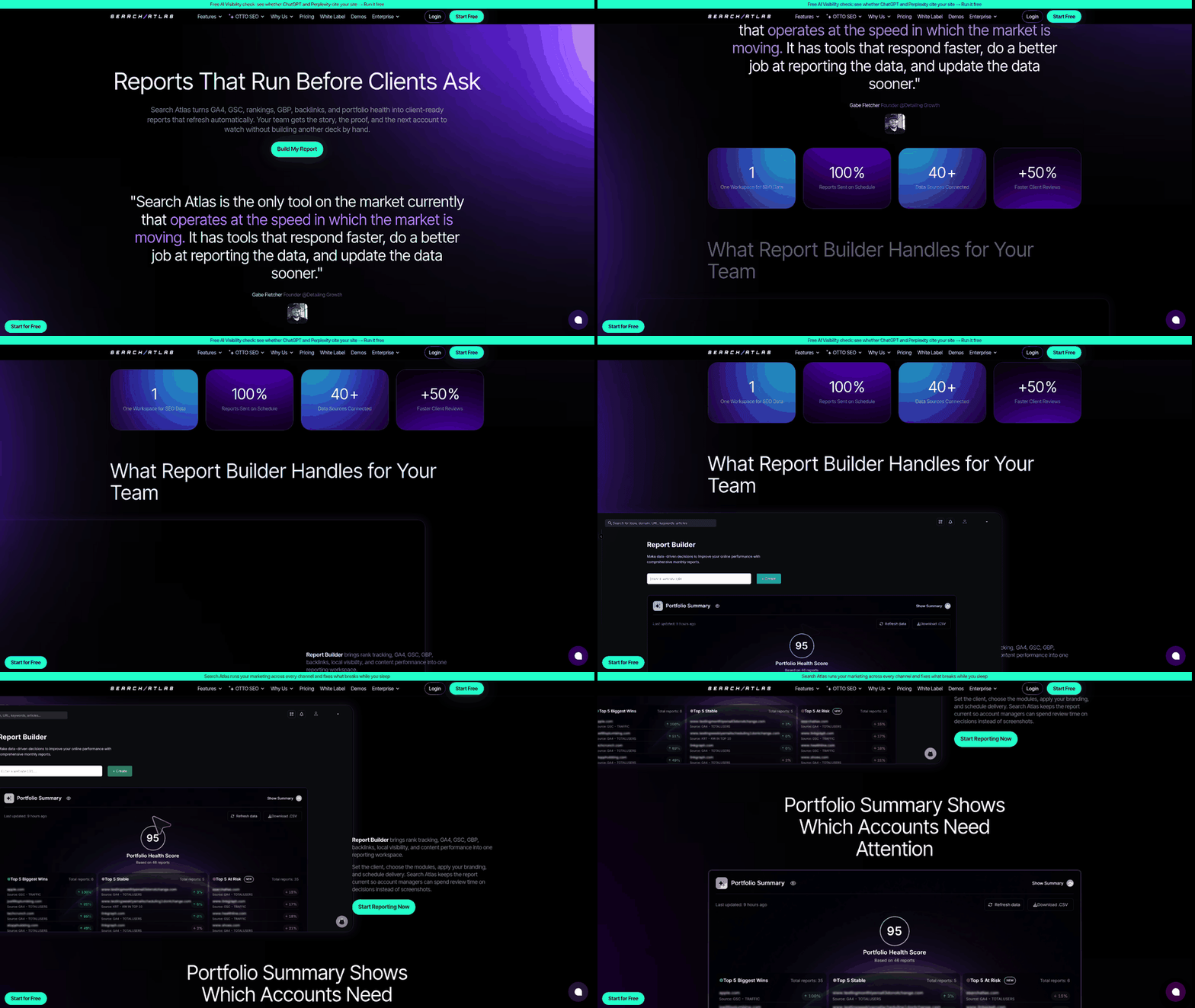
Report Builder gives agencies and marketing teams a white-label environment that refreshes on a recurring cadence and organizes account performance for quick scanning. The Portfolio Summary feature, described as industry-first in their comparison table, groups accounts by health score. Competitors do not currently show the same multi-account categorization.
That matters when you're managing a client roster and need to spot which accounts deserve attention before the next review call. Gabe Fletcher, founder of Detailing Growth, says Search Atlas moves quickly and updates data sooner than competitors.
Ahrefs wins for teams that build custom automation
Ahrefs doesn't compete with Search Atlas's reporting dashboard. It solves a different automation bottleneck through API access. The strongest documented Ahrefs example is Agent A, its content-refresh automation for data-driven publishers: it updates existing posts with fresh API data rather than assembling client-facing reports. The key limitation from the sources is that it works from Ahrefs data; external sources still require API or middleware.
That's the split: Search Atlas automates client-facing reports across portfolio sites; Ahrefs provides the API foundation for teams to automate internal content operations. Automation changes where teams spend attention. Reports can be assembled faster, but the output still needs human review before a client or executive treats it as decision-ready.
Why Automated SEO Reports Matter
Manual reporting still swallows entire afternoons at most SEO teams. The operational cost becomes clear when you consider the stages: pulling data from multiple sources, translating it for stakeholders, verifying accuracy before sharing. But the efficiency story is more nuanced than velocity alone.
What manual reporting actually costs teams
The hidden tax shows up in three workflow stages: data collection, stakeholder translation, and quality control. Teams pull rankings from one tool, backlink data from another, GA4 metrics from a third, then paste everything into a deck or dashboard. Copy/paste errors accumulate. Definitions drift between reports. Context gets lost when the person who compiled the data isn't the one presenting it.
Automated dashboards reduce that assembly work, but they don't remove judgment. Someone still has to check whether a traffic spike came from real organic growth, a tracking change, a branded campaign, or an analytics anomaly.
Stakeholder benefits by role
Automated reporting handles different visibility needs across the org chart. Executives benefit from portfolio health summaries that flag risk categories without opening five dashboards.
Content teams get week-over-week performance signals that show which updates moved traffic and which didn't. SEO specialists benefit from multi-source visibility: rankings, analytics, and backlinks refresh automatically in one workspace rather than requiring manual stitching.
Time savings vs ROI realism
The evidence supports workflow efficiency but doesn't prove that automated reporting alone increases organic traffic. Faster reviews mean account managers spend client calls on decisions instead of data assembly. Daily refreshes reduce waiting for manually compiled updates. But teams with documented workflows often choose not to automate some tasks when quality control takes longer than the original manual work.
The ROI case depends on what you do with the time saved. Automated reporting reduces the mechanics of assembly so teams can focus on interpreting the data and making decisions that move rankings and traffic.
Search Atlas: Automation at Scale
When your client list crosses ten accounts, the manual reporting cycle starts to break. You're pulling rank changes from one tool, traffic from another, backlink health from a third, then pasting it all into decks before every review call. Search Atlas built Report Builder to collapse that workflow: one dashboard pulls GA4, GSC, GBP, rank tracking, and backlink data into a single view that refreshes daily. The time savings show up fastest for agencies juggling portfolios, where the alternative is opening five tabs per client just to answer whether visibility moved this week.
What Search Atlas automates that Ahrefs leaves to API workflows
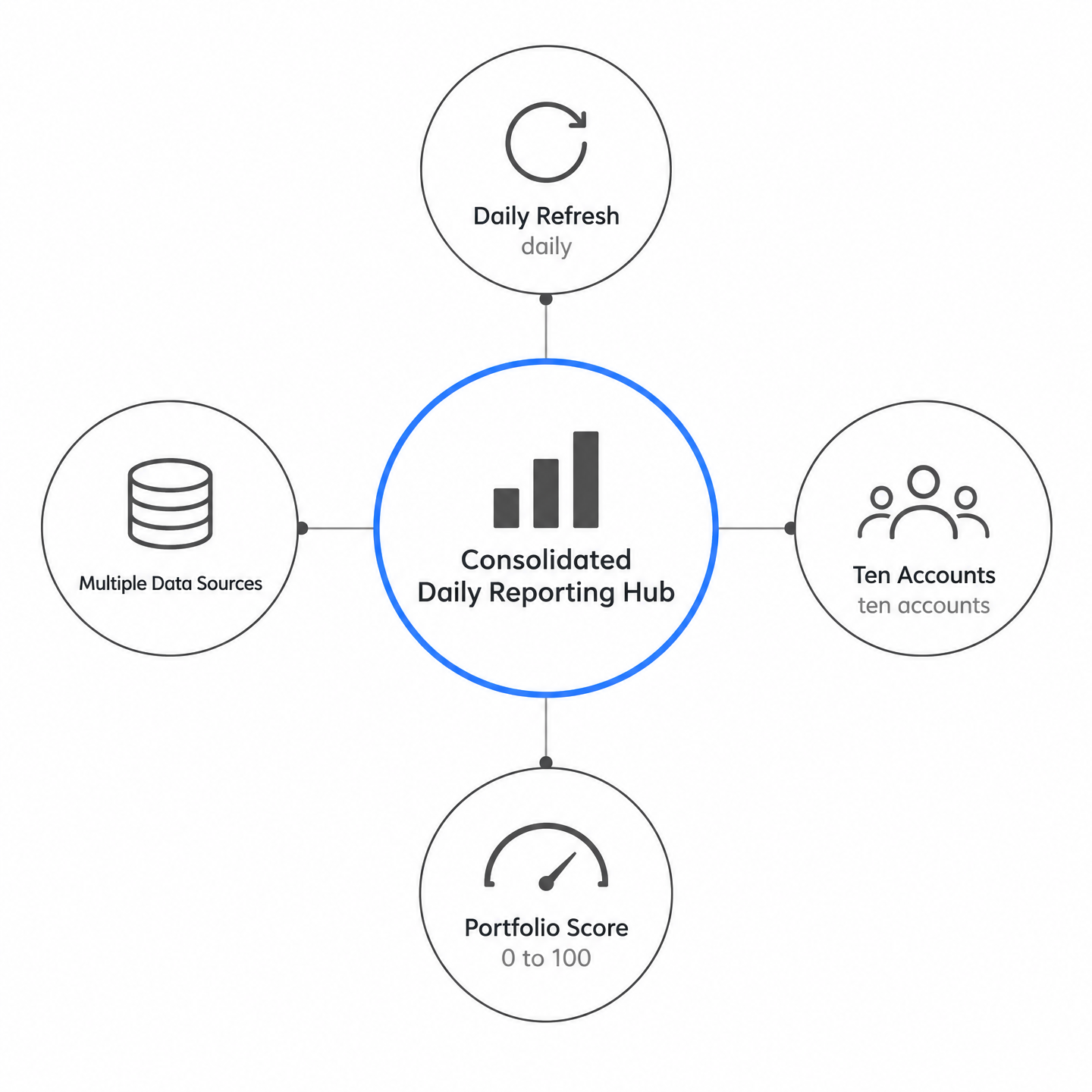
The Portfolio Summary feature uses a 0 to 100 health score to group accounts into three tiers: Biggest Wins, Stable, and At Risk. That categorization matters when you're trying to surface which accounts need attention before a client flags the problem themselves. Instead of treating every account as another tab in a reporting queue, the dashboard gives account managers a triage view before they start digging into individual metrics.
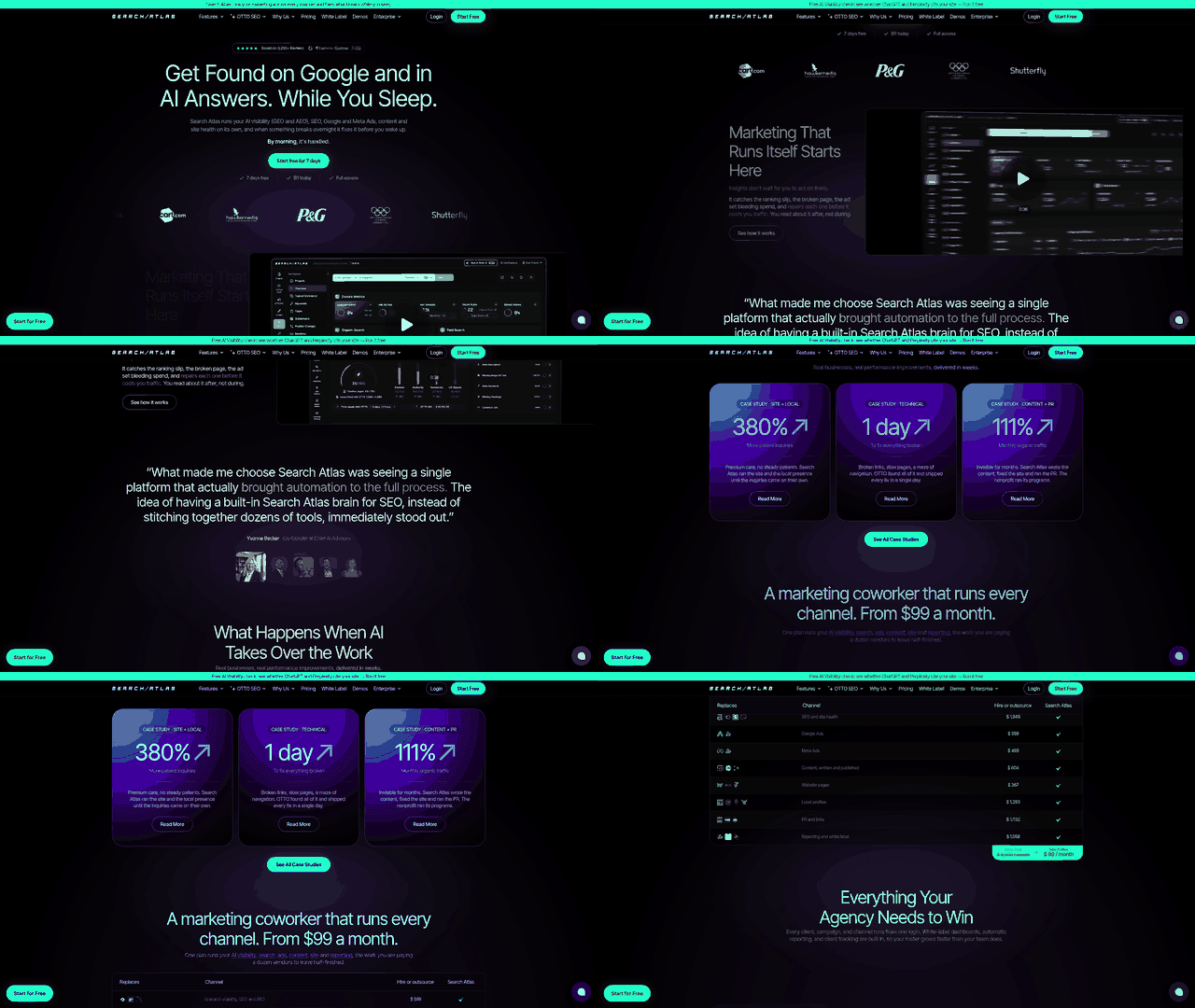
Ahrefs documents API access for teams that want to build custom reporting workflows, but that path assumes you have engineering resources to write the integration, maintain it when endpoints change, and troubleshoot when data stops flowing. For agencies without a dedicated dev layer, that's a non-starter. Search Atlas ships the dashboard ready to use. White-label reporting is available by plan, so teams that need to remove branding should confirm tier access before committing.
Search Atlas mentions scheduled delivery and export options, but the exact formats and cadence should be confirmed for your plan before you rely on them.
OTTO sits one layer deeper than the reporting dashboard. It doesn't just flag technical issues—it can deploy fixes across schema markup, meta tags, and internal links without waiting for someone to action each item. The hands-on reality carries tradeoffs: one reviewer reported the tool crashed multiple times, and several reports loaded slower than expected. Another tester found the task list mixed genuinely useful fixes with low-priority items. Some user discussions mention concerns about automated changes after deployment, which is why the standard recommendation is to start with one site, keep approval enabled, and compare OTTO's visible changes against your CMS before widening permissions.
The deployment options now span edge-layer injection, direct CMS connections, code-pipeline routes, and JavaScript—more paths than most reporting tools offer, but also more surface area for integration instability. DIY AI's review notes that trust and integration stability determine whether OTTO saves time or creates review work. Some users report running established SEO tools alongside Search Atlas because they don't yet trust OTTO's output in production. That's the gap between workflow automation capability and operational reliability: the platform can execute faster, but the review burden doesn't disappear. It shifts from manual fixes to QA passes on automated changes.
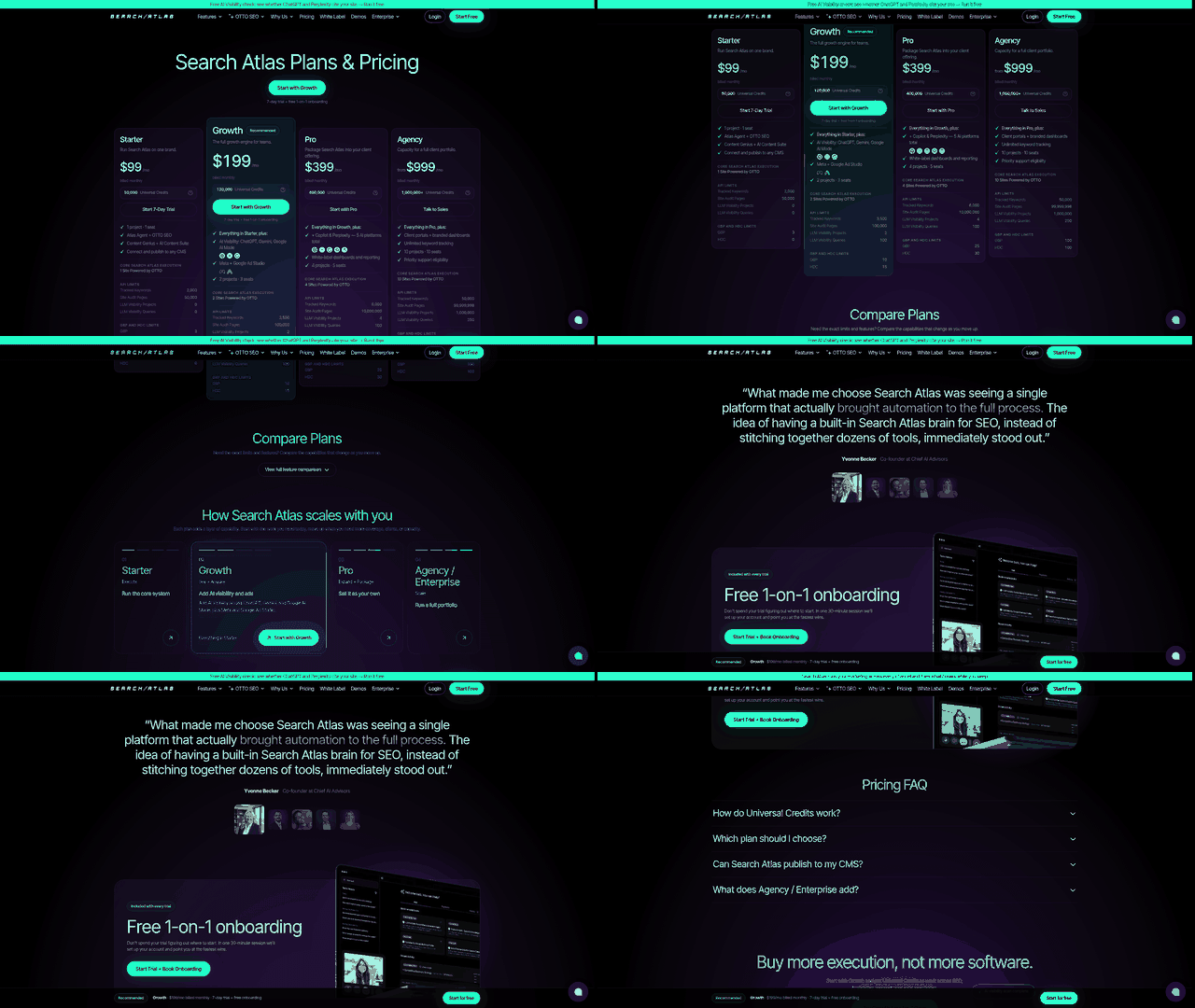
Search Atlas pricing spans multiple tiers designed for different team sizes and site counts. Ahrefs documents API access, but no pre-built reporting dashboard in the provided sources. If your team would otherwise spend engineering hours building and maintaining an Ahrefs reporting integration, Search Atlas can deliver better unit economics. If you already have that pipeline built and trust it, the case weakens. The question isn't which tool has better raw data—it's whether automation at the reporting and execution layers justifies the subscription when your workflow bottleneck is implementation speed rather than research depth.
Feature-by-Feature Comparison
When you're comparing Search Atlas vs Ahrefs on automated reporting, the documented differences show up across five workflow stages: what data each tool pulls in, how it schedules updates, where customization lives, what white-label options exist, and how much setup time you need before the first report goes out.
Reporting automation: what each tool actually delivers
| Feature | Search Atlas | Ahrefs |
|---|---|---|
| Update Frequency | Daily automated refresh with week-over-week tracking; scheduled delivery options should be confirmed by plan | Manual exports from monitoring tools; no documented native scheduled delivery without API integration |
| Data Source Breadth | GA4, GSC, GBP, rank tracking, backlinks, local visibility, content performance | Ahrefs proprietary data only; external integrations require API or third-party middleware |
| Cross-Account Visibility | Dashboard groups accounts into Biggest Wins, Stable, At Risk with 0–100 scoring per client | No documented aggregated view across projects; manual comparison likely |
| Branding Control | Available by plan; custom branding, logo, and client-specific module selection should be confirmed before purchase | Not documented as native; white-label exports may require manual formatting or third-party report builders |
| Client Access Model | Daily refresh with historical trend overlays; live client access may depend on plan | Tools provide current data; no persistent client dashboard without custom build |
| Initial Configuration | Connect data sources once; automated reports begin after GA4/GSC authorization | Immediate access to Ahrefs data; external integrations via custom API or middleware add setup time |
| Best For | Agencies managing 10+ clients who need branded, recurring reports across multiple data sources | In-house teams or consultants who pull Ahrefs data into custom dashboards or BI tools |
Search Atlas built the automation layer directly into the product. You connect GA4, GSC, and GBP during onboarding, choose which modules each client sees, apply your logo, and set the delivery cadence. After that, updates arrive without manual assembly. The cross-account dashboard surfaces risk tiers before client calls instead of forcing account managers to open five tabs per brand.
Ahrefs remains more manual unless your team builds a reporting layer around it. The tools surface the data, but getting it into a scheduled client report means building the workflow yourself—through a custom API integration or a third-party reporting tool. That approach gives technical teams full control over what gets pulled and where it goes, but it doesn't eliminate the setup or maintenance cost. The bottleneck isn't access to data; it's the review and assembly stage that automation tools collapse.
Match the Tool to Your Bottleneck
When you're choosing between Search Atlas and Ahrefs for automated reporting, the decision branches on what you're automating: data assembly or implementation. Search Atlas gives you Report Builder with refreshed dashboards that pull connected SEO and analytics data into one view without manual pasting. Ahrefs gives you API access and expects your team to build the automation layer themselves. The productivity gap shows up when you're managing multiple client accounts—Report Builder collapses the multi-tab ritual into a single reporting environment, while Ahrefs requires a developer to wire the endpoints together before you see similar efficiency.
Who should pick Search Atlas for portfolio reporting
Search Atlas fits teams that need white-label client dashboards without hiring an engineer to stitch together API calls. Report Builder automates the assembly step: it connects multiple data sources, schedules recurring updates, and can produce client-ready exports, though formats should be confirmed by plan. Agencies managing multiple accounts see the ROI—one dashboard per client and fewer copy-paste cycles between tools.
OTTO adds a second automation layer that Ahrefs doesn't attempt: it can deploy schema, update meta tags, and push internal link fixes across your portfolio without waiting for someone to manually action each recommendation. That workflow advantage shows up when Search Atlas scores 9.8/10 for Technical SEO & Automation in DIY AI's dataset. The score reflects speed once the opportunity is identified, not depth of the underlying keyword or backlink database.
The operational ceiling appears when deployment trust breaks. A single bad approval can affect multiple sites before the team notices, so the safest rollout is staged rather than portfolio-wide on day one. Treat OTTO as an execution accelerator that still needs governance, not as a replacement for technical SEO oversight.
When Ahrefs stays the default choice
Ahrefs owns the backlink layer. If your workflow centers on link-gap analysis, referring-domain audits, or tracking competitor link velocity, Ahrefs remains the specialist database. Its API gives you programmatic access to that data, so teams with developer capacity can build custom reporting dashboards that rival Search Atlas's Report Builder—but you're building it yourself, not subscribing to a pre-made one.
Ahrefs also wins when you need research depth over deployment speed. Site Explorer surfaces granular SERP history, organic traffic estimates per URL, and keyword distribution across a domain. If your team spends more time researching opportunities than implementing fixes, Ahrefs gives you a deeper well to draw from.
The API-first approach means Ahrefs automation stays as custom as you build it. Agent A, Ahrefs' content-refresh automation, remains the strongest documented example: it automates existing-post updates with fresh API data for data-driven publishers. That is internal content operations, while OTTO targets external client-facing implementation across portfolio sites. Neither competes directly; agencies running both workflow types need different tooling for each.
Decision framework
| Your Workflow Priority | Pick Search Atlas When | Pick Ahrefs When |
|---|---|---|
| Client Reporting at Scale | You manage multiple sites and need white-label dashboards without API work | You have developer capacity to build custom reporting dashboards |
| Implementation Speed | OTTO deployment (schema, meta tags, internal links) saves more time than deeper backlink research | Link-gap analysis and referring-domain audits drive most of your client wins |
| Automation Preference | You want pre-built Report Builder with daily refresh out of the box | You prefer API access to build exactly what your team needs |
| Database Depth vs Workflow Integration | You're optimizing for implementation velocity across a portfolio | You're optimizing for research depth on fewer, higher-stakes projects |
We see Search Atlas work best for teams where the implementation bottleneck costs more than the research bottleneck. If your analysts spend two hours finding opportunities but your developers spend six hours deploying fixes, OTTO's automation layer justifies the switch. If research depth determines whether you win the client and implementation is already handled efficiently, Ahrefs remains the sharper tool for that stage.
Neither tool solves both problems at the specialist level. Search Atlas automates the assembly and deployment workflow; Ahrefs gives you a deeper backlink and keyword database with API access to automate your own workflows. The honest answer for many agencies is running both: Ahrefs for competitive research and link analysis, Search Atlas for portfolio reporting and OTTO-driven deployment. The tools tend to complement rather than duplicate each other's strengths.
Frequently Asked Questions
Can I run Search Atlas and Ahrefs together, or does choosing one mean dropping the other?
Yes. Treat them as tools for different jobs rather than direct replacements. Search Atlas is stronger when the deliverable is a recurring client report or portfolio-level workflow, while Ahrefs is stronger when the work depends on backlink intelligence and competitive research.
Does automated reporting actually increase organic traffic, or just save time on assembly?
Automated reporting mainly improves operating speed and consistency. It can help teams notice problems sooner, but rankings improve only when the team turns those findings into better content, technical fixes, links, or local SEO work.
What happens if OTTO deploys a fix that breaks something across multiple client sites?
The risk is governance, not just software reliability. Keep approvals tight, limit the initial rollout, and document what changed so your team can reverse or adjust updates quickly if an automated recommendation creates an issue.
If Ahrefs requires API work to match Search Atlas's reporting dashboard, how much developer time does that actually take?
It depends on the stack and the complexity of the report. A basic pull into an existing dashboard is simpler than a branded client portal with scheduling, permissions, and recurring QA. The bigger cost is usually not the first build—it's maintaining the workflow as reporting needs change.