SEO Content Automation: How Generation, Optimization, and Distribution Pipelines Connect

What You Need to Know
- Automated SEO content pipelines connect five stages—ideation, generation, on-page optimization, distribution, and performance tracking—through structured data handoffs.
- One reported e-commerce case study describes simultaneous publication across WordPress, Shopify, Medium, and social platforms, with higher content production.
- An n8n workflow connecting Google Custom Search, Gemini, and Sheets can generate SEO metadata and marketing descriptions once configured.
- Google's scaled content abuse policy penalizes pages with minimal differentiation that exist primarily to manipulate rankings rather than serve users.
- Quality gates must enforce uniqueness ratios, word count minimums, source diversity, and readability checks before any automated page publishes.
- Multi-platform distribution systems handle keyword insertion, meta description generation, and schema markup automatically while humans focus on accuracy and brand alignment.
- Index coverage rate and engagement signals indicate whether automated content meets user intent rather than just hitting keyword density targets.
The Part Teams Get Wrong About Content Automation
The hard part isn't writing the content. It's building the data foundation and quality gates that make automated publishing trustworthy at scale. When you automate content creation for SEO, you're connecting five distinct stages: ideation, generation, on-page optimization, distribution, and performance tracking. Each stage hands off structured data to the next. The pipeline only works when those handoffs are clean.

Here's what that pipeline looks like in practice:
The Five Core Stages of an SEO Content Automation Pipeline
| Stage | Key Actions | Representative Automation Tools | Available Time or Output Benchmark | Primary KPI |
|---|---|---|---|---|
| Ideation | Keyword pattern discovery, competitor SERP analysis, search intent validation | Google Custom Search API, SE Ranking Keyword Suggestion, Ahrefs Content Helper | Setup time varies by API access | Keyword clusters identified, search volume captured |
| Generation | Template population, AI-driven copywriting, multi-source data aggregation | ChatGPT API, Google Gemini via LangChain, n8n workflow automation | Higher content production than manual methods | Unique pages published per sprint |
| On-Page SEO | Metadata optimization, schema markup, internal linking, readability checks | Surfer Content Editor, Semrush Content Toolkit, automated quality scoring | Structured content with semantic HTML and keyword integration | Index coverage rate, page quality signals |
| Distribution | Multi-platform publishing, CMS delivery, social media syndication | WordPress automation, Zapier, Medium API, automated posting workflows | Simultaneous multi-platform publishing without manual intervention | Engagement metrics, cross-platform reach |
| Performance Loop | Ranking tracking, traffic analysis, A/B testing, content refresh triggers | Google Search Console, GA4, SE Ranking rank tracker, automated alert systems | Continuous monitoring with performance dashboards | Organic traffic growth, conversion rate by page type |
The setup time varies by API access and data complexity. One live n8n template connects Google Custom Search, Google Gemini, and Google Sheets in a single flow that takes one product title input and outputs two distinct content categories—SEO metadata and marketing-focused descriptions—once configured.
Real implementations can show measurable lift. One reported e-commerce case study describes a move from a manual posting bottleneck to simultaneous publication across WordPress, Shopify, Medium, and social platforms, with higher content production. Well-executed programmatic strategies can deliver significant organic-traffic growth when pages meet genuine quality thresholds: unique content, data pulled from multiple sources, and genuine utility beyond a results page.
From 2024 forward, volume without value became a liability. Google's scaled content abuse policy now penalizes pages where content is only slightly different and exists primarily to manipulate rankings rather than help users. That means your pipeline must enforce uniqueness ratios, word count minimums, source diversity, and readability checks before any page goes live. Healthy systems prioritize index coverage and engagement signals—indicators that automated content is meeting user intent, not just keyword density targets.
Why Automation Is Now Table Stakes
You compete on velocity without sacrificing ranking power
Teams running automated pipelines can scale content output while maintaining SEO quality standards. The gap isn't just speed. It's consistent execution across hundreds of pages where manual workflows swallow whole afternoons on repetitive optimization tasks. Multi-platform publishing—WordPress, LinkedIn, X, Instagram—becomes feasible when the system handles keyword insertion at specified density, meta description generation, and schema markup automatically. Human review focuses on accuracy and brand alignment rather than formatting busywork.
The shift matters because AI adoption in SEO workflows has grown rapidly, yet full automation remains rare. That middle ground is where pipelines earn their value: machines handle the structural optimization, humans steer the strategy and voice.
Quality controls separate scalable systems from spam factories
Google's scaled content abuse penalties create clear boundaries around what automated content can and can't do. Pages need sufficient unique content, multiple credible sources, and adequate depth for their query type. Automation that skips these fundamentals risks penalties. The solution isn't slowing down—it's embedding quality checks before publication. Real-time competitor scraping, multi-source data aggregation, and automated uniqueness scoring keep pages citation-ready for both traditional search and AI overviews, where brand visibility increasingly depends on citation-worthy depth rather than simple keyword placement.
We see the biggest wins when teams treat automation as a content engineering discipline rather than a shortcut. Set up composite indexes for multi-field queries from day one. Build refresh workflows that update existing pages as data changes, because refresh velocity now matters more than first-publish volume. Connect your pipeline to five-stage content marketing operations that govern creation through measurement, not just draft generation.

Mapping the End‑to‑End SEO Content Pipeline
A public workflow template can take one product title, pull live competitor results from search, pass titles and snippets to an AI model, and place SEO metadata plus a product description in a spreadsheet. The speed is useful, but a sheet full of drafts isn't a pipeline. Each stage needs a defined handoff and checkpoint. A practical sequence connects an AI writer, a shared document, a CMS, and social scheduling:
Keyword patterns → Data + SERP research → AI draft → [Human gate] → CMS publish → Social repurpose → Performance review.
 ↑ |
 └──────────────────────── intent + ranking signals route back to planning ─────────────────────────┘
Humans belong at checkpoints, not every step
Most teams place review gates around source quality, factual accuracy, originality, brand compliance, and legal risk—the spots where reputation is on the line. Formatting, publishing, and scheduling can run unattended.
A one-way flow publishes and forgets. A loop sends ranking and search intent signals back to the keyword stage. You can then decide which pages need updates and which patterns to drop entirely. How much volume you need depends on your domain. Directories and comparison sites tend to scale content across large data sets, while niche B2B or local service businesses often prioritize depth and relevance over sheer page count.
AI‑Powered Content Generation at Scale
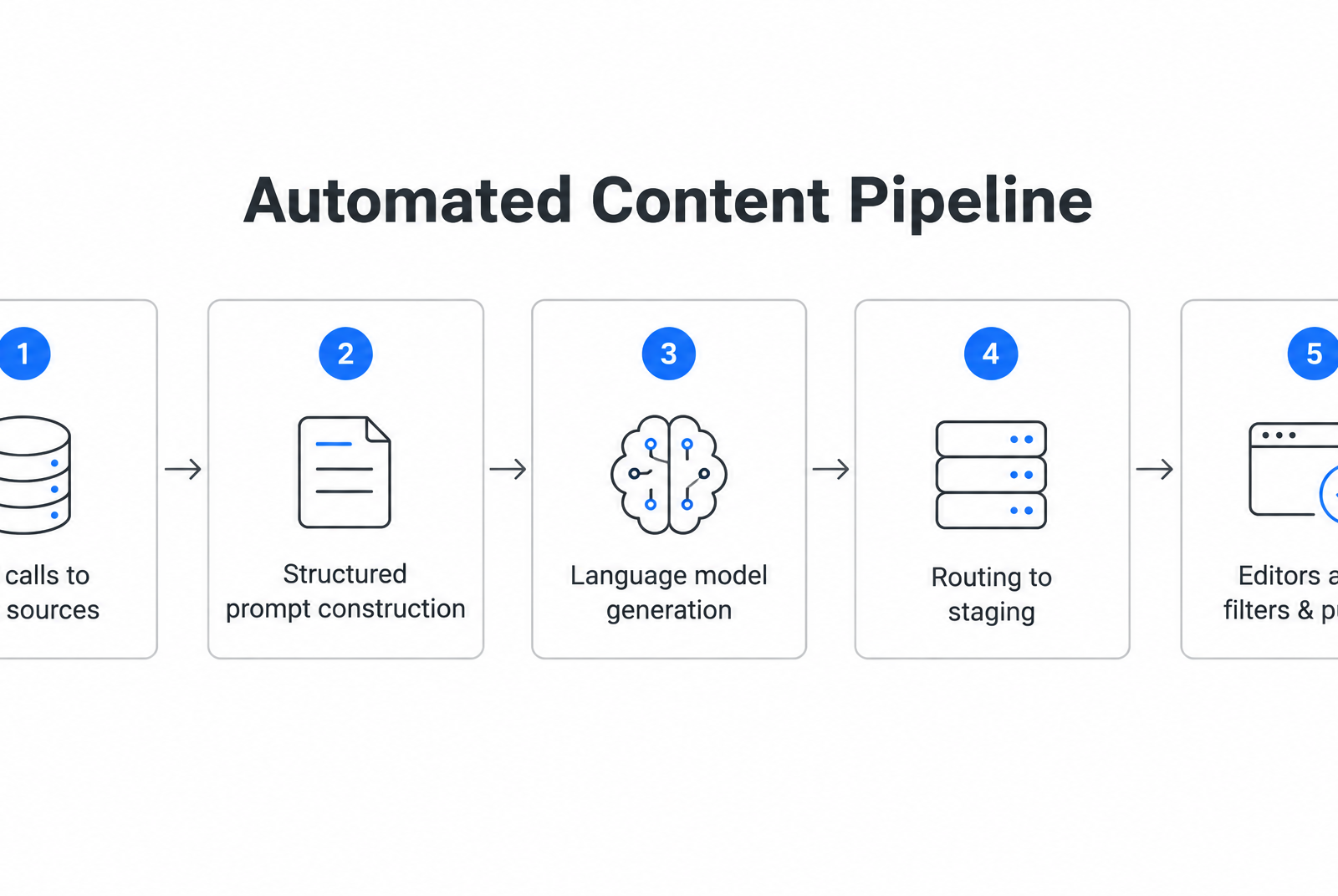
Teams often treat AI content generation like a vending machine: drop in a keyword, pull out a draft, hit publish. That's not a pipeline. That's a recipe for indexed pages that bring no traffic. At scale, the value sits in the workflow controls around the text, not the text itself. A typical workflow connects API calls to multiple data sources, passes structured prompts to a language model, then routes output to staging environments where editors apply brand filters and fact-check claims before publishing. The generation step is fast. The control layer determines whether your pages rank or vanish.
What programmatic page generation actually requires
Programmatic SEO lets you build hundreds of landing pages from templates and structured data—Zillow's property listings and Zapier's integration pages follow this pattern. The difficult part is quality gating. Search engines have tightened enforcement around thin, repetitive content at scale, and the penalty can involve mass deindexing.
Each page needs meaningfully distinct content, data pulled from multiple credible sources, and utility beyond a keyword-stuffed results page. Successful programmatic implementations work because each page documents a specific use case or answers a distinct question, not just because a template swaps variables. That's the bar.
AI changes the economics, but workflow discipline still separates ranking pages from spam
Modern AI content tools can generate long-form drafts quickly when you provide a detailed outline or let the system create one automatically. Contentful's AI Actions product ships six automation templates: keyword optimization with adjustable density, document outlines analyzing top-ranking search results, meta description generation, FAQ creation with localization, and image-to-alt-text conversion. You can customize existing prompts or build new ones from scratch rather than being locked into predefined templates.
Automated drafts still require editorial polishing. Workflows that connect AI generation to publishing platforms—ChatGPT, Google Docs, WordPress, Shopify, Medium, and social automation—can accelerate production, but brand review, source verification, and readability checks still belong before publication. HubSpot's content assistant, for instance, generates blog post outlines but flags them for human review before moving to draft status.
Programmatic SEO now splits into two channels: traditional Google rankings and generative engine optimization (GEO). Search engines increasingly surface AI-generated summaries at the top of results pages, which means pages that aren't structured, citation-ready, and verifiable often get summarized instead of clicked. Optimization for LLMs like ChatGPT and Claude therefore matters alongside traditional on-page SEO.
Automated SEO Optimization & Authority Building
Once the content exists, optimization turns it into a consistent, discoverable asset. The work spans metadata, structure, internal links, schema, and the evidence supporting each page.
Quality controls are the difference between scale and spam
The practical threshold is measurable. Each page needs substantive unique content, credible sources, and enough informational depth to stand alone. A workflow that publishes location pages with nothing but city-name swaps will trigger scaled content abuse penalties. A workflow that pulls real-time competitor data, aggregates multiple APIs, and generates distinct comparisons for each market has a stronger basis for publication.
Before an automated page goes live, the workflow should verify meaningful uniqueness, sufficient depth, multiple data sources, and valid schema markup attached. Tools like Copyscape API, Screaming Frog, and custom Python scripts can gate publication on those checks. For local or comparison pages, set the data model to require live competitor or pricing inputs, named sources, and structured fields such as feature tables or entity attributes before the page can publish. A Zapier workflow that blocks publishing until those checks pass can prevent thin pages from entering the site.
How AI search changes what "optimized" means
Most search engines now deliver AI-generated answers in their results. Google's AI Overviews appear at the top of the page. Perplexity and ChatGPT cite sources directly inside their responses. Brands are increasingly appearing in these summaries, but many citations come from sites they don't own. If your programmatic pages aren't structured for citation—entity-rich, verifiable, and built around named sources—they may be summarized without attribution.
Traditional SEO optimized for rankings. Modern workflows optimize for both rankings and citations. That means embedding schema markup at scale, structuring content around entities and relationships, and ensuring every programmatic page includes verifiable supporting data. Content optimization platforms now monitor brand mentions across ChatGPT and other AI systems. Tools that only handle keyword density and on-page scoring are giving way to platforms that also track citation readiness.
When you publish a comparison page like "Tool A vs. Tool B," AI engines look for structured feature tables, quoted statistics, and clearly sourced claims. A page that only swaps product names into template slots is unlikely to be cited. A page that pulls live pricing data, aggregates user reviews, and structures the comparison with schema gives systems more useful material to reference.
The authority-building angle most teams miss
Backlinks still matter, but automated outreach at scale is risky and most platforms won't touch it. The safer play is distribution architecture. When you generate comparison pages, integration guides, or local service content and publish them to WordPress, Medium, and owned properties within the same workflow, each instance becomes a potential backlink source to your core domain. If different subdomains or distribution channels cross-link strategically, you're building distributed link signals with less manual outreach.
The gain is not merely volume. It's systematic reuse. Blog content can become social posts and be scheduled automatically, with each channel pointing readers toward the primary resource. Avoid template-swapped guest posts or directory spam. Those tactics can create risk without establishing authority. Useful structured data, real comparisons, and aggregated insights are more likely to earn citations and natural links.
Cross‑Channel Distribution Engine
Distribution is the step most teams treat like an afterthought, then wonder why optimized content sits in a CMS gathering dust. The pipeline extends to every channel where an audience consumes information: a blog, social platforms, third-party publishers, and niche communities. The gap between generation and reach is where velocity dies.
Why simultaneous publishing matters more than scheduled posting
The bottleneck in many content operations isn't writing speed. It's the manual work of reformatting, uploading, and scheduling across platforms. A connected distribution pipeline eliminates that friction by pushing each piece live across approved channels after review. The value isn't faster drafting. It's reducing the delay between approval and visibility.
A distribution engine lets you create once and publish in several forms: your WordPress site gets the full article, LinkedIn and X get platform-optimized posts, and Instagram gets carousel treatments. Each destination receives content formatted for its native experience, without manually adapting headlines or copying text into upload forms.
Coordinating timing without creating audience fatigue
Publishing everywhere at once sounds efficient until an audience sees the same headline three times in one morning. A better approach uses staggered cadences: the owned blog goes live first, social excerpts follow 24 to 48 hours later, and syndication to third-party platforms happens a week out. This sequencing keeps content fresh across touchpoints and avoids the spam signal created by indiscriminate cross-posting.
The calendar becomes part of the quality process. If you're generating 50 local service pages in a single batch, space their social promotion over weeks, not days. Tools that support CMS delivery—WordPress auto-posters, social schedulers, and multi-platform distribution plugins—handle timing logic so you're not manually queuing posts or second-guessing publication order.
Measuring, Governing, and Iterating the Pipeline
The hard part of an automated content pipeline isn't generation. It's knowing whether the pages you generate are helping you or quietly hurting you. Publishing at scale is easy now. Understanding what that volume is doing to site health takes deliberate instrumentation.
Traditional analytics only covers part of the picture. Google Analytics tells you what happened after someone clicked, while a growing share of discovery happens before any click. Brand visibility in AI-generated answers often depends on citations from sites the brands don't own (Slate). If your pages aren't structured, extractable, and ready to be cited, they may be summarized rather than visited. You therefore need two views: performance in classic search and references in AI-generated answers.
What makes a KPI set actually actionable
A useful KPI set does more than describe activity. It points to the part of the pipeline that's breaking. That usually means measuring by page template or content type instead of looking only at sitewide totals, because a single weak template can drag down hundreds of pages while the overall numbers still look fine.
Index coverage in Google Search Console is often an early warning sign. If a growing share of a template's pages sits unindexed, the cause is more often thin or repetitive content than a slow crawler. In that case, the pipeline is producing pages faster than it is producing value, and the fix belongs in the template or underlying data, not in a resubmission request.
Engagement signals show a different gap: pages that earn the click and then lose the visitor. When a page type consistently underperforms on engagement compared with the rest of the site, the title may promise something the page doesn't deliver. Pages that only swap a city name or a product name are common suspects. Search engines have grown less tolerant of near-duplicate pages at scale, even when each page looks acceptable on its own.
AI search visibility needs its own measurement. Ranking position doesn't tell you whether ChatGPT, Perplexity, or Gemini mentions you when someone asks for a recommendation in your category. Run a consistent set of category queries through these assistants on a regular schedule and record how often your pages are cited and in what context. Answers can shift from week to week, so watch the trend over time rather than any single check.
The human gates that keep quality from sliding
Automation removes hours of manual drafting. It shouldn't remove judgment. Before a generated batch goes live, the checks worth keeping tend to fall into three areas:
- Originality: Does each page add something the reader can't get from its sibling pages or from what already ranks?
- Substance: Is the page built on real data and sources, or does it merely restate a template with new variables?
- Brand voice: Does it sound like your business, or like a generic reference entry with your logo on top?
Brand voice is the hardest gate to automate and the easiest to skip. Tone-matching tools such as our Persona Engine can do much of the work by matching content to the voice you've established. Even so, spot-checking a batch before it ships is a cheap safeguard. One workable pattern is to review a random sample from every new batch and send the whole batch back for template revision if too many pages miss the mark. Set the sample size and failure threshold to match your volume and risk tolerance. The review slows you down a little, but it's far cheaper than cleaning up pages that never should have gone live.
Where to start without rebuilding everything
Most teams already have pieces of this pipeline in place. You likely have a keyword tool, a CMS, and some form of analytics. The gap is usually in the connective tissue—the handoffs between stages and the quality gates that sit before publication.
Start with one template and one channel. Pick a page type you already publish manually—local service pages, product comparisons, integration guides—and automate its generation and distribution to a single platform. Build the quality checks into that workflow: uniqueness score, source count, readability threshold. Measure index coverage and engagement for that batch. If the numbers hold or improve, expand the template to other channels. If they slide, tighten the gates or rework the template before scaling further.
The loop closes when measurement feeds back into generation. Ranking movement, index coverage, engagement, and citation patterns should flow into your brief templates. Templates that perform well get expanded into new keyword clusters. Weak templates get reworked with richer data sources or pruned. Refreshing existing pages often pays off more than another round of first-time publishing, because keeping a large set of pages current is where most pipelines fall behind.
Frequently Asked Questions
What's the difference between automated SEO content and scaled content abuse that triggers penalties?
The distinction is purpose and execution. Automation is a production method; it becomes problematic when pages offer little independent value and are created mainly to influence rankings. Review each template for a distinct user need, supporting evidence, clear structure, and a meaningful reason for the page to exist. A human approval step should be able to reject pages that are technically complete but provide no useful answer.
Can you automate backlink building as part of an SEO content pipeline?
A pipeline can support distribution, internal linking, and the publication of resources that other sites may find useful. It should not treat automated placement as a substitute for editorially earned links. Comparison pages, integration guides, and research-led articles give partners something substantive to reference, while cross-channel publishing helps those assets reach relevant audiences.
Why do some programmatic pages rank while others with similar keyword optimization get deindexed?
Keyword alignment is only one part of the evaluation. The stronger pages usually contain information specific to their subject, answer a recognizable question, and offer evidence or functionality that neighboring pages lack. Before troubleshooting crawling, compare indexed and unindexed examples for data depth, internal linking, uniqueness, and whether the page serves a real search intent.