
The Five-Stage Content Marketing Pipeline: Why Most AI Tools Automate Only Ideation and Drafting

What You Need to Know
- AI delivers strong gains in ideation and drafting, but stalls at QA and publication.
- Most teams over-automate drafting and under-automate research validation, QA, distribution, and measurement.
- Connecting CMS, scheduler, and analytics into one workflow extends time savings.
- AI can produce a readable first draft in under a minute.
- Most AI-generated pieces still need brand-voice revision.
- B2B and high-volume marketing teams see the clearest returns.
- Standardized formats, like product descriptions, see dramatic time reduction.
The Part Most Teams Underestimate Isn't Writing the Content
It's what happens after the draft exists. When you try to automate content marketing with AI, the gains show up fast in ideation and drafting, then slow when a finished draft needs checking, publishing, distributing, and measuring.
That slowdown creates a gap between production velocity and business impact. Drafting may become easy, but performance depends on whether the rest of the operation can absorb, improve, ship, and learn from the work. Faster creation without a connected back end is just a bigger queue.
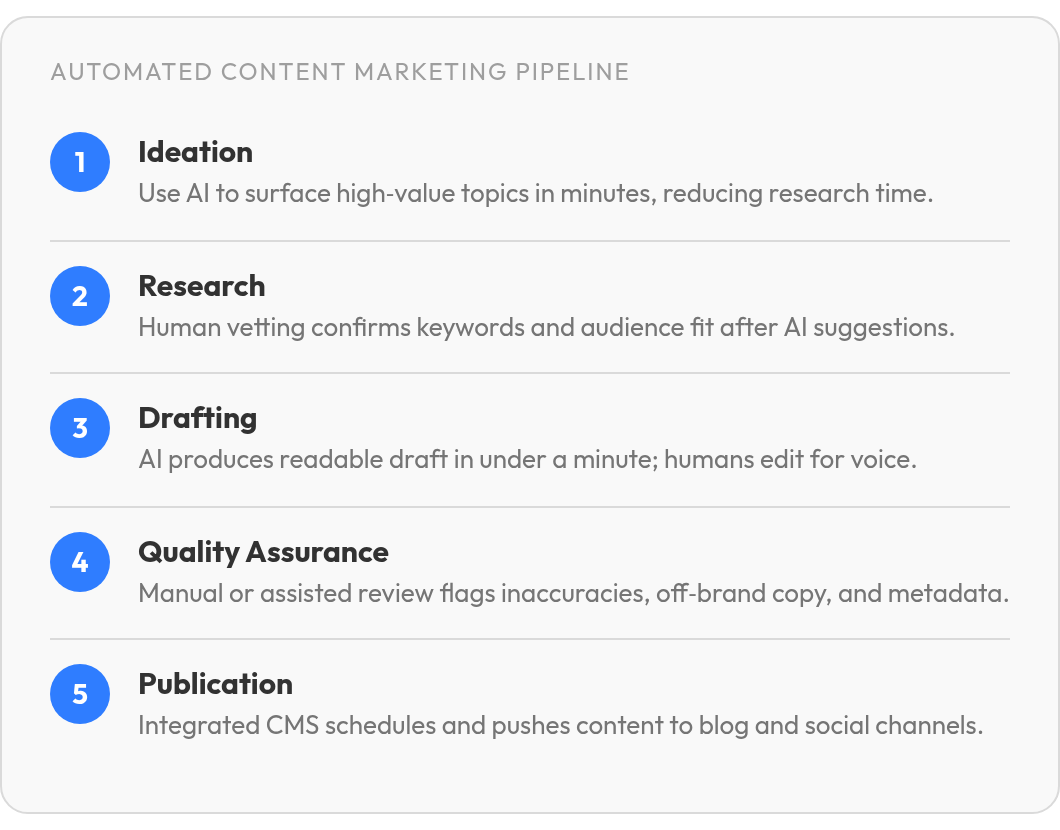
Here's the pipeline at a glance, with what the evidence actually supports:
| Stage | Purpose | Where AI evidence is strongest | Notes |
|---|---|---|---|
| Ideation | Surface topics worth writing | Strong — months of ideas in minutes | — |
| Research | Validate demand and angle | Partial — synthesis helps, vetting stays human | Taxonomy research surfaces winnable keywords |
| Drafting | Produce a first version | Strong — fast first drafts | Still needs editing |
| QA | Fact-check, brand voice, accuracy | Weak — mostly manual | Brand-voice checks help, but review remains human |
| Publication | Schedule and push live | Thin — often disconnected | Publishing connectors exist; integration is uneven |
A single blog post done by hand can swallow whole afternoons. Done with a stack of disconnected AI tools, it still eats time through formatting, handoffs, and platform switching. The tools got faster. The handoffs didn't.
Integration Is the Constraint, Not Drafting Speed
The real tax is coordination. Integration challenges tend to be the main barrier, and most teams still run AI ad hoc rather than wired into one workflow. Put the CMS, scheduler, and analytics layer in the same operating path, and the system starts saving time beyond the writing step. Automate the whole chain, not just the easy middle.
Why the Five‑Stage Content Marketing Pipeline Matters
Most teams don't have a writing problem; they have a volume and sequencing problem. The bottleneck has moved from sentence production to the higher-leverage stages around it: research validation, QA, distribution, and measurement.
That shift explains why teams over-automate drafting while under-automating the stages that determine whether the content works. Drafting is visible and fast, so it attracts AI first. Research, QA, publication, and measurement are harder to connect, so they stay manual or only partially automated. The result is a faster drafting engine feeding a manual relay. That gap is the whole reason to wire content marketing stages together instead of running a pile of clever point tools.
Teams running automated workflows tend to produce more content than teams working manually. That multiplier doesn't come from sharper prompts. It comes from making each stage hand clean inputs to the next one instead of rebuilding context every time.
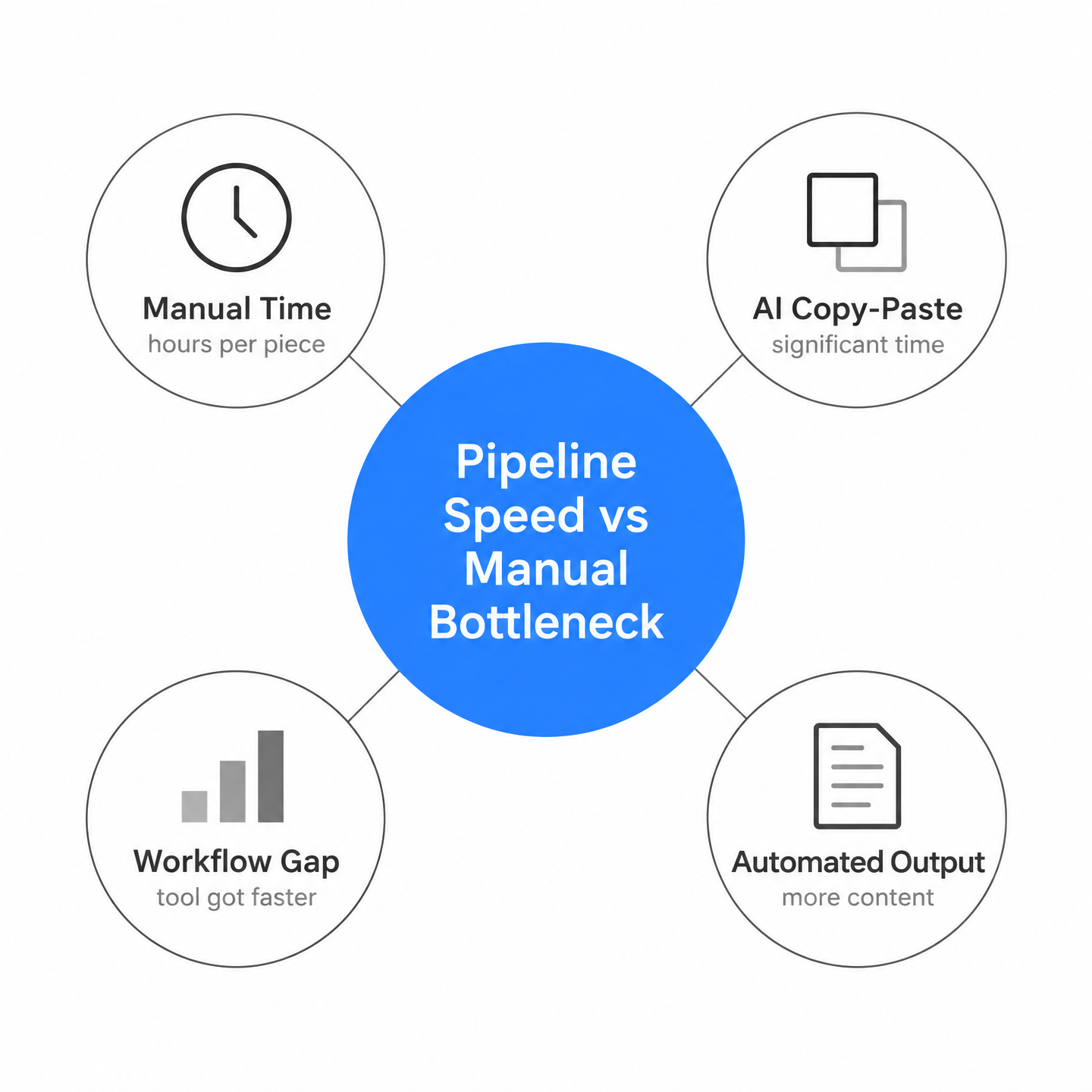
A pipeline fixes that by making work visible, routable, and repeatable, so nothing gets stuck waiting on a kickoff call or a lost brief.
Where the Pipeline Pays Off First
B2B content teams and high-volume marketing teams see the clearest returns, because they carry the heaviest coordination load. Over time, a working pipeline tends to show up as measurable gains in organic traffic, lead generation, and brand authority. We won't claim pipeline maturity guarantees better lead quality. The evidence isn't there yet.
The barrier is rarely the AI. Adoption usually breaks at the seams: ownership, integrations, review paths, and the moment when a personal productivity experiment has to become a shared operating system.
Skip the full five-stage build if you publish a handful of posts a quarter. At that volume, the overhead you'd be automating barely exists.
Stage 3 – Drafting: AI's First Draft, Not the Final Word
Drafting is where most teams feel the magic. It's also where they get overconfident. AI can compress work that used to dominate a writing block into a much smaller editing cycle. That's not a rounding error. It's a different use of the same afternoon.
The Draft Is Raw Material, Not Finished Copy
Our editing queue keeps proving the same point: a fast draft is not a finished one. Some drafts only need trimming. Others need a stronger point of view, better evidence, cleaner positioning, or removal of generic claims that sound plausible but don't say much.
Skip the fantasy that AI writes in your voice out of the box. The draft gives you structure and coverage, but the judgment has to come from you: what to emphasize, what to challenge, what to cut, and what your company would actually stand behind.
Where Drafting Automation Pays Off, And Where It Doesn't
The payoff isn't uniform. Repeatable formats benefit most because the structure is known before the model starts writing. Strategic pieces are different. They depend less on sentence production and more on angle, audience knowledge, proof, and willingness to say something specific.
We treat the draft as a handoff, not an endpoint. Teams that cut editorial oversight to chase speed often sacrifice the authority and nuance that separate effective content from noise.
Point the model at a first draft, then feed that output straight into quality control and SEO review instead of pasting it between tabs. The draft is a starting line, not a finish line.
Stage 4 & 5 – Quality Assurance & Publication: The Human Bottleneck and the Automation Opportunity
Drafting compresses time. QA can burn it right back. The productivity spike in Stage 3 often crashes into a hidden wall at Stage 4: the part where someone checks whether the AI wrote something accurate, on-brand, and publishable. If review still depends on manual searching, rewriting, routing, and approval chasing, the constraint simply moved.
This pattern tends to show up whenever drafting speeds up without the downstream work catching up. More output can leave pipeline performance flat because the bottleneck relocates to editorial review, compliance, stakeholder feedback, or channel preparation. Speed without quality infrastructure just creates inventory you can't ship. A brand-voice layer that captures your tone up front can help drafts arrive closer to your standards before the first edit begins.
The QA Checklist Most Teams Run Manually
Quality assurance for AI-generated content isn't a single pass. It's a stack of discrete checks that most teams improvise per piece: factual accuracy review, brand voice enforcement, source and link validation, formatting consistency, metadata completeness (titles, descriptions, alt text), structured data or schema markup where relevant, basic accessibility compliance, and final stakeholder sign-off. Each item compounds when the volume goes up.
The workload evidence is blunt. AI-generated drafts often need human intervention before they're publishable, whether that's line editing, claim review, product-language cleanup, or a full accuracy pass. Quality can even slip when teams adopt AI without a QA layer. The practical upshot is that the time saved in generation gets consumed by verification and cleanup unless the review process is designed as part of the pipeline. The fix is to capture tone, product language, and audience context up front, before drafting starts, so QA does not have to rebuild that context manually on every piece.
The categories of tools that can automate parts of this exist. Brand-voice analyzers that flag off-brand phrasing, grammar and style checkers that catch surface errors, fact-checking assistants that cross-reference claims against source material, link validators that scan for broken URLs, metadata helpers that generate SEO-optimized titles and descriptions, and schema generators that produce structured data markup. None of them eliminate editorial judgment. They compress the mechanics so human reviewers can focus on the parts that matter: Does this claim stand up? Does this answer the reader's question? Would we defend this in a sales call?
Approval Workflows and the Publishing Handoff
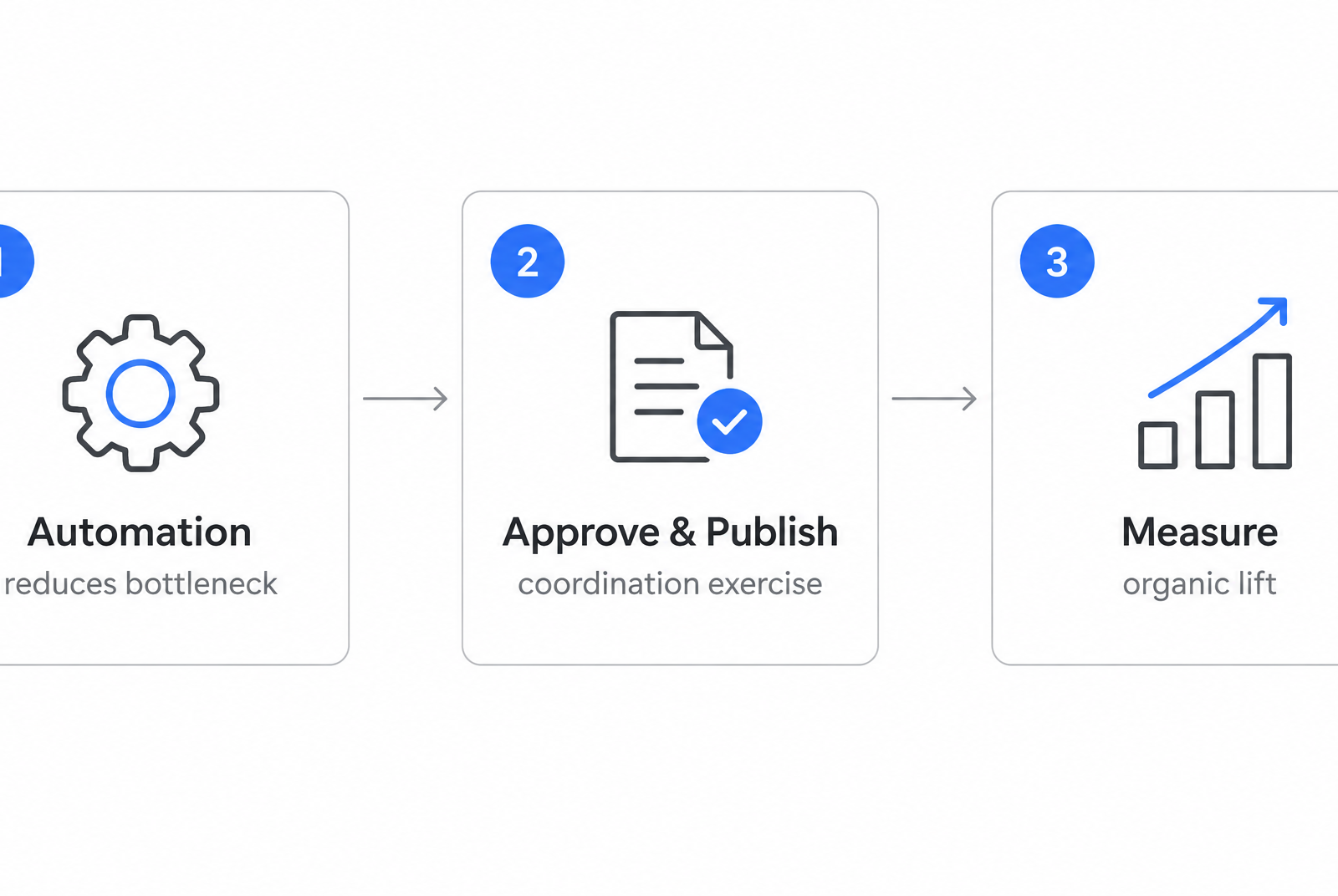
Even after QA passes, publication itself is a coordination exercise. Common approval patterns include CMS review queues where drafts move from writer to editor to final approver, comment threads inside the CMS or in tools like Notion or Google Docs, Slack approval requests that ping stakeholders for sign-off, and role-based publishing permissions that gate who can hit the publish button. The cycle time varies wildly. Some pieces clear in hours, others sit for weeks. But the coordination overhead stays constant regardless of how fast the draft was generated.
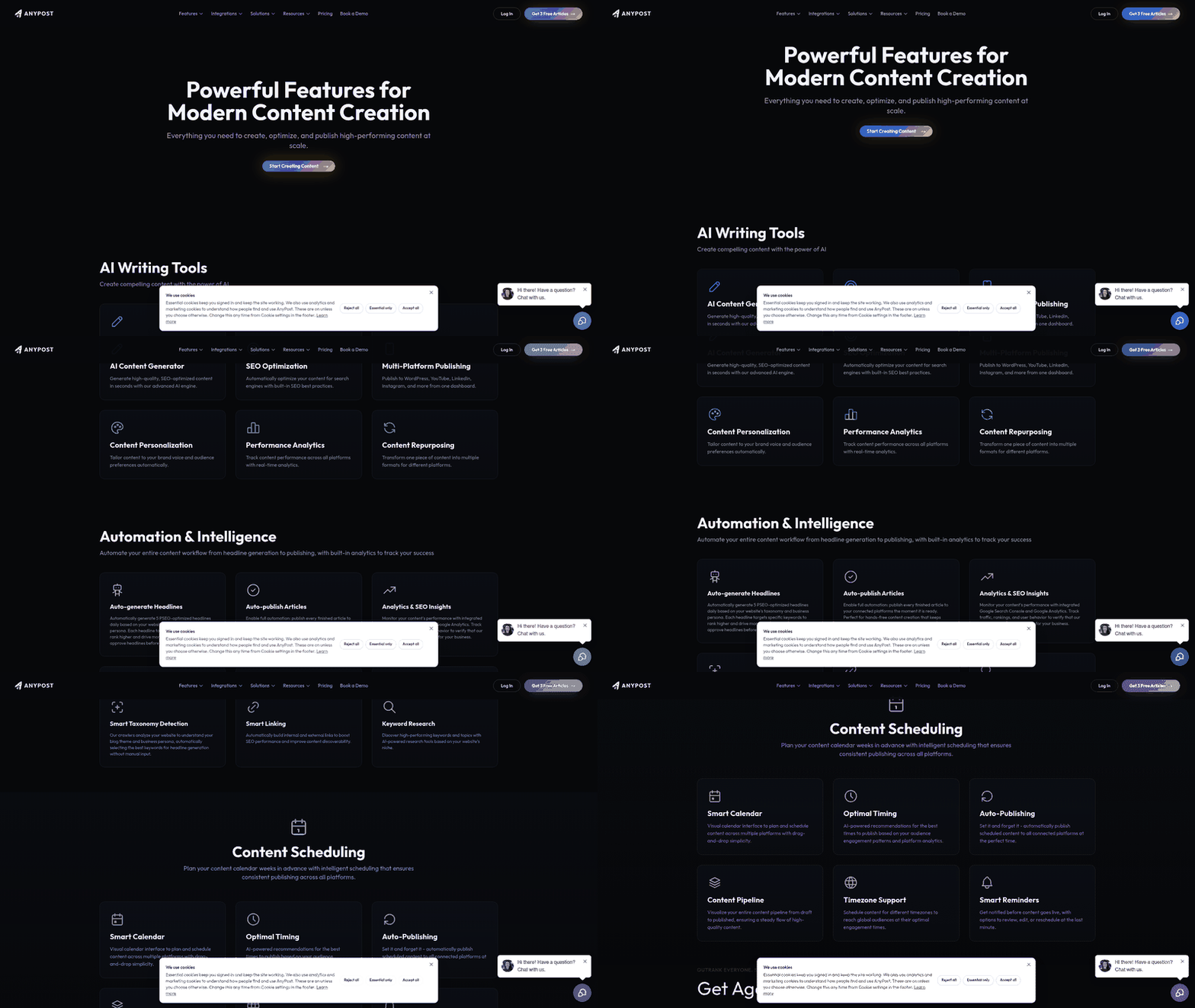
Distribution multiplies the handoff problem. A single piece might need manual cross-posting to the blog, reformatting for email, adaptation for LinkedIn and Twitter, and queuing across each platform's native scheduler. Batching and scheduling social content ahead of time tends to recover meaningful hours each week compared with daily manual posting. Multi-platform publishing can turn one piece of content into social carousels and posts for LinkedIn, X, Instagram, TikTok, and YouTube, with scheduling discipline built in before content creation ends.
Teams that wire these stages together can convert production speed into actual reach. QA automation should feed approval workflows, and approval should feed synchronized multi-channel publishing. The gain isn't from AI writing better content by default. It's from eliminating the manual relay between draft completion and audience delivery, so the content you already paid to produce actually reaches the people it was written for.
Bridging the Gaps: Building a Full‑Pipeline Engine with AnyPost.ai
The gaps between stages are where content programs quietly bleed time. You can automate the front end and still watch a finished draft sit in a tab, waiting for someone to check it, publish it, push it out, and measure it. The capability exists for each stage. The connective tissue usually doesn't.
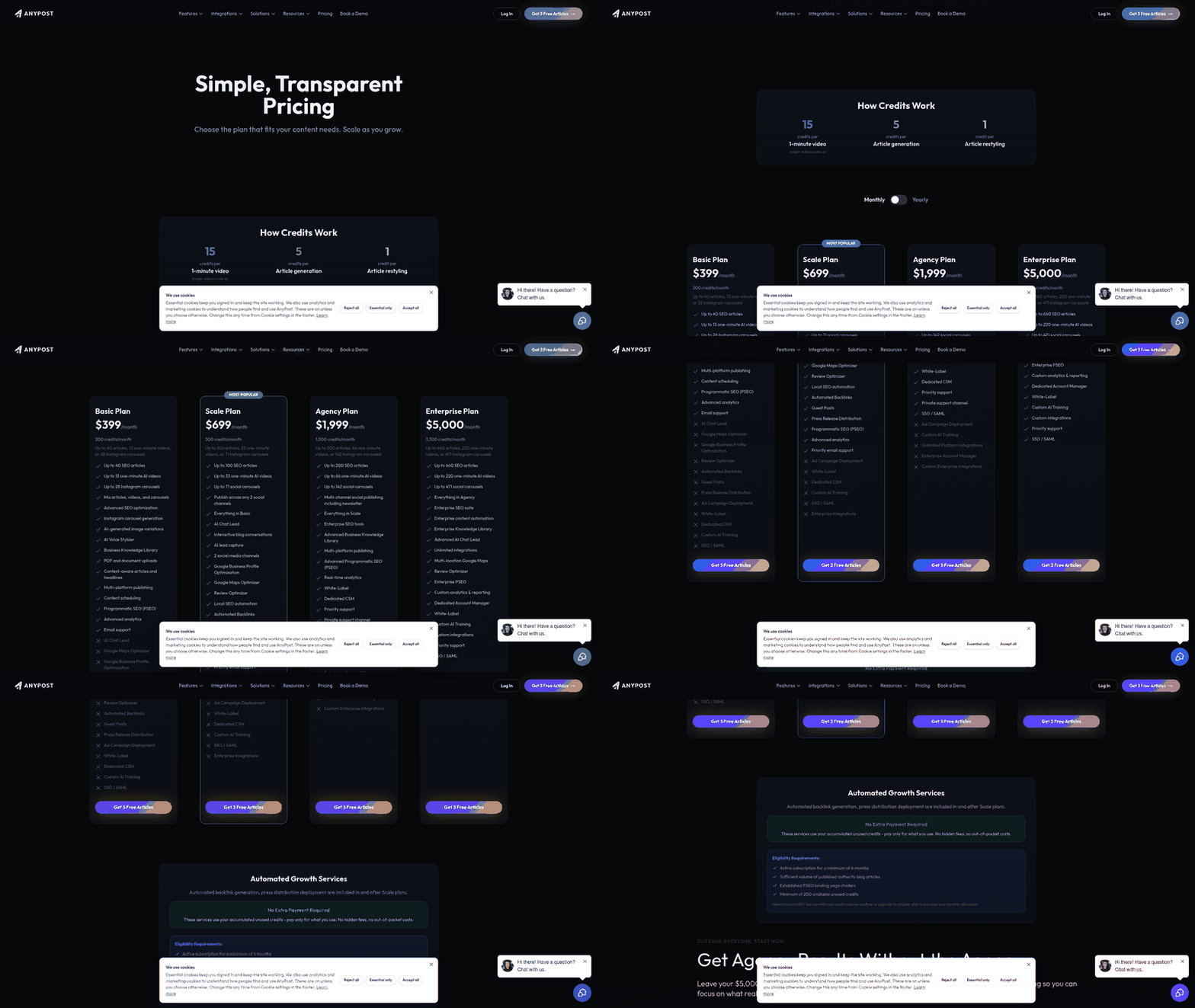
That's the case for a full-pipeline engine over a pile of point tools. Disconnected AI tools tend to leave teams managing every transition by hand, and integration across those tabs is often the hidden tax that eats the time you thought you saved. When drafting, publishing, and distribution each live in a different app, the process depends on memory and manual follow-through. The fix is to pull creation, SEO-optimized publishing, and multi-platform distribution into one place, so the work moves from idea to live post without the manual relay between tools.

A Stage-to-Capability Map You Can Actually Build
Below is the version worth trusting, with a clear line between what the evidence supports and what still needs a vendor's own documentation before you rely on it.
| Stage | AI capability | What the evidence supports |
|---|---|---|
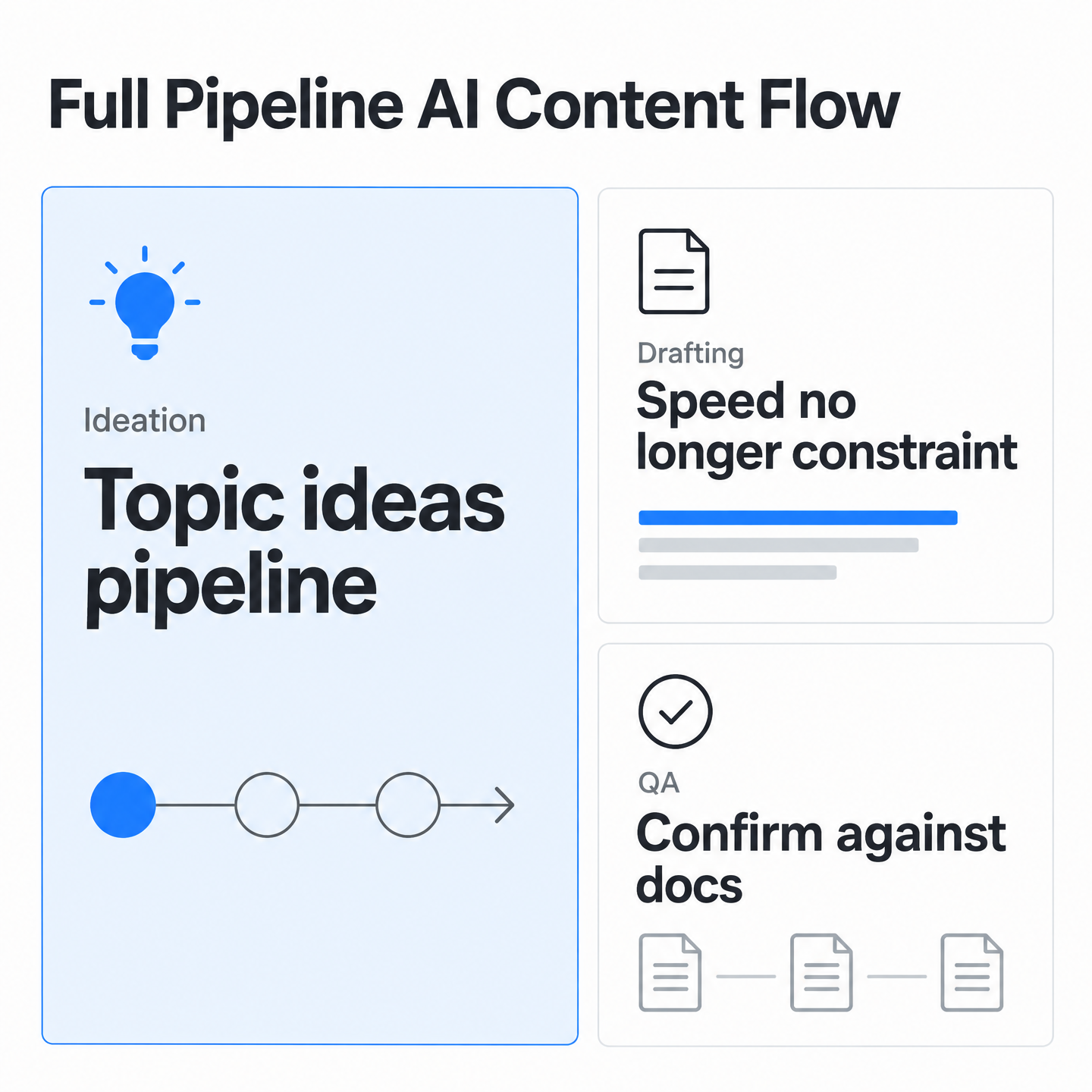
| Ideation | Keyword clustering, persona and pain-point mapping, funnel-stage and content-gap analysis | A pipeline of topic ideas without the manual research grind |
| Drafting | First drafts, outlines, metadata | Drafting speed is no longer the constraint |
| QA | Flag off-voice copy and unsupported claims | Confirm against product documentation |
| Publication | Schedule and route to channels | Vendor-specific; verify before relying on it |
| Distribution | Cross-channel scheduling | Push each asset to the channels it was built for |
| Measurement | Reporting that closes the loop | The stage almost nobody staffs |
The front rows are proven. The QA and publication rows are where you ask for documentation instead of taking a feature claim on faith.
Why the Wiring Beats the Tools
Faster drafting only pays off when the downstream handoffs stop being manual. Automate ideation and drafting while leaving distribution untouched, and you've built a quicker way to produce content fewer people see. Connect the stages, and the speed you gained up front finally shows up in results.
Common Questions
1. Can I automate the entire content pipeline end-to-end without any human review?
No. AI can move a piece through several operational steps, but editorial accountability cannot be delegated completely. Someone still has to decide whether the claims are defensible, the positioning is accurate, and the finished asset is something the company would stand behind.
2. Which content types see the biggest time savings from AI automation?
The best candidates are repeatable assets with predictable structure: catalog copy, templated landing-page sections, recurring social posts, and similar formats. Content that depends on original judgment, executive perspective, or a non-obvious argument still benefits from AI support, but the human work shifts toward strategy and proof rather than disappearing.
3. What happens if I speed up drafting but leave the rest of the pipeline manual?
You make the queue longer. Drafts arrive faster than editors, approvers, and channel owners can process them, so the operation feels busier without necessarily reaching more people. The fix is to improve review, routing, publishing, and distribution along with generation.
4. How long does it take to see measurable results from a connected content pipeline?
Expect results to depend on publishing cadence, site authority, channel mix, and how much workflow debt you remove. The operational benefits usually appear first: fewer stalled drafts, cleaner handoffs, and more consistent distribution. Performance metrics follow only if the content itself is useful and the publishing rhythm holds.
5. Is pipeline automation worth it if I only publish a few posts per quarter?
Probably not. At low volume, there may not be enough recurring coordination work to justify a full pipeline build. The clearest case is a team with frequent publishing, multiple reviewers, several distribution channels, and enough handoffs that the process itself has become a constraint.