Site Explorer for Programmatic SEO: Web Page Keyword Analysis That Finds Scalable Pages

What You Need to Know
- Google Search Console queries ranking in positions 11-30 reveal existing domain relevance without an optimized page, making them ideal targets for programmatic templates.
- Long-tail keywords under 10 monthly searches each represent 91.8% of all queries but collectively drive the majority of total search volume.
- Programmatic SEO templates succeed only when each page variation serves a distinct intent backed by consistent demand across multiple query modifiers.
- Site explorer workflows filter GSC data to surface scalable keyword clusters where volume, difficulty, and data depth align for template automation.
Related Video
Watch: Lovable's Explosive Programmatic SEO Growth: Smart Strategy or Reckless Scaling? by Edward Sturm
Your Search Footprint Is the Starting Point
The best programmatic SEO opportunities don't come from finding new keywords. They come from finding where your domain already shows up in search results but has no page built to capture the click. That gap is what site explorer workflows surface.
Queries with fewer than 10 monthly searches make up 91.8% of all queries. Individually, they're noise. Grouped into patterns, they're volume you can actually build for. When you're building programmatic SEO at scale, the job is figuring out which of those scattered queries can be grouped into repeatable patterns, and which patterns actually justify automation. That's the difference between pages that rank and pages that sit in "Discovered – not indexed" purgatory.
Site explorer workflows give you that footprint data before you write a line of template code. Instead of starting with speculative keyword lists from third-party tools, you can see where your domain is already being tested in search results and where no purpose-built page exists to capture that demand. Third-party keyword tools are still useful for expansion. GSC gives you the grounded layer: what real users typed, how your domain appeared, and which gaps you can fill without cannibalizing content you already rank for.
When a Keyword Pattern Earns a Template
A keyword pattern is worth building only if it shows consistent demand across enough variations to justify the template-building effort. The distinction matters because programmatic templates tend to work when each variation serves a distinct intent. Someone searching "best project management software for small teams" expects different information than someone searching "best project management software for agencies," even though both follow the same head-term-plus-modifier structure. When you validate patterns through site explorer data before building templates, you avoid the most common programmatic SEO failure: publishing pages for a pattern that collapses into a small set of nearly identical search needs.
Scalable SEO success depends on clustering queries where volume, difficulty, and data depth all align. Programmatic SEO implementations can generate large page sets targeting many related keywords when the underlying pattern holds real search demand. These aren't accidents. They're the result of finding keyword clusters that support genuine variation at scale.
Turning GSC Opportunity Mining Into Page Patterns
Site explorer workflows let you isolate queries where your domain has traction but lacks a dedicated destination page. The strategy works because you're expanding from existing authority rather than entering cold keyword spaces where your domain has no footprint. Identify location-based, feature-based, or use-case-driven query patterns in your GSC data. Build templates around the variations that show consistent impressions. You turn fragmented demand into a repeatable publishing system.

Template speed matters once you've validated a pattern. The repeatable page elements (URL structure, H1 formatting, metadata variables, body copy placeholders, internal linking logic) let you publish dozens or hundreds of pages in the time it would take to draft one manually. But speed without differentiation creates thin content. Each generated page still needs unique data: local details for location pages, feature-level comparisons for integration pages, or workflow specifics for use-case pages. When your dataset is rich enough to make each variation genuinely distinct, automation accelerates legitimate differentiation instead of mass-producing duplicates.
Finding Keyword Patterns Worth Automating
Google Search Console holds the exact query data most teams waste by jumping straight to third-party tools. For programmatic SEO, the value is not just keyword discovery; it's pattern discovery. You can see which searches already trigger your site, which page currently ranks, and whether that ranking page is actually built for the intent. That footprint layer helps you spot gaps that programmatic templates can fill without competing against pages you've already published.
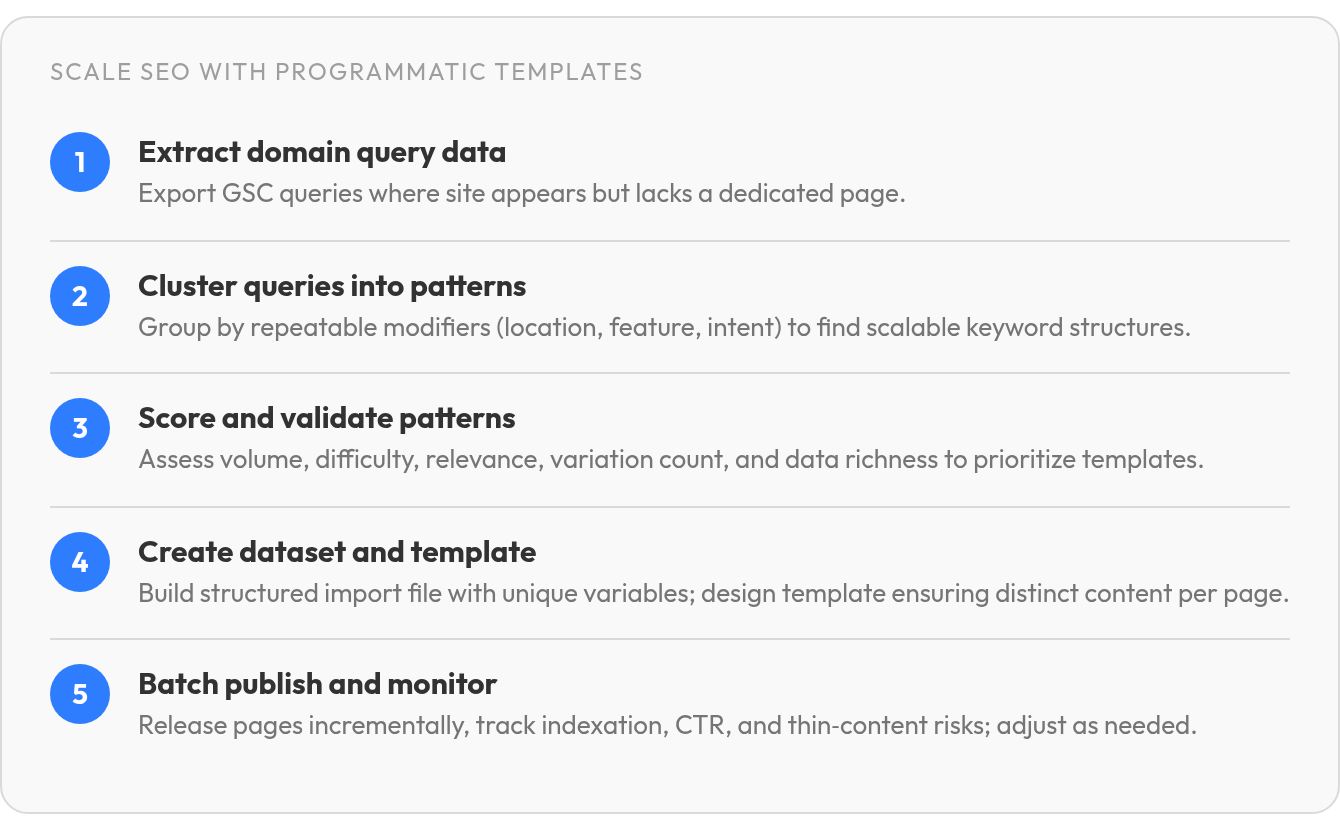
Start with Domain-Specific Query Data
Pull several months of Search Console data and export the queries where your site appears beyond its strongest ranking set. These queries show topical authority without full capture: users see your domain in results, but competitors are likely earning the click. Third-party keyword tools estimate demand across the broader market. Search Console shows how your own domain participates in that demand.
Filter the export by repeating modifiers: city names, product features, comparison terms, price qualifiers. If many queries all follow the pattern "best [feature] software" and your site appears for them without a dedicated page type, that's a validated template opportunity. If the pattern produces only a small handful of variations, traditional SEO is usually more cost-effective than programmatic automation.
Group Keywords by Repeatable Modifiers and Intent Patterns
Intent-based modifiers split commercial queries ("best," "top," "compare") from informational ones ("how to," "what is"). Location modifiers work when your data supports city-level or region-level differentiation. "Plumbing services in [city]" justifies automation only if each city page offers unique pricing, service areas, or local case studies. Price modifiers ("under $50," "cheap," "budget") require dataset columns for actual price ranges.
Successful programmatic SEO campaigns follow a recognizable pattern: companies identify a repeating keyword structure where they already hold some authority, build templates that serve the underlying search intent, and generate pages that provide genuine differentiation through structured data. The common thread is aggregate demand. When many keyword variations collectively represent meaningful search opportunity and your dataset can support unique, valuable pages for each variation, programmatic generation becomes more efficient than manual content creation.
Scoring Patterns Before You Build
When you pull query data from a site explorer tool like Google Search Console, you're looking at hundreds or thousands of variations that could theoretically become pages. The question isn't whether you can build them. It's whether you should. We prioritize by balancing aggregate demand against the risk of creating content Google will flag as thin or redundant.

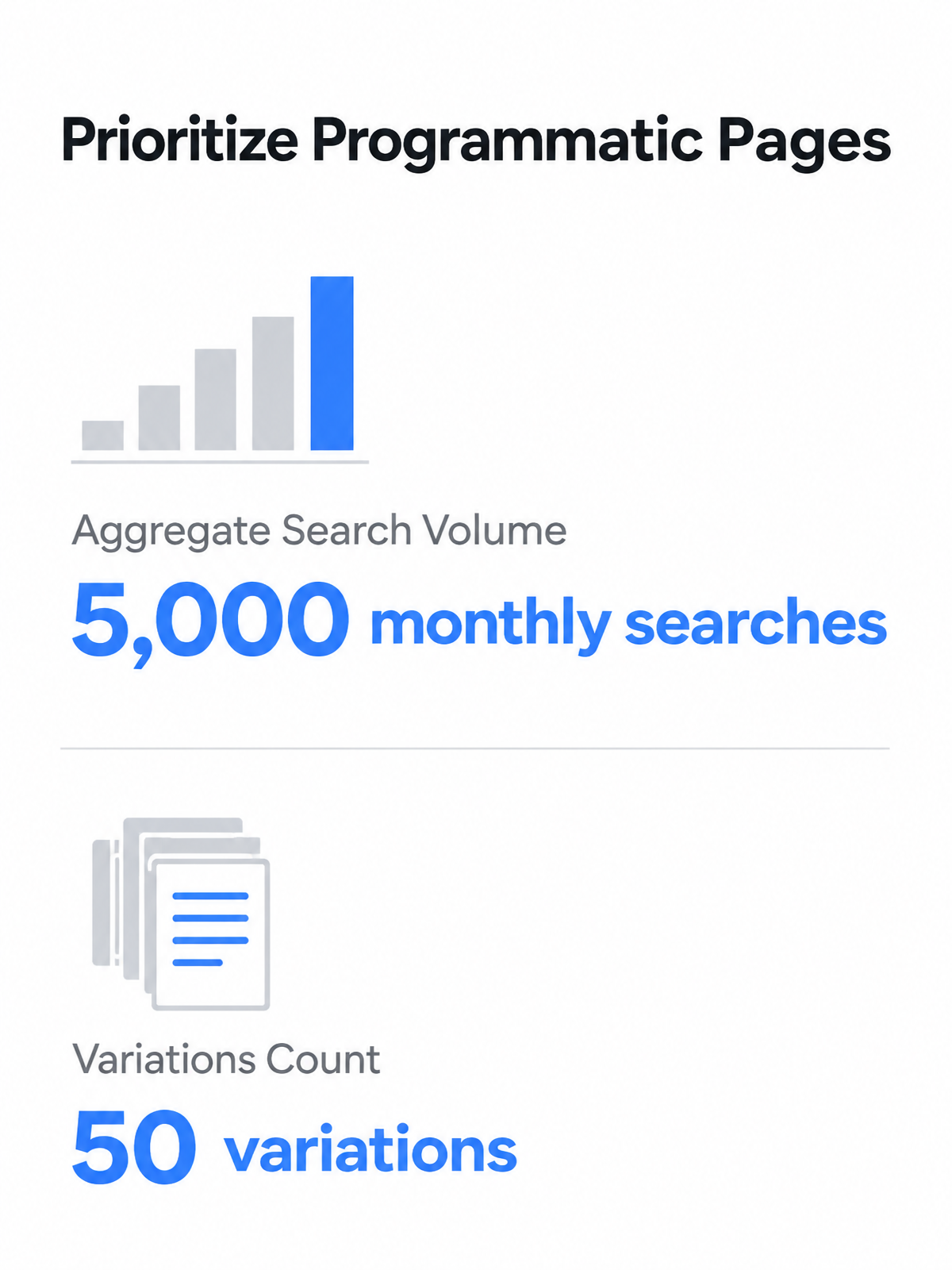
Build a Lightweight Scoring Model Using Real Inputs
We use a simple scoring sheet that ranks each pattern across five dimensions. Aggregate search volume comes first: add up the monthly searches across all variations in the pattern. A pattern with many variations can generate enough monthly searches to justify automation. Keyword difficulty filters next. We target patterns where variations cluster at manageable competition levels, meaning you're not fighting entrenched authority on every page. Existing GSC relevance weighs heavily: if your domain already ranks on the second or third page of results for queries in the pattern, you have topical authority without an optimized page to capture it. That's the sweet spot site explorer workflows reveal.
Modifier type affects production fit. Location modifiers like "plumber in Boston" scale easily if you have real local data: addresses, service areas, reviews. Feature modifiers like "best CRM for small teams" demand distinct feature comparisons for each variation, which means richer datasets and slower production. We score patterns higher when our data can genuinely differentiate each page.
Number of viable variations rounds out the model. Patterns with hundreds of variations justify template investment. Patterns with a handful don't.
Flag Thin-Content Risk Before You Publish
The scoring model tells you what to build. The thin-content check tells you when to stop. We don't use fixed word-count thresholds or duplicate-overlap percentages. Those miss the point. Instead, we ask three questions for each pattern.
Can the template supply distinct data for every variation? If you're generating "best restaurants in [city]" pages but only have restaurant names and no ratings, hours, or photos, the pages will read identically.
Can it cover distinct intent? A user searching "self-guided tours of Rome" wants route maps and audio guides, not the same booking widget you show for "private tours of Rome."
Does each page offer page-specific value a human would choose over hitting the back button? If the answer to any question is no, we flag the pattern and either enrich the dataset or skip it entirely. Careful pattern validation before launch helps avoid the indexing problems that often hit rushed programmatic campaigns.
Balance scale with authority by starting with high-aggregate, high-relevance patterns where site explorer data proves you already rank nearby. Once those pages stabilize and earn links, layer in long-tail or niche variations that strengthen topical coverage even if individual search volume is low. The scoring model is a prioritization tool, not a gate. Small patterns still ship when they fill a gap your competitors ignore.
Building the Pages: Dataset First, Then Template
Once you've identified which keyword patterns justify automation and how your pages will deliver unique value, the next step is transforming that scored list into live pages. This stage separates programmatic SEO strategies that scale cleanly from those that collapse under duplicate content penalties or indexing failures.
Structure Your Dataset Before You Touch a Template
Your scored keyword list needs to become a structured import file where each row represents one page and each column maps to a page element. At minimum, you'll need columns for the target keyword, URL slug, H1 tag, meta title, meta description, and the primary variable that changes across pages. That variable could be a city name, a product feature, or a comparison pair. If your template includes comparison tables, FAQ sections, or feature lists, those need dedicated columns too.

The dataset is where you prevent thin content before it happens. A row with only a city name and no supporting data will generate a page identical to many others except for that one word swap. Enriching the dataset means adding columns for local statistics, population figures, area codes, zip codes, regional context, or pricing variations. Anything that lets each page offer information the others don't. When travel platforms generate destination pages, they often pull in climate data, local festivals, and neighborhood breakdowns so each page can answer distinct questions.
Publish in Batches, Not Floods
Programmatic SEO systems can generate large volumes of pages quickly. Marketplaces have expanded by generating template pages for categories, locations, or feature sets. Design platforms have built extensive libraries of template pages targeting specific search patterns. These deployments work best as staged releases rather than one-time bulk uploads, because each batch gives you a chance to confirm that the template, internal links, and metadata are behaving as intended.
Staggered publishing gives you time to check Google Search Console for indexing errors, broken internal links, or pages flagged as duplicates. If early batches show poor indexing rates, you can pause and diagnose the template before publishing additional pages with the same structural flaw.
What to Measure After Launch, and What Derails Programmatic Pages
The part most teams underestimate isn't the launch. It's what happens after. Programmatic pages can go live and sit in limbo if you don't set up a measurement framework that tracks whether the program justifies its cost. When you're publishing at scale, you can't afford to wait six months to find that half your pages never indexed or that your template generates impressions but zero clicks.
Track Indexation and Crawl Health First, Traffic Second
Start with Google Search Console's Coverage report. Filter by the URL pattern your programmatic pages follow, whether that's /integrations/[tool-name] or /locations/[city-name], and check how many pages Google discovered, crawled, and indexed. Set a checkpoint, such as 90 days, as your measurement milestone, noting that indexation speed varies with domain authority and crawl frequency.

Run a site explorer query in GSC to pull impressions, clicks, CTR, and average position for your programmatic page set. If pages indexed but show zero impressions after your checkpoint, your keyword validation was off or the intent doesn't match the template. If impressions are strong but CTR is weak, your meta descriptions or titles aren't compelling enough to pull clicks away from competing results. Separate analytics tools like GA4 track engagement metrics (bounce rate, time on page, conversions), but GSC data tells you whether Google considers your pages relevant in the first place.
Audit for Bulk-Publishing Pitfalls Before They Tank Your Rankings
Duplicate titles and meta descriptions are usually the first failure mode you'll hit when generating pages from templates. Export your programmatic URL list, scrape the title and description tags, and check for exact duplicates. Even minor variations matter: if your titles all use the same structure with only one variable swapped, Google may treat the set as near-duplicate and suppress much of it from results.
Check canonical tags next. A misconfigured template that points every variation back to a hub page tells Google to ignore the programmatic pages entirely. Use GSC's sitemap report to confirm all published pages appear in your submitted XML sitemap, and verify crawl depth with a tool that maps internal link distance from your homepage. Pages buried too deep in your site architecture tend to struggle, no matter how well-optimized the content is.
Orphan pages (those with no internal links pointing to them) are another red flag. Teams often publish page sets with polished templates and no navigation paths from existing authority pages, then wonder why traffic never arrives.
Run a content audit at your measurement checkpoint to identify pages that should be improved, consolidated, noindexed, or removed. If a page shows minimal impressions and no clicks after sufficient time, it's likely not serving a real search intent. Batch-update those pages with richer data, merge them into a broader hub page, or noindex them to prevent them from diluting your domain's perceived quality. Thin-content risk doesn't come from automation itself. It comes from publishing pages that don't answer a distinct question with unique information.
Common Questions
Why does Google Search Console data matter more than third-party keyword tools for programmatic SEO?
Google Search Console shows your own search footprint: the queries triggering impressions, the pages Google currently associates with them, and the gaps where a better-matched page could win traffic. Third-party tools are useful for expansion, but they don't show how your domain is already performing against a query set.
How many keyword variations do I need before a programmatic template is worth building?
Look for enough variations to make the template cheaper and more consistent than manual production. The decision depends on aggregate demand, competition, and whether your dataset can make each page meaningfully different. If the pattern is small or the pages would be nearly identical, write a focused manual page or hub instead.
What's the biggest mistake teams make when publishing programmatic pages at scale?
The biggest mistake is treating launch as a single push instead of a controlled rollout. Smaller batches let you catch title duplication, internal-link gaps, crawl issues, and canonical mistakes while the problem is still contained.
How do I know if my programmatic pages are too thin before Google penalizes them?
Review the template output like a searcher, not just like an SEO. If two pages differ only by a swapped variable, or if the page doesn't answer the specific query better than a broader hub page would, the dataset needs more depth before you scale it.