
Skip the 12-Tool Stack: One Workflow Drafts, Repurposes, and Publishes

What You Need to Know
Moving a draft between separate writing, SEO, and scheduling tools can add manual transfer work and increase the chance of errors at each handoff. A unified workflow can run research, drafting, repurposing, and publishing through one system and, depending on the platform, can push localized content to Google Business Profiles and local directories. One content hub can keep the outline, draft, keyword targets, tone profile, and distribution settings attached to a single record, so one edit can update downstream versions. Some unified platforms can be configured to format output with search-intent headings, semantic HTML, and section tags.
The Problem Isn't Your Content. It's the Copy-Paste.
Many marketers work across several disconnected tools, and the handoffs can add friction. A unified workflow can reduce that friction by running research, drafting, repurposing, and publishing through one system. The potential payoff is usually in speed, brand consistency, and data that stays connected to the same draft.
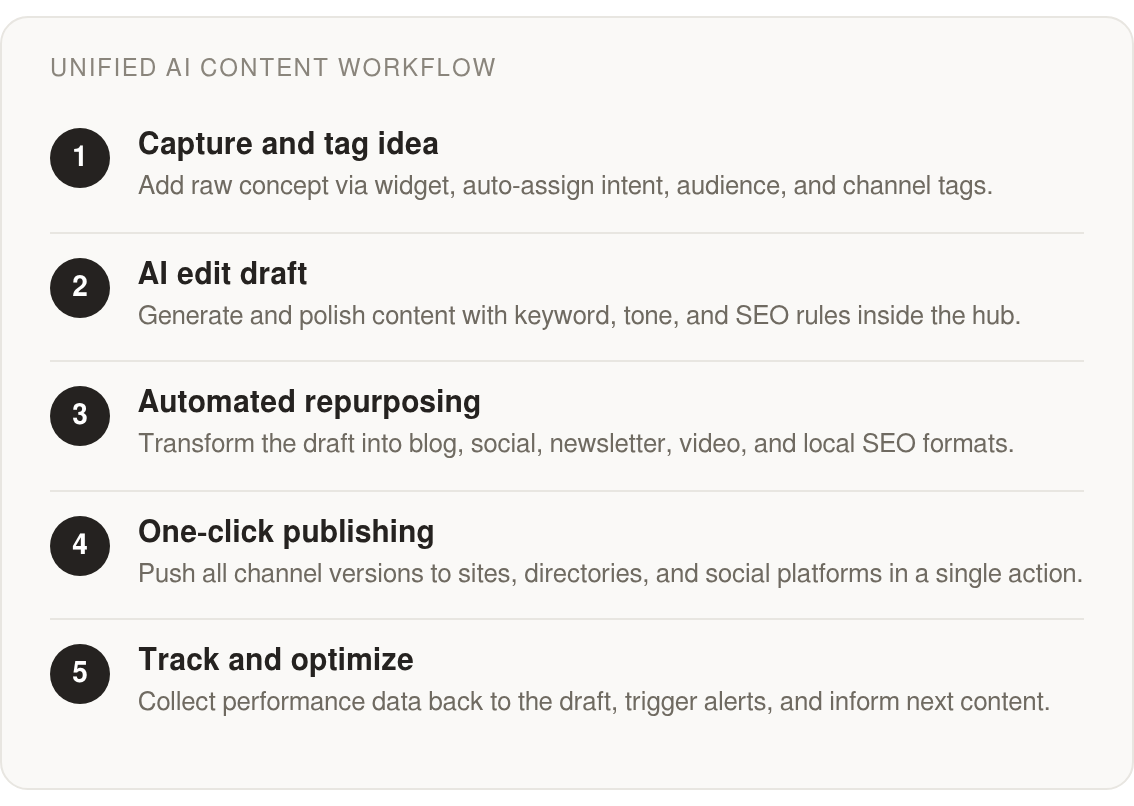
So the reframe is: the bottleneck may not be content creation itself. It can be the copy-paste between tools. Every time a draft moves from a writing tool to an SEO checker to a social scheduler, there is a handoff that can introduce errors and consume time.
Why does tool sprawl hurt content quality?
Tool sprawl can leave content in fragments, and every handoff adds risk. A draft that moves from research tool to editor to CMS to scheduler can lose focus at each transition. More stops can mean more voice drift.
Fragmentation can also block reuse. When a piece is published once and then sits in an archive, the refresh cycle can stall. If republishing requires re-threading several tools, the process may stop before it starts.
This is a common pattern for small local businesses: they may have ideas but not the staff to run a large stack, so good content ships once and then gets abandoned.
How does a faster workflow improve SEO?
Publishing cadence can influence visibility. Brands that refresh and redistribute on a regular cycle may continue building search presence; those that publish once and walk away may see it decay.
Manual handoffs can break that cadence. Automating distribution may be what allows a regular publishing rhythm to continue, since moving content between tools by hand can interrupt the process before it compounds.
Structure can also matter. Some unified platforms can be configured to output search-intent headings, semantic HTML, and section tags. If you are comparing tools, it can help to look at whether the writer reduces manual transfer work rather than just producing a draft.
What ties this back to business goals?
One workflow can connect publishing to lead generation by pushing localized content into Google Business Profiles and local directories. That is an area where a multi-tool stack may not provide the same chain: a unified system can localize copy, format it for search, and publish it where nearby customers are likely to look.
For a local business without a marketing department, that can be the difference between showing up in local search and staying invisible.
The Draft Hub: One Record for the Whole Lifecycle
A draft hub can be one place where raw ideas, working outlines, finished articles, and channel cut-downs all live. Running AI content generation through a single hub instead of a scatter of apps can reduce the chance that something gets stranded in an unopened tab. The draft, its SEO scoring, its tone pass, and its published destinations can share one record.
That can matter for local businesses. The hub can become the home for localized content, where one article is tuned for a city or neighborhood and then feeds Google Business Profile posts, review management, and local SEO activity without manual re-keying in between. Not every multi-tool setup keeps that entire chain inside one asset.
What actually lives in the hub?
Potentially the full lifecycle of a piece, not just the text. The outline, the branded draft, the keyword targets, the tone profile, and the distribution settings can all attach to the same object.
Because those layers travel together, an upstream change can update downstream versions. Adjust the target city in the brief, and the article and its Google Business Profile content can both reflect it. That is the point of consolidation: one edit instead of several.
How does one platform replace a 12-tool stack?
Platforms that replace a multi-tool setup typically combine a few capabilities on the same data: a single dashboard for drafting and review, programmatic SEO for targeted pages, and website integration plus multi-platform publishing. Approved content can flow to your site, newsletter, and social channels such as LinkedIn, X, Instagram, TikTok, and YouTube—depending on the platform.
The gap is often distribution automation rather than writing volume. When distribution is manual, content can fade into the archive even if production is steady.
One honest limit
Drafts still need a human pass before they go live. Factual checks and final brand-voice calls stay with you. A hub can remove some copy-paste work and handoff errors. It does not remove your judgment, and it should not.
Capture, Tag, and Edit Without Switching Apps
Many ideas get lost between having them and writing them down. A capture-first workflow can close that gap. Some platforms offer a mobile widget or browser extension that can drop a raw idea into a hub, timestamped and ready, without switching apps.
That single entry point can be where AI content generation starts saving time. The capture can carry context the system may later use to tag intent, match audience, and suggest a channel. The front end of the workflow is often where teams either bank time or lose it.

Capture feeds two ideation signals, not one
There are two common ideation signals. One is live search data: demand volume and exact phrasing. The other is first-party feedback such as support tickets, sales calls, and community threads. For a local business, both can be useful at different scales.
Search data can tell you demand volume and the exact phrasing people use. Front-desk conversations and inbox messages can tell you neighborhood-specific concerns, such as “customers keep asking if we deliver to the east side.” That is a first-party signal search volume may never surface.
Feeding both into the same ideation stage can sharpen topic selection. Teams often gather many candidates but choose only a few; better inputs can mean the survivors match local demand more closely.
Automatic tagging is what makes repurposing cheap
A capture with no tags can be just a note in a pile. Tags for intent, audience, and channel can let one idea split into a blog post, a Google Business Profile update, a directory listing, and a social caption without manual re-keying each time.
If AI writes the draft but you still shuttle it between tools by hand, you may have moved the work rather than removed it. Structured tags can allow a system to route each version to its destination.
AI editing that bakes in local SEO
The editing pass can be where a unified workflow helps. Some AI editing tools can handle keyword placement, readability, and brand-voice matching inside a draft, applying tone rules and word-count targets without a separate style guide or SEO checker open in another tab. Well-formatted output may earn more visibility in AI-driven search results, so a small business might get a discoverability edge without hiring a specialist.
First drafts can stay rough on purpose: get the thoughts down, mark placeholders like “[add local stat here],” and let the AI edit clean it up. The polish may come faster once the raw material is captured and tagged well.
Automated Repurposing: Six Channels From One Draft
One well-structured draft can feed more channels than many teams use. The blog post can be the anchor. The same text may contain a LinkedIn hook, an X thread, an Instagram carousel outline, a newsletter teaser, and the spine of a YouTube script. Automated repurposing can extract each one without manual re-typing.
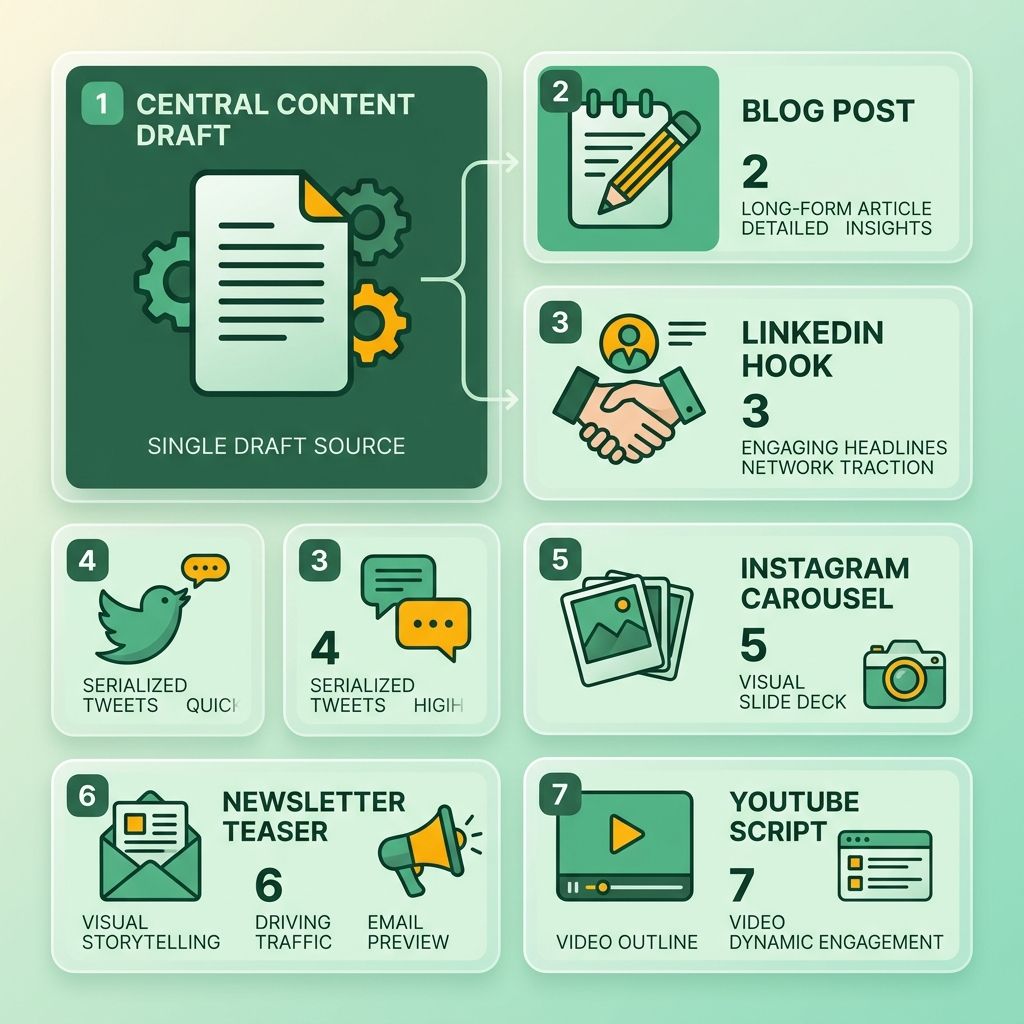
How does one draft adapt per channel?
Repurposing can run on two layers. The first is rule-based: character limits, aspect ratios, and format constraints per platform. A carousel can be sliced into slide-sized chunks. A newsletter snippet can be capped at a set length. These rules can be applied automatically.
The second is an AI-driven pass: it can rewrite tone, tighten hooks, and reshape structure for how people read on each channel. LinkedIn may lean professional and detailed; an X thread can be stripped into punchy fragments; a TikTok or YouTube script can get a spoken cadence with a cold open. Same core message, different formats.
For a local business, the same pipeline may also output SEO-structured posts to Google Business Profiles and local directories, plus review management and local SEO activity as part of the same run. That can reduce the need for a dedicated SEO hire or a stitched-together stack.
What does the transformation flow look like?
Linear and repeatable. One possible shape:
- Outline captures the core idea and target keyword.
- Blog post becomes the long-form anchor with full structure.
- Social variants (LinkedIn, X, Instagram, TikTok) can spin off with platform rules applied.
- Newsletter snippet condenses the hook into a teaser.
- Local publish can push SEO-formatted versions to profiles and directories.
Each step reads from the one asset, so the message stays consistent while the format bends to fit.
Does this actually move the numbers?
It can, and some platforms can show performance data from Google Search Console. Instead of an agency report on what was done, you may see impressions and clicks from consistent distribution. Content stalling in the archive can be a drag on scaling; keeping it circulating across channels can help it continue earning.
Automated repurposing may not be necessary if you publish on one channel only. But if you are a local shop trying to appear in map packs, directories, and social feeds at once, manual channel-by-channel work can be a bottleneck. One draft feeding several channels can mean a single edit propagates across versions, so a corrected fact or updated offer is less likely to linger stale on a forgotten platform.
One-Click Publishing Across Platforms
The final stage can be where time saved earlier leaks away. You may generate a clean draft, repurpose it into several formats, then spend time loading each one into a CMS, a scheduler, and an email tool by hand. One-click publishing can push every repurposed asset to its destination in a single action.
For a local business, a single localized article can go to a blog, social channels, and the profiles and directories that feed local search, all at once, skipping manual re-keying.
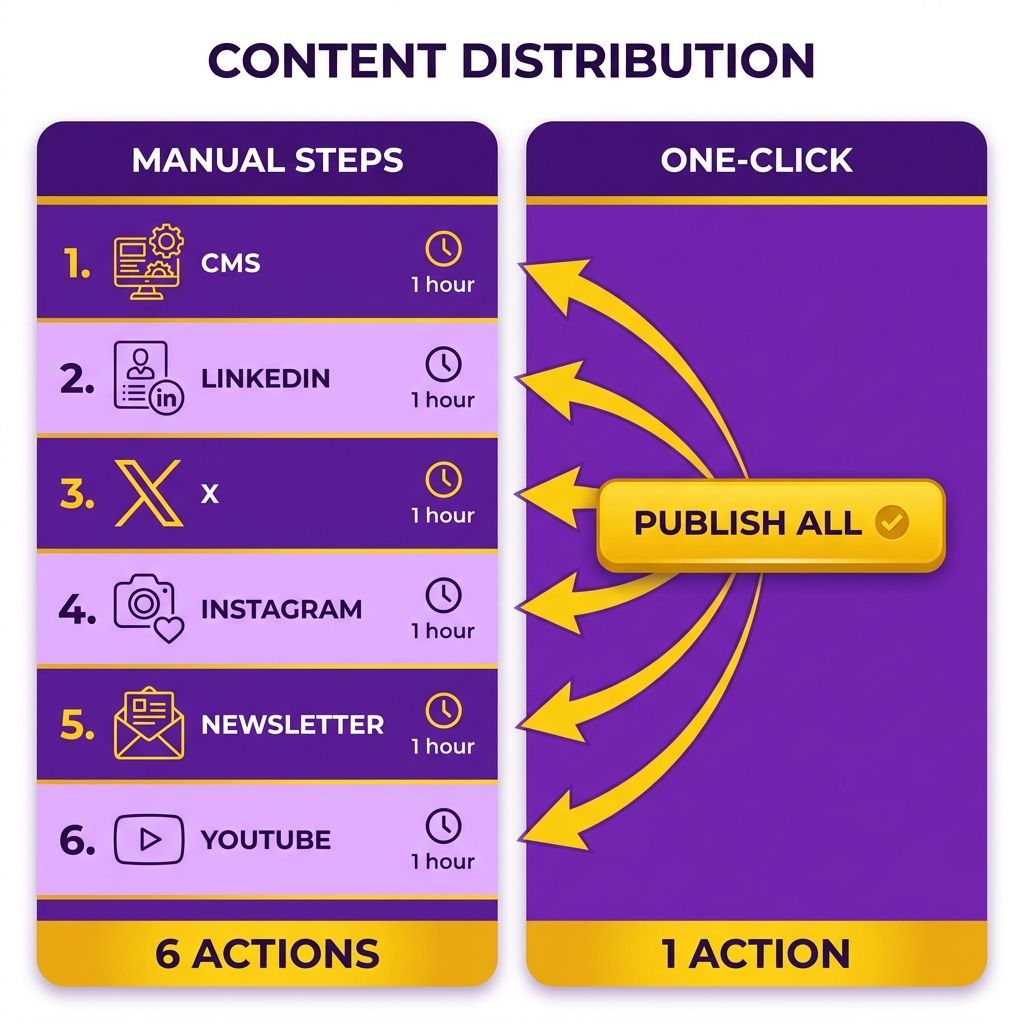
Why does automated publishing protect the cadence?
Format can matter as much as frequency. Some unified platforms can be configured to wrap major topics in semantic <section> tags and build keyword-aligned headings, clean HTML, and relevant internal and external links into articles. A pipeline that outputs SEO-formatted content directly to directories and profiles can provide that structural edge without requiring a specialist.
How do scheduling and fallbacks keep it reliable?
One-click does not mean one-time. Scheduling can queue the same asset across channels at different moments, so a blog post can go live now while its social cuts stagger over the following week.
Reliability can still be an issue. Connections can break, tokens expire, and API keys rotate. Some platforms can be configured with managed authentication so credential refresh happens in the background, reducing the chance that a scheduled publish fails because an OAuth grant timed out.
A fallback can protect the cadence: if a channel rejects a push, the asset can hold in the hub as a draft rather than vanish, ready to retry once the connection is restored.
What still needs your eye before you publish
Platform-specific rules still need a human check. Character limits, image dimensions, and profile formatting differ across destinations, and a caption that fits one channel can get truncated on another.
Set transformation rules once so each output respects its target’s constraints, then spot-check local profile entries before they go live. Skip a full manual review only after you have watched a few cycles publish clean.
Tracking, Optimizing, and Scaling Without Adding Headcount
The last stage can make earlier stages smarter. When traffic, engagement, and lead data live near your drafts, you can stop guessing what to write next. A feedback loop can turn AI content generation from a publishing habit into a system that improves itself.
Fragmented reporting can split your story across a rankings tool, a social dashboard, and an email platform, so you may spend part of every review stitching numbers together before deciding anything. When performance data connects back to the exact draft that produced it, the decision can get faster because context is already attached.

What should you actually track?
Pick metrics that map to business goals, not vanity. For many local businesses, useful signals include organic traffic to each published piece, ranking movement on target terms, engagement on repurposed social variants, and leads or conversions the content drove. Newsletter open rates can round out the picture if email is in the mix.
Watch them together. A blog post might show flat traffic but strong newsletter opens, which can tell you the topic works better as a nurture asset than a search play. That pattern is easier to catch when the metrics share one view instead of living in separate tabs.
How do AI recommendations close the loop?
Consolidated data can support recommendations. When a system can see which topics rank, which formats are shared, and which pieces convert, it can suggest the next round instead of leaving you to reverse-engineer it. A format that consistently pulls leads can be recommended again; a topic cluster that stalls can be flagged before you sink more hours into it.
Simple alerts can reduce dashboard babysitting. A ranking drop on a page that used to convert can ping you. A social variant outperforming the blog anchor can be a signal to double down there. The difference between a tool that converts traffic to leads and one that just reports numbers usually comes down to whether the data triggers a next action.
Can you scale to hundreds of pieces without hiring?
It can be possible to scale output without adding headcount if capture, drafting, repurposing, publishing, and measurement share a record. The bottleneck in some content teams is not writing itself but manual handoffs between tools.
Programmatic pages can be a way to increase volume. A single template plus localized data can generate many targeted pages aimed at long-tail, low-difficulty terms. Each page can be tuned to a neighborhood or service area and feed local search presence.
A scale-first approach may not help if fundamentals are not yet working. Publishing hundreds of pages nobody finds can bury the pages that do work. It may be better to get a few pages converting first, read what the data says, then let volume follow the winners.
Common Questions
1. What happens if a publishing connection breaks during a scheduled post?
A workflow can be configured with managed authentication and fallbacks to reduce dropped posts. Credential refresh can run in the background so an expired token or rotated API key does not kill a scheduled publish overnight. If a channel rejects a push, the asset can hold in the hub as a draft rather than vanish, ready to retry once the connection is restored.
2. Does automating the workflow mean I can stop reviewing content before it goes live?
No stage fully removes human judgment. Drafts still need a pass for factual checks and final brand-voice calls before publishing. Platform-specific rules also need a human eye, since a caption that fits one channel can get truncated on another. Set transformation rules once, spot-check local profile entries, and only skip full manual review after you have seen a few cycles publish clean.
3. Should a local business push out hundreds of programmatic pages right away?
Publishing hundreds of pages nobody finds can bury the pages that work. It may be better to get a few pieces converting first, read what the performance data says, then let volume follow the winners. Programmatic pages can compound fastest once you know which topics and formats actually earn traffic and leads.
4. How is a unified hub different from just using an AI writer plus a scheduler?
An AI writer plus a separate scheduler can still leave the copy-paste tax in place. You generate a draft, then shuttle it by hand into your scheduler and directory listings, relocating effort rather than removing it. A unified hub can keep the outline, draft, keyword targets, tone profile, and distribution settings on one record, so a single edit can update everything downstream automatically.