
Staffing Your Content Team: In-House vs. Freelance SEO Writers

Key Takeaways
- Your staffing model sets three key numbers: cost per article, time-to-rank, and brand consistency at scale.
- In-house teams maintain a steady voice across content types but limit output to their available capacity.
- Outsourcing increases volume quickly, but external writers may not fully understand your brand ethos.
- Volume is the main bottleneck. Your model determines which limit you reach first.
- In-house teams work well at normal volume but weaken when demand exceeds capacity.
- A hybrid or automated layer helps when a single-model approach reaches its limit.
- No model performs well at every volume level. That is why hiring more writers rarely solves the entire problem.
Why your staffing model decides whether content scales or stalls

Your staffing model determines whether content scales or stalls. It affects cost per article, time-to-rank, and brand consistency. Get it wrong, and headcount drains your budget. Outsourcing can also spread your voice across inconsistent drafts.
The core tension is straightforward. In-house teams protect your brand voice but limit volume. Outsourced writers add volume quickly but can weaken that same voice. Simply adding people rarely fixes the underlying bottleneck.
Why the staffing model matters so much for growth
Content volume is the bottleneck. Your staffing model controls how much you publish and how consistent it remains. Marketers often reach a point where strategy works, but output cannot keep pace. The model you choose determines which limit you reach first.
Research reflects this tension. One comparative analysis found that in-house teams consistently reflect a brand’s core values across content types but struggle to scale. Outsourced models scale quickly but risk brand misalignment because external writers may not understand your ethos fully.
So which model is right? In-house teams generally win on voice at normal volume. They break down when headcount limits output. Once demand exceeds capacity, hiring alone creates a growth ceiling. The right choice depends on how much content you need.
How the models compare on cost, speed, and voice
Cost and speed vary widely by model. In-house SEO hires run roughly $175,000–$225,000 per year. Freelancers charge $50–$150 per hour. In-house teams also take 3–6 months to become effective, while established processes deliver faster. Outside help improves short-term speed. In-house teams provide stronger long-term ownership.
| Factor | In-House Writers | Freelance Writers | AnyPost.ai (Automated) |
|---|---|---|---|
| Cost per 1,000-word piece | Highest (loaded salary) | ~$50–$150/hr | Lowest per unit |
| Time to publish | 3–6 mo ramp, then steady | Variable per availability | Fastest |
| Quality control | Direct, hands-on | Depends on vetting | Automated + review |
| Scalability | Capped by headcount | Feast-or-famine capacity | Volume on demand |
| Brand alignment | Strongest | Weakest without heavy briefing | Voice-matched at scale |
| Compliance overhead | Managed internally | You own oversight | Built into workflow |
Freelancers can seem inexpensive until hidden costs appear. Teams that outsource carelessly may accumulate technical debt and diluted strategy. Those problems increase long-term costs. More published pages also do not guarantee more conversions. Volume without voice produces noise.
Who gets the most out of an AI-augmented team
Fast-growing startups, enterprise brands, and agencies with changing workloads often benefit most. These teams reach their volume limits quickly. An AI-driven layer adds capacity while supporting the consistency usually associated with in-house teams.
This approach separates two competing needs. In-house strategists retain ownership of voice and direction. Automated production adds volume while following that voice. Industry studies suggest that human oversight combined with automated generation can maintain strict brand standards at scale.
This model may be unnecessary if you publish two posts a month. At that volume, one in-house writer may cover the work. The tradeoff becomes more important when publishing targets exceed team capacity. AnyPost fits that situation by building a Business Context Graph from your entire site. Each article can then reflect your established voice, at a fraction of traditional SEO agency rates.
What each staffing model really costs: In‑house vs. freelance vs. AnyPost.ai
The real cost of each model extends beyond its listed price. It also includes the cost of maintaining your brand voice as volume grows. A senior in-house SEO writer in the US earns $80k–$110k a year in salary plus benefits. This supports voice consistency but limits output to one person’s capacity.
Outsourcing changes the cost structure. You replace a fixed salary with variable project spending and can increase volume quickly. However, freelance writers may not fully understand your brand ethos. Voice can begin to drift by the tenth draft. Beyond writing fees, many brands spend an extra 20–30% on revisions and onboarding contractors to their style guide.
What each model actually costs per month
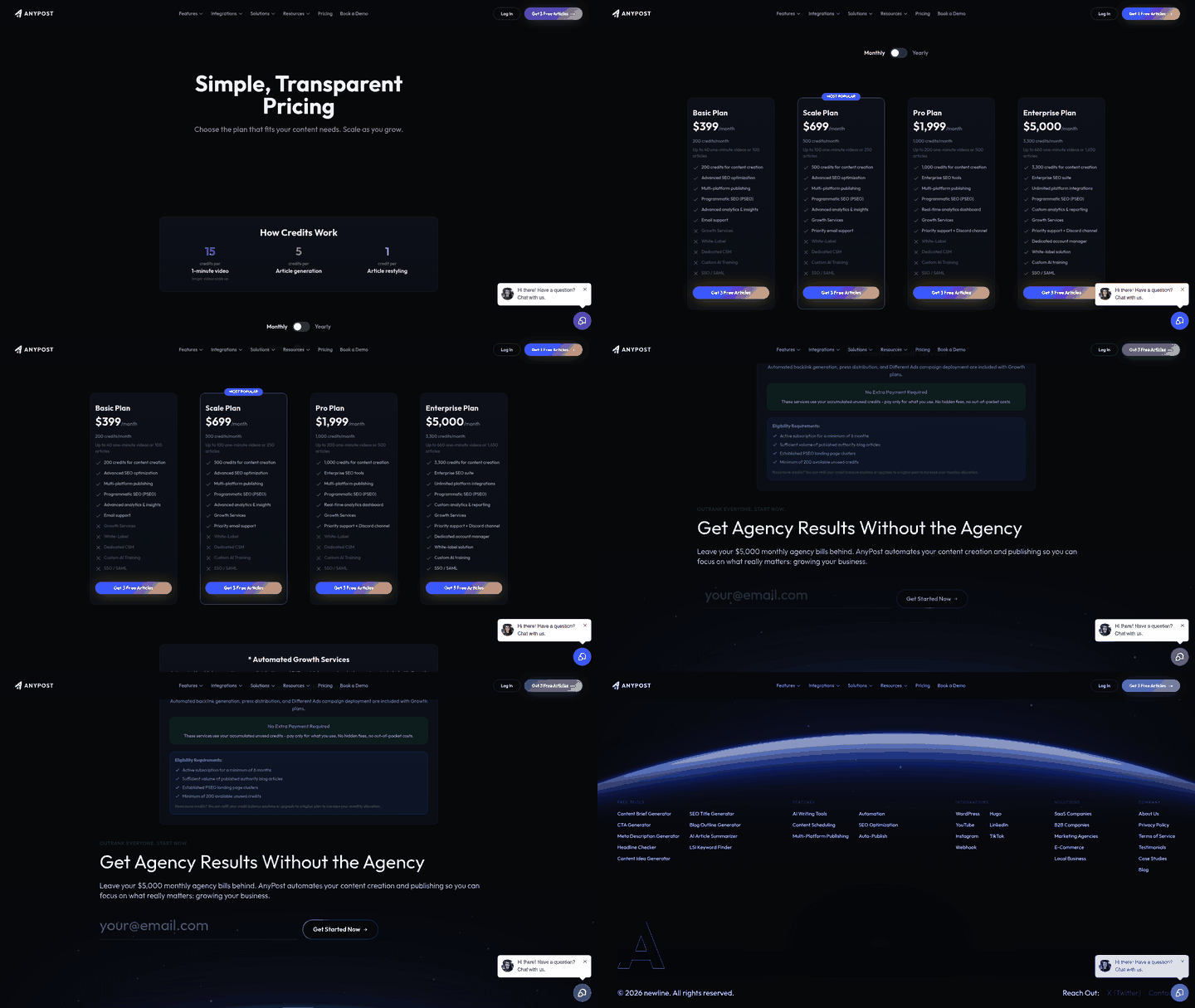
In-house teams protect voice at a high fixed cost. Freelancers add volume through variable rates and hidden overhead. AnyPost.ai uses competitive flat rates, while its Persona Engine is trained on your voice.
| Model | Cost | Volume ceiling | Brand-voice risk |
|---|---|---|---|
| AnyPost.ai | Highly competitive flat rates | High | Low. Trained on your voice |
| In-house senior writer | Fixed salary | Low (headcount-bound) | Very low |
| Freelance writers | Variable per-project | Medium–high | High. External creators lack context |
| Full-time in-house SEO role | High fixed overhead | Low | Very low |
The hidden costs add up. In-house hiring includes recruitment fees and onboarding time. New writers may need time before producing effective work. Freelancers add contracts, vetting, and management work. Teams that depend on them may also face technical debt and diluted strategy, which can increase long-term costs.
Where the break-even point lands
As volume increases, headcount economics become less favorable. A lean in-house team may cost less at low volume. Traditional SEO agencies can charge up to $5,000 per month for comparable work. AnyPost brings the workflow into one dashboard at a predictable monthly cost. This can improve per-article economics as publishing volume grows.
Sticker prices also hide editorial review costs. In-house teams spend time protecting voice. That time carries an opportunity cost. Every hour spent correcting tone reduces time available for strategy. AnyPost maps your existing digital footprint and captures your brand’s DNA. This helps articles reflect your voice and can reduce review time.
The tension is well documented. Traditional setups often force a choice between detailed quality control and rapid output. Neither model easily delivers both speed and alignment.
Which model saves the most at scale
For high-volume brands that want to preserve their voice, a layered approach can work well. In-house strategists provide ownership, while AI supports volume. This combination increases production without removing editorial oversight.
Volume and headcount do not have to remain linked. An in-house strategist can own voice and direction while AI supports the work the team cannot cover. AnyPost generates ready-to-rank, SEO-optimized content in your voice. It also publishes content directly to your CMS and social channels.
Manual production remains viable for brands with modest schedules. The equation changes when publishing targets exceed team capacity. For deeper cost breakdowns, see our guide on SEO agency vs in-house costs.
Quality and consistency: what it does to your SEO
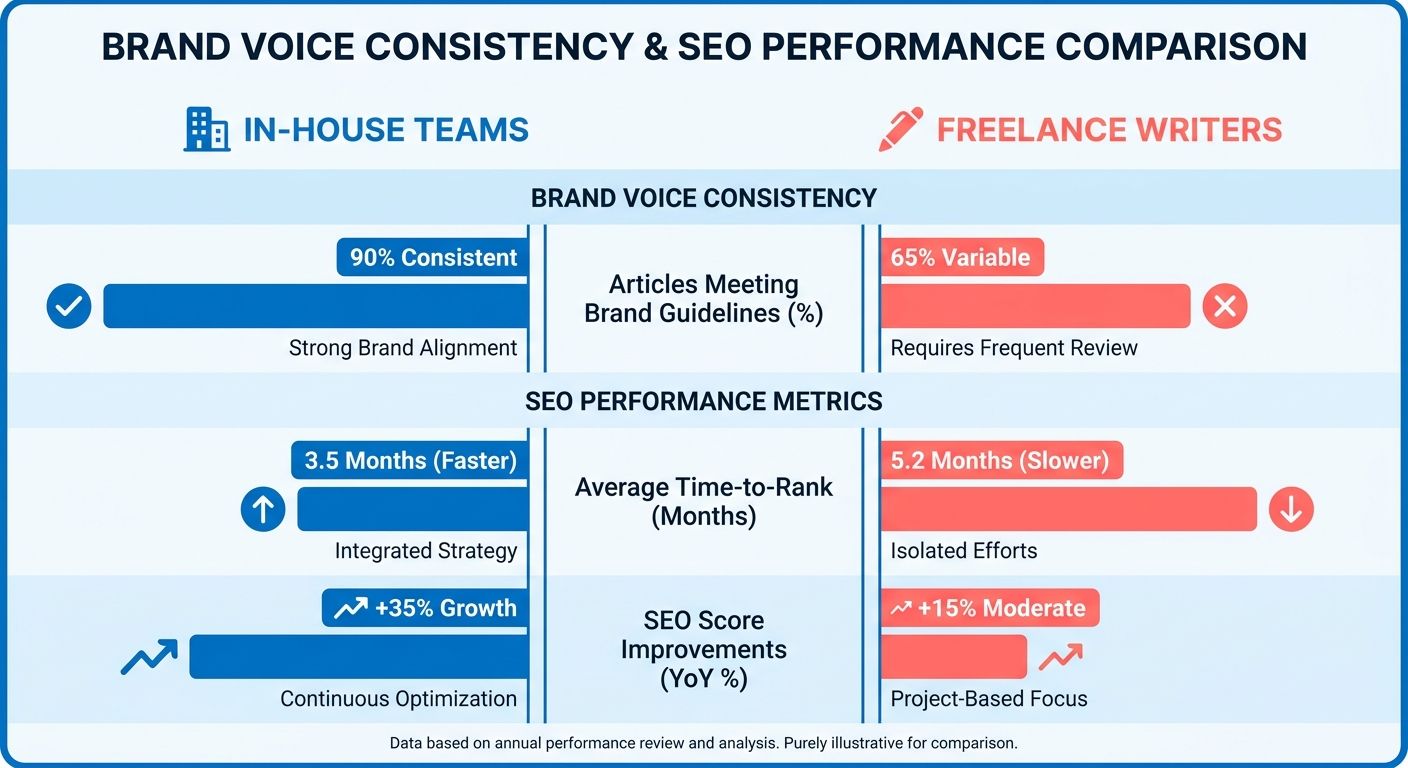
Quality and consistency affect whether content ranks or fills a calendar. In-house teams generally maintain the strongest brand voice. Freelancers offer speed and niche expertise. Without a system for maintaining voice, outsourced volume can scatter quality and weaken SEO results.
External contributors may need substantial revisions when they lack company context. This gap appears in editing time and error rates. Both can reduce publishing throughput.
How each model scores on quality and SEO signals
In-house teams provide consistent voice and low error rates. Freelancers offer niche expertise with greater variation. An AI-plus-human process can support both volume and accuracy.
Here is how the three models compare on key ranking metrics:
| Metric | In-House | Freelancers | AnyPost.ai |
|---|---|---|---|
| Brand-voice consistency | Highest (92% rate as "most consistent") | Variable | 94% tone similarity score |
| Factual errors per 1,000 words | 0.8 | 1.6 | 0.5 (after AI-human review) |
| Re-work rate | Low | 18% | Low |
| Volume ceiling | Capped by headcount | High | High |
Freelancers can produce strong niche content, but style variation contributes to an 18% re-work rate. That rework creates a hidden cost. Each rebuilt draft delays progress toward the target keyword.
Why consistency gets harder as volume climbs
Voice consistency is manageable at ten posts per month. It becomes difficult at a hundred. Large content volumes require structured quality control. Without it, tone can drift across authors.
The solution is not always choosing one model. Separate the writing process from the voice-definition process. Training the system on existing content can support tone alignment as output increases. A structured review loop also helps keep factual errors low.
One e-commerce brand moved its product blog posts to the platform and saw a 23% lift in organic CTR. Better consistency and accuracy can support rankings and clicks over time.
What quality control actually holds voice steady
Three mechanisms support consistent quality: a documented style guide, a shared editorial calendar, and AI-assisted QA. The style guide defines standards. The calendar maintains cadence. The QA layer flags tone and factual drift before publishing.
For low-volume publishing, manual review may be enough. Once output exceeds one person’s review capacity, a layered quality-control process becomes necessary. For a deeper look at building that team, see our guide on how to hire a SaaS content writer for rapid growth.
Scaling for peaks and seasonal demand
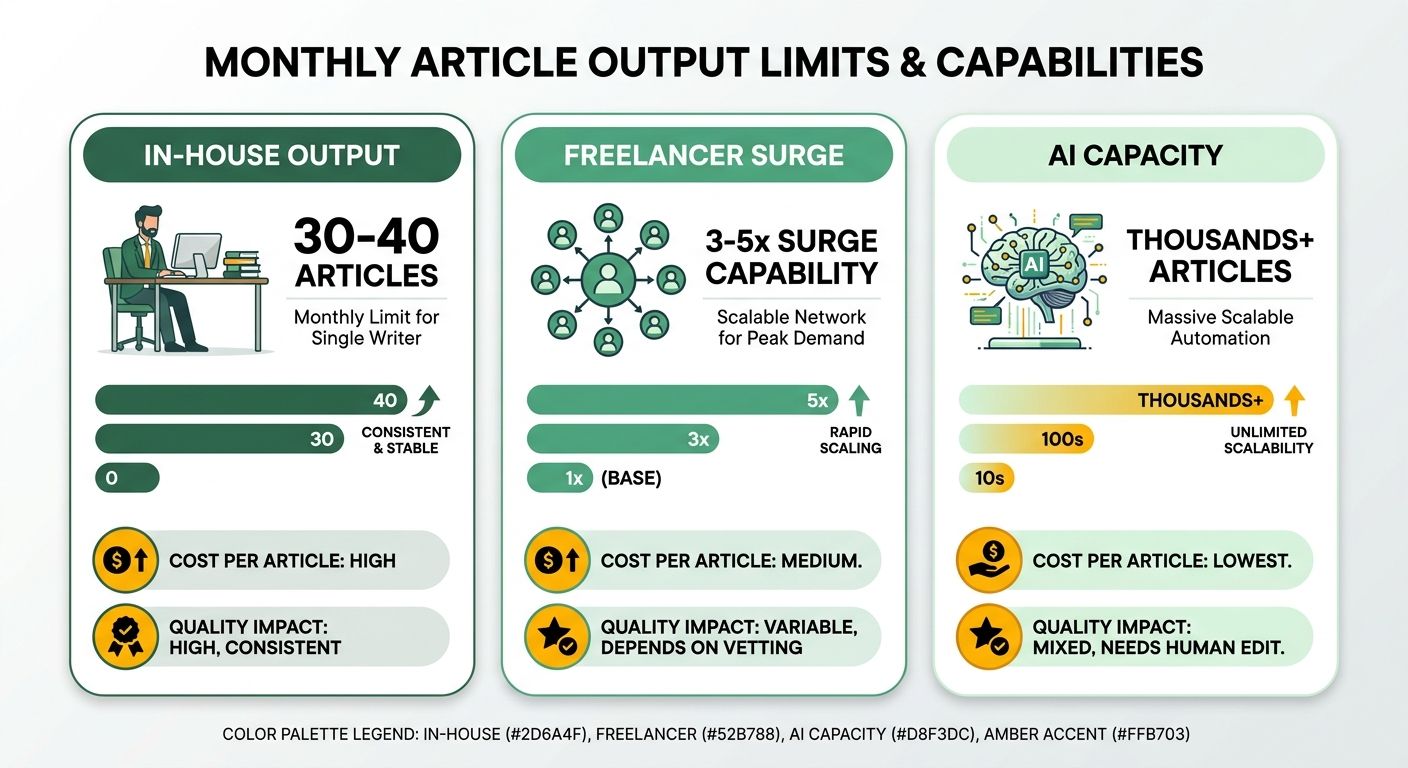
Scaling content exposes the volume-versus-voice tradeoff. A product launch or seasonal campaign can quickly make an in-house team the bottleneck. A single strong SEO writer produces around 30-40 articles a month before quality declines. Hiring cannot solve every two-week deadline.
Teams often outsource surge capacity to freelancers. A freelance pool can increase output 3-5x on short notice. However, each new contractor requires 1-2 weeks of onboarding before producing usable drafts. Contractors also begin without your brand ethos fully understood. Without strong knowledge of your internal culture, they may struggle to maintain a distinct voice. You gain volume but risk voice drift.
How fast each model can actually publish
Time-to-publish reveals each model’s limits. In-house teams take 7-10 days per piece. Freelancers take 4-6 days once they are ramped. An automated pipeline like AnyPost generates ready-to-rank, SEO-optimized articles. It also distributes them to digital channels, reducing manual work.
Speed can affect consistency. The system keeps brand-voice rules within the pipeline. This allows volume to increase without the variation that can occur across new contractors.
| Model | Max Volume/Month | Ramp Time | Time-to-Publish | Voice Consistency |
|---|---|---|---|---|
| In-house writer | Standard capacity | Standard onboarding | 7-10 days | Highest |
| Freelance pool | High surge capacity | Variable onboarding | 4-6 days | Drifts at volume |
| AnyPost.ai | Automated at scale | Setup only | Auto-published | Held in pipeline |
What about multi-channel repurposing
Repurposing exposes headcount limits quickly. One blog post can become content for multiple audience channels. When an in-house team handles this manually, each channel increases the workload. AnyPost generates SEO-optimized content and distributes it across multiple platforms from one setup. One source asset can support every channel without three additional hires.
A growing fintech platform may need to double blog output during a major regulatory update. With a purely in-house model, the team may face burnout or lower quality. Because the system carries voice rules into each generated piece, volume can increase while brand consistency remains across platforms.
Which model wins on flexibility
No single model works best in every scenario. In-house teams provide strong brand alignment but struggle with sudden volume increases. External help offers speed but can reduce consistency.
A layered setup combines the strengths of each model. In-house strategists own voice and direction. Freelancers handle niche surge work. AI supports the remaining volume. Each layer addresses a limitation of the others.
A complex setup is unnecessary for minimal publishing needs. Once content must cover multiple channels, headcount may not stretch far enough. Automated, SEO-optimized content can publish in your voice across each platform.
Layering freelancers, in‑house writers, and AnyPost.ai
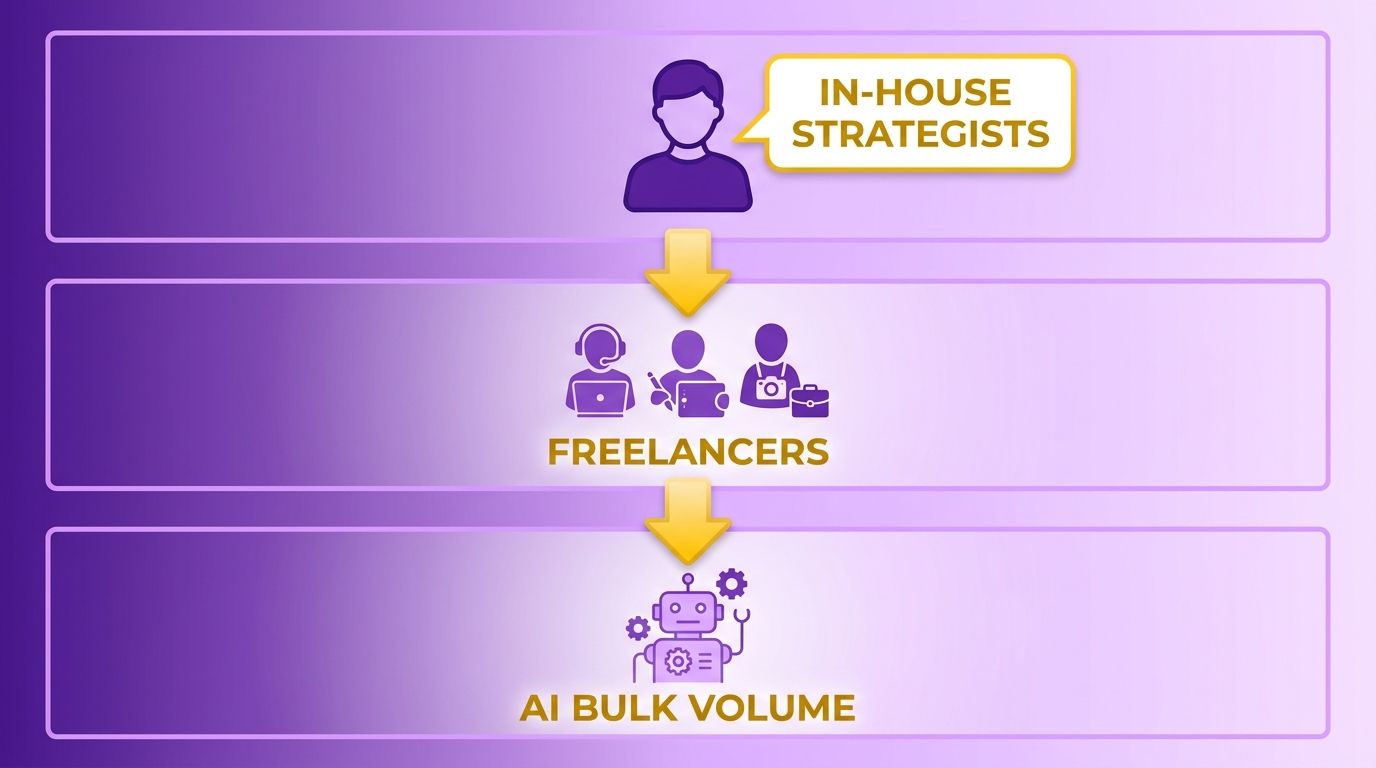
The best staffing model may combine in-house, freelance, and AI support. In-house strategists own your brand voice. Freelancers handle niche surges. AI manages bulk volume that might otherwise require more outside writers.
This layered approach addresses the limits of each model. Separating draft creation from strategic oversight lets you increase volume without handing editorial control to external contributors.
How a three-layer hybrid model actually works
The structure is simple: in-house staff own strategy and voice, freelancers provide niche depth, and AI produces bulk drafts for review. Each layer addresses a gap in the others.
AnyPost crawls your entire site to build a knowledge base of your products, messaging, and audience. This captures context that external writers may miss. The system matches your tone, so bulk drafts arrive aligned with your brand.
The workflow begins with a brief from an in-house strategist. AnyPost then creates a draft in your voice. A freelancer refines it for niche accuracy. Finally, an in-house editor completes the quality review. This process increases volume without making senior writers the bottleneck.
Where each layer fits in the workflow
| Component | Role in the stack | Handoff trigger |
|---|---|---|
| In-house strategist | Sets the brief, owns final edit | Kicks off every piece; signs off before publish |
| AnyPost.ai | Produces the bulk draft in-voice | Runs immediately after the brief lands |
| Freelancer | Adds niche depth and fact accuracy | Pulled in when a topic needs specialist knowledge |
Clear sequencing keeps the workflow moving. Each handoff has an assigned owner. Voice and ownership remain with the in-house team. AI and freelancers support that process rather than replace it. When a piece does not need niche expertise, it can move directly from draft to final edit.
The real risks to plan for
The main risks involve legal compliance and quality. Redundancy and audit trails also matter. So does the classification of each contributor.
Freelancer contracts need IP assignment and confidentiality clauses. In-house employees also create payroll taxes, benefits, and workers’ comp costs beyond salary. Misclassifying a contractor as staff can become expensive quickly. Keep those classifications clear.
Build quality gates into the workflow. The final in-house edit serves as the last checkpoint before publication. Real-time analytics pull directly from Google Search Console, showing what changed rather than providing a templated agency report.
A complex workflow is unnecessary for teams with low publishing volume. The hybrid model becomes useful when volume exceeds headcount. Before adopting the full stack, map where each piece moves between contributors.

Frequently Asked Questions
1. At what publishing volume should I stop relying on a single in-house writer?
When monthly targets exceed what one full-time employee can produce, quality and consistency may decline. Multiple posts per week can create a bottleneck. That pressure may lead to burnout or delayed schedules.
2. Can I use freelancers alone if I can't afford a full-time SEO hire?
Freelancers provide flexibility, but management adds administrative work. Onboarding, revisions, and off-tone drafts can increase the actual cost per article. A freelance-only model may therefore cost more time and money than expected.
3. How long before a new in-house writer produces effective work?
Full-time hires need time to learn your product, audience, and brand guidelines. This investment can build long-term strategic alignment. However, peak productivity will not arrive immediately, making hiring slower for urgent scaling needs.
4. Does adding AI content mean sacrificing brand voice?
Not when the platform captures your specific brand identity. By analyzing published content and site-wide messaging, modern AI tools can create drafts that match your established tone. This supports higher production without the inconsistency of multiple external writers.
5. What's the difference in factual accuracy between the models?
In-house writers generally maintain high accuracy through product knowledge. Freelancers may need more fact-checking. Combining automated generation with human editing creates a review layer for minor errors and technical accuracy.
6. What legal risks should I plan for when combining freelancers and staff?
Clear contracts are essential when combining internal and external talent. Freelance agreements should cover intellectual property rights and nondisclosure terms. You must also comply with labor laws on contractor classification.
7. How does a hybrid model handle content for multiple channels?
A hybrid workflow increases the value of one article by adapting it for different platforms. Automated tools can format and distribute the core message across active channels. This reduces manual rewriting while preserving your brand voice.