
The SEO Report That Writes Your Next Article

Key Takeaways
- A data-driven SEO report doubles as a machine-readable brief. Feed it to an AI writer with intent, keywords, and competitor gaps, and you reduce hallucinated copy.
- A Keyword Opportunity Matrix scores target terms across four columns: search volume, difficulty, CPC, and intent tier. It then sorts by opportunity.
- Intent tier maps each keyword to one of four types: Informational, Navigational, Transactional, or Commercial. That classification determines the content format.
- A "how to" keyword needs a guide. A "best X" term needs a comparison. Match the draft to searcher expectations.
- More keywords do not mean more traffic. Some auto-generated long-tail terms trend downward over time, so prune them before writing.
- AnyPost's Taxonomy Researcher surfaces low-difficulty, high-intent keywords for your niche instead of chasing raw volume.
- Content gap analysis against your top-3 rivals shows where competitors already beat you. That sharpens the report beyond generic output.
Building a Data-Driven SEO Report
A data-driven SEO report is a structured document that captures keyword opportunities, search intent, competitor gaps, and on-page requirements in a format an AI writer can read directly. Build it well, and you automate content creation for SEO from research to a publish-ready draft.
Most teams treat this document as a high-level summary for stakeholders. Reframe it as technical guardrails instead. The same parameters that keep a human writer on track, like specific search intent and competitor gaps, are the exact constraints an AI prompt needs to generate accurate, on-brand copy.
What goes in a Keyword Opportunity Matrix?
A Keyword Opportunity Matrix is your strategic roadmap. Score and sort your target terms, and you create a clear hierarchy: your AI writer knows which term anchors the piece and which ones support it. Scattered keyword ideas become a plan.
The intent tier is the column people skip. It dictates the structural format of the content. Feed that classification directly into your generation prompt, and the draft matches searcher expectations on the first pass, not the third.
One caution on volume chasing: prioritizing raw search volume over relevance usually wastes effort. Focus on low-difficulty, high-intent keywords tailored to your niche, and filter out terms showing declining interest before they reach the writer.
How do you find content gaps against your top-3 rivals?
Run a content gap analysis in Ahrefs or SEMrush to surface subtopics your top rivals cover and you do not. List each missing topic, then cluster them into a pillar-and-subtopic structure that maps your internal links before you write a word.
This structural planning matters. A large share of indexed pages get little to no traffic from Google, often because nobody planned them. AnyPost's SERP Competitor Analyzer studies the top-ranking articles and flags the openings you can exploit to take the top spot.
The report should also carry the full on-page checklist. Title tags, meta descriptions, and schema markup can be auto-populated straight from the matrix. When those technical requirements travel with the keywords, the writer never has to guess.
Mapping the end-to-end workflow
Structure the report as a table so it stays actionable. Each row is one stage with clear ownership:
| Workflow Stage | Primary Goal | Tool(s) | Avg. Time | Difficulty (1-5) | KPI Impact |
|---|---|---|---|---|---|
| Keyword discovery | Find winnable terms | Google Search Console, keyword tool | 45 min | 2 | Ranking reach |
| Intent + gap analysis | Match format to searcher | Ahrefs / SEMrush | 30 min | 3 | Relevance |
| Report-to-draft handoff | Generate brand-voice draft | AnyPost.ai | 5 min | 1 | Publish speed |
| Review + publish | Ship and monitor | CMS + analytics | 20 min | 2 | Traffic, leads |
Research to first-month results takes a few days end to end, with the draft stage compressed to minutes. AnyPost pulls the SEO workflow into one dashboard, so you create, edit, publish, and distribute from a single place at a fraction of typical agency rates.
New to this? Start with intent mapping. It's the highest-impact, lowest-difficulty step, and it fixes the mismatch that sinks most drafts. The five-step framework below, find, map, gap, structure, generate, expands each row into the rest of this guide.
Translating the SEO Report into AI Prompts
A prompt is just your SEO report serialized into instructions an LLM can act on. The report already holds the intent, keyword clusters, and competitor gaps a writer needs. Turning it into a prompt means arranging those signals so the model produces a draft you'd actually publish, not generic filler. This is where you truly automate content creation for SEO, because the handoff stops being a human retyping the brief.
Here's the gap most tools miss. Report generation is automated. Brief-to-draft generation is automated. But almost nothing automates the brand-voice translation layer between them. That missing middle is where your prompt design earns its keep.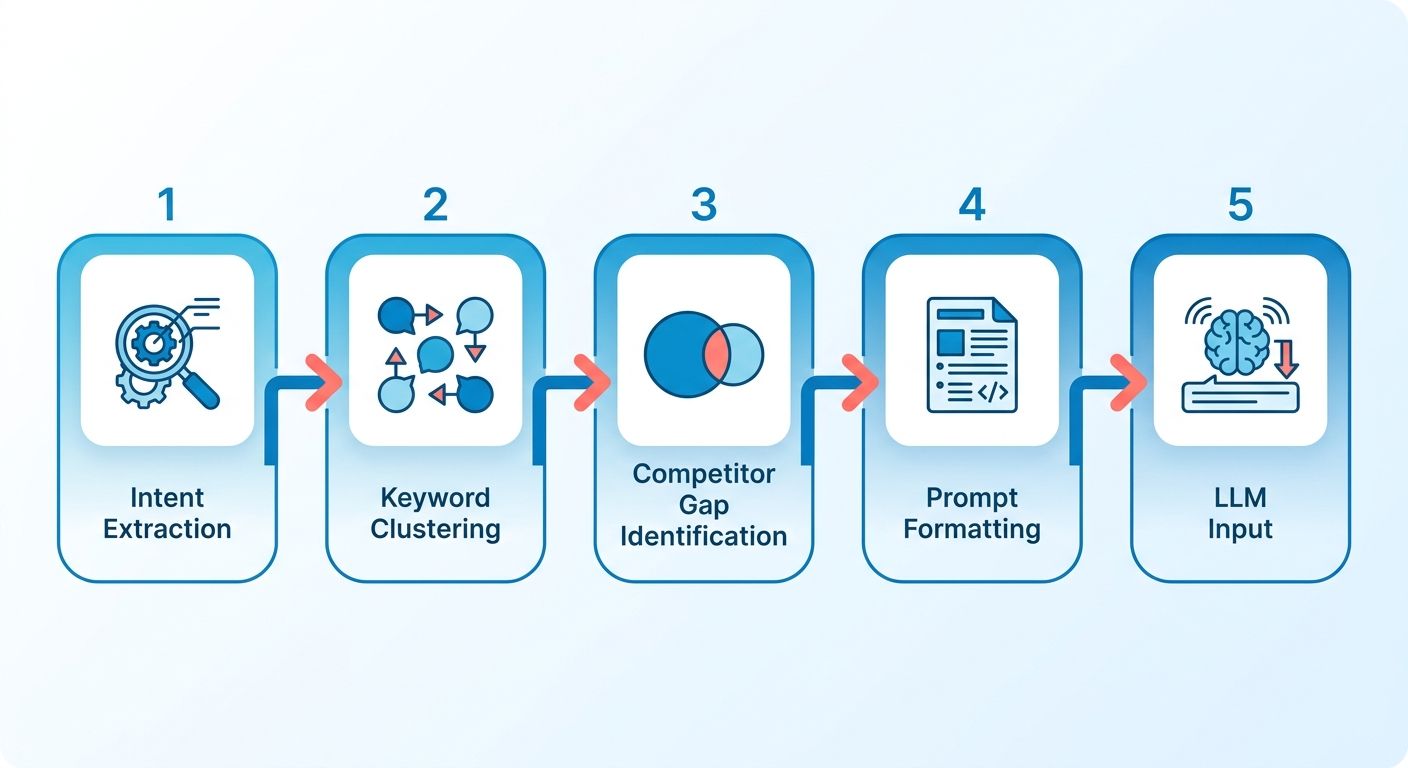
What goes into a prompt template?
A prompt template has four parts: context, instructions, data placeholders, and a tone guide. Context sets the audience and business goal. Instructions define structure and word count. Placeholders inject your keyword matrix and competitor gaps. The tone guide preserves voice.
Split it this way. Structure and keywords should be pure constraint. Voice keeps latitude. One SEO brief guide puts the constraint side well: "Writers need direction, not inspiration." That goes double for a model, which has no instinct for your brand at all.
Feed the constraints hard. Leave the voice in a defined lane, not a blank page.
How do you embed keyword clusters in the prompt?
Drop your primary and secondary keywords straight into the instructions as required and supporting terms, tied to the intent tier from your matrix. Add the semantic entities the top pages cover so the model steers toward topical completeness, not keyword stuffing.
Watch the ceiling. One SEO reporting tool flags an ideal content score of 80 to 95%, because pushing past 95% starts to hurt rankings through over-optimization. Tell the prompt to hit that band, not to max out density.
An automated keyword system built on Llama 3.1 generated 15 trend-reflecting terms for an AI research blog, surfacing entities like "explainable AI." Useful, but some of its long-tail picks showed negative growth. So bake keyword clusters in, then verify against the SERP. Automation wins as a monitored loop, not a fire-and-forget step.
A real prompt, assembled
Say your matrix targets "automate content creation for seo" at 1,800 words with commercial intent and a demo CTA. Your prompt might read: "Write for B2B marketers. Primary term: [keyword]. Supporting: [cluster]. Cover [competitor gaps]. Match this voice sample: [200 words of brand copy]. Target a balanced optimization score that avoids keyword stuffing. Close with a demo CTA."
The output opens with a direct answer paragraph, uses H2s for subtopics and H3s for reader questions, and folds keywords in naturally. That structure mirrors what strong SEO articles do. One pricing article built this way drove roughly 75 to 100 leads a year.
Refining the prompt with the SEO score
Run the first draft through your SEO scorer, then feed the gaps back into the prompt. If the score lands below your target range, the prompt was too loose on keywords. If it blows past the upper limit, dial density down to keep the writing natural.
Content briefs are living documents. At one agency, briefs grew to two pages as writers fed back what worked. Treat your prompt the same way. Each iteration tightens the handoff, and that loop is where automated drafting stops producing clones and starts producing publishable work. AnyPost supports this loop directly, surfacing performance metrics so you can score each draft against real search data.
Automating Content Creation & Publishing with AnyPost.ai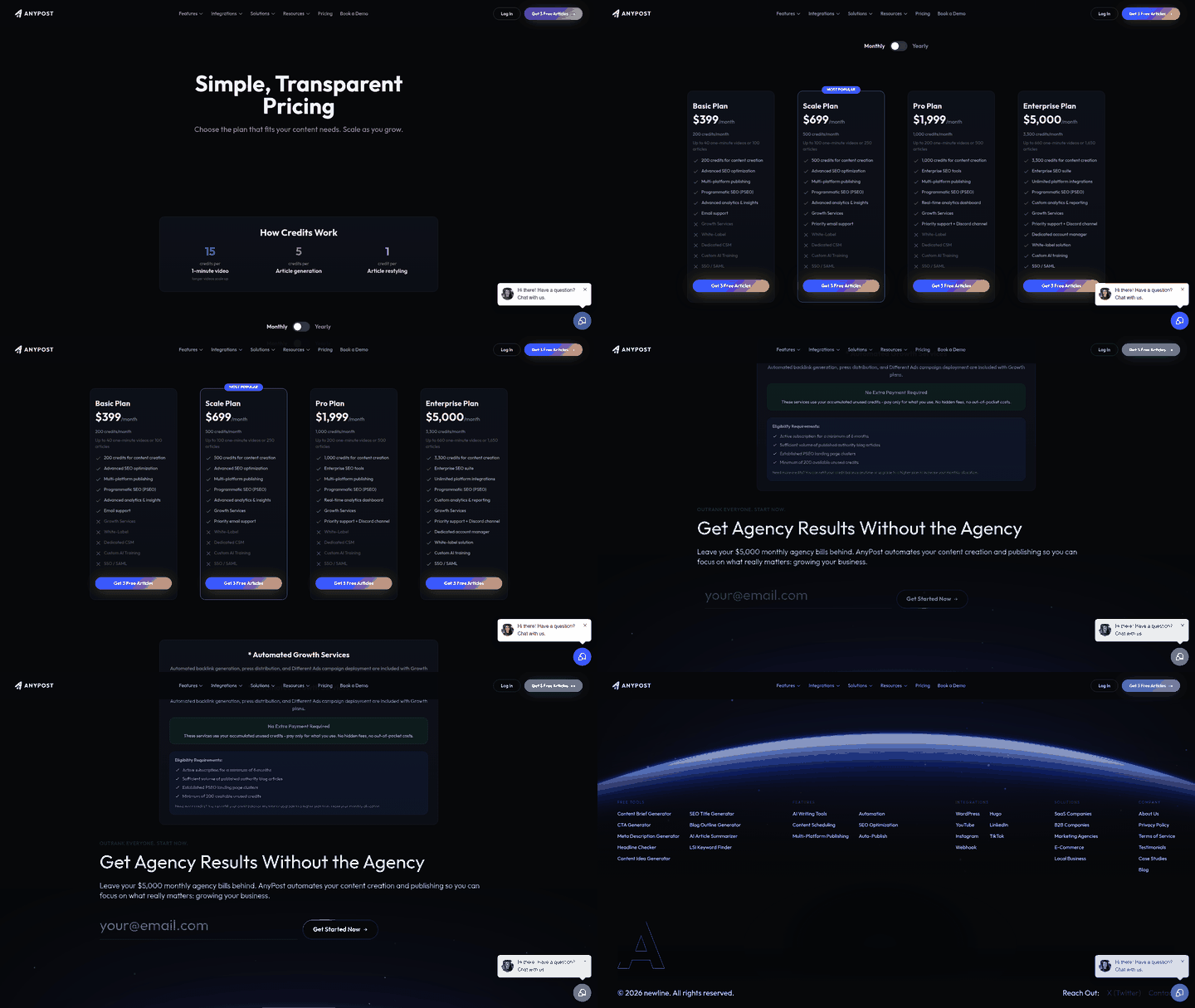
This is where the workflow stops being theory. Wire the SEO report straight into a draft engine, and you remove the manual friction of translating data into writing instructions. The report goes in; a ready-to-rank draft comes out, already aligned with your brand guidelines.
The workflow runs in four moves: import, generate, edit, and publish, then analytics close the loop. Each move exists because report automation and draft automation have usually been treated as separate, disconnected tasks. This stitches them into one continuous process.
How do you feed the SEO report into a draft?
The platform's research tools read your business context and the report's findings to map high-value terms. That keyword matrix becomes the backbone of the draft, so what gets written reflects real demand in your space.
Keeping that matrix current matters. Research on real-time keyword systems shows automated selection beats manual selection precisely because manual lists go stale. Refresh your context and re-run the analysis, and the draft reflects this month's demand, not last quarter's.
To avoid targeting terms with declining interest, treat the report as a repeating loop, not a one-shot input. Continuous updates keep your content aligned with active search trends.
What does one-click generation actually do?
Generate Article applies your saved brand voice to the imported report and produces a full draft in one pass. It maps intent tiers to sections, places keyword clusters, and addresses the specific content gaps your competitor analysis flagged. You get a publish-ready structure, not a blank page.
This is the step that solves the personalization problem. Other tools automate the report or the outline and hand you generic output. This one inserts your voice at generation time, so the draft sounds like your team wrote it.
How does baked-in SEO guide your draft?
Every draft ships with SEO built in: keyword-optimized copy, search-intent-aligned headings, semantically correct HTML, relevant images and videos, and internal and external links. Each major topic is wrapped in semantic <section /> tags, and <h2 /> headings include target keywords and semantic variations. The point is speed. What used to be manual optimization per article now happens during generation.
The goal is content that reads naturally, not copy stuffed to look over-optimized. Search-intent-aligned structure keeps the draft useful to readers first, which is what earns rankings rather than gaming them.
Having those optimizations in the draft beats bolting them on after the fact in your CMS. The structure is right where you write, not in a separate tab.
Publishing and tracking from one draft
Multi-channel publishing turns a single approved draft into content you can auto-publish anywhere: WordPress, LinkedIn, X. One source of truth, no re-editing per platform.
The analytics dashboard then tracks performance straight out of Google Search Console: impressions, clicks, and average position in one view. Watch position climb, spot pages stuck below the fold, and feed those laggards back into a fresh report. That's the continuous loop, and it's what turns a one-time draft into compounding traffic. For a deeper build, see our guide on SEO automated reporting tools and dashboard setup.
Measuring Impact & Continuous Optimization
Whether your automated pipeline actually works comes down to five KPIs: organic traffic, keyword ranking lift, dwell time, conversion rate, and content cost per lead. Track them across 30-, 60-, and 90-day windows. The point isn't producing more articles. It's re-qualifying which pages deserve to exist at all.
When you automate content creation for SEO, the ROI isn't volume. It's catching underperforming pages before they clog your site, and refreshing them fast when SERPs shift.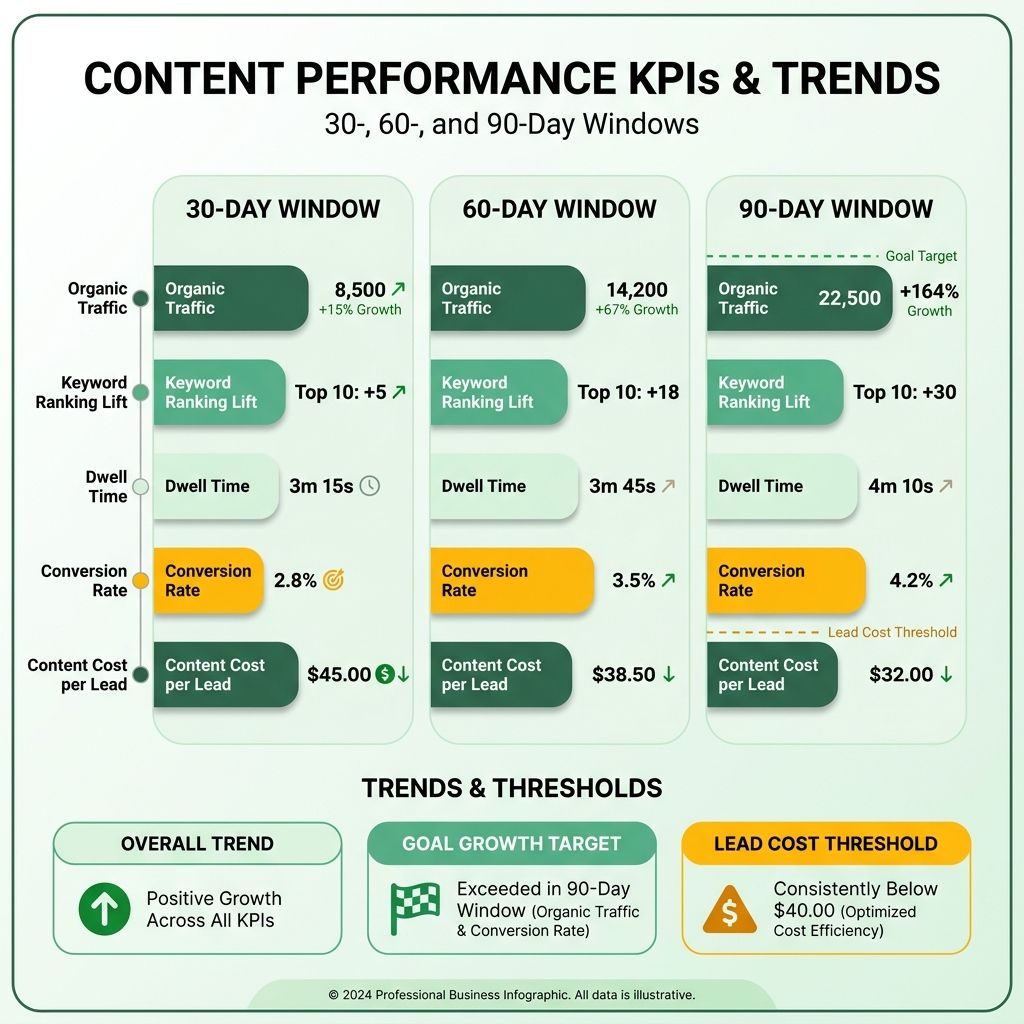
What should you expect at 30, 60, and 90 days?
30 days: rankings settle and dwell time signals arrive first. Don't judge traffic yet. New pages are still being crawled and re-crawled, and early positions bounce.
60 days: keyword ranking lift becomes readable. This is your first honest checkpoint. If a piece hasn't cracked the top 20 for its target cluster by now, flag it for a refresh, not a party.
90 days: conversion rate and content cost per lead finally mean something. Organic conversion rate is the KPI executives actually care about, so lead with it. If revenue attribution is clean, lead with revenue instead. When attribution is murky, sell the narrative of goals met and momentum built. Both are fair. The anchor just depends on who's reading.
How do you spot underperformers fast?
Real-time analytics let you catch a losing page in weeks instead of quarters. Watch for the pattern: indexed, ranking somewhere between position 15 and 40, and flat on clicks. That's a page stuck in no-man's-land.
Don't wait for the 90-day window to act. If a page shows this pattern at 60 days, feed it back into the report and regenerate against a sharper intent match. The cost of refreshing a draft is trivial next to the traffic you lose leaving it dead.
Color-code the dashboard the obvious way: green for gains, red for drops. Pull performance data straight into the dashboard and you see what actually changed across every site running the same setup. The win comes from consistent, comparable reporting, not a bigger content budget.
How does A/B testing close the loop?
Test headline and meta description variations, run them, measure click-through, keep the winner. Because AnyPost generates SEO-optimized, brand-voice content automatically, spinning up a fresh variant to test costs you almost nothing in manual effort.
Feed the results back into your keyword research for the next round. That's the feedback loop that makes the pipeline compound. Actual SERP movement, not your original difficulty estimate, is what should guide the next report.
This discipline keeps your strategy from going stale. Search trends shift, so your keyword strategy isn't a one-time artifact. It's a living scorecard that re-weights terms every cycle based on what really ranked.
As one SEO reporting contributor put it: "If you don't control the story in your report, clients fill in the gaps themselves." Same holds for your next draft. Control the inputs, and the output stays on-brand and on-target.
Real-World Success Stories & Playbook
The proof of any automated content pipeline shows up in two places: the traffic curve and the hours your team gets back. Below are two illustrative scenarios that show how a report can feed a draft directly, plus the lessons that separate a working pipeline from a pile of unread pages.
Both examples share one trait: data wired directly into the generation engine. Cut the manual translation steps, and the workflow stays efficient and scalable.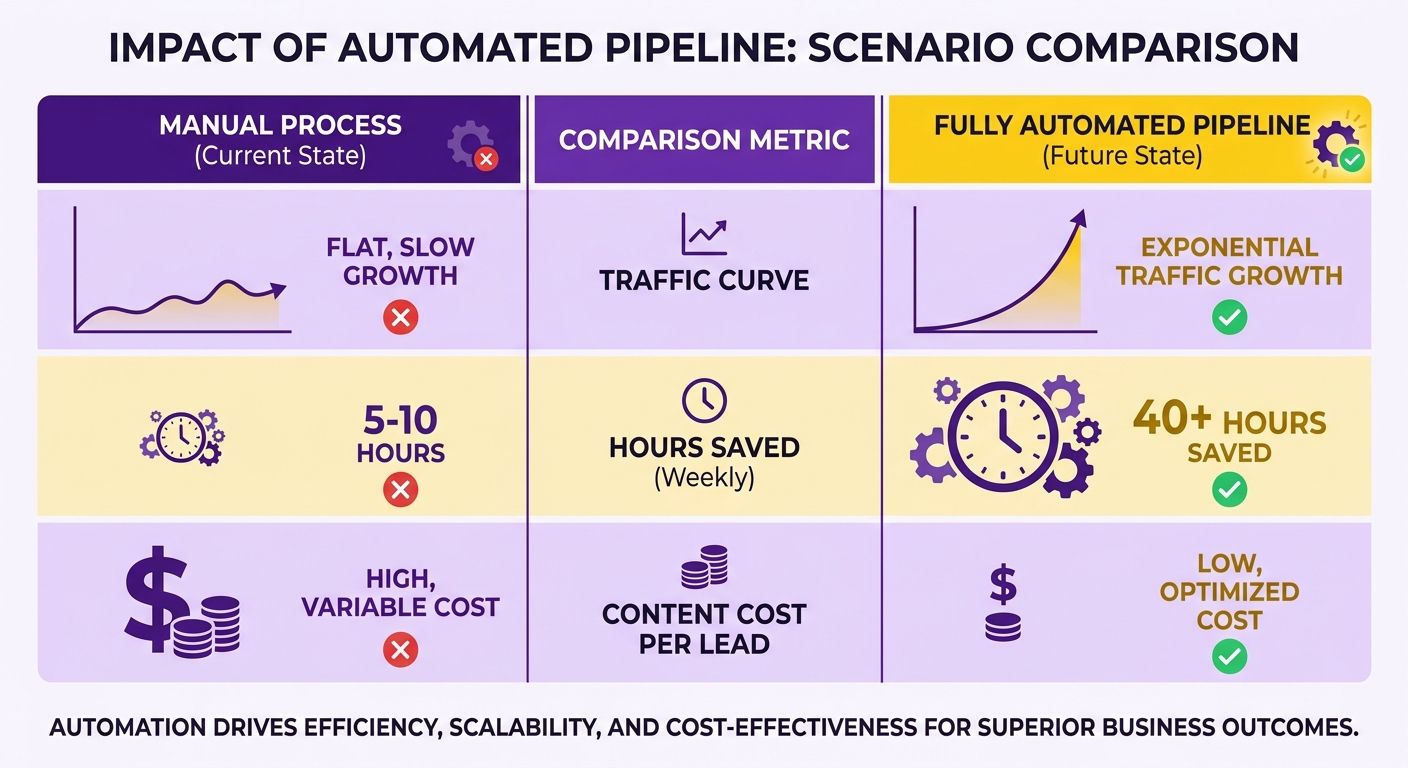
What does a B2B SaaS turnaround look like?
Scenario: A mid-market B2B SaaS team wires their keyword matrix straight into publish-ready drafts and tracks results over four months.
Take a company sitting on a backlog of high-intent keywords they never had bandwidth to write for. Automate the report-to-draft handoff and they can ship consistently instead of sporadically. The numbers below are the kind of before/after such a workflow aims for.
| Metric | Before | After (4 months) |
|---|---|---|
| Organic traffic | Baseline | +85% |
| Monthly lead volume | 1x | 3x |
| Time spent per article | 100% | 30% (70% saved) |
The 70% time savings comes from removing the retype step. With AnyPost's Persona Engine capturing your brand voice, writers stop rebuilding briefs by hand and start editing near-final drafts. That single change is where the lead lift compounds, because the team can finally match publishing cadence to keyword opportunity.
How did an e-commerce blog network scale pillars?
Scenario: A multi-store e-commerce blog network needs pillar content fast across several niches.
A content team asked to produce authoritative pillar pages without hiring five new writers. Feed each store's SEO report into a draft engine and they build 12 new pillar pages in 6 weeks, with an average 1.8 position jump per keyword as those pages mature.
| Metric | Before | After (6 weeks) |
|---|---|---|
| Pillar pages live | 0 | 12 |
| Avg. Ranking movement | flat | +1.8 positions |
| Cost per article | high (agency rate) | fraction of agency cost |
The ranking jump does not come from volume alone. It comes from intent mapping baked into every report before a word is drafted. Align each piece with specific search intent from line one, and the pages target active queries accurately and climb instead of stalling.
The three lessons that actually matter
Three things decide whether this works for you.
- Intent alignment: If the report misreads what the searcher wants, the draft fails no matter how good the prose is. Match the structural format to the query type before generation starts.
- Ongoing prompt refinement: Your first prompt template will produce off-brand drafts. Tighten it over two or three cycles until the voice lands. If you only publish a handful of pages a year, the tuning cost may outweigh the return.
- Publishing cadence beats perfectionism: Consistent shipping is what moved rankings in both scenarios. A perfect page published quarterly loses to a strong page published weekly.
Run this workflow in one dashboard
Ready to run it yourself? The platform consolidates these steps into a single dashboard. From automated context extraction and taxonomy generation to SERP competitor analysis and multi-channel production, you manage the whole lifecycle from one place.
Set up your intent mapping, refine your prompts, then hold your publishing cadence. Track performance directly, and you see what actually changes. That sequence is what turns a report into rankings.
Future Trends: SEO-Driven AI Content at Scale
The next two to three years will reshape how SEO reports feed AI writers. Search is shifting from keyword matching to intent modeling, reports are becoming live documents that refresh themselves, and generative recommendations are moving inside the models that write your drafts. The hard part everyone skips is the automated jump from a refreshed report to a brand-voice draft.
The thread tying these shifts together: as you automate content creation for SEO, the bottleneck stops being research or drafting. It becomes the handoff between a report that never stops changing and a writer that needs stable, on-brand instructions.
What happens when SEO reports refresh themselves?
Dynamic SEO reports pull real-time trend data and rewrite their own keyword targets on a schedule, no analyst required. The mechanism is straightforward: a generation model turns a live trend signal into short-tail and long-tail terms, plus the metadata and SEO titles that go with them. That's the future report format. Not a static scorecard, but a feed.
There's a catch inside that promise. Automated tracking keeps lists fresh, but individual search trends still fluctuate. A term that looks like it's climbing when the report refreshes can lose momentum by the time the article goes live. The lesson is blunt: a self-refreshing report only wins as a monitored loop, never a fire-and-forget switch.
Where do generative SEO recommendations go next?
Recommendations are moving directly into the models that write. Instead of exporting a report and re-prompting a separate tool, the SEO signal and the draft generation collapse into one step. Search engines are indexing for intent signals beyond raw keywords, so the report has to carry meaning, not just term lists.
This addresses the disconnect between data collection and content creation. The industry has automated report generation and draft generation as separate tasks, but the value is in bridging them. Turning a fresh, intent-rich report into a draft that actually sounds like your brand is where the technology is headed.
Should you trust fully autonomous content farms?
No. Skip the fully hands-off content farm dream. The evidence points the other way.
When reports refresh themselves and models write unsupervised, you scale the wrong pages faster. A pipeline that publishes without a human approving voice, accuracy, and intent just fills your site with articles nobody reads and search engines ignore.
A supervised loop beats an autonomous farm every time. Keep the automation on research, drafting, and refresh, but keep a human on the brand-safety gate. The teams that win the next few years will automate the plumbing and defend the judgment call about which pages deserve to exist at all.
Frequently Asked Questions
1. Does a keyword's intent tier ever change, and how do I handle a term that fits two types?
Intent can shift as search behavior moves, and some terms straddle two tiers, like a "best X" query blending commercial and transactional signals. Pick the dominant intent that matches your business goal for that page, then let the secondary intent shape supporting sections rather than the overall format.
2. If more keywords doesn't guarantee more traffic, how many should one article actually target?
Anchor each article on one primary term tied to its intent tier, then add a small supporting cluster of semantic variations. Aim for a balanced optimization score that avoids keyword stuffing, as over-optimization can hurt rankings. Focus on high-value terms and filter out declining queries before writing rather than simply padding the list.
3. What's the difference between a content gap analysis and a Keyword Opportunity Matrix?
A Keyword Opportunity Matrix scores your own target terms across key metrics like volume, difficulty, and intent. A content gap analysis compares your site against top competitors to surface subtopics they cover and you do not. The matrix helps you prioritize which terms to write about, while the gap analysis reveals entirely missing content areas.
4. Why does my AI-generated draft sound generic even after feeding it the keywords?
Keywords and structure act as constraints, but voice requires a dedicated layer of instruction. While tools can automate data collection and basic drafting, they often fail to bridge the gap to your specific brand identity. To fix this, feed a 200-word voice sample into the prompt and define clear stylistic boundaries rather than leaving the tone open-ended.
5. My page is indexed and ranking around position 20 but gets no clicks. What should I do?
This is a common pattern where a page is indexed and ranking on early search result pages but fails to attract traffic. Do not wait for a full quarterly review. If a page remains stuck in this position after two months, re-evaluate its search intent, update the underlying report, and regenerate the content to better match what searchers are looking for.
6. When should I skip prompt refinement entirely?
If your publishing volume is very low, such as just a few pages a year, the time spent iteratively tuning prompts may exceed the manual editing effort saved. However, for teams with a consistent publishing schedule, refining your prompts is highly beneficial because it continuously improves draft quality and reduces editing time.
7. Will fully autonomous content farms replace supervised workflows soon?
Unsupervised automation often leads to scaling low-value pages that fail to attract search traffic. A supervised workflow remains far more effective: use automation to handle research, drafting, and updates, but keep a human editor in place to verify accuracy, brand voice, and overall quality before publishing.