
Turn One Blog Post Into 20 Assets Without Diluting Your Message

The math on one post seeding 20 assets
Publishing a blog post and moving on can waste much of the work you put into it. A well-researched pillar post can seed multiple assets across channels, and AI content repurposing can make that math work in your favor instead of adding to the workload. You already put time into the research and the core message. Every format you build on top of that can be extra return on the same investment.
Look at the distance between two behaviors. Many marketers reuse content in some form. Fewer take a single idea and run it across multiple channels on purpose. Most teams recycle a little. Few practice true multi-channel content repurposing. That gap between “we reuse stuff” and “we run one idea across several platforms” may be where much of the traffic and lead opportunity sits.
A blog-only strategy reaches one slice of your audience
Your audience is fragmented across formats. Some read. Some watch. Some listen. A meaningful share of people consume audio through podcasts regularly. If your idea only exists as text, that entire group never encounters it.
Repurposing is how one message meets each of those habits without new research every week. As Iconic Digital frames it, every asset should push the reader along a path that attracts, captures, nurtures, and converts. The lesson is not “make more content.” It is “make one strong thing reach everyone who consumes differently.”
You don't run out of ideas, you run out of hours
Marketers rarely run dry on topics. They run out of time. Keyword research, drafting, editing, sourcing quotes, and building visuals can eat a large slice of the week for a single post. Then the calendar demands the next one. Automation can change that equation. When the tailoring work drops from hours to minutes, publishing 20 assets becomes more realistic instead of a fantasy.
Here is a starter map for turning one post into varied assets. Treat the times as rough examples, not guarantees:
| Asset | Format | Channel | Example Time to Produce | Difficulty |
|---|---|---|---|---|
| Micro-posts | Text | LinkedIn, X | 10 min | Low |
| Quote graphics | Image | Instagram, LinkedIn | 20 min | Low |
| Newsletter snippet | Owned list | 15 min | Low | |
| Short-form video | Video | Reels, TikTok, Shorts | 45 min | Medium |
| Downloadable checklist | Gated landing page | 30 min | Medium | |
| Podcast segment | Audio | Podcast feed | 60 min | High |
Weight that mix by return, not by count. Match each asset to reader intent instead of blasting the same CTA everywhere: the checklist can work as a top-of-funnel offer, a comparison guide as mid-funnel bait, and the newsletter snippet as a direct line to an audience you already own. Platforms with newsletter automation and multi-platform publishing options for channels like LinkedIn, X, Instagram, TikTok, and YouTube can help you cover those channels from one place.
Volume without a voice layer backfires
Chasing 20 assets carries a real risk. The more you tailor format per platform, the more your tone can drift. A punchy TikTok script and a formal whitepaper can end up sounding like two different companies. High-volume adaptation is generally safer with a brand-voice-consistency check sitting on top of it.
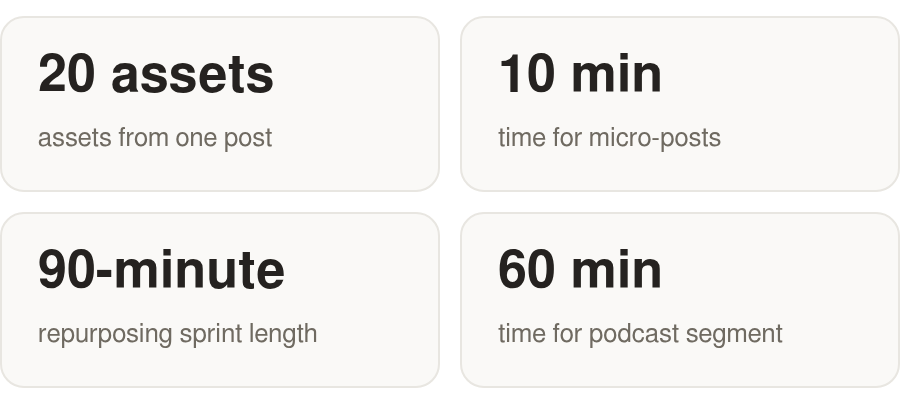
That is the role a persona engine can play. Some platforms can analyze your existing site to build a business context graph of your products, messaging, and audience, helping every asset stay closer to your usual voice. Scale the assets, concentrate them on the few channels your audience actually uses, and lock the voice so 20 pieces still read as one brand. Our 90-minute repurposing sprint walks through one possible flow: identify, map, create, automate, publish, measure.
Key Takeaways
- Treat the original post as the source of truth, not just another item in the calendar.
- Build a format mix intentionally: text, visuals, email, video, downloadable resources, and audio all serve different audience habits.
- Repurposing works best when the message travels across channels by design rather than being copied and pasted from place to place.
- The strongest asset set usually comes from matching each idea to the format that makes it easiest to understand.
- Consistency needs its own process; otherwise, platform-specific edits slowly change your brand's voice.
- A clear message anchor gives editors, designers, and AI tools the same standard to work from.
Find the core message and sort what's evergreen
Before you spin out a single asset, you need one sentence that every other piece has to obey. That sentence is your core message, and it is the difference between AI content repurposing that scales cleanly and a pile of posts that slowly forget what the original argued. Skip this step and each new format drifts a little further from the source, until asset number 15 contradicts asset number 2.
This is the planning stage that decides whether the whole system holds together. A strong source post usually contains several useful points, but not all of them deserve equal treatment. Some ideas should become durable assets. Others belong only in the original article because they depend on timing, context, or a narrow campaign.
Distill the post to one sentence first
Read your pillar post and force yourself to answer one question: if the reader remembers only one thing, what is it? Write that as a single declarative sentence. No qualifiers, no list of five points, just the one claim the whole piece defends.
That sentence becomes your control. Every carousel, email, and short video gets checked against it. If an asset doesn't advance that message, it gets cut or rewritten. This is the anchor that keeps tone steady even when you hand drafts to an AI tool to generate the next ten variations.
Map it visually. Headline at the top, core message underneath, supporting arguments as branches. Each branch is a candidate asset. You can see at a glance whether a format is on-message or wandering off into a tangent your audience never asked about.
Separate evergreen nuggets from expiring data
Not every takeaway deserves to be repurposed. Evergreen content stays relevant no matter how much time passes, while time-based details rot fast. A point tied to a specific algorithm change from years back is dead weight in a video you want running for two years.
So sort your takeaways into two buckets before you build anything. Evergreen points, the principles and frameworks that hold, become the spine of durable assets like guides, explainers, and quote graphics. Time-sensitive stats stay in the blog and maybe one timely social post, then you let them expire.
That sorting does double duty. It protects message consistency, because evergreen nuggets carry the same meaning across every format, and it saves you from republishing something that quietly became wrong.
Weight assets by return, not raw count
A repurposing plan shouldn't reward output for its own sake. If your audience is active on LinkedIn and your email list converts, those channels deserve more attention than a platform you only post to because it's there. Depth beats scattershot distribution when the goal is leads, not a swollen content folder.
Think in terms of usefulness at each stage of the buyer journey. A quick social post can introduce the problem. A downloadable resource can help someone organize next steps. A more evaluative asset can support comparison and decision-making. The source argument stays intact, but the job of each derivative changes. That's how you get several on-brand assets from one post without the tone fraying at the edges.
Match each takeaway to the format that shows it off
Every takeaway has a natural home. A statistic wants a visual. A how-to step wants a sequence. A punchy line wants motion and sound. The core skill in AI content repurposing is matching the shape of the idea to the format that shows it off, then choosing the channel where that format actually performs.
Here's the mapping we run when we break one pillar post into assets. Treat it as a starting grid, not a rulebook.
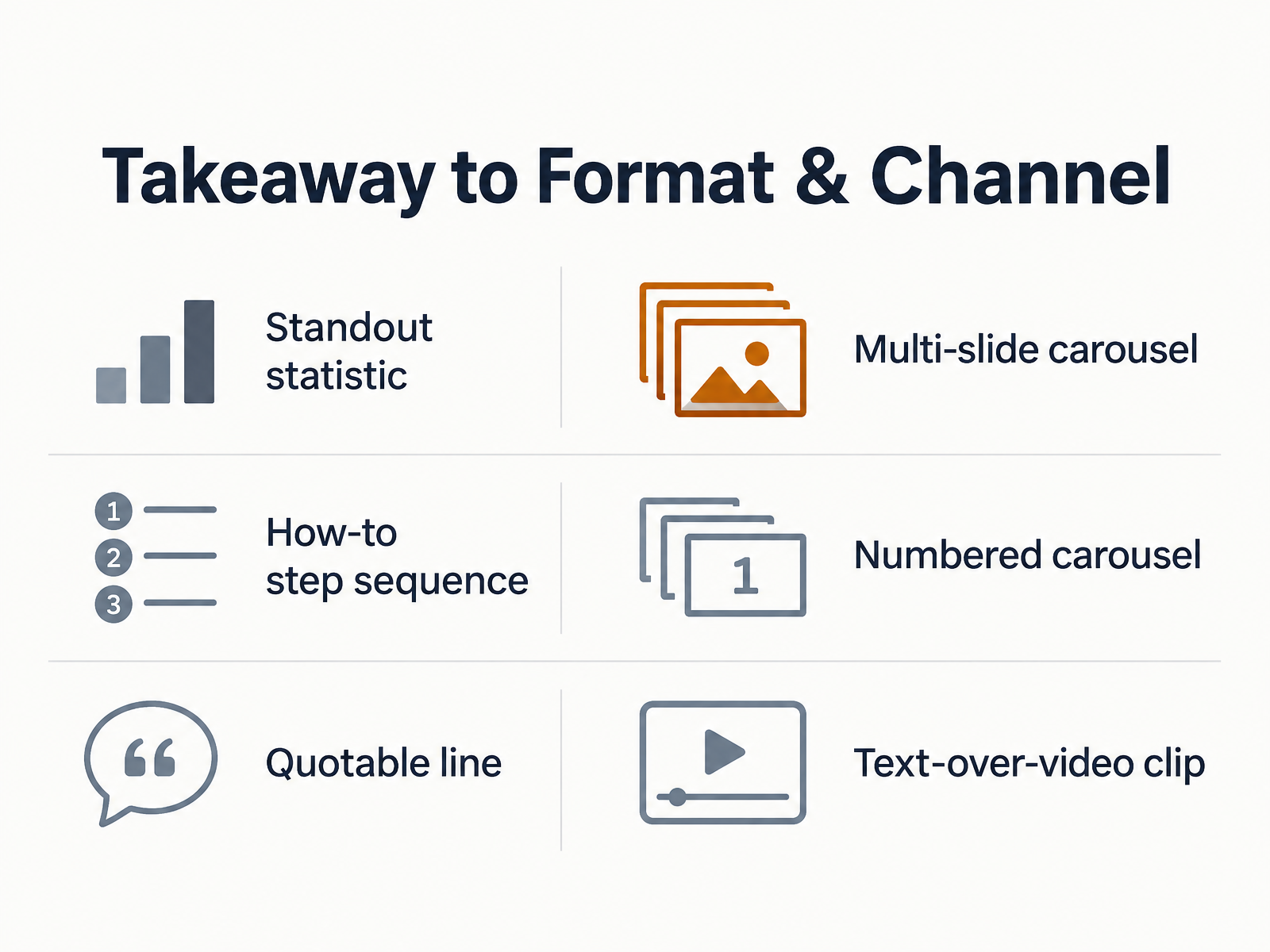
| Takeaway type | Asset format | Best channel |
|---|---|---|
| Standout statistic | Multi-slide carousel | Instagram, LinkedIn |
| How-to step sequence | Numbered carousel or slide deck | |
| Quotable line | Text-over-video clip | TikTok, Reels, Shorts |
| Data cluster | Infographic | Pinterest, LinkedIn |
| Full argument | Short video explainer | YouTube |
| Key insight | Newsletter snippet linking back |
A single number lands harder as a designed graphic than buried in a paragraph. A process reads better as swipeable steps. And you don't need a designer for the visual pieces. Drag-and-drop tools can handle carousels and infographics without a budget line.
Put your effort into the formats that move revenue
Not all formats should enter production at the same level of polish. Start with the assets most likely to influence revenue or deepen trust, then use lighter derivatives to extend reach.
Email is the clearest case. A newsletter snippet that pulls three insights from your post and links back to the pillar can keep your audience engaged and move readers toward a clear next action, like a call booking or demo. It's not a throwaway. It can be one of the highest-return assets in the batch.
Podcasts can carry similar weight for trust. A conversational format reaches people through a channel they choose to spend time in. If your takeaway suits that format, a short audio episode can reach an audience that never opens your blog.
Once those anchor assets are in motion, the smaller pieces support them. Quote graphics, brief text posts, and single-idea captions keep the idea visible between larger launches without pretending to carry the whole conversion burden.
One idea, two assets, same voice
The proof that a takeaway can split into distinct formats is straightforward. A long-form resource can often be condensed into a short video answering one question. A data-heavy section can become a standalone infographic. Same source idea, two different assets, two different audiences.
That's the move to copy. Take one takeaway and give it two formats aimed at two channels.
The editorial challenge is deciding what changes and what doesn't. The hook can change. The length can change. The CTA can change. The underlying claim shouldn't. A video may lead with a spoken problem while a carousel leads with a visual contrast, but both should make the same promise to the reader.
So run a voice check on every asset before it ships. Same core message, same tone, same phrasing rules across the batch. That consistency layer is what makes high-volume adaptation safer instead of sloppy. If you want the full breakdown of running this at speed, the repurposing sprint guide walks through the workflow.
Playbooks for social, email, video, audio, and visual assets
Every asset family has its own rules, and the fastest way to dilute your message is to treat them all the same. The playbooks below are where AI content repurposing stops being theory and becomes a repeatable production line. Each one starts from a single blog paragraph and ends with a finished asset that still sounds like you.
Use the source paragraph as raw material, not a script to paste everywhere. Each channel needs a different cut of the idea: a social post needs immediacy, an email needs a reason to click, a visual needs hierarchy, a video needs a spoken arc. The discipline is adapting the delivery while protecting the argument underneath.
Social and email run on one idea, not the whole post
For LinkedIn, don't repost the article. Pull the single most compelling data point or claim, lead with it, then link back. A carousel works best when each slide carries one takeaway and the first slide does the job of the hook.
Email follows the same discipline. Extract one section, write a subject line that promises the specific payoff, and drive to the full post. The landing page it points to should stay ruthless: one headline, one benefit, one form, one CTA. Match the offer to intent too, so the reader lands on the next step that fits their level of interest rather than a generic ask.
Turn one paragraph into a script, a slide, and an infographic
Short video is where a paragraph can earn the most reach. Use the paragraph's claim as the opening line, the reason as the middle, and the CTA as the close. That structure keeps the clip tight without flattening the point into a generic teaser.
Visuals scale even faster when the source section contains comparisons, steps, or clustered facts. Instead of copying the paragraph into a graphic, strip it down to the hierarchy a viewer can grasp in seconds: headline, supporting point, proof, next action. Drag-and-drop design tools can let you build shareable graphics yourself in a single session.
Batch this. Draft every carousel slide, quote graphic, and infographic caption in one design sitting rather than spinning up a new file per asset. It keeps color, type, and phrasing aligned across the set.
Naming conventions are your brand-voice insurance
The less glamorous part of repurposing is the part that keeps the system usable. If every file has a different naming pattern, every review turns into a scavenger hunt. A clean asset library lets editors trace each derivative back to the source post before approving it.
Store every derivative next to its source post with a clear tag for format, channel, and version. When each asset traces back to one anchor file, you can audit the whole set against your core message in minutes instead of hoping nobody notices the tone slipped. AnyPost's content repurposing features can be configured around the same batch-and-tag discipline, helping you create social media carousels and posts across channels such as LinkedIn, X, Instagram, TikTok, and YouTube.
Keep the voice consistent and measure ROI across every asset
Scaling a repurposing workflow only pays off if you can prove the output is coherent and valuable. Two systems have to run together: an editorial review that protects voice, and a measurement setup that connects derivative assets back to the original post.
This is where many teams stop too early. They create the formats, publish them, and judge performance one platform at a time. That hides the real question: did the original idea create value across the entire campaign? A repurposing system should make that answer visible.
What goes on a brand-voice consistency checklist?
Build a short checklist and run every asset against it before publishing. Keep it tight enough that a reviewer can clear an asset in under two minutes.
- Does the opening line match your usual register? Punchy or measured, but consistent.
- Are the same three or four core phrases showing up that anchor your brand?
- Does the call to action use your standard verb set, not a random synonym?
- Would a regular reader recognize this as you without seeing the logo?
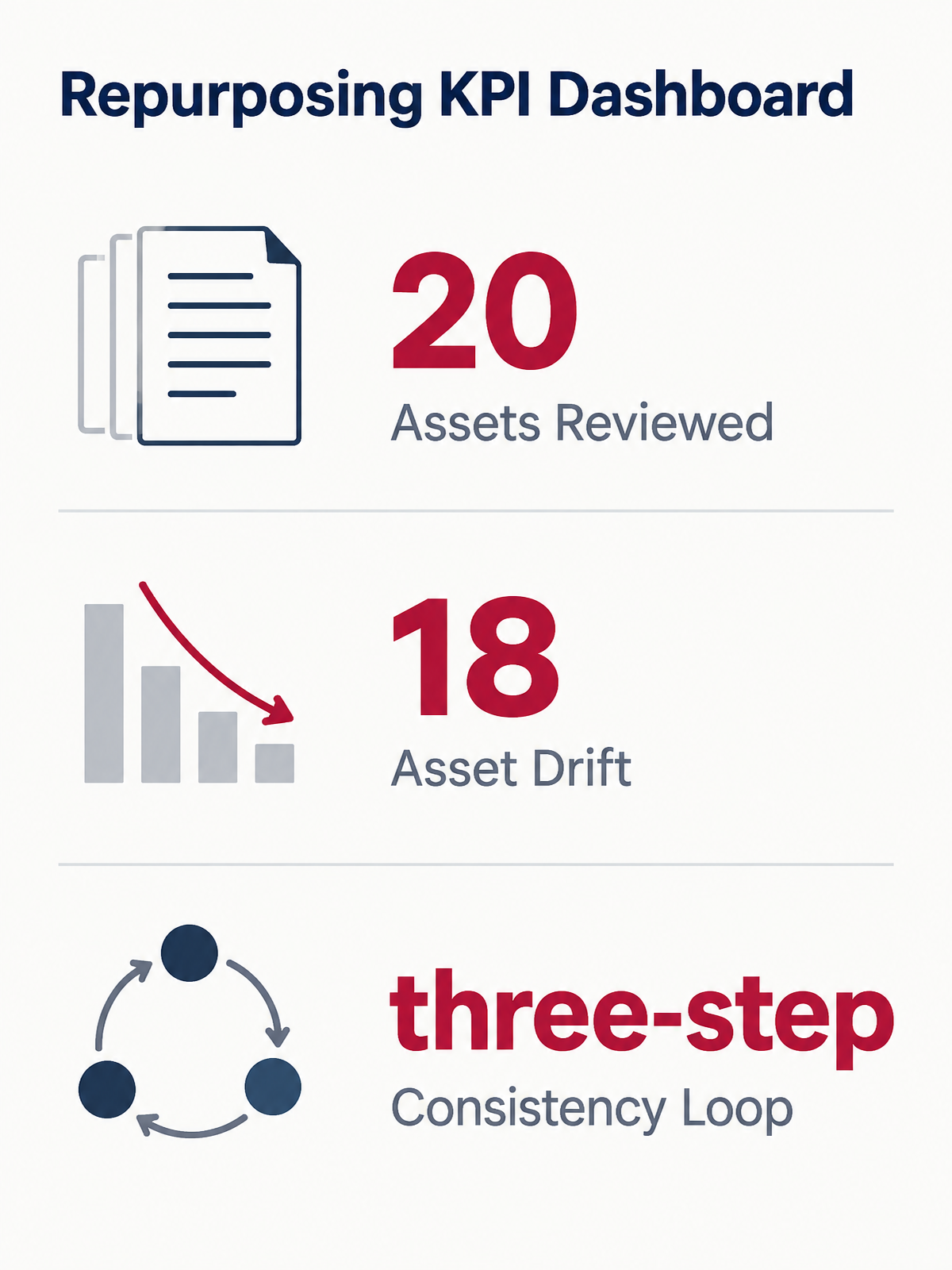
Pair that human check with tone scoring. Text-similarity and sentiment-scoring tools can compare each new asset against a reference sample of your approved copy and flag pieces that drift outside a set range. AI can generate the draft, the score can catch the outliers, and a human can clear the edge cases. That three-step loop can help you review a larger batch without reading every asset word by word.
Which KPIs actually matter per channel?
Every format earns its keep differently, so stop measuring them all the same way. A story slide and a YouTube explainer share almost no meaningful metric.
- Short video (Shorts, Reels, TikTok): completion rate and shares, not raw views.
- Carousels (LinkedIn, Instagram): saves and swipe-through depth.
- Newsletter snippets: open rate and click-through to the source post.
- SEO assets: organic impressions and keyword-position movement.
- Every asset: lead conversions attributed back to the pillar piece.
Tracking these separately is what makes attribution possible. When multiple touchpoints all trace to one blog post, you can finally see which formats pull leads and which just pull vanity numbers.
How do you roll it into one ROI dashboard?
Pipe your SEO, social, and email data into a single view keyed to the source pillar post. Tag every asset with the parent post ID so the dashboard rolls up impressions, engagement, and conversions per idea, not per platform. That's how you can show whether one post generated returns across several channels instead of guessing.
A/B test the variations that matter most. Run two hooks on the same carousel, two subject lines on the newsletter cut, two thumbnails on the video. Change one element, measure against the KPI that fits that format, and feed the winner back into your next batch. Skip A/B testing on low-traffic assets, though. The sample sizes are too small to tell you anything real.
Your next move: pilot, measure, then scale
Don't scale the whole library at once. Start with a controlled pilot, study the results, and expand only after the process proves it can protect quality under real deadlines. That sequencing keeps AI content repurposing from turning into a volume problem you can't manage.
The goal is a rhythm, not a heroic sprint. Fully repurpose a single post, confirm the brand-voice check survives contact with real deadlines, then widen into a pipeline where a handful of pillar posts feed the whole calendar. Tools such as AnyPost's Persona Engine can help keep tone matched across every asset, so this scales because the consistency layer travels with every batch, not because you're producing faster.
How do you batch-process multiple blogs a month?
Batching works when you separate the thinking from the making. Run all your core-message distillation for the month in one sitting, so every pillar post has its one-sentence anchor locked before a single asset gets built. That front-loading is what stops tone from wandering once the production line speeds up.
Then batch by format, not by post. Cut all your video clips in one block, all your carousels in another. You stay in one mental mode, and the voice check becomes a single pass across similar assets instead of twenty scattered decisions.
Can programmatic SEO feed the same engine?
Yes, and this is where the model compounds. Programmatic SEO builds large volumes of long-tail pages from a repeatable template, and your pillar posts are the raw material those pages pull from. A single well-argued post can seed dozens of targeted variations aimed at specific search queries you're not yet ranking for.
The catch is quality control. Template-based pages can turn generic fast if the inputs are thin or the review step gets skipped. Give each page a clear search intent, a connection to the original argument, and the same editorial review you'd apply to any other published asset.
What signals an asset set is saturated?
Watch for diminishing returns per asset, not just total output. Falling click-through on repurposed pieces and flat impressions on a topic you keep re-slicing both signal it's time for a fresh angle, not another format.
Run a short post-pilot review after your first full cycle:
- Which formats drove the most qualified traffic per hour of production?
- Did any asset drift off-voice, and where did the check catch it?
- Which channels underperformed enough to drop from the next batch?
- What's the one takeaway that outperformed everything and deserves its own pillar post?
Answer those four, adjust your asset matrix, and expand. That loop, pilot then measure then refine, is how one blog post a month becomes a content engine that keeps its voice at twenty assets and beyond.
Common Questions
How do I start repurposing if I only have time for one post right now?
Choose one strong pillar post and define success before you create anything. Pick the channels you can realistically support, assign each derivative a clear job, and review the results after publishing. The first round should teach you which formats are worth repeating.
Should I aim for exactly 20 equal-effort assets from every post?
No. Use 20 as a ceiling for what one post can support, not as a quota. Some posts contain enough depth for a full asset set; others may only justify a few strong derivatives. Let audience value and channel fit decide the final count.
What's the actual difference between reusing content and repurposing it?
Reusing usually means reposting or lightly recycling material. Repurposing means rebuilding the idea for the context in which it will be consumed. The message stays recognizable, but the structure, hook, format, and CTA are shaped for the channel.
Does every takeaway from my post deserve to become an asset?
No. Promote the points that can stand alone and help the audience make a decision, understand a process, or remember a useful insight. Leave narrow asides, dated references, and supporting details inside the original post unless they serve a specific campaign need.
How do I stop AI-generated variations from sounding off-brand?
Give the AI a clear source message, examples of approved copy, and rules for tone before generation starts. Then review the output against your voice checklist instead of judging it from scratch each time. A persona or context tool such as AnyPost's Persona Engine can help by grounding each asset in your existing site context.
Which metrics should I track for each format instead of raw views?
Tie each asset to the behavior it is supposed to create. A video should hold attention, a carousel should earn saves or swipes, an email should drive clicks, and an SEO page should gain search visibility. Conversions should still roll back to the parent post.
How do I know when I've squeezed enough assets from one post?
Stop when new derivatives stop adding reach, engagement, or learning. If the same angle keeps underperforming, the issue is not format variety; the idea has likely reached its current limit. Use the best-performing angle as a clue for the next original piece.
Can programmatic SEO pages drift off-voice like social assets do?
Yes. Any repeatable template can flatten personality if the review process only checks keywords and structure. Keep the search page useful, but also make sure it reflects the same positioning, vocabulary, and point of view as the rest of your content.