
Turn Research Notes into Instagram, LinkedIn, Twitter, Blog, and Video Scripts

Quick Answers
- One set of research notes can become several platform-ready pieces much faster with AI tools than by manual rewriting.
- A well-structured source can fuel multiple derivative pieces before quality starts to slip.
- Per-piece cost can fall substantially when an automated pipeline replaces separate writers for video, carousels, and threads, depending on the processor and workflow.
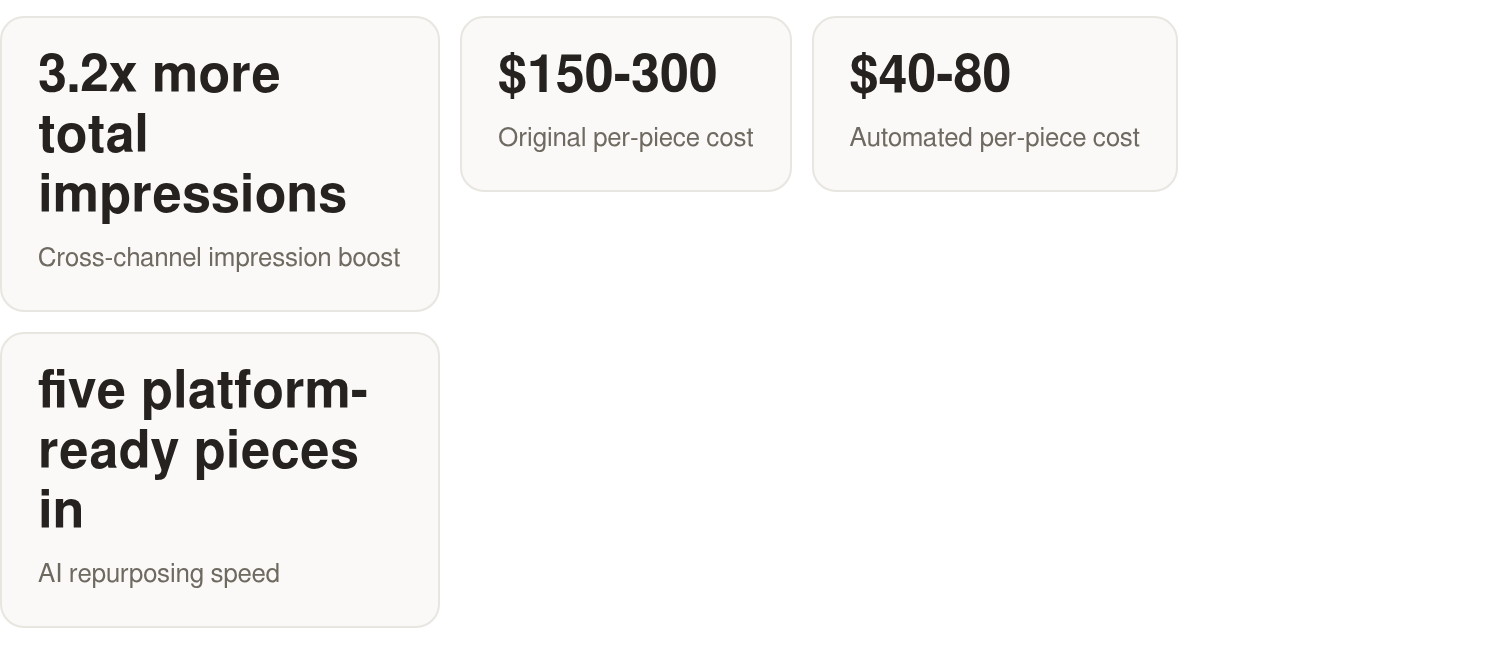
- Cross-channel publishing can increase total impressions and site traffic through cumulative touchpoints.
- Each format needs its own shape: blog posts need search-intent headings, video scripts usually need an early hook.
- Instagram carousels tend to work best as a small number of slides with brief text each; a single written source often supports one strong short video script rather than many.
Quick Summary
Turning one set of research notes into several platform-ready pieces can take far less time with AI generation tools than doing the same work by hand. That gap is the entire reason the workflow exists. You already did the hard part when you gathered the notes. The labor was never the thinking, it was reshaping the thinking for each platform.
Most guides miss the shortcut. Research notes are already atomized, so you can decompose before you compose. Skip the "write a polished pillar, then break it apart" step every blog-first pipeline assumes. Slice the notes straight into a blog draft, a video script, and three social formats, in parallel.
What does each output format require?
Each platform rewards a different shape. Matching that shape is what separates real repurposing from lazy copy-paste. Here's the map from raw notes to five finished pieces.
| Output | Typical size | Native must-have | AI tool type |
|---|---|---|---|
| Blog post | Long-form draft | Search-intent headings | AI writing assistant |
| Video script | Short-to-medium script | Early hook | AI script + clip tool |
| Instagram carousel | A few slides with brief text | One idea per standalone slide | AI carousel generator |
| LinkedIn thread | Connected posts | Data point up top | AI writing assistant |
| Twitter/X thread | Short posts | Punchy opener, one claim per line | AI writing assistant |
A well-structured source holds at least a handful of distinct knowledge units, enough for multiple derivative pieces. Push past that and quality drops. One post often gives you a single strong short video script, not several clips at that level.
A Tool-Agnostic QA Checklist
Before publishing any derivative, check:
- Native fit: Does the asset match how the platform is actually consumed, such as vertical video, carousel, thread, or long-form?
- Factual accuracy: Can each factual claim be traced to the source notes or another verifiable source?
- Distinctiveness: Does this version justify publication, or is it nearly identical to another channel's post?
- Platform shape: Does it use the native structure—search-intent headings for the blog, early hook for video, standalone slides for carousels, punchy opener for threads?
- Voice consistency: Does it still sound like the same brand?
How much time and cost does automated repurposing save?
Teams running AI pipelines often report producing a batch of derivative pieces in far less time than manual rewriting would take. Per-piece cost can fall when you drop separate writers for video, carousels, and threads, but the exact savings depend on the processor, formats, and existing workflow. The savings come from removing redundant reformatting work.
Metrics worth tracking once it's live:
- Volume: whether one source post can feed multiple derivative pieces once notes drive the pipeline
- Ideation: whether atom-first planning replaces the blank calendar
- Reach: whether cross-channel distribution outperforms single-channel over the same period
- Traffic: whether cumulative touchpoints produce more site visits than one channel alone
Before you start
Fast generation and smart timing run on two different clocks. Build the full asset set in one sitting, then stagger the release over the following weeks instead of dumping everything at once. Batching lets you produce fast. Drip distribution keeps the feed alive.
Front-load the effort into rich, atom-dense notes. A thin outline gives you a handful of pieces. A deep set of notes can fuel a larger batch. Format-native adaptation, not word count, decides whether people engage or scroll past.
Why One Blog Post Reaches a Fraction of Your Audience
Most of your audience will never read your blog post. That single fact is the case for converting one body of research into Instagram, LinkedIn, X, blog, and video. People retain a message more readily when they watch it than when they read the same words, and each format reaches people the others never touch. The ideas can be identical. The delivery decides whether anyone remembers them.
AI generation is what makes hitting all those formats realistic instead of aspirational. The strategic case isn't "post more." It's reaching the people who were already tuning your writing out. Plenty of people skim rather than read word for word. If a blog is your only output, you're speaking clearly to a fraction of the room.
Readers, Watchers, and Listeners Are Three Different Rooms
People learn in different ways, and they sit on different platforms while they do it. One person reads long-form at a desk. Another only watches short clips. A third listens on a commute and never opens a browser.
Publish in one format and you self-select for one slice of that group. Reformat the same research across channels and you stop losing the video-first and audio-first majority by default. The reach gain isn't vanity. It's the difference between a message landing and a message evaporating.
Multi-Channel Doesn't Add Reach, It Multiplies It
Some teams tracking cross-channel attribution report that repurposed content generates more total impressions than single-channel and drives more site traffic through cumulative touchpoints.
Sit with the connection for a second. If most readers skim and most viewers retain more from what they watch, those extra impressions aren't one person seeing you repeatedly. They can be different audiences you'd never have reached from one channel. A consistent voice across all of them turns scattered touchpoints into one recognizable brand, which also feeds the signals search engines reward when your topic shows up in multiple formats.
Where AI Closes the Repurposing Gap
The bottleneck was never desire. Marketers know repurposing works. The manual labor is what stops them. Adapting a single blog post into video scripts, carousels, and newsletters the traditional way can add significant time on top of the hours already spent writing it.
That's what AI generation actually closes. Automating the reformatting makes the growth-driving short-form layer nearly free, so your scarce human hours stay on the one rich source instead of the ten reformats.
One limit worth naming: skip this if your instinct is to paste the identical post everywhere. Cross-posting isn't repurposing, and platform algorithms suppress it on sight. The value comes from adapting each piece to how the platform is actually consumed. Do that, and one research file quietly becomes a week of content your whole audience can find.
Mapping Core Themes to Platform-Specific Formats
The fastest way to waste AI generation is to point it at every platform at once and ask for "the same thing, but for Twitter." That produces mush. The real work happens before you generate anything: deciding which theme from your notes belongs on which platform, and why.
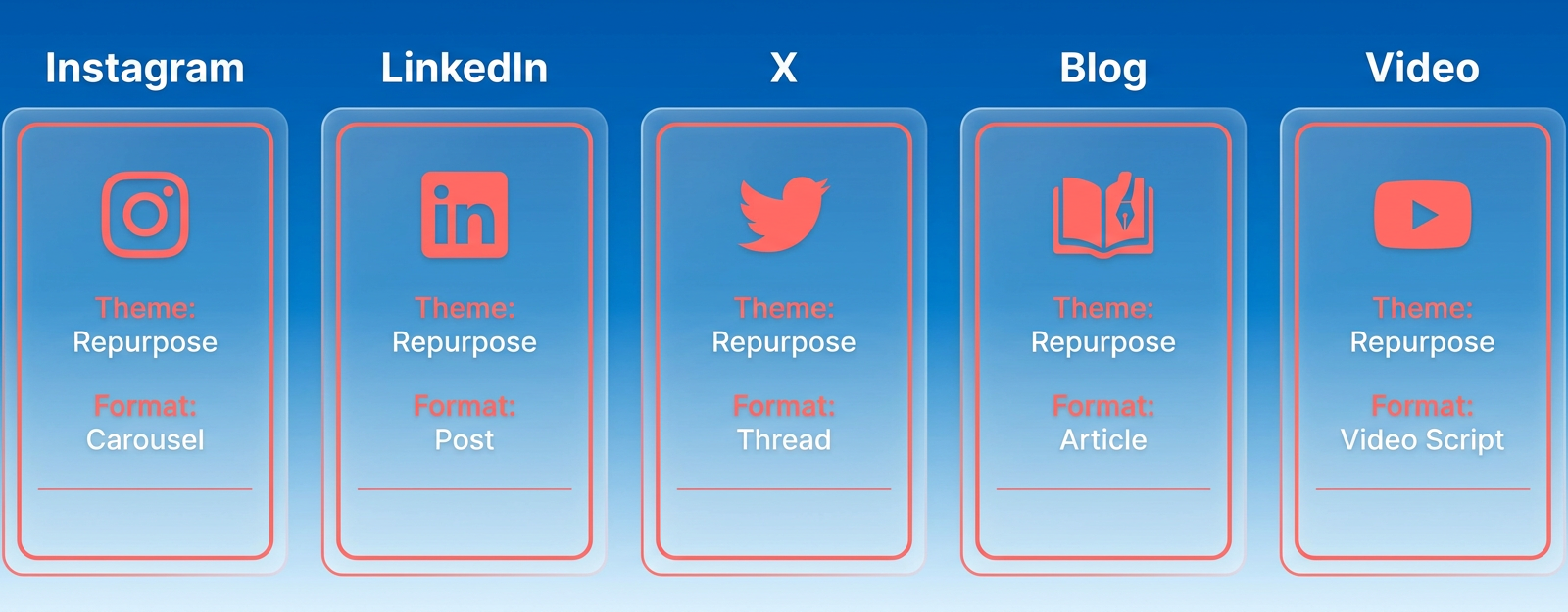
Match the format to what the reader came for. Someone scrolling Instagram wants raw, authentic visual storytelling. Someone on LinkedIn wants a professional insight they can act on. X rewards a sharp take. A blog reader wants depth. Sort your themes by intent first, and the AI stops fighting you and starts doing what it's good at: reshaping one idea into many native shapes.
Which Theme Belongs on Which Platform?
Map by audience culture, not convenience. LinkedIn wants professional insight. TikTok wants entertainment and higher production value with scripted cuts. Instagram rewards raw, unfiltered authenticity. X rewards hot takes. The same clip can perform well on one platform and barely register on another. That gap is culture, not quality.
Here's the rule we keep coming back to: if your short-form works on every platform, it probably works on none. A framework theme maps to a LinkedIn carousel or an Instagram slide set. A single sharp data point becomes an X post. A story with a before-and-after belongs in a video or a longer LinkedIn post.
Discovery platforms such as Instagram, TikTok, Facebook, and YouTube Shorts favor vertical video that lands the point instantly. Intent platforms like YouTube often favor horizontal video and longer watch time. Carousel slides work best when each card carries a single, self-contained point.
How Many Assets Can One Theme Actually Produce?
Two common views seem to disagree. One frames a written post as yielding only a limited set of quality assets. Another says a single long-form video can become many short-form pieces.
Both can be right, and the difference is source richness. A tight written post holds only a handful of distinct ideas. Hours of raw talking-head footage hold far more. The ceiling is how many separate ideas your source actually contains, not how badly you want more posts. Slicing thin material past its limit is a common conversion mistake.
Why AI Makes the Growth Layer Nearly Free
Creators often pour most of their time into long-form, yet a large share of growth comes from short-form. That imbalance used to be unavoidable.
AI breaks it. Automating the repurposing work drops the cost per piece sharply, and the short-form layer that actually drives growth gets cheaper enough to stop rationing. You reinvest the saved effort into the one rich source everything else feeds from.
Build Platform-Specific Scripts from One Source
The same script rarely performs identically across feeds. A caption that reads as sharp on LinkedIn falls flat on TikTok, where the first frame does the work a headline used to. That mismatch is why one script can't serve every platform, and why AI generation only pays off when you tune each output to where it lives.
Treat the source notes as one asset and rebuild every version from scratch inside the tool. A repurposing platform can be configured to turn a single piece of content into social carousels and posts, then publish across LinkedIn, X, Instagram, TikTok, and YouTube, which makes running several variants at once a realistic option instead of a manual grind.

Sameness reads as filler, so every version below starts from the notes, not from the last draft.
How Do You Draft the Blog and Video Scripts?
Start with the two longest formats. They hold the most material. A long-form SEO blog carries the full argument: problem, framework, steps, proof. The video script pulls a thinner line through the same notes.
For a short video script, lead with the main idea, name who it's for, then set the channel voice before you outline a word. Open on a hook that lands in the first few seconds, state the problem, walk the solution, close on one clear ask.
Vary sentence length in the script. Not every line needs to be short. The rhythm is what makes it sound like a person talking, not a teleprompter.
One caution on video: a single long written post gives you one strong short-to-medium script or a handful of very short clips at real quality, not both. Pick the depth that fits the platform and stop trying to cover everything.
What Does Each Social Format Need?
Match the shape to the feed. A LinkedIn carousel slide holds a small amount of text, so each slide has to stand alone: title slide, one data visual, the takeaway, then the ask.
The LinkedIn thread wants a professional insight wrapped in a short story. The Twitter thread wants pacing: one idea per tweet, a sharpened first line, a couple of hashtags at most so the read stays clean.
Aspect ratio decides the video cut. Discovery feeds like Instagram and TikTok favor vertical video that lands the point instantly. YouTube often favors horizontal video and longer watch time. The register flips too: TikTok rewards polished, scripted cuts, while Instagram rewards raw, unfiltered talking-head footage.
Why Bother Tuning Each One?
Because the payoff compounds. Short-form drives an outsized share of your growth, so a single long-form source cut and tuned for each platform does far more work than one post dropped into a single feed.
One note on the customer-story format: the customer is the hero, not you. The script should carry their voice and their pain, with your solution showing up as the natural turn in their win.
Automating the Repurposing Process with AI (Spotlight on AnyPost.ai)
Any repurposing tool should be evaluated on source ingestion, platform-native output, scheduling, tone consistency, and performance tracking.
The clearest argument for automation isn't time or even cost. It's consistency. When a human team splits one idea across several formats, each writer drifts, and the brand voice fractures a little more with every handoff. Automation can hold a single reference tone across all of it.
That reframes the economics. When each extra format costs far less to produce, the question stops being whether you can afford multiple platforms and becomes why you're still publishing to one. Some repurposing platforms include tone-matching features that try to match your voice across every piece, so the content sounds like you wrote it no matter where it lands. The tone matching has to be good enough that nobody can tell a machine reshaped the source, or the whole approach falls apart.
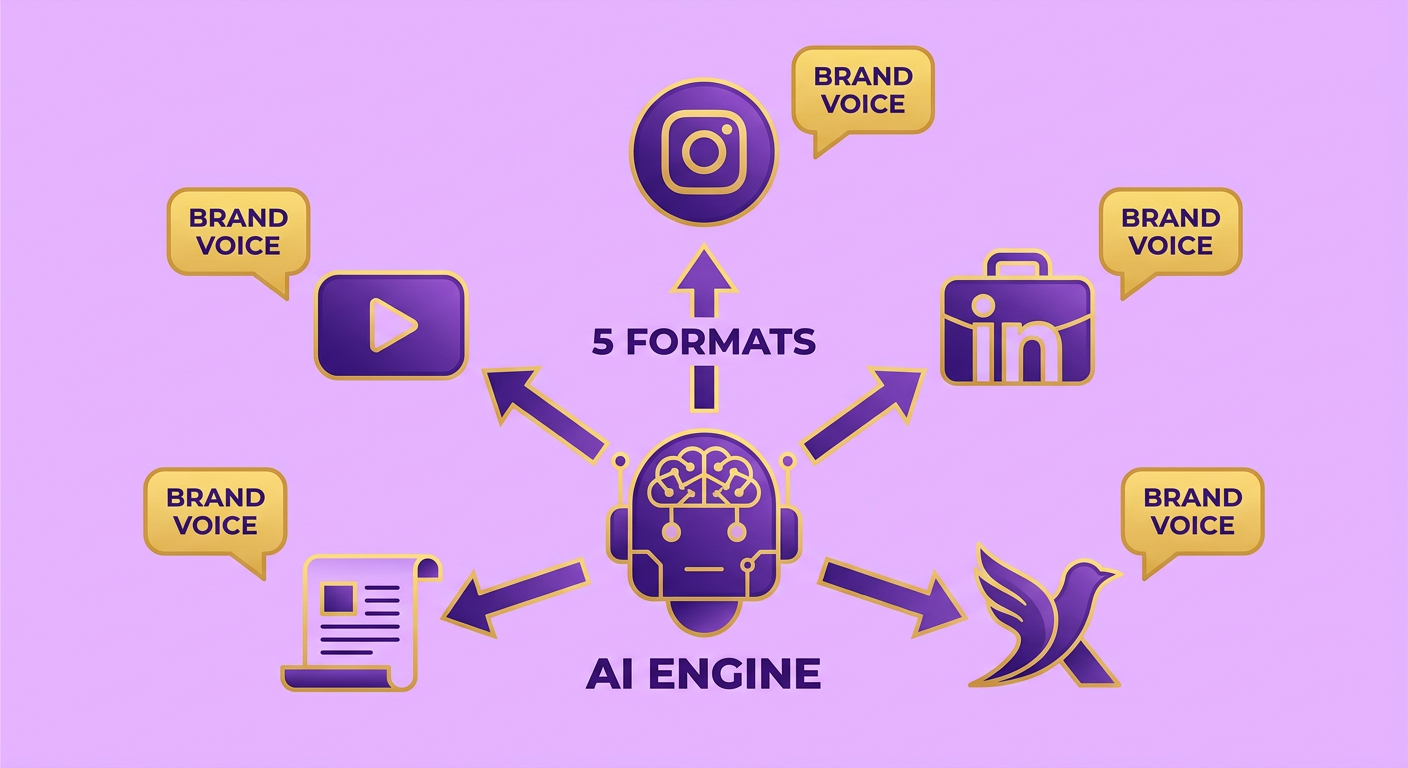
Feed the Notes In, Pull Multiple Formats Out
The input doesn't need to be polished. A messy research doc works because notes are already broken into discrete points, which is exactly the raw material the automation wants.
Point a repurposing platform at one structured source and it can be configured to turn that content into SEO-ready articles, social carousels, and platform-native posts for LinkedIn, X, Instagram, TikTok, and YouTube. Some teams find a single well-structured source can yield multiple derivative pieces, from video scripts to individual social posts, when you extract each distinct point instead of copy-pasting the whole thing.
The bigger shift is upstream. Plan around discrete knowledge units rather than platforms, and you stop reinventing angles for every channel and start slicing one rich source. That's where the time savings compound.
The Impression Math That Justifies the Extra Formats
More formats isn't vanity volume. Some teams find that repurposed content spread across channels increases total impressions and site traffic through cumulative touchpoints.
That happens because someone who finds you on one feed gets guided toward your work on another. Real-time analytics can help you track performance across the channels you publish to, so you can see what's actually moving the needle instead of guessing. If you can't measure the compounding, you'll underinvest in it.
Build Fast, But Don't Dump It All at Once
Here's a tension worth naming. The tooling generates a week of assets in one sitting, which tempts you to publish them the same afternoon. Don't.
Production speed and publishing cadence run on different clocks. Generate the full batch fast, then drip it over the following weeks so each format gets its own moment instead of crowding the others out.
One caveat: automation doesn't manufacture depth that isn't there. A thin source only holds so many distinct points, and stretching it across too many derivatives just thins each one further. Skip the heavy automation for shallow notes. Feed it atom-rich material and the per-piece math works in your favor. Starve it and you're just producing filler faster.
How to Prove the ROI and Scale from Here
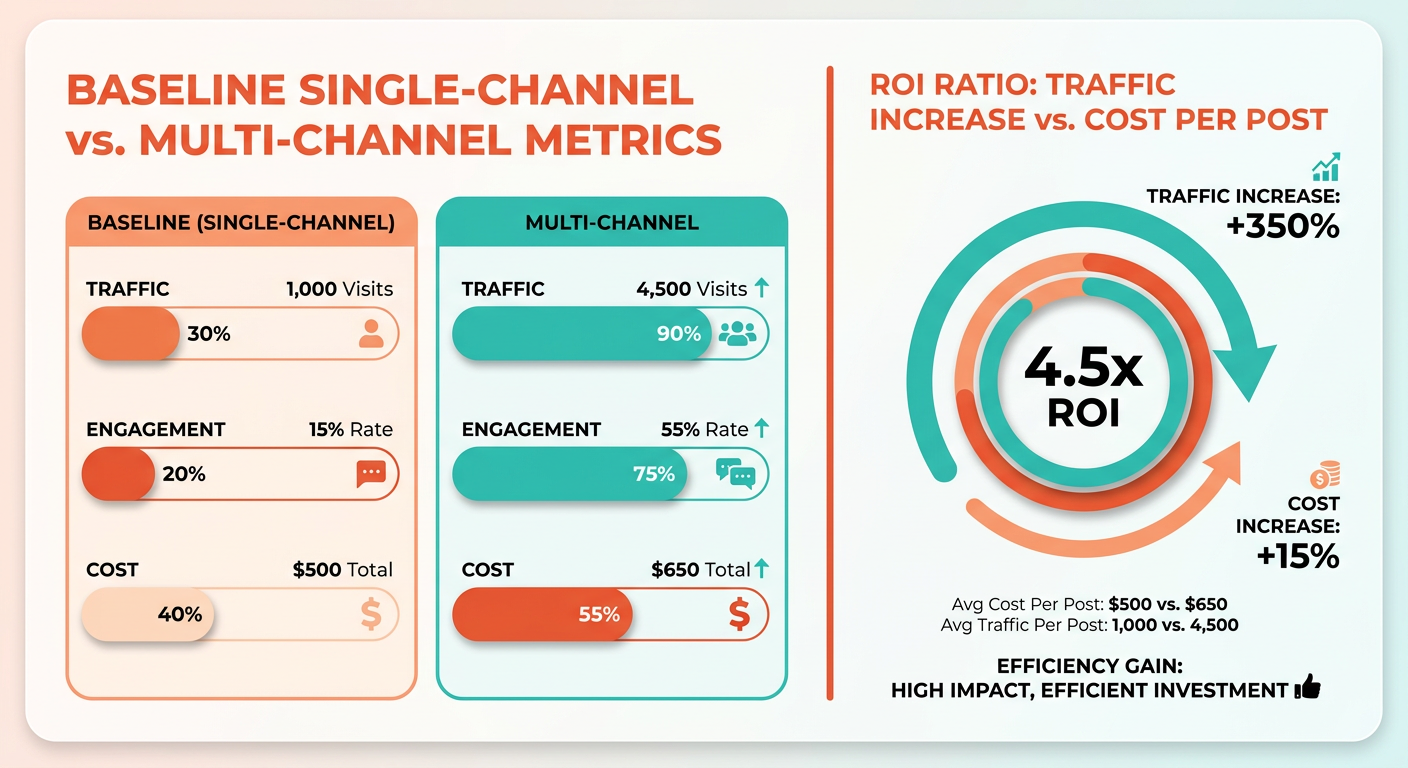
Start with the ratio that justifies the spend, not the raw output count. The question is never "how many posts did we ship." It's how much traffic and engagement the whole cluster pulled versus the same research published once, on one channel. Track that ratio over a full quarter and the case for scaling makes itself.
Set a baseline first. Publish one topic the old way, single-channel, and record what it returns over a fixed window. Then run the next comparable topic through the full multi-channel treatment and measure the same window. The delta between those two numbers is your real return, and it's the only figure worth taking to a budget conversation. Reach is a vanity metric until it moves people onto your site.
The KPIs Worth Watching Per Channel
Each channel answers a different question, so give each its own scoreboard. Lumping them into one "engagement" number hides what's working.
- Blog: organic traffic and time on page. This is where sustained search traffic lands.
- Video: watch-time and view count, not likes. A short clip and a long-form cut earn very different bars.
- Carousels: saves. A save is intent to return; it beats a passive like.
- Threads and short posts: replies and reshares, the signals that push distribution.
Teams that move to a content-first workflow often report large reductions in manual production time. That output jump is meaningless unless the per-channel KPIs hold, so watch both together.
Tie Every Asset Back to Its Source Topic
Here's the attribution model we run. Tag every derivative with the research topic it came from, not just the platform it lives on. When multiple formats all trace to one set of notes, you can total the impressions, saves, and clicks across all of them and score the topic, not the post.
That single view tells you which research themes deserve another round of atoms and which to retire. A topic that yields a viral carousel and a dead video isn't a failed video. It's a topic that wants more visual formats. You only see that when the attribution rolls up to the source. Solid topic research feeds this loop by pointing you at themes with room to rank before you commit the effort.
Batch Fast, Then Drip the Distribution
Speed and timing are two different clocks, and confusing them is where scaling breaks. You can generate a full asset set from one source quickly. You shouldn't publish them all in one afternoon.
Space each derivative out instead of dumping the whole set on launch day, so the cluster earns touchpoints over time rather than competing with itself. Batch the generation, stagger the release across a calendar. Build the whole week's worth. Drip them out.
Keep a human in the loop on the way out. A fast tone-check and fact-check per asset costs minutes and protects the brand. Automation earns the volume. Your judgment keeps it worth reading. That division of labor is what lets a two-person team run five channels without the output turning to mush.
Common Questions
1. What happens if my research notes are thin or shallow?
Thin notes cap how many quality pieces you can produce. Automation cannot manufacture depth that isn't there — a shallow source only holds a few distinct points, and stretching it across too many derivatives just thins each one further. For sparse notes, skip heavy automation and build a smaller set of strong pieces instead.
2. Isn't posting the same content to every platform the same as repurposing?
Cross-posting identical content is not repurposing, and platform algorithms suppress it on sight. Real repurposing adapts each piece to how that platform is actually consumed — a LinkedIn insight, an Instagram slide set, a sharp X take. If your short-form works everywhere unchanged, it usually works nowhere, because sameness reads as filler.
3. Should I publish everything the same day I generate it?
Generate fast, but stagger release over the following weeks. Production speed and publishing cadence run on different clocks. Dumping the whole batch at once makes your formats compete with each other, while dripping them out earns cumulative touchpoints over time and keeps your feed alive between source topics.
4. Why does the same clip perform completely differently across platforms?
Platform culture, not clip quality, drives the gap. The same clip can perform well on one platform and barely register on another. TikTok rewards polished, scripted cuts; Instagram rewards raw, unfiltered authenticity; LinkedIn wants professional insight; X rewards hot takes. Match the theme to each audience's culture rather than reusing one shape everywhere.
5. Which format should I draft first from my notes?
Start with the two longest formats — the blog and the video script — because they hold the most material. A long-form blog carries the full argument: problem, framework, steps, and proof. The video script then pulls a thinner line through the same notes, so the social formats slice down from there.
6. Can one long video produce as many clips as one blog produces posts?
A long video usually yields far more than a written post because it contains more distinct ideas. Hours of talking-head footage hold many separate points; a tight blog holds only a handful. The ceiling is always source richness, not ambition. Note that a single long written post often gives you one strong short script, not many.
7. Does automation remove the need for a human entirely?
Automation earns the volume, but a human should stay in the loop on the way out. A quick tone-check and fact-check per asset costs minutes and protects the brand. That division of labor — machine speed plus human judgement — is what lets a two-person team run five channels without the output turning to mush.
8. How do I prove this workflow is actually paying off?
Set a baseline before scaling. Publish one topic the old single-channel way and record its return over a fixed window, then run a comparable topic through the full multi-channel treatment and measure the same window. The delta is your real return. Tag every derivative with its source topic so you score the research theme, not each isolated post.