Why Automated SEO Software Still Needs Human Oversight: Risks and Savings Explained

Where automated SEO software trips up
The part teams underestimate isn't generating content. It's the stretch between a finished draft and the publish button, where nobody is quite sure who's supposed to read the thing. One analysis looked at the success stories that AI SEO automation vendors feature on their own websites. It found that 75% of those showcased clients had significant traffic losses, and these were the wins the vendors chose to show off. The analyst, sample size, and method weren't disclosed, so we read the figure as a warning light, not a precise measurement. Brian Dean, who shared the analysis, drew the conclusion we share. AI in SEO is fine. Handing everything to an agent and hoping is where teams get hurt.
Generation speed outruns review capacity
Automation produces material far faster than anyone can vet it. Modern SEO tools can analyze large keyword sets and competitor data quickly, and an AI writer can turn out a full first draft in about the time it takes to refill your coffee. Someone on your team still has to decide which of those keywords fit your offer and whether the draft is accurate. That review work is the hidden tax on every "minutes to publish" claim.
| Automated output | Time to produce | Human check before publishing |
|---|---|---|
| Keyword list for one seed term | Seconds to minutes | Relevance to your business and realistic ranking chances |
| First-draft article | Minutes | Facts, statistics, tone, real examples |
Surfer, which sells this kind of software, tells its own readers to verify facts, edit AI phrasing, and add experience-based examples before anything goes live.
Vendor efficiency claims need independent checks
Surfer says its two-person team publishes 10-20 posts a month with year-over-year traffic growth. Look at who does the drafting in that pipeline, though. Human writers still handle that stage. The showcased clients who lost traffic show what can happen when it disappears. A vendor's own output numbers tell you what's possible with people in the loop. They tell you much less about what happens once you take the people out.## Where the money actually goes The draft is the cheapest part of an automated SEO workflow. Research, briefs, and first drafts become close to free, so most of what you still pay for is human review. Surfer's pipeline runs at the pace its writers set, not the pace of its generator. That's where the real budget question sits. In our experience, review is the step teams are most tempted to cut once the spreadsheet comes out. It's also the step that protects your traffic.### Feeling productive doesn't mean you're ranking Vendor articles often cite workplace surveys to show that people trust automation. A common one ran as sponsored content on Harvard Business Review in 2023. More than 90% of workers said automation raised their productivity, and nearly 90% trusted it to work without errors. Vendors paid for that survey, and it measures how the tools feel to use. It says nothing about rankings. Ranking evidence lives elsewhere. Check impressions and clicks in Google Search Console, how many published pages actually get indexed, and position changes for the keyword each post targets. Put your automated posts and your human-edited ones side by side on those numbers before you decide the tool is paying for itself. The losses in vendors' own showcase stories suggest that confidence can run well ahead of results. Surfer frames automation as amplifying human expertise rather than replacing it.
Spend on review and automate everything before it
| Pipeline stage | Our recommendation | Why |
|---|---|---|
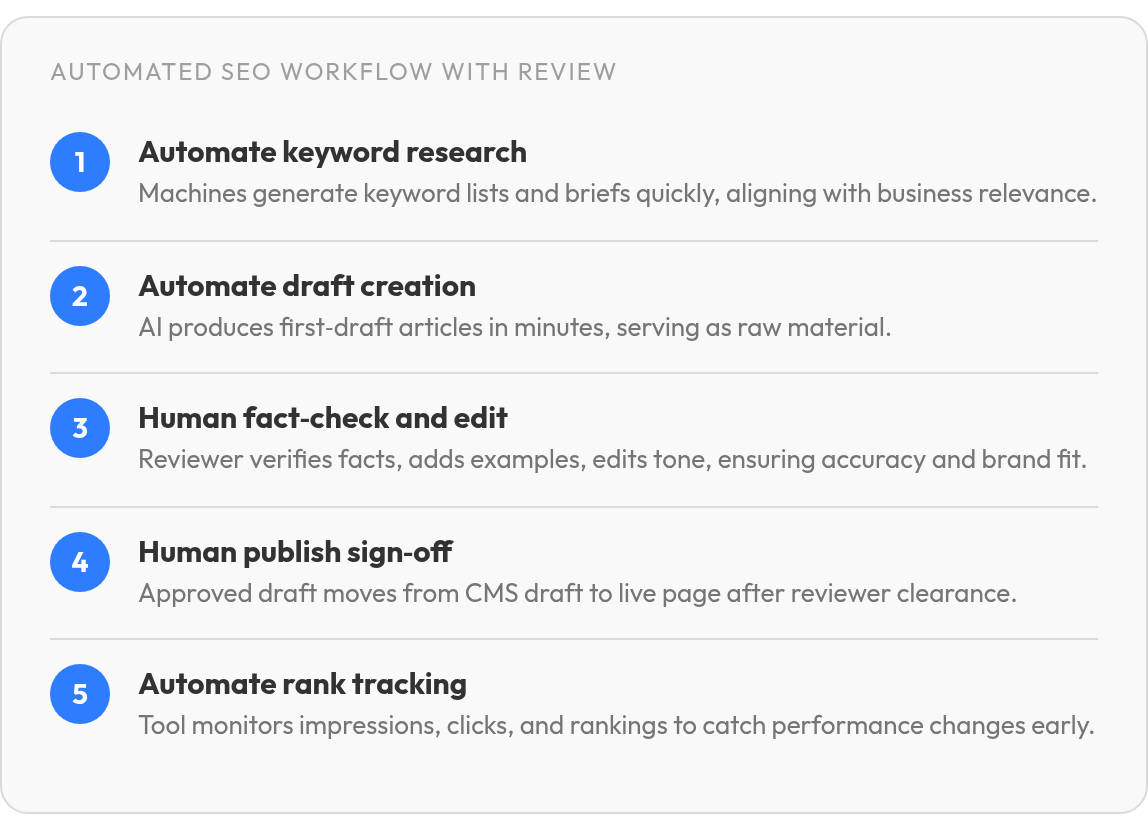
| Keyword research and briefs | Automate | Machines handle this work quickly and cheaply |
| First drafts | Automate, as raw material | Drafts take minutes but aren't ready to publish |
| Fact checks, experience, editing | Keep human | This step protects your traffic |
| Rank tracking after launch | Automate | Ongoing monitoring at low cost |
Our research turned up no cost-per-hour benchmarks, ROI calculators, or documented examples of reduced spend, so we won't hand you a dollar figure. The budgeting logic holds without one. Fund the review hours first, then let the tools cover everything around them. Automated rank tracking then tells you whether those reviewed posts are working. If you can't fund any review time yet, hold off on full automation.## What we could and couldn't verify about the tools Most comparison grids for automated SEO software fill every cell with confidence. We'd rather show you the blanks. Our research turned up verifiable detail on only one vendor, Surfer, and nothing reliable on competitor pricing, support tiers, or plan limits. The grid below scores what the evidence covers and labels the rest. The row that matters most is oversight. Vendor pages describe how much a tool automates. They rarely say how much checking its output still needs. Since showcased clients have turned out to lose traffic, we treat every vendor's marketing as unverified until someone on your team has reviewed the work.
| Criterion | Surfer | AnyPost.ai |
|---|---|---|
| Automation depth | Keyword research feeds briefs, briefs feed on-page suggestions to writers, plus AI drafts and rank tracking after launch | Built for teams that don't want to run content, SEO, and social manually; feature detail not sourced for this grid |
| Oversight required | High. Surfer's own guide says to add experience-based examples, edit AI phrasing, verify facts and stats, and run AI detection | Not sourced here; plan a human review step regardless |
| Cost | Not verified | Not verified |
| Scalability | Self-reported small-team output with year-over-year traffic growth | Not verified |
| Support | Not verified | Not verified |
| Productivity claims | One sponsored survey of self-reported perceptions | Not verified |
The Surfer row points to the review step
Surfer describes its setup as end-to-end automation. The same article also says AI can't write ready-to-publish articles that rank. Both claims hold up once you look at the pipeline. Surfer automates everything up to the draft and keeps a human writer in charge before anything goes live. Sites tend to lose traffic when that review step disappears. Read the scalability cell the same way. Surfer's output is capped by its reviewers, not its generator. For the stage after publishing, our guide to automated rank tracking software covers how to spot a slipping page early.## Where the human sits in an automated pipeline The stage most teams skip sits between "draft ready" and "live." You can automate nearly everything before that point and still protect your traffic, as long as a person signs off before anything publishes. That's where we draw the line with automated SEO software. Automate the pipeline broadly, but never automate the approval. Vendor success stories don't move that line. A showcased client shows what a tool can produce. It doesn't show whether the pages held their rankings months later.### Every automated step gets a named reviewer
| Automated task | Human check | What the check catches |
|---|---|---|
| Keyword and topic ideas | Look at who already ranks and whether your site fits that authority tier | Topics that pass the tool's filters but miss your audience or search intent |
| AI draft | Add examples from real experience, edit the AI phrasing, and verify every fact and statistic | Invented claims, generic voice, off-brand tone |
| Published page | Run a technical audit after the page goes live | Broken links, new 404 errors, indexing problems |
| Link building or disavow | Audit backlink quality before you act | Spammy links you'd otherwise pursue, and good links you'd otherwise disavow |
"Authority tier" here just means the rough weight class of the sites already on page one. If they're all major publications and you're a two-year-old SaaS blog, the tool's keyword score won't tell you that.Long drafts need this checklist most. An AI tool can turn out a long, heavily structured draft in minutes, and a wrong statistic is easy to miss when it's buried halfway down. Checking a draft like that properly can swallow a whole afternoon, which is exactly why the step tends to get skipped.### Nothing goes live without sign-off Build the approval gate into your tools instead of relying on good intentions. Keep AI output in a CMS draft status that only a named reviewer can change to published. Send a Slack notification when a draft lands in the review queue. After publishing, use automated rank tracking to catch drops early. Then set your publishing volume by how much your reviewers can check, not by how much the tool can generate. If one person can review three posts a week properly, publish three. Any posts beyond that go out unchecked.## The bottom line on automated SEO software Whether automated SEO software helps or hurts you comes down to who approves each page before it goes live. Surfer publishes with a two-person team and still tells writers to verify facts, add examples from experience, and rewrite AI phrasing before publishing. If the company that built the generator won't ship its raw output, you shouldn't either. You should also know that the independent research behind this article contains no data on AnyPost.ai. It includes no awards, case studies, pricing, or measurements of our Persona Engine or real-time analytics. What follows is our own description of the service. Treat it as a vendor's claim and test it against your own review queue.### Automate up to the approval step, then stop Our approach is to automate the slow work before review and keep a person in charge of the publish decision. AnyPost.ai generates SEO-optimized articles and matches your tone through the Persona Engine. It also builds programmatic pages, runs backlinking and Google Business Profile tasks, and publishes to your site and social channels.
| Setup | What runs automatically | Human sign-off | Best fit |
|---|---|---|---|
| Fully hands-off agent | Everything through publishing | None | Skip it. This is the pattern behind the showcased traffic losses |
| Surfer's described pipeline | Keyword research, briefs, on-page suggestions, rank monitoring | In-house writers draft and edit | Teams that already employ writers |
| AnyPost.ai | Drafts, tone matching, programmatic SEO, backlinks, GBP, newsletters, multi-platform publishing | Your reviewer before publishing (our recommendation) | SMBs and SaaS teams that want volume without skipping review |
We're the wrong choice if you want pages to publish without anyone reading them. Whether you're evaluating us or another tool, start with one number: how many drafts your reviewer can read properly in a week. Size the pipeline to that, not to what the generator can produce. After launch, use automated rank tracking to confirm that the reviewed pages hold their positions.